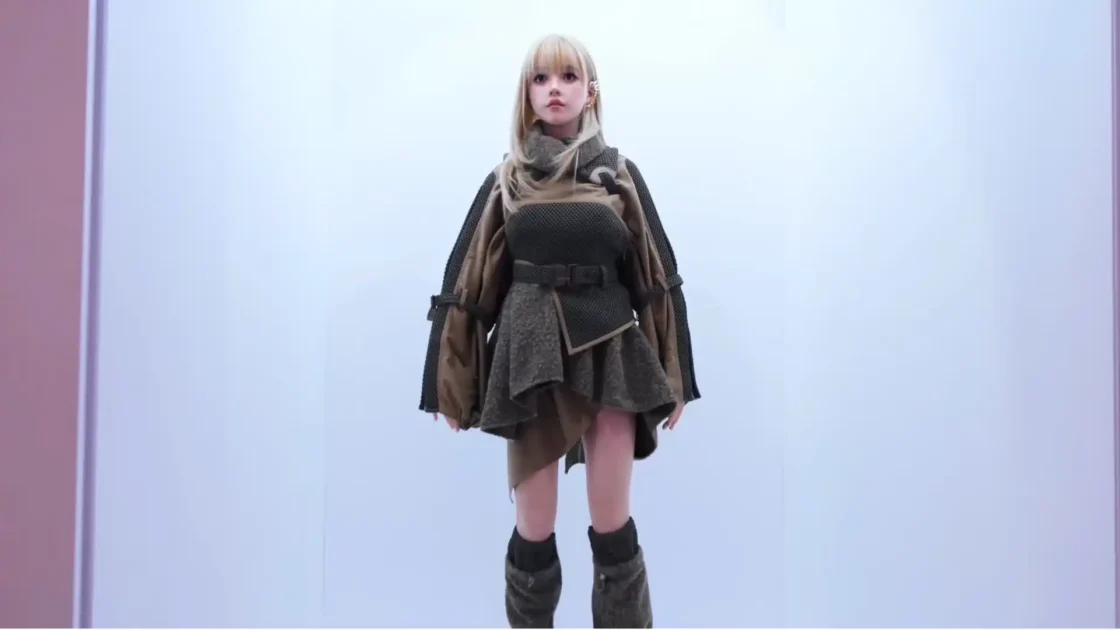
LimX Dynamics has introduced Luna as a full-size interactive humanoid for places where robotics must be seen, photographed, talked to and remembered. The Shenzhen company is not presenting Luna as a warehouse picker, a factory assistant or a domestic helper. It is aiming at experiential commerce: shopping malls, museums, theme parks, live stages, car dealerships, conferences and branded events. That choice matters more than the robot’s gendered styling. It shows where humanoid robots may find paying customers before they become reliable general-purpose workers.
Table of Contents
A humanoid launch built around attention
Luna is a 160 cm humanoid robot with 27 degrees of freedom, according to LimX Dynamics’ own product page. The company describes it as a “full-size interactive humanoid robot” and highlights a second-generation Sys 0 motion engine, multimodal interaction, synchronized control, an AI task editor and content creation tools for scenes and performances.
Those specifications are not incidental. They show that LimX is treating Luna less as a machine for moving boxes and more as a programmable body for public-facing scenes. A robot in a warehouse is judged by throughput, uptime and error recovery. A robot in a mall or theme park is judged by a different mix: whether people stop, whether they feel safe standing near it, whether it performs consistently, whether staff can operate it without an engineering team, and whether the client can update the show or sales script quickly enough to justify the purchase.
The company’s launch language leans heavily into motion and appearance. Luna is wrapped in a softer, textile-like exterior, presented with an elegant silhouette and marketed around fluid movement. The official page lists shopping malls, museums, theme parks and live stages as target environments, and it says Luna can respond with gestures during conversations and create scenes through natural-language input.
That tells us what kind of commercial problem LimX is trying to solve first. Luna is an attention machine before it is a labor machine. This is not a criticism. Attention is a real market. Retailers, event organizers and destination venues spend heavily on installations, performers, screens, mascots, immersive rooms and temporary spectacles. A humanoid robot that can be programmed, transported and reused across campaigns fits that spending category more naturally than it fits the category of autonomous worker.
The “humanoid woman” framing has made Luna spread quickly online, but the deeper commercial story is more practical. The industry has learned that humanoid robots attract enormous public curiosity but face hard technical limits in dexterity, autonomy and endurance. Luna’s positioning avoids the hardest near-term problem: replacing skilled human labor in messy real-world tasks. It focuses instead on controlled performances, guided interaction and branded presence.
LimX is entering a market where the first widely visible humanoid deployments may not look like science fiction’s all-purpose domestic helper. They may look like robotic hosts, museum guides, synchronized performers, car showroom greeters and event mascots with software-defined choreography.
The confirmed Luna facts
The confirmed public details put Luna in the middle of the full-size humanoid category. LimX lists a 160 cm body, 27 degrees of freedom, a high-performance motion engine, multimodal interaction, smart synchronized control and an AI task editor. The company also says Luna includes improved cooling, improved battery management, multi-layer protection, active fall mitigation, external force sensing, a hardware emergency stop and real-time safe action override.
TechNode reported on May 26, 2026, that LimX unveiled Luna on the previous Monday, priced at RMB 298,000, or about $41,000. The same report described intended commercial and entertainment settings including shopping mall assistance, immersive role-playing NPC experiences and theme park interactions.
That price puts Luna in an interesting band. It is far below many experimental humanoid systems that cost six figures or more, but it is not a consumer gadget. It is priced for companies, agencies, venue operators, public institutions, event producers and robotics integrators. A mall would not compare it with a vacuum cleaner. It would compare it with a campaign installation, a staffed event team, a branded attraction, a publicity stunt, a long-term customer-service kiosk or a recurring entertainment feature.
The 27-degree-of-freedom figure also needs careful interpretation. Degrees of freedom describe the number of independently controllable movements across the body. More degrees of freedom do not automatically mean better autonomy, richer intelligence or safer operation. They do, however, matter for expressive motion. A humanoid designed to dance, wave, turn, gesture and maintain balance in front of people needs enough mechanical articulation to avoid looking like a stiff prop.
Core public facts about LimX Luna
| Fact | Publicly stated detail | Commercial meaning |
|---|---|---|
| Height | 160 cm | Full-size public presence rather than tabletop social robot |
| Body motion | 27 degrees of freedom | Enough articulation for walking, gestures and performance routines |
| Launch price reported | RMB 298,000, about $41,000 | Business purchase, not consumer adoption |
| Target settings | Malls, museums, theme parks, live stages | Built for controlled public interaction and brand spectacle |
The table matters because the Luna story is easy to flatten into novelty. Its specifications point toward a more specific product category: a full-size humanoid performance and interaction platform for commercial venues.
The mass-produced claim needs careful handling
Several social and media posts have described Luna as the first “mass-deliverable” or mass-produced full-size female humanoid robot. The wording is powerful, but it deserves discipline. The official product page shows a buy path and commercial positioning, and TechNode reported a launch price. Those facts support the idea that LimX is offering Luna as a commercial product, not just a research prototype. They do not, on their own, prove large-scale production volume, delivery numbers or installed fleet size.
The distinction matters. Robotics companies often use terms such as mass production, batch production, commercialization, delivery, launch and availability in ways that blur together. A product may be available for purchase while only shipping in small batches. A company may have production tooling but still be limited by supply chain, certification, support capacity or customer readiness. A humanoid robot may be “mass-deliverable” in the sense that it is designed to be sold repeatedly, yet still far from consumer-scale manufacturing.
China’s humanoid robot policy language has created its own translation problem. A U.S.-China Economic and Security Review Commission issue brief noted that some reporting has treated China’s 2025 humanoid goal as “mass production,” while the underlying Chinese term can also be read as production at scale or batch production within a broader early-stage innovation system.
For Luna, the safest editorial description is this: LimX Dynamics is commercializing Luna as a full-size interactive humanoid, with reported pricing and public-facing use cases, while public evidence of production volume remains limited. That does not weaken the story. It makes it more credible.
The robot industry is full of impressive demonstrations that never become durable businesses. The meaningful question is not whether Luna is the first of anything in a headline sense. The useful question is whether LimX can produce, ship, maintain and support a humanoid robot at a price and reliability level that venue operators can accept.
If Luna reaches real customers in repeatable deployments, the “first” label will become less important. The market will care about three practical points: delivery schedule, operating cost and proof that non-technical staff can run the robot safely in public.
Luna is not aimed at the hardest humanoid job
The most difficult humanoid ambition is not walking across a stage. It is working for long shifts in cluttered places, sensing the world accurately, using hands without destroying objects, recovering from mistakes, and doing all of this safely around people who are not trained robot operators.
Luna’s launch avoids that full challenge. Its first commercial lane is controlled, visible and scripted. That is a smart place to begin. Public performance is easier to structure than general labor, yet it still showcases motion, personality and human-scale embodiment.
A theme park can define routes. A mall can create a protected activation zone. A showroom can run a timed presentation. A conference booth can limit the interaction script. A museum can place a robot in a known path with known visitor flows. These environments still require safety engineering, staff training and fault handling, but they are far more manageable than a home, a hospital ward or a warehouse aisle full of unpredictable edge cases.
This is why Luna may be more commercially realistic than it first appears. A humanoid does not have to be a universal worker to be worth money. It only has to perform a valued role better than the alternatives at a tolerable cost. A venue that already pays for performers, campaign installations, host staff, LED walls, projection mapping and experiential marketing may see value in a programmable humanoid that delivers repeatable moments and social-media reach.
The same logic helped early service robots find niches. Delivery robots, cleaning robots and guidance robots did not become general-purpose machines. They succeeded where the task could be bounded. Luna follows that older robotics lesson while wearing a newer humanoid body.
The tension is that humanoid form raises expectations. A machine shaped like a person invites people to assume intelligence, flexibility and understanding. That gap between appearance and capability is the risk every Luna deployment will need to manage. Clear boundaries, staff supervision, safe distances and honest messaging will matter.
The 160 cm body is a commercial decision
A full-size humanoid body changes how people respond. A small robot may feel like a gadget. A rolling kiosk may feel like furniture. A full-height humanoid becomes a presence. It occupies the same social scale as a person, which makes it more compelling and more sensitive.
LimX’s 160 cm design is short enough to reduce intimidation and help balance mass, yet tall enough to read as human-scale in a store, lobby or stage environment. The textile-wrapped exterior softens the mechanical impression, which matters in public venues where people may approach the machine casually. LimX says the fabric-like finishes are meant to reduce the stark mechanical feel and create a more approachable presence.
The commercial meaning is direct. In experiential retail, visual identity is part of the product. A mall does not buy only locomotion. It buys a character. A theme park does not buy only a moving mechanism. It buys a performer that must fit into a story world. A car dealer does not buy only a speaking system. It buys a branded moment that makes visitors stay longer, record video and remember the showroom.
Luna’s body design also reflects the growing split inside humanoid robotics. Some companies are building rugged machines for manufacturing and logistics. Others are building softer, more expressive platforms for public interaction. A factory robot can look industrial if it works. A public robot needs a different kind of trust. Its body must signal capability without threat.
That does not mean softer styling automatically makes a robot safe. It does not. Safety depends on controls, force limits, perception, emergency systems, operating procedures and environmental design. But public acceptance starts before a technical explanation. People react to shape, motion, sound, speed and proximity.
Luna’s body is a user interface. Its height, surfaces, motion style and gendered cues all tell visitors how to treat it before it says a word.
Degrees of freedom are about expression, not intelligence
The 27 degrees of freedom are central to Luna’s pitch, but the number should not be mistaken for a measure of intelligence. A robot with many joints may still need scripted routines. A robot with fewer joints may perform a specific industrial task reliably. The value of Luna’s articulation is that it supports full-body motion, gestures, walking style and performance timing.
In a public-facing humanoid, expressiveness is part of the function. A robot that answers questions without matching gestures will feel like a speaker on legs. A robot that gestures naturally, turns toward the user and moves with controlled timing has a better chance of holding attention. LimX’s official page says Luna integrates multimodal interaction so it can respond with natural gestures during conversations.
The bigger technical issue is coordination. Humanoid movement is not a collection of independent joint motions. The control system must coordinate legs, torso, arms and head while preserving balance. Even a simple greeting can become complex when the robot shifts weight, turns, raises an arm and tracks a person.
This is where motion engines become more important than raw mechanical counts. A robot that can generate smooth transitions, stop safely, recover from external disturbance and execute routines consistently is more useful than one with impressive hardware but jerky motion.
Public venues are unforgiving in a specific way. They tolerate limited capability if the show works. They do not tolerate embarrassing instability, unsafe gestures, repeated resets or long staff interventions. The robot must either perform smoothly or fail gracefully.
For Luna, 27 degrees of freedom are only commercially meaningful if LimX’s control stack turns them into reliable stage behavior. The audience does not care how many actuators are inside the body. It cares whether the robot moves with confidence and stops before it becomes a hazard.
Sys 0 and the control stack carry the real burden
LimX says Luna is powered by the second-generation Sys 0 engine with upgraded joint motors. Interesting Engineering, citing the company, described the system as a motion platform designed for dancing, gymnastics and catwalk-style demonstrations, with upgraded cooling and battery systems for longer sessions.
This is the right technical focus. Humanoid commercialization depends heavily on the control layer between abstract instructions and motor commands. The control stack has to decide how the body moves in real time, how it maintains posture, how it handles disturbances, and how it transitions between actions without creating unsafe or awkward motion.
The public may focus on AI dialogue because conversation is easy to understand. In humanoid robots, the harder problem is often physical. Speech can be generated in the cloud. Movement has to obey gravity, friction, joint limits, motor heat, battery constraints and the immediate presence of people nearby.
A robot in a public venue has to avoid both extremes: stiff, lifeless motion that disappoints audiences and exaggerated movement that creates safety risks. A good motion engine gives operators a usable middle ground. It produces movement expressive enough to be worth watching and controlled enough to be deployable.
LimX’s larger product line suggests why Luna exists. The company has built Oli as a general-purpose humanoid platform and TRON as a modular embodied robot platform. Its official company history lists product milestones including TRON 1, Oli, TRON 2 and COSA, the company’s embodied agentic operating system.
Luna appears to take that technical base and aim it at a narrower commercial surface. Instead of asking customers to build research workflows, it packages motion, interaction and content creation into a venue-friendly product.
That is a familiar pattern in technology markets. The first broad platform is hard to sell to mainstream buyers. A specific package with obvious use cases is easier.
Multimodal interaction turns the robot into a venue interface
LimX says Luna supports multimodal interaction, meaning it can combine speech, gestures, perception and movement rather than acting as a voice assistant inside a body. In venue terms, multimodal behavior is what makes the robot more than a moving mannequin.
A mall robot may need to greet visitors, point toward a store, react to a crowd, perform a short dance, answer basic questions and hand off complex requests to staff. A museum robot may need to guide visitors through a fixed route, introduce exhibits and coordinate with screens or audio. A theme park robot may need to behave like a non-player character, staying inside a story role while avoiding unsafe improvisation.
These use cases do not require general intelligence. They require bounded intelligence with strong choreography. The robot needs enough perception to avoid obvious mistakes, enough language control to respond within its domain, enough motion control to look alive, and enough operator tooling to let staff update content without calling LimX engineers.
This is why the AI task editor is important. LimX says Luna can create scenes through natural language input, composing dance, motion, visuals and voice into tasks. TechNode reported that the robot supports task-trigger settings through a no-code interface, where users describe needs and the system generates triggers and workflows.
The no-code claim should be treated as a promise to test, not a proven outcome. No-code robotics is hard because the physical world produces edge cases that software interfaces hide. A workflow that looks simple in a task editor still needs safe execution in a crowded venue.
Still, the direction is right. Public-facing humanoids will not scale if every campaign requires roboticists. They will scale only if event staff, content teams and venue operators can build and update interactions with guardrails.
Video-to-motion changes the content model
One of Luna’s most commercially interesting features is “Video to Motion.” LimX says users can import a video and Luna will analyze and replicate the movements. The official page also lists kinesthetic teaching and preloaded routines.
The immediate use case is obvious: brands and venues want fresh content. A robot that repeats the same three gestures becomes stale quickly. A robot that can learn a routine from a video, adapt it to its own body and perform it safely has a better chance of staying relevant across campaigns.
This is also where technical caution is needed. A human dance video cannot be copied directly by a humanoid. Human bodies have different joint ranges, balance strategies, muscle control and physical intuition. A robot must translate the motion into its own kinematic and dynamic limits. If the source move requires a hip angle, foot placement or torso acceleration the robot cannot safely reproduce, the system must modify the motion.
Research in whole-body tracking and cross-embodiment transfer has become important because humanoids increasingly need to convert human or robot demonstrations into usable movement. A 2026 arXiv paper on Any2Any reported experiments transferring whole-body tracking models across platforms including Unitree G1, LimX Oli and LimX Luna, using kinematic alignment and dynamics adaptation to reduce retraining cost.
The commercial promise is not that Luna will copy any viral dance perfectly. The promise is that it may reduce the cost of creating new robot performances. That matters for malls, stages and brand events, where novelty decays fast.
If video-to-motion works reliably inside safety limits, Luna becomes less like a fixed robot product and more like a content platform with a body. That could be the real business model.
Synchronized control points to robot shows, not only individual robots
LimX says Luna can support synchronized control for more than 200 units with millisecond-level precision. This claim is easy to read as spectacle, and that is exactly the point. A single humanoid attracts attention. A coordinated group becomes an event.
China has already shown how synchronized humanoid performances can become national technology theater. Reuters reported that humanoid robots took part in China’s 2026 CCTV Spring Festival Gala, with startups including Unitree, Galbot, Noetix and MagicLab presenting martial arts, dance and comedy-style demonstrations.
Group performance has a different commercial profile than individual customer service. It can be sold for launches, festivals, tourism events, sports ceremonies, shopping center campaigns and corporate conferences. It also fits China’s strength in large public technology showcases, where choreography, manufacturing and spectacle meet.
The technical challenge is not trivial. Synchronizing many robots means coordinating timing, spacing, communication, fallback behavior and emergency stops. A small delay may be harmless in a video wall. In moving robots, timing errors can create collisions or visible mistakes. Multi-robot shows require both network reliability and carefully designed physical space.
Still, synchronized control gives Luna a path to revenue that does not depend on solving general manipulation. A fleet of robots dancing, greeting guests or forming a moving installation may be commercially attractive even if each robot has limited independent autonomy.
That is an important signal. The early humanoid market may be less about one robot replacing one worker and more about robot fleets replacing temporary spectacle infrastructure. It is not the future imagined by warehouse automation forecasts, but it is a plausible near-term business.
Experiential retail is a real market with different rules
The phrase “experiential retail” can sound soft, but it describes real spending. Shopping centers, car brands, entertainment venues and consumer companies have been trying to make physical spaces harder to ignore. Online commerce took the transaction. Physical venues need reasons for people to visit, linger and share.
A humanoid robot fits that pressure. It creates a photo opportunity, a guided interaction and a moving display in one object. It can be a host, performer, mascot, greeter, traffic driver and content asset. That mix is why Luna’s target markets make sense.
The economics are not the same as factory automation. A factory robot justifies itself through labor substitution, throughput, quality or safety. A retail robot may justify itself through foot traffic, dwell time, media impressions, campaign differentiation, ticket sales or sponsor value. These returns are harder to measure, but venue operators already buy many things with the same logic.
That does not mean every mall should buy a humanoid. Many will not. The first buyers are likely to be premium retail centers, large entertainment groups, government-backed tech showcases, major car brands, tourism sites and agencies that rent robots for events. They have the budget and the appetite for novelty.
The risk is that novelty alone fades. After the first videos spread, the robot has to keep providing useful or entertaining interactions. This is why content creation tools matter as much as hardware. A venue will ask whether Luna can be refreshed for holidays, product launches, school visits, VIP events and local campaigns.
A public-facing humanoid succeeds only when it becomes programmable culture, not a one-week curiosity.
Shopping malls are controlled enough to be useful test beds
Shopping malls are one of Luna’s clearest target settings. They offer high foot traffic, controlled indoor conditions, predictable layouts, facility staff and marketing budgets. They also have recurring problems: wayfinding, event activation, tenant promotion, family entertainment and differentiation from competing centers.
A humanoid robot can serve as a moving anchor for these tasks. It can greet visitors near entrances, guide them toward promotions, perform scheduled routines, pose for photos and answer basic questions. It can also draw children and families, which matters for weekend traffic.
The mall environment is still more complex than a stage. Floors may be reflective. Crowds may surround the robot. Children may step into its path. People may touch it, block it, shout at it or try to confuse it. Security teams and operators must define the robot’s zone, route and interaction rules.
This is where Luna’s safety features become part of the sales pitch. LimX lists active fall mitigation, external force sensing, hardware emergency stop and safe action override. Those are necessary features for public venues, but the real test is whether they work under messy visitor behavior.
Shopping malls also expose the value of multilingual and localized interaction. A robot in Shenzhen, Dubai, Singapore, Prague or Los Angeles will face different languages, accents, signage systems and visitor expectations. LimX’s product will need localization and reliable handoff to human staff.
A robot that fails to answer a question is not dangerous. A robot that moves unpredictably near a child is. Malls will care less about whether Luna seems futuristic and more about whether operators can keep the experience controlled during peak hours.
Theme parks and NPC experiences fit the humanoid body
Theme parks may be a better fit for Luna than conventional retail. They already use characters, animatronics, scripted performances, parades, interactive queues and immersive storytelling. Visitors expect artifice. They are willing to suspend disbelief. A humanoid robot can become part of a story world rather than pretending to be a universal assistant.
TechNode reported that Luna is designed for immersive role-playing NPC experiences and theme park interactions. That phrase points to a potentially large shift. In games, non-player characters are software-controlled figures that populate a world. In theme parks, a physical NPC could greet guests, deliver clues, perform routines and respond within a scripted personality.
This use case reduces some pressure and raises other demands. It reduces the need for open-ended competence because the robot can remain inside a role. It raises the demand for timing, theatrical quality, costume integration, safe proximity and reliable reset between interactions.
A theme park robot also benefits from environmental design. The park can control lighting, routes, floor surfaces, crowd flow and interaction zones. It can hide charging docks and maintenance areas. It can train staff to supervise. It can design the story around the robot’s actual capabilities rather than forcing the robot to handle everything.
This is one reason humanoids may appear first in entertainment before they appear in homes. Entertainment environments can be engineered around limitations. Homes cannot.
The best early humanoid deployments will not deny constraints. They will turn constraints into show design.
Car showrooms and conferences need repeatable drama
The user’s topic mentions car stores and business conferences. Those are natural Luna settings because both rely on presentation. A car showroom wants to turn a product explanation into a moment. A conference wants traffic at booths and memorable stage cues. A humanoid robot can make a familiar sales script feel new.
Automotive brands have special reasons to experiment. They already sell technology narratives: electrification, autonomy, smart cabins, software-defined vehicles and AI. A humanoid host in a showroom reinforces that identity, even if the robot is not made by the car company. It signals that the dealer or brand is technologically current.
The practical use cases are narrow but real. Luna could introduce a vehicle, guide visitors to a test-drive counter, perform timed dances during launch events, answer basic model questions, direct visitors to staff, or act as a photo point. For premium dealers, the robot may function as both attraction and status symbol.
Business conferences are even simpler. Booth traffic is measurable. A robot that draws attendees, repeats product messages, performs at scheduled intervals and generates videos can justify rental or purchase during major events. The robot does not need deep autonomy because staff are nearby and the environment is temporary.
The challenge is logistics. A conference robot must be transported, assembled, charged, insured, programmed, supervised and reset in a booth that may have poor connectivity or crowded aisles. If Luna is meant for this market, LimX will need not just hardware but a deployment kit: route planning, safe-zone templates, staff training, emergency procedures, content tools and remote support.
The humanoid body gets attention. The support package earns repeat customers.
Luna and Oli show LimX splitting the humanoid market
LimX’s earlier full-size humanoid, Oli, is presented as a general-purpose humanoid robot for research, development, entertainment, event guidance, inspection, industrial operations and property management. The official Oli page lists 165 cm height, 31 degrees of freedom, modular SDK support, open APIs, development manuals and support for simulation platforms including NVIDIA Isaac Sim, MuJoCo and Gazebo.
TechNode reported in July 2025 that Oli launched with prices starting at RMB 158,000, or about $21,800, and was aimed at AI researchers, robotics developers and solution integrators.
Luna is different. It has fewer degrees of freedom than Oli on the public numbers, but it is packaged around interaction, performance, content creation and public-facing scenes. That suggests LimX is segmenting the market rather than replacing one robot with another.
Oli is closer to a developer and integrator platform. Luna is closer to a commercial performance product. TRON 2, meanwhile, is a modular embodied robot platform with dual-arm, bipedal and wheeled configurations, aimed at research and industrial needs.
This product split mirrors the wider humanoid industry. Companies are learning that “general-purpose humanoid” is too broad to sell cleanly. Customers buy use cases. Researchers buy access. Factories buy reliability. Retail venues buy experience. A single body may not satisfy all of those markets.
Luna’s significance is not that LimX built another humanoid. It is that LimX is packaging a humanoid for a buyer who cares about audience reaction. That is a narrower and potentially more commercial decision.
China’s humanoid push gives Luna a stronger tailwind
Luna arrives inside a national robotics push, not in isolation. China has identified humanoid robots and embodied AI as strategic industrial priorities. The State Council Information Office reported in November 2023 that China planned to establish a preliminary innovation system for humanoid robots by 2025. MERICS has described Beijing’s robotics policy stack as including the “Robot+” initiative, AI + Manufacturing plans, humanoid pilot lines and a standardization committee under the Ministry of Industry and Information Technology.
That policy context matters because humanoid robotics is a systems industry. It needs motors, reducers, batteries, sensors, compute, simulation, datasets, software tools, safety rules, integration partners and buyers willing to run pilots. State support cannot solve all technical problems, but it can reduce friction for trials and manufacturing.
China also has a manufacturing base that is unusually relevant to humanoids. The same industrial ecosystem that supports electric vehicles, drones, consumer electronics, batteries and precision hardware can support robot component supply chains. Startups do not have to build every part of the ecosystem from scratch.
The advantage is not only cost. It is iteration speed. A company that can source parts quickly, revise designs, test with local partners and move into small-batch production has a better chance of discovering what customers will actually buy.
Luna’s experiential retail positioning may also benefit from China’s large malls, tourism destinations, live-commerce culture and appetite for technology spectacle. A robot that performs well in Shenzhen, Hangzhou, Shanghai or Beijing can collect public feedback quickly.
The international question is whether this advantage travels. Selling into Europe, North America or the Gulf will require certifications, insurance, service networks, privacy compliance, localization and different risk expectations. The domestic market may prove the concept. Export will test the company.
Robotics commercialization is moving from demos to proof
The humanoid sector has entered a more demanding phase. Walking on stage is no longer enough. The market now asks for proof of useful deployment.
Figure AI has published results from an 11-month Figure 02 deployment at BMW Group Plant Spartanburg, saying the robot loaded more than 90,000 parts, ran more than 1,250 hours and contributed to production of more than 30,000 BMW X3 vehicles. BMW also said the Figure 02 pilot showed physical AI could deliver measurable added value under real-world conditions and that the robot handled precise sheet-metal positioning for welding.
Agility Robotics said its Digit humanoid moved more than 100,000 totes at GXO’s Flowery Branch facility, using the milestone to argue that humanoids need throughput proof rather than novelty. Tesla says Optimus is intended as a general-purpose bipedal autonomous humanoid for unsafe, repetitive or boring tasks, but its public commercial deployment story remains less mature than its automotive business.
These examples set the benchmark for Luna, even though Luna is targeting a different market. A public-facing robot does not need to load 90,000 sheet-metal parts. It does need its own proof: hours performed, visitors engaged, incidents avoided, content updates completed, staff interventions reduced and repeat bookings won.
The humanoid industry is splitting into two proof regimes. Industrial robots must prove work. Public-facing robots must prove engagement and safety. Luna sits in the second category.
Public-facing and industrial humanoids face different proof tests
| Deployment type | Primary buyer question | Main risk | Useful evidence |
|---|---|---|---|
| Factory humanoid | Does it improve throughput or reduce strain? | Low reliability disrupts production | Cycle time, uptime, interventions, quality |
| Logistics humanoid | Does it move goods at acceptable cost? | Poor recovery from edge cases | Totes moved, shift hours, cost per task |
| Retail humanoid | Does it attract and guide visitors safely? | Novelty fades or crowds behave unpredictably | Dwell time, interactions, staff resets, incidents |
| Entertainment humanoid | Does it deliver repeatable spectacle? | Performance failure in front of audiences | Show count, routine updates, synchronization, safety records |
The market should stop asking whether humanoids are “ready” in one universal sense. They are ready only for tasks whose operating boundaries match their current limits.
Luna’s $41,000 price changes the buyer calculation
A reported price near $41,000 is high for a consumer product and low for a full-size humanoid. It positions Luna in a middle market where buyers may not expect perfect autonomy but will expect business value.
For a theme park, $41,000 may be comparable to a small attraction component or a recurring entertainment investment. For a car dealer, it may be comparable to a marketing package or showroom upgrade. For a conference agency, it may be a reusable asset if rented across events. For a museum, it may fit into a sponsored technology exhibition.
The price also creates a support question. A humanoid robot is not a one-time object like a display screen. It needs maintenance, software updates, batteries, spare parts, operator training, repairs, insurance documentation and perhaps remote monitoring. The purchase price may be only part of the total cost.
This is where the business model becomes important. Direct sales may work for research labs and well-funded venues. Rental, leasing or robot-as-a-service may work better for events and malls. The International Federation of Robotics reported that robot-as-a-service fleet models grew 31% in 2024 in professional service robotics, while traditional sales remained the main monetization channel in transportation and logistics.
Luna may eventually need a similar service layer. Customers may prefer paying for performance days, campaign periods or monthly operation rather than owning hardware and carrying maintenance risk. That is especially true for venues that want novelty without becoming robotics operators.
A $41,000 humanoid is affordable enough to start conversations and expensive enough to demand evidence. LimX will need case studies, uptime records and clear deployment templates.
The global competitor set frames Luna’s niche
Luna competes in a crowded field, but not all humanoids are aimed at the same buyer. Unitree’s G1 is listed by Unitree at a starting price of $13,500, with 23 to 43 joint motors depending on configuration, a 132 cm height and a research/education flavor. Figure is focused on industrial labor and has emphasized factory deployment evidence. Agility’s Digit is focused on logistics and industrial automation. Tesla’s Optimus is framed around large-scale general-purpose autonomy, tied to Tesla’s AI and manufacturing ambitions.
Luna’s niche is more theatrical. That may protect it from direct comparison with industrial humanoids, at least at first. A buyer seeking a robot to move totes will not choose Luna. A buyer seeking a programmable humanoid for a public campaign may not consider Figure or Digit.
The competitor that matters most may be not another humanoid but a cheaper substitute: human performers, LED installations, projection mapping, animatronics, mobile kiosks, AR experiences, staff greeters or influencer campaigns. Luna must beat those alternatives on a mix of novelty, repeatability, operating cost and brand impact.
This is why the “female humanoid” framing cuts both ways. It may attract attention, but it also raises ethical and brand questions. Some premium brands may want a gendered robotic host. Others may avoid it to reduce reputational risk. A neutral or customizable persona may become commercially safer in many markets.
The global race is not only about who builds the most humanlike machine. It is about who matches robot form to a buyer’s actual problem. Luna is a useful case because it does not pretend that every humanoid must begin in a factory.
Public safety is the condition for public adoption
A humanoid robot in a public venue must earn trust physically before it earns trust socially. Visitors will stand close, children will reach out, cameras will distract people and staff may have to intervene quickly.
LimX lists several safety features: active fall mitigation, external force sensing, a dedicated hardware emergency stop and safe action override. These are necessary, but public deployment requires a wider safety system than the robot itself.
The full system includes the floor surface, route design, speed limits, crowd barriers, signage, operator line of sight, emergency procedures, maintenance checks, battery handling, connectivity fallback and insurance rules. A robot’s internal fall detection is only one layer. The venue’s operating plan is another.
Safety standards are still catching up with the humanoid category. ISO 13482:2014 covers safety requirements and guidelines for personal care robots, including mobile servant robots, physical assistant robots and person carrier robots. ISO’s robotics standards page lists ISO 10218-1 and ISO 10218-2 for industrial robot safety, ISO/TS 15066 for collaborative robots, ISO 8373 for vocabulary and ISO 13482 for personal care robots.
A retail humanoid may not fit neatly into one older category. It is not a classic industrial arm. It is not a medical robot. It is not exactly a personal care robot. It is a mobile, expressive, AI-enabled machine in a public space. That category will force regulators, standards bodies and insurers to clarify requirements.
The first serious Luna deployments will be judged as much by the absence of incidents as by the quality of the show. One viral stumble in a crowded mall can damage confidence faster than a polished launch video builds it.
The regulatory burden will rise with autonomy
A scripted robot performance in a controlled zone is one regulatory problem. A mobile robot that recognizes people, responds to speech, records video, adapts behavior and guides visitors is another.
The European Union’s AI Act creates a risk-based framework for AI systems, with rules for developers and deployers. The European Commission describes it as the first comprehensive legal framework on AI worldwide and says it is intended to support trustworthy AI while protecting safety and fundamental rights.
For a robot like Luna, the relevant questions depend on what the deployed system does. Does it collect video or audio? Does it identify individuals? Does it infer emotions? Does it process children’s data? Does it store conversations? Does it make decisions that affect access to services? Does it operate in a workplace? Does it integrate with security systems?
A basic greeting robot may fall into a lighter compliance category than a robot that performs biometric identification or emotion analysis. But public venues often add features over time. A robot that begins as a performer may later become a guide, sales assistant, data collector or queue manager. Each added function changes the risk profile.
This is why customers should demand clear data documentation. They need to know where data is processed, what is stored, how long logs are retained, whether voice or video leaves the site, how updates are managed, and what happens if connectivity fails.
The strongest commercial deployments will be boring on compliance. Visitors should not have to guess whether a humanoid robot is recording them for training. Staff should not have to improvise privacy answers. Venue owners should not discover after purchase that a feature creates a regulatory problem.
Gendered humanoids carry brand and ethical risks
Luna’s description as a “humanoid woman” will attract attention, but it also puts LimX into a long-running debate about gendered machines. Humanoid robots do not have biological sex. Designers give them cues that people read as gender: body shape, voice, name, clothing, movement style and role. Those cues influence how users behave.
A scoping review in the International Journal of Social Robotics found that gendered robot design is often redundant and can reinforce stereotypes and binary views of gender. The review also emphasized that robot “gender” should be understood as a process of encoding cues by designers and decoding them by users.
A 2025 Frontiers in Psychology study found that participants interacting with female-gendered robot assistants showed greater willingness to accept challenging tasks than those interacting with male-gendered counterparts, while also warning that gendered anthropomorphism can entrench stereotypes. UNESCO’s work on voice assistants has raised similar concerns about feminized AI assistants reinforcing harmful expectations of women as compliant helpers.
For Luna, the issue is not that a robot has a feminine design. The issue is what role that design serves. A female-coded robot used mainly for greeting, service, pleasing movement and brand hospitality can reproduce old patterns unless designers handle persona and behavior carefully.
Brands will notice this. A car company, museum or conference may ask whether the robot’s persona aligns with its values. International buyers may prefer adjustable voices, neutral bodies, different costumes or non-gendered character modes. LimX may need to offer more persona flexibility if it wants broad adoption.
The safest design strategy is not to pretend gender cues have no effect. It is to make them intentional, optional and bounded by respectful behavior.
Human labor impact will be indirect at first
A robot like Luna is unlikely to replace large numbers of workers immediately. Its near-term function is more promotional than operational. It may reduce the need for some event hosts, brand ambassadors or performers in specific settings, but it will also create work for operators, technicians, content designers, safety supervisors, repair teams and robotics integrators.
The labor impact becomes more serious if public-facing humanoids move from spectacle into routine service. A mall robot that only dances is one thing. A robot that handles wayfinding, promotions, reception and scripted customer support across many locations is another. It could reduce demand for some entry-level hospitality roles, especially where staffing is already thin.
The near-term pattern is likely hybrid. Human staff will remain nearby because robots need supervision, edge-case handling and emotional judgment. The robot becomes a draw and a first-contact layer. Humans handle complaints, complex questions, accessibility needs and relationship work.
That hybrid model may be attractive to venues. Staff can focus on higher-value interactions while the robot handles repetitive greetings or scheduled routines. But it also risks deskilling if businesses use robots mainly to cut visible human service without improving visitor experience.
The best deployments will be transparent: the robot is a tool, not a fake person; human staff remain available; visitors understand when they are interacting with automation; and workers are trained to supervise rather than simply compete with the machine.
Robotics will not enter service labor as a single shock. It will enter through narrow roles, staged events and partial automation. Luna is a sign of that slower, messier process.
Data collection is the quiet issue in public robot deployment
A humanoid robot in a mall is not only a body. It is a sensor platform. Depending on configuration, it may use cameras, microphones, depth sensors, inertial sensors, network connections and logs of interactions. Even if the robot does not identify individuals, public deployment raises data questions.
Visitors may not know when they are being recorded. Children may approach the robot. Bystanders may be captured in video streams. Staff may use the robot’s logs to measure engagement. Brands may want analytics on foot traffic, demographic patterns or campaign performance. Each layer turns a performance robot into a data system.
The cybersecurity problem is also physical. A compromised website leaks data. A compromised humanoid can move, speak, record, mislead or create unsafe behavior. Research on humanoid cybersecurity has warned that production robots may transmit detailed state information such as audio, visual, spatial and actuator data to external servers without clear user notice, and that humanoids require security thinking suited to physical-cyber systems.
Customers should ask simple questions before deployment. Which sensors are active? Is video stored or processed in real time only? Is speech retained? Are logs anonymized? Is remote access enabled? Who can push software updates? Is there a local shutdown mode? Are credentials managed properly? Are network connections isolated from the venue’s core systems?
For public-facing robots, privacy is not a side policy. It is part of safety. A robot that people approach because it seems friendly must meet a higher standard of clarity.
Battery life and heat determine show design
LimX says Luna has upgraded thermal management and an improved battery management system. The official page presents this as better endurance for longer performance. Interesting Engineering reported company claims of lower joint surface temperature and extended endurance.
These details may sound less exciting than AI, but they matter more in deployment. Heat limits how long motors can perform demanding motions. Battery life determines show schedules, route length and staffing. Charging time affects whether the robot can run all day or only in bursts.
A mall may want repeated performances every hour. A theme park may want timed appearances. A conference may need a robot active through long exhibition days. Each use case has a duty cycle. If the robot needs long breaks, the operator must design around that constraint.
Hot surfaces matter because Luna is meant to be near people. Even if visitors are told not to touch, some will. Joint surface temperature is therefore both a technical and public-safety issue. A robot designed for interaction cannot ignore tactile risk.
Battery systems also shape fleet economics. Hot-swappable batteries reduce downtime but increase operational complexity. Fixed charging simplifies hardware but limits runtime. Autonomous docking sounds attractive but requires a safe charging zone and reliable navigation. For public events, the simplest answer may be scheduled breaks and staff-managed battery changes.
The commercial buyer will not ask for a lecture on actuator heat. They will ask how many shows Luna can run per day. LimX will need operational numbers, not only engineering claims.
Dexterity remains the wall between spectacle and labor
Luna’s launch emphasizes motion, interaction and performance. It does not make strong claims about complex manipulation, and that restraint is telling. Dexterity is still one of the hardest barriers in humanoid robotics.
Hands are difficult. Objects vary in shape, weight, texture, fragility and position. Human hands combine dense sensing, soft tissue, learned force control and years of experience. A humanoid robot may wave beautifully and still struggle to pick up a crumpled brochure from a glossy floor.
That is why many early industrial humanoid pilots choose constrained tasks: moving totes, loading known parts, placing objects within defined tolerances, or repeating motions in structured workcells. Even those tasks require months of tuning. Figure’s BMW deployment described sheet-metal loading as a classic pick-and-place task but also noted strict cycle time, placement accuracy and intervention goals.
For Luna’s target markets, limited dexterity may not be fatal. A public robot can gesture, guide, dance and speak without handling many objects. If it needs to hand out brochures, scan tickets or open car doors, the difficulty rises.
This is another reason experiential retail is a logical first market. It rewards full-body presence without demanding full human dexterity. The robot can be valuable even if its hands are mostly expressive.
The danger comes when marketing outruns capability. A humanoid body invites customers to imagine humanlike service. If sales teams imply that Luna can perform open-ended physical tasks in busy venues, disappointment will follow. The stronger pitch is narrower: a programmable full-size robot for controlled interaction and performance.
Autonomy should be bounded, not theatrical
Autonomy is one of the most abused words in robotics. A robot may be autonomous in one routine, teleoperated in another, scripted for a third, and monitored by humans throughout. Public audiences often cannot tell the difference.
For Luna, the responsible question is not whether it is “fully autonomous.” The question is which parts are autonomous under which conditions. Does it navigate independently in a mapped space? Does it select gestures based on conversation? Does it generate routines offline but execute them as scripts? Does it require a staff member to approve motions? Does it stop automatically when people approach too closely?
This matters because public-facing robots need predictable behavior. Full improvisation may be less desirable than bounded automation. A theme park would rather have a robot stay in character safely than improvise an unsafe move. A mall would rather have a robot fail to answer a question than wander into a crowd.
LimX’s AI task editor and no-code triggers suggest a model where users define scenes and workflows, while the robot executes within preset limits. That is a sensible architecture for early deployment. It lets non-engineers create content without giving the robot unrestricted freedom.
The near-term goal should be reliable autonomy inside designed scenes, not open-ended autonomy everywhere. That may sound less dramatic, but it is closer to what paying customers need.
A humanoid robot that knows when not to act will be more valuable than one that tries to impress at the wrong moment.
Public robots need operators, not just owners
A company that buys Luna will need people to run it. The operator role may become one of the most important parts of the business.
Operators will schedule routines, check batteries, inspect joints, set safety zones, monitor crowds, update scripts, handle resets, clean surfaces, manage privacy notices and coordinate with venue security. During a live event, they may need to stop the robot instantly, switch routines, answer visitor questions and protect the machine from rough handling.
This means LimX’s customer base is not only buying hardware. It is adopting a new operational discipline. Venues with strong technical teams may handle this internally. Others may rely on integrators or LimX-certified service providers.
The operator requirement affects scale. A robot that needs one full-time specialist beside it at all times has a different cost profile than a robot monitored by existing event staff after short training. The difference may decide whether Luna becomes a common commercial product or remains a premium event novelty.
Training materials, remote diagnostics and predictable recovery workflows will matter. A robot that fails in an obscure way during a live show can ruin the experience. A robot that gives a clear error, stops safely and restarts in a minute can be managed.
Humanoid adoption will depend as much on boring operational design as on impressive motion. That is the part launch videos rarely show.
The robot-as-a-service option may fit Luna better than sales
Direct purchase is not always the best way to commercialize public-facing robots. A mall may want Luna for a holiday season. A car brand may want it for a model launch. A conference organizer may want it for three days. A tourism board may want it for a festival. These buyers may not want to own, store and maintain a humanoid.
Robot-as-a-service could match the use case. LimX or partners could supply the robot, operator, content package, insurance documentation and maintenance for a fixed event fee or subscription. The customer buys the outcome, not the engineering burden.
The IFR’s 2025 service robot report noted growing robot-as-a-service adoption in professional service robotics, especially as companies seek automation without heavy upfront investment. That logic applies strongly to Luna.
A service model also helps LimX learn faster. By staying involved in deployments, the company can collect failure data, improve routines, refine safety procedures and identify which venues produce repeat demand. Selling robots outright may generate revenue faster, but it can also produce messy customer experiences if buyers are underprepared.
For international expansion, service partnerships may be essential. Local partners can handle certification, support, language, insurance and event staffing. The robot becomes a platform; the deployment becomes a managed service.
This is how many complex technologies cross from novelty to normal procurement. Customers buy a package before they buy a category.
The China advantage is supply chain plus demand density
China’s robotics push is often described through government policy, but policy is only one part. The stronger advantage may be the combination of supply chain depth and dense local demand.
Humanoid robots need many components from nearby industries: electric motors, reducers, batteries, sensors, cameras, compute modules, machined parts, plastics, textiles, connectors and embedded systems. China has deep capacity in most of these categories. That helps companies iterate quickly and reduce costs.
The demand side also matters. China has large malls, tech parks, theme parks, public exhibitions, live-stream commerce, government showcases and industrial pilot zones. A company like LimX can test public reaction across many venues without leaving its home market.
The IFR reported that China represented 54% of global industrial robot deployments in 2024 and that Chinese manufacturers sold more robots than foreign suppliers in their home market for the first time, with domestic market share reaching 57%. That industrial robotics base does not automatically translate into humanoid leadership, but it creates supplier experience and buyer familiarity.
Humanoid robots are still technically immature, yet the industrial ecosystem around them is no longer small. That gives Chinese firms room to try multiple product categories at once: low-cost research platforms, factory humanoids, social robots, event robots and modular embodied platforms.
Luna is one expression of that experimentation. Its value is not only as a single product. It is a market probe.
Western companies are proving different parts of the market
The global humanoid field is not a simple China-versus-US race. Different companies are proving different market assumptions.
Agility is trying to prove that a humanoid can earn its place in logistics. Figure is trying to prove humanoid labor in manufacturing. Tesla is trying to connect robotics to large-scale AI, batteries, actuators and manufacturing. NVIDIA is trying to become the compute, simulation and foundation-model layer for the whole sector. LimX is now trying to prove that public-facing commercial humanoids can sell as interactive platforms.
NVIDIA’s Project GR00T is relevant because it shows where the software stack is headed. NVIDIA announced GR00T in 2024 as a general-purpose foundation model for humanoid robots, alongside Jetson Thor and updates to the Isaac robotics platform. NVIDIA later described Isaac GR00T as a development platform for robot foundation models and data pipelines to accelerate humanoid robotics.
This matters for Luna because hardware alone will not define the market. Simulation, synthetic data, motion transfer, foundation models, perception libraries and developer tools will shape how fast humanoid capabilities improve.
If software becomes more reusable across robot bodies, companies with strong manufacturing and deployment channels may gain. If each robot needs bespoke training and tuning, the market will fragment and scale more slowly.
The race is not only to build the best body. It is to build the best loop: collect data, train models, test in simulation, deploy safely, learn from failures and update fleets.
Humanlike design raises expectations faster than capability
Humanoid robots suffer from a peculiar market problem: their shape makes people overestimate them. A wheeled kiosk can fail politely. A humanoid that looks like it should understand people creates disappointment when it cannot.
Luna’s feminine styling intensifies this. People may expect warmth, service, recognition or emotional responsiveness. If the robot delivers only scripted lines, some visitors will still be delighted. Others may feel misled. The difference depends on context and framing.
This is why public messaging should be specific. A venue should present Luna as a robot performer, guide or interactive host with defined abilities. It should not imply that the robot understands everything, remembers visitors or can handle any request.
The uncanny valley also matters. Luna does not appear to be aiming for hyper-realistic human skin or a fully human face, which may be wise. Moderately humanoid designs often avoid the discomfort that highly humanlike but imperfect robots can create. The robot can be expressive without pretending to be a person.
The same applies to voice and persona. A respectful, clearly synthetic persona may be safer than a flirtatious or submissive one. A robot in a family mall or museum should not rely on gendered service tropes to seem appealing.
Public trust depends on the gap between promise and experience. The narrower the gap, the better Luna’s chances.
Museums may be better early adopters than stores
Museums are listed on the Luna page, and they may be a strong early market. Unlike stores, museums already frame technology as education. Visitors are more patient with experimental systems. The content can be curated. Routes can be fixed. Interactions can be designed around exhibits.
A museum robot could introduce science, robotics, space, history or art exhibitions. It could serve as a moving exhibit itself. It could explain how humanoid robots work, perform scheduled demonstrations and guide school groups through controlled areas.
This setting also reduces some commercial pressure. A mall robot must help drive engagement or sales. A museum robot can be part of the educational mission. Sponsors may fund it. Visitors may accept occasional limitations because the robot is a subject of learning as well as a guide.
Museums also have experience managing visitor behavior around objects. They use barriers, docents, timed entries and signage. That operational culture fits early humanoid deployment better than a chaotic open retail floor.
The challenge is content depth. A museum visitor may ask better questions than a casual mall visitor. The robot’s knowledge base, speech recognition and fallback handling need care. A poor answer in a museum is more visible because the environment implies authority.
If LimX can support curated knowledge bases, multilingual scripts and safe guided routes, museums could become a credible bridge between demo and public service.
Luna’s real buyer may be the marketing department
The internal champion for Luna will often be a marketing leader, not an operations chief. That shapes the purchase decision.
Marketing teams care about launch moments, audience attention, brand association and media value. They may accept a robot that is limited but visually striking. Operations teams care about uptime, safety, training and cost. They may resist a robot that creates work without clear return. Successful Luna sales will need both sides.
The pitch to marketing is obvious: a humanoid robot makes a campaign visible. The pitch to operations must be more practical: the robot can be deployed safely, reset quickly, maintained predictably and run by trained staff without disrupting the venue.
The best sales materials will not only show Luna dancing. They will show setup time, staffing requirements, battery schedule, safety perimeter, content editor, emergency stop, maintenance checklist and sample deployment plans. Buyers need to know what happens after the launch video ends.
A marketing-led purchase also carries the risk of short-termism. A company may buy or rent Luna for one viral moment and never use it again. That may still produce revenue, but it does not build a durable market. LimX will need repeatable use cases: monthly campaigns, seasonal shows, daily museum routines, recurring dealership activations and touring conference packages.
The robot must move from publicity expense to programmable venue asset. That transition is the difference between fad and category.
The public-facing humanoid market will reward content ecosystems
Hardware launches attract attention, but content will decide repeat value. A robot that can only perform factory-loaded routines is a closed attraction. A robot that supports routine libraries, local scripts, seasonal updates, branded gestures and safe custom choreography becomes a platform.
LimX’s AI task editor and video-to-motion tools point in that direction. The commercial opportunity is not only selling Luna units. It may include selling routine packs, event templates, character modes, industry-specific scripts, museum guide packages, car showroom presentation flows and holiday performances.
This is similar to how digital signage evolved. The screen hardware mattered, but the value came from content management, scheduling, templates and integration. Luna could become a physical content endpoint: a body that runs brand experiences.
A content ecosystem also invites third-party creators. Agencies, choreographers, event producers and robotics developers could build Luna-ready experiences if LimX provides tools and guardrails. That would expand the robot’s usefulness beyond what the company can produce internally.
The hard part is safety validation. A bad graphic on a screen is harmless. A bad motion routine can be dangerous. LimX will need constraints that prevent unsafe moves, excessive speeds, unstable transitions or gestures that violate venue rules.
The winning platform will make creativity easy and unsafe creativity difficult.
The symbolism of a female humanoid will travel unevenly
Luna’s gendered presentation may play differently across markets. In some contexts, it may be read as elegant, futuristic or entertainment-oriented. In others, it may trigger concerns about objectification, gender stereotypes or the feminization of service labor.
This is not a marginal issue. Public-facing robots are brand objects. A robot’s body and persona become part of the customer’s public identity. A museum, government conference or premium brand may be cautious about deploying a machine marketed mainly as a “humanoid woman.”
LimX can reduce that risk by offering persona flexibility. The hardware may have a fixed shape, but voice, costume, movement style, name, role and interaction behavior can be varied. A robot can be a guide, performer, alien, ambassador, science host, museum assistant or brand character without leaning heavily on human gender.
Research on gendered robots suggests that designers should not treat gender as a decorative afterthought. Users decode cues, and those cues affect expectations.
The better path is conscious design. If Luna is used in a stage show, feminine styling may be part of a character. If it is used in customer service, a more neutral persona may be appropriate. If it is used around children, behavior and language need stricter controls.
A humanoid’s identity is not only aesthetic. It is a governance decision.
The early market will tolerate limitation but not confusion
Early customers can tolerate limited capability if they know what they are buying. They cannot tolerate confusion about what the robot can do, how it behaves, or who is responsible when something goes wrong.
A Luna deployment should begin with a narrow scope. For a mall: greeting, wayfinding to selected areas, scheduled performances and photo moments. For a museum: exhibit introduction, fixed-route guidance and timed demonstrations. For a car showroom: model presentation, guest welcome and staff handoff. For a conference: booth attraction, scripted Q&A and stage cue.
Each scope should include explicit no-go areas. No unsupervised roaming in dense crowds. No physical interaction with children without staff control. No open-ended advice outside the knowledge base. No biometric identification unless the venue has a lawful basis and clear consent. No high-energy dance near visitors.
This may sound restrictive, but constraint is how robotics becomes reliable. Industrial automation succeeds because tasks are specified. Public humanoids need the same discipline, translated into venue design.
Customers who buy Luna as magic will be disappointed. Customers who buy it as a programmable attraction may find real value.
Humanoid robots are becoming cheaper, but not simple
The reported Luna price and Unitree’s low-cost G1 show how quickly humanoid hardware prices are falling. Unitree lists the G1 from $13,500, while LimX’s Luna is reported at about $41,000. These prices would have seemed startling not long ago for full-body robots.
Lower hardware prices will expand experimentation. Schools, labs, agencies, integrators and mid-sized companies can begin to test humanoids without seven-figure budgets. That will accelerate learning.
But cheaper hardware does not remove complexity. A humanoid still has powerful actuators, batteries, sensors, embedded software and physical risk. Unitree’s own G1 page warns that humanoid robots have complex structures and powerful power, asks users to keep safe distance, and says the global humanoid industry is in early exploration.
That warning applies broadly. A lower price may encourage casual buyers, but casual operation is dangerous. Public-facing humanoids need safety culture even when they are marketed as approachable.
The market may split between hobbyist/research platforms and professionally deployed venue robots. Luna is clearly in the second category if LimX wants serious adoption. It should be sold with procedures, not only specs.
Affordability brings robotics into more hands. It also raises the stakes for responsible deployment.
The role of AI is practical, not magical
Luna’s AI features should be judged by practical outcomes. Does the AI task editor reduce setup time? Does video-to-motion create usable routines? Does multimodal interaction make conversations feel smoother? Does the robot recover safely from misunderstood commands? Does no-code workflow creation work for non-technical staff?
The word AI can inflate expectations. In robotics, AI is useful only when it survives contact with physical constraints. A generated routine still needs balance. A natural-language command still needs safe translation into action. A vision model still needs to handle lighting, occlusion and crowds. A dialogue system still needs guardrails.
The most valuable AI in Luna may be backstage rather than visible. It may help convert videos into motion, schedule routines, generate safe task graphs, detect abnormal posture, support diagnostics or simplify content authoring. These are less glamorous than open-ended conversation but more likely to improve deployment.
AI also raises update risk. A software update that changes behavior can affect safety. Customers need version control, validation and rollback options. A robot’s movement stack should not change unpredictably because a content model was updated.
Public-facing humanoids need conservative AI engineering. The robot can be charming; its safety logic must be strict.
The first serious metric is intervention rate
For public-facing Luna deployments, one metric may matter more than most: human intervention rate. How often does staff need to stop, reset, reposition, answer for or rescue the robot?
Interventions are expensive because they consume staff attention and break the illusion. A robot that performs smoothly for an hour but needs constant small corrections is not ready for normal venue operation. A robot that completes scheduled routines with predictable breaks is easier to manage.
Industrial robotics has similar metrics. Figure defined interventions as a critical KPI in its BMW deployment, with the goal of zero per shift. Public deployments should borrow that discipline.
For Luna, intervention categories might include crowd blockage, speech misunderstanding, route deviation, balance events, content errors, battery issues, connectivity problems, overheating, safety stops and visitor misuse. Tracking these categories will show whether the product is improving.
Venues should ask for evidence. How many hours has Luna operated in a mall-like environment? How many safety stops per hour? How many staff resets per show? How many routines can be run before charging? How many units can one operator supervise? How fast can a failed routine be restarted?
A humanoid becomes commercial when intervention rates fall low enough that normal staff can live with it.
The maintenance story may decide customer satisfaction
Humanoid robots are mechanical systems under stress. Joints wear. Batteries age. Connectors loosen. Covers scuff. Sensors drift. Motors heat. Software logs fill. Public interaction adds bumps, dust, fingerprints and unpredictable contact.
A venue buyer may not think about maintenance at first. It will think about maintenance after the first failure. LimX’s success will depend on how quickly customers can diagnose and fix issues.
The strongest product package would include remote diagnostics, modular parts, clear service intervals, battery health data, joint temperature monitoring, event logs, guided troubleshooting and local service partners. For public venues, appearance maintenance matters too. A scratched or dirty humanoid loses its premium effect.
This is one reason industrial robotics companies build deep service organizations. Hardware margins may be attractive, but customer trust depends on support. A robot that cannot be repaired quickly becomes an expensive prop.
Luna’s fabric-like surfaces may improve approachability, but they may also create cleaning and durability questions. Public venues are hard on objects. Materials must handle repeated transport, contact and cleaning without looking worn.
The first buyers may forgive rough edges. Mainstream buyers will not.
Luna’s best case is a new category, not a viral moment
The best case for Luna is not a viral launch video. It is a repeatable category: full-size interactive humanoids for venue experience.
In that category, Luna would be sold or rented with content tools, safety templates, support plans and industry-specific packages. A mall package might include wayfinding, store promotions, seasonal shows and family photo routines. A museum package might include guided scripts, exhibit integration and school group mode. A conference package might include booth attraction, product pitch, lead handoff and stage performance. A car showroom package might include model presentations and test-drive routing.
That category could exist before general-purpose humanoid labor becomes viable. It would be closer to event technology, attraction design and service robotics than to factory automation.
The risk is that buyers treat Luna as a novelty and move on. Many social robots have suffered from this pattern. They create excitement, then fail to deliver daily value. The difference with Luna is its full-size body and richer motion. That may buy more attention, but attention still depreciates.
The product must become useful after the audience stops being surprised that a robot is present. That is the real commercial test.
The worst case is overpromising human replacement
The worst case for Luna is not technical failure alone. It is overpromising. If the robot is sold as a near-human service worker, expectations will outrun reality. If it is framed as a controlled interactive attraction, it has a better chance.
Overpromising creates practical and ethical damage. Customers may deploy the robot in unsafe contexts. Staff may be undertrained. Visitors may be misled. Media may frame ordinary limitations as scandal. Regulators may react to incidents. The company’s reputation may suffer.
Humanoid robotics has already seen cycles of hype and disappointment. Each new machine is greeted as the arrival of the future. Then the slow work begins: uptime, safety, edge cases, cost, maintenance and customer fit.
LimX appears to be avoiding some overreach by targeting entertainment and public interaction rather than claiming Luna can run a household. That discipline should continue. A robot can be commercially meaningful without pretending to be general intelligence in human form.
The phrase “first mass-produced humanoid woman” may generate clicks, but it is not the strongest story. The stronger story is that LimX is testing a more plausible early market for humanoids: controlled public experiences that monetize attention and embodiment.
Strategic value for LimX
Luna gives LimX a product with broader public visibility than developer platforms alone. Oli and TRON appeal to researchers, integrators and industrial users. Luna appeals to brands, venues, media and the public. That visibility can attract customers, partners, investors and talent.
It also gives LimX real-world data from human-facing environments. Public interaction data is valuable if collected responsibly. The company can learn which gestures work, which routines draw crowds, which safety stops occur, which scripts fail and which deployment templates repeat. That feedback can improve both Luna and future robots.
The challenge is focus. Public-facing robots can pull a company toward marketing demands that do not improve core robotics capability. Custom costumes, one-off event requests and celebrity-style demos can consume resources. LimX will need to turn those demands into reusable product features rather than bespoke distractions.
If managed well, Luna becomes a commercialization layer on top of LimX’s embodied AI stack. If managed poorly, it becomes a flashy side product with high support burden.
The company’s broader strategy appears to include hardware, motion control, embodied operating systems and developer platforms. Luna can strengthen that strategy by proving that LimX can package technology for non-technical buyers.
A robotics company that sells only to researchers learns slowly about mainstream markets. A robotics company that sells to venues learns quickly about people.
Strategic value for China’s humanoid industry
Luna also fits China’s larger effort to move humanoid robots from lab demonstrations into public and commercial settings. The country’s first national standard system for humanoid robots and embodied intelligence was reported in early 2026, covering the industrial chain and lifecycle of the sector.
This standardization push matters because the market needs shared expectations. If every company defines safety, testing, data handling and performance differently, buyers will struggle. Standards do not guarantee quality, but they make procurement and regulation easier.
China’s humanoid industry is also competing for narrative leadership. Public-facing robots are powerful symbols. They make industrial policy visible. A humanoid dancing on a stage or greeting visitors in a mall communicates technological momentum in a way that a component factory does not.
That symbolic value can attract investment, but it can also distort priorities. The industry must avoid optimizing for viral demonstrations while underinvesting in reliability. Luna’s public role makes this tension clear.
If China’s ecosystem can combine spectacle with disciplined deployment, it may gain a strong early lead in humanoid commercialization. If spectacle overwhelms proof, the market may see a wave of impressive robots with weak business cases.
Luna is a useful test because it sits exactly between show and product.
The next indicators to watch
The next important Luna news will not be another launch clip. It will be customer evidence.
The market should watch for named deployments, delivery numbers, repeat customers, fleet sizes, international certifications, rental partnerships, service plans, incident-free operating hours and case studies from malls, museums, theme parks or car brands. These will tell us whether Luna is becoming a product category or remaining a demonstration.
Pricing will also matter. The reported RMB 298,000 price may be only the base hardware cost. Buyers will want to know what is included: software, content tools, batteries, charger, support, warranty, training, updates, accessories and end effectors. International pricing may differ because of shipping, certification and support.
Another indicator is content ecosystem growth. If third parties begin creating Luna routines, show packages or venue integrations, LimX will have a stronger platform. If all content must come from LimX, scaling will be slower.
Safety evidence is the hardest but most important signal. A public-facing humanoid needs a record of controlled operation. Venues, insurers and regulators will ask for it.
The real Luna story begins after the first customers try to run it outside a launch environment.
The broader lesson for humanoid robotics
Luna shows that humanoid robotics may commercialize through many doors, not one. The popular imagination expects a single path: robots become capable, then they enter homes and workplaces as general assistants. The actual path is more fragmented.
Some humanoids will enter factories. Some will enter warehouses. Some will enter labs. Some will enter hospitals only in limited teleoperation or logistics roles. Some will enter entertainment. Some will serve as brand installations. Some will fail because their form factor is unnecessary.
The humanoid body is useful where human spaces matter, where social presence has value, or where tasks require legs and arms in existing infrastructure. It is not automatically useful everywhere. Wheels, arms, kiosks, drones and fixed automation will remain better choices for many jobs.
Luna’s strongest argument is not efficiency. It is presence. Presence is commercially valuable in places designed around human attention. That is why its target markets make sense.
The robot’s limitations will be real. It will not solve general service labor. It will not make human hosts obsolete. It will not prove that humanoids are ready for every environment. But it may prove something narrower and more immediate: a full-size humanoid can become a reusable medium for public experiences.
That would be a meaningful step. Not the arrival of robot society. Not the end of human labor. A new kind of commercial object: part machine, part performer, part interface, part brand asset.
Luna’s arrival should be read as a market experiment
LimX Luna is a serious signal because it is specific. A vague humanoid promise is easy to dismiss. A 160 cm robot with 27 degrees of freedom, reported pricing, content tools and clearly named target venues is more concrete. It can be evaluated.
The evaluation should be strict. Does Luna ship? Does it work safely in public? Does it create repeat demand? Does the AI task editor reduce labor? Does video-to-motion produce usable content? Can venues operate it without engineers? Does it avoid reinforcing crude gender stereotypes? Does it protect visitor data? Does it survive daily use?
Those questions are more useful than asking whether Luna is “the future.” Robotics is not a prophecy contest. It is an accumulation of deployments that either work or do not.
Luna’s first advantage is attention. Its second must be reliability. Its third must be repeatable customer value. Without the second and third, the first becomes a short-lived spectacle.
The launch still deserves attention because it points to a plausible early humanoid market. The first broadly commercial humanoids may not be the machines that do our laundry or take over factory lines. They may be the robots that greet us at a car launch, dance at a shopping center, guide us through a museum, or turn a theme park queue into a story.
That is less grand than the usual humanoid dream. It is also more believable.
Reader questions about LimX Luna and public humanoid robots
LimX is commercializing Luna as a full-size interactive humanoid, and several reports and social posts describe it as the first mass-deliverable full-size female humanoid. Public evidence confirms the product page, target use cases and reported price, but not large delivery volume. The safest wording is that Luna is being offered commercially while production scale still needs proof.
Luna is listed by LimX Dynamics as a 160 cm full-size humanoid robot.
LimX lists Luna with 27 degrees of freedom. That supports full-body motion, gestures and performance routines, but it does not by itself prove high autonomy or dexterity.
TechNode reported a launch price of RMB 298,000, or about $41,000, on May 26, 2026.
LimX’s own materials and launch reporting point to shopping malls, museums, theme parks, live stages, car showrooms, conferences and other public-facing commercial settings.
Luna is not being primarily positioned as an industrial robot. LimX’s Oli and TRON platforms are closer to research, development and industrial experimentation, while Luna is packaged around interaction, performance and venue use.
LimX markets Luna around performance motion and says it supports video-to-motion, preloaded routines and content creation tools. Reports also describe dance-learning capability through video analysis.
Yes, but the useful question is which functions use AI. LimX highlights an AI task editor, natural-language scene creation, multimodal interaction and video-to-motion tools. Those features should be judged by real deployment performance.
LimX says Luna supports no-code or natural-language task creation. In practice, public deployments will still need trained operators, safety procedures and content preparation.
LimX lists active fall mitigation, external force sensing, a hardware emergency stop and safe action override. Those features are necessary, but real safety also depends on venue layout, staff training, speed limits, crowd management and maintenance.
A public humanoid may use cameras, microphones and logs depending on configuration. Customers should ask what sensors are active, what data is stored, where processing happens and whether visitors are clearly notified.
LimX appears to be using a softer, more elegant design language for public-facing interaction and performance. The gendered presentation may attract attention, but it also raises ethical and brand questions around stereotypes in service robots.
Near-term replacement is likely limited. Luna is better understood as a promotional, entertainment and interaction platform. It may reduce some event-hosting tasks but will also require operators, technicians and content staff.
Oli is a broader full-size humanoid platform aimed at developers, researchers and integrators, with 31 degrees of freedom listed by LimX. Luna is shorter, listed with 27 degrees of freedom and packaged for interactive public scenes.
Unitree G1 is a lower-cost humanoid platform listed from $13,500 and aimed strongly at education, research and experimentation. Luna is larger and positioned for public commercial interaction and performance.
Figure and Agility are focused on industrial and logistics proof: factory tasks, parts handling and tote movement. Luna targets public-facing experience, so its success metrics are engagement, safety, uptime and content flexibility rather than factory cycle time.
Potentially, but European deployments would need to address safety certification, insurance, privacy rules and AI Act obligations depending on the robot’s functions. Data collection, biometric features and emotion recognition would need special care.
Theme parks can control the environment, script interactions, train staff and design stories around the robot’s limits. That makes them better suited to early humanoid deployment than open-ended household or street environments.
Named customers, repeat deployments, fleet operation, low intervention rates, clear safety records, useful content tools and strong support packages will matter more than launch videos.
Luna suggests that early humanoid commercialization may begin with controlled public experiences rather than general-purpose labor. Its market test is whether a humanoid body can become a repeatable venue asset after the novelty fades.
Author:
Jan Bielik
CEO & Founder of Webiano Digital & Marketing Agency

This article is an original analysis supported by the sources cited below
LimX Luna
Official LimX Dynamics product page for Luna, including body height, degrees of freedom, motion, interaction, safety and target venue information.
LimX Dynamics unveils Luna humanoid robot with AI dance learning
TechNode report on Luna’s unveiling, price, height, degrees of freedom and target commercial scenarios.
LimX unveils Luna humanoid robot for dance, work and live interaction
Interesting Engineering report describing Luna’s motion engine, public-facing positioning, safety layers and content tools.
About LimX Dynamics
Official LimX Dynamics company page describing its product history, technology pillars, investment milestones and Shenzhen base.
LimX Oli
Official LimX Dynamics product page for Oli, used to compare Luna with LimX’s broader general-purpose humanoid platform.
LimX Dynamics launches humanoid robot LimX Oli starting at $21,800
TechNode report on Oli pricing, intended users and developer-facing architecture.
TRON 2
Official LimX Dynamics product page for TRON 2, used for context on the company’s modular embodied robot strategy.
LimX COSA, the first-of-its-kind agentic OS for humanoid robots
LimX Dynamics news item on COSA, used for context on the company’s embodied operating system direction.
LimX DreamActor
LimX Dynamics news item on multi-source data training in embodied AI, used for context on the company’s robotics software research.
World Robotics 2025 report service robots
International Federation of Robotics press release on professional service robot sales, robot-as-a-service growth and application categories.
Best-of World Robotics 2025
International Federation of Robotics summary of 2025 industrial and service robotics data, including China’s industrial robot market share.
China aims to build innovation system for humanoid robots by 2025
State Council Information Office article on China’s national humanoid robot development goals.
China releases national standard system for humanoid robots
State Council Information Office article on China’s humanoid robot and embodied intelligence standardization system.
Embodied AI, China’s ambitious path to transform its robotics industry
MERICS analysis of China’s embodied AI and robotics policy ecosystem, including industrial pilots and standardization.
Unitree G1
Official Unitree product page for the G1 humanoid robot, used for comparison on pricing, size and configuration.
F.02 contributed to the production of 30,000 cars at BMW
Figure AI deployment report on Figure 02 at BMW Plant Spartanburg, including runtime, parts handled and production contribution.
BMW Group to deploy humanoid robots in production in Germany for the first time
BMW Group press release on humanoid robot pilots, including Figure 02 results and the next German production deployment.
Digit moves over 100,000 totes in commercial deployment
Agility Robotics article on Digit’s commercial logistics milestone at GXO.
AI and Robotics
Tesla official AI and Robotics page describing Optimus as a general-purpose bipedal autonomous humanoid robot project.
NVIDIA announces Project GR00T foundation model for humanoid robots
NVIDIA announcement of Project GR00T, Jetson Thor and Isaac platform updates for humanoid robotics.
NVIDIA Isaac GR00T
NVIDIA developer page describing Isaac GR00T as a research initiative and development platform for robot foundation models and data pipelines.
AI Act
European Commission page explaining the EU AI Act’s risk-based framework and its role in trustworthy AI regulation.
ISO 13482:2014 robots and robotic devices
International Organization for Standardization page on safety requirements for personal care robots.
Robotics standards
ISO overview of robotics standards including ISO 10218, ISO/TS 15066, ISO 8373 and ISO 13482.
Robot’s gendering trouble
International Journal of Social Robotics scoping review on gendering humanoid robots and its effects on human-robot interaction.
Gendered anthropomorphism in human-robot interaction
Frontiers in Psychology study on how gendered robot design affects motivation and user perception in collaborative contexts.
I’d blush if I could
UNESCO report on gender divides in digital skills and the gendered design of AI voice assistants.
| Citing this article? Brief excerpts are welcome. Please credit Webiano.digital, name the author where stated, and include a link to https://webiano.digital and to this original article. Full or substantial republication requires prior written permission. Read our Copyright and Content Use Policy. |
This article was prepared with the assistance of artificial intelligence tools. The content underwent expert human review, and Webiano Digital & Marketing Agency assumes editorial responsibility for its final version and publication.