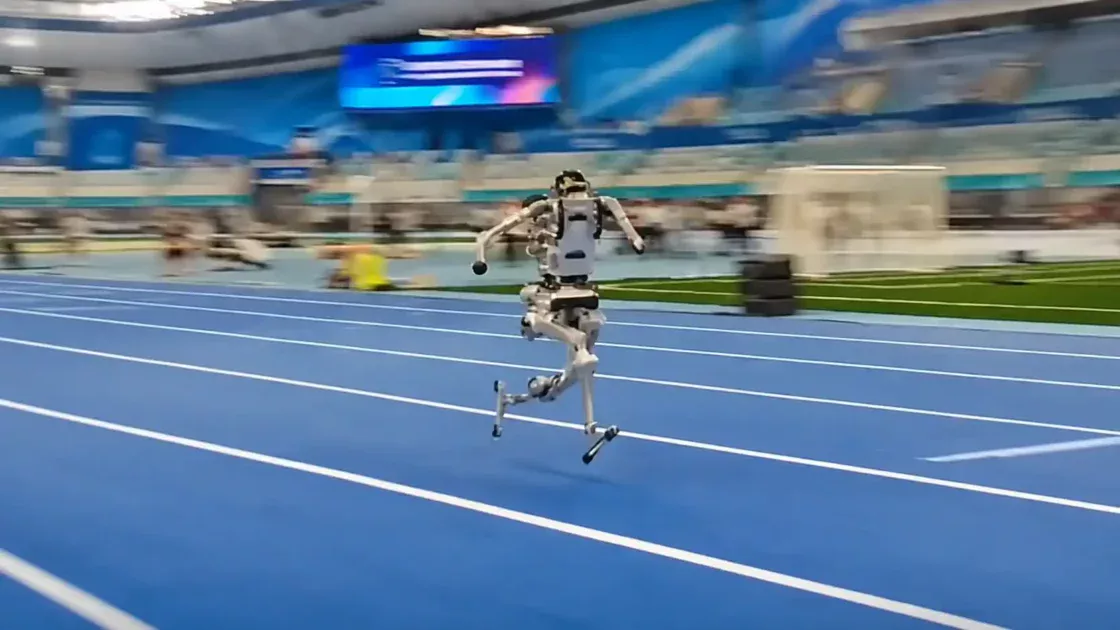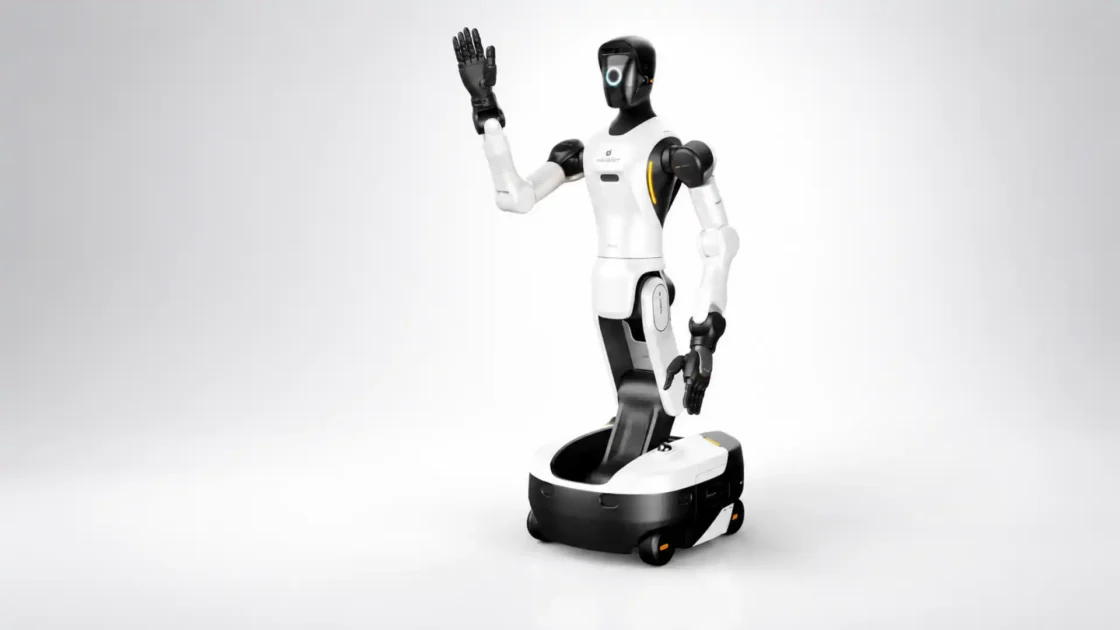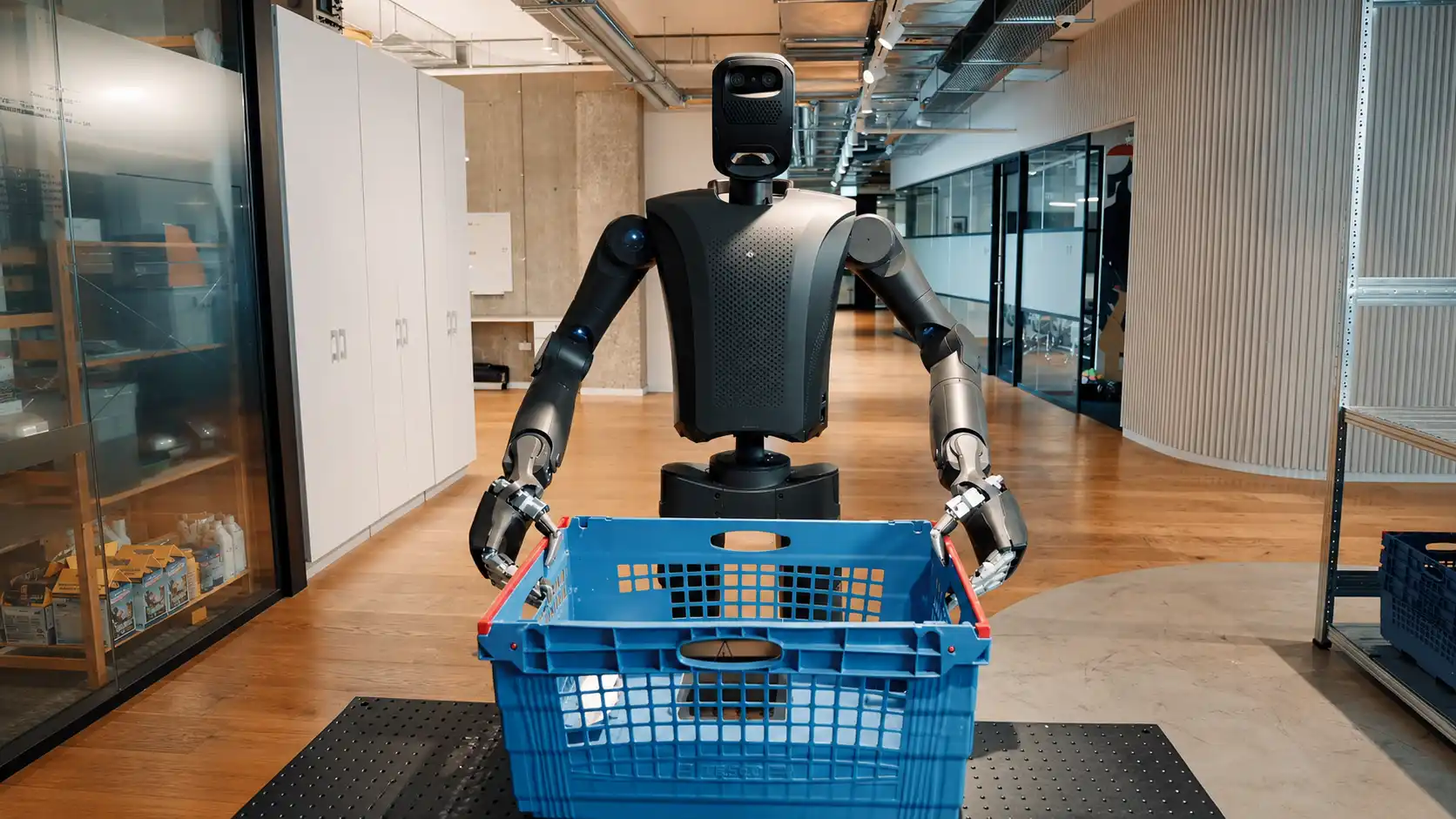
NVIDIA’s new Isaac GR00T Reference Humanoid Robot matters because it changes the starting point for humanoid research. The announcement is not a claim that human-level robots are ready for factories, hospitals or homes. It is a claim about infrastructure. NVIDIA, Sharpa and Unitree are trying to give labs a shared robot body, tactile hands, onboard AI compute, simulation workflow and open model stack so researchers stop rebuilding the same machine before they can test the intelligence inside it. NVIDIA announced the reference design at GTC Taipei on May 31, 2026, and Sharpa followed with its own announcement on June 1, 2026.
Table of Contents
A reference robot is different from a robot product
A humanoid robot sold as a finished product has one job: work reliably enough for a buyer to justify the cost. A reference robot has a different job. It gives researchers a common machine on which they can compare policies, collect data, test manipulation skills and move software from simulation to hardware without inventing a new electrical, mechanical and data stack each time.
That distinction matters because the humanoid sector has a habit of collapsing several separate claims into one demo. A robot walking onstage does not prove it can stock shelves. A hand turning an object does not prove a factory deployment is near. A foundation model answering a language instruction does not prove a whole-body system will stay safe around people. The Isaac GR00T Reference Humanoid Robot is best understood as a development platform, not a commercial worker.
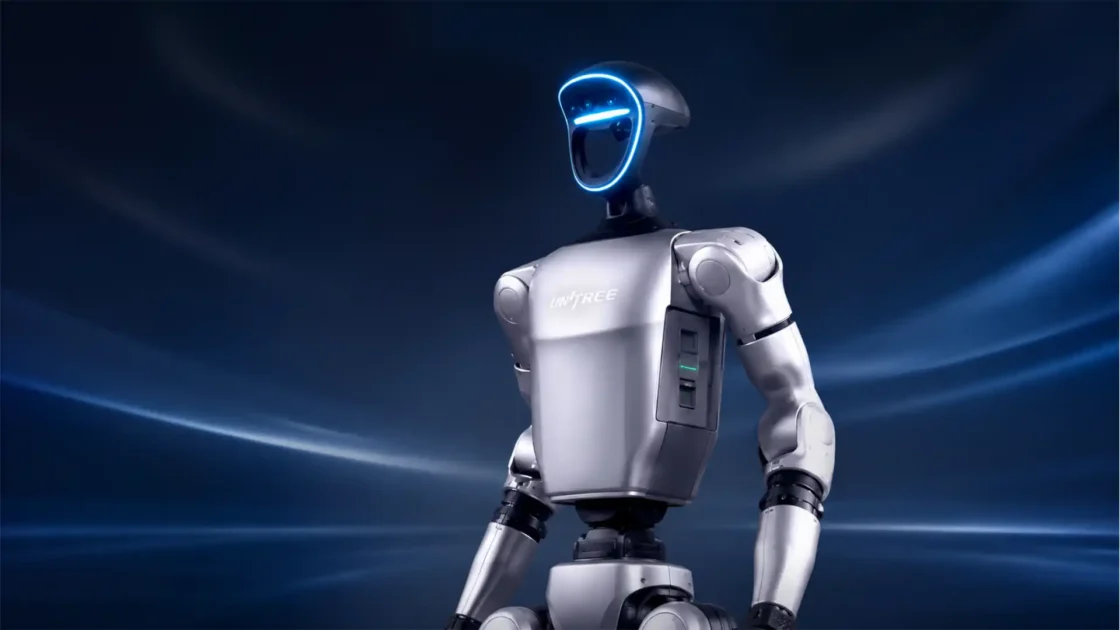
NVIDIA’s own announcement is careful in one way and ambitious in another. The careful part is the stated audience: academic research and frontier humanoid robotics development. NVIDIA names Ai2, ETH Zurich, Stanford Robotics Center and UC San Diego’s Advanced Robotics and Controls Laboratory as institutions that will use the reference design. The ambitious part is the architecture: a full-sized Unitree H2 Plus humanoid body, Sharpa Wave tactile five-finger hands, Jetson AGX Thor T5000 onboard compute, Isaac GR00T software, Isaac Sim, Isaac Lab, Isaac Teleop and Isaac ROS in one validated system.
That package turns humanoid research into something closer to an AI platform problem. The value is not that every lab gets the same robot forever. The value is that a baseline exists. A researcher working on dexterous manipulation can start from the same chassis and hand configuration as another lab working on bimanual task planning. A model developer can test whether a policy trained in simulation carries over to the same physical sensor and actuator layout elsewhere. A safety researcher can reproduce failure modes on a machine that others can buy, inspect and instrument.
The phrase “open reference design” needs restraint. It does not mean every mechanical drawing, firmware layer or supply chain dependency is public property. NVIDIA’s public language emphasizes an open software stack, open models and a reference design that avoids fully proprietary humanoid platforms. GR00T N1.7 is available through GitHub and Hugging Face, and NVIDIA describes it as commercially licensed under Apache 2.0 in its repository. But the robot is still built from named commercial hardware: Unitree’s body, Sharpa’s hands and NVIDIA’s compute. “Open-source-style” is a fair description only if readers understand the style as open development workflows and accessible model code, not as a fully open hardware bill of materials.
The practical point is less romantic and more useful. Humanoid robotics has suffered from too much bespoke engineering before meaningful learning begins. Labs spend time fixing cable routing, syncing cameras, writing drivers, attaching hands, tuning safety stops, rebuilding simulation models and matching action spaces. Those tasks are real engineering work, but they slow research into autonomy. A reference platform concentrates that burden in one place. The rest of the field then gets to test whether its models, teleoperation data, synthetic data and evaluation tools actually improve robot behavior.
NVIDIA is also doing what it has done in other markets: define the stack around compute. In data centers, the company did not win only by selling GPUs; it built CUDA, libraries, model tools and developer habits. In autonomous driving, it sold compute modules, simulation, sensor processing and software pipelines. In humanoid robotics, the reference robot repeats the same playbook. The robot is a machine, but the strategy is platform gravity.
The confirmed launch details
The confirmed system has three hardware pillars. The body is Unitree’s H2 Plus humanoid, a human-scale platform with 31 degrees of freedom. The hands are Sharpa Wave tactile five-finger hands, each listed by Sharpa as having 22 degrees of freedom, with a high-resolution digital tactile array. The onboard computer is NVIDIA Jetson AGX Thor T5000, built around the Blackwell architecture and specified at 2,070 FP4 teraflops of AI performance, with a 14-core Arm CPU and 128GB of unified memory. NVIDIA lists a configurable 40W to 130W power range for the module in the reference robot announcement.
The combined degree-of-freedom count is one of the cleaner ways to explain the design. Unitree contributes 31 degrees of freedom across the body. Sharpa’s two hands add 44 active hand degrees of freedom in total, bringing the body-and-hand configuration to 75 degrees of freedom. That does not mean the robot is human-equivalent. It means the machine has enough joints to test whole-body and fine-hand coordination rather than treating manipulation as a gripper problem.
NVIDIA’s announcement lists the H2 chassis at nearly six feet tall and around 150 pounds, with multi-view sensing that includes a head-mounted stereo camera, wrist cameras and an inertial measurement unit. It also lists arm torque up to 120 newton-meters, leg torque up to 360 newton-meters, a rated arm payload of 7 kilograms and peak payload of 15 kilograms. Unitree’s own H2 Plus page lists 1820 mm height, around 70 kg weight with battery, the same 31 body degrees of freedom, a 15Ah 0.972 kWh battery and about three hours of battery life.
The system is meant to run NVIDIA’s Isaac GR00T workflow, not just carry an NVIDIA chip. The reference stack includes Isaac Teleop for demonstration capture, Isaac GR00T open foundation models for reasoning, learning and multitask behavior, Isaac Sim and Isaac Lab for simulation and policy training, Isaac ROS for deployment middleware, and Jetson Thor for onboard inference and control.
Availability is one point where wording needs care. NVIDIA’s newsroom says the Isaac GR00T Reference Humanoid Robot will be available from Unitree in late 2026. Some trade coverage and social posts describe October 2026 availability, and the user-supplied brief says shipping begins in October 2026. Because NVIDIA’s canonical public line is “late 2026,” the safest published wording is that availability is expected in late 2026, with October 2026 reported by secondary coverage but not stated in the NVIDIA newsroom text reviewed here.
Reuters added another relevant angle on June 1, 2026. It reported that NVIDIA plans to work with humanoid robot makers in the United States, Europe and South Korea in addition to Unitree, and that NVIDIA executives framed the Unitree collaboration partly around improving cybersecurity through NVIDIA’s chip-level controls. Reuters also reported that the robot body comes from Unitree, the hands from Singapore-headquartered Sharpa and the compute from NVIDIA.
That Reuters detail matters because the Unitree connection is politically sensitive. U.S. lawmakers have raised concerns about Unitree, and Reuters reported allegations and proposed restrictions related to federally funded research. NVIDIA’s reported answer is not to hide the supply chain but to route updates through NVIDIA compute and extend server-grade security practices such as secure boot and confidential computing to robots. The result is a platform story wrapped in a geopolitics story: a U.S. AI chip company, a Chinese humanoid body, a Singapore hand supplier and global academic buyers.
The robot is a stack, not a single breakthrough
The easiest mistake is to treat the announcement as if NVIDIA invented a complete humanoid robot from scratch. It did not. The reference robot is assembled from already specialized parts: Unitree’s full-sized body, Sharpa’s dexterous tactile hands and NVIDIA’s compute-and-software stack. The launch is still news because the integration is the product.
Humanoid robotics does not fail because one component is missing. It fails in the connections between components. A strong hand is not useful if the policy cannot interpret touch. A foundation model is weak if the robot’s action space is poorly mapped. A simulation environment is useful only if the physical robot’s sensors, joints and timing are represented with enough fidelity to reduce the gap between training and deployment. The hard problem sits between body, data, model, simulator, controller, safety layer and deployment workflow.
NVIDIA’s reference design is a bet that the field needs an integrated full-stack default. That default includes the physical embodiment, the simulation representation, the demonstration capture workflow, the policy model, the onboard inference computer and the middleware path to real motors. Each part has value, but the packaging changes the research tempo. A lab can spend less time proving the machine boots and more time asking whether a policy learns.
The choice of hands is especially telling. The industry’s early humanoid race often emphasized walking, balance and theatrical body motion. Walking is hard, but many economically useful tasks are not solved by legs. They are solved by grasping, stabilizing, sliding, pressing, folding, orienting, handing over and recovering from contact. A robot in a warehouse or lab may need to pick up soft bags, awkward packaging, tools, trays, cables, bottles or loose parts. A two-finger gripper can handle some of those tasks under controlled conditions. A five-finger tactile hand targets a more demanding class of work.
Sharpa says its Wave hand uses a high-resolution digital tactile array with more than 1,000 pixels per fingertip and 0.02N pressure sensitivity. Those details are not trivia. They show the reference design is aimed at contact-rich manipulation, where vision alone often fails. Cameras lose track when fingers occlude the object, when surfaces are reflective, when a part slips inside the hand or when the robot needs to feel the difference between stable contact and unstable contact. Touch data gives a model another signal stream.
The compute choice points in the same direction. Jetson AGX Thor’s headline figure, 2,070 FP4 TFLOPS, should not be read as direct evidence of real robot competence. It is a hardware capability figure for low-precision AI operations. The more relevant point is that the module gives a mobile robot enough onboard memory and inference capacity to run vision-language-action models, sensor processing and real-time control closer to the machine. NVIDIA’s Jetson Thor page describes 128GB memory, 273 GB/s memory bandwidth, 14 CPU cores and support for edge physical AI workloads.
This local compute matters because humanoids cannot rely on cloud inference for every movement. Latency, connectivity, privacy, safety and reliability all argue for onboard autonomy. A robot may use cloud systems for heavy training, fleet analytics or remote supervision, but the loop that stops a hand from crushing an object or a body from moving into a person needs local responsiveness. A serious humanoid platform must treat the edge computer as part of the body, not as an accessory.
The hardware choices reveal the research target
Unitree’s H2 Plus body gives the reference robot a human-scale frame rather than a tabletop manipulator or small educational humanoid. That choice expands the task space. Researchers can test reaching height, balance under arm movement, whole-body coordination, mobile manipulation and the mechanical awkwardness of operating in spaces built around human dimensions. A robot that is nearly six feet tall and about 70 kg has a different safety and control profile from a small lab platform.
Human scale also creates a harsher evaluation environment. A small robot can fail gently. A full-sized humanoid can damage itself, nearby equipment or people if control fails. That is one reason the reference robot includes a remote emergency stop and why NVIDIA and Reuters both place security and control in the story. The platform is for research, but it is not a harmless toy. It is a powered, articulated machine with leg torque listed up to 360 N·m and peak arm payload near 15 kg.
The 31-degree body is not the most exotic number in humanoids, but it is enough for many research questions. The leg joints support locomotion and stance. The arms provide reach and bimanual positioning. The waist adds torso motion. The head supports sensing direction. When paired with hands, the platform moves from “humanoid as walker” toward “humanoid as worker.” That is the category NVIDIA cares about because the economic story sits in tasks that mix perception, language, manipulation and mobility.
Sharpa’s hands narrow the target further. NVIDIA’s press release says the reference design includes dual Sharpa Wave tactile five-finger hands for dexterous manipulation. Sharpa’s own statement says the hands give the robot 75 total degrees of freedom across hands and body and support long-horizon manipulation tasks such as in-hand rotation and bimanual operation. “Long-horizon” is the crucial phrase. Many robot demos succeed at one action: pick, place, push. Real work requires chains of actions with error recovery.
A robot folding a towel, assembling a small part, opening packaging or using a tool must coordinate sight, touch, joint state and task memory. If it begins to fail, it needs to notice the failure before the final result is lost. Tactile hands and vision-language-action models are meant to address that failure mode from opposite ends. The hand senses contact. The model interprets task intent and chooses actions. The controller turns policy output into joint movement. The system is only as strong as the loop among them.
The sensor package reinforces the same design logic. A head-mounted stereo camera gives wider scene perception. Wrist cameras give close manipulation views. The inertial measurement unit tracks body motion. Microphones and speakers support voice interaction, though voice is likely less central to research value than vision, touch and proprioception. NVIDIA and Unitree list Ethernet, Wi-Fi 6, Bluetooth 5.2 and USB connectivity, which matters for labs wiring the robot into data capture, debugging and safety systems.
The result is not a robot optimized for one chore. It is a compromise machine: mobile enough, human-scale enough, tactile enough, compute-rich enough and standardized enough to host many research programs. That makes it less glamorous than a viral demo and more useful than a one-off prototype. The reference robot’s real specification is not 31 body degrees of freedom or 2,070 TFLOPS; it is the attempt to make embodiment, sensing and AI development repeatable.
Jetson Thor gives NVIDIA a body-side beachhead
NVIDIA’s strongest business instinct is to move compute into the place where new software demand appears. In the AI data center, demand moved into model training and inference. In vehicles, demand moved into sensor fusion, planning and driver assistance. In humanoids, demand moves into the robot body. Jetson Thor is NVIDIA’s attempt to own that body-side compute layer.
Jetson Thor is not merely a faster embedded board. NVIDIA positions it for agentic AI and physical robotics, with up to 2,070 FP4 TFLOPS, 128GB memory, a 40W to 130W power range and support for open-source models through Jetson AI Lab. The Jetson Thor page ties the product directly to humanoid robotics and Isaac GR00T workflows. That positioning turns the reference humanoid into a showcase for a chip family.
The technical logic is straightforward. Humanoid robots ingest multiple camera streams, tactile data, joint states, IMU data, audio and possibly force signals. They need perception, mapping, language grounding, task planning, policy inference, safety checks and motor control. Those workloads are not identical. Some are neural network heavy. Some are timing sensitive. Some must run at high frequency. Some can run slower but require more context. A platform with a GPU, CPU, memory bandwidth and specialized acceleration is better suited to mixed workloads than a controller board built only for deterministic motor loops.
FP4 performance deserves careful interpretation. Low-precision AI math is useful for modern neural inference because many models tolerate quantization when carefully handled. The TFLOPS number does not translate into a simple “robot intelligence” score. A poorly trained model, weak sensor calibration or bad control interface can waste plenty of compute. Yet compute limits do matter. If a robot cannot run the policy fast enough, it will hesitate. If it cannot process enough sensor data locally, it will miss state changes. If memory is too tight, developers must shrink models or split workloads. Thor’s role is to make the robot a credible host for large multimodal policies at the edge.
NVIDIA also gains influence through the software that surrounds the chip. Jetson without Isaac would be hardware. Jetson with Isaac Sim, Isaac Lab, Isaac ROS and GR00T becomes a development path. A lab that builds around this stack may later train on NVIDIA GPUs, simulate with NVIDIA tools, deploy on Jetson modules and benchmark against NVIDIA model releases. That is the same flywheel that made CUDA durable: developers build habits around the platform, and those habits create demand for the hardware.
The open model angle strengthens the pitch. GR00T N1.7 is described by NVIDIA’s GitHub repository as an open vision-language-action model for generalized humanoid skills. It accepts multimodal inputs including language and images and maps them toward manipulation actions. The repository notes that the model is adaptable through post-training for specific embodiments, tasks and environments. That makes Jetson Thor more than an inference box; it is the intended local target for an evolving model family.
This matters strategically because the humanoid industry has not settled on one dominant software substrate. Robot makers have proprietary stacks. Research labs use ROS, MuJoCo, Isaac, custom simulators and their own data schemas. Foundation-model labs use different action representations and training recipes. A reference robot running NVIDIA’s compute and workflow tries to pull these loose threads toward one center. The center is not the body vendor. It is the compute-and-model vendor.
The risk for NVIDIA is also clear. If humanoid robotics remains a niche research market longer than expected, the reference robot may become a prestigious lab platform rather than a large revenue driver. If robot makers prefer their own stack or cheaper compute, NVIDIA’s influence may be limited. If safety and reliability slow deployment, demand for body-side AI chips may grow slower than investor narratives suggest. But NVIDIA does not need mass humanoid deployment tomorrow to justify this move. It needs to become the default platform while the field is still forming.
GR00T is the software bet inside the machine
The Isaac GR00T name has been around longer than this reference robot. NVIDIA announced Project GR00T in 2024 as a general-purpose foundation model effort for humanoid robots, and Reuters covered the company’s move into generative AI for humanoids at GTC 2024. In March 2025, NVIDIA announced Isaac GR00T N1 as an open humanoid robot foundation model, alongside simulation frameworks and Newton physics engine work with Google DeepMind and Disney Research. The 2026 reference robot gives that software effort a standard body.
GR00T N1’s model architecture matters because it mirrors a broader split in robotics AI. NVIDIA describes a dual-system approach: a slower vision-language reasoning component that interprets the environment and instruction, and a faster action model that turns plans into continuous robot movements. This is not human cognition in any deep philosophical sense. It is an engineering pattern: separate high-level task interpretation from low-level motor output, then train the connection between them.
GR00T N1.7 moves the story forward. NVIDIA’s GitHub repository says N1.7 is an open vision-language-action model using a vision-language foundation model with a diffusion transformer head that denoises continuous actions. The repository describes support for fine-tuning, inference, evaluation and deployment, with model weights and reference code released for research and prototyping. Hugging Face’s NVIDIA blog describes N1.7 as a 3B-parameter open reasoning VLA model that maps visual observations and natural language instructions to continuous robot actions.
The VLA framing is central. A vision-language-action model is not just an image classifier attached to a controller. It tries to link perception, instruction and movement in one learned policy. A human might say “pick up the red cup and put it on the tray.” The robot must identify the relevant objects, infer the task sequence, select grasps, move without collision, respond to slippage and finish in a state that matches the instruction. That chain is why humanoid AI is harder than chatbot AI. The output is not text. The output is force, motion and risk.
GR00T also belongs to a wider movement in robot learning. Earlier robot policies often trained on narrow tasks, specific arms and specific environments. Foundation model robotics tries to train on mixed data from many embodiments, demonstrations and simulations, then adapt to a target robot. The attraction is obvious: if every robot task requires a large hand-collected dataset on the final hardware, scaling is painfully slow. If a base model transfers useful priors, labs can fine-tune with less task-specific data.
NVIDIA’s N1.7 materials point to this transfer ambition. The GitHub repository says the model is cross-embodiment and trained on mixed robot data including bimanual, semi-humanoid and humanoid datasets. Hugging Face describes support for custom embodiments through the LeRobot dataset format. The reference humanoid then becomes a clean downstream target: a body and hand configuration that NVIDIA can tune, validate and document.
The limits are just as important. A VLA model does not erase the need for stable low-level control, calibrated sensors, safe fallback states, task-specific evaluation and high-quality demonstrations. Generalist robot models remain fragile compared with human workers. They can be confused by small distribution shifts, unseen objects, lighting changes, contact failure or hidden state. A model that completes a benchmark task may still fail in a real workplace with clutter, interruptions and moving people.
GR00T’s real promise is not instant autonomy. It is a research shortcut for learning-based control. Instead of training every skill from scratch, labs start from a model that already encodes some visual, linguistic and action priors. Instead of inventing a deployment interface, they adapt a known stack. Instead of testing on incompatible custom machines, they can compare progress on a shared platform. That is how a model becomes infrastructure.
Tactile hands are the quiet center of the announcement
The hands may be the most consequential part of the robot. Legs make a humanoid look like a humanoid. Hands decide whether it can do useful work. A biped that walks well but grasps poorly is a mobile display. A manipulator that can handle contact, force and object uncertainty begins to touch the economics of labor.
Sharpa’s contribution is not a generic end effector. The company says the reference robot uses its Wave tactile five-finger hands, each with 22 degrees of freedom, and a digital tactile array with more than 1,000 pixels per fingertip and 0.02N pressure sensitivity. NVIDIA’s own release points to dexterous manipulation, sensing and whole-body control as core pieces of the platform. Those claims should be tested over time, but they show the design target: contact-rich manipulation rather than simple pick-and-place.
Vision gets most of the attention in AI because images are easy to display and data is abundant. Touch is harder. It requires sensorized surfaces, calibration, durability, signal interpretation and physical trials. Yet touch is often the missing channel when robots fail. A camera can show that a cup is in a hand; tactile data can reveal whether the cup is slipping. Vision can estimate the pose of a small part; touch can correct that estimate when the part is partly hidden by fingers. Vision can guide a reach; touch can finish an insertion, press, twist or handoff.
The model side is beginning to reflect that reality. NVIDIA’s EgoScale research page says the company trained a VLA model on more than 20,000 hours of action-labeled egocentric human video and found a log-linear relation between human data scale and validation loss. The same page reports that the resulting policy improved average success rate by 54% over a no-pretraining baseline using a 22-DoF robotic hand. Hugging Face’s N1.7 blog ties EgoScale to GR00T N1.7 and says the model was pretrained on 20,854 hours of human egocentric video across more than 20 task categories.
That matters because tactile hands are data-hungry. A five-finger hand creates a large action space. Each finger adds motion choices, contact states and failure modes. Traditional teleoperation can collect useful data, but scaling teleoperation across thousands of hours of dexterous behavior is expensive. Human egocentric video offers a larger source of hand-object interaction, though it comes with a transfer problem: human hands are not robot hands, and video does not automatically reveal force. EgoScale’s claim is that human video can provide a transferable motor prior when combined with aligned human-robot training.
The reference robot gives that research a physical target. A 22-DoF hand paired with GR00T N1.7 makes the question concrete: do human video priors, simulation and limited robot data produce better dexterous manipulation on this machine? If the answer is yes, labs can begin comparing policies across tasks. If the answer is no, the failure will be instructive because the hardware is shared.
The durability question remains. Tactile fingertips must survive repeated contact, cleaning, impacts, misgrasps and calibration drift. Industrial grippers often win because they are simple, rugged and easy to maintain. Dexterous hands must prove they are not only capable in demos but serviceable in daily use. A tactile hand that works beautifully for 20 minutes but becomes unreliable after weeks of handling boxes, tools or lab objects is not a deployment breakthrough.
Still, NVIDIA’s choice of Sharpa hands signals a serious shift. The field is moving from “humanoids need hands because humans have hands” to “humanoids need tactile hands because useful work is contact work.” That shift is healthy. It grounds humanoid AI in the physics of objects rather than the spectacle of walking.
Simulation is the bridge from demo to repeatable research
The reference robot’s software story depends on simulation. NVIDIA Isaac Sim is described by NVIDIA as an open-source reference framework built on Omniverse libraries for robotics simulation, testing and synthetic data generation in physically based virtual environments. Isaac Lab is the robot-learning layer built on Isaac Sim, with the Isaac Lab paper describing GPU-native robotics simulation for multimodal learning, reinforcement learning, imitation learning, contact-rich manipulation and whole-body control.
Simulation is not a magic substitute for the real world. Anyone who has moved a policy from a simulator to a robot knows the gap: friction is wrong, contacts are unstable, sensors are cleaner than reality, lighting is simplified, motors heat, cables pull, surfaces deform, latency appears and objects behave unpredictably. But simulation is still necessary because physical data is slow, risky and expensive. A humanoid falling in simulation costs compute. A humanoid falling in a lab costs repair time, safety review and possibly a destroyed sensor.
NVIDIA’s stack tries to make simulation part of the standard workflow rather than a side project. Isaac Sim can ingest CAD, URDF, MJCF and real-world captures, assign physics and sensor models, generate synthetic data and run software-in-the-loop or hardware-in-the-loop testing. NVIDIA’s page also says Isaac Sim connects with Isaac Lab for robot learning and supports synthetic data pipelines. For a reference humanoid, those capabilities matter because labs need a digital representation of the exact robot, not a rough placeholder.
The whole point of a reference design is repeatability. If NVIDIA, Unitree and Sharpa provide a known simulation model and physical configuration, researchers can compare the effect of policy changes without uncontrolled hardware variation swallowing the signal. A manipulation policy trained for one body-hand configuration has a better chance of being evaluated fairly when another lab has the same embodiment. That is not perfect reproducibility, but it is better than comparing results across unrelated custom robots.
Simulation also supports safety work. Before a robot tries a new whole-body movement near a person, researchers can test ranges of motion, collision envelopes, failure recovery and task constraints digitally. That does not certify the robot, but it filters bad ideas. It also supports red-team testing: researchers can create unusual object placements, sensor dropouts, occlusions or interrupted instructions and see where the model fails.
Synthetic data is another piece. Robot learning needs examples of objects, tasks and failures. Physical collection is costly. Synthetic data can create many variations in lighting, pose, background and object arrangement. NVIDIA’s Isaac Sim page describes controllable synthetic data generation and domain randomization. The challenge is that synthetic data must be useful rather than plentiful. Millions of unrealistic examples may train the wrong behavior. The strongest research workflows use simulation to expand coverage while grounding policies in real demonstrations and real evaluations.
The reference robot’s value depends on the quality of its simulator. If the digital twin is crude, labs will still spend large amounts of time closing the sim-to-real gap. If the simulator captures sensors, hands, joint limits, timing and contact behavior well enough for early training and evaluation, the whole platform becomes more than hardware. It becomes an experimental loop: capture data, simulate variations, train policies, test failures, deploy to robot, collect more data, refine.
Academic labs get a common denominator
NVIDIA named Ai2, ETH Zurich, Stanford Robotics Center and UC San Diego’s Advanced Robotics and Controls Laboratory among the research institutions expected to use the reference design. Those names are not decoration. They indicate the platform is aimed at labs that influence the research agenda, publish results, attract students and create the next generation of robot-learning methods.
Academic robotics has always benefited from shared platforms. The PR2 robot helped mobile manipulation research in the 2010s because labs could compare work on a common machine. TurtleBot played a similar role for education and navigation. Franka arms became common in manipulation research because they were capable, accessible enough and well supported. Unitree’s smaller robots have already become common in legged robotics work. Humanoids, by contrast, have lacked a widely shared full-stack platform with serious hands and modern foundation-model tooling.
A common denominator does not eliminate diversity. Labs will still use custom robots, cheaper arms, specialized hands, quadrupeds, mobile bases and proprietary platforms. The reference humanoid gives researchers a shared target when they need one. That is especially useful for papers on generalist policies, sim-to-real transfer, tactile manipulation, benchmark evaluation and human-robot interaction.
The publication effect could be large. Research claims are easier to evaluate when other labs can reproduce the setup. A paper that says “our policy improves bimanual tool use on the Isaac GR00T Reference Humanoid Robot” is more comparable than a paper built around a one-off robot only one lab owns. Benchmarks become cleaner. Failure cases become easier to share. Datasets become more reusable because embodiment tags, sensor layouts and action spaces are known.
The platform also gives students a cleaner learning path. Humanoid robotics is intimidating because it spans mechanics, controls, perception, machine learning, safety, simulation and systems engineering. A reference robot will not make those topics simple. It may reduce the amount of undocumented integration work that blocks new researchers from meaningful experiments. A graduate student should spend more time testing a hypothesis and less time discovering that a wrist camera timestamp is misaligned with a hand command.
There is a risk of monoculture. If too many labs build around one vendor’s stack, research may drift toward questions that platform answers well. NVIDIA tools may become the default framing for simulation, data format, model deployment and benchmarks. That can speed progress but also narrow it. Open research needs alternative simulators, alternative models, alternative hands and alternative safety architectures. The best outcome is not a single NVIDIA-defined humanoid field. The best outcome is a reference platform strong enough to make comparisons useful, while the broader community keeps pressure on assumptions.
Cost and access will matter. NVIDIA and Unitree have not put a public price in the primary sources reviewed here. A full-sized humanoid with tactile hands and Jetson Thor compute will not be a casual purchase for many labs. If the platform is too expensive or supply-constrained, it may cluster in elite institutions and large corporate labs. The open-model story helps, but physical hardware remains a gatekeeper.
Still, a standardized humanoid research platform is a rational next step. The field has reached the point where software questions need better bodies, and body questions need better software. Academic labs can contribute by testing whether the integration actually supports learning, measuring failure modes, publishing reproducible tasks and resisting the hype that surrounds any humanoid announcement.
NVIDIA’s platform strategy echoes CUDA
NVIDIA’s robotics move looks familiar because it follows a pattern the company has already used. CUDA made NVIDIA GPUs programmable for general-purpose computing. cuDNN, TensorRT, NCCL and other libraries made the hardware practical for deep learning. Data center systems then turned those tools into infrastructure. The company’s durable advantage came from the combination of silicon, software, developer familiarity and ecosystem inertia.
Humanoid robotics is nowhere near the maturity of data-center AI. The analogy should not be stretched too far. GPU clusters process digital inputs and outputs; robots interact with a messy physical world. Yet NVIDIA’s strategic instinct is the same: own the platform layer before the application market is fully formed. If physical AI becomes a large category, the company wants developers to think of NVIDIA as the default way to build, train, simulate and deploy it.
The Isaac GR00T Reference Humanoid Robot is a physical CUDA moment in miniature. It is not enough to release a model. The model needs a robot. It is not enough to sell Jetson Thor. The chip needs a workload. It is not enough to promote Isaac Sim. The simulator needs a widely used physical counterpart. By combining all of them, NVIDIA creates a path that begins in research and could end in commercial robot fleets.
That platform path has many entry points. A lab may start with GR00T N1.7 on GitHub, fine-tune a policy and deploy it to a robot. A robot maker may use Isaac Sim and Isaac Lab to train policies before moving them to its own hardware. A manufacturer may use Omniverse and Isaac tools to simulate robot workflows before buying machines. A developer may use Isaac ROS packages for perception and deployment. Each path creates more data, more tooling, more familiarity and more reasons to stay in the NVIDIA stack.
This is also why NVIDIA does not need to manufacture the whole humanoid. Making robots is capital-intensive, operationally difficult and lower-margin than selling compute. Robot companies handle bodies, actuators, assembly, service and customer deployments. NVIDIA supplies the AI layer that many bodies may need. Reuters’ report that NVIDIA plans to work with U.S., European and South Korean humanoid makers in addition to Unitree fits that model. Unitree is one body partner, not necessarily the permanent hardware endpoint.
The ecosystem strategy also spreads risk. If Unitree’s platform succeeds in research, NVIDIA benefits. If another humanoid body gains traction, NVIDIA can support it through Isaac GR00T workflows. NVIDIA’s announcement already says the Isaac GR00T developer platform will support Unitree’s G1 humanoid, extending the same approach to a robot already used by researchers and developers. The more embodiments GR00T supports, the less NVIDIA depends on one chassis.
The challenge is that robotics ecosystems are harder to standardize than AI software ecosystems. Robots vary in kinematics, payload, sensors, hands, actuator dynamics, safety ratings and maintenance. A model trained for one machine may not transfer cleanly to another. A middleware layer may hide some complexity, but physics does not disappear. NVIDIA’s platform will need to respect embodiment differences rather than pretend they are minor.
Still, the direction is clear. NVIDIA is trying to make humanoid robotics legible to AI developers. It packages the robot as a programmable platform, the model as a downloadable base, the simulator as a training environment and the edge computer as the inference target. That is a powerful narrative because it reduces a bewildering field to a workflow. Whether the workflow proves strong enough is the next question.
The Unitree connection brings scale and scrutiny
Unitree is a logical body partner for a reference humanoid. The company has become one of the most visible Chinese robot makers, especially through quadrupeds and increasingly affordable humanoids. Its robots are widely seen in research, demos and developer communities. Unitree’s H2 Plus page presents the platform as built on NVIDIA Isaac GR00T, with open models, simulation frameworks and validated workflows from data to deployment.
Unitree brings manufacturing experience and a willingness to ship research platforms at prices below many Western competitors. That matters because a reference robot needs availability. A beautifully engineered machine that only a handful of labs can obtain will not become a shared baseline. Unitree’s hardware supply chain may be one reason NVIDIA chose it for the first reference design.
The same connection brings political and security scrutiny. Reuters reported that U.S. lawmakers have alleged Unitree has ties to the Chinese government and military and introduced a bill that would ban use of the firm’s robots by researchers receiving U.S. government funding. Reuters also reported that NVIDIA executives said they plan to work with humanoid robot makers outside China and that the Unitree collaboration is aimed partly at improving cybersecurity for researchers.
For universities, this is not abstract. A research robot may contain cameras, microphones, telemetry logs, motion data, network interfaces, firmware update mechanisms and remote access tools. A humanoid operating in a lab can observe experiments, people, spaces and equipment. If the robot is later used in industrial research, the data may be more sensitive. A humanoid is not only a machine that moves; it is a mobile sensor platform with actuators.
NVIDIA’s reported security approach is to make software updates flow through NVIDIA’s chip, where code can be checked for authenticity, and to apply secure boot and confidential computing practices associated with data center infrastructure. That is a sensible direction, but it does not settle every concern. Supply chain trust includes firmware, hardware debug paths, telemetry defaults, cloud services, physical ports, maintenance access and vendor support practices. Universities will need procurement reviews, network segmentation, data policies and clear update controls.
The geopolitical issue also affects global adoption. A lab in Europe may evaluate Unitree differently from a U.S. federally funded lab. A private company may care more about performance and cost than political risk. A government lab may avoid certain vendors entirely. NVIDIA’s plan to support other regional robot makers suggests the company understands that one hardware supplier cannot solve the global market.
Unitree’s role also raises a market question: will the body become commoditized? If Unitree and other manufacturers can produce capable humanoid bodies at falling cost, then the profit pool may move toward software, compute, hands, data and integration. NVIDIA would welcome that outcome because it sells the compute-and-platform layer. Western robot makers may see it differently. A standard NVIDIA stack on low-cost bodies could pressure higher-priced platforms unless they offer better reliability, safety certification, service or application-specific performance.
There is no clean answer yet. Unitree gives the reference design a plausible manufacturing base. It also forces buyers to face supply-chain trust earlier than they might prefer. That tension is likely to shape humanoid robotics as strongly as raw performance.
Sharpa’s role shows where value may migrate
Sharpa is less famous than NVIDIA and Unitree, but its role may say more about the next stage of humanoid robotics. The company supplies the tactile hands that turn the H2 Plus body into a dexterous reference platform. Without those hands, the robot would be another full-sized humanoid chassis with limited manipulation depth. With them, the system becomes a test bed for tactile bimanual work.
Sharpa’s announcement frames its Wave hands as a way to reduce setup time “from days to hours” and enable developers to capture upper-body demonstrations, simulate tactile manipulation and deploy policies through NVIDIA’s stack. The setup-time claim will need real-world confirmation, but the direction is credible. Hands are one of the hardest parts of humanoid integration. They require mechanical mounting, electrical connections, drivers, sensor interpretation, calibration, grasp control and simulation parameters.
A supplier that solves the hand problem becomes strategically valuable. Many humanoid companies build their own hands because manipulation is core to the product. But research labs and some robot makers may prefer a proven tactile hand module if it speeds development. If Sharpa’s hand becomes a default option in NVIDIA’s reference stack, it gains the kind of developer exposure that can shape future datasets, benchmarks and model assumptions.
The over-1,000-pixels-per-fingertip claim is especially relevant to AI models. Dense tactile data can be treated more like an image stream than a handful of force readings. That opens a path to learned tactile perception: slip detection, contact localization, object pose refinement, texture cues and grasp stability prediction. The challenge is that tactile data is harder to standardize than camera data. Different sensors have different noise, wear patterns, sampling rates and physical placement. A reference hand gives researchers a common tactile modality.
The hand also changes the economics of tasks. Many high-value human tasks involve small parts, flexible objects, packaging, tools or irregular items. Traditional industrial automation handles structured tasks by controlling the environment: fixtures, jigs, conveyors, known part poses. Humanoids are interesting precisely because they might work in less modified spaces. Dexterous hands are part of that bet. If humanoids require every environment to be redesigned around simple grippers, their economic appeal shrinks.
Sharpa’s challenge will be reliability and manufacturability. Tactile dexterous hands are complex. More joints mean more actuators, more cables, more failure points and more control difficulty. Sensorized fingertips may wear. Calibration may drift. Repairs may be costly. For research, those trade-offs are acceptable if the hand enables new experiments. For commercial deployment, they become a service problem.
The reference robot may give Sharpa a proving ground before mass deployment. Academic labs will stress the hands in unusual ways, publish limitations and produce datasets. That feedback can improve hardware and software. It can also reveal whether dexterous hands are ready for broad humanoid use or remain a research luxury.
The two tables that matter most
Isaac GR00T Reference Humanoid Robot confirmed components
| Layer | Confirmed element | Practical meaning |
|---|---|---|
| Body | Unitree H2 Plus humanoid with 31 body degrees of freedom | Human-scale mobility and whole-body research baseline |
| Hands | Dual Sharpa Wave tactile five-finger hands, 22 DoF per hand | Dexterous, contact-rich manipulation target |
| Compute | NVIDIA Jetson AGX Thor T5000 with 2,070 FP4 TFLOPS and 128GB unified memory | Onboard inference, sensor processing and control headroom |
| Sensing | Head stereo camera, wrist cameras, IMU, microphones and speakers | Scene perception, close manipulation views and motion tracking |
| Software | Isaac GR00T models, Isaac Teleop, Isaac Sim, Isaac Lab and Isaac ROS | Data capture, simulation, training, evaluation and deployment path |
| Availability | NVIDIA says late 2026; some secondary reports say October 2026 | Labs should cite “late 2026” unless relying on secondary reporting |
The table shows why the announcement is bigger than a new robot body. The value sits in the integration of embodiment, sensing, tactile manipulation, onboard compute and model workflow. A lab buying the system is not just buying motors; it is buying a research loop.
The specifications are impressive but not decisive
Humanoid announcements often invite a numbers contest. Degrees of freedom, TFLOPS, payload, torque, battery size and sensor counts are easy to compare. Those numbers matter, but they do not determine whether the robot will become useful. A robot with high torque may still stumble. A robot with many hand joints may still drop objects. A robot with high compute may still run a brittle policy.
The 31 body degrees of freedom give the H2 Plus enough articulation for human-scale research. The 75 total degrees of freedom across body and hands give the reference design a larger action space than simpler humanoids. The 2,070 FP4 TFLOPS compute figure gives the system room for modern AI inference. The 0.972 kWh battery and about three-hour operating life create a reasonable lab window. But none of those figures proves reliability.
The central question is not whether the robot moves. It is whether it can recover. A useful humanoid must notice when its grasp is off, when a foot placement is unstable, when an object is not where the policy expected, when a human interrupts, when a sensor drops frames, when a tool slips or when an instruction is ambiguous. Recovery is what separates a demo from autonomy.
Specs rarely show recovery. They show capacity. Capacity is the amount of room engineers have to build control and learning systems. More compute gives policy designers room. More tactile sensors give grasping researchers richer signals. More degrees of freedom give movement planners more options. More battery capacity gives longer experiments. Capacity creates possibility; behavior proves value.
This is why the reference design’s research orientation is sensible. NVIDIA is not pretending the platform is ready to replace workers. It is giving researchers capacity in a standardized form. If the platform generates strong datasets, reproducible benchmarks and better sim-to-real workflows, the specs will have served their purpose. If labs spend most of their time debugging integration, the spec sheet will look better than the lived experience.
The payload figures deserve similar restraint. A rated arm payload of 7 kg and peak payload of 15 kg are meaningful for lab tasks and some industrial motions. But payload is not only about lifting weight. It is about holding objects while moving, maintaining balance, avoiding collisions, controlling momentum and staying inside safety limits. A humanoid carrying a 10 kg object near people is a different risk than a stationary industrial arm lifting the same load inside a fenced cell.
Battery life is another practical constraint. Around three hours is useful for experiments but not enough for many shift-length commercial tasks without battery swaps, charging infrastructure or duty cycling. Robots in factories may not need human-like work shifts, but they do need predictable uptime. Research platforms can tolerate pauses. Production systems cannot.
The right way to read the specifications is as an invitation to serious experiments. NVIDIA, Sharpa and Unitree have assembled a machine with enough physical and computational capability to test frontier humanoid AI. The market should judge the platform by what researchers build on it, not by the launch numbers alone.
The data problem remains the real bottleneck
Humanoid robots need data that is harder to collect than text, images or videos. A robot policy needs observations, actions, timing, joint states, contact states, success labels, failures and environmental context. If the robot has tactile hands, it needs touch streams. If the task is bimanual, it needs coordinated actions. If the robot uses whole-body movement, it needs balance and posture data. Every example is expensive because it comes from a physical system or a high-quality simulator.
NVIDIA’s GR00T workflow addresses this through several channels. Isaac Teleop captures demonstrations. Isaac Sim and Isaac Lab generate and test simulated tasks. GR00T models start from pretrained priors. EgoScale adds large-scale egocentric human video. Each source solves part of the data problem and creates its own weaknesses.
Teleoperation is grounded in the robot’s real embodiment. It captures the right sensors and actions. But it is slow and expensive. Skilled operators are rare. Poor teleoperation can teach poor behavior. Some tasks are hard to teleoperate with enough precision. Whole-body teleoperation for humanoids is especially demanding because the operator must manage arms, hands, locomotion and task state.
Simulation is cheap compared with physical collection and safer for risky behaviors. But simulation may misrepresent contact, friction, sensor noise, deformable objects and actuator dynamics. Policies trained in simulation may exploit simulator quirks. Domain randomization helps, but it does not remove the need for real validation.
Human video is abundant and semantically rich. People perform countless dexterous tasks every day. EgoScale’s use of more than 20,000 hours of egocentric human video is an attempt to extract useful priors from that abundance. But human video lacks direct robot action labels unless transformed through retargeting, hand tracking and assumptions. A human hand is biologically different from a robotic hand. A human can feel forces that the video may not show. Transfer is possible, but not free.
The reference robot’s standardization could reduce waste. If many labs use the same embodiment, data collected in one lab may be more useful to others. Demonstrations, failures, calibration routines and task setups could become shared assets. GR00T’s support for common dataset formats also matters because data trapped in incompatible schemas loses value. NVIDIA’s Hugging Face blog says N1.7 supports LeRobot dataset format for fine-tuning custom embodiments.
The bigger question is whether humanoid robotics will find a data flywheel. Chatbots improved partly because the internet provided huge text corpora and user interaction generated more data. Robots do not get that gift. They must collect data in homes, labs, factories or simulations. If reference platforms allow many labs to collect compatible robot data, the field gets closer to a flywheel. If every robot company hoards incompatible datasets, progress stays fragmented.
The Isaac GR00T Reference Humanoid Robot is a data standardization move as much as a hardware launch. The body and hands define the action space. The sensors define observations. The simulator defines digital variation. The model defines input-output expectations. The middleware defines deployment. Put together, they make data easier to reuse.
The benchmark problem needs more discipline
Humanoid robotics has a measurement problem. A video can hide resets, remote control, edited failures, simplified environments and cherry-picked trials. A benchmark can be too narrow, rewarding policies that solve a toy task but fail elsewhere. A research paper can report success rates under conditions that are hard to compare. The field needs benchmarks that are repeatable, difficult and relevant.
A reference humanoid could improve this. If multiple labs use the same platform, they can define tasks with common objects, initial conditions, sensors, success criteria and failure logging. A task such as “pick up a flexible pouch, place it in a bin, recover from slip and report completion” becomes more meaningful when performed on the same hand-body system across labs. Results can include not only success rate but time, number of recoveries, contact forces, energy use, intervention rate and damage rate.
The danger is benchmark gaming. Once a task becomes a known target, models can overfit. Labs may tune for the benchmark rather than general ability. This happened in computer vision and language benchmarks. It can happen in robotics too. The answer is not to avoid benchmarks. It is to design them as rotating, transparent and failure-aware.
Humanoid benchmarks should include contact-rich manipulation, whole-body constraints, perception changes, ambiguous instructions, safe stopping, human interruption, object variation and recovery after partial failure. They should report interventions and resets. They should distinguish teleoperated, autonomous and supervised modes. They should include negative results. A policy that succeeds 70% of the time but fails dangerously 5% of the time is different from one that succeeds 60% of the time and fails safely.
The reference robot also makes tactile benchmarks possible. For instance, researchers could compare policies on in-hand rotation, soft-object handling, slip recovery, small-part insertion and bimanual stabilization. Touch data can be logged and shared. That opens new research into tactile representations and multimodal fusion.
NVIDIA’s GR00T N1 arXiv paper presents GR00T N1 as a vision-language-action model trained on mixed real-robot trajectories, human videos and synthetic datasets, and reports performance on simulation benchmarks across embodiments. Those kinds of claims need physical benchmarks to mature. Simulation benchmarks are useful, but humanoid robotics must eventually be judged by real hardware.
A reference platform should also encourage reporting costs. How many demonstrations were needed? How many failed runs occurred during training? How much compute was used? How long did deployment take? How often did hardware need repair? How many safety interventions occurred? A humanoid benchmark without operational cost hides the hardest part of robotics.
The field will be healthier if the NVIDIA reference robot becomes a place where failure is documented rather than polished away. The best academic contribution may not be a viral success video. It may be a careful paper showing why a GR00T-based policy fails under certain tactile conditions and how to fix one part of the loop.
Safety standards will lag the new robot category
Industrial robot safety has a mature standards base compared with humanoid AI. ISO lists ISO 10218-1 and ISO 10218-2 as 2025 robotics safety requirements, and ISO/TS 15066 as the 2016 technical specification for collaborative robots. A3 describes ISO 10218 as the foundational safety standard for industrial robots and notes that the 2025 revisions replace the 2011 versions, with collaborative application material from ISO/TS 15066 incorporated where appropriate.
Those standards matter, but humanoids stress the framework. Traditional industrial robots are often fixed arms in defined cells. Collaborative robots operate near people under controlled force, speed and separation assumptions. A full-sized humanoid with legs, arms, tactile hands, cameras, language instructions and learned policies is harder to classify. It may act like a mobile manipulator, a collaborative robot, a service robot and an AI system at once.
Safety for such robots has mechanical, functional, software and governance layers. Mechanical safety covers joint limits, force limits, emergency stops, pinch points, payload, stability and protective design. Functional safety covers reliable sensing, safe stopping, speed limits, fault detection and control integrity. Software safety covers policy constraints, update control, model validation, logging and fallback behavior. Governance covers who approves tasks, where the robot operates, what data it collects and how incidents are reviewed.
The reference robot includes a remote emergency stop, which is necessary but not enough. Emergency stops are last-resort controls. Safe operation also requires preventing unsafe states before a human has to intervene. A humanoid moving through a lab must know where it is allowed to move, how fast it may move near people, how to handle uncertainty and how to fail without creating a hazard.
AI policies complicate validation. A conventional controller can be analyzed through known states and limits. A learned policy may behave differently under small input changes. A vision-language model may misinterpret instructions. A diffusion action head may produce movement that is locally plausible but unsafe under a hidden condition. The safety case for humanoid AI must cover behavior distributions, not only mechanical design.
European regulation adds another layer. The EU AI Act sets a risk-based framework for AI developers and deployers, and the European Commission describes it as the first comprehensive legal framework on AI worldwide. AI inside machinery may face both product-safety and AI-governance obligations, depending on use. A humanoid in a research lab is one thing. A humanoid assisting workers, moving goods or interacting with the public is another.
NIST’s AI Risk Management Framework offers a broader governance lens for trustworthy AI, including validity, reliability, safety, security, resilience, accountability, transparency, explainability, privacy and fairness. For humanoids, those categories become physical. A privacy failure may involve camera data from a workplace. A security failure may involve malicious motion. A reliability failure may injure someone or damage equipment.
The Isaac GR00T Reference Humanoid Robot should push safety research forward because it gives labs a common body for testing risk controls. But no buyer should read the reference design as a safety-certified commercial system. It is a research platform that must be placed inside strong lab procedures, physical supervision and network controls.
Cybersecurity becomes physical security
Robots turn cybersecurity into a physical problem. A compromised chatbot may leak data or produce harmful text. A compromised humanoid may move, record, collide, damage property or become a foothold inside a sensitive facility. That is why Reuters’ cybersecurity reporting around NVIDIA and Unitree is central rather than incidental.
A humanoid robot has a large attack surface. It may receive software updates, connect to Wi-Fi, expose debugging ports, use cloud services, store logs, stream video, accept remote commands and run third-party research code. It may also contain vendor firmware below the level researchers normally inspect. Each layer creates trust questions.
NVIDIA’s reported answer is to route subsystem updates through NVIDIA chips, check code authenticity and bring secure boot and confidential computing practices from data centers into robots. That is a serious direction because it treats robot compute as a root of trust. Secure boot helps ensure authorized software runs at startup. Confidential computing protects certain data and computation from unauthorized access. Authentic update paths reduce the risk of malicious firmware or software injection.
Yet robot security cannot stop at the compute module. Physical access matters. A lab robot may be opened, modified, repaired or instrumented by students. Research code may disable safeguards. Test networks may be poorly segmented. Logs may include sensitive visual data. Teleoperation tools may expose control channels. A robot that is safe in a locked lab may be unsafe if connected to a broader university network without controls.
Security also interacts with openness. Researchers need access to logs, drivers, policies and low-level behavior. Too much lockdown can make research impossible. Too little control can make a mobile sensing and actuation platform risky. The reference platform must balance inspectability and protection. That balance will determine whether security-conscious institutions trust it.
Supply chain concerns are harder. A platform assembled from U.S., Chinese and Singaporean components must satisfy buyers with different legal and political constraints. Some institutions may require source code review, network isolation or vendor attestations. Others may avoid certain hardware entirely. NVIDIA’s plan to work with robot makers outside China could reduce adoption barriers in markets where Unitree is sensitive.
In humanoid robotics, cybersecurity is not an IT department afterthought. It is part of the robot’s safety case. A safe robot must not only avoid accidental harm; it must resist unauthorized behavior. That includes malicious code, compromised updates, data exfiltration and remote control abuse.
The reference design may help if it standardizes secure update paths, logging and deployment practices. It may hurt if researchers treat it as a black box. The best outcome would be a clear security model: what runs where, what data leaves the robot, how updates are signed, how third-party code is sandboxed, how logs are protected, how emergency controls override software and how buyers verify the system.
The open model claim needs precise language
Open models are not the same as open robots. NVIDIA’s GR00T N1.7 repository says the model weights and reference code are released for early access, with commercial licensing under Apache 2.0 and support for fine-tuning, inference and deployment. Hugging Face describes GR00T N1.7 as an open, commercially licensed VLA model available through Hugging Face and GitHub. That is meaningful for researchers. It does not make the whole reference humanoid open source.
The robot includes proprietary or commercial components from multiple suppliers. The body is Unitree hardware. The hands are Sharpa hardware. The Jetson module is NVIDIA hardware. Some software is open; some may be proprietary, early-access, licensed or tied to NVIDIA platforms. A reader should not assume they can fully reproduce the robot from public plans.
This distinction is not pedantic. Openness shapes research independence. If the model is open but the simulator, drivers or firmware are constrained, researchers may still face limits. If the hardware is commercially available but expensive, openness benefits well-funded labs more than smaller groups. If policy deployment requires proprietary acceleration, alternative compute paths may lag.
At the same time, partial openness is still useful. A fully proprietary humanoid platform limits peer review. An open model with reference code, documented data formats and a commercially available robot is more inspectable than a closed robot demo. GR00T N1.7’s support for fine-tuning and the LeRobot format gives researchers a path to adapt and critique the model. NVIDIA’s use of Isaac Sim and Isaac Lab, which are more accessible than traditional closed industrial simulation tools, adds another layer of developer access.
The right phrase is “open reference platform,” not “open-source humanoid” unless a writer defines exactly which layers are open. NVIDIA itself uses “open humanoid robot reference design” and “open software stack” language. Sharpa calls the configuration a validated reference design built on Isaac GR00T. Those descriptions are more accurate than calling the whole robot open source.
The open model also raises responsibility questions. Commercial licensing makes deployment easier, but models that control robots need guardrails. A downloadable VLA model can be fine-tuned for useful tasks or risky ones. Research access is valuable, but robot action policies require safety evaluation before deployment. Open code accelerates learning and scrutiny; it also spreads capability. The answer is not to close everything. It is to pair openness with clear safety practices, evaluation protocols and deployment constraints.
For publishers, the cleanest formulation is this: NVIDIA’s reference humanoid is an open-development, commercially available research platform built from commercial hardware and open GR00T software components. That says enough without overselling.
Humanoid robots remain economically unproven
The market excitement around humanoids rests on a seductive idea: build robots in human form so they can use human spaces, tools and workflows. If true, the prize is large. Workplaces are built around human bodies. Homes, warehouses, hospitals, stores and factories contain doors, shelves, carts, handles, stairs, tools and objects sized for people. A general-purpose humanoid would not need every environment redesigned.
But the economics are not proven. A humanoid must cost less than the labor or risk it replaces, deliver reliable uptime, avoid injuries, integrate with workflows, survive maintenance cycles and handle task variation. Many industrial automation systems win because they are specialized, fixed and predictable. A humanoid is attractive because it is flexible, but flexibility is expensive.
The International Federation of Robotics reported 542,000 industrial robots installed in 2024 and an operational stock of 4,664,000 units worldwide. Asia accounted for 74% of new deployments. Those figures show automation demand is real, but they do not prove humanoid demand. Most deployed industrial robots are not human-shaped. They are arms, gantries, SCARA robots, delta robots and mobile platforms matched to specific tasks.
Humanoids must compete against those alternatives. If a warehouse needs to move totes, autonomous mobile robots and conveyors may be cheaper. If a factory needs machine tending, a fixed arm may be safer and faster. If a hospital needs delivery, a wheeled service robot may be better. Humanoids make sense where the environment is hard to modify, tasks vary and human-like reach or manipulation matters. That is a narrower but still valuable category.
The reference robot is useful precisely because the economic question is unresolved. Labs need to test which tasks actually justify a humanoid body. They need to compare bipedal movement against wheels, dexterous hands against grippers, generalist models against task-specific controllers and full-stack humanoids against simpler automation. Without common platforms, these comparisons stay speculative.
NVIDIA’s public language includes large economic ambition. Jensen Huang’s quote in the announcement says humanoid robots will bring physical AI to the world’s largest industries and create a multitrillion-dollar opportunity. That statement is a strategic forecast, not a measured market result. It should be read as NVIDIA’s thesis.
A more grounded view is that humanoids may first win in constrained professional settings: research labs, pilot manufacturing cells, logistics tests, data collection, inspection, teleoperation-assisted tasks and environments where human form reduces integration cost. Broad deployment in homes or public spaces will take longer because those settings are less controlled and safety expectations are higher.
The Isaac GR00T Reference Humanoid Robot does not prove the humanoid business case. It gives the field a better instrument for testing it.
Manufacturing impact will start inside constrained pilots
If humanoids enter manufacturing, they will likely start with constrained, low-throughput or ergonomically difficult tasks rather than the fastest production lines. Industrial environments are structured, but they are also unforgiving. Downtime is expensive. Safety audits are strict. Integration must be documented. A robot that occasionally improvises badly is unacceptable.
A reference humanoid may help with early pilots in tasks such as parts presentation, inspection assistance, kitting, tool delivery, simple machine tending, packaging support and data collection for future automation. These tasks involve human spaces but can be bounded. The robot can work in a marked area, under supervision, with controlled objects and emergency stops. That is where research transitions into field learning.
Whole-body humanoids become interesting when the task requires moving between workstations, reaching human-height surfaces and using both hands. A fixed arm may be better at one station. A humanoid may be better if the environment changes and the same machine must perform different supporting actions. But “may” is doing a lot of work. Real pilots must prove cycle time, reliability and cost.
The tactile hands matter again. Manufacturing often involves parts that require force control: connectors, clips, flexible packaging, cables, soft goods, small tools. A simple gripper can handle rigid parts in fixtures. A dexterous hand is more useful when the world is less prepared. If Sharpa’s hands and GR00T policies can handle that uncertainty, the platform becomes relevant to more factory tasks.
Safety standards will shape deployment. Industrial robot cells are usually engineered around risk assessments, guarding, safety-rated monitored stops, speed and separation monitoring, power and force limiting, and procedural controls. Humanoids cannot skip that discipline because they look familiar. They may actually require more conservative controls early because their movement is less predictable than a fixed arm. ISO 10218 and collaborative robot guidance give starting points, but humanoid AI will need application-specific safety cases.
The economic bar is not just replacing wages. A humanoid must account for purchase price, software, integration, safety engineering, maintenance, downtime, training, supervision and insurance. It must also fit production quality requirements. If it scratches parts, drops items or slows a line, labor savings disappear.
Still, research platforms influence manufacturing by producing validated capabilities. If academic labs and corporate R&D teams use the reference robot to solve repeatable manipulation tasks, those skills may later transfer to commercial humanoids or specialized robots. The near-term impact may be indirect: better policies, better tactile datasets, better simulation workflows and clearer task benchmarks.
Factories will not buy humanoids because they are humanoids. They will buy them when a task outcome beats the alternatives. NVIDIA’s platform is a tool for finding those outcomes.
Logistics may be the first serious proving ground
Warehouses and logistics centers are often mentioned as early humanoid markets because they contain varied objects, human-designed workstations and repetitive physical tasks. They also already use automation, which means buyers understand robots, uptime metrics and integration trade-offs. But logistics is also brutally cost-sensitive. A humanoid must justify itself against conveyors, sorters, autonomous mobile robots, robotic arms and human labor.
The reference robot’s combination of mobility, bimanual manipulation and tactile hands could be useful for tasks that resist simple automation: handling irregular parcels, opening totes, transferring objects between shelves and carts, sorting mixed items or recovering from exceptions. The value may be highest where the workflow is full of edge cases that break specialized systems.
Yet humanoids are not automatically suited to logistics. Bipedal locomotion is mechanically complex. Wheels are usually cheaper, safer and more energy-efficient on flat warehouse floors. A humanoid body may make sense if the robot must operate in spaces built around people and cannot rely on modified infrastructure. If the facility can be modified, simpler robots may win.
This is why a reference humanoid is valuable for honest evaluation. Researchers can test when legs matter and when they do not. They can compare bimanual tasks against fixed arms. They can measure whether tactile hands reduce exception rates. They can quantify the supervision burden. Without data, “humanoids for logistics” remains a slogan.
A useful logistics pilot would track not just success rate but throughput, intervention frequency, failure type, object damage, safety stops, energy use, maintenance, operator workload and learning time for new SKUs. A robot that works on 80% of items but requires human rescue for the hardest 20% may still be useful if the rescue workflow is cheap. It may be useless if failures block the line.
GR00T’s language interface could help in logistics if it allows workers to give flexible instructions, but language is not the core challenge. The core challenge is grounding instructions in physical state. “Put the damaged box aside” requires seeing damage, understanding the target location, grasping a variable object, moving safely and confirming the result. A language model is only one piece.
The logistics question is not whether a humanoid can pick up a box. It is whether it can handle the messy tail of exceptions better than cheaper automation. The Isaac GR00T reference platform gives labs a way to test that tail in a repeatable setup.
Homes are a much later market
Home robots attract public imagination because the tasks are familiar: tidying, laundry, dishes, cooking, elder assistance. They are also among the hardest environments for humanoids. Homes are cluttered, unstructured, emotionally sensitive and full of fragile objects, pets, children, stairs, liquids, fabrics and ambiguous instructions. Safety and trust expectations are higher than in a lab.
A research humanoid with tactile hands is relevant to home tasks because home work is dexterous. Folding clothes, loading a dishwasher, opening containers, wiping surfaces and handling cords all involve contact-rich manipulation. But a robot that can perform a controlled lab version of a task is far from a reliable home helper.
The home market adds privacy pressure. A humanoid would likely use cameras, microphones and scene memory. It would observe personal spaces. Data handling becomes a consumer trust issue. A home robot must explain what it records, where data goes, how updates work and who can access control. A security failure in a home humanoid would be deeply personal.
Cost is another barrier. A full-sized humanoid with advanced hands and high-end compute is likely too expensive for mainstream households for years. Early home use may be teleoperated, subscription-based, limited to wealthy buyers or framed as assistive pilots. Research platforms can advance the skills, but consumer deployment requires product maturity far beyond a lab reference design.
Home tasks are also difficult to benchmark. A warehouse can define SKUs and bins. A home contains personal variation. “Clean the kitchen” means different things in different homes. A robot must negotiate preferences, social cues and incomplete instructions. It must know when not to act. Those are AI and human-factors problems, not only robotics problems.
The reference robot should not be marketed as a home robot. It lacks the product framing, safety proof, service model and cost structure for that. Its value for home robotics is upstream: learning dexterous behaviors, testing human instruction grounding, collecting data and discovering failure modes.
The path from a reference humanoid in a lab to a trusted robot in a kitchen is long. The new platform may shorten research cycles, but it does not remove the hard social, safety and economic requirements of domestic deployment.
Robot foundation models are still early science
GR00T N1 and N1.7 are part of a broader effort to bring foundation-model logic into robotics. The concept is attractive: train one large model on mixed data, then adapt it to many tasks and embodiments. The challenge is that robotics data is embodied. A text model predicts tokens. A robot model predicts actions that must obey physics, safety and hardware limits.
The GR00T N1 paper describes a vision-language-action model with a dual-system architecture, trained on real-robot trajectories, human videos and synthetic datasets, and evaluated across multiple embodiments. NVIDIA’s N1.7 materials add a newer VLM backbone, a diffusion transformer action head and human egocentric pretraining through EgoScale. These are serious research directions, but the field is still learning how to evaluate them.
Robot foundation models face at least five obstacles. First, embodiment mismatch: a model trained on one robot may not map cleanly to another. Second, sparse real data: failures and rare conditions are underrepresented. Third, contact complexity: small physical differences can change task outcomes. Fourth, safety constraints: exploration in the real world is limited. Fifth, evaluation: benchmarks may not predict real deployment reliability.
The reference robot addresses the first and fifth obstacles by creating a shared embodiment and evaluation target. It does not solve the others. Data remains expensive. Contact remains hard. Safety limits remain necessary. Models will still need task-specific post-training and real-world validation.
A useful analogy is autonomous driving. Foundation models and simulation improved perception and planning, but deployment required years of sensor integration, safety engineering, mapping, validation and regulatory work. Humanoid robots may be even harder because they touch objects and people directly. A robot action policy cannot be judged only by semantic correctness; it must be physically safe.
GR00T’s use of human video is an ambitious response to data scarcity. If human egocentric data transfers well to robot hands, it reduces dependence on teleoperation. EgoScale’s reported scaling relation and 54% success-rate improvement over a no-pretraining baseline are promising research signals. They are not a guarantee that all dexterous tasks will scale the same way.
Robot foundation models should be treated as accelerators for research, not as finished brains. They provide priors, representations and policy starting points. The final behavior still emerges from the full system: hardware, sensors, controllers, training data, simulator, safety constraints and deployment environment.
The reference platform could shape datasets
Datasets are where platform power becomes durable. If many labs collect data on the same robot, the dataset becomes more reusable. If those datasets use GR00T-compatible formats, they feed the model ecosystem. If the model ecosystem improves, more labs have reason to use the platform. That is the data flywheel NVIDIA wants.
The reference humanoid defines a data schema by implication. It has specific cameras, hands, joints, tactile arrays, action spaces and compute targets. Demonstrations captured through Isaac Teleop can be associated with that embodiment. Simulation tasks in Isaac Sim and Isaac Lab can mirror it. Fine-tuning data can be packaged for GR00T. Evaluation logs can be compared across labs.
This matters because robot data is often trapped in lab-specific formats. A dataset collected on one arm with one gripper and one camera setup may be hard to reuse. Even if the video is useful, the action labels may not transfer. A common humanoid platform reduces translation costs.
The data opportunity is especially large for failures. Successful trajectories are useful, but failures teach recovery. A robot needs to learn slip, misalignment, missed grasps, occlusion, unstable objects, ambiguity and unsafe states. Labs often discard or underreport failures. A shared platform could encourage failure datasets with labeled recovery actions.
Privacy and ownership will matter. NVIDIA’s announcement says researchers retain control of robot data, training data, telemetry and logs. That statement is important because labs and companies will not share sensitive data if they fear platform capture. At the same time, model improvement benefits from pooled data. The field will need mechanisms for sharing non-sensitive task data, synthetic data, benchmark logs and failure labels without forcing every lab to give up control.
A strong open dataset around the reference robot would be a major contribution. It could include standardized tasks, object sets, teleoperation demonstrations, tactile streams, simulation configurations, real-world validation runs and safety events. If licensed clearly, such data could support academic research beyond the institutions that can buy the robot.
The platform’s lasting value may be measured less by units shipped and more by the datasets it makes possible. Hardware ages. Datasets and benchmarks shape research for years.
The software stack depends on ROS culture
Isaac ROS sits inside the reference workflow because robotics needs middleware. NVIDIA describes Isaac ROS as a collection of NVIDIA-accelerated ROS 2 packages for autonomous robots using Jetson and other NVIDIA platforms. ROS itself is described by the ROS project as a set of software libraries and tools for building robot applications, with open-source tooling, drivers and algorithms.
This matters because robot software is distributed. A humanoid is not a single program. It has camera drivers, perception nodes, controllers, planners, safety monitors, logging systems, teleoperation tools, model servers and hardware interfaces. Middleware provides messaging, timing, composition and developer conventions.
NVIDIA’s Isaac ROS strategy is to bring hardware acceleration into that culture. Rather than replace ROS, it accelerates parts of the stack on NVIDIA hardware. That is practical because ROS has wide adoption in research. A reference humanoid that ignores ROS would isolate itself from many researchers. A reference humanoid that integrates ROS workflows is easier to extend.
There is still friction. ROS is flexible, but flexibility can become complexity. Real-time control, safety-critical motion and learned policies need careful architecture. Message delays, callback timing, sensor synchronization and node failures can create subtle bugs. A high-performance GPU does not fix bad software architecture.
The reference platform should make these issues more visible. If NVIDIA provides known ROS packages and deployment paths, labs can spend less time building basic interfaces. But they must still understand timing, safety and data logging. Isaac ROS may accelerate perception and deployment, but researchers need to avoid treating middleware as a black box.
The best reference robot will not hide the system from researchers. It will make the system understandable enough to modify safely. That includes clear interfaces between GR00T policies, ROS nodes, low-level controllers, emergency stops and logging.
The ROS connection also helps non-NVIDIA interoperability. If the platform uses common middleware patterns, researchers can insert alternative models, sensors or controllers. That openness is important for academic credibility. A reference design that only works inside a closed vendor path would be less useful.
The announcement pressures rival humanoid companies
NVIDIA’s reference robot is not a direct competitor to every humanoid company, but it changes the competitive environment. Companies such as Tesla, Figure AI, Agility Robotics, Boston Dynamics, 1X, Apptronik, Fourier and others are building their own bodies, hands, models and deployment strategies. NVIDIA’s move says: there will also be a shared research platform with open models and a major compute vendor behind it.
For proprietary humanoid companies, the threat is not that universities will buy a reference robot instead of a commercial worker. The threat is that the reference platform becomes the place where young researchers learn, datasets accumulate and benchmarks form. If GR00T workflows become familiar, rival companies may need to support them or explain why their closed stack is better.
The move also pressures companies that sell humanoid bodies without a strong software ecosystem. A body alone is less attractive if researchers can buy a body-hand-compute-model-simulation package. Unitree benefits because its body becomes part of the NVIDIA reference path. Other body makers may seek similar certification or support.
For robot companies that already use NVIDIA compute, the move may be helpful. NVIDIA is not trying to own every robot body. Reuters reported that NVIDIA plans to work with humanoid makers in multiple regions. If GR00T models and Isaac workflows support more embodiments, robot makers get a common development layer. The trade-off is dependence on NVIDIA.
Tesla is a special case because it has its own AI compute ambitions, manufacturing base and Optimus program. NVIDIA’s reference robot does not replace Tesla’s vertical strategy. It does, though, challenge the idea that humanoid progress must come from fully integrated proprietary companies. A modular stack may move faster in research because many labs can contribute.
Boston Dynamics, Agility and others have deep robotics expertise that NVIDIA does not replicate with a reference design. Locomotion, mechanical reliability, actuator design and field deployment are hard-won. NVIDIA’s strength is AI infrastructure. The humanoid race may split between body excellence, manipulation excellence, model excellence and deployment excellence. Winners may combine all four.
The launch turns humanoid competition from a robot-vs-robot race into a platform-vs-platform race. The question becomes: whose body, whose hands, whose compute, whose simulator, whose model and whose data format become standard enough to matter?
The reference robot will expose model limits faster
A capable platform does not only prove progress. It reveals weaknesses. That may be the healthiest effect of the Isaac GR00T Reference Humanoid Robot. When many labs use a shared full-body, tactile platform, brittle models fail in ways others can study. The field gets better error maps.
Generalist robot models often look strong until the environment changes. A new object shape, lighting condition, table height, instruction phrasing or contact state can break a policy. Tactile hands add more variables. Whole-body movement adds balance constraints. A reference robot creates a harder test than a tabletop arm because it combines multiple difficulties.
This is good. The field needs less edited optimism and more systematic failure. Which tasks fail because of perception? Which fail because of hand control? Which fail because the model lacks task memory? Which fail because simulation data was unrealistic? Which fail because tactile signals were noisy? Which fail because the policy cannot recover after a partial mistake?
NVIDIA’s platform may also reveal limits in GR00T itself. Open models invite scrutiny. Researchers can fine-tune, compare, replace components and publish results. If GR00T performs well, that strengthens NVIDIA’s position. If alternatives outperform it on the same robot, the platform still benefits because it becomes a benchmark host.
A shared robot also clarifies embodiment dependence. If a policy works on the reference robot but not on another humanoid, researchers can study why. If a policy transfers from Unitree G1 to H2 Plus, that is meaningful. If it fails when the hand changes, that tells the field where action representations remain too hardware-specific.
A reference platform is valuable when it makes bad results useful. Humanoid robotics needs a culture where failure logs, safety stops and task breakdowns are publishable artifacts. NVIDIA’s launch could support that culture if institutions use the robot for rigorous evaluation rather than promotional videos.
Regulatory pressure will grow with physical AI
AI regulation often focuses on data, discrimination, transparency and model risk. Physical AI adds bodily risk. A humanoid robot can influence safety through movement, force, navigation, sensing and human interaction. As such systems leave labs, regulators will look at them through overlapping lenses: machinery safety, product liability, workplace safety, cybersecurity, privacy and AI governance.
The EU AI Act is likely to matter for many deployments because it uses a risk-based framework and interacts with product safety rules for systems placed on the EU market. The European Commission describes the Act as setting rules for AI developers and deployers regarding specific uses of AI, with unacceptable-risk prohibitions and high-risk obligations. A humanoid used as a safety component or in sensitive contexts may face stricter obligations than a research prototype.
In the United States, the path is more fragmented. NIST’s AI RMF is voluntary, while sector rules, workplace safety agencies, product liability law and procurement requirements may shape deployment. For federally funded research, supply-chain restrictions could also matter, especially where Chinese robot hardware is involved. Reuters’ Unitree reporting shows those concerns are already live.
The reference robot may need different compliance stories for different buyers. An academic lab can operate under institutional safety procedures. A factory pilot needs industrial safety review. A healthcare or eldercare deployment would face much higher scrutiny. A consumer product would need privacy, product safety, repair and liability frameworks. One platform cannot satisfy all of those by default.
This is another reason NVIDIA is focusing on research. The regulatory burden is lower than broad commercial deployment, and the research value is high. But the data and methods developed on the platform will feed future products. Researchers should build governance habits early: documented task boundaries, data retention rules, safety event logs, model versioning, update approval and clear human supervision.
The regulatory challenge for humanoids will not be a single approval hurdle. It will be a stack of obligations that follows the robot into each setting. A warehouse humanoid, a hospital humanoid and a home humanoid are legally different systems even if they share the same base model.
Labor impact should be discussed without fantasy
Humanoid robots are often framed as a response to labor shortages, unsafe work and repetitive tasks. NVIDIA’s 2025 GR00T N1 announcement referenced global labor shortages estimated at more than 50 million people. The labor argument has merit in some sectors. Aging populations, logistics demand, manufacturing reshoring and care needs create pressure. But labor impact should be discussed with care.
Robots do not replace jobs as abstract units. They automate tasks inside workflows. A humanoid may take over lifting, sorting, fetching, inspection or cleaning steps. Human workers may shift to supervision, exception handling, maintenance, programming or customer-facing work. In some settings, automation reduces hiring needs. In others, it changes job design.
The first humanoid deployments are likely to be supervised. That means human workers remain in the loop. The robot may perform repetitive motions while a person handles exceptions. Teleoperation may assist difficult tasks. Engineers may monitor logs. Maintenance staff may replace parts. The labor equation includes all of that.
There is also a dignity and safety argument. Robots could reduce injury in strenuous or hazardous work. They could handle dull night-shift tasks, repetitive lifting or exposure-prone duties. But those benefits depend on deployment choices. A badly implemented robot can create new hazards, surveillance pressure or job insecurity without improving working conditions.
The reference robot is not a labor policy instrument. It is a research platform. Yet the work it enables will shape future automation. Labs and companies should evaluate not only task success but human impact: workload, supervision stress, trust, deskilling, privacy and safety perception. Human factors research will matter as much as model benchmarks when humanoids share workplaces.
The honest labor story is neither “robots will take every job” nor “robots will only help.” Humanoids will affect tasks unevenly. The first serious impacts will appear where the work is physical, repetitive, hard to staff and structured enough for supervised autonomy.
The reference design changes procurement questions
For a university or AI lab, buying a humanoid has been difficult because the market is fragmented. A buyer must compare bodies, hands, compute, software support, simulation tools, model compatibility, safety systems, warranty and data access. The Isaac GR00T reference design packages those questions into one offering, though price and supply details remain open in the reviewed primary sources.
Procurement teams will still need hard answers. What is included in the base system? Which software is licensed and under what terms? What parts are user-serviceable? How are firmware updates handled? Can the robot operate offline? Where are logs stored? What warranty covers hands, batteries and actuators? What export controls apply? What safety documentation is included? What training is required? What network access does the system need?
The reference design may simplify technical evaluation but complicate vendor evaluation because it involves multiple companies. Unitree supplies the body. Sharpa supplies the hands. NVIDIA supplies compute and software. A buyer needs clarity on support boundaries. If a tactile sensor fails, who handles repair? If a GR00T deployment bug appears, who supports it? If a motor issue affects policy behavior, who diagnoses it?
Research labs may tolerate ambiguity better than commercial buyers, but institutional buyers still need governance. The supply-chain and cybersecurity concerns reported by Reuters add another layer. Some institutions may require the robot to run on isolated networks. Some may ban cloud telemetry. Some may demand update review. A reference platform must make those controls practical.
The procurement upside is reproducibility. If several institutions buy the same system, they can share setup notes, safety procedures, task definitions and code. That reduces adoption friction. A lab considering its first humanoid may trust a platform already used by Stanford, ETH Zurich, Ai2 and UC San Diego more than an unknown custom build, provided the cost is manageable.
The best procurement question is not “Is this robot advanced?” It is “Will this platform let our team produce better research faster than alternatives?” For many labs, the answer may depend less on the robot’s stage demo and more on documentation, support, simulator fidelity and data compatibility.
The two-year horizon will be about evidence
By late 2026 and through 2027, the key evidence will come from early users. The launch announcement sets expectations, but research output will decide whether the platform matters. Watch for papers, datasets, benchmark tasks, open-source tools, failure reports and independent comparisons.
Useful evidence will include successful sim-to-real transfers on the reference robot, dexterous manipulation tasks using tactile data, policy fine-tuning with small robot datasets, cross-lab reproduction of skills, safety and cybersecurity evaluations, and clear comparisons against non-humanoid alternatives. Promotional videos alone should carry little weight.
Availability will also shape impact. If the robot ships broadly to labs in late 2026, the research ecosystem could form. If supply is limited, the platform may remain a prestige object. Pricing will matter too. A reference design that only the richest labs can afford will still produce research, but it will not democratize the field as much as NVIDIA’s language suggests.
Model updates will be another signal. GR00T N1.7 is early access, with NVIDIA’s repository noting limited support and stability guarantees until general availability. Future releases may improve reasoning, dexterity and deployment. The reference robot gives NVIDIA a target for those updates. Researchers should track whether model improvements translate into physical task gains, not only benchmark gains.
Safety documentation will also matter. A serious platform should publish clear operating procedures, risk boundaries, emergency stop behavior, update policy and data handling. Universities will create their own controls, but vendor guidance sets the baseline.
The most credible success story would look modest at first: shared manipulation benchmarks, reliable teleoperation data capture, repeatable simulation workflows, measurable reduction in setup time, strong tactile grasping results and transparent failure logs. That would be more valuable than a dramatic video of a humanoid doing one chore.
The platform’s first year should be judged by research velocity, not deployment hype. If labs can test more ideas, reproduce more results and spend less time on integration, NVIDIA’s move will have worked even before commercial humanoids are ready.
The broader robotics market explains the timing
The timing is not accidental. Industrial robot demand is large and global. IFR’s 2025 report showed more than half a million industrial robot installations in 2024 and more than 4.6 million units in operational use worldwide. At the same time, foundation models have changed expectations about AI adaptability. Robotics sits between those forces: automation demand on one side, AI model ambition on the other.
Humanoids attract investment because they promise a general platform for physical work. That promise is not yet fulfilled, but the direction is compelling enough for NVIDIA to move early. The company sees a future where robots need powerful onboard inference, simulation, synthetic data, model training and software deployment. Those are all NVIDIA strengths.
The hardware ecosystem is also ready enough for reference designs. Affordable legged robots, better actuators, improved batteries, cheaper sensors, stronger edge AI modules and more mature simulation tools make humanoid research less exotic than it was a decade ago. Unitree’s body and Sharpa’s hands show that specialized suppliers can provide pieces of a larger stack.
The AI ecosystem is ready enough too. Vision-language models, diffusion policies, imitation learning, reinforcement learning, synthetic data and large-scale video pretraining give researchers tools that did not exist in this form a few years ago. GR00T packages those tools for humanoids. Isaac Sim and Isaac Lab create the training loop. Jetson Thor brings inference into the body.
The missing piece is still proof. The market has capital, components and models. It lacks broad evidence that humanoids can do economically useful tasks with reliable safety and acceptable cost. A reference robot is a way to produce that evidence faster.
NVIDIA is entering before the market is proven because platform standards are set early. Waiting until humanoids are commercially mature would mean accepting someone else’s stack. Moving now gives NVIDIA a chance to shape the field.
The reference robot reframes physical AI
Physical AI is a broad phrase, and it risks becoming marketing fog. In this announcement, it has a concrete meaning: AI models that perceive, reason and act through a physical body in real time. The body matters because the model’s output changes the world. The world pushes back through sensors, contact and failure.
A chatbot can be wrong and still stay inside a screen. A robot can be wrong with a moving arm. That difference changes everything. Physical AI needs grounding, timing, control, safety and embodiment. It also needs memory of state: what object is in the hand, where the hand is, whether the robot is balanced, whether the task is still valid and whether a person entered the workspace.
The Isaac GR00T Reference Humanoid Robot gives physical AI a development target. It joins the cognitive layer, the sensor layer and the actuation layer. It does not solve physical intelligence, but it makes the problem harder to evade. A model either moves the robot correctly or it does not. A policy either recovers from slip or it does not. A simulator either prepares the robot for reality or it does not.
This is valuable for AI researchers who have mostly worked in digital domains. Humanoid robotics punishes vague reasoning. The world has friction, inertia, occlusion, latency and breakage. A robot cannot complete a task by producing a plausible answer. It must change physical state.
That may also improve AI research more broadly. Robotics forces models to learn causality through action. It forces grounding in space, objects and feedback. It exposes the gap between language descriptions and embodied competence. A model that can talk about using a tool is not the same as a policy that can hold the tool, orient it and apply force safely.
The reference robot is an embodied test of whether AI can move from language fluency to physical competence. That is why the announcement matters beyond robotics companies.
The strongest interpretation of the launch
The strongest interpretation is that NVIDIA is trying to create the humanoid equivalent of a developer kit. A developer kit does not finish the market. It lowers the cost of entry for people building the market. It gives them a shared board, a known software stack, sample code, tools and a deployment path. The Isaac GR00T Reference Humanoid Robot applies that idea to a full-sized machine.
This is more ambitious than a Jetson board and less mature than a commercial robot product. It lives in the middle. It gives researchers a physical platform complex enough for serious humanoid work and standardized enough for shared progress. It gives NVIDIA a way to make GR00T, Isaac and Jetson Thor central to the field. It gives Unitree a route into high-profile academic research. It gives Sharpa a showcase for tactile hands.
The launch also clarifies the next stage of humanoid competition. The field is moving from isolated robot demos toward platform stacks. Bodies, hands, models, simulators, data formats, deployment middleware and security architectures will compete. The winner may not be the robot with the best viral video. It may be the ecosystem that lets the most capable researchers and developers produce reliable behavior fastest.
A cautious reading is still necessary. The platform is not proof of near-term general-purpose humanoids. It is not fully open-source hardware. It is not yet broadly shipping. It carries supply-chain and security questions. Its price is not clear from primary sources reviewed here. Its real value will depend on documentation, availability, support, simulator fidelity, hand durability, safety controls and independent research results.
Even with those limits, the announcement is meaningful. Humanoid robotics has needed common ground. NVIDIA, Sharpa and Unitree are offering one version of it. The field should now test it hard.
If the Isaac GR00T Reference Humanoid Robot succeeds, its legacy will not be that it looked human. Its legacy will be that it made humanoid AI research less fragmented.
Answers readers will need as humanoid research accelerates
NVIDIA announced the Isaac GR00T Reference Humanoid Robot, an open reference design for academic humanoid robotics research that combines a Unitree H2 Plus body, Sharpa Wave tactile hands, Jetson AGX Thor compute and NVIDIA’s Isaac GR00T software workflow.
No. It is a research and development platform. It is meant to help labs test humanoid AI, simulation, tactile manipulation and deployment workflows, not to serve as a ready replacement for human workers.
NVIDIA provides compute and software, Unitree provides the humanoid body, and Sharpa provides the tactile five-finger hands.
The platform is built on Unitree’s H2 Plus humanoid body, which has 31 body degrees of freedom and a human-scale form factor.
The robot uses dual Sharpa Wave tactile five-finger hands. Sharpa lists 22 degrees of freedom per hand and more than 1,000 tactile sensing pixels per fingertip.
The robot uses NVIDIA Jetson AGX Thor T5000 onboard compute, specified by NVIDIA at 2,070 FP4 TFLOPS of AI performance with 128GB unified memory.
It means the onboard computer has high low-precision AI inference capacity. It does not prove robot intelligence by itself, but it gives developers more room to run multimodal models and sensor processing locally.
Isaac GR00T is NVIDIA’s humanoid robot foundation model and development platform for training, fine-tuning, evaluating and deploying robot policies.
NVIDIA’s GR00T N1.7 repository describes open model weights and reference code with commercial licensing. The whole humanoid robot should not be described as fully open-source hardware.
NVIDIA’s newsroom says the robot will be available from Unitree in late 2026. Some secondary reports mention October 2026, but the primary NVIDIA wording reviewed here is late 2026.
NVIDIA named Ai2, ETH Zurich, Stanford Robotics Center and UC San Diego’s Advanced Robotics and Controls Laboratory among institutions that will use the reference design.
A reference design gives researchers a shared platform for comparing policies, collecting data, testing simulation transfer and publishing reproducible results.
No. It means labs have a stronger platform to test the technologies that may later support factory robots. Commercial deployment still requires safety, reliability, cost and workflow proof.
Tactile sensors let a robot detect contact, pressure, slip and grasp stability when cameras cannot see enough. That is crucial for dexterous manipulation.
Isaac Sim and Isaac Lab let researchers train, test and evaluate robot policies digitally before trying them on the physical robot. Simulation lowers cost and risk but still needs real-world validation.
The main risks include overhype, high cost, supply-chain concerns, cybersecurity exposure, hand durability, safety validation, simulator mismatch and weak real-world reliability.
Reuters reported U.S. lawmaker concerns about Unitree and proposed restrictions for federally funded research. NVIDIA executives told Reuters they plan to work with other regional robot makers and improve cybersecurity through NVIDIA’s compute layer.
That is NVIDIA’s apparent strategy. The company wants its compute, software, models and simulation tools to become a default development stack for physical AI.
Credible evidence would include independent papers, shared datasets, repeatable benchmarks, reliable sim-to-real transfer, tactile manipulation results, safety evaluations and clear failure reporting.
Author:
Jan Bielik
CEO & Founder of Webiano Digital & Marketing Agency
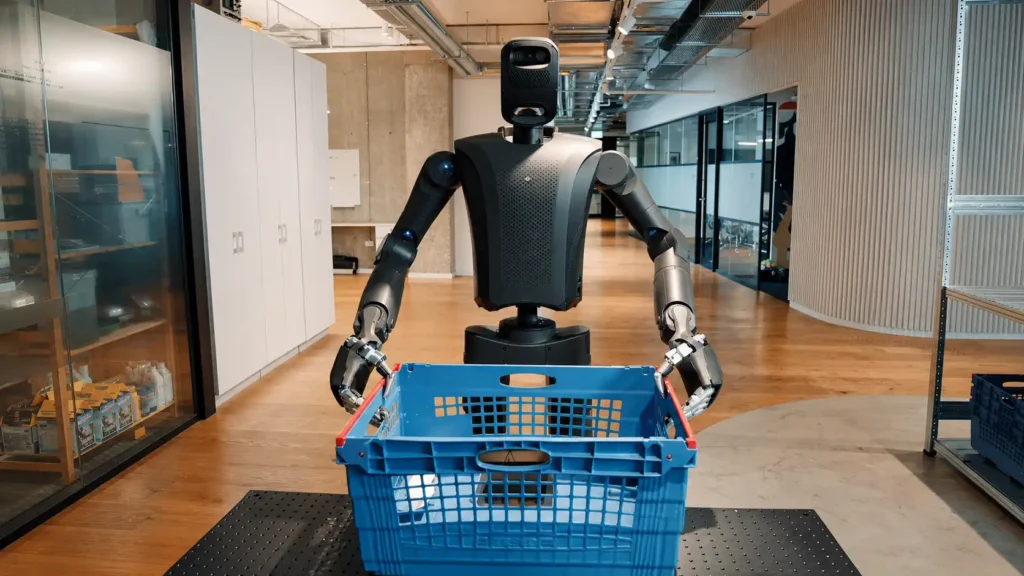
This article is an original analysis supported by the sources cited below
NVIDIA announces NVIDIA Isaac GR00T Reference Humanoid Robot for academic research
NVIDIA’s primary newsroom announcement for the Isaac GR00T Reference Humanoid Robot, including the body, hands, compute, software stack, research institutions and late-2026 availability wording.
Sharpa brings dexterous, tactile manipulation to the NVIDIA Isaac GR00T Reference Humanoid Robot
Sharpa’s announcement detailing the Wave tactile five-finger hands, 22 degrees of freedom per hand, tactile sensing claims and role in the NVIDIA reference design.
Unitree H2 Plus
Unitree’s H2 Plus product page with mechanical dimensions, body degrees of freedom, payload, battery, sensor, connectivity and Jetson Thor integration details.
NVIDIA Jetson Thor
NVIDIA’s Jetson Thor product page listing 2,070 FP4 TFLOPS, 128GB memory, power range and robotics workload positioning.
NVIDIA Isaac Sim
NVIDIA’s Isaac Sim developer page describing simulation, testing, synthetic data generation, Isaac Lab integration and robotics workflows.
NVIDIA Isaac ROS documentation
Documentation for NVIDIA-accelerated ROS 2 packages used in robotics deployment workflows on Jetson and other NVIDIA platforms.
NVIDIA Isaac GR00T N1.7 GitHub repository
NVIDIA’s public repository for GR00T N1.7, including model description, open VLA framing, fine-tuning, inference and deployment workflow notes.
NVIDIA Isaac GR00T N1.7 on Hugging Face
NVIDIA’s Hugging Face blog explaining GR00T N1.7, the VLA architecture, EgoScale training and fine-tuning workflow.
NVIDIA GR00T N1 2B model card
Hugging Face model card for NVIDIA’s GR00T N1 model, including description, intended use, architecture and references.
EgoScale
NVIDIA Research page describing the EgoScale human-to-robot learning framework, egocentric video scale and reported dexterous manipulation gains.
GR00T N1 arXiv paper
Research paper introducing GR00T N1 as an open foundation model for generalist humanoid robots and explaining its VLA architecture.
Isaac Lab arXiv paper
Research paper describing Isaac Lab as a GPU-accelerated simulation framework for multimodal robot learning, contact-rich manipulation and policy training.
NVIDIA announces Isaac GR00T N1
NVIDIA’s 2025 newsroom post announcing Isaac GR00T N1, simulation frameworks and the broader humanoid foundation model strategy.
Reuters reports NVIDIA plans work with more humanoid makers
Reuters coverage of NVIDIA’s Unitree collaboration, planned work with other regional humanoid makers and cybersecurity framing.
Reuters coverage of Project GR00T in 2024
Reuters report on NVIDIA’s original Project GR00T announcement and Jetson Thor positioning for humanoid robots.
International Federation of Robotics World Robotics 2025 report release
IFR press release with 2024 industrial robot installation and operational stock data used for automation market context.
European Commission AI Act overview
European Commission explanation of the AI Act’s risk-based framework and policy context for AI developers and deployers.
ISO robotics standards overview
ISO’s robotics standards page listing ISO 10218, ISO/TS 15066 and related robot safety standards.
A3 updated ISO 10218 FAQ
Association for Advancing Automation explainer on the 2025 ISO 10218 revisions and industrial robot safety context.
A3 ISO/TS 15066 safety standard explainer
A3 explainer on collaborative robot safety requirements, risk assessment and the role of ISO/TS 15066.
NIST AI Risk Management Framework
NIST’s AI RMF page describing a voluntary framework for managing AI risks to individuals, organizations and society.
ROS official site
Official Robot Operating System site describing ROS as open-source libraries and tools for building robot applications.
Cover image: Reprophoto YouTube, upscaled
| Citing this article? Brief excerpts are welcome. Please credit Webiano.digital, name the author where stated, and include a link to https://webiano.digital and to this original article. Full or substantial republication requires prior written permission. Read our Copyright and Content Use Policy. |
This article was prepared with the assistance of artificial intelligence tools. The content underwent expert human review, and Webiano Digital & Marketing Agency assumes editorial responsibility for its final version and publication.