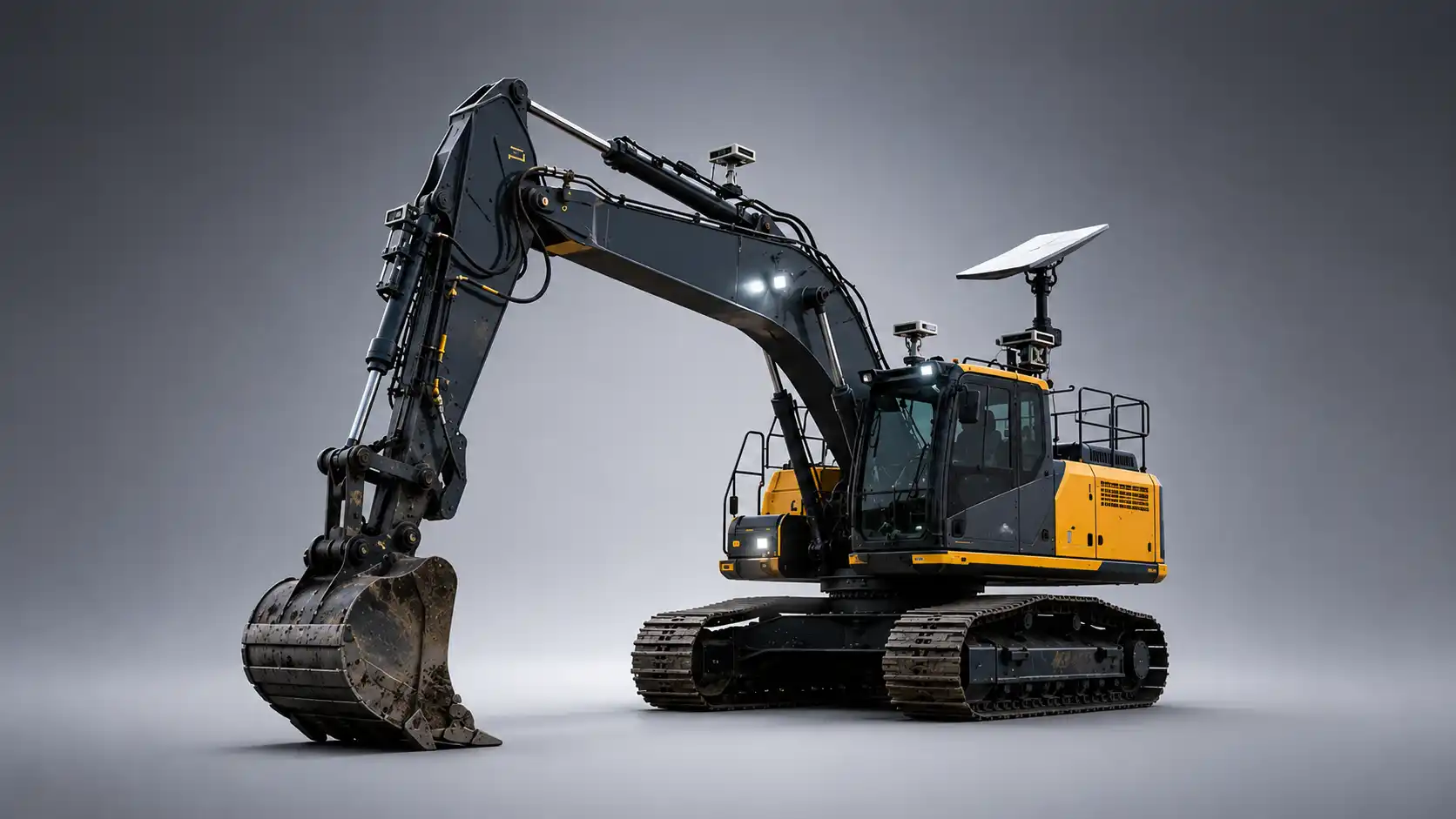
The reported U.S. excavator test matters because it changes the question around construction automation. The old question was whether a machine could be built to dig without a person in the cab. The sharper question is now whether one skilled operator’s working pattern can be captured, compressed into a robot policy, and copied across machines that already sit in contractor fleets. Actor’s public posts describe real jobsite data collection, a first real-world excavator policy, and earlier work connecting a Vision-Language-Action model to a mini excavator trained on roughly 200 real-world trajectories. A separate widely shared LinkedIn post says the newer policy was trained from 2.5 hours of skilled operator data, while an X post from Lane Burgett says Starlink was used for remote inference of the excavator robot model. Those claims are promising, but they remain public demonstration claims rather than peer-reviewed production data.
Table of Contents
The real shift is skill capture, not just a driverless excavator
Heavy equipment automation has been creeping into construction and mining for decades. Caterpillar autonomous mining trucks have run at vast scale. Built Robotics has promoted retrofit autonomy for trenching. Trimble and Komatsu have built digital machine-control systems that guide operators and connect the site to the office. The latest excavator story sits in that long path, but it points to a different operating model. The machine is not only following a pre-built design file or a fixed route. It is trying to learn the physical routine of digging from the way a skilled person actually moves the machine.
That distinction matters. A grade-control system helps an operator hit a target slope or elevation. A teleoperation system moves the operator away from the cab. An autonomous mining truck follows routes inside a tightly managed mine. A learned excavator policy aims at something harder and messier: using demonstrations to reproduce a task where the soil changes, the bucket bites differently every pass, the machine hydraulics lag, the site geometry is imperfect, and the work is judged by field results rather than a clean digital benchmark.
Actor’s own public material does not yet give a full technical report for the 2.5-hour claim. Its LinkedIn company page says the team is teaching heavy machines to do real tasks on real jobsites by learning from skilled operators across the U.S., starting with excavators. It also says Actor is collecting data from real machinery performing real jobs. Earlier posts describe a natural-language-controlled excavator using a π0.5 Vision-Language-Action model and a custom policy trained on about 200 trajectories of real-world data.
The public story therefore has two layers. The confirmed layer is that Actor has been demonstrating learned control of excavators and collecting field data from heavy machines. The reported layer is that one newer policy used only 2.5 hours of operator data and was run remotely through Starlink. The reported layer is valuable as a signal, but serious contractors will ask for cycle times, duty cycles, safety case documents, fault logs, site conditions, productivity comparisons, operator handoff rules, and insurance treatment before treating it as ready for normal work.
The deeper change is economic. Contractors do not lack machines in the abstract. They lack qualified people, jobsite certainty, and repeatable output under shifting conditions. A machine that learns from one operator would not remove the need for operators. It would change where the operator’s value sits. Instead of spending every hour in one cab, the best operator becomes a source of training data, a supervisor of exceptions, a reviewer of machine behavior, and a standard-setter for a fleet.
This is why the phrase “the model never forgets” resonates, even though it should not be taken literally. Machines do forget in their own way. They drift when environments change, fail when inputs move outside training range, and need maintenance, calibration, and monitoring. Still, a trained policy gives contractors a new asset class: operating skill as software. That asset can be copied, audited, improved, and deployed across multiple machines if the safety and reliability problems are solved.
A good excavator operator is not just pulling levers. The operator feels resistance through the hydraulics, reads the pile, anticipates how the bucket will fill, avoids overloading the swing, knows when the trench wall looks wrong, and coordinates with ground crews. A learned policy may capture visible motion and control sequences, but it does not automatically capture judgment. That gap is where the next phase of competition will sit.
The reported 2.5-hour claim should be read as a data-efficiency signal
The most eye-catching number is 2.5 hours. In robotics, that is not just a marketing line. It is a claim about data efficiency. If a robot needs months of curated demonstrations, the economics break for most contractors. If a robot can learn a narrow excavation task from a short recording session with a normal operator, the sales pitch changes. A contractor could imagine sending a data kit to a site, recording a trusted operator, and using the result to automate repeatable earthmoving work across similar machines.
The phrase “learned in 2.5 hours” needs careful handling. It does not mean the excavator learned every excavation task from scratch. It does not mean the system became a general construction worker. It does not mean the policy will perform safely in every soil, grade, lighting condition, weather condition, or site layout. It likely means the system used a small amount of task-specific demonstration data to tune or train a model for a constrained activity, probably supported by earlier model architecture work, prior robotics data, system engineering, and machine instrumentation.
That is still a serious signal. Data-hungry robotics has always struggled outside factories because the real world is expensive to label and repeat. A factory robot can run the same path millions of times. A jobsite changes under the bucket. The ground is both the workpiece and the disturbance. Soil clumps, collapses, saturates, freezes, slides, and hides objects. Every dig changes the next dig. The machine’s state is not just its joint angles. It includes the geometry of material that the machine itself is modifying.
A short training window would make deployment less like installing an industrial robot cell and more like onboarding a machine to a local task. The contractor does not want to hire a robotics engineer every time the site changes. The contractor wants a repeatable path from “watch my operator do this” to “let the machine repeat the safe parts while a human supervises.” That path is exactly where imitation learning and Vision-Language-Action models become commercially interesting.
Research has been moving in that direction. The ExACT paper from Baidu Research presented an end-to-end autonomous excavator system using Action Chunking with Transformers. It used raw LiDAR, camera data, and joint positions to output valve commands, and the authors described imitation learning from limited human demonstrations for tasks such as reaching, digging, dumping, and returning.
Physical Intelligence’s π0.5 work also matters because it describes co-training Vision-Language-Action models on heterogeneous data, including robot demonstrations, actions, images, text, and other multimodal annotations. The stated aim is to teach physical skills, semantic context, task structure, and transfer across robot embodiments.
An excavator is not a kitchen robot or a tabletop manipulation arm. It weighs tons, stores energy in hydraulics, and can kill people. Yet the model trend is similar: less hand-coded behavior, more learned action from mixed sensory and demonstration data. The 2.5-hour claim is therefore not a standalone miracle. It is a visible example of a broader technical race to reduce the amount of expensive, task-specific robot data needed before useful work begins.
The business meaning is sharper than the research meaning. If a contractor has to collect 500 hours of data for every task, adoption stays narrow. If a contractor collects a few hours of data from its own best operator and gets a useful supervised autonomy mode, adoption moves closer to normal fleet management. That is the threshold investors, OEMs, insurers, and large contractors are watching.
Starlink changes the deployment map, but not the safety case
Starlink is important in this story because construction and mining work often happen where wired broadband is poor, cellular coverage is patchy, or the site moves faster than fixed network installation. SpaceX says Starlink satellites orbit at about 550 km and that low Earth orbit gives the service much lower latency than geostationary satellite internet. Starlink’s legal specifications list typical land latency at 25 to 60 ms, with higher figures in some remote areas.
That latency range is good enough for many remote operations tasks. It is not a magic safety guarantee. A heavy machine should not depend on a single satellite link for collision avoidance, emergency stop behavior, people detection, geofence enforcement, or hydraulic safety. Network delays, packet loss, terminal obstruction, local Wi-Fi failure, software service interruptions, and power issues all belong in the hazard analysis. On a jobsite, a dropped connection must push the machine into a safe state, not into uncertainty.
The phrase “remotely controlled through Starlink” also deserves precision. Classic teleoperation means a human continuously drives the machine from a remote console. Remote inference means the model may run off-machine or be supervised through a remote connection, sending decisions, data, or control outputs over the network. Remote monitoring means the machine acts locally while humans watch status feeds. These are different architectures with different risks.
Lane Burgett’s X post, as indexed by search, says Starlink was used to remotely inference the excavator robot model trained with 2.5 hours of operator data. That wording suggests something more specific than simple joystick teleoperation. It points to a model-in-the-loop setup where connectivity supported computation or control outside the cab. Public posts do not yet show a full architecture. The responsible reading is that Starlink was part of the remote operations stack, not that satellite internet alone made the machine autonomous.
For contractors, satellite connectivity changes geography. A remote quarry, solar field, pipeline right-of-way, rural road project, disaster cleanup zone, or mine portal could support machine telemetry, video feeds, updates, remote supervision, and off-site specialists without waiting for fiber. That matters because skilled operators are not evenly distributed. A company might have three excellent operators and fifty machines across scattered sites. Better connectivity lets that expertise travel through software and supervision.
Connectivity also changes accountability. If the model runs in the cloud, who is responsible when the link degrades? If the operator supervises several machines from a control room, what workload limit is safe? If a machine records and uploads production data, who owns the data? If the system updates mid-project, who validates the changed behavior? The technical ability to connect a machine over satellite is only the beginning. The operating rules around it will decide whether contractors trust it.
The right analogy is not remote desktop for a laptop. It is aviation, rail, mining, and industrial control. Networked heavy equipment needs defined fallback states, local autonomy for safety functions, tamper-resistant logs, role-based access, verified software versions, and a human-machine interface that does not bury risk under a clean dashboard. Starlink may make connection possible in more places. It does not remove the need for conservative machine design.
Operator shortages make the timing politically and commercially charged
The construction labor story is not vague. The U.S. Bureau of Labor Statistics says construction equipment operators drive, maneuver, or control heavy machinery used to build roads, buildings, and other structures. It projects 4 percent employment growth from 2024 to 2034 and about 46,200 openings per year on average, much of it tied to replacement needs as workers change occupations or leave the labor force. BLS listed a May 2024 median annual wage of $58,320 for construction equipment operators.
Associated Builders and Contractors estimated in January 2026 that the construction industry needs to attract 349,000 net new workers in 2026 to meet demand, with the need rising to 456,000 in 2027 if spending growth resumes. ABC’s model ties construction spending to payroll employment and embeds job openings, unemployment, and retirements.
Those numbers explain why robotics companies are not pitching automation only as a futuristic upgrade. They are pitching it as a response to a practical scheduling problem. A contractor can own the excavator, win the bid, secure the material, and still lose time because the right operator is unavailable. Machines depreciate while they wait. Crews stand around. Weather windows close. Project managers reshuffle work. The shortage is not only a headcount issue; it is a planning risk.
The operator shortage also changes the ethics of automation. Replacing people is one story. Capturing scarce expertise and spreading it across more machines is another. If a 25-year veteran can train a model that handles routine trenching passes while the veteran supervises edge cases and mentors apprentices, the role becomes more technical and less physically punishing. If the same system is used to cut wages, deskill crews, and remove human authority from dangerous decisions, resistance will be justified.
The near-term labor effect will probably be uneven. Large contractors with repetitive work, controlled sites, strong digital teams, and high machine utilization will test first. Utility-scale solar trenching, quarry haulage, mining, landfill work, highway grading, and repetitive earthmoving fit better than dense urban excavation around utilities and pedestrians. Small contractors may adopt through rentals, dealer packages, or retrofit services once the support model is clear.
The biggest commercial pressure may come from projects that already struggle to staff remote sites. A contractor building in a rural corridor may have no shortage of machines but a shortage of workers willing to commute, live on site, or work harsh schedules. Remote operation and learned autonomy are attractive there. The machine does not need housing. The operator can supervise from a safer, more stable workplace.
The political pressure will be harder. Construction is a large employer and a visible path into the middle class for people without a four-year degree. Any AI system that touches heavy equipment will be judged not only by productivity but by whether it keeps skilled work viable. The winning vendors will speak to that directly: not “no operators,” but fewer empty seats, fewer dangerous exposures, more consistent output, and better use of the operators already trusted by contractors.
The machine is learning choreography, not magic
Excavation looks simple from outside the cab. The boom rises, the stick extends, the bucket curls, dirt moves. In reality, the operator is coordinating linked hydraulic systems with delay, load variation, changing geometry, and limited visibility. The bucket is not a hand. It is a steel edge pushing into an uncertain material. Every control input affects balance, pressure, fuel use, cycle time, wear, and the shape of the next cut.
A learned policy must solve at least four problems at once. It needs to perceive the current scene. It needs to estimate machine state. It needs to choose actions that move material toward the target. It needs to stay inside safety and mechanical limits. A human blends these tasks through habit. A model must represent enough of that habit in a form that works beyond the original demonstration.
Imitation learning is attractive because it starts with human examples. Instead of hand-designing every bucket trajectory, engineers record what a skilled operator does, then train a model to map sensory inputs to actions. This works best when the task is clear and the variation is bounded. It struggles when rare events matter. A person steps behind the machine. A buried pipe appears. The soil gives way. A rock jams the bucket. A truck parks slightly outside the expected zone. The model may have seen none of these in the 2.5-hour window.
Action Chunking with Transformers, used in ExACT, points to one way robotics researchers handle control over time. Rather than predicting one tiny action at a time, the model predicts chunks of actions, then uses temporal smoothing to reduce unstable behavior. For hydraulic machines, smoothness is not cosmetic. Jerky motion wastes fuel, wears parts, makes the bucket less precise, and creates safety risks.
Vision-Language-Action models add another layer. A VLA model links visual perception, language understanding, and action output. On a machine, that could support commands such as “dig this trench to this line,” “clear this pile,” or “load from this cut to that truck,” but the language layer must never outrun the safety layer. A natural-language command is easy to misunderstand. Jobsite language is full of shorthand, slang, and assumptions. A safe system needs a constrained command grammar, confirmation, geofenced work zones, and validation against plans.
The value of operator data is that it contains many small adaptations that are hard to write down. An experienced operator does not always dig the mathematically shortest path. The operator may feather the controls because the ground feels hard, rotate slightly to avoid spillage, adjust bucket angle because material is wet, or reduce force because the trench wall is suspect. A model trained on demonstrations may capture some of those patterns without being told their names.
Yet learning choreography is not the same as learning responsibility. A machine may reproduce the motion of digging while lacking the situational judgment of excavation work. That judgment is tied to site meetings, utility locates, markings, crew signals, soil classification, weather, shoring, traffic control, and production pressure. Any serious deployment must connect the robot policy to the job’s safety process, not treat it as a separate gadget.
A compact view of what is known and what remains unproven
Confirmed signals and open questions
| Item | Public signal | Open question for deployment |
|---|---|---|
| Actor excavator policy | Actor says it released a first real-world viable excavator policy and is learning from skilled operators | Production reliability across weather, soil, machine types, and longer shifts |
| 2.5-hour training claim | A widely shared LinkedIn post reports training from 2.5 hours of skilled operator data | Whether the result generalizes beyond the shown task and site |
| Starlink role | Indexed X post says Starlink was used for remote inference of the model | Exact architecture, fallback behavior, latency tolerance, and safety case |
| Prior VLA demo | Actor-linked posts describe π0.5 on a mini excavator and about 200 real-world trajectories | Whether language control is constrained enough for hazardous work |
| Market need | BLS and ABC show ongoing operator and construction labor pressure | Whether automation raises operator productivity or mainly shifts bargaining power |
This table separates public evidence from commercial readiness. The demo is newsworthy because it points to a new deployment model, but contractors will need field evidence, not viral clips, before they trust learned autonomy around people, utilities, deadlines, and insurance exposure.
The difference between autonomy, teleoperation and machine control will decide adoption
Construction technology discussions often blur three categories that must stay separate. Machine control gives an operator guidance or automatic assistance against a digital design. Teleoperation moves the human away from the machine but keeps the human in continuous control. Autonomy lets the machine execute a defined task without direct moment-by-moment control. The Actor-Starlink story touches all three, but its commercial meaning depends on which architecture wins.
Machine control is already familiar. Trimble Earthworks, for example, gives operators live design data, cut-and-fill indicators, avoidance zones, and bucket or blade guidance. Trimble describes its systems as tools for reducing rework and helping operators of any skill level dig, grade, compact, and load with more accuracy.
Teleoperation has a different value. It reduces exposure. A person can operate from a control room rather than a dusty pit, unstable slope, hazardous cleanup zone, or blast area. It also allows scarce operators to serve remote sites without travel. But teleoperation does not remove the human bottleneck. One machine still needs a person driving, except during pauses or assisted modes.
Autonomy changes utilization. If the machine can run repetitive passes under supervision, one operator may oversee more work. The machine may work during breaks, perform night shifts under controlled conditions, or handle monotonous production tasks while humans deal with setup, layout, exceptions, and quality control. That is the model mining has pursued for haulage, where routes are controlled and traffic rules are strict.
Learned excavation blurs the boundary. A model trained from operator demonstrations may perform a limited task autonomously, while a remote human monitors and intervenes. Starlink may support off-site supervision or inference. Machine control may provide the digital target. Local sensors may enforce safety. This layered architecture is likely more realistic than a fully independent “AI excavator” roaming a site.
The legal and safety vocabulary also separates the categories. ISO 17757 covers autonomous and semi-autonomous earth-moving and mining machine system safety, including machines, systems, infrastructure, hardware, and software across defined functional environments. The ISO page also notes that ISO 17757 is not applicable to remote control capability, which is covered by ISO 15817.
That sentence is not a footnote. It means vendors cannot casually call a remote-control product autonomous or treat autonomous safety as the same thing as teleoperation safety. Each mode needs its own safety case. A remote operator’s console, camera latency, emergency stop circuit, access control, work-zone boundary, and fail-safe state differ from the hazards of a machine acting on a learned policy.
For contractors, the cleanest buying decision will be task-based. Do not ask whether the excavator is “AI.” Ask what task it is allowed to perform, in what environment, with what sensors, under what human supervision, at what stop distance, with what fallback, and with what record of performance. The label matters less than the operating envelope.
A jobsite is harder than a mine and less forgiving than a lab
Mining autonomy succeeded first because mines can be managed like industrial systems. Routes are mapped. Traffic is controlled. Access is restricted. The same haul roads, dump points, and loading zones are used repeatedly. Machines are large and expensive, so high utilization justifies major system integration. The environment is still harsh, but it is easier to structure than an urban construction site with pedestrians, utilities, subcontractors, deliveries, inspectors, and shifting work zones.
Caterpillar’s scale shows what happens when autonomy has the right environment. Caterpillar says its autonomous trucks on three continents had traveled more than 325 million kilometers and moved more than 8.62 billion tonnes by late 2024. Another Caterpillar page says Command for hauling enables autonomous truck operation, interaction with other equipment, and integration with customer mining processes.
Construction is more fragmented. Every site is temporary. Plans change. Subcontractors overlap. The ground contains unknowns. Equipment is bought, rented, borrowed, modified, maintained unevenly, and moved between jobs. A contractor may use different brands, attachments, buckets, couplers, control patterns, and aftermarket systems. A learned policy that works on one excavator might need calibration, sensor alignment, hydraulic mapping, and validation on another.
The Actor story is compelling because it claims to reduce that friction. If a policy can learn from an operator on a real machine in a short window, it might avoid the brittle setup that has slowed earlier autonomy. But a short demo cannot prove fleet-level reliability. The hardest failures are not the normal cycle. They are the rare cases that appear once every few thousand passes and carry large consequences.
A real jobsite also has social complexity. A foreman may give an instruction that conflicts with the plan. A laborer may walk into a zone because the old workflow allowed it. A delivery truck may block the planned swing path. Rain may turn stable ground into a hazard. A utility mark may be wrong. A machine may need to stop not because the model is unsure about digging, but because the site has changed legally and practically.
This is where automation often disappoints non-technical buyers. A demo shows the core task. The deployment requires everything around the core task: training, signage, access control, maintenance, connectivity, cybersecurity, insurance, incident investigation, contract language, union or workforce policy, and project-specific approval. None of that is glamorous. All of it decides whether the machine works Monday morning.
The most realistic near-term deployments will pick simple environments. Flat, fenced, repetitive, low-pedestrian sites are better. Solar farms are attractive because trenching for underground cables repeats across long runs. Quarries and mines are attractive because access can be controlled. Hazardous cleanup and disaster response may be attractive because removing the operator from the cab has clear safety value, even if productivity is secondary.
Dense utility excavation in a city is the opposite. That work involves buried gas, water, telecom, electric lines, traffic, pedestrians, inspectors, and emergency consequences. There may be value in remote operation or assisted digging, but fully learned autonomy will face a much higher bar.
Safety cannot be an afterthought because excavation is already deadly
Excavation hazards are not theoretical. CDC/NIOSH warns that trench walls can collapse suddenly and that one square yard of dirt can weigh more than 3,000 pounds, enough to fatally crush or suffocate workers. NIOSH says 373 trenching deaths occurred from 2003 to 2017, with more than 80 percent in construction. OSHA said 39 people died doing trench or excavation work in the U.S. in 2022 and cited 166 trench cave-in deaths from 2011 to 2018.
Those figures explain why autonomy has a safety argument. Taking a worker out of the cab during hazardous digging, unstable slope work, demolition cleanup, mining, or contaminated material handling can reduce exposure. Remote control and supervised autonomy can also keep people away from falling loads, rollover risk, dust, vibration, noise, and collision zones.
But automation can create new hazards while reducing old ones. A human operator in the cab sees and hears things that may not appear in a camera feed. A ground worker may trust a silent autonomous machine too much or misunderstand its planned motion. A remote supervisor may miss peripheral cues. A model may behave smoothly until it hits a rare condition, then choose the wrong action with mechanical confidence. A software update may change behavior in ways the crew has not practiced.
OSHA’s excavation standards under 29 CFR 1926 Subpart P cover open excavations and trenches, including requirements around soil, protective systems, inspections, and site conditions. OSHA 1926.651 requires, among other provisions, safe egress in trench excavations 4 feet or deeper so workers do not have to travel more than 25 feet laterally to reach it.
A robot excavator does not remove those obligations. It may change who enters the trench and when, but it does not change the physics of cave-ins, falling loads, hazardous atmospheres, or mobile equipment hazards. In some cases, automation could allow fewer people to stand near open trenches. In other cases, it could tempt crews to treat the machine as separate from the excavation safety plan. That would be dangerous.
The safety case should be layered. The machine needs local emergency stop behavior that does not rely on the network. It needs person detection, exclusion zones, speed limits, hydraulic limits, geofencing, and clear indicators of autonomous mode. The site needs training so every worker knows what the machine can do, what it cannot do, what lights or alarms mean, where not to stand, and how to stop the operation.
Logs matter too. After a near miss, a contractor must know what the model saw, what command was issued, who was supervising, what connection state existed, what software version ran, and whether any safety boundary was crossed. Without that evidence, trust collapses. Insurers and regulators will not accept a black-box explanation after an incident involving heavy machinery.
The safest path is not full autonomy first. It is bounded autonomy for narrow tasks, with conservative stop behavior and human authority. The machine should earn trust through boring performance: repeated safe cycles, clear handoffs, predictable motion, and transparent records.
The business case depends on utilization, not novelty
Contractors do not buy technology because a demo looks impressive. They buy when the economics survive rain, maintenance, breakdowns, training, insurance, and jobsite chaos. For AI heavy equipment, the business case starts with utilization. A $200,000 to $500,000 machine that sits idle because no operator is available is an expensive problem. A system that increases the hours a machine can work, or lets one senior operator supervise more output, has a clearer path to return.
The highest-value work is often repetitive and schedule-sensitive. Trenching for solar farms, mass grading, stockpile movement, quarry loading, tailings work, landfill cover, and some pipeline or road-building tasks fit that pattern. The value is not that AI “replaces digging.” The value is that it reduces waiting time, variance, and fatigue in work that must be done thousands of times.
A learned policy trained from a contractor’s own operator also has a cultural advantage. Many operators distrust systems that feel imposed by software teams. If the model is trained from the company’s best operator, it may be seen as a way to preserve local practice rather than erase it. The phrase “our machine learned from Mike” lands differently from “the vendor uploaded a generic model.” That emotional detail matters in adoption.
The cost side is still unclear. A retrofit autonomy kit includes sensors, compute, installation, calibration, software subscription, support, connectivity, insurance adjustments, and downtime during setup. The contractor also pays for process change: site training, safety review, operator supervision, data governance, and maintenance routines. A small contractor will not absorb that unless the pricing is bundled through rental houses, dealers, or task-specific service contracts.
This is why Built Robotics narrowed around specific applications such as autonomous trenching for utility solar. Its Exosystem is described as an aftermarket upgrade for modern excavators, and the trenching page lists production rates and digging accuracy for that use case. Built’s technology page says the Exosystem includes an all-weather enclosure, 360-degree smart cameras, GPS, and a liquid-cooled computer, with cloud-based command software.
The Actor approach, if it proves reliable, could widen the set of tasks because it starts from operator demonstrations rather than a fully pre-coded workflow. Still, the first revenue will likely come from narrow packages. Contractors prefer buying “dig this kind of trench safely at this production rate” over buying “AI for excavators.” A task-specific product is easier to price, insure, train, and compare against current crews.
Fleet owners will also care about machine neutrality. Construction fleets are mixed. A contractor may own Caterpillar, Deere, Komatsu, Hitachi, Volvo, Bobcat, Takeuchi, and rented machines in the same year. A model that depends on one OEM’s deep integration may be reliable but narrower. A retrofit that works across brands may be attractive but harder to validate. The market may split between OEM-integrated autonomy for new machines and retrofit learning systems for existing fleets.
The strongest long-term business case is not one robot replacing one operator. It is a site where machines, plans, survey data, production logs, and operators become connected. The excavator digs against a digital work package. The operator trains and supervises. The project manager sees progress. The safety manager sees alerts. The mechanic sees fault trends. The insurer sees controlled procedures. That is when AI becomes part of construction operations, not a side experiment.
Heavy equipment autonomy has been real for years, but unevenly distributed
People who follow mining will not be shocked by driverless heavy machines. Caterpillar, Komatsu, and others have spent years building autonomous haulage. The difference is that mining is capital-intensive and controlled. Construction is fragmented and mobile. The news value of an AI excavator trained from operator data is that it brings autonomy closer to the contractor’s messy world.
Caterpillar’s official materials show the mature end of the spectrum. Its Command for hauling system integrates autonomous trucks with mine processes and other equipment. Caterpillar has cited major gains in utilization and safety-linked metrics for autonomous haulage.
Komatsu’s Smart Construction page describes a suite of products and digital services for interconnection across the construction process, including design, drone, edge, dashboard, training, support, and production studies. The theme is not one robot. It is the digitization of work planning and execution.
Trimble Earthworks sits closer to daily civil construction. It gives operators guidance and automation features across excavators, dozers, graders, compactors, and loaders. It is not the same as a learned autonomous policy, but it has trained the market to accept screens, sensors, digital design files, and machine-assisted precision.
Built Robotics represents the retrofit autonomy path. Rather than waiting for a fully autonomous OEM excavator, it installs autonomy hardware and software onto existing machines for defined tasks. This path speaks directly to contractors with fleets already on the balance sheet.
Actor’s reported model points to a fourth layer: learned behavior from field operators. It may sit on top of machine control, beside teleoperation, or inside a retrofit kit. It may also be licensed to OEMs if the model proves transferable. The value is not simply “driverless.” It is turning the operator’s repeated know-how into a trainable control policy.
These paths will not merge overnight. OEMs worry about safety, warranty, liability, and dealer support. Startups move faster but face trust barriers. Contractors want results but fear downtime. Insurers want evidence. Regulators prefer clear responsibility. Unions and workers want a say in job design. The technology may improve faster than the operating system around it.
This uneven distribution is normal. Industrial automation usually starts where the environment is controlled and the payoff is high. Then it moves into less controlled work through narrow use cases, guarded modes, human supervision, and better standards. Excavators will follow that path. The question is whether imitation learning shortens the gap between demo and deployment.
The operator becomes more valuable, not less, if the system is designed well
The most damaging version of the story is “AI replaces the excavator operator.” It is too simple and probably wrong for the next phase. The better version is that the operator becomes the trainer, supervisor, exception handler, and quality authority for machine work. That change may reduce cab hours, but it raises the value of judgment.
A skilled operator knows which parts of a task are routine and which parts are risky. That knowledge is exactly what an autonomy vendor needs. The operator can show the machine how the task is done, identify failure cases, flag unacceptable motion, and test the system under real conditions. The operator can also decide when the machine should not run: bad weather, poor visibility, uncertain utility markings, unstable soil, crowded work zones, or unfamiliar attachments.
This creates a new career path. The senior operator may become a remote operations lead. The apprentice may learn in a simulator and then supervise low-risk autonomous cycles before moving to manual controls. The mechanic may need more sensor and software skills. The foreman may schedule work around machine autonomy windows. The safety manager may become a reviewer of autonomy logs.
There is also a risk of false deskilling. A contractor may assume the model reduces the need for human skill, then staff the site with fewer experienced people. That is the wrong lesson. Learned autonomy depends on skilled humans because the model’s limits are tied to the quality and range of demonstrations, the design of the work zone, and the handling of exceptions. Removing skill from the site too early increases risk.
The best deployments will treat operators as subject-matter experts. Their demonstrations should be compensated. Their feedback should shape model acceptance. Their names and methods should not be extracted without recognition. If a company uses an operator’s skill to train a fleet, the company should have a policy for credit, pay, and authority. Otherwise, the technology will be seen as appropriation.
The human-machine interface will decide much of this. If the remote supervisor sees a vague confidence score and a video feed, the role is weak. If the supervisor sees task plan, machine state, predicted path, safety zones, recent anomalies, stop reasons, and replayable logs, the role becomes real. Human authority must be designed into the workflow, not bolted on for optics.
Training will need to change too. Operators are often trained through hands-on practice, apprenticeships, and union or employer programs. AI-heavy equipment adds digital literacy, remote supervision, sensor cleaning, fault recognition, data collection discipline, and software version awareness. None of that replaces machine feel. It adds a second layer of skill.
Learned autonomy will expose the hidden craft of excavation
A good demonstration policy forces the industry to admit something it often underprices: operating an excavator well is craft. The operator is not a joystick accessory. The operator is solving a physical control problem under pressure. The shortage of operators exists partly because that craft takes time to build, and because many companies have not invested enough in career pathways.
AI makes this visible because the machine needs examples. When a model cannot dig well without human demonstration, the value of the human becomes measurable. The operator’s movements become data. The data becomes a policy. The policy becomes production. This chain is new for many contractors, but the underlying truth is old: skilled operators carry institutional knowledge.
The model may also reveal differences between operators. One person may dig faster but create rougher surfaces. Another may reduce wear. Another may spill less material. Another may avoid risky edges instinctively. Recording machine state, control inputs, fuel use, cycle time, bucket fill, and final grade could turn these differences into training signals. That raises quality, but also raises privacy and labor questions.
A contractor could use the data to build better training programs. New operators could compare their motion to a master operator’s recorded task. Supervisors could spot inefficient habits without standing beside the machine. Safety teams could show exactly why a certain swing path is dangerous. That is a constructive use.
A contractor could also use the data punitively. Every hesitation, cycle time, and motion could become a score. Operators may resist being measured by systems that ignore site complexity. A slow pass may be safer because the operator noticed a ground worker or suspected a buried obstruction. Data without context will create bad incentives.
The best use of operator data is collaborative. The operator explains why a motion was chosen. The model learns the repeatable part. The safety team marks forbidden behavior. The production team sets realistic targets. The result is a standard that reflects field wisdom rather than abstract software assumptions.
This also changes vendor competition. A vendor with better data collection and operator feedback loops may beat a vendor with a larger generic model. Heavy equipment is not only a machine-learning benchmark. It is a trust business. The company that treats operators as partners will collect better data and face less resistance.
The role of Vision-Language-Action models is powerful but easily overstated
Vision-Language-Action models sound almost too convenient for construction. They promise a bridge from perception and language to physical control. The operator or foreman gives a command. The machine sees the scene. The model acts. That is the simple story. The actual deployment story is more disciplined.
Physical Intelligence describes π0.5 as a VLA model built through co-training on many data sources. It says such training can teach physical skills, semantic context, high-level task structure, and transfer of physical behaviors from other robots. The model can be trained on combinations of actions, images, text, and annotations.
This direction is relevant to excavators because jobsites are semantically rich. A pile, trench, spoil area, truck bed, utility mark, exclusion zone, slope stake, and access road all carry meaning. Pure geometry is not enough. A system needs to know what objects and zones mean for the task. Language helps connect the digital plan, the human instruction, and the robot behavior.
Yet language is risky in hazardous work. “Clean that up,” “take a little more off,” “dig to the line,” or “make it match the other side” may be clear to a human who shares context. A model may misread the reference. Construction commands often rely on pointing, shared memory, drawings, stakes, and crew convention. A safe VLA system should translate language into a constrained task plan, then require confirmation before movement.
The word “generalist” also needs restraint. A VLA model may generalize better than a narrow controller, but a real excavator still has hardware-specific dynamics. A mini excavator differs from a 30-ton machine. Hydraulic response differs by brand, age, temperature, load, maintenance state, and attachment. Soil interaction is not a clean object manipulation problem. The model’s semantic understanding cannot repeal hydraulic physics.
The useful near-term role for VLA is not free-form autonomy. It is task setup, scene interpretation, operator assistance, and policy selection. A foreman might select a trenching task through language, the system maps it to a digital plan, and the machine executes a bounded policy with local safety checks. That is more believable than a machine taking open-ended construction instructions.
There is still a major advantage. Traditional machine automation often requires specialized programming. VLA-style systems could reduce the interface burden. A contractor should not need a roboticist to define every work package. If natural language and visual grounding make setup easier while keeping safety constraints hard, they will matter.
The danger is demo inflation. A natural-language excavator clip may make viewers think the machine “understands construction.” It probably understands a narrow task representation well enough to move. That is valuable. It is not a substitute for engineering controls, competent supervision, or jobsite planning.
Remote inference raises hard questions about architecture
Remote inference sounds technical, but the concept is simple. The machine collects sensor data. A model somewhere else processes it. The system returns actions, decisions, or guidance. Starlink or another network carries the traffic. This architecture may reduce onboard compute needs, allow faster model updates, and let engineers monitor behavior closely. It also adds dependency on communication.
For a heavy machine, architecture is safety. If the model runs off-machine and the link degrades, what happens inside 100 milliseconds, one second, five seconds, and thirty seconds? Does the machine finish a motion? Freeze hydraulics? Lower the bucket? Stop the engine? Alert the site? Does the fallback depend on the task? Who has override authority? The answers must be designed before deployment, not after a failure.
A safer architecture keeps critical safety functions local. Person detection, geofence enforcement, emergency stop, speed limits, hydraulic cutoffs, and fail-safe state changes should not depend on a cloud round trip. Remote inference may support high-level decisions, but the machine must protect people and itself when the network disappears.
Starlink’s typical land latency range may be suitable for supervision and some control tasks, but latency is not the only variable. Jitter matters. Packet loss matters. Obstruction matters. A terminal on a moving or vibrating machine may behave differently than a fixed terminal with open sky. Dust, trees, buildings, slopes, and equipment booms may block views. The network may be good enough most of the time, but safety must handle the rest.
There is also a cybersecurity layer. A connected excavator is an industrial control system with physical force. It needs authentication, encryption, access control, logging, update management, and protection against unauthorized commands. A stolen password should not move a bucket. A compromised laptop should not enter the command path. A fake GPS signal should not silently shift the work zone.
The construction industry has lived with telematics for years, but telematics usually reports status. Autonomous control closes the loop. That is a different risk category. The AEM page for ISO/TS 15143-3 describes a communication schema for mobile machinery status data from telematics provider servers to customer applications. That type of standard supports fleet data exchange, but control safety needs more than status reporting.
Contractors should ask vendors for architecture diagrams in plain English. Where does perception run? Where does planning run? Where does control run? What happens if each component fails? What data leaves the site? Who can access it? How are updates approved? How are incidents reconstructed? A vendor unable to answer these questions is not ready for hazardous work.
Regulation will likely arrive through safety duties before AI-specific law
There may not be a single “AI excavator law” in the near term. Instead, existing safety duties, equipment standards, contract requirements, insurance underwriting, and procurement rules will shape adoption. OSHA will care about worker safety. Employers will remain responsible for training and hazard control. Standards bodies will guide autonomous machine systems. Insurers will demand procedures and evidence. Large project owners may write their own requirements.
ISO 17757 is one of the clearest starting points because it directly addresses autonomous and semi-autonomous earth-moving and mining machine system safety. It covers defined functional environments, hardware, software, system infrastructure, and life-cycle guidance. It also distinguishes autonomous systems from remote-control capability.
NIST’s AI Risk Management Framework is broader, but it gives a useful governance vocabulary for AI risks affecting individuals, organizations, and society. NIST describes the framework as a way to better manage risks associated with AI.
For construction, the practical regulatory question is traceability. If a machine causes harm, investigators will ask who planned the task, who set the work zone, who approved autonomous mode, what the operator or supervisor saw, what the machine detected, what the model commanded, what safety systems did, and whether the employer followed required procedures. A vague claim that “AI made the decision” will not satisfy anyone.
Procurement may move faster than legislation. A utility, mining company, solar developer, government agency, or data center owner may require autonomous equipment vendors to meet specific safety, cybersecurity, logging, and worker-training rules before entering a site. Large owners often create de facto standards because contractors want the work.
Insurance may become the harder gate. Underwriters will want to know whether autonomy reduces risk or adds unknown exposure. A strong vendor will bring test data, safety certifications, incident logs, operator training materials, maintenance procedures, and clear contractual responsibility. A weak vendor will bring a demo video and claims about AI. The difference will show in premiums or exclusions.
Labor agreements may also matter. If a union or workforce group sees autonomy as a way to remove operators without negotiation, deployment may stall. If the technology is framed as remote operations, safer work, training, and skill extension, it may be easier to integrate. The law may set the floor, but workplace legitimacy sets the pace.
A useful regulatory principle is simple: the machine’s autonomy should be bounded by a documented operating envelope that a site supervisor, operator, inspector, and insurer can understand. If the system cannot explain where it is allowed to work and when it must stop, it should not be used around people.
The fleet model is the real commercial prize
The user’s original point is the center of the story: before, a contractor needed to find people who knew how to operate the equipment. Now, in principle, the contractor can record one operator’s skill and spread it across a machine park. That is the fleet model, and it is far more important than a single excavator.
Construction fleets are underused in complex ways. A machine may be available but lack an operator. An operator may be available but assigned to the wrong site. A job may need a specific attachment. A machine may wait for survey layout. A night shift may be impossible because supervision is scarce. If learned autonomy reduces any of those bottlenecks, it changes fleet planning.
The fleet model works only if policies transfer. A policy trained on one machine must work on another machine of the same type, or be adapted quickly. It must understand differences in hydraulic response, bucket geometry, weight, wear, sensor placement, and attachment. It must also adapt to different sites without needing a full robotics team every time.
This is where data collection becomes strategy. Actor’s public posts emphasize data from real machinery and skilled operators across the U.S. That suggests the company is trying to build a data moat around real jobsite behavior rather than only lab demonstrations.
The fleet owner will want model governance. Which operator’s data trained this policy? Which tasks is it approved for? Which machines has it passed validation on? Which versions are active? Which sites produced anomalies? Which policy performs best in wet clay, sand, gravel, or rocky soil? This starts to look less like buying equipment and more like managing a software fleet.
There is a strong analogy with driver assistance in trucking or aviation, but construction has more variability. A fleet policy cannot assume lane markings, road signs, or mapped intersections. It needs site-specific context. The work package may become the unit of autonomy: a digital trench, a defined pile, a loading pattern, a graded surface, a haul route. The model operates inside that package.
The economic upside is not only fewer operators per machine. It is better standardization. A contractor with ten crews may see ten different digging styles. Some are fast but rough. Some are careful but slow. Some cause more wear. If the best repeatable practice can be codified, the company can reduce rework and variance. That matters in bids where margins are tight.
The risk is overcentralization. If one flawed policy is deployed across a fleet, the same mistake can repeat quickly. Human variation sometimes limits systemic failure because different operators make different choices. Fleet autonomy needs staged rollouts, monitoring, rollback, and site-specific approval. Copying skill across machines is powerful. Copying errors across machines is dangerous.
Data ownership will become a contract fight
The moment operator skill becomes data, ownership becomes contested. A contractor owns the machine and the project. The operator performs the work. The vendor collects sensor streams, control inputs, video, task labels, and outcomes. The project owner may own site data. The general contractor may control records. The insurer may request logs. The regulator may demand evidence after an incident. These interests collide.
A data collector on a machine may record more than bucket motion. It may capture site layout, production rates, worker behavior, delivery timing, material volumes, subcontractor performance, utility locations, and safety incidents. That information has commercial value. It may also contain sensitive project details. Vendors will need transparent terms, not buried clauses.
Operators should care because their skill is part of the dataset. If a company records a master operator and uses that data to train machines across the country, the operator has contributed something beyond normal hourly work. The law may treat it as employer-owned data, but workplace trust may require more. Bonus structures, recognition, and clear limits on surveillance could reduce conflict.
Contractors should care because production data reveals competitiveness. A vendor that aggregates anonymous data may improve models, but it might also learn which contractors perform well, which sites are slow, and which methods reduce cost. Large contractors will want control over data sharing, model training rights, and competitive use.
Project owners should care because site data may include security and infrastructure information. Utilities, energy projects, ports, data centers, mines, and public infrastructure work often involve sensitive layouts. A Starlink-connected machine sending data to a remote model raises questions about storage, jurisdiction, access, retention, and incident response.
A workable contract should define at least five things: raw data ownership, model-training rights, access to logs, retention period, and use of aggregated performance data. It should also define how worker privacy is protected and how safety-critical logs are preserved after a near miss or incident.
The vendors that handle this well will gain trust. The ones that treat data as automatically theirs will face pushback from contractors, unions, owners, and insurers. Heavy equipment autonomy is not only a robotics product. It is a data relationship with physical consequences.
Insurance and liability will separate demos from real products
A demo can run on private land with a controlled crew and a friendly camera angle. A product must survive liability. If an autonomous excavator damages a water main, hits a worker, undermines a trench, strikes a gas line, tips on unstable ground, or destroys a buried cable, everyone will ask who is responsible.
The contractor controls the site. The vendor supplies the system. The operator or supervisor approves the task. The owner may set schedule pressure. The machine OEM may have warranty limits. The dealer may have installed hardware. The connectivity provider may have had an outage. The model may have issued the motion. Liability will not be simple.
This complexity does not make adoption impossible. Mining autonomy already operates under contracts, procedures, and safety cases. But construction needs similar discipline at a smaller and more fragmented scale. A startup selling to contractors must make the liability chain legible.
Insurance products may evolve around supervised autonomy. Underwriters may price based on task type, site controls, worker exclusion zones, operator training, vendor certification, incident history, and autonomy hours. A machine used for fenced solar trenching may be priced differently from one used near public traffic or utilities.
Logs will matter again. A contractor with clean logs can show that the machine was inside its approved zone, the operator followed procedure, the network state was normal, the emergency stop worked, or the incident was caused by an external factor. Without logs, everyone argues from memory.
There may also be warranty disputes. Heavy equipment hydraulics, frames, pins, bushings, buckets, tracks, and engines are designed for hard use, but automated operation may change wear patterns. A model may dig consistently in a way that increases stress. OEMs will want to know whether aftermarket autonomy affects warranty coverage. Contractors will want written answers before installation.
Liability will push the market toward certified packages and dealer-supported deployments. A contractor may prefer a slower, more expensive system from a trusted OEM or authorized dealer over a cheaper retrofit with unclear responsibility. Startups can still win, but they need partnerships and documentation.
The credible vendors will not sell autonomy as risk-free. They will say exactly which risks are reduced, which risks are added, and how each is controlled. That honesty will sound less exciting than a viral post. It will sell better to serious buyers.
The productivity promise must be measured pass by pass
Productivity in earthmoving is deceptively hard to measure. A fast cycle that spills material, misses grade, overcuts, damages the machine, or creates rework is not productive. A slower cycle that hits grade, protects utilities, reduces fuel, and avoids callbacks may be better. AI excavation must be judged by the whole job, not by a short clip.
Metrics should include cycle time, bucket fill, fuel burn, idle time, grade accuracy, rework, machine wear, stop events, human interventions, near misses, and weather or soil conditions. For trenching, depth, width, line accuracy, spoil placement, wall condition, and downstream crew productivity matter. For loading, truck spotting, fill consistency, spillage, swing path, and queue time matter.
Caterpillar’s mining autonomy materials use industrial-scale measures such as tonnes moved, kilometers traveled, utilization, and lost-time injury records. Those measures make sense in mining because the work is repetitive and quantifiable. Construction needs its own task metrics.
A learned excavator policy trained from 2.5 hours of data should be tested against a human baseline. The comparison should not be a single pass. It should cover many cycles, multiple soil conditions, different times of day, changing pile geometry, and normal interruptions. The test should report when the machine stopped or required intervention. Stop events are not failures if they are safe and expected. They are part of the productivity model.
Contractors also care about crew productivity. If the autonomous excavator digs well but forces ground crews to wait, reset, or work around awkward spoil piles, the gain may disappear. The machine’s task must fit the workflow. Earthmoving is connected to layout, pipe laying, inspection, backfill, compaction, hauling, and cleanup.
The strongest AI systems will learn not only machine motion but job outcomes. A policy trained only to mimic lever movements may reproduce bad habits. A policy trained with outcome feedback can prefer movements that produce better grade, less wear, and safer conditions. That requires data beyond the cab.
This is where digital construction platforms matter. Survey models, drone scans, telematics, machine control data, production logs, and safety records can become feedback. The excavator policy becomes one part of a measurement loop. Without that loop, the model is just imitating. With it, the system can improve against real job results.
Construction automation will spread through boring tasks first
The first commercially durable use cases will not be the most cinematic. They will be repetitive, fenced, measurable, and painful to staff. That means long trenching runs, material movement, haul routes, grading under controlled conditions, stockpile work, and hazardous but structured environments. The machine may not need to be brilliant. It needs to be predictable.
Utility-scale solar is a good example. Built Robotics has focused on autonomous trenching for solar, where electrical infrastructure requires long, repeated trench runs across open sites. Its trenching page lists maximum production rates and digging accuracy, and its safety pitch is to take operators out of harm’s way.
Mining and quarry work will stay ahead because the operating environment can be controlled. A quarry may not have the scale of a giant mine, but it has repeated loading, hauling, stockpiling, and restricted access. Caterpillar’s move to demonstrate autonomy at Luck Stone’s Bull Run quarry shows the push from mining into aggregates and construction materials.
Roadwork may adopt in pieces. Machine control for dozers and graders is already common in advanced fleets. Learned autonomy could handle repetitive shoulder shaping, ditch cleaning, or material spreading under lane closures. Public-road proximity raises the safety bar, but controlled work zones may support supervised modes.
Urban excavation will be slower. Buried utilities, pedestrians, traffic, old infrastructure, narrow access, and legal exposure make autonomy harder. The machine may still use AI for guidance, utility avoidance assistance, remote inspection, and operator support, but full learned digging will face many constraints.
Disaster response and hazardous cleanup are special cases. Productivity may matter less than removing humans from danger. A remotely supervised excavator could clear debris after a collapse, work near unstable structures, or handle contaminated soil. These tasks are variable, but the safety benefit may justify slower supervised operation.
The lesson is straightforward: AI heavy equipment will not arrive as one universal product. It will arrive as task packages, each with its own operating envelope, safety case, and economic trigger.
The second compact table shows where adoption is most likely
Adoption paths for AI heavy equipment
| Use case | Adoption speed | Main reason | Main barrier |
|---|---|---|---|
| Utility-scale solar trenching | Fast | Repetitive work on controlled sites | Weather, soil variation, production proof |
| Mining and quarry haulage/loading support | Fast to moderate | Existing autonomy culture and restricted access | Integration with legacy mine systems |
| Rural infrastructure and pipelines | Moderate | Remote staffing pressure and long work corridors | Connectivity, utility risk, site movement |
| Highway grading and earthworks | Moderate | Existing machine-control base | Public work-zone safety and approval |
| Dense urban excavation | Slow | High labor cost and schedule pressure | Utilities, pedestrians, traffic, liability |
| Disaster and hazardous cleanup | Selective | Strong safety case for remote work | Unstructured scenes and emergency conditions |
The table points to a staged market. The technology does not need to solve every construction task to matter. A narrow system that handles high-volume repetitive work safely could shift fleet economics long before fully autonomous urban excavation is realistic.
Small contractors will need dealer and rental support
Large contractors can run pilots, hire digital teams, negotiate custom insurance, and absorb failures. Small contractors cannot. If AI excavators are going to move beyond flagship projects, the support model must look familiar: dealer installation, rental options, field service, training, clear pricing, and downtime guarantees.
The equipment dealer could become the bridge. Dealers already handle sales, rental, maintenance, financing, and customer trust. A dealer-supported autonomy kit would be easier for contractors to accept than a remote startup relationship alone. The dealer can install sensors, calibrate machines, train operators, maintain hardware, and coordinate warranty questions.
Rental houses may play an even larger role. Many contractors rent equipment for specific jobs. If autonomy is priced as a task add-on, a contractor might rent an excavator with a trenching policy for a solar project, use it for the defined work, then return it. That avoids permanent capital risk and lets the rental company manage upgrades and support.
Small contractors also need simple operating rules. They cannot assign a full-time robotics engineer. The system must tell them where it can work, what setup is needed, how to mark the site, how to stop the machine, how to resume after an interruption, and when to call support. If the interface is complex, adoption will stay with large firms.
Training materials must match field reality. Crews need short, direct procedures, not academic explanations. Operators need hands-on time. Foremen need checklists. Mechanics need sensor maintenance routines. Safety managers need incident records. Project managers need productivity data. The product must fit each role.
Pricing will be decisive. A subscription that makes sense for a machine used 2,000 hours per year may not work for a small firm using a rented excavator intermittently. Vendors may charge per hour, per task, per project, per machine, or through production-based pricing. The best model may vary by use case.
If the technology remains expensive and fragile, it will widen the gap between large and small contractors. If it becomes dealer-supported and task-priced, it could give smaller firms access to skills they struggle to hire. The social effect depends on the business model.
The jobsite data layer is now as valuable as the machine layer
A modern excavator already produces data: engine hours, fault codes, location, fuel use, idle time, hydraulic state, grade-control information, payload estimates, and sometimes camera feeds. AI adds richer data: demonstrations, scene context, action histories, model confidence, interventions, and outcomes. The machine becomes a sensor platform and a production system at once.
This data layer has strategic value because construction has long suffered from poor feedback. Crews often know work was slow, but not exactly why. A site may overrun because of weather, layout errors, late material, machine downtime, operator availability, rework, inspection delays, or coordination failures. Machine data can make some causes visible.
Komatsu Smart Construction and Trimble’s digital products show this broader direction. They are not only selling control of the blade or bucket. They are selling connection between design, field work, measurement, and project decisions.
Learned autonomy increases the stakes. If the model needs data to improve, every job becomes a training opportunity. That rewards companies with more machines, more sites, and more standardized workflows. A vendor that sees thousands of excavation cycles across many geographies may improve faster than a vendor with better lab results but little field exposure.
Contractors should not give away this data casually. Their field data contains hard-won knowledge about soil, methods, productivity, and crews. It may also reveal inefficiencies they do not want competitors or project owners to see. Data contracts should be negotiated as business assets.
There is also a quality control opportunity. A contractor could build a library of approved task demonstrations: trenching in sandy soil, trenching in clay, grading a pad, loading a truck, cleaning a ditch, shaping a berm. Each demonstration could be tagged with operator, machine, attachment, soil, weather, target, and outcome. Over time, this becomes a company operating standard.
The risk is data fragmentation. OEM telematics, aftermarket sensors, grade control, rental systems, drone platforms, project management tools, and AI vendors may each create separate dashboards. Site teams will ignore systems that force them to reconcile five sources of truth. Interoperability will matter.
AEM’s ISO/TS 15143-3 work around fleet data exchange points to the need for standard machine-status data. Autonomy will require richer standards over time: task definitions, safety zones, interventions, model versions, and incident logs.
The AI model must understand soil as a changing opponent
Soil is the quiet reason excavator automation is hard. It is not a rigid object. It changes shape when touched. It hides rocks, roots, pipes, voids, debris, water, and different layers. It behaves differently when dry, wet, compacted, frozen, mixed, or disturbed. The bucket does not simply move through space. It interacts with a material that pushes back.
Traditional robotics often depends on stable geometry. Excavation destroys stable geometry every pass. The model digs, then the scene changes because of the dig. The next observation is partly the result of the previous action. This feedback loop makes the task physically rich and computationally demanding.
Human operators learn soil through experience. They listen to the engine, feel hydraulic load, watch the bucket fill, notice when material fractures, and sense when force is wrong. Some of this can be captured through sensors: pressure, joint state, machine acceleration, audio, video, LiDAR, and bucket trajectory. Some may remain hard to infer.
Research on autonomous excavation has explored different methods: modular perception-planning-control systems, imitation learning, reinforcement learning, data-driven trajectory planning, and hydraulic-aware control. The ExACT paper uses multimodal sensing and imitation learning. The HEAP walking excavator project converted an off-the-shelf construction machine into an autonomous robotic system with sensing, state estimation, and controllers for applications including trench digging and forestry work.
The 2026 paper on high-precision hydraulic excavator control tackles another piece of the problem: grading at expert-operator speed across different hydraulic architectures. It reports a controller split between a hydraulic-aware low-level loop and a path-tracking layer, benchmarked on two excavators with different hydraulics.
These research threads show that no single model solves excavation. The system needs perception, task planning, hydraulic control, safety monitoring, and outcome measurement. A VLA policy may make task learning easier, but the hydraulic and soil interaction problems still exist.
For contractors, soil variation is where demos meet reality. A machine trained on one material may behave differently in sticky clay, loose sand, rocky fill, or saturated ground. Vendors must state the tested soil conditions and provide a process for local validation. A field supervisor should not assume a policy trained on a clean demo pile is ready for unknown excavation.
Remote operation could improve working conditions
The safety case is not only about preventing fatalities. It is also about daily working conditions. Heavy equipment operators deal with vibration, noise, dust, heat, cold, awkward posture, long shifts, and isolation. Remote operation and supervised autonomy could reduce physical strain and make the job accessible to more people.
A remote operations center can be climate-controlled, quieter, and better connected to supervisors and support staff. Operators can switch between machines or sites without travel. Workers with some physical limitations may be able to operate equipment remotely even if cab access is difficult. Senior operators may stay in the workforce longer by moving from full-time cab work to training and supervision.
This could also help recruitment. Younger workers raised with game controllers, simulators, and digital tools may be more interested in a trade that includes remote operations and robotics. That does not mean turning construction into a video game. It means presenting heavy equipment as a technical craft with modern tools.
There are risks. Remote work can become monotonous or mentally draining. Supervising several autonomous machines may create attention problems. Video feeds can narrow perception. Latency can frustrate control. A remote operator may lose the embodied feel of the machine. Employers must design schedules, interfaces, and workload limits around human performance.
There is also a community issue. Construction jobs often support local economies. If remote operation centralizes work far from the project site, local hiring may suffer. If it lets experienced local operators cover more projects without long commutes, it may help. The outcome depends on company choices.
The strongest worker-centered model uses remote operation to remove the most punishing parts of the job while preserving career paths. Operators train models, supervise machines, handle complex work, inspect results, and teach apprentices. The machine handles repetition. That division is not automatic; it must be designed and negotiated.
The hype cycle will be brutal because the visuals are irresistible
A real excavator moving without a person in the cab is visually powerful. It makes a perfect social clip. The machine is large, familiar, and dangerous enough to feel consequential. The story is easy to compress: AI watched a human for 2.5 hours, then drove the excavator through Starlink. That simplicity guarantees hype.
The problem is that construction buyers live in the details. They know that a clean video may hide preparation, controlled conditions, human supervision, repeated attempts, or narrow task boundaries. They know that one good pass does not prove a workday. They know that the difference between demo and job is everything.
The right editorial stance is neither dismissal nor breathless belief. The demo is worth attention because it aligns with real progress in imitation learning, VLA models, machine control, satellite connectivity, and construction labor pressure. It also needs verification because public evidence does not yet show long-duration production data or third-party safety validation.
A useful test is to ask what would convince a skeptical superintendent. A viral post will not. A week-long pilot with clear conditions, cycle metrics, intervention logs, safety reports, and operator feedback might. A month-long deployment across multiple sites would be stronger. Insurance acceptance and repeat customers would be stronger still.
Hype can hurt vendors too. If a company implies the machine can “learn any task in 2.5 hours,” buyers may expect too much and reject the product after normal limitations appear. A narrower claim may sell better: this system can learn defined excavation routines from operator demonstrations and perform them under supervised conditions within a documented envelope.
The AI industry has often treated generality as the prize. Construction may reward reliability over generality. A boring machine that digs one kind of trench safely every day is worth more than a flashy machine that sometimes follows open-ended commands. The best products will look less magical over time because their boundaries will be clear.
Procurement teams should ask harder questions than investors do
Investors may ask about market size, data advantage, and model performance. Procurement teams should ask about worksite reality. The first questions should be operational. What exact task is approved? What site setup is required? What machines and attachments are supported? What weather and soil conditions are excluded? What is the stop behavior? What human staffing remains necessary? What training is required?
Safety questions come next. What standards does the system follow? Has a third party reviewed the safety case? How are exclusion zones enforced? How does the machine detect people and obstacles? What happens during network failure? Where are emergency stops located? How are near misses logged? Who investigates incidents? What maintenance is required for sensors?
Data questions should be early, not late. What data is collected? Where is it stored? Who can use it to train future models? Can the contractor delete it? Can the vendor use it with competitors? Are videos of workers recorded? Are utility locations captured? How are cybersecurity controls tested?
Commercial questions must include downtime. How long does installation take? How often does calibration fail? What support response time is guaranteed? What happens if the autonomy kit disables a machine during a critical pour, inspection, or weather window? Is there a rental replacement? Who pays for lost production?
Legal questions should be written into the contract. Who is responsible for damage caused by model behavior? Does the vendor carry insurance? Does the system affect OEM warranty? Who approves software updates? Can the contractor freeze a version during a project? What logs are preserved after an incident?
A good vendor will welcome these questions. A weak vendor will treat them as resistance. For construction, the buyer who asks hard questions is not anti-technology. The buyer is doing the same risk management that keeps crews alive and projects solvent.
The likely winners will combine models, machines and field support
AI talent alone will not win heavy equipment. Heavy equipment knowledge alone may not win either. The winning companies will combine machine learning, hydraulic control, sensors, safety engineering, field service, fleet economics, operator training, and contractor trust. That is a rare mix.
Startups bring speed and willingness to rethink the stack. They may collect new data faster, test new model architectures, and focus on under-served retrofit markets. Actor fits that pattern if its public direction holds: collecting real machine data, learning from operators, and moving from excavators to more equipment.
OEMs bring installed base, dealer networks, warranty control, brand trust, and deep machine knowledge. Caterpillar’s autonomy history in mining is not easy for a startup to copy. OEMs understand hydraulics, safety certification, parts, and service. They can integrate sensors and compute at the factory.
Construction technology firms bring digital workflow. Trimble and Komatsu understand the jobsite as a connected data problem, not just a vehicle problem. Their systems already sit between design and machine execution. That position could be powerful if learned autonomy becomes another layer in the work package.
Connectivity providers bring reach. Starlink and other low-Earth-orbit networks can connect sites that were difficult to digitize. But connectivity will be one component, not the product. A contractor does not buy a satellite link to be modern. The contractor buys reliable supervision, telemetry, and support for work that earns money.
Dealers and rental houses bring the last mile. They know which customers are ready, which machines are maintained, which crews are careful, and which sites are too chaotic. They can stop bad deployments before they become incidents. They can also train customers in a language contractors trust.
The market may not produce one winner. It may produce layers: OEM safety systems, retrofit autonomy kits, VLA task policies, satellite connectivity, machine-control integration, dealer support, and project-owner data requirements. Contractors will buy bundles, not research papers.
Heavy equipment AI will spread beyond excavators
Excavators are a natural starting point because they are versatile, common, and central to earthmoving. But the same skill-capture idea could apply to bulldozers, skid steers, compact track loaders, wheel loaders, graders, rollers, haul trucks, drills, and material handlers. Actor’s public post says it started with excavators but expects to appear on more machines. The widely shared Innovation Network post also says Actor is working with excavators, bulldozers, and skid steers across the U.S., although that broader claim should be treated as secondary-source reporting unless the company publishes more detail.
Each machine has a different automation profile. Haul trucks are easier when routes are controlled. Dozers and graders benefit from digital terrain models. Rollers can follow compaction patterns. Skid steers work in tighter, more variable spaces. Wheel loaders interact with piles and trucks. Excavators have complex arm and bucket motion. No single policy transfers cleanly across all of them.
The common thread is operator demonstration. A skilled dozer operator shaping a pad, a loader operator managing a stockpile, or a grader operator finishing a road surface all produce valuable motion data. If AI can learn from these examples, the contractor’s best practices become portable.
The harder question is whether a model can transfer concepts across machines. A VLA model may understand “move material from here to there” across different embodiments, but the controls differ. A skid steer turns differently from a loader. A dozer blade is not a bucket. A grader moldboard is a specialized tool. The system needs both semantic understanding and machine-specific action mapping.
A multi-machine fleet also raises coordination. One autonomous excavator is hard. An autonomous excavator working beside a haul truck, a dozer, and ground crews is harder. The site needs traffic rules, priority rules, communication protocols, and shared maps. Mining autonomy has worked on this for years. Construction will need lighter-weight versions.
The fleet-level dream is a site where each machine performs bounded tasks, shares status, and stays out of dangerous conflicts. Humans set goals, inspect work, handle exceptions, and coordinate changes. That is far from a fully independent construction site. It is still a major change from today’s equipment scheduling.
AI will change equipment design itself
If machines are going to be operated by learned policies and remote supervisors, future equipment may be designed differently. Cabs may shrink or become optional in some special-purpose machines. Sensor mounts may be built into frames. Hydraulics may expose cleaner control interfaces. Electrical architectures may support higher compute loads. Safety systems may be easier to certify. Maintenance access may include sensor cleaning and calibration points.
Retrofit systems are useful because the installed base is huge. Contractors cannot replace fleets overnight. But retrofits have limits. Sensors may be exposed, wiring may be vulnerable, hydraulic interfaces may be awkward, and warranty questions may be complicated. Factory-integrated autonomy will have advantages once demand is proven.
OEMs may first add autonomy-ready packages: drive-by-wire, hydraulic control interfaces, power for compute, camera mounts, radar or LiDAR options, secure gateways, and remote update infrastructure. Contractors could buy machines that are not autonomous on day one but can accept approved autonomy packages later.
The cab will not disappear quickly. Many machines will need manual operation for travel, setup, complex work, and fallback. A hybrid design is more likely: manual controls, assisted modes, remote operation compatibility, and bounded autonomy. The same machine may shift between modes during a project.
Attachment design may change too. Buckets, couplers, blades, compactors, breakers, augers, and grapples may carry IDs and calibration data so the control system knows what tool is installed. A policy trained with one bucket should not silently run with another if geometry and weight differ.
Maintenance will become more digital. A dirty camera, misaligned LiDAR, loose sensor bracket, failing GNSS antenna, or software mismatch may stop autonomy even though the machine still runs manually. Mechanics will need tools to diagnose sensors and compute, not only engines and hydraulics.
This creates a new aftermarket. Sensor cleaning kits, calibration services, autonomy inspections, software validation, retrofit certification, and remote support may become normal parts of equipment service. The dealer who once sold filters and undercarriage parts may also sell model readiness checks.
The environmental argument is real but must be proven
Automation is often sold with fuel and emissions benefits. The argument is plausible. A smoother operator wastes less fuel, reduces idle time, avoids overcutting, minimizes rework, and uses the machine within better load ranges. A learned policy based on a skilled operator might reproduce those habits. But the claim needs measurement.
Earthmoving burns fuel not only during digging but during waiting, repositioning, rework, and hauling. If AI reduces idle time or improves coordination, emissions fall. If it enables more work to be done overnight or with fewer crew constraints, fuel use may rise because machines run more hours. The environmental result depends on the whole job.
Electric heavy equipment adds another layer. Battery-electric compact machines are already appearing, and larger electric or hybrid machines are being tested in mining and construction. AI control could make electric equipment more useful by managing power draw and task planning carefully. Remote operation could also suit machines without traditional cab layouts.
Solar construction is an interesting case because autonomous trenching supports renewable energy infrastructure. Built Robotics explicitly frames trenching around utility-scale PV solar. Faster trenching could speed interconnection and cable installation, though the environmental benefit depends on project execution and total lifecycle impact.
There is also a material efficiency angle. Accurate digging reduces over-excavation, imported fill, concrete volume, and rework. Trimble’s machine-control marketing emphasizes fewer errors, tighter tolerances, and less rework. Those are cost claims, but they often carry material impacts too.
The industry should avoid unsupported green claims. A vendor should report fuel per cubic yard moved, rework reduction, idle reduction, and maintenance effects under comparable conditions. Without that, environmental language becomes decoration. With it, automation could become part of lower-waste construction methods.
The most convincing sustainability argument may be indirect: better precision, fewer rework cycles, safer remote work, and improved scheduling. These are operational gains first. Environmental benefits follow if the data supports them.
The public will judge these machines by failures, not averages
Autonomous heavy equipment may run safely for thousands of hours and still be judged by one dramatic failure. A video of an excavator moving unexpectedly, striking a structure, or endangering a worker would travel faster than any productivity chart. This is why public trust has to be built before broad deployment.
Construction sites are often visible. A road project, housing development, or utility repair may operate near the public. People may see a machine without an operator and feel uneasy. Clear signage, barriers, visible supervisors, and predictable machine behavior matter. The public should not have to guess whether a machine is autonomous or whether someone is watching it.
Failure communication must be honest. If a machine stops because the network dropped, say that. If it stopped because a person entered the zone, that is a safety success. If a model made a poor decision, investigate and report corrective action. Treating every stop as a secret will erode trust.
The industry should learn from autonomous vehicles on public roads. Overpromising damages credibility. Blaming humans after automation failures damages credibility. Hiding disengagements damages credibility. Heavy equipment vendors should publish bounded performance data for serious pilots, at least to customers and insurers.
Local communities may also worry about jobs. Contractors should explain when remote or autonomous equipment is used and why: safety, staffing, schedule, hazardous exposure, or precision. They should also explain what human roles remain. Silence invites suspicion.
The best public-facing version is practical. A remote operator is supervising from a safe station. The machine works inside barriers. It stops if people enter. It is approved for this task. Logs are kept. A trained crew is present. That sounds less futuristic than “AI excavator,” but it is the version people may accept.
International competition will accelerate the race
The U.S. demonstration is part of a global race. Japan, China, Europe, South Korea, Australia, and North America all have strong incentives to automate construction and mining. Aging workforces, infrastructure backlogs, energy projects, mining demand, housing pressure, and remote resource sites all push in the same direction.
Japan has long been interested in smart construction because of labor aging and disaster resilience. Komatsu’s Smart Construction reflects that heritage. Europe has strong robotics research, safety standards, and machine-control adoption. ETH Zurich’s HEAP project shows the depth of academic work on autonomous excavators. China has large construction equipment manufacturers, strong robotics investment, and vast infrastructure use cases. Australia’s mining sector has been a proving ground for autonomous haulage.
The global race matters because data and deployment environments differ. A company that trains on U.S. jobsites may learn U.S. practices, machines, soil types, and regulations. A company working in mines may learn controlled haulage. A company working in dense Asian cities may learn tight-space operations. Model transfer will not be automatic.
Regulatory differences will also shape markets. Some countries may allow faster testing in controlled industrial zones. Others may impose stricter worker-safety or data rules. Large multinational contractors will push vendors to meet the highest standard across regions.
Supply chains matter too. Sensors, compute modules, satellite terminals, hydraulic interfaces, and ruggedized electronics are global products. Geopolitical tension could affect access, pricing, cybersecurity review, and procurement eligibility. Public infrastructure owners may care where autonomy systems are built and where data is stored.
The winning countries may be those that connect field testing with safety standards and workforce training. Robotics demos alone are not enough. A national advantage comes from contractors willing to test, regulators able to evaluate, training institutions ready to teach, insurers able to price, and vendors able to support.
The construction schedule is becoming a software problem
Every construction schedule already contains hidden assumptions about machine availability, operator availability, weather, inspection timing, material delivery, and rework. AI heavy equipment turns some of those assumptions into software variables. A machine policy can be scheduled. A remote operator can supervise. A task can be validated. Production can be logged in near real time.
This changes project management. Instead of asking whether an operator is free for eight hours, the planner may ask which autonomous task packages are approved, which machines are autonomy-ready, which supervisor has capacity, and which weather conditions allow safe operation. The work plan becomes more modular.
Digital design files already guide machine control. Autonomy could make those files executable in limited ways. A trench line, grade surface, haul route, or stockpile boundary becomes a task object. The operator or supervisor approves it. The machine executes under constraints. Progress updates flow back into the model and project dashboard.
This is attractive for owners who hate uncertainty. Infrastructure, energy, and data center projects often face schedule pressure. If AI equipment reduces variance, it may be valued even without dramatic speed gains. Predictability is money.
But software scheduling can create brittle plans. If managers assume autonomous machines will run continuously and ignore setup, inspection, weather, and maintenance, delays may worsen. A machine that stops safely because of uncertainty is doing its job. The schedule must include safe stops and human review.
The project manager’s job may become more analytical. Machine logs could show where production slowed. Drone scans could verify progress. Model reports could identify tasks that are ready for autonomous operation. This is a different kind of construction management, closer to industrial operations.
The risk is that the office loses respect for the field. A dashboard may show a task as ready, while the foreman sees unstable soil, a missing utility mark, or a crew conflict. Human field authority must remain strong. Software should expose options, not override reality.
The next proof point is not another clip, but repeatable field data
The next stage for Actor and similar companies is evidence. A serious proof package would include site descriptions, machine types, task definitions, amount of training data, model architecture at a high level, sensor suite, connectivity architecture, human supervision, safety systems, test duration, interventions, productivity, failure modes, and comparison to manual work.
The 2.5-hour number would be more useful if paired with results. How many cycles did the policy complete? At what success rate? How many human interventions occurred? What counted as failure? Did the model run on the same site where training occurred or a different one? What lighting changes did it handle? What soil conditions? What machine warm-up state? Did it perform after rain? Did it work with a different operator’s style?
Third-party validation would carry weight. A university lab, insurer, major contractor, equipment dealer, or standards body could review controlled deployments. Peer-reviewed papers are not always necessary for commercial tools, but independent evidence helps when the tool moves heavy machinery.
The company’s earlier natural-language mini excavator demo and π0.5 integration are interesting, but they should not be mixed carelessly with the full-size jobsite claim. A mini excavator and a real work machine may share concepts but differ in risk, dynamics, and deployment burden. The public discussion should keep them separate.
Contractors should also ask for negative results. What did the system fail to do? Where did it stop? Which soil conditions caused trouble? Which sensor faults were common? Which human interface features confused users? Mature vendors know their limits. Immature vendors hide them.
A credible field report may be less exciting than the original post. It may say the machine handled one narrow trenching or digging task under defined conditions with a trained supervisor and safety perimeter. That would still be progress. Construction automation is built from bounded wins.
Search and AI answer engines will reshape the story too
This story will not only travel through industry magazines and social posts. It will be summarized by AI search tools, answer engines, and short-form feeds. That creates a risk of distortion. A careful claim such as “a reported demonstration used 2.5 hours of operator data for a defined excavator policy and Starlink for remote inference” may become “AI learned construction in 2.5 hours.”
The difference matters. Contractors, workers, policymakers, and investors may form expectations from summaries. If the public record is sloppy, the market will be sloppy. Articles, vendor posts, and source pages should separate facts, company claims, third-party reporting, and analysis.
Search visibility also matters for vendors. Contractors looking for “AI excavator,” “autonomous trenching,” “remote excavator Starlink,” or “operator shortage construction automation” will compare companies through search snippets and AI summaries. The firms that publish clear technical and safety information will earn more trust than firms that rely on dramatic clips.
Google News and AI Overviews tend to reward factual clarity, named entities, dates, and source backing. For this topic, the source trail should include Actor, Starlink, Physical Intelligence, BLS, ABC, OSHA, NIOSH, ISO, NIST, Built Robotics, Caterpillar, Trimble, Komatsu, and relevant academic papers. That creates a semantic map around the story rather than a narrow viral claim.
The industry should expect misinformation. Fake clips, exaggerated reposts, and low-quality summaries will appear. Some will imply no operators are needed. Some will claim the machine is already commercial across all jobsites. Some will confuse remote control with autonomy. Careful reporting has to correct those errors early.
The best summary sentence is this: AI-controlled heavy equipment is moving from pre-programmed assistance toward learned task execution, but safe construction deployment still depends on narrow operating envelopes, local safety systems, operator supervision, and proof from real jobsites.
The strategic impact is bigger than one startup
Actor may or may not become a major construction robotics company. The larger strategic signal will remain: field robots are entering a phase where a small amount of expert demonstration data may unlock useful task policies. If that holds, the structure of construction technology changes.
Traditional automation favored large firms with standardized processes. Learned autonomy could let contractors encode local methods faster. A company with a few elite operators could turn their style into a fleet standard. A project owner could require validated autonomous task packages for repetitive work. A rental company could offer machines preloaded for certain jobs.
This also changes competition between contractors. Firms that collect high-quality operational data may improve faster. Firms that still treat machine work as undocumented craft may struggle to standardize. The best operators may become even more valuable because their demonstrations improve the fleet. Data discipline becomes part of field excellence.
There may be consolidation. Large contractors and OEMs may buy startups with valuable data and models. Equipment rental companies may partner with autonomy vendors. Insurers may favor approved systems. Project owners may prefer contractors with documented autonomous safety programs. The market could move from scattered pilots to ecosystem deals.
The risk is a new digital divide. Large firms may gain access to autonomy, data analytics, and remote operations, while smaller firms face higher costs and less bargaining power. Policy and training programs could reduce that gap by supporting shared training centers, rental access, and standards-based procurement.
The strategic question for a contractor is not whether to believe every AI claim. It is whether to start building readiness: digital plans, machine-control literacy, telematics hygiene, operator data policies, safety procedures for remote equipment, and relationships with dealers and vendors. A contractor that waits until the systems are mature may find its competitors already have the data and workflows.
The most realistic timeline is phased and uneven
The next one to two years will likely bring more pilots. Startups will show learned policies on excavators, skid steers, dozers, and loaders. OEMs will add AI assistants, remote features, autonomy-ready systems, and controlled-site deployments. Contractors will test in fenced, repetitive settings. Starlink and other connectivity options will support remote sites.
From 2027 onward, successful systems may become task products. Autonomous trenching for certain sites, supervised loading, remote operation packages, and operator-trained routines may enter rental and dealer channels. Insurers will begin distinguishing approved use cases from experimental ones. Standards and owner requirements will become more specific.
Urban general-purpose autonomy will take longer. Dense sites with public exposure, utilities, mixed crews, and rapidly changing conditions will remain hard. Assisted operation and remote supervision may arrive there before full autonomy. The machine may suggest, warn, guide, and stop rather than act independently.
The workforce transition will also be uneven. Some operators will become remote supervisors and trainers. Some companies will misuse automation to cut labor. Some workers will resist. Some training programs will adapt. The outcome will depend on whether contractors treat operators as partners in skill capture.
Technical progress may be fast, but construction adoption is conservative for good reasons. A failed software feature on a phone annoys users. A failed excavator policy can kill someone or shut down a project. The industry will move where the safety and business case are obvious.
The likely result is not a sudden driverless construction site. It is a gradual rise of supervised autonomy in the parts of construction that are repetitive, dangerous, remote, or hard to staff. That is still enough to change fleet economics.
The phrase “one operator to a whole fleet” is the new frontier
The most consequential idea in the user’s prompt is not Starlink, and not even the 2.5-hour number. It is the idea that one operator’s skill can be recorded once and distributed across a whole equipment fleet. That is the strategic frontier.
Construction companies have always scaled skill through training, apprenticeship, supervision, and standard operating procedures. AI adds a new mechanism. Instead of only teaching people, the company also teaches machines. Instead of skill living only in bodies and habits, some of it lives in data and policies. That is a profound shift for a craft industry.
The phrase must be bounded. One operator’s skill cannot cover every site condition. A fleet policy needs validation, monitoring, and adaptation. Human judgment remains necessary. But the direction is clear. Operator expertise is becoming an input to automation rather than only a labor resource assigned one machine at a time.
This may change how companies identify their best operators. The best trainer may not be the fastest operator. It may be the operator whose technique is safe, consistent, explainable, and adaptable. A model trained on reckless speed would be a liability. A model trained on careful production habits could become a company asset.
It may also change how companies document work. A good operator’s demonstration needs context: soil, machine, attachment, target, constraints, and safety setup. The demonstration alone is not enough. The metadata makes it reusable. Contractors that learn to collect clean demonstrations will have better models.
If this becomes normal, fleet management will include a library of skills. “Solar trenching in sandy soil,” “ditch cleaning with 20-ton excavator,” “stockpile loading with loader,” “pad rough grading with dozer,” “final trim under machine control.” Each skill has an approved machine list, operator source, validation record, and safety envelope.
That is the future hinted by the demo: not machines replacing all field work, but fleets carrying learned routines from the best people in the company.
The unanswered questions are the ones that matter most
The story is exciting because it compresses many frontier themes into one machine: AI learning, heavy equipment, skilled labor, satellite connectivity, construction productivity, remote work, and safety. The unanswered questions are just as revealing.
Does the policy generalize to another machine? Does it work after rain? Does it detect people reliably? Does it stop predictably? Does it know when not to dig? Can it handle utilities? How much setup is needed? Who approves the task? Where does inference run? What happens when Starlink drops? Who owns the data? What does insurance say? How much does it cost? What does the operator think after a week?
These questions do not weaken the story. They define the path from demo to industry. Every serious construction technology has passed through this stage. The impressive part gets attention. The boring part earns adoption.
The 2.5-hour claim, if confirmed in broader field tests, would be a major step because it attacks one of robotics’ hardest commercial problems: the cost of teaching machines real tasks. Starlink adds another piece by making remote sites more connectable. VLA models add a richer interface between human intention, perception, and action. Operator shortages add urgency.
The hard truth is that construction will not accept autonomy just because AI has entered other industries. Dirt, steel, people, utilities, weather, and liability make this domain unforgiving. The companies that win will respect that. They will publish limits, design safe fallbacks, keep operators central, and prove value in repetitive work before claiming general autonomy.
The excavator demo should be read as an early sign of a new operating model. The machine is no longer only a tool controlled by one person in one cab. It is becoming a connected platform that can observe expert work, learn bounded routines, and perform under supervision. That shift will take years to mature. It has already begun.
Reader questions about AI excavators and remote heavy equipment
Public posts report that an Actor Labs excavator policy was trained from 2.5 hours of skilled operator data, but the full technical report has not been published in peer-reviewed form. The safest reading is that the claim refers to a defined excavation task under specific conditions, not general construction autonomy.
The company most closely tied to the public posts is Actor, also referred to as Actor Labs. Its LinkedIn page describes real-world excavator policy work and earlier VLA-based excavator demonstrations.
A public X post indexed by search says Starlink was used to remotely inference the excavator robot model. That suggests Starlink supported the remote model or control stack, but public sources do not yet provide a full architecture.
No. Remote control usually means a human continuously operates the machine from another location. Remote inference means model computation or decision-making happens away from the machine and is sent back through a network. The safety requirements differ.
No. The more realistic near-term model keeps operators central as trainers, supervisors, exception handlers, and safety authorities. Skilled operators become more valuable if their demonstrations train safe and repeatable machine behavior.
Repetitive, fenced, measurable tasks are most likely to move first. Utility-scale solar trenching, quarry work, mining support, rural infrastructure corridors, stockpile work, and controlled grading are better fits than dense urban excavation.
It depends on the system and site controls. A safe system needs local emergency stops, exclusion zones, person detection, geofencing, clear mode indicators, trained crews, and logs. Networked AI alone is not a safety system.
Yes. OSHA excavation and trenching duties still apply. Automation may reduce worker exposure, but it does not remove requirements around protective systems, inspections, egress, mobile equipment hazards, and competent supervision.
Starlink’s official materials describe low-Earth-orbit latency far below geostationary satellite internet, and Starlink specifications list typical land latency at 25 to 60 ms. That may support many remote operations tasks, but safety-critical functions should remain local and fail-safe.
In principle, yes for narrow tasks if the system captures good demonstrations and validates the policy across machines and sites. In practice, fleets differ by machine brand, hydraulics, attachments, wear, sensor setup, and site conditions.
Yes. Built Robotics focuses on retrofit autonomy for defined tasks such as trenching. Caterpillar has mature autonomous haulage in mining and quarry-related settings. Actor’s reported angle is learned task behavior from skilled operator demonstrations.
A VLA model could link visual context, human commands, and machine actions. It may make task setup easier. For hazardous equipment, language must be constrained and checked against safety rules before the machine moves.
They could reduce costs where operator scarcity, rework, idle time, travel, and repetitive work create large losses. The economics must include hardware, installation, support, training, connectivity, insurance, maintenance, and downtime.
Small contractors may benefit if autonomy comes through rentals, dealer-supported kits, or task-priced services. If systems remain expensive and custom, large contractors will benefit first.
That depends on contracts and employment policies. The issue is likely to become contested because demonstrations contain operator skill, project data, machine data, video, and production information.
Assisted operation and remote supervision may appear in cities, but fully learned autonomy will be slower there because of buried utilities, pedestrians, traffic, limited space, inspections, and high liability.
They should ask for field test data, task limits, safety case documents, intervention logs, stop behavior, supported machines, training requirements, cybersecurity controls, insurance information, and clear responsibility for failures.
No. AI policies may sit on top of or beside machine-control systems. Digital plans, grade control, telematics, and survey data will likely become part of the autonomy stack.
The biggest risk is overtrust. A machine that performs a demo well may still fail outside its operating envelope. Safe adoption requires bounded tasks, local safety systems, human supervision, and honest reporting of limits.
The biggest opportunity is turning scarce expert skill into repeatable machine behavior. If done responsibly, one skilled operator’s knowledge could raise fleet productivity while reducing exposure to dangerous and repetitive work.
Author:
Jan Bielik
CEO & Founder of Webiano Digital & Marketing Agency
This article is an original analysis supported by the sources cited below
Actor Labs VLA excavator research page
Actor’s public research page for its VLA excavator work, used as the canonical project URL even though the page requires JavaScript in some browsers.
Actor on LinkedIn
Actor’s company page with public updates on real-world excavator policy work, data collection from machinery, and earlier VLA excavator demonstrations.
Innovation Network LinkedIn post on the 2.5-hour excavator claim
Public post reporting that Actor Labs trained an autonomous excavation policy from 2.5 hours of skilled operator data.
Lane Burgett X post on Starlink and remote inference
Public post indexed by search describing Starlink use for remote inference of an excavator robot model trained from 2.5 hours of operator data.
Physical Intelligence π0.5 blog
Technical overview of the π0.5 Vision-Language-Action model and its co-training approach across robotic and multimodal data.
ExACT autonomous excavator paper
Research paper on an end-to-end autonomous excavator system using Action Chunking with Transformers and imitation learning.
HEAP autonomous walking excavator paper
Research paper describing conversion of an off-the-shelf excavator into an autonomous robotic system for tasks including trench digging.
AES autonomous excavator system paper
Research paper on autonomous excavation for real-world and hazardous environments using perception, planning, and control.
3D operation of autonomous excavator based on reinforcement learning
Research paper on reinforcement-learning-based control of excavators in three-dimensional operation.
Towards learning boulder excavation with hydraulic excavators
Research paper on learned excavation of irregular boulders with standard excavator buckets under varied soil conditions.
High precision hydraulic excavator control for heavy-duty grading
Research paper on hydraulic-aware autonomous grading control across excavators with different hydraulic architectures.
Starlink technology page
Official Starlink page explaining the low-Earth-orbit network architecture and latency advantages compared with geostationary satellite systems.
Starlink specifications
Official Starlink specification document listing typical upload speeds and latency ranges for service on land and in remote areas.
U.S. Bureau of Labor Statistics construction equipment operators outlook
Official BLS occupational outlook data for construction equipment operators, including job duties, median pay, projected growth, and annual openings.
Associated Builders and Contractors 2026 workforce shortage release
ABC’s January 2026 workforce estimate for the U.S. construction industry and its projected need for net new workers.
OSHA 1926 Subpart P excavations
Official OSHA excavation standards covering open excavations and trenches.
OSHA 1926.651 specific excavation requirements
Official OSHA page with specific excavation requirements, including means of egress and protection from traffic exposure.
NIOSH trenching and excavation safety
CDC/NIOSH safety page explaining trench collapse hazards, trenching deaths, and prevention measures.
U.S. Department of Labor OSHA excavation hazards release
OSHA release citing trench and excavation fatalities and describing outreach to reduce deadly excavation hazards.
Built Robotics technology page
Built Robotics overview of its Exosystem retrofit autonomy hardware, sensors, safety stack, and cloud command system.
Built Robotics autonomous trenching solution
Built Robotics application page for autonomous trenching in utility-scale solar and related buried infrastructure work.
Caterpillar autonomous technology at Luck Stone quarry
Caterpillar release describing autonomous truck milestones, distance traveled, and material moved through Cat Command systems.
Caterpillar autonomous Cat 794 AC mining truck release
Caterpillar release on the Cat 794 AC with MineStar Command for hauling and autonomous mining truck performance claims.
Trimble Earthworks grade control
Trimble’s product page for Earthworks grade control, machine guidance, digital design data, and automated bucket or blade assistance.
Komatsu Smart Construction
Komatsu’s overview of Smart Construction digital tools for connected jobsite planning, production studies, and machine-related workflows.
ISO 17757 autonomous and semi-autonomous machine system safety
ISO standard page describing safety requirements for autonomous and semi-autonomous earth-moving and mining machine systems.
NIST AI Risk Management Framework
Official NIST page for the AI Risk Management Framework, used for broader AI governance and risk-management context.
AEM ISO/TS 15143-3 fleet data exchange page
Association of Equipment Manufacturers page describing the ISO fleet data exchange schema for mobile machinery status data.
| Citing this article? Brief excerpts are welcome. Please credit Webiano.digital, name the author where stated, and include a link to https://webiano.digital and to this original article. Full or substantial republication requires prior written permission. Read our Copyright and Content Use Policy. |
This article was prepared with the assistance of artificial intelligence tools. The content underwent expert human review, and Webiano Digital & Marketing Agency assumes editorial responsibility for its final version and publication.