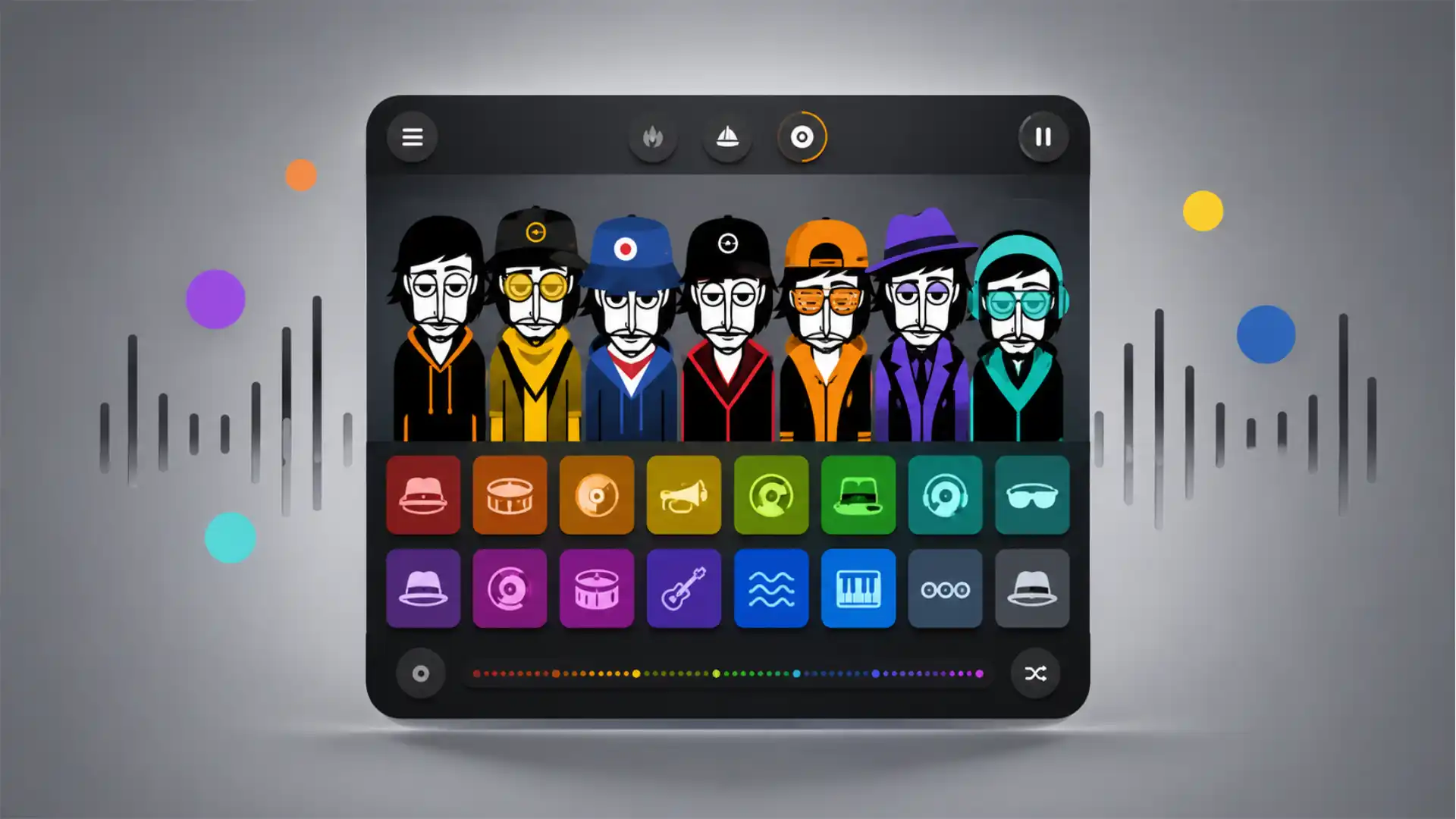
Incredibox does one thing that many music tools still fail to do: it makes you sound good before you understand why. Open it, pick a style, drag a little icon onto one of the blank animated performers, and the loop starts. Add another. Add a voice. Add a melody. Mute one character, solo another, swap a hat, trigger a chorus. Within half a minute, you are not learning software. You are playing with a tiny vocal machine that behaves like a band.
Table of Contents
The site feels almost suspiciously simple because the hard work is hidden in the taste. Incredibox describes itself as a musical app where you create music with a crew of beatboxers, choose a musical style, record, and share the mix. The official homepage still frames it as “part game, part tool,” an audio-visual experience built around music, graphics, animation, and interaction. It also says more than 100 million players worldwide have used it, which explains why this small French project feels like a quiet internet classic rather than a random web toy.
What makes Incredibox worth opening is not technical depth but instant musical confidence. Most browser-based music makers ask you to understand tempo, grid timing, samples, tracks, effects, or at least the difference between a kick and a snare. Incredibox skips the studio metaphor. It gives you human-ish characters, sound icons, and loops that already know how to sit together. You are composing, but the interface never makes you feel like you are being tested.
That is a rare design trick. A beginner gets the pleasure of building something rhythmic without the humiliation of bad timing. A musician gets a fast sketchpad with a strong aesthetic. A teacher gets a classroom-friendly creative activity. A tired person with headphones gets five minutes of pattern-making that feels less empty than scrolling. Incredibox is not trying to replace a DAW. It is closer to a musical fidget object with genuine production taste.
The little machine behind the charm
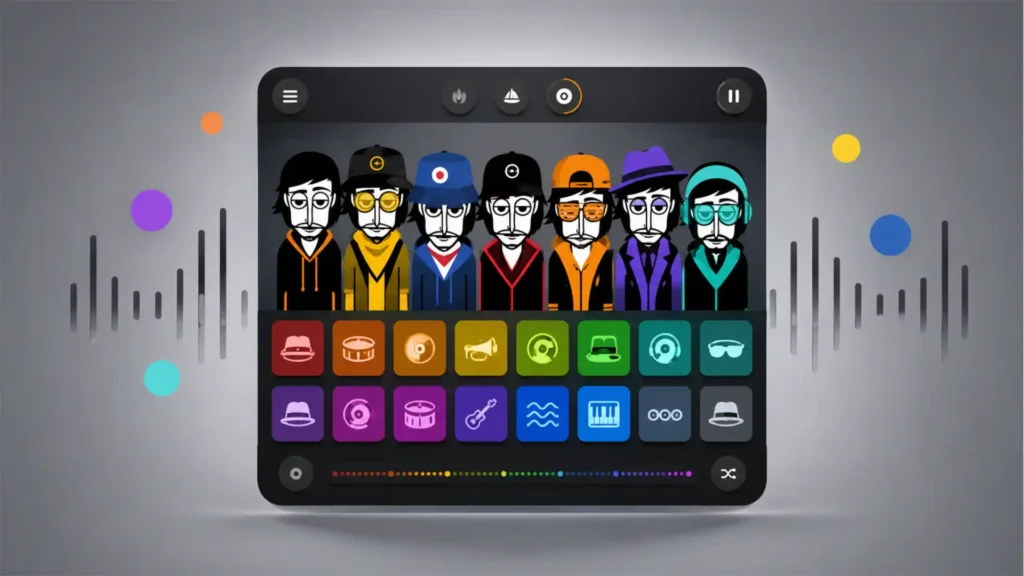
The central interaction is almost childishly direct. You drag icons onto performers. Each icon dresses a character and gives him a loop. The loops are grouped into beats, effects, melodies, and voices. The characters stay synchronized, so the moment you add or remove a sound, the whole arrangement keeps breathing. The official site explains the core action in exactly that way: drag and drop icons onto avatars, make them sing, compose your own music, and unlock animated choruses by finding sound combinations.
That drag-and-drop decision matters more than it looks. In a normal music app, a loop is a block on a timeline. In Incredibox, a loop is a performer. You are not placing audio; you are casting members of a strange a cappella crew. The character with headphones becomes a bassline. The one with glasses becomes a vocal texture. The one with a mask adds rhythm. The UI turns arrangement into a small stage.
This is why Incredibox works so well on the web. A browser is a restless place. Tabs compete. Attention is thin. Nobody wants to read an onboarding flow before a beat starts. Incredibox understands that the first sound must happen quickly. The player needs to feel, almost immediately, that the site has a pulse.
The strongest part of the design is the way it avoids blank-canvas anxiety. Creative tools often make a brutal first demand: start with nothing. Incredibox gives you a limited cast, a limited set of icons, and a fixed musical universe. That limit is generous. It says: make choices inside this box, and the box will protect you from sounding terrible. The result is a rare kind of playful constraint.
The characters are also more useful than decorative. They let you see the mix. A full row of dressed performers means a thick arrangement. A single soloed character means focus. Empty bodies signal available space. You can read the song with your eyes before you judge it with your ears. That is one reason the interface feels so friendly to people who do not speak music theory.
The animated bonuses add another layer of desire. Incredibox does not only reward you with sound. Find the right combination and you trigger a short animated chorus. This turns experimentation into a hunt. You start with “what sounds good?” and then drift into “what combination unlocks the secret?” It is a small mechanic, but it keeps the toy from becoming a flat loop board.
The share feature is just as important. Once a mix sounds good, the official site says you can save it, get a link, share it, and let others listen or vote. Enough votes may put a mix into the Top 50 chart. That leaderboard is not the point for every user, but it gives the whole thing a public edge. Your tiny beat can leave your browser.
The site’s best trick is that it makes sequencing feel social even when you are alone. The performers bob, sing, wait, and react. You are not dragging sterile samples. You are managing a chorus of visual personalities. The music is loop-based, but the experience feels like handling a little troupe.
That human layer is why the app ages better than many clever web experiments. Plenty of interactive music projects are impressive for two minutes and forgettable by the third. Incredibox has a stickier rhythm. You remember the faces. You remember the satisfying snap of adding a voice. You remember the sudden completeness when a thin beat becomes a track.
The interface is also honest about its limits. You are not mixing stems in detail. You are not shaping synth patches. You are not exporting a serious multitrack session from the web demo. The experience is built for arrangement, surprise, and mood. That narrowness gives it confidence. Incredibox knows exactly what kind of musical pleasure it wants to deliver.
A French web project that refused to disappear
Incredibox began as a small creative experiment, not as a venture-backed productivity platform. So Far So Good’s own company page traces the idea back to 2006 in Saint-Étienne, France, when Allan, Romain, and Paul started making a musical game together in their spare time. The first version went online at the end of 2009, and the team later created So Far So Good in 2011 to keep developing the project while doing creative work for clients.
That origin story explains the personality of the site. It feels handmade in the best sense. Code, graphic design, music, animation, and game design were not outsourced into separate generic layers. They came from a small team with overlapping taste. The official team page credits Allan with code and animation, Romain with visual identity and the faces, icons, and clothing, and Paul with the musical side of the project.
The survival of Incredibox is part of its appeal. A lot of web-born creative tools from the Flash era either vanished, became broken museums, or were absorbed into larger platforms. Incredibox crossed that messy bridge. It moved from a browser curiosity into apps, classrooms, albums, and now official mod culture. The official materials still say it has been “designed with love & passion since 2009,” a line that would sound corny if the product did not actually feel cared for.
The project’s longevity comes from a clean core loop. Pick a version. Add performers. Listen. Rearrange. Unlock. Record. Share. That loop does not depend on social feeds, daily streaks, loot systems, or artificial urgency. It is satisfying because the music changes when you touch it. That sounds obvious, but many digital experiences forget the pleasure of immediate cause and effect.
The product also has a strong visual grammar. Incredibox’s characters are not realistic avatars, but they are not generic mascots either. They are flat, clean, slightly odd figures with enough expression to feel alive and enough neutrality to be reused across different styles. The costumes carry the identity of each version. This lets the same interface travel from old-school beatbox to cyberpunk to retro hip-hop without becoming visually incoherent.
The nine official versions give the project its sense of a discography. The app page presents styles such as Wekiddy, Dystopia, Jeevan, Alive, Brazil, The Love, Sunrise, Little Miss, and Alpha, with each version tied to a different musical and visual world. Wekiddy, for example, is framed around a 90s-inspired, pre-web pop culture mood, while Dystopia leans into cyberpunk fantasy and darker electronic textures.
That version structure is smarter than a giant open library. Instead of overwhelming the user with hundreds of samples, Incredibox packages sound into authored worlds. You are not browsing loops. You are entering a mood. The limitation makes each version memorable. It also gives the project a collectible feeling without turning it into a shop full of disposable packs.
The official album page deepens that idea. Incredibox now has musical releases connected to the app, including remixed app tracks, unreleased versions, and tunes inspired by bonus themes. The page lists V9 Bonus Tracks, Wekiddy, The Unreleased, and Dystopia, showing how the app’s short loop worlds can become standalone listening material.
That matters because Incredibox has always sat between toy and music release. Some users come to play. Some come to make. Some come to listen. The site never resolves that tension, which is part of the charm. It is not only a game about music. It is also a music object that behaves like a game.
The best web projects often have that ambiguity. They are not easy to categorize because their usefulness is emotional as much as practical. Incredibox is useful if you need a classroom exercise, a quick musical sketch, or a shareable loop. It is also useful if you just want to click something that responds beautifully.
The company’s own story mentions early attention from web awards and a wave of visitors after launch. By the end of 2010, the first version had reportedly been played more than a million times, and the team began to see the project as something larger than a side experiment. That early web momentum still hangs around the product. It feels like a survivor from an era when a delightful site could spread because people sent links to each other.
The modern web has fewer of those moments. Discovery is often flattened by platforms. You encounter tools through feeds, app stores, sponsored videos, or SEO pages. Incredibox still feels like a site someone might send with a short message: “try this.” That is not nostalgia. It is a real product quality. The experience is small enough to recommend without explanation.
The joy of sounding good by accident
The phrase “make beatbox loops in your browser” undersells the emotional effect. The real pleasure is not only that the loops run. It is that the loops flatter you. Incredibox makes most combinations sound intentional. That means experimentation feels safe. You can remove the bassline, add a high vocal, swap the rhythm, and the system absorbs your choices without collapsing.
This kind of design takes musical discipline. If every loop is too busy, the mix becomes mud. If every loop is too plain, the user gets bored. If the melodies clash, the magic dies. Incredibox’s sound sets are built like modular arrangements. Each loop has a role. Some carry weight. Some add color. Some create motion. Some are there to make the chorus feel earned.
The genius is that users do not need to know any of that. They only need to notice that one combination feels better than another. The app teaches taste through play. You learn that too many voices crowd the mix. You learn that a beat can feel naked without texture. You learn that muting one element can make the whole track cleaner. Those are real arrangement lessons, hidden inside a cartoon.
This is why Incredibox travels well into education. The official homepage says the app is used by schools, and the dedicated schools page offers access to the Incredibox universe through a browser for teachers and students, with an ad-free, secure setup and class organization features. The educational fit is obvious once you use it. It gives students musical agency without requiring notation, instruments, or production software.
For teachers, the browser version matters. A class does not need every student to install a heavy application or understand audio routing. They can open a web-based tool and begin. The official school product is more structured than the public demo, but the deeper point is the same: Incredibox makes composition visible and low-friction.
For parents, the appeal is different. The app page says the full app has no ads or microtransactions, and it includes parental controls that can disable sharing functions so children are not redirected online or exposed to user-created content. That is a quiet but important product decision. Many “creative” apps for kids are wrapped around attention traps. Incredibox feels cleaner because the creative loop is already rewarding.
For adults, the appeal may be harder to admit. It is fun to control a little band. It is fun to make a beat that sounds better than expected. It is fun to discover that you can still enjoy an online toy without being forced into an account funnel. Incredibox has enough polish to avoid feeling childish and enough simplicity to avoid feeling like work.
The interface gives you the pleasure of mastery without pretending you are a producer. You are not learning compression. You are not editing MIDI velocity. You are not arranging bridges and drops. You are doing something smaller and more immediate: deciding who sings now. That role is closer to conductor, DJ, and puzzle solver at once.
The sound design also has an unusual warmth because of the voice-first approach. Even when a version uses electronic, hip-hop, or pop references, the vocal body remains central. Beatboxing gives the loops a human grain. The sound may be processed, stylized, and layered, but it does not feel like a sterile sample pack. The characters seem to breathe the track into existence.
That human grain changes how failure feels. A bad mix in a normal production tool can sound like broken machinery. A weak Incredibox mix sounds like a group waiting for a better arrangement. You can fix it by moving people around. The metaphor remains forgiving.
This is also why the automatic mode makes sense. The Google Play description says users can let automatic mode play for them, while the main site emphasizes recording and sharing your own mixes. Auto mode turns the app from a maker into a tiny music player. It is not the main pleasure, but it proves the loops are strong enough to survive randomization.
The product sits in a sweet spot between control and surrender. You decide the lineup, but the tempo holds. You choose the voices, but the loops behave. You search for bonuses, but the system hides them until you stumble into the right recipe. It gives enough authorship to feel personal and enough guardrails to feel relaxed.
What makes Incredibox click so fast
| Element | Why it works |
|---|---|
| Seven performers | The mix becomes visible as a cast, not a timeline. |
| Drag-and-drop sound icons | The first action is obvious and instantly rewarded. |
| Fixed musical versions | Each sound set feels authored instead of random. |
| Animated bonuses | Experimentation becomes a small treasure hunt. |
| Recording and sharing | A private loop can become a public link. |
| App extras and school tools | The project extends beyond the browser without losing its core. |
The compact brilliance of Incredibox is that every major feature reinforces the same behavior: try something, hear it, change it, share it. Nothing in the interface feels like a separate productivity layer pasted onto a toy. The table makes the system look simple because it is simple, but the simplicity is designed rather than empty.
The browser demo and the paid app do different jobs
The browser version is the hook. It is the thing to open when someone sends you incredibox.com and says you can make beatbox loops in your browser. It carries the magic of instant access. No app store. No login wall before the first sound. No heavy promise. The homepage still pushes “Try web version” as a primary action, which is exactly right for a discovery-led product.
The paid app is where Incredibox becomes a fuller library. The official app page says the app includes current and future versions, fan-made mods, no pop-up ads, MP3 downloads, a Mixlist for recorded tracks, and controls for children’s sharing functions. That difference is clean: the web sells the feeling, the app expands the habit.
This split is one reason the product has stayed legible. Many web toys make a bad jump to mobile by overcomplicating the experience. Incredibox keeps the central mechanic intact. The app adds breadth and ownership rather than turning the whole thing into a subscription maze. The app page even says there are no ads or microtransactions, a line that feels increasingly rare in casual creative software.
The MP3 export is a bigger deal than it sounds. On the web, a shared mix is still part of the Incredibox ecosystem. In the app, downloading a mix as an MP3 lets the track leave as a file. That turns play into a keepsake. It also makes the app more useful for teachers, students, and casual creators who want evidence of the thing they made.
The Mixlist gives the app a memory. Every recorded mix can be reviewed, shared, downloaded, deleted, or made private, according to the official app page. That matters because a loop toy without memory becomes disposable. A saved mixlist invites return. It lets the user build a small archive of experiments.
The school version extends the same idea into a managed setting. The official school page says teachers can organize classes, choose licenses based on school size, and let students create at school or at home through the browser. That is the sensible institutional version of Incredibox: the same playful core, wrapped in a classroom structure.
The product does not need to pretend every user is the same. The public demo is for discovery. The app is for deeper play. The schools product is for managed learning. The mods area is for community expansion. The albums are for listening. Each layer has a clear reason to exist.
The risk, of course, is fragmentation. When a project spreads across demo, app, schools, mods, albums, app stores, and web pages, the identity can blur. Incredibox avoids most of that because the central image remains stable: animated beatboxers, icons, loops, mix. Every branch still points back to that core.
The app store presence also anchors Incredibox as a real product rather than a forgotten website. Google Play describes it as a Lyon-based So Far So Good project created in 2009, starting as a webpage before moving into mobile and tablet apps. It repeats the familiar formula: create, record, share, find combos, unlock animated choruses, and use automatic mode when you do not want to build a mix manually.
That consistency across official channels matters. The site, app page, and store listing all describe the same experience in nearly the same terms. For a playful project, that discipline is useful. It tells you the team knows what the product is. They have not buried the original joy under years of feature sprawl.
The browser demo still has a cultural advantage over the app. It is linkable in the old internet sense. A person can discover it at a desk, during a break, in a classroom, on a shared screen, or through an article like this. Apps are private spaces. Websites are passable objects. Incredibox benefits from remaining both.
This dual identity also protects the project from platform dependence. If someone finds it through Steam, mobile, a school license, or the web, they are still entering the same little beatbox universe. That is a healthier shape than a product trapped inside one distribution channel.
The site is not perfect. Some users will hit the limits quickly. Serious producers may want timeline control, export options, stems, tempo changes, or deeper editing. People who dislike loop-based music will not be converted. But those are not failures of the product. They are boundaries. Incredibox is good because it does not chase every possible user.
Why the mod era makes it more interesting now
The newest reason to revisit Incredibox is the official embrace of mods. The official Mods page now presents Incredimods as community-made versions available in the app, with a list of mod projects and creators. This is a major shift in the life of a polished, tightly authored tool. It turns Incredibox from a closed set of worlds into a platform with community pressure.
The dedicated modding page is unusually revealing. It says mods can now be installed by every user within the Incredibox app, that So Far So Good set up an official home on mod.io, and that creators can submit their work there. The page’s last update is listed as 14 October 2025. That date matters because it shows the project is not merely coasting on old affection. It is still changing.
The modding process also shows how much craft sits behind the friendly interface. The official documentation page says creating an Incredimod requires vector drawing, music making, 2D animation, storyboarding, and video editing. That list is a useful correction to the idea that Incredibox is just a simple soundboard. The simplicity users touch is built on a mixed-media production stack.
Community mods are a natural fit and a real risk. They can bring new styles, stranger moods, and fan energy into the app. They can also dilute the taste that made the original versions feel so controlled. So Far So Good seems aware of this. The mod charter tells creators not to submit minor forks, not to use inappropriate content, and not to copy famous songs, characters, logos, brands, or copyrighted projects if they want inclusion in the app.
That moderation stance is important because Incredibox has a large kid and school audience. A creative community can turn chaotic quickly. The official mod page says every mod submitted to the official mod.io page is published there, but only mods that pass a check and comply with the charter become available directly inside the app. That creates a useful two-layer system: open community submission, filtered in-app exposure.
The mod scene also changes what Incredibox is. Before mods, the project felt like a set of albums by one small studio. With mods, it becomes closer to an instrument with scenes, dialects, and fan-made subgenres. That could extend its life dramatically, especially for users who already exhausted the official versions.
The challenge is tastekeeping. Incredibox’s main strength has always been the way everything fits: sound, character, animation, mood, interface. Mods need more than good loops. They need a world. They need restraint. They need visual rhythm. They need to understand that a sound icon is also a costume, a gesture, and a piece of arrangement logic.
That is why the best Incredimods may feel closer to small animated EPs than user skins. A strong mod has to answer the same questions as an official version: What is the mood? What kind of voices belong here? How busy can the beats be? What does the chorus reveal? What should the characters look like before the user even hears them? Good modding in Incredibox is not just fan enthusiasm. It is mini world-building.
The official Mods page already makes the community feel alive. It lists many available mods with creator names and visible counts, turning the site into a catalog of fan-made variations. Even if you only care about the original app, that public list is interesting. It proves users did not merely consume Incredibox; they studied its grammar and started writing in it.
That is a powerful sign for any creative web project. The deepest affection is not applause. It is imitation with effort. When a tool inspires people to learn vector drawing, music production, animation, and packaging just to create inside its format, it has become more than content. It has become a creative language.
Mods also make Incredibox feel newly relevant in a web culture obsessed with remixing. The internet has always loved rearrangement, but platform economies often reduce remix culture to templates and trends. Incredibox mods are slower and more crafted. They demand assets, sound, timing, and compliance. They are not a one-click meme format. That friction may keep the scene healthier.
The mod era could also complicate the beginner experience. Too much choice can weaken the clean first impression. A new user needs the original simplicity before entering a huge catalog. The best path is probably the one Incredibox already suggests: discover the official feel first, then open the wider community once the grammar makes sense.
For Web Radar, this is the strongest reason to cover Incredibox now rather than treat it as a nostalgic relic. The project has moved from web toy to app to school tool to community platform. It has done that without discarding the tiny interaction that made it memorable. That is rare.
A site for people who like playful constraints
Incredibox is especially good for people who freeze in front of professional tools. Give someone a blank DAW session and they may feel stupid before they make a sound. Give them Incredibox and they will probably drag a hat onto a character. That first action is small enough to avoid fear and rewarding enough to invite a second action.
The tool also suits people who think visually. The performers become a living arrangement map. You can remember your mix as “the one with the orange glasses, the blue headphones, and the low voice” rather than as a sequence of track names. That kind of visual memory is underrated in music interfaces.
It works for classrooms because it makes group discussion easy. Students can talk about which performer to add, which sound should be muted, where the track gets too crowded, and what changes when a voice enters. The teacher can focus on listening, structure, and creative choice instead of troubleshooting software. The official school product leans into that classroom use with browser access, licenses, and class organization.
It works for casual creators because it gives them a finished-feeling object. A quick mix in Incredibox does not feel like a half-made file. It feels like a complete loop performance. That matters psychologically. People return to tools that give them finished feelings quickly.
It works for designers because it is a clean study in interaction. Every sound has a visual identity. Every icon does something obvious. Every performer is both output and interface. The product does not need a heavy tutorial because the metaphor is strong. Drag costume onto singer. Singer sings. Remove costume. Sound leaves. The relationship is plain.
It works for product people because it shows the value of a strong core loop. Incredibox did not need to become a giant platform to remain alive. It kept improving around the loop. New versions, apps, sharing, schools, albums, mods, and exports all orbit the same action. That is the difference between extension and bloat.
It works for musicians in a lighter way. Nobody should open Incredibox expecting full production control, but a musician can still appreciate the arrangement craft. The loops are coordinated. The moods are distinct. The constraints can spark ideas precisely because they remove decisions. Sometimes a small toy shakes loose a better rhythm than a serious studio.
It works for internet culture watchers because it carries old-web DNA without feeling dusty. It is interactive, self-contained, linkable, visual, and delightful. It does not ask for your identity before it gives you the thing. It lets you play first. That alone makes it feel almost rebellious compared with many modern web products.
The project is also a reminder that “simple” does not mean “thin.” Incredibox is simple at the point of use, but it contains music direction, illustration, animation, web engineering, community management, education packaging, and distribution strategy. The user only sees the fun part. That is good product work.
The weakness of the tool is also part of the recommendation. If you want freedom, you will outgrow it. If you want novelty every day, the official versions may feel finite unless you enter mods. If you want exact control over song structure, you will feel boxed in. But for the right mood, that box is the whole pleasure.
The best time to open Incredibox is when you want to make something without preparing to make something. No setup ritual. No gear fantasy. No tutorial spiral. Just a browser, sound, and a line of strange little performers waiting to be dressed.
That makes it an unusually humane creative interface. It lets the user feel competent quickly, but not because it lies. It simply narrows the field until good choices become easier. Many tools sell power. Incredibox sells a tiny pocket of confidence.
The name itself captures the trick better than it should. It is a box, yes. But inside the box, the loops feel alive. The “incredible” part is not that the app can make music. Many apps can. The surprising part is that it makes a person with no plan feel like they have taste.
The web still needs more things like this
Incredibox belongs to a category the web should protect: delightful utilities with no obvious category. It is not only a game, not only a music tool, not only an educational resource, not only an app funnel, not only a community platform. It is a memorable thing you open because it gives you a specific feeling.
That kind of project is harder to discover now. Search results tend to favor explainers, marketplaces, and download pages. Social feeds favor short clips of outcomes rather than the pleasure of touching the interface yourself. App stores flatten personality into screenshots, ratings, and categories. Incredibox benefits from all those channels, but its natural habitat is still the open web.
The official homepage is refreshingly direct. It explains the activity, shows the web version, points to the app, and frames the project as music, graphics, animation, and interactivity working together. It does not need a grand manifesto. The product is understandable because the interaction is understandable.
The So Far So Good story adds a human scale that suits the product. Three friends started with a musical game idea, worked on it for years, launched it online in 2009, built a company around it in 2011, and kept shaping it. That is a cleaner origin than many digital projects get. You can feel the continuity.
The app’s current feature set shows careful expansion rather than panic. No ads, no microtransactions, MP3 export, Mixlist, child sharing controls, community mods, and future versions are all sensible additions to the original loop. None of those features ruins the first five seconds of play. That restraint is worth noticing.
The school version shows another kind of restraint. It does not turn Incredibox into a heavy learning management system. It gives schools browser access, class organization, licenses, and a safer setup for students. The learning still happens through play, not through a layer of educational bureaucracy.
The albums show respect for the music itself. They suggest the team does not treat the loops as disposable interface sounds. The official album page presents remixed app tracks, unreleased versions, and bonus-inspired tracks as listenable releases. That adds depth to the project’s identity: the app is playful, but the sound world is not throwaway.
The mods show respect for the community. The official modding page gives creators a path, rules, and a place to publish. It also protects the in-app experience through compliance checks. That balance matters. A community can feed a project or flood it. Incredibox seems to be trying to let fans expand the world without letting chaos become the product.
The result is a small but instructive model for digital longevity. Keep the core interaction sacred. Add new doors around it. Let different audiences enter through the door that fits them. Do not punish the casual user for the needs of the power user. Do not bury the magic under the roadmap.
Incredibox also reminds us that browser-based creativity does not need to imitate professional software. The web is at its best when it invents its own forms. A beatbox chorus controlled by costumes is not a cut-down studio. It is a native web object: visual, shareable, quick, and strange.
There is taste in the refusal to become more serious than necessary. Many creative tools climb toward complexity because complexity is easier to sell. Incredibox stays close to play. That does not make it shallow. It makes it approachable in a way that serious tools often envy.
The site is worth opening even if you only spend five minutes with it. You will understand the appeal almost immediately. A character starts singing. Another joins. The loop thickens. A hidden chorus appears. You save or you do not. You close the tab with a small beat still stuck in your head.
That aftertaste is the recommendation. Incredibox is not important because it offers the deepest music-making system on the web. It is important because it turns the act of arranging sound into something readable, forgiving, and charming. It makes the user feel invited rather than underqualified.
And in a web full of dashboards, feeds, forms, and funnels, that invitation feels precious. Open the site, put headphones on, drag the first icon, and listen to the little human machine start working.
Small answers before opening it
The official site still offers a web version you can try from the homepage, while the paid app contains the fuller experience, including more versions, app features, and community mods.
No. The design is friendly enough for children and useful for schools, but the sound design, visual consistency, and arrangement logic make it enjoyable for adults too. Its best quality is not childishness; it is low-friction creativity.
The official app page says the app lets users download mixes as MP3 files, while recorded mixes are saved in a Mixlist for reviewing, sharing, downloading, deleting, or making private.
Yes, Incredibox now has an official Incredimods area, and the modding page says mods can be installed inside the app, with submissions handled through the official mod.io setup and checked for in-app compliance.
Open it if you like playful web tools, music toys, classroom-friendly creative apps, loop-based sound, charming interface design, or small sites that still feel hand-shaped. It is especially good for anyone who wants to make something before they have time to become self-conscious.
Author:
Jan Bielik
CEO & Founder of Webiano Digital & Marketing Agency
This article is an original analysis supported by the sources cited below
Incredibox official website
Official homepage for Incredibox, used for the core description of the web experience, the drag-and-drop music mechanic, sharing, voting, school use, and the project’s public positioning.
Incredibox app page
Official app page, used for details about the full app, current and future versions, no ads, community mods, MP3 export, Mixlist, and child sharing controls.
Incredibox mods page
Official mods catalog page, used for the current Incredimods direction and the existence of community-made versions available through the app.
Incredibox modding page
Official modding documentation page, used for the 2025 modding update, mod.io submission process, approval process, charter rules, and the creative skills involved in making an Incredimod.
Incredibox for schools
Official schools page, used for the education-specific browser access, classroom organization, licensing, safe environment, and school use cases.
Incredibox albums
Official album page, used for the project’s music releases, including remixed app tracks, unreleased versions, and bonus-inspired tracks.
So Far So Good
Official studio page, used for the origin story of Incredibox, the Saint-Étienne team, the 2009 launch, the 2011 company formation, team roles, and the project’s long-running development.
Incredibox on Google Play
Official Google Play listing, used for the app-store description of Incredibox, its Lyon-based studio background, gameplay features, automatic mode, MP3 export, and mobile positioning.
| Citing this article? Brief excerpts are welcome. Please credit Webiano.digital, name the author where stated, and include a link to https://webiano.digital and to this original article. Full or substantial republication requires prior written permission. Read our Copyright and Content Use Policy. |
This article was prepared with the assistance of artificial intelligence tools. The content underwent expert human review, and Webiano Digital & Marketing Agency assumes editorial responsibility for its final version and publication.