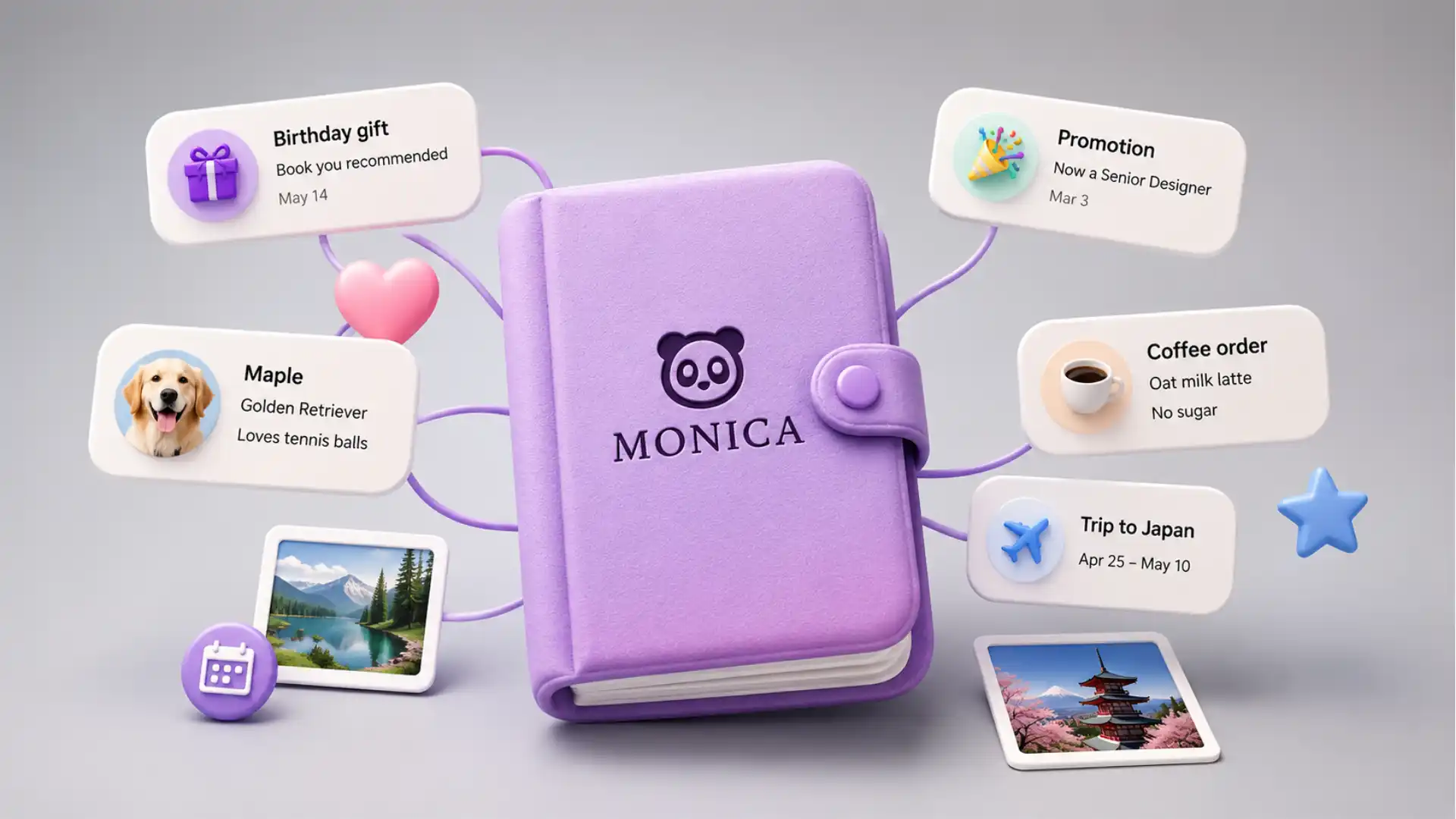
Monica starts from a truth that feels a little rude once you admit it: we forget things about people we love. Not because we are cruel. Not because we do not care. Because modern life is noisy, friendships stretch across cities and time zones, families become complicated, work eats the soft parts of memory, and the small details slip first. The dog’s name. The surgery date. The gift someone gave you. The job they were nervous about. The anniversary that still hurts. Monica is built for that exact gap.
Table of Contents
On paper, Monica is an open source personal CRM. Its own homepage says it helps people organize social interactions with loved ones, follow up, and strengthen relationships, with the option to use the hosted service or install it on your own server. That description is accurate, but it undersells the emotional weirdness of the product. A CRM normally belongs to sales teams, pipelines, reminders, leads, and revenue. Monica drags that structure into friendship and asks whether remembering people might deserve the same care companies give to prospects.
The result is not a social network, and that matters. Monica’s own materials are blunt about this: the product is private, “for your eyes only,” not a social network, and not built to scan your life or guess what you want from people. That refusal gives Monica its shape. It does not want you to post, perform, react, collect followers, or broadcast your closeness. It wants you to write down the things you would be embarrassed to forget before the next dinner, call, birthday, hospital visit, or awkward family gathering.
That makes Monica one of the more interesting small web projects hiding in plain sight. It takes a cold software category and warms it up by changing the motive. In sales, memory is a tactic. In Monica, memory becomes an act of care. You record that your friend’s child is called Leo, that Leo loves dinosaurs, that your friend’s mother died last May, that they hate surprise parties, that they gave you a scarf, that you still owe them money for train tickets. None of these facts are grand. The whole product is built around the dignity of tiny facts.
Monica is also slightly uncomfortable, which is why it is worth opening. A private database about loved ones sounds thoughtful until it starts sounding like a dossier. The product lives in that tension. Used badly, it could turn people into files. Used well, it becomes a private memory aid for attention you already want to give. Monica does not solve the ethics for you. It only gives you a place to store the details. The user has to bring the manners.
The official feature pages show how specific Monica gets. It lets users store family information, work information, relationships between contacts, pets, shared activities, reminders, gift ideas, gifts given, tasks, debts, a journal, and notes about how a day went. That list sounds almost too ordinary to be interesting. Yet those ordinary fields are exactly the point. Friendship often fails at the level of logistics. Someone meant to call. Someone meant to check in. Someone meant to remember the new partner’s name. Monica gives those intentions a shelf.
The most refreshing thing about Monica is its lack of theatrical intelligence. The GitHub README says Monica is not a smart assistant, does not guess what users want, and does not include built-in AI integrations such as ChatGPT. That may sound like a missing feature in 2026. For this kind of tool, it feels more like restraint. Monica does not read your messages and infer who matters. It does not turn your friends into machine-generated profiles. You decide what matters enough to write down.
That old-fashioned manual quality changes the mood of the app. You are not feeding a prediction engine. You are keeping a private notebook with fields. There is something almost stubbornly human about that. Before a meeting, you refresh your memory. After a conversation, you save what deserves not to vanish. Before a birthday, you check the gift notes. Before calling your grandmother, you remember what you talked about last time. Monica does not make care automatic; it makes forgetfulness less likely.
The genius is in the awkward premise
The phrase “personal CRM” sounds wrong before it sounds useful. A customer relationship management system is built for business. Monica’s documentation explains that a normal CRM tracks who sales teams have spoken to, who may buy, and how to follow up through a customer lifecycle, while a personal CRM borrows some of that behavior for personal contacts outside business. The definition is dry, but the cultural shift is strange. It takes a tool for commercial memory and turns it toward private life.
That shift creates a small shock. Nobody wants to imagine their oldest friend sitting in a database row beside a reminder, relationship type, gift log, and note history. Friendship is supposed to feel spontaneous, not maintained. Yet adult friendship is full of hidden maintenance. Someone remembers the date. Someone books the table. Someone checks the allergy. Someone asks the follow-up question. Someone notices the silence. A lot of warmth arrives through boring admin.
Monica is honest about the admin. The homepage asks whether you remember the names of your friends’ children, your brother’s wedding anniversary, or the last time you called your grandmother and what you discussed. Those examples work because they are not dramatic. They are exactly the kind of facts that reveal whether attention has survived distance. If you remember them, the other person feels held in mind. If you forget them, the relationship may not break, but something small dulls.
The product’s core bet is kind rather than cynical. It assumes forgetting does not always mean indifference. Some people have weak memory for names and dates. Some are overwhelmed. Some move often. Some have friends in several countries. Some are neurodivergent. Some are caring for children, parents, partners, teams, and themselves at the same time. Monica’s GitHub README says the project is for people who want to document their lives and those who struggle to remember details about people they care about.
That line gives the app its emotional center. Monica is not mainly for the power networker collecting lunches. It is for the person who wants to be less careless with the few people who matter. It is for the friend who remembers the feeling of a conversation but loses the facts. It is for the sibling who forgets anniversaries and hates themselves for it. It is for the adult who has discovered that love does not automatically keep a calendar.
The best Monica use case is probably not “remember everything.” It is “remember what would change how I show up.” There is no need to record every joke, mood, outfit, text, and offhand remark. The useful details are the ones that carry care forward: the pet’s name, the hard date, the new job, the recurring migraine, the gift idea, the topic to avoid, the promise to send an article, the money owed, the dinner preference, the anniversary. A good record should make the next interaction more attentive, not more managed.
This is why Monica’s awkwardness is not a flaw. The discomfort forces a decision. Are you writing this down because you want to care better, or because you want to control the impression you make? Are you saving a private detail because it would spare someone from repeating pain, or because you enjoy possessing private knowledge? Are you logging a gift because you listened, or because you keep score? The app cannot answer those questions, but it makes them visible.
Most software avoids that kind of moral friction. Social apps prefer easy gestures: likes, reactions, stories, streaks, hearts, reminders, memories, automated greetings. Monica is heavier because it makes the user decide what deserves memory. The slowness is part of the value. You pause, type, and commit the fact to a place. That small act creates a different relationship with attention. Manual entry turns remembering into a choice.
There is a version of this idea that would be much worse. Imagine a glossy app that reads every message, scans every photo, listens to calls, guesses your friend’s emotional state, ranks who is drifting away, and suggests the perfect line to send. It would demo beautifully and feel awful. Monica is more modest. It stores what you give it and reminds you when you ask. Its refusal to guess protects the humanity of the habit.
That refusal also makes Monica feel less like a productivity app. Productivity software often treats people as interruptions or tasks to clear. Monica treats them as lives with context. The difference is subtle but real. You are not only marking “call Daniel” as done. You are remembering that Daniel just adopted a cat, hates phone calls after 9 p.m., and was waiting on medical results last week. The task matters because the person has a story around it.
The deeper insight is that relationships decay quietly. Not always through betrayal or conflict. Often through missed follow-ups, unreturned calls, generic messages, forgotten names, and months that pass without anyone noticing. Monica cannot stop that by itself. No app can. But it gives drifting relationships a timestamp and a reminder. It lets you see, sometimes uncomfortably, that the friend you call “close” has not heard from you since March. A private dashboard can become a mirror.
That mirror is why the product has editorial interest beyond its feature list. Monica is not just “contacts plus notes.” It is a different theory of digital social life. Social platforms keep showing us people. Monica asks us to remember them. Social platforms reward public proof of closeness. Monica keeps care private. Social platforms are excellent at birthdays and bad at grief. Monica leaves room for the date nobody else knows. It turns friendship away from performance and back toward recall.
The tiny details Monica gives a home
Monica’s feature set reads like someone audited ordinary friendship and found all the missing fields. The official site lists family, work, contact relationships, pets, activities done together, reminders, gifts, tasks, debts, journal entries, and a way to mark how the day went. The features page adds contact methods, private notes, calls, reminders for events, gift management, money owed, and a central place to track interactions. These are not glamorous features. They are the parts of other people’s lives that normal address books flatten.
A normal contact card is mostly coordinates. Name. Phone. Email. Address. Maybe birthday. Maybe company. That is useful when you need to reach someone, but it says little about the relationship itself. Monica tries to store the missing context: who belongs to whom, what has happened, what you did together, what should be remembered, what was promised, what was given, what is owed. It turns a contact into a small social map.
Pets are a perfect example. A “pet” field may sound trivial until you remember how often pets carry real emotional weight. A dog’s illness can dominate someone’s week. A cat’s death can wreck them. A new puppy can become the brightest thing in a bleak year. Remembering the animal’s name is not trivia to the person who loves it. Monica understands that small lives around a person are part of the person’s world.
Gift tracking works the same way. Monica lets users manage gifts already offered or gifts they want to offer, and it also includes money owed or owed back. This could sound transactional, but the better use is gentler. You remember that someone gave you a ceramic mug from Lisbon. You remember they dislike scented candles. You remember they mentioned wanting a certain cookbook. You avoid giving the same safe object three years in a row. A gift note is often delayed listening.
Debts are another tiny social pressure Monica names directly. Small debts are socially odd. They are too small to litigate and too sticky to ignore. Who paid for the taxi? Did you repay the concert ticket? Did someone cover dinner when your card failed? Monica gives that kind of loose end a field. The point is not to make friendship an accounting exercise. The point is to prevent money from becoming quiet awkwardness.
The activity log may be the most revealing part. Monica lets users manage activities with contacts, record calls, and track interactions in one place. That sounds bland until you look at it honestly. If you thought you had seen someone recently and the last activity says eight months ago, the software has not accused you of anything. It has simply removed a comforting illusion. Relationship memory becomes less dependent on vibe.
Reminders are the hook most people will understand first. Birthdays are automatically filled when available, and Monica supports reminders for dates and events. Birthdays are useful, but Monica becomes more interesting when the reminders are private and specific: ask about the interview, text after the surgery, call the week after the move, check in before the court date, remember the anniversary of a parent’s death. Those are the dates that make care feel personal rather than automated.
Private notes are where Monica becomes powerful and risky. The features page says users can add private notes about a person. That simple sentence covers everything from “likes Ethiopian food” to “is frightened about divorce.” The tool does not distinguish harmless preferences from vulnerable truths. The user has to. A good note saves context. A bad note becomes gossip with a search bar. The ethics live in the keyboard.
The journal broadens Monica beyond a relationship database. The documentation says Monica lets users document their life and contacts, while the GitHub README lists diary features, recording how the day went, uploading documents and photos, multiple vaults, labels, and custom sections. That moves Monica closer to a personal archive. Your friendships do not happen outside your own life. A dinner, a call, or a hard conversation lands differently depending on what season you were in.
This matters because memory is not only factual. You might remember that you called a friend. The journal lets you remember the texture around it: you were exhausted, newly moved, angry with yourself, relieved, lonely, grateful, grieving. A bare activity log says what happened. A journal says what it felt like to be there. Monica’s strongest version is not a people database; it is a life-context system.
The API gives technical users room to build around the habit. Monica’s API documentation covers resources such as activities, calls, contacts, conversations, debts, documents, gifts, journal entries, notes, photos, relationships, reminders, tags, and tasks, and the overview says API access uses HTTPS and JSON with support for custom instances. Most users will never touch that. For self-hosters, tinkerers, and people with existing workflows, it means Monica is less sealed than a typical consumer app.
Data export matters for the same reason. Monica’s privacy page says users can export their data at any time and can also use the API to export data if they know how. That is not a decorative detail. A relationship archive becomes emotionally heavy after a year or two. If you store the birthdays, grief dates, gifts, notes, and contact history of people you love, leaving the app should not feel like abandoning your own memory. Exit is part of trust.
The strange thing is how quickly these tiny fields start to look obvious. Once you see a place for pets, you wonder why contacts apps rarely treat pets as first-class personal context. Once you see gift history beside reminders, you wonder why calendars and notes never quite handled the full loop. Once you see calls, activities, debts, and family links in one place, the normal address book starts to look thin. Monica’s power is not invention; it is aggregation with emotional purpose.
That aggregation is also the reason to stay selective. Monica could become a chore if you try to log everything. The product does not need a full report after every coffee. A lighter habit is better: save the facts that would hurt to lose, the dates that deserve action, and the preferences that make future care more precise. The goal is not complete memory; the goal is useful tenderness.
The privacy question is not optional
A personal CRM holds data that feels different from ordinary app data. A note app may contain your thoughts. A contact app may contain phone numbers. Monica can contain your thoughts about other people, their family links, pets, addresses, debts, gifts, emotional context, and dates that may be painful. That makes the privacy question central, not decorative. A database about loved ones needs a stricter trust standard.
Monica’s privacy page is unusually candid, and that honesty is useful. It says the hosted version collects name, email address, and encrypted password when a user creates an account, uses cookies for login, runs on Linode, performs hourly database backups, supports two-factor authentication, and does not show ads or sell data. Those are ordinary operational facts, but they matter because the stored information is not ordinary. A birthday reminder is one thing. A private note about grief is another.
The same privacy page includes a detail users should not miss. Monica says that apart from password and similar mechanisms, hosted user data is not encrypted in the database, meaning someone with database access would be able to read the data. That line is not comforting, but it is clarifying. Hosted Monica may still be the right choice for many people, yet the user should understand the bargain. Convenience and data sensitivity are pulling in opposite directions.
Self-hosting changes that bargain. Monica says users may download and run the product themselves, and in that case the team does not track anything or even know the product was downloaded. The homepage and pricing page also point users toward installing Monica on their own server, with self-hosting offered for free. For people who want a private memory system about loved ones, self-hosting is not just a hobbyist option. It is the cleanest privacy posture.
Self-hosting is not magic. A badly maintained server can be less safe than a hosted service run by people who know the application. The trade is control for responsibility. You need updates, backups, access control, a strong password, and some confidence that you will not accidentally lose the database. Owning the server also means owning the boring work.
The pricing page makes the practical choices clear enough. Monica currently lists hosted pricing at $9 per month or $90 per year, with flat pricing, unlimited contacts, unlimited reminders, and a free plan that includes 10 contacts with some restricted features; it also says self-hosting is free. The free plan is a good fit for testing the habit because 10 contacts forces a useful question: who actually belongs in this system? A smaller Monica may be a better Monica.
The open source part matters more here than it would for many apps. Monica’s documentation says the code is free and available for anyone to read or change, and the GitHub repository identifies Monica as an open source personal relationship management system. Open source does not guarantee safety. It does give users, contributors, and technically minded observers a way to inspect, host, modify, and challenge the project. For intimate software, visibility is part of the trust story.
The project also has a recognizable human scale. The team page says Monica has two official members, headquarters in Montreal, and 150 open source contributors, with a mission to use technology in a way that does not harm human relationships like large social networks can. That scale gives the project a particular charm. It is not trying to become the next universal graph of human connection. It wants people to strengthen a few relationships.
That mission changes how the product reads. Monica is not pitching infinite networking. It is not promising influence. It is not chasing the language of audience, reach, or virality. The team page says the project came from a personal need to keep track of what friends living in other countries were doing with their lives. That origin feels visible in the product. It was born from distance, not ambition.
The project’s ongoing rewrite adds another layer. Monica’s blog describes Chandler as a complete reimagining of Monica, built from the ground up, with a new layout, dark mode, customization, and some beta-era limitations such as no import from current Monica data, no mass contact import, and no API at that time. The GitHub README also warns that the main branch is a beta version and points users who want the stable current version to the 4.x branch. Users should know which version they are choosing.
That caveat does not make Monica less interesting. It makes it feel alive in the open-source sense: history, branches, technical debt, beta work, contributors, rough edges, public tradeoffs. A polished closed app may hide all of that and still fail. Monica exposes more of its machinery. The mess is not a dealbreaker; it is part of the project’s texture.
The privacy conversation also lands differently because Monica rejects ads and tracking in its stated principles. The privacy page says the site does not show ads, does not intend to sell data to third parties, and does not use tracking third parties such as Google Analytics or Intercom. The GitHub README lists principles including no ads, no tracking, transparency, open source, and not being a social network. For this category, those choices are not branding. They define whether the tool feels safe enough to use honestly.
The honest advice is to treat Monica like a private notebook, not a disposable app. Put less in it than you could. Store what you would be comfortable protecting. Avoid cruel or sensational notes. Export periodically. Consider self-hosting if the data feels sensitive. Use the free plan before committing. The product invites intimacy, so the user should bring restraint.
Why Monica feels different from social media
Social media remembers people in the loudest possible way. It surfaces birthdays, posts, stories, photos, job changes, travel, arguments, reactions, and public milestones. That is useful, but it is also noisy and performative. Monica remembers in the quietest possible way. No feed. No audience. No likes. No public proof that you cared. The care happens offstage.
That offstage quality is the product’s strongest cultural argument. The homepage says Monica is not a social network and will never be, while the GitHub README says it is built for the user’s eyes only. That refusal is rare because many social products drift toward visibility. A private memory tool has no viral loop built into the relationship itself. You do not invite a friend so they can see how well you remember them. You simply remember.
Social platforms also confuse being updated with being close. You may know that someone went to Berlin, got promoted, posted a photo of their child, liked a joke, and shared a political rant. Yet when you meet them, you may not remember the thing they told you privately six months ago. A feed gives you recent signals. Monica stores chosen context. It is the difference between seeing a life pass by and holding a piece of it carefully.
This is why Monica’s manual input matters again. A social platform pushes memory at you. Monica asks you to curate it. The feed says, “Look, this happened.” Monica says, “You decided this mattered.” That is a more demanding relationship with information. It also feels cleaner. You are less likely to mistake ambient awareness for attention when you had to type the note yourself. The friction gives the memory weight.
Monica also avoids the public awkwardness of performative care. A birthday wall post, a heart reaction, a comment under a grief announcement, a public “so proud of you” message: these gestures may be real, but they also perform for an audience. Monica points toward the private text, the call, the remembered question, the gift that matches the person. It is software for care that does not need witnesses.
The product is especially interesting in an era of people leaving or reducing social feeds. Many users still want to remember birthdays, babies, moves, losses, jobs, and milestones without living inside the platforms that surface them. Monica offers a self-owned alternative. You record the social facts directly instead of letting a feed mediate them. It turns memory from platform dependency into a personal practice.
There is also a web-history charm here. Monica belongs near personal wikis, self-hosted tools, RSS readers, local-first habits, open-source utilities, and private databases made by people with a specific itch. It is not trying to be a giant consumer network. It does not need everyone you know to join. It becomes useful even if no one else has heard of it. That independence is rare for relationship software.
The team’s stated mission fits that older web spirit. Monica says it wants technology that does not harm human relationships, and it wants to help people strengthen relationships with only a few friends rather than chase thousands of virtual connections. That sounds almost unfashionable in the best way. The product gets stronger when the contact list is smaller, more personal, and more carefully kept. Scale is not the point; specificity is.
Specificity is exactly what feeds tend to erase. A feed shows the same birthday notification to everyone. Monica lets you remember that this birthday is hard because the person’s father died two days before it. A feed tells you someone changed jobs. Monica lets you remember that the previous job burned them out, so the new one is not just a title change. A feed shows a pet photo. Monica lets you remember the pet’s surgery date. The private layer is where the human meaning sits.
The lack of AI also sets Monica apart from a newer class of memory tools. Many apps now want to capture and summarize everything. Monica’s README says it does not include built-in AI and will not guess what the user wants. That may sound less advanced. It also keeps the relationship between the user and the data more direct. The tool stores memory; it does not interpret the people in your life for you. For friendship, that restraint feels right.
A relationship system that guesses too much risks becoming manipulative. It might suggest when someone is lonely, when a friendship is decaying, when a message would produce the best response, or how to phrase care for maximum effect. Monica is less dramatic. It will remind you of what you asked it to remember. It will show you what you logged. Then you have to decide what to do. The person remains responsible for the relationship.
That is why Monica’s “dumbness” is a feature. Dumb tools can be trusted in ways clever tools sometimes cannot. A notebook does not infer. A calendar does not psychoanalyze. A private database does not flatter you with emotional predictions. Monica’s best version lives in that family of tools. It is clever in what it refuses to become.
The product also reveals how thin most digital friendship tools are. Messaging apps are good for conversation but terrible for long memory. Calendars are good for dates but bad for context. Contacts apps are good for reachability but poor at relationships. Notes apps can store anything, which means they often organize nothing. Monica has enough structure to hold the recurring facts without turning them into content. It fills the space between a phone book and a diary.
That space is quietly large. People have always kept address books, birthday books, family trees, notebooks, recipe cards, Christmas card lists, gift lists, letters, albums, and diaries. Monica is not inventing relational memory. It is giving those old habits a web app shape. That is why it feels less strange after a few minutes. The software is new; the impulse is ancient.
A compact look at the appeal
Monica becomes easier to judge when the features are grouped by the kind of care they support. A long feature list can make the app sound busier than it feels. The compact view below shows why the pieces belong together.
What Monica is really storing
| Monica area | What goes there | Why it matters |
|---|---|---|
| Contact profiles | Names, contact methods, family links, partners, children | Turns a flat address book into a social map |
| Life details | Pets, jobs, private notes, preferences, sensitive context | Keeps the details that make people feel remembered |
| Activities and calls | Meetings, calls, shared events, last contact | Shows whether a relationship is active or drifting |
| Reminders | Birthdays, anniversaries, follow-ups, hard dates | Moves care from intention into action |
| Gifts and debts | Gift ideas, gifts given, money owed, money owed back | Prevents lazy gifts and small awkwardness |
| Journal and documents | Daily notes, photos, documents, personal life context | Connects other people’s stories to your own season of life |
| Open source control | Self-hosting, public code, API access, export | Makes a private memory system less dependent on a closed platform |
The table shows why Monica works better as a set of small fields than as one dramatic feature. A pet name alone is trivia. A birthday alone is a calendar event. A gift idea alone is a shopping note. A call log alone is admin. Together, they create the kind of context that makes the next meeting feel less generic. Monica’s appeal is cumulative.
The table also shows where the danger sits. “Private notes” and “life details” are only as respectful as the person writing them. “Activities” can become pressure. “Gifts” can become scorekeeping. “Reminders” can become performance. Monica gives structure to attention, but structure is morally neutral. The same field can hold care or control.
The healthiest use is probably sparse. A Monica account with fifteen carefully kept people may be better than one with four hundred half-filled contacts. The product is not asking you to build a complete social graph. It is asking you to protect the relationships where remembered detail changes the quality of the next interaction. A small, warm database beats a huge cold one.
The right way to use Monica
Start by adding fewer people than you think. Monica’s team explicitly talks about strengthening relationships with only a few friends rather than chasing thousands of virtual friends. Take that seriously. Add the people whose details you are sad to forget: a parent, a sibling, a close friend far away, a grandparent, a friend in a hard season, a former colleague who became family-adjacent, a neighbor who matters. The first limit should be emotional relevance, not available contacts.
Then build the record around future care. Add birthdays if they matter. Add children, partners, and pets if they come up often. Add job context if work shapes their life. Add gift notes if you actually give gifts. Add reminders when a follow-up would be kind. Add private notes only when they would spare awkwardness, pain, or repeated explanation. Every field should earn its place by improving how you show up.
Avoid turning Monica into a gossip cabinet. This is the cleanest rule: do not store notes you would be ashamed to have the person read. Some private details are appropriate because they protect care. Others are invasive because they preserve vulnerability without purpose. “Do not bring up the divorce unless she does” is a respectful note. “Messy divorce, probably her fault” is not. The difference is not subtle once you look at it directly.
Use reminders for tenderness, not theatrics. A reminder to text someone after an operation is good. A reminder to mention an obscure detail so you seem impressive is worse. Monica cannot know the difference, but you can. The tool should reduce the friction between caring and acting. It should not become a script for simulated intimacy. A reminder is only as honest as the motive behind it.
Review before contact, then close the app. Monica’s best moment is five minutes before a call, dinner, visit, or long-postponed message. Open the person’s page, scan the notes, check the last interaction, notice the reminder, then leave the software alone. The goal is to enter the conversation already oriented. The app belongs before the meeting, not inside it.
Use the activity log lightly. Logging every text and coffee will turn the product into homework. Logging meaningful calls, visits, shared events, and long gaps is enough for many people. The activity record should tell you whether a relationship is alive, neglected, changing, or mostly nostalgic. It should be a mirror, not a scoreboard.
Treat gifts as listening history. Monica’s gift feature is strongest when it catches small signals: someone’s favorite tea, the book they nearly bought, the color they always wear, the object they do not need because they already own it, the experience they would prefer over another thing. Gift memory is useful when it prevents generic care.
Let debts stay practical. Money can spoil a relationship quietly when both people are too polite to mention it. Monica’s debt field is not an invitation to audit every shared coffee. It is a place for the things that would otherwise linger: ticket money, a large dinner share, a loan, a shared booking. The best debt record disappears when the debt is cleared.
Use the journal to keep your own life visible. Without personal context, a relationship database can feel strangely external, as if other people are records floating outside your own story. A journal entry adds weather. You were lonely that month. You were newly sober. You were taking care of a parent. You were trying to repair a friendship. Relationships are not just facts about others; they happen inside your life too.
Delete as deliberately as you add. Some friendships end. Some acquaintances never belonged in the system. Some notes expire. Some details become too sensitive to keep. A private memory system should have seasons. Prune it. Archive old contacts. Remove notes that no longer serve care. Forgetting can also be respectful.
Try the free plan as a test of the habit. Monica’s free hosted plan currently allows 10 contacts with some restricted features, while the paid hosted plan allows unlimited contacts and reminders. Ten contacts are enough to learn whether you will actually use the product before calls and birthdays. If you cannot maintain 10, you probably do not need 100. The limit is a useful filter.
Self-host only if you will maintain it. The privacy benefits are real, but they come with work. A self-hosted Monica instance without backups is a fragile memory box. A forgotten server with weak security is not noble privacy. If you host it yourself, treat backups, updates, and access control as part of the practice. A private archive deserves boring discipline.
Do not use Monica to become socially “better” in a fake way. Use it to become less forgetful in the places where forgetfulness hurts. That distinction keeps the product human. It is not a charm machine. It is not a networking weapon. It is a structured notebook for people you already value. The right outcome is not more impressive social performance; it is fewer careless misses.
Small doubts worth answering
It can be, if the user makes it creepy. A private database about people has real weight. The better use is restrained: details you were trusted with, dates that deserve care, preferences that prevent awkwardness, and reminders that lead to kind action. The ethical line is not in the software; it is in what you decide to store.
No. The hosted version exists for people who do not want to run software. The self-hosted version exists for people who want control and know how to maintain it, and the documentation says Monica provides an official Docker image along with other installation methods. The product has a friendly side and a self-hosted side, and they serve different users.
That depends on your notes. Monica says it does not show ads, does not sell data, avoids tracking third parties, and keeps contact information private to each account, but it also says hosted user data is not encrypted in the database apart from password-related mechanisms. Use the hosted service with that reality in mind.
Not completely. Your phone’s contacts app is still better for fast calling, texting, and system-level integration. Monica is for context: pets, partners, gift history, reminders, activities, debts, notes, calls, journal entries, and relationship links. It answers a different question: not “how do I reach this person?” but “what should I remember before I do?”
No built-in AI, according to the GitHub README, which also says Monica is not a smart assistant and will not guess what users want. That may disappoint people who want automated summaries. For a private relationship archive, it is a defensible choice. Less automation means fewer creepy leaps.
The project has a long history, a public GitHub repository, a stable 4.x branch reference, and a beta main branch connected to the Chandler rewrite. It is not a faceless, abandoned landing page. It is a living open-source project with visible caveats. Expect a serious community project, not a friction-free consumer toy.
People with friends in different countries. People who forget dates. People who want to leave social feeds without losing birthday and life-event memory. People caring for relatives. People with high social load. People who prefer open-source software. People who want to be more deliberate with fewer relationships. The best user is not the person who knows everyone; it is the person who wants to remember a few people properly.
People who hate manual entry. People who collect tools and abandon them. People who want automated social coaching. People who would turn notes into gossip. People who feel uneasy storing private details about others, even locally. Monica asks for judgment, not just attention.
The most honest praise for Monica is that it makes a small promise and takes it seriously. It will not fix loneliness. It will not repair every drifting friendship. It will not make you a kinder person by itself. But it can remind you before you meet someone that their dog is called Maple, that their new job started in March, that they gave you a book, that they hate oat milk, that their mother’s anniversary is next week, and that you promised to ask how the trip went. Sometimes that is enough to make care arrive on time.
That smallness is the reason Monica lingers. The web keeps producing tools for broadcasting, scaling, ranking, automating, and measuring human attention. Monica points in the opposite direction. It says: remember fewer people better. Write down what you would be sorry to forget. Keep it private. Come back before the next meeting. It is a database with manners, and that is rarer than it should be.
Author:
Jan Bielik
CEO & Founder of Webiano Digital & Marketing Agency
This article is an original analysis supported by the sources cited below
Monica official website
Official product homepage used for Monica’s positioning as an open source personal CRM, its relationship-focused premise, hosted and self-hosted options, and core examples of what users may record.
Monica features
Official features page used to verify contact details, significant others, children, pets, private notes, call logging, reminders, gifts, debts, central interaction tracking, and REST API import and export references.
Monica pricing
Official pricing page used for the hosted plan price, yearly price, free-plan limit, unlimited contacts and reminders, and free self-hosting references.
Monica documentation
Official documentation used for the personal CRM definition, open-source explanation, self-hosting context, official Docker image reference, side-project background, and project history since 2017.
Monica privacy policy
Official privacy page used for hosted versus self-hosted privacy details, account data collection, cookies, Linode hosting, backups, two-factor authentication, ads, tracking, data sale policy, export, and hosted database-encryption nuance.
Monica team page
Official team page used for the project’s mission, Montreal headquarters, team size, contributor count, origin story, and focus on strengthening a few relationships rather than chasing thousands of online connections.
Monica GitHub repository
Official source-code repository used for the project description, feature list, target audience, statements about what Monica is not, no built-in AI claim, principles, stable branch note, and beta branch warning.
Chandler is in beta
Official Monica blog post used for the Chandler rewrite context, beta status, new layout, dark mode, customization, beta-era limitations, and self-hosting note.
| Citing this article? Brief excerpts are welcome. Please credit Webiano.digital, name the author where stated, and include a link to https://webiano.digital and to this original article. Full or substantial republication requires prior written permission. Read our Copyright and Content Use Policy. |
This article was prepared with the assistance of artificial intelligence tools. The content underwent expert human review, and Webiano Digital & Marketing Agency assumes editorial responsibility for its final version and publication.