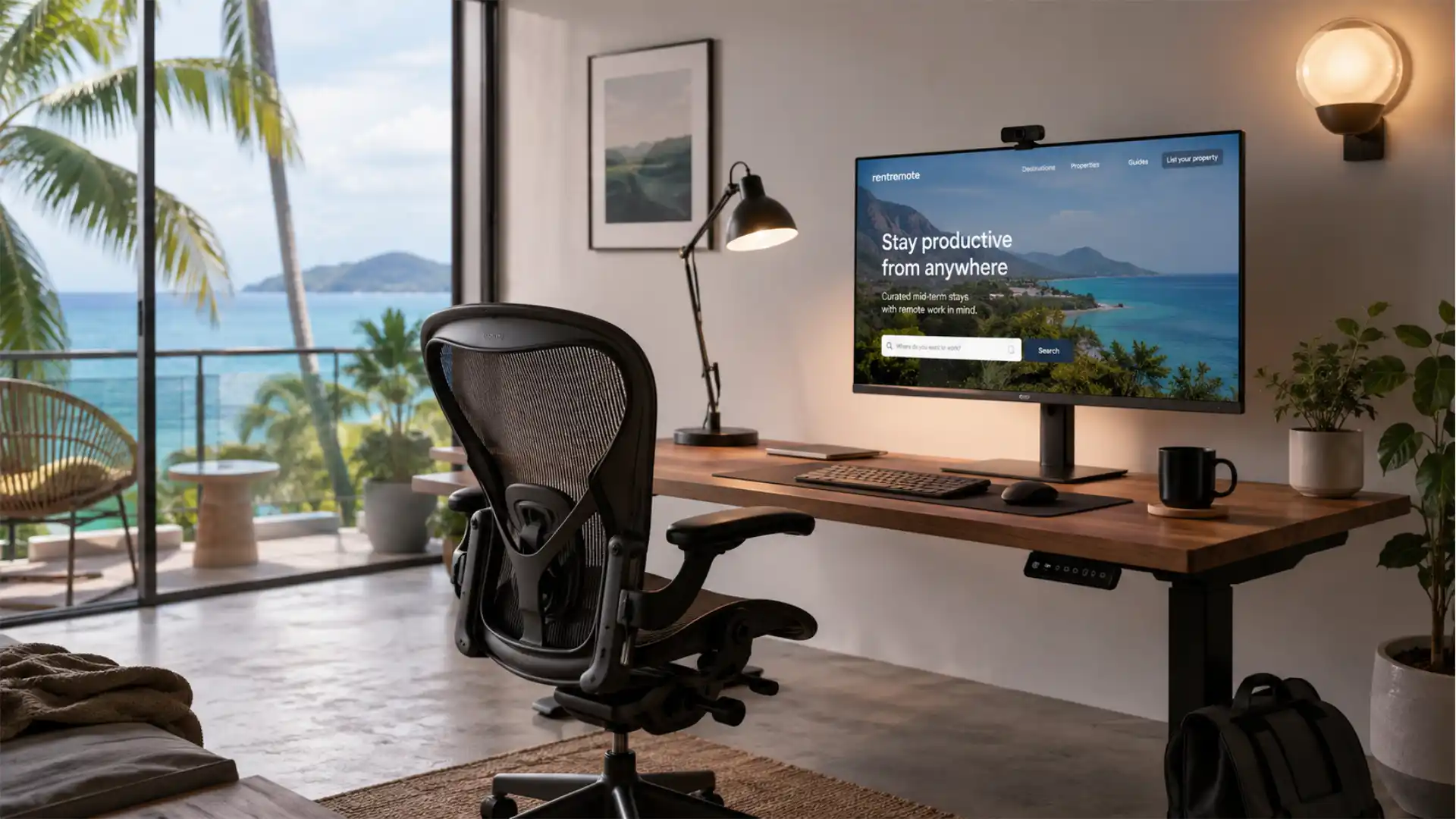
The oddest thing about RentRemote is not that it lists furnished apartments for people who move around. Plenty of sites do that now. The odd thing is that it seems genuinely preoccupied with the desk. Not the balcony shot. Not the white bedding. Not the vague promise of “fast Wi-Fi”. The desk. The chair. The monitor. The place where a person has to sit at 9:17 on a Tuesday morning and explain a roadmap, review a pull request, edit a deck, close a ticket, calm a client, or pretend not to notice construction noise outside.
Table of Contents
RentRemote describes itself as a platform for remote workers looking for furnished apartments with workstations, with stays running from one month to 11 months and properties equipped with high-speed internet, ergonomic workstations, and premium equipment. That sounds small until you remember how much of the internet still treats remote work as a decorative lifestyle category rather than a daily operating condition.
The digital nomad image usually arrives dressed as freedom. Laptop near a pool, laptop beside a latte, laptop on a balcony, laptop balanced somewhere no sensible person would actually work for longer than twelve minutes. RentRemote is built around the less photogenic truth: remote work is still work. It follows you into rentals. It punishes bad chairs. It exposes weak Wi-Fi. It turns a beautiful apartment into a poor decision if the only table is round, glass, and knee-height.
That is why the site is more interesting than a normal furnished-rental marketplace. RentRemote is trying to make “remote-work ready” feel like a certifiable property condition, not a marketing adjective buried under amenities. It takes the anxiety every traveling worker knows—will I actually be able to do my job here?—and makes that the thing it wants to solve.
There is a clean product idea hiding underneath the travel gloss. A mid-term stay is not a holiday rental and not a lease. It sits in the awkward middle: long enough that a bad setup becomes painful, short enough that you do not want to buy furniture, call an internet provider, haul in a monitor, or negotiate with a landlord about a chair. RentRemote’s useful trick is that it treats that middle category as its own creature.
Airbnb already tells hosts that a dedicated workspace can be as simple as a table or desk used for work, a nearby power outlet, and a comfortable chair. That definition is understandable for a mass marketplace, but it leaves a lot of room for disappointment. A dining chair can technically be comfortable. A tiny table can technically be a desk. A weak router can technically count as internet. RentRemote’s pitch starts where that ambiguity becomes annoying.
There is a good Web Radar reason to care about this. RentRemote is not just selling apartments; it is selling reduced uncertainty. The best niche internet products often look boring until you see the pain they remove. They do not invent a new human behavior. They name an already common frustration, make it searchable, and build around it with enough seriousness that the whole category starts to look underdeveloped elsewhere.
The apartment that admits you have a job
Most accommodation platforms are built around desire. Sea view, old town, bathtub, terrace, king bed, bright living room, close to cafés. Work sometimes appears as an amenity, but it is rarely the center of the page. RentRemote flips the emotional order. The pretty apartment still matters, of course. Nobody wants to spend three months in a bleak box with a monitor. But the site begins from a more adult question: can this place carry a workweek?
That makes the experience feel strangely sane. The product is aimed at people whose trip has consequences beyond the trip. A freelancer who misses a client call does not get to write it off as travel chaos. A remote employee cannot treat a broken connection as part of the adventure. A founder staying in Lisbon for six weeks still has investor calls. A designer testing Barcelona for a quarter still has deadlines. The romance of mobility does not erase the need for a stable work surface.
RentRemote’s homepage is plain about that center of gravity. It says users can rent from one month to 11 months and add a workstation, and it positions the platform around furnished apartments for remote workers rather than holiday guests. That one-month floor matters because it places the site firmly in mid-term territory, where the quality of the apartment starts to blend with the quality of someone’s working life.
A weekend rental can get away with charm. A three-month rental needs infrastructure. You can tolerate a soft chair for two evenings. You can take a call from the sofa once. You can write a few emails from the kitchen counter. Then the body keeps score. Your back notices. Your wrists notice. Your patience notices. The difference between “nice place” and “usable place” becomes less theoretical after the fifth day.
RentRemote is interesting because it does not pretend the worker will adapt to whatever furniture happens to be in the flat. It treats the workstation as a first-class part of the stay. That is not just a comfort detail. It is a trust detail. If a site shows you the desk and tells you what the setup includes, it is asking to be judged on work-readiness, not just atmosphere.
The travel internet has spent years teaching hosts to stage spaces for photographs. RentRemote’s premise quietly asks hosts to stage spaces for Monday morning. That is a different design problem. A good listing photo can hide the fact that the only outlet is behind the bed. A good work setup cannot. You either have room for the monitor and keyboard, or you do not. You either have a chair built for hours, or you have a dining-room compromise with nicer upholstery.
There is also a subtle psychological benefit in the way the site frames the stay. A proper workstation gives permission to work without feeling like you have failed at travel. Many nomads live inside a mild contradiction: they want the city, the movement, the new neighborhood, the café, the beach, the evening walk, but they also need to sit still for long blocks of time. A good rental should not make that feel like a betrayal of the trip. It should make it ordinary.
That ordinariness is the point. RentRemote is not selling the fantasy that every workday will be cinematic. It is selling the possibility that the workday will be unremarkable in the best way. The Wi-Fi connects. The desk height is sane. The monitor is not an afterthought. The call works. The chair does not become the main character by lunch.
This is where the “Nomad Lifestyle” idea gets more precise. The better version of nomad life is not permanent vacation; it is location flexibility with fewer broken basics. The basics are boring to photograph but brutal to lose. Internet. Light. A door that closes. A chair. A screen. A landlord who understands that a renter might be working full days from the apartment, not just sleeping there between excursions.
RentRemote’s site language leans into digital nomads and remote workers, but the audience is probably wider than the phrase “digital nomad” suggests. The strongest fit may be ordinary professionals in temporary motion: someone trying Madrid before relocating, someone spending two months near family abroad, someone escaping a winter city without taking time off, someone doing a project in another country, someone between leases, someone who wants a base that does not sabotage their calendar.
The platform’s “how it works” page reinforces that practical mood. Users browse apartments designed for digital nomads and remote workers, view real photos and detailed descriptions, check availability in real time, and filter by price, location, accommodation type, and move-in date. This is not a dreamy travel discovery flow as much as a decision-support tool for people with constraints.
The booking flow also speaks to a user who wants less drama. RentRemote says a booking is reserved while the owner confirms availability within 24 business hours, and the first payment includes a refundable security deposit and the first month’s rent, with other costs such as utilities or service fees listed in the property description. The site is trying to make the awkward handoff between marketplace browsing and actual housing feel less mysterious.
That does not mean every listing should be accepted without scrutiny. Mid-term rentals always deserve careful reading. Fees, deposits, bills, workstation availability, cancellation terms, neighborhood noise, building rules, and exact move-in dates all matter. But RentRemote earns attention because it starts from the correct concern. A remote worker does not only ask, “Can I stay here?” The real question is, “Can I live and work here without creating a new problem every day?”
Why the chair matters more than the view
The workstation page is the most revealing part of RentRemote because it turns taste into equipment. There is a Comfort package and a Premium package, and the Premium package reads like someone has actually watched remote workers suffer through bad rentals. The listed Premium setup includes a Herman Miller Aeron chair, a motorized standing desk, dual 4K monitors or an UltraWide display, a studio microphone, a 4K webcam, and priority support and setup. The page lists Premium at €299 per month for European properties.
The Comfort package is less extravagant but still more explicit than the usual “desk available” checkbox. It lists an ergonomic chair, standard desk, UltraWide monitor, HD webcam and microphone, and standard support, with the price shown at €149 per month. The strongest signal here is not the brand name or the price. It is the fact that the workstation is packaged and named at all.
This matters because the chair is where the platform stops being a rental directory and starts being a remote-work product. A chair is not aspirational in the normal travel sense. Nobody forwards a listing to a friend because the task chair made them emotional. But a serious chair tells you the operator understands the hidden cost of temporary living. Bad ergonomics do not feel like a missing amenity. They feel like a slow tax on attention.
The Herman Miller Aeron appears by name on RentRemote’s workstation page, and the Premium package repeats the Aeron, motorized standing desk, dual 4K or UltraWide display, high-quality microphone, 4K webcam, and priority phone support. That specificity is the selling point. “Comfortable workspace” asks the user to believe. “Herman Miller Aeron, standing desk, dual 4K monitors” gives the user something to judge.
Specificity changes the bargain. A remote worker can compromise on style more easily than on equipment. A slightly dull living room might be fine. A less photogenic bedroom might be fine. A workstation that turns every call into a battle with posture, camera angle, audio, and cable reach is not fine. The more serious the job, the less romantic improvisation becomes.
The Premium package is also a little funny, in the best internet-product way. It brings the office procurement mindset into the furnished apartment. A rental stay becomes modular. You are not only choosing a neighborhood and a bed count; you are choosing the kind of work surface and display setup that follows you into the city. That is weird enough to be memorable and useful enough to be more than a gimmick.
One listing example shows how that idea appears at property level. A RentRemote apartment page for Hamilton Apartments introduces a Premium Workspace starting from €215 per month, listing an UltraWide monitor, standing desk, and Herman Miller Aeron chair. The workstation is not hidden in a paragraph; it is merchandised as an upgrade.
That detail points to the company’s larger bet. Remote workers will pay to remove workstation uncertainty. They already pay in other ways: coworking passes, luggage upgrades for portable monitors, emergency cables, cafés with awkward table politics, chiropractor visits, lost hours. A workstation add-on turns that mess into a line item. Whether the price feels fair depends on the user, the stay length, and the available alternatives. But the line item itself is refreshingly honest.
There is a good critique here too. A paid workstation package is only as good as its actual delivery. The equipment list must match the apartment, the setup must be ready when promised, and support must be available when something is missing, broken, or awkwardly placed. A remote worker who pays extra for a workstation will be less forgiving than a tourist who finds the toaster disappointing.
The good version of RentRemote is not “luxury housing for laptop people.” The good version is logistics that respect the fact that work has physical requirements. A monitor means less neck strain. A good camera and microphone mean fewer apologetic calls. A standing desk means body movement during long days. A real chair means the apartment does not become an ergonomic trap.
The site’s equipment choices also reveal the cultural shift around remote work. The home office has become portable, but not weightless. Software travels instantly. Bodies do not. Bodies still need height, support, light, quiet, and screens at the right angle. The remote-work story often celebrates freedom from the office. RentRemote’s workstation obsession reminds us that people did not escape furniture.
This is why the view is secondary. A beautiful view can lift a mood, but it cannot rescue a bad eight-hour workday. A proper setup can make an ordinary apartment more valuable than a prettier one. That is not how travel sites traditionally trained us to choose, but it is how a large number of remote workers actually experience a stay.
The monitor is another underappreciated signal. A 4K display or UltraWide monitor says the user might be doing serious visual or multi-window work, not just checking email between beach visits. Developers, analysts, designers, operators, editors, consultants, founders, and support leads all know the pain of shrinking their job into a laptop screen for too long. Portable monitors help, but carrying one is a tax. Arriving to one is a relief.
Audio and webcam gear matter for the same reason. Remote work is partly performance through a rectangle. You can be competent and still look chaotic if the lighting is bad, the laptop is too low, the mic is poor, and the background is a mess. RentRemote’s inclusion of webcam and microphone gear in workstation packages acknowledges that the modern workday is not just typing. It is being seen and heard clearly from temporary places.
The standing desk might be the most symbolic object of the whole platform. It says the apartment is allowed to behave like an office without becoming one. You can raise the desk, take the call, finish the sprint review, then close the laptop and walk into a neighborhood that is not your usual neighborhood. The best remote infrastructure disappears when you do not need it and holds steady when you do.
There is also a subtle class divide in this product, and it is worth naming. RentRemote is not for every traveler, every budget, or every version of nomad life. The Premium workstation price alone could buy a lot of coworking days in some cities. Some people will keep choosing cheaper rentals and making do. Others will see the workstation as insurance against lost productivity. The interesting thing is not that one choice is morally better. It is that RentRemote is making the trade-off visible.
The most persuasive version of the site is not the one that says every remote worker needs a Herman Miller chair. The persuasive version says serious work has a setup cost, and temporary housing has ignored that cost for too long. Once you see the problem clearly, the normal rental marketplace starts to look strangely under-specified. “Dedicated workspace” becomes a little too soft. “Fast Wi-Fi” becomes a little too vague. “Laptop-friendly” starts to sound like a warning.
RentRemote turns the filter problem into the product
The ordinary rental search makes remote workers behave like detectives. They zoom into listing photos, inspect table heights, count outlets, scan reviews for Wi-Fi complaints, message hosts about upload speeds, ask whether the chair has arms, and wonder whether the “workspace” is actually a console table in a hallway. The process is ridiculous because the user is trying to infer professional usability from leisure photography.
RentRemote’s deeper product move is that it tries to remove that detective work. The site turns work-readiness from a filter into the main promise. Instead of treating the desk as one amenity among dozens, it frames the apartment around the ability to stay productive. That does not eliminate the need to check details, but it changes the default expectation.
A normal rental marketplace has to serve too many intents at once. Someone wants a romantic weekend, someone wants a cheap bed, someone wants a family kitchen, someone wants a pet-friendly place, someone wants a pool, someone wants nightlife, someone wants silence. Remote workers become one segment among many. RentRemote narrows the audience, and that narrowing is the point.
Narrow products often feel better because they can be opinionated. RentRemote does not need to pretend every stay is for everyone. It can assume the user cares about the workday. It can place workstation options in navigation. It can build city pages around remote-work demand. It can speak to property managers about mid-term tenants rather than weekend guests. The whole product becomes easier to understand because the customer is less blurry.
The “How it works” page is straightforward: browse apartments designed for digital nomads and remote workers, view real photos and detailed descriptions, check availability in real time, and filter by price, location, accommodation type, and move-in date. That combination sounds basic, but basic is exactly what housing search needs when someone is planning a month or more.
The platform also brings the owner-confirmation step into the open. RentRemote says the apartment is reserved while the owner confirms availability within 24 business hours. That detail matters because mid-term rentals often suffer from stale availability, especially when inventory is distributed across owners, managers, and channels. The promise is not instant perfection; the useful part is naming the confirmation window.
Auckland listing details show the other layer of trust language. One RentRemote listing displays “Order a Workstation,” “High Speed Wifi,” and a “Rent Remote Promise” that includes deposit protected, property checked, instant booking, some bills included, protection and support, and verified landlord. This is not proof that every stay will be flawless, but it shows how the site tries to package trust cues around the listing page.
The “property checked” and “verified landlord” language is especially relevant because remote workers are not only afraid of bad furniture. They are afraid of losing time to housing friction. A bad stay can eat days through messages, refunds, repairs, replacement bookings, and awkward negotiations. A platform built for mid-term professionals has to sell more than comfort. It has to sell lower interruption risk.
RentRemote’s partner side makes the marketplace mechanics more visible. Its Partner Network page says membership is reserved for professional property managers operating more than 30 properties, with approved portfolios receiving access to verified tenants, guaranteed payments, and dedicated portfolio support. It also says it verifies portfolio scale, quality standards, inventory fit, and operating readiness before onboarding.
That partner model suggests a sharper supply strategy than “anyone can list a spare room.” RentRemote appears to want managed inventory, not random hospitality. That can be a strength if it produces more predictable standards, better maintenance, and faster issue resolution. It can also limit supply if only certain operators qualify. For users, the upside is consistency; the downside is that availability may cluster around markets and managers where RentRemote has traction.
The partner page also uses the language of mid-term demand. It mentions 1–12 month flexible stays, reduced turnover, guaranteed payment on every booking, and dedicated partner support for qualified portfolios. That tells you the company is not just building a traveler-facing search page; it is trying to make remote workers legible to property managers as a desirable tenant class.
This matters because the remote-work rental problem is two-sided. Guests want work-ready homes, but hosts and managers need a reason to invest in work readiness. A standing desk, monitor, and better chair cost money. Clear photos take effort. Good support takes operations. If a platform can channel enough mid-term professional demand, those upgrades start to look like revenue infrastructure rather than decorative extras.
The product has an almost certification-shaped ambition, even when the word itself should be used carefully. RentRemote’s value depends on whether “remote-work ready” means something consistent across listings. The stronger that standard becomes, the less the user has to ask. The weaker it is, the more the site becomes another directory with nicer labels.
That is the real test. A category promise has to survive contact with the least polished listing. The best property pages will always look convincing. The question is whether the average property gives enough evidence: photos of the workstation, actual internet claims, clear billing, real availability, equipment details, neighborhood expectations, support paths, and honest notes about what is included or optional.
RentRemote’s corporate housing page gives another clue about where the company wants to sit. It describes corporate apartments with dedicated workspaces for professionals and lists work-ready spaces with high-speed internet, ergonomic chairs, external monitors, dedicated workspace, and video conferencing. The same page breaks out corporate housing by regions and shows Europe as a major focus, with countries including Spain, France, Portugal, and the United Kingdom.
Corporate housing is not as glamorous as nomad travel, but it may be closer to the economic engine. Companies understand temporary housing when a worker is relocating, joining a project, or spending a season in another city. If RentRemote can serve both independent nomads and corporate teams, the workstation idea becomes less like a lifestyle accessory and more like business accommodation infrastructure.
The name “RentRemote” is almost too literal, but literal names can work when the product is specific. It tells you the use case before the homepage finishes loading. This is not a platform for finding a castle, a treehouse, or a deeply unusual weekend. It is for renting somewhere because your job has become location-flexible and your apartment needs to keep up.
There is a real editorial lesson here. The web keeps producing better tools when someone stops treating a niche user as a decorative segment. Remote workers have been visible to travel platforms for years, but often as a marketing angle: work from anywhere, stay longer, live like a local. RentRemote focuses on the less glamorous unit of value: can you sit down and get through the day?
The mid-term stay has become its own internet category
RentRemote makes more sense when you see it beside the growing group of sites aimed at people staying longer than a trip but shorter than a lease. The mid-term stay has become a separate internet category because the old categories fit badly. Hotels are too expensive or too cramped for long stays. Traditional leases are too rigid. Holiday rentals can be charming but operationally uneven. Corporate housing can be useful but often feels built for relocation departments rather than independent workers.
Flatio calls itself a marketplace for hand-picked monthly rentals and mid-term rentals, with rentals around the world and digital-nomad accommodation among its categories. That puts RentRemote in a wider movement toward monthly living as a product, not a workaround.
Nomad Stays is another useful comparison. It positions itself around digital nomad accommodation, longer-stay hotels, remote-worker accommodation, verified Wi-Fi, and workspaces, and it says its stays have Wi-Fi with speeds independently tested by the platform. This shows that connectivity and work suitability are now major discovery signals for nomad housing, not niche afterthoughts.
Spotahome’s digital-nomad page makes the pain even more explicit. It says moving for a few months means finding temporary accommodation that combines comfort, good location, and a space that is ready for work, and warns that the search can turn into hours of uncertainty and options that do not deliver what was promised. RentRemote lives right inside that uncertainty problem.
The difference is in emphasis. Flatio leans into mid-term rental trust, Nomad Stays leans into nomad-friendly accommodation and tested Wi-Fi, Spotahome leans into flexible furnished stays, and RentRemote leans hard into the workstation. That is the memorable bit. It is not trying to be the broadest rental platform. It is trying to make the work setup the thing you remember.
Airbnb remains the giant shadow over this category because it has the listings, the habit, and the consumer trust. But Airbnb’s scale also makes its workspace language broad. Its hosting guidance says a dedicated workspace can be a table or desk used for work, a power outlet, and a comfortable chair, and it encourages hosts to show workspace photos and amenities. Useful, yes. Exacting, not always.
Airbnb also offers Wi-Fi speed testing guidance, but even there the responsibility lands on hosts to make sure the speed shown is accurate, available throughout the listing, and representative of what guests can expect. The broader marketplace can provide tools and fields, yet the remote worker still has to judge how much to trust a host’s setup.
That gap creates room for RentRemote. A specialist does not need to beat Airbnb at everything; it only needs to beat it at the thing a specific user cares about most. For a remote worker booking a month in Barcelona or Madrid, the decisive factor may not be the number of total listings. It may be confidence that the apartment has been selected, described, and equipped with work in mind.
The rise of this category also says something about remote work culture. The first wave of remote work content obsessed over freedom; the second wave is about maintenance. How do you keep habits? How do you avoid burnout? How do you protect your back? How do you choose a neighborhood where you can work and live? How do you stop the logistics from eating the reason you moved in the first place?
RentRemote is part of that second wave. It is not selling escape from work; it is selling a way to make work portable without making it fragile. That is less glamorous, but it is far more useful. The real nomad problem is rarely whether a city has good coffee. It is whether your temporary life can hold a recurring calendar.
This is also why mid-term stays feel different from travel. A one-week trip can survive novelty; a two-month stay needs routine. You need grocery patterns, sleep, laundry, calls, a place for your charger, and some separation between work and rest. A platform that understands routine will design differently from one that optimizes for the first impression.
The best RentRemote listings should feel like bases rather than escapes. A base lets you stop solving the same problems every morning. You know where you work. You know the connection is good enough. You know the chair will not betray you. You know whether bills are included. You know whom to contact if something fails. That is not glamorous. It is the foundation that makes the rest of the city available.
The workstation emphasis also changes how a city is chosen. A remote worker may pick a destination partly because the right apartment exists there. Lisbon, Barcelona, Madrid, Medellin, Mexico City, Porto, Valencia, London, and similar cities already attract mobile professionals, but the stay itself can be the bottleneck. A city with excellent cafés and coworking still loses appeal if the apartment makes every morning irritating.
RentRemote’s workstation page lists city counts and featured destinations, including Barcelona, Paris, Medellin, Porto, Valencia, Mexico City, Miami, Lisbon, Madrid, London, Dubai, Auckland, Goa, Tokyo, and others. The breadth is attractive, but the important question for users is not the headline count; it is whether the exact city, date, budget, and workstation requirement line up.
That is where a specialist platform has to be disciplined. The more cities it lists, the harder it becomes to keep the promise sharp. A remote-work ready apartment in Madrid and one in Auckland should not feel like two unrelated interpretations of the phrase. If the site becomes a patchwork of inventory quality, the workstation branding loses force.
Still, the category direction feels right. Remote workers are tired of translating their needs into platforms built for someone else. They do not want to ask whether “desk” means desk. They do not want to gamble on Wi-Fi language. They do not want to buy a chair for six weeks. They do not want to spend the first two days of a new city turning an apartment into a workplace.
That is the small but real cultural shift RentRemote captures. The laptop lifestyle is growing up, and grown-up nomadism has procurement problems. Not romantic problems. Not identity problems. Procurement problems. Where is the monitor? Who checks the landlord? How long is the stay? What is included? What happens when the internet fails? The websites that answer those questions plainly become more interesting than the ones with better sunsets.
What stands out once the novelty wears off
RentRemote’s first impression is easy to like because the pain is obvious. Many remote workers have had the “nice apartment, terrible workday” experience. The richer question is whether the platform has enough operational seriousness behind the good idea. Work-readiness is not a vibe. It has to be delivered through equipment, standards, support, and honest listing detail.
A compact view of the product
| Product choice | What it signals | Why it matters |
|---|---|---|
| Workstation packages | Work setup is treated as a paid, named product | Users know what equipment to expect instead of guessing from photos |
| Monthly stay focus | The site is built for mid-term life | Bad furniture and weak Wi-Fi hurt more over weeks than over weekends |
| Property trust cues | Listings use signals such as property checked and verified landlord | Remote workers need fewer housing interruptions, not just nicer rooms |
| Partner network | Supply is aimed at professional managers | Managed inventory may support more consistent standards |
| Optional upgrades | Some workstations appear as add-ons | Users must check what is included and what costs extra |
The table is where the product becomes clearer: RentRemote’s strongest feature is not one object, but a chain of choices that all point toward the same user pain. The platform is best understood as an attempt to make temporary housing less hostile to serious remote work.
The most attractive part is the equipment clarity. A named workstation package makes the rental feel less like a gamble. You can decide whether the Comfort package is enough, whether Premium is worth paying for, or whether a specific property already includes what you need. That is a better decision than staring at a listing photo and wondering if the chair is secretly terrible.
The second strength is the mid-term framing. RentRemote is not asking users to pretend a month-long stay is just a stretched vacation. It acknowledges the dull realities: deposits, first month’s rent, utilities, support, booking confirmation, and workstation needs. This is refreshing because so many travel products make administrative details feel like mood-killers. For remote workers, those details are the mood.
The third strength is the two-sided marketplace logic. RentRemote speaks to guests and to professional property managers in the same language of mid-term usefulness. Guests want work-ready homes. Managers want longer stays, lower turnover, and reliable payment. If those incentives meet, better remote-work inventory may become easier to justify.
The risk is standard drift. A platform that promises work-readiness has to be more careful than a platform that promises only accommodation. Users will forgive small cosmetic differences. They will be far less forgiving if a workstation is missing, a monitor is not as described, Wi-Fi is unstable, or support does not understand the urgency of a work problem.
There is also a branding risk around premium equipment. The Herman Miller and 4K monitor language is memorable, but it can raise expectations very high. Once you invoke serious office gear, the user expects serious execution. The desk cannot be wedged into a dark corner. The cables cannot be missing. The monitor cannot arrive two days late. The setup has to feel intentional.
The optional nature of workstation packages needs close attention from users. Some properties may be work-ready by default, while others may require ordering a workstation or paying for an upgrade. That is not a flaw by itself, but it means the booking decision has to include exact equipment questions. Remote workers should not assume every listing includes every premium item just because the platform is workstation-forward.
The city counts are another place to stay sober. Large listing numbers can be useful for confidence, but they do not guarantee the right apartment for a specific month. Availability, pricing, workstation eligibility, neighborhood, bills, and landlord terms all narrow the real choices. A platform can have hundreds of listings in a city and still have only a handful that fit your actual dates and budget.
The strongest user experience would be one where every listing answers the same core work questions without making the user ask. What is the internet speed? Is there a dedicated desk? What chair? What monitor? Is the workstation included or optional? Where is it placed? Is there natural light? Is the room quiet enough for calls? What support exists if something fails? RentRemote’s promise becomes more valuable as those answers become more standardized.
There is another tension in the product: home versus office. A good remote apartment should not feel like a cubicle with a bed attached. The workstation has to be strong, but the place still has to live well. People choosing mid-term stays are often trying to experience a city, not hide inside a corporate pod. The best RentRemote properties will preserve that balance: productive by day, residential after the laptop closes.
The design of the listings matters here. Photos of the workstation should be as honest as photos of the sofa. A cropped monitor shot is less useful than a full view showing desk placement, chair, light, outlets, and room context. A remote worker does not only need to know that equipment exists. They need to know whether it fits into a daily routine.
There is a useful skepticism to bring to any platform in this category. “Remote-work ready” should never be accepted as magic language. The user still needs to check reviews, terms, fees, equipment, neighborhood, and support. But a good specialist platform moves many of those checks closer to the surface. That alone saves attention.
RentRemote’s place in Web Radar comes from this mix of mundane and sharp. It is not a dazzling web experiment, but it points at a better way to structure a familiar search. The internet has enough places to find a bed. The more interesting frontier is finding places that match the messy ways people now live: part renter, part traveler, part worker, part local, part temporary resident.
The project also makes a quiet argument about online marketplaces. The next useful marketplace may not be broader; it may be narrower and stricter. We have already seen giant platforms absorb every possible use case. The opportunity now is to carve out the users who feel underserved by that breadth. RentRemote carves out people who cannot afford to have their housing search ignore their calendar.
The hidden promise is less glamorous than it sounds
The phrase “nomad lifestyle” usually invites images of motion. RentRemote’s hidden promise is stillness. A desk is a place where movement pauses. A monitor is an anchor. A chair is a commitment to being in one place long enough to need support. The platform is interesting because it dares to make those anchors part of the lifestyle rather than evidence against it.
That is a more honest picture of remote work. People do not become less dependent on routine just because they can change countries. Many become more dependent on it. New city, new language, new supermarket, new transit habits, new apartment quirks, new sleep patterns: all of that adds cognitive load. A good workstation removes one piece of instability.
A poor rental creates invisible work. You arrive, then you start fixing the place. You move furniture. You test Wi-Fi in corners. You hunt for an HDMI cable. You stack books under a laptop. You message the host about a chair. You buy a power strip. You discover the desk is under the air conditioner. None of that appears in the listing price, but it is part of the cost.
RentRemote’s promise is to reduce that invisible work. The site is valuable when it lets the guest arrive closer to operational. Not pampered. Not amazed. Operational. That is the word many remote workers secretly want from accommodation. They want the city to be surprising and the apartment to be boringly functional.
This is why the product has appeal beyond digital nomads with Instagram energy. It may be even more useful for people who dislike the chaos associated with nomadism. A remote engineer with two monitors at home might want to spend a month in Porto but refuses to downgrade to laptop-only work. A project manager might want a proper call setup. A founder might need a professional background. A consultant might need to work European mornings and U.S. afternoons without fighting the room.
The best version of the platform makes travel less performative. You do not need to turn every day into content or every stay into an adventure. You can have a normal workday in a different place. You can buy groceries, take calls, cook dinner, walk after dark, and slowly understand a neighborhood. That is a calmer, more sustainable version of location flexibility than the constant highlight reel.
The workstation also changes how couples or teams think about stays. One “dedicated workspace” may not be enough when two people work full-time. Airbnb’s own hosting guidance suggests that couples working remotely may need separate spaces, which is one of those obvious truths that many listings still fail to respect. RentRemote’s equipment-first approach makes that conversation easier because it foregrounds the work layout rather than hiding it under generic amenities.
For companies, the same logic becomes even sharper. A relocated employee or temporary team member needs housing that does not quietly damage performance. Corporate housing pages on RentRemote emphasize dedicated workspaces, high-speed internet, ergonomic chairs, external monitors, and video conferencing. That is exactly the kind of language procurement teams understand.
The corporate angle could make RentRemote less romantic but more durable. Independent nomads are a visible audience, but business travel and relocation budgets may make the workstation standard easier to fund. If companies are willing to pay for reliable temporary work housing, property managers have a stronger reason to install better equipment. The consumer side then benefits from the raised standard.
There is a design lesson here for any digital product serving remote workers. Do not sell freedom without selling the boring support that makes freedom usable. The remote-work internet is full of tools that promise flexibility. The better ones notice that flexibility creates new chores. RentRemote notices one large chore: turning a temporary apartment into a real place to work.
The platform also exposes a flaw in how many rental pages are written. Amenities are often listed as nouns, but remote workers need evidence. “Internet” is a noun. “High-speed Wi-Fi tested at the property with stable coverage in the workspace” is evidence. “Desk” is a noun. “Motorized standing desk with external monitor and ergonomic chair” is evidence. The more evidence a listing gives, the less trust it asks the user to donate.
Airbnb’s Wi-Fi testing help page makes the same point indirectly by saying hosts are responsible for making sure the displayed speed is accurate, available throughout the listing, and representative of what guests can expect. Remote workers do not just need speed; they need the speed to be true where they will work.
RentRemote’s opportunity is to make that evidence routine. A great specialist marketplace teaches users what to expect and teaches suppliers what to provide. If enough guests choose listings with real workstations, hosts learn that “desk-like surface” is not enough. If enough hosts upgrade, guests become less tolerant of vague claims. The category improves through repeated pressure.
The danger is that the phrase “remote-work ready” becomes diluted across the web. Once a phrase starts converting, every listing wants to borrow it. A kitchen table becomes a workspace. A speed-test screenshot becomes a promise. A nice chair becomes ergonomic because the word sounds good. RentRemote’s brand strength depends on resisting that dilution within its own inventory.
This is why the site should be judged less on its best pages and more on its weakest claims. A trustworthy niche platform has to say no. No to unclear workspaces. No to under-described equipment. No to fake desk photos. No to listings where the internet is technically present but practically poor. No to properties that cannot handle the support expectations of working guests. Saying no is what makes curation worth paying attention to.
At the same time, the platform should not over-polish the experience into sterility. Remote workers still care about place. The apartment should feel like it belongs in Barcelona, Lisbon, Medellin, Porto, Mexico City, Auckland, or wherever it sits. A workstation should not erase local character. The best outcome is not a global sameness of grey desks. It is a local home with a reliably serious work corner.
That balance is harder than it sounds. Too much standardization makes every apartment feel like a serviced office; too little makes the platform unreliable. RentRemote’s challenge is to standardize the work-critical parts while leaving room for the home to feel specific. Chair, desk, monitor, internet, support: strict. Art, layout, neighborhood, mood: varied.
The site’s most memorable idea is that the remote worker’s body belongs in the listing. Not just their suitcase, not just their laptop, not just their passport. Their back, eyes, wrists, voice, calendar, calls, and attention span all come along. A listing that ignores those things is not fully describing the stay.
Things worth knowing before booking
It is best for someone who already knows they will work full days from the apartment and does not want to rebuild a workstation after arrival. The strongest fit is a remote employee, freelancer, founder, consultant, designer, developer, operator, or relocation tester staying at least a month. If the stay is mostly leisure, the workstation may be more than you need. If the stay depends on calls and deep work, it may be the whole reason to book.
No, and that is part of its appeal. The term “digital nomad” can make the audience sound younger, looser, and more travel-obsessed than it really is. RentRemote’s practical audience includes people doing temporary life: trial relocations, corporate projects, seasonal moves, team assignments, family visits, study-adjacent work, or a winter month somewhere brighter. The common trait is not identity. It is the need for a rental that respects the workday.
Users should check carefully. RentRemote promotes workstation packages and some listing pages show options such as “Order a Workstation,” while package pages describe Comfort and Premium tiers for European properties. That means the workstation may be included, optional, location-dependent, or priced separately depending on the property and setup. The smartest move is to confirm the exact equipment before booking.
The important checks are exact workstation contents, whether the equipment is included or added monthly, internet speed and reliability, workspace photos, chair type, monitor size, desk placement, cancellation terms, deposit rules, included bills, move-in process, and support response. The point of a specialist platform is to reduce guessing, not to remove due diligence completely.
It depends on the worker. Coworking gives separation, community, and often strong internet. A home workstation gives privacy, no commute, easier calls, and a setup available at odd hours. RentRemote is most compelling for people who want the apartment itself to carry the workday, not for people who prefer leaving home to work.
Supply and consistency. RentRemote’s idea is sharp, but the real value depends on whether the right property exists in the right city, at the right price, with the right workstation, on the right dates. A narrow marketplace can feel brilliant when it matches your need and thin when it does not. That is normal for specialist platforms, but users should go in with clear constraints.
RentRemote is worth opening because it reframes accommodation search around the part of remote life that most listings treat lazily. It makes the desk visible. That alone changes the user’s attention. You start judging apartments by whether they can support your actual day, not by whether the photographs suggest a lifestyle you may not have time to live.
It shows how mature online categories split into sharper tools. First we had travel booking. Then holiday rentals. Then long-stay rentals. Then digital-nomad accommodation. Now we get platforms where the workstation becomes the differentiator. The web keeps getting more useful when it stops pretending one search box can understand every kind of life.
RentRemote is a strong Web Radar find because it takes an unglamorous problem and gives it product shape. It is not strange in a novelty sense. It is strange because it makes you notice how underbuilt most rental search still is for people who work remotely. Once you see an apartment listing organized around the chair, monitor, desk, and Wi-Fi, the old “dedicated workspace” checkbox starts to look painfully thin.
The final reason RentRemote sticks is that it treats productivity as physical. Remote work is not only a software condition; it is a room condition. It needs furniture, light, bandwidth, silence, support, and proof. RentRemote’s best idea is to make those conditions searchable and sellable. For anyone who has ever opened a laptop in a beautiful apartment and immediately realized the workday was going to be a fight, that is enough to earn the click.
Author:
Jan Bielik
CEO & Founder of Webiano Digital & Marketing Agency
This article is an original analysis supported by the sources cited below
RentRemote homepage
Official RentRemote homepage describing the platform’s furnished apartments for remote workers, one-to-11-month stay positioning, high-speed internet, ergonomic workstations, and workstation add-on.
RentRemote workstations
Official RentRemote workstation page detailing Comfort and Premium workstation packages, including ergonomic chairs, Herman Miller Aeron chairs, standing desks, UltraWide or dual 4K displays, webcams, microphones, and monthly pricing.
RentRemote how it works
Official RentRemote booking explanation covering browsing, real photos, detailed descriptions, availability checks, filtering, owner confirmation, payment components, deposits, and fees.
RentRemote partner network
Official RentRemote partner page explaining its selective membership for professional property managers, portfolio verification, mid-term rental demand, guaranteed payments, and dedicated support.
RentRemote corporate housing
Official RentRemote corporate housing page describing dedicated workspaces, high-speed internet, ergonomic chairs, external monitors, video conferencing support, and regional corporate housing coverage.
Airbnb guide for remote-worker spaces
Official Airbnb host resource explaining its dedicated workspace guidance, remote-worker amenities, fast Wi-Fi, workspace photos, ergonomic support, and other work-friendly listing improvements.
Airbnb Wi-Fi speed test help
Official Airbnb help page explaining host responsibility for Wi-Fi speed test accuracy and how Wi-Fi speed information should represent what guests can expect at the property.
Flatio homepage
Official Flatio homepage used for market context around hand-picked monthly rentals, mid-term rentals, coliving, and accommodation categories for digital nomads.
| Citing this article? Brief excerpts are welcome. Please credit Webiano.digital, name the author where stated, and include a link to https://webiano.digital and to this original article. Full or substantial republication requires prior written permission. Read our Copyright and Content Use Policy. |
This article was prepared with the assistance of artificial intelligence tools. The content underwent expert human review, and Webiano Digital & Marketing Agency assumes editorial responsibility for its final version and publication.