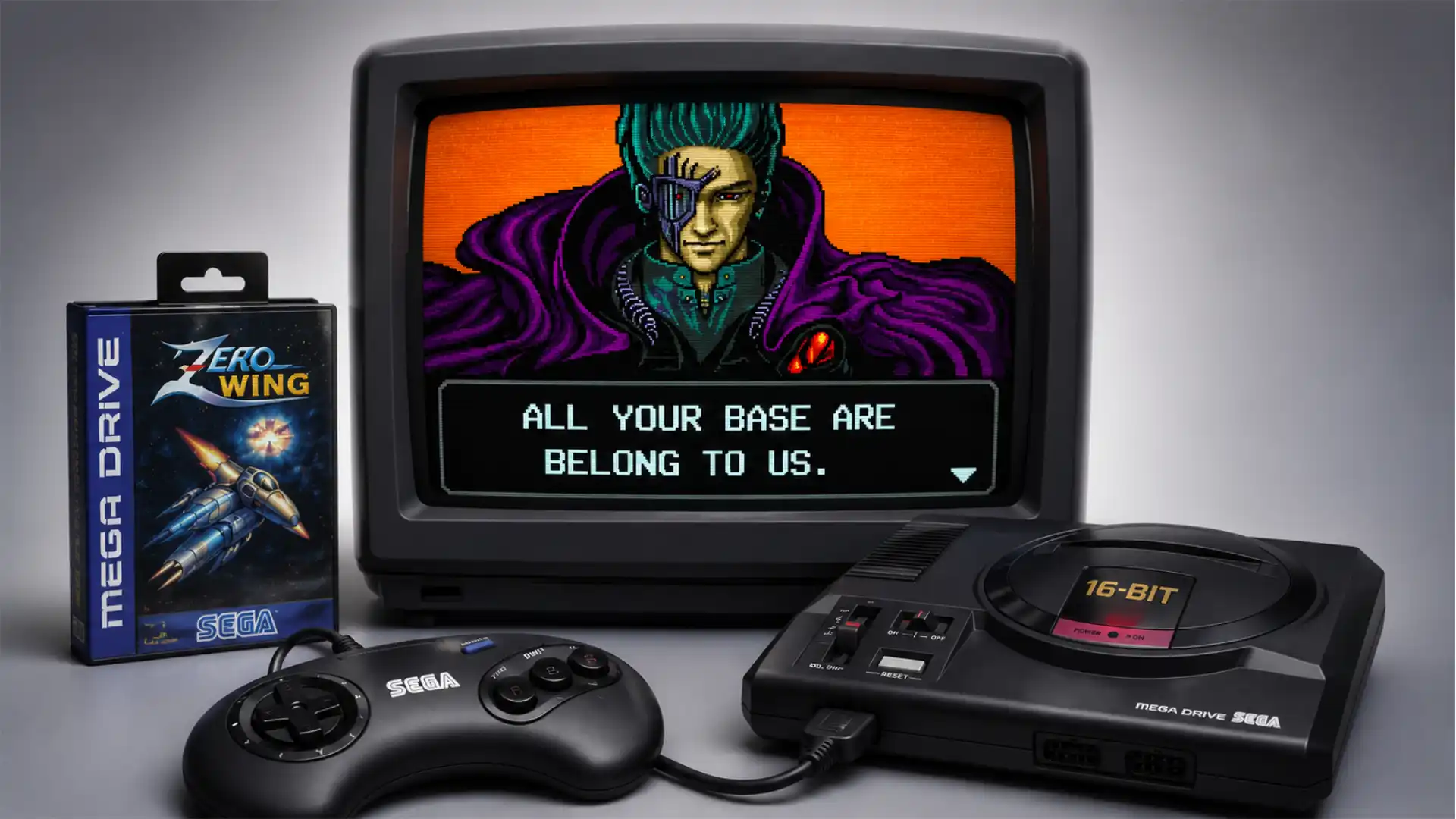
The phrase should have died inside a forgotten shooter intro. It was awkward, stiff, and grammatically wrecked in the exact way a commercial release was not supposed to be. A villain appeared on a spaceship monitor, delivered a mangled threat, and moved the plot forward for players who mostly wanted to shoot things. The line was not polished comedy. It was not written as a joke. It was not trying to become a badge for people who knew how the internet worked before the internet explained itself. It was just there, badly translated and somehow perfectly shaped: “All your base are belong to us.”
Table of Contents
A wrong sentence with perfect rhythm
That is the first reason it still feels alive. The line is not merely wrong; it is wrong with rhythm. “All your base” gives you a noun that refuses to behave. “Are belong” jams two verbs together like a machine-translated sentence before machine translation became a daily habit. “To us” lands with the smug certainty of a villain who has no idea his English has collapsed. The sentence is broken, but it still communicates. You understand the threat. You understand the pose. You understand that somebody, somewhere, has seized the bases. The error makes the line funnier because it does not destroy the meaning. It distorts it.
The second reason is that the sentence arrived with a face. The Zero Wing intro did not give the web a loose phrase floating in space. It gave it CATS, the blue-faced antagonist on the main screen, staring out from a sci-fi interface like a pirate dictator trapped in a cartridge. Know Your Meme traces the phrase and footage to the Mega Drive port of Toaplan’s 1989 arcade shooter Zero Wing, where CATS delivers the line during an exchange with the ship’s captain.
The third reason is harder to fake: the line came from a real object. Zero Wing was not a spoof website or a sketch made to bait attention. It was a commercial game, a side-scrolling arcade shooter from a serious Japanese studio, later ported to Sega hardware. The modern Steam page sells Zero Wing as a preserved Toaplan horizontal arcade shooter with PC features such as rewind, quick saves, leaderboards, assist options, and practice tools. That tension still matters. The phrase became absurd because it leaked out of something sincere. The joke rests on the fact that someone shipped it.
Open the clip now and it looks tiny by current standards, which makes it sharper. No algorithmic feed had to decide the clip was “performing.” No brand voice joined the joke by lunch. No platform dashboard told users which remix format to copy. Early web users saw a bad translation, clipped it, repeated it, pasted it into images, and treated the sentence like a secret handshake. The fun came from participation, not passive scrolling. The line spread through craft: forums, Flash files, GIFs, personal sites, comments, image edits, and people with too much time plus just enough tools.
The phrase also arrived before “meme” had hardened into a household label. People had jokes, running gags, macros, forum signatures, viral videos, and catchphrases, but the fixed grammar of modern meme culture was still forming. “All your base” sits at that strange hinge point. It was visual, textual, musical, repeatable, remixable, and easy to carry outside its source. It was not the first internet joke, and it was not the first phrase to spread online. The reason people keep treating it as early, foundational, or “the first true meme with legs” is that it behaved like the formats that followed: it could detach from its origin and still work.
The real discovery now is not only the line. The web still has enough pieces of the chain to let you inspect how a joke became infrastructure. You can read the Know Your Meme entry, open the archived Flash item, compare the Japanese with the English through Legends of Localization, see how Wired covered the frenzy in 2001, and buy the polished PC release of Zero Wing. That makes “All your base are belong to us” a rare thing: a prehistoric meme whose fossil record is still clickable.
Resist clean nostalgia for a moment. Yes, the line belongs to a dial-up, forum-heavy, Flash-era web. Yes, it carries the smell of CRT monitors, Winamp skins, late-night browser tabs, and old pages that looked as if someone built them with a keyboard and stubbornness. But the reason it deserves another look is not that the old internet was pure and the current internet is false. The reason is cleaner: this one shows how an accidental phrase became a format before formats were professionally managed. It shows the web discovering that a mistake could become a shared object, and that repetition could turn nonsense into culture.
The game behind the line was real enough to matter
Zero Wing itself is easy to underestimate because the meme ate its name. For many people, the game is only a delivery mechanism for the sentence. That is unfair, but easy to understand. The line is more famous than the shooter, more famous than most of its mechanics, and more famous than the people who made it. Yet the game matters because the bad translation had to come from somewhere with enough texture to hold a joke. Zero Wing is not an empty container. It is a horizontal shooter about a galaxy under attack, a ZIG craft, and a villainous space-pirate commander whose name sounds like the internet was already joking before it knew it had one.
The intro feels like a tiny stage play with damaged subtitles. The crew receives a signal. The main screen turns on. CATS appears. The captain reacts. Threats are issued. The ZIG takes off. Nothing about that scene is complicated, which is part of why the bad English stands out so cleanly. The story beats are simple enough that even the broken lines remain readable. Know Your Meme preserves the surrounding dialogue, including “Somebody set up us the bomb,” “What happen?” “You have no chance to survive make your time,” and “For great justice.” Those lines matter because the meme did not live on one sentence alone. It came from a whole pocket of malformed sci-fi urgency.
Clyde Mandelin’s Legends of Localization page is one of the best places to open after the video. Mandelin treats the scene as a translation artifact rather than a cheap punchline, comparing the Japanese script with the English script. His article notes that the Japanese version has its own script and that the opening scene comes off differently when paired with the original text. That matters because the joke becomes lazy if you only laugh at “bad English.” The more interesting angle is how a small commercial localization gap produced a sentence with stronger cultural life than thousands of flawless marketing lines.
The more accurate sense of CATS’s boast is not nonsense at all. The Japanese line says CATS has taken the heroes’ bases. Wikipedia’s transcript comparison places the broken English line beside a clearer rendering in which CATS has taken all of the bases, with later revised wording in the 2023 release. The broken version did not invent a new plot. It damaged the surface of a straightforward threat. That is the exact pocket where the phrase lives: intelligible enough to quote, broken enough to enjoy, short enough to mutate.
The game’s modern PC release gives the source material a second, calmer life. Steam lists Zero Wing with Bitwave Games and Toaplan as developers, Clear River Games as publisher, and a 14 February 2023 release date. That modern page is almost funny in its dignity. It sells features, composers, leaderboards, rewind, quick saves, and practice options. It treats Zero Wing as a game again. After years of being reduced to one line, the original artifact now sits in a storefront like a recovered object in a museum gift shop.
That tension makes the Steam page worth opening even for non-players. It reminds you that memes can flatten their sources. Zero Wing has weapons, enemies, music, difficulty, co-op, and arcade craft. The meme treats all of that as scaffolding for one collapsed sentence. The modern release restores some of the game’s shape, even if most visitors still arrive through the joke. There is a quiet irony in the page’s neat product language. It tries to sell an old shooter while the internet keeps barging in to point at CATS and shout the line again.
The line also exposes how localizations used to carry risk in plain sight. A mistranslation in a cartridge could not be patched overnight. It sat in the product, passed from console to television, then from capture hardware to GIF to forum thread. The error had weight because the medium was less liquid. Today a typo in an interface might disappear by morning. Zero Wing’s English intro became fixed enough to become legendary. The permanence made the joke collectible. People were not sharing a mistake that would vanish; they were sharing a mistake with a home address.
The source game gives the meme its odd dignity. A purely manufactured nonsense phrase might have burned hot and disappeared. A translation error in a real sci-fi shooter gave the web a better toy: a found object with accidental authorship. Nobody sat in a room planning the perfect viral sentence. A line passed through production, shipping, obscurity, rediscovery, and collective misuse. That path gives it texture. The web did not only laugh at the sentence. It adopted it.
The line also belongs to a specific kind of imported game culture. English-speaking players in the 1990s often encountered Japanese games through odd translations, compressed manuals, strange title screens, and localizations that felt half polished and half mysterious. Some of those mistakes were irritating. Some became beloved. “All your base” landed in the rare zone where the error was public, quotable, and weirdly musical. The line sounded like a threat, a bug, and a slogan all at once.
There is a human story hiding behind the joke, even if the meme rarely pauses for it. Someone had to translate the line. Someone had to approve the text. Someone had to put it into the build. Someone had to ship it into a regional market. The internet later treated the result as an anonymous accident, but commercial media is never fully anonymous. It is made by people under deadlines, budgets, assumptions, and constraints. Laughing at the line is easy. The richer reading notices how many ordinary production decisions had to line up before the sentence could enter culture.
That production reality also protects the meme from feeling too designed. Web culture has always had a nose for bait. The more something begs to become viral, the less people enjoy carrying it. “All your base” carried no such smell. It was not asking to be shared. It was just wrong in public. That lack of ambition is one of its great advantages. It gave users the pleasure of discovery, not compliance.
The early web knew what to do with a mistake
Before the Flash video, the phrase moved like contraband. It traveled through GIFs, quote pages, forums, and small sites where a weird game line could be treated as treasure. Know Your Meme credits early GIF circulation to the late 1990s, with Zany Video Game Quotes helping popularize the opening-sequence GIF around 1998 or 1999. This phase is the part that gets lost when people reduce the meme to one famous music video. The web did not wake up one morning and suddenly know CATS. It warmed up through small acts of recognition.
That slow build matters because pre-feed virality worked differently. A person saw the GIF, sent it to another person, posted it in a thread, quoted it in a signature, or tucked it into a personal page. The joke spread through social texture rather than platform architecture. It did not need a share button. It needed people who enjoyed confusing other people. The pleasure was partly in making the next reader ask what the hell they were looking at. That slight gatekeeping, half annoying and half affectionate, was central to early web humor.
The format was already visible before anyone called it a format. Take a phrase from a specific source. Repeat it where it does not belong. Place it on signs, screens, objects, fake ads, game references, and edited photos. Let the original grammar stay broken so the joke remains identifiable. This is almost the same logic that later meme templates would formalize, except the tools were rougher and the audience smaller. “All your base” gave people a phrase that could be inserted into the world like graffiti.
The original wording also worked because it had several reusable parts. “All your X are belong to us” is not correct English, but it is structurally generous. You can replace “base” with almost anything and the joke still points home. “You have no chance to survive make your time” is stranger, less flexible, but perfect as a secondary quote. “For great justice” gives the sequence a heroic button. The whole Zero Wing intro became a small phrase kit. A meme with one line has a hook. A meme with a kit has legs.
Wired’s 2001 coverage captures the moment when the private joke became public noise. The article describes T-shirts, chat rooms, web reporters looking for an explanation, and a Flash file built from screenshots of an old arcade game spreading across the web. Read it now and the tone is deliciously confused. It is not hostile. It is baffled. The piece has the feeling of mainstream web culture looking at forum culture and realizing that something had escaped the lab.
The confusion was part of the event. The line was funny to insiders because it needed no explanation once you had seen the source. It was funny to outsiders because it seemed to arrive fully formed, already overused, already wearing its own fake importance. Wired quoted people trying to explain the craze through MetaFilter, gaming sites, and the original bad translation. That public act of explanation changed the meme. A joke that had thrived on “you had to be there” became something people could join after reading a primer.
The early web also had a cruel metabolism. By the time press coverage arrived, some early fans were already tired of the line. Wired quoted the Zany Quotes owner pleading for people to stop, complaining that jokes stop being funny when they become catchphrases. That complaint sounds familiar because every meme cycle still contains it. The people who found a joke early feel robbed when the crowd arrives. The crowd arrives because the joke is good enough to travel. Then the joke becomes unbearable because it traveled.
This is where “All your base” starts to look less like an antique and more like a blueprint. It had discovery, insider pride, remix labor, mainstream confusion, merch, exhaustion, and backlash. It moved from obscure source to shared reference to overexposed slogan. The cycle now happens in hours. Back then it had room to breathe, which made the trail easier to see. The bones of modern meme culture were already there: find, isolate, repeat, mutate, explain, commercialize, cringe, archive.
The old image edits deserve special attention because they made the sentence spatial. The joke was not only that CATS said a weird thing. The joke was that the phrase had invaded the visible world. Put it on a highway sign, a storefront, a government notice, a computer screen, a protest banner, or a product label, and the line became a fake act of conquest. The content matched the grammar. The words announced takeover, and the edits made it look as if the takeover had happened. That is cleverer than it first appears.
The old web also rewarded visible effort. A bad Photoshop could still be funny if the placement was smart. A crude edit could earn a laugh because someone had bothered to make it. The joke lived in the gap between skill and dedication. People were not only consuming a line; they were proving they could place it somewhere new. That gave the meme a participatory engine. Every new fake sign or doctored image said, in effect: I found another base.
The meme’s spread also depended on small sites acting like memory pockets. A page such as Zany Video Game Quotes could hold a strange fragment until the larger web was ready for it. Forums could repeat it. Image threads could mutate it. Flash portals could package it. Press sites could explain it. The old internet was less centralized, so cultural objects often moved by hopping from room to room. “All your base” was well built for that kind of hopping because it was light, weird, and easy to recognize.
The phrase was also social because it punished over-explanation. The more you explained why it was funny, the weaker it became. The line worked best as a thing dropped into a conversation with no setup. That was a core early-web skill: knowing when a reference should remain slightly rude and unexplained. “All your base” was funny partly because it made the uninitiated feel late. That is not always a generous impulse, but it is a real one, and early web culture ran on it.
Flash turned a catchphrase into a shared ritual
The Flash video is where the meme became a full-body experience. It bundled the game intro, the broken subtitles, the music, and the image edits into something you could send to a friend without explaining the separate pieces. The Internet Archive entry lists the archived Flash item as “All your base are belong to us,” credits The Laziest Men on Mars and Bad_CRC, gives a February 2001 publication date, and identifies it as a Flash artifact. That page is one of the cleanest places to see the meme as a preserved object rather than a memory.
The video matters because it solved the distribution problem. A GIF could introduce the source. A forum thread could host the joke. A folder of image edits could reward insiders. The Flash video compressed the whole ecosystem into one file with momentum. It gave the phrase a beat. It turned scattered participation into a watchable sequence. It made “All your base” easier to pass along to people who were not already inside the forum joke. That is why the video often functions as the public birthday of the meme, even though the line had circulated earlier.
The music did more work than nostalgia admits. Wikipedia’s history notes that Jeffrey Ray Roberts of The Laziest Men on Mars made the techno track “Invasion of the Gabber Robots” in November 2000 and that Bad_CRC posted an animated music video to Newgrounds on 16 February 2001. The beat made the joke less like a quote and more like a ritual. Once a phrase becomes something you can hear in your head, it stops needing the screen.
Newgrounds was the correct room for that kind of explosion. It was messy, creative, adolescent, fast, rude, and full of people who knew how to turn scraps into spectacle. The Newgrounds “All Your Base” collection still files the phrase under “Memes and Trends,” framing it as a native part of the site’s culture rather than a footnote from gaming history. That placement is not trivial. The meme did not merely pass through Newgrounds. Newgrounds gave it a stage and an audience ready to reward amateur polish, absurd repetition, and shared references.
The Flash era had a special kind of intimacy. A file could feel handmade even when thousands of people watched it. You could sense the labor in the timing, the cuts, the image choices, the looped audio, the slightly crude compositing. “All your base” benefited from that texture. Its edits did not need to look perfect. They needed to look committed. The joke became funnier when someone had clearly spent time placing the broken phrase into places where it did not belong. The effort was part of the punchline.
The video also taught the web a useful lesson: compilation is authorship. The Zero Wing intro was old. The line was already circulating. The image edits were made by participants. The song had its own life. The Flash video brought those pieces together with enough timing and confidence that people treated it as the definitive version. That pattern now runs through reaction videos, edits, TikTok sounds, YouTube compilations, and every culture loop where selection becomes creation.
The archived file also carries the melancholy of obsolete formats. Flash once felt like the web’s playground. Then it became a security headache, then a dead format, then an emulated museum piece. The Verge’s 20th anniversary note reported that the All Your Base video remained viewable in a Flash-emulating container after Flash itself had been discontinued. That makes the clip doubly preserved: it is an old meme inside an old medium, kept alive by another layer of web repair. The joke survives because people kept building shelves for it.
The video’s pacing feels alien now, but that is a feature. It does not sprint like a vertical-feed joke. It lets the premise accumulate. It trusts repetition. It gives you time to recognize the same phrase in different places, then waits for the recognition to become funny through overload. Current memes often arrive pre-captioned, pre-indexed, and pre-explained. “All your base” asks for a little patience. It rewards the viewer not with a twist, but with surrender. After enough appearances, the phrase becomes weather.
The Flash video also made the meme exportable outside gaming circles. Someone who had never touched Zero Wing could still laugh at the absurdity of world conquest through broken grammar. Someone who had no interest in shooters could enjoy the fake signage. Someone who did not know CATS from any other pixel villain could understand the rhythm of the phrase. That is where the meme crossed from gaming in-joke into web culture. It had a source, but it no longer depended on source knowledge.
The delivery format also made the joke feel official in a strange way. A forum post could be dismissed as noise. A GIF could feel like a scrap. A Flash animation with music, sequencing, and dozens of edits felt like an event. It had duration. It had an opening. It had escalation. It had the force of a collective joke that someone had finally edited into a single object. That gave people a reason to pass it on even if they did not know the backstory.
The phrase gained a body through repetition. Every loop of the song, every reappearance of the text, every edited image made the sentence less like dialogue and more like an incantation. This is why the meme still works in memory. People do not only remember the line; they remember the chant. The web’s old audio jokes often worked this way. They wedged themselves into the brain through cheap loops and shared annoyance. The annoyance was not a side effect. It was part of the social glue.
Flash’s death makes the archive feel more precious than it would have felt in 2001. At the time, Flash was everywhere. A Flash file did not feel fragile. It felt normal. Now, opening one through an emulator gives the meme a museum-window quality. You are not only seeing an old joke; you are seeing the software ecology that carried it. The joke and the container aged together. That pairing gives the page its special charge.
The video also explains why people remember the meme as larger than it may have been in their own lives. A person might have watched it once or twice, seen a few edits, heard the phrase in chat, then moved on. Yet the object had the feeling of total saturation because its premise was saturation. It showed the phrase everywhere. The meme did not only spread; it depicted its own spread. That is a brilliant accident. It made the takeover joke look as if it had already succeeded.
The grammar failure became the format
The line survives because the error has architecture. Many bad translations are funny once and then evaporate. This one is built like a slogan. It starts with “all,” which gives it scale. It has “your,” which makes it confrontational. It has “base,” a gaming word and a military word at once. It has “belong to us,” which sounds like conquest even while the grammar fails. The phrase is not random noise. It is a hostile takeover written by a sentence that has lost control of its own machinery.
The singular “base” is doing strange work. In proper English, the villain would take all of your bases. The meme leaves “base” singular, which makes the line feel more blunt and more alien. It sounds like “base” might be a mass noun, a whole category of possession, not a set of locations. That accident makes the phrase bigger. It does not feel like CATS has captured a few facilities. It feels like he has absorbed the concept of base itself. Bad grammar accidentally gives the threat mythic compression.
The double verb is even better. “Are belong” should not fit, but the ear can process it. The phrase feels translated and mechanical, as if the sentence passed through a machine that understood vocabulary but not movement. That sensation is now common because machine translation, auto-captioning, and cross-language posting are everywhere. Back then, it felt like a tiny glitch from another culture entering English-language web space. The joke had a foreignness that was often handled crudely by users, but the sentence’s staying power came from its weird internal music, not just from mockery.
The line also arrived at the right level of absurdity. It is not too obscure. It is not too long. It does not require lore. It is not vulgar, which helped it travel into places where harsher forum jokes would have stalled. Wikipedia’s history notes that later culture sites marked the meme as unusual among early web memes because it lacked sexual innuendo or vulgarity. That cleanliness gave it reach. You could put it on a T-shirt, a school project, a website maintenance notice, or a fake road sign without carrying much extra baggage.
Its grammar became a password. To type the phrase correctly was to type it incorrectly. You had to preserve the mistake. Fixing it killed the reference. “All your bases belong to us” is clear and dull. “All your base are belong to us” is wrong and alive. That is an important meme principle: the error is not noise around the signal; the error is the signal. A person who knows not to correct it knows the culture. A person who corrects it has missed the ritual.
This is why the line became a template before templates were visually standardized. Later image macros often gave users a fixed picture and replaceable caption slots. “All your base” worked almost in reverse. The fixed part was the grammar. The image could change. You could paste the phrase anywhere, swap a noun, or echo its cadence. The phrase itself carried the template. That made it light. You did not need the original CATS image every time. The broken sentence had become portable code.
The joke also fits the psychology of repetition better than it should. The first time, it is confusing. The second time, it is funny. The tenth time, it becomes annoying. The hundredth time, it becomes funny again because the overuse is now part of the joke. Wired quoted Joshua Schachter describing the phrase as a catchphrase that fit many settings and got funnier through repetition for online gamers. That observation still feels right. The phrase was not only shared; it was worn down until the wear became visible.
The sentence’s command tone also made it easy to repurpose. It sounds like a takeover notice. That means every edited placement becomes a tiny occupation. The phrase on a corporate logo says the company has been seized. The phrase on a city sign says the city has been seized. The phrase on a website says the page has been seized. The text does not need to describe the image. It claims it. That relationship between caption and image is much stronger than a normal quote pasted onto a random picture.
There is also a softer reason it works: it is harmlessly stupid. The web has plenty of jokes with sharper teeth. “All your base” is not innocent in every possible reading, but its core pleasure is not cruelty. It is absurdity, recognition, and group play. You laugh at the broken sentence, at the seriousness of the game scene, at the flood of edits, and at the fact that everyone keeps going. That relative harmlessness gave it a long afterlife. It could become corny without becoming toxic.
The phrase now reads as a relic of a web that still loved broken things. Not broken in the sense of unusable, but broken in the sense of visibly human, visibly patched, visibly weird. Personal pages had dead links. GIFs had jagged edges. Flash animations loaded slowly. Forum threads wandered. A mistranslated game line fit that environment. It looked like the web sounded: improvised, uneven, full of accidental charm. The line’s brokenness matched the medium that adopted it.
The wrongness also made the phrase easier to remember than its clean version. Correct sentences pass through the mind without leaving much damage. Broken sentences catch. They make the brain pause. They force a tiny repair attempt. That repair attempt becomes memory. “All your base are belong to us” is hard to forget because the mind keeps wanting to fix it and failing, or refusing, because the broken version is the joke.
The phrase has a rare balance between specificity and openness. “CATS” and “ZIG” belong to Zero Wing, but the line does not require them. It has enough source flavor to feel anchored, yet enough empty space to be applied anywhere. Many source-specific jokes cannot leave home. Many generic jokes have no home. “All your base” does both. It points back to a 16-bit game and forward to any object someone wants to comically seize.
The line’s ugliness also protects it from polish. Modern brands often try to make meme-like language that sounds slightly off, but planned awkwardness usually smells planned. “All your base” has the durable feel of a real mistake. Its grammar is not focus-grouped weirdness. It is a production scar. That scar gives the phrase authority. You cannot improve it without ruining it.
The places still worth opening
The best part of revisiting “All your base” is that the trail is not sealed behind screenshots of screenshots. You can still open several pieces that show different angles of the phenomenon. None of them alone gives the full feeling. The archive gives you the artifact. Know Your Meme gives you the genealogy. Legends of Localization gives you the translation. Wired gives you contemporary confusion. Steam gives you the game’s restored commercial body. Together they make the meme feel less like a trivia answer and more like a small web excavation.
Start with the Internet Archive item if you want the shortest hit. The archived Flash page identifies the piece by title, credits The Laziest Men on Mars and Bad_CRC, lists a February 2001 publication date, and identifies the item as Flash. Opening it first is useful because the meme’s later explanations make more sense after you feel the sequence. The video is not slick by current standards. Good. Slickness would ruin it. You want the edits, the rhythm, the strange confidence, the sense that a crowd of people collectively decided a line was worth hammering into the planet.
Then open Know Your Meme for the map. The entry traces the phrase back to the Mega Drive port, notes the role of early GIF circulation, and places the quote inside the intro exchange with CATS. Know Your Meme pages can sometimes feel like pinboards that have absorbed too many edits, but for a web artifact like this, that density is useful. The meme did not move in a straight line. It moved through pages, posts, uploads, and partial memories. A messy map suits a messy object.
Legends of Localization is the page to open when the cheap laugh starts feeling too cheap. Mandelin’s comparison shifts attention from “ha ha, bad English” to the mechanics of translation, tone, and lost meaning. That shift matters because the meme’s afterlife can flatten the people behind the original work. The translation was poor, yes. The source scene still had intention. Looking at both at once gives the joke more depth. You can laugh without pretending the only thing here is incompetence.
The Wired article is worth reading because it was written inside the blast radius. Published in February 2001, it describes the phrase spreading through emails, chat rooms, T-shirts, and web coverage while people were still trying to figure out why it was funny. Later retrospectives know the ending. Wired did not. That makes its confusion useful. It captures a moment when internet culture was already powerful but still strange enough to embarrass anyone asked to explain it out loud.
The Steam page is the oddest stop, and maybe the most underrated. It presents Zero Wing as a playable arcade title with modern PC features rather than as the corpse from which a meme grew. The page lists Bitwave Games and Toaplan as developers, Clear River Games as publisher, and a February 2023 release. It also describes the capture-beam mechanic and the restored arcade-shooter framework. That page quietly restores the game’s dignity while still letting the joke hover nearby.
The quickest way into the all your base rabbit hole
| Open this | What you get | Why it matters |
|---|---|---|
| Internet Archive Flash item | The preserved 2001 video | The meme as a watchable object |
| Know Your Meme entry | Origin notes and spread timeline | The clearest map of the trail |
| Legends of Localization | Script comparison and translation notes | The joke with its language restored |
| Wired 2001 article | Contemporary confusion and media reaction | The meme before it became history |
| Steam Zero Wing page | The current playable game listing | The source game outside the punchline |
The table is deliberately small because the rabbit hole does not need much more to begin. Open those five pages and you can see the whole shape: source, mistake, remix, spread, explanation, preservation, and commercial afterlife. The pleasure is in moving between them, not in pretending the meme needs a museum wing.
Newgrounds is worth a separate pause because it represents the social room around the object. Its All Your Base collection still places the meme among the site’s memes and trends, which is a neat reminder that web artifacts live differently on the platforms that carried them. An archive preserves a file. A collection preserves a cultural association. Newgrounds remembers the meme as part of its own house style: loud, amateur, communal, and allergic to good taste in productive ways.
The later references are less important than the early trail, but they show the phrase’s reach. Wikipedia’s history notes that the phrase later appeared through episodes such as an unauthorized Raleigh TV ticker message and a YouTube maintenance joke in 2006. Those callbacks matter because they show the phrase escaping the original web pockets. Once a platform the size of YouTube could riff on it, “All your base” was no longer a forum token. It had become common web inheritance.
The Nintendo Switch appearance gives the story a neat loop. The Verge reported in 2022 that Zero Wing became playable through the Sega Genesis app available with Nintendo Switch Online + Expansion Pack. That is funny because the meme sent many people backward toward the game, and now the game can send new players forward toward the meme. A person can encounter Zero Wing as a retro title first, then discover that one line from its intro spent decades wandering the internet under its own power.
The open web still matters here. Search platforms, social feeds, and short-video apps often compress old culture into detached clips with no source trail. “All your base” rewards the opposite behavior. You follow links. You compare pages. You notice dates. You see how memories disagree around regional releases, GIF origins, forum posts, and the 2001 Flash upload. That slight messiness is not a flaw. It is the texture of a real web event, assembled by many people and then retroactively explained by people who arrived later.
The source trail also reveals how preservation changes humor. A joke made for passing around becomes an object made for visiting. The archive page does not recreate the feeling of receiving the link from a friend in 2001, but it gives you a way to inspect the thing that moved. That is the trade. You lose the surprise. You gain the skeleton. For Web Radar, that skeleton is the gem: a working path through old internet culture that still has enough life to reward opening.
The strange part is that the official game page now sits beside the unofficial memory pages. A store page, an archive page, a meme database, a translation comparison, and a magazine article all contribute to the same cultural object. None of them owns it. Each holds one angle. That is a very web-native form of preservation. The meme survives not because one institution saved it, but because several types of pages accidentally made a net.
What it reveals about meme culture before the word hardened
“All your base” is useful because it makes meme mechanics visible. Later meme culture became so fast that the machinery often hides itself. A sound trends, a template spreads, brands join, the joke becomes unbearable, and another joke replaces it before anyone has time to inspect the gears. This older meme moved slowly enough to leave marks. You can see the source object, the first repeated line, the edited images, the music-video bundle, the press confusion, the backlash, the archive, and the anniversaries.
It also proves that memes do not need perfect design. They need a strong handle. The phrase was short enough to remember, weird enough to quote, flexible enough to alter, and specific enough to point back to a source. That combination beats polish. Many polished campaigns have tried to manufacture this kind of behavior and failed because they lack the found-object charge. People are more willing to carry something that feels discovered than something that feels assigned.
The meme’s spread also depended on shared labor. Somebody captured the intro. Somebody posted the GIF. Somebody collected quotes. Somebody made a dub. Somebody made the track. Somebody assembled the Flash video. Many people edited images. Many more repeated the phrase until it became unbearable. That distributed authorship is the real story. No single creator fully owns the meme in the way a filmmaker owns a short film. It is a chain of handling. Each hand left a print.
This is why the phrase feels more like folklore than content. Content usually has a publisher, a page, a performance metric, and an audience. Folklore has versions. “All your base” has versions. It has source lines, remixes, altered captions, fake sightings, corrections, explanations, and arguments about dates. The Internet Archive entry preserves one canonical object, but the meme itself is bigger than that object. It is the social use of the object, repeated until the source and the repetition blur.
The old web’s technical limits shaped the joke. File sizes mattered. Flash mattered. Forum signatures mattered. Image-editing tools mattered. Slow loading mattered. Those constraints encouraged compactness and reuse. A phrase that could be pasted anywhere had an advantage. A video that compressed many edits into one shareable file had an advantage. “All your base” did not spread despite the tools of its time. It fit them.
The phrase also shows how early internet culture loved visible incompetence when it felt accidental. The web collected bad translations, odd signs, broken interfaces, weird manuals, strange local ads, and amateur animations. Not all of that culture aged gracefully. Some of it punched down. “All your base” sits in a more complicated place because it is clearly tied to translation failure, yet the line’s long life comes from its beauty as a broken object. The better reading is not “foreign English is funny.” The better reading is “a commercial sci-fi threat accidentally became perfect internet language.”
The meme’s mainstream coverage was a second mutation. Once Wired and other outlets started explaining it, the meme became something you could know about without having participated. Wired’s article caught exactly that threshold, with web reporters trying to understand why an old arcade-game subtitle had captured attention. Explanation changes a joke. It turns a living signal into a describable event. “All your base” survived that conversion because the phrase was already strong enough to work as both joke and reference.
The phrase also trained people to enjoy bad syntax as identity. Later web speech would absorb misspellings, intentional grammar breaks, clipped captions, lolcat syntax, doge patterns, cursed subtitles, and auto-caption errors. “All your base” did not cause all of that, but it belongs near the root of the habit. The web learned that broken language could be expressive, not merely mistaken. A mangled sentence could carry tone, community, timing, and memory.
There is a design lesson here, though not the kind a brand deck would enjoy. The line worked because nobody sanded it down. Every “wrong” part stayed visible. The source remained weird. The remixers leaned into excess. The community repeated the joke beyond good taste. The press did not fully understand it. The overuse became part of its identity. Trying to clean that process would have killed it. Some web objects need friction, ugliness, and bad timing to become memorable.
The phrase’s afterlife also proves that meme age is not only about visibility. Plenty of old viral objects are still known because they appear in lists. “All your base” is known because the phrase remains usable. People still know how to bend it. “All your data are belong to us” or “all your snacks are belong to us” needs no formal explanation for a certain audience. The structure still carries charge. A meme is alive when people can still use it without opening the museum case.
The corny factor is part of the charm now. Quoting “All your base” in a current thread can sound ancient, like making a Monty Python reference in a room full of people born after YouTube. But that age is also the joke. The phrase has become a fossil you can throw. Its uncoolness is readable. It says: I know this is old, and I am using it anyway. A younger meme tries to be current. An old meme can afford to be a little embarrassing.
The meme also exposes a difference between virality and memory. Viral things spread quickly. Memorable things stay usable after the spread is gone. “All your base” did both, but its deeper success is memory. You can separate it from 2001 and still understand the comic shape. The phrase has enough internal structure to survive outside its news moment. That is rare. Many viral objects are famous only because they were once famous. This one still has a working engine.
The line’s endurance also has something to do with control. The sentence is about possession. The meme’s behavior is about possession too. Users took a line from a game, took images from the world, took a song, took a format, and made all of it belong to a distributed joke. The content and the process rhyme. The phrase announces a takeover while the web performs one. That gives the meme a satisfying hidden symmetry.
Things readers ask after opening the clip
No, not in a strict historical sense. Internet culture had running jokes, Usenet lore, ASCII art, viral emails, dancing babies, Hamster Dance, Mahir, and many other pre-2001 phenomena. The stronger claim is narrower: it was one of the first web memes that behaved like later meme culture, with a source clip, remixes, image edits, catchphrase mutation, mainstream explainers, backlash, and long-term references. That is why calling it “the first true meme with legs” feels defensible as an editorial phrase, not as a clean academic ranking.
The source line comes from the Mega Drive version of Zero Wing, and many English-language discussions use “Genesis” because that was the North American name for the hardware line. Know Your Meme identifies the meme footage with the Sega Mega Drive port, while the Internet Archive description refers to the European Mega Drive/Genesis port of the 1989 arcade game. The safest wording is Mega Drive port, with “Genesis” added only when speaking broadly to North American readers.
Release history around old regional console ports can be messy, and meme pages often mix game-release dates, port dates, regional releases, and the later video upload. Some sources describe the European Mega Drive release as 1991, while others describe the relevant port or meme footage as 1992. The core point remains stable: the meme comes from the English intro of the Mega Drive version of Zero Wing, itself based on Toaplan’s 1989 arcade shooter.
CATS is the antagonist who appears on the main screen during the intro and delivers the famous threat. The modern Steam listing describes the game’s conflict against vicious space pirates, while old meme culture mostly remembers CATS as the blue-faced speaker of the broken line. He matters because the meme needed a villainous mouth. A floating sentence is weaker than a sentence attached to a smug sci-fi enemy.
The intended meaning is that CATS has taken control of the heroes’ bases. Wikipedia’s comparison table gives a plain rendering of the Japanese line as CATS having taken all of the bases, placed beside the 1991 English line that became famous. The meme is funny because the bad English does not fully hide the threat. You still understand the conquest through the wreckage.
The video packaged the scattered joke into a single shareable experience. The Internet Archive page credits The Laziest Men on Mars and Bad_CRC and lists the archived item as a February 2001 Flash work. That packaging changed the scale. People no longer needed to know the forum trail, the GIF source, or the image-editing game. They could watch one file and get the joke’s rhythm.
Yes, because the age is now part of the point. The clip shows a web before feeds trained every joke into the same few shapes. It shows remix culture before “creator economy” language swallowed it. It shows a meme moving through personal effort rather than automatic distribution. Even when the punchline feels dusty, the mechanism still feels instructive.
Send the Internet Archive page if you want them to experience the artifact quickly. Send Know Your Meme if they want the trail. Send Legends of Localization if they care about language. Send Wired if they want to feel what 2001 confusion sounded like. The best single starting point is the archived Flash item, because the meme makes more sense after you hear it move.
It had a perfect imbalance. It was short, wrong, visual, musical, repeatable, and attached to a real source. It could be used sincerely, ironically, lazily, lovingly, or badly. Most clean jokes can only do one job. “All your base” could be a quote, a caption, a template, a password, a parody, an old-person reference, and a tiny act of mock conquest.
It probably buried the game’s identity for many people, but it also kept the title alive in a way few 1989 shooters can claim. The Steam release gives Zero Wing another route back into public view, while the meme remains the loudest doorway. That trade is strange but not entirely bad. A forgotten game became a known game because one sentence escaped.
It has the right mix of error, portability, and attitude. It is short enough to type, wrong enough to recognize, and flexible enough to adapt. It also carries a small amount of menace without becoming harsh. The web likes phrases that can be both joke and badge. “All your base” still does that job.
It can be used that way, and parts of old “Engrish” humor aged badly for that reason. The better version of the joke focuses on the specific artifact: a shipped game intro whose mistranslation accidentally created an unforgettable sentence. The line’s durability comes from rhythm, context, and remixability, not from a blanket laugh at non-native English. Legends of Localization is useful because it restores the source text and keeps the joke from becoming cheap.
The web gem inside the joke
The site worth opening is not one site, but the surviving path between them. Web Radar usually points toward a single strange tool, platform, archive, or digital object. “All your base” is better treated as a small constellation. The Internet Archive item is the artifact. Know Your Meme is the index. Legends of Localization is the language lab. Wired is the period reaction. Steam is the source game’s modern storefront. Newgrounds is the cultural room where the Flash object belongs. The discovery is the path.
That path is satisfying because it still feels handmade. The archived video does not behave like a polished corporate anniversary asset. The Know Your Meme page feels like accumulated web memory. The Legends of Localization page feels like someone with actual craft taking an old joke seriously. The Wired piece feels like a reporter squinting at a wave as it breaks. The Steam page feels like a recovered arcade game trying to stand apart from its loudest accident. Each page has a different texture. Together they make the old web feel less like myth and more like infrastructure built by odd people.
It is also a useful antidote to flat nostalgia. People often talk about early internet culture as if it was either a lost paradise or a swamp. “All your base” argues for a less tidy reading. The old web was strange, repetitive, dumb, inventive, exclusionary, generous, tedious, funny, and full of people turning scraps into shared rituals. This meme contains all of that. It is not pure. It is not profound by default. It is a joke that became large enough to reveal the medium around it.
The phrase has aged better than many early web artifacts because it never asked to be admired. It asks to be repeated. That is a lower, sturdier form of survival. You do not need to think the Flash video is brilliant to understand why it spread. You do not need to love Zero Wing to appreciate the line. You do not need to be nostalgic for forums to see the mechanism. The meme does not demand reverence. It only needs you to recognize that a broken sentence once gave people a shared toy.
The joke also has a rare kind of innocence for a conquest phrase. It is aggressive in grammar but soft in use. CATS is taking all the bases, yes, but the meme’s real energy is communal play. People were not rallying around a grievance or humiliating one target. They were inserting a ridiculous sentence into the world and laughing at its persistence. That makes it easier to revisit without feeling like you are handling radioactive old internet sludge. It is dated, not poisonous.
The strongest reason to open it now is that it teaches memory through use. Reading that it was popular is one thing. Watching the video, reading the translation comparison, then seeing a modern game page for Zero Wing is better. You feel how a small mistake can detach, travel, and return. You see how web culture turns a line into a format and then into a reference that outlives the people who first passed it around. That is more interesting than a meme ranking.
The phrase also reveals how much of the web is built on accidents that somebody bothered to keep. Without captures, archives, fan pages, old articles, and community memory, “All your base” would be a half-remembered quote from people aging out of message boards. Instead, the trail remains open. You can still see the intro, the remix, the sources, the explainers, the game’s current release, and the arguments around dates. Preservation is not glamorous work, but it is the reason digital culture has depth.
There is a nice final irony in the fact that the corrected version is less useful. “All of your bases have been taken over by CATS” is clearer. It is also dead on arrival as a meme. The error carried the soul. The awkwardness made the phrase ownable by everyone who repeated it. The broken line became more culturally precise than the correct line ever could. That is the whole internet trick in miniature: sometimes the flawed version is the one that travels because people can feel the seam.
Open the archive and the joke may not hit as hard as it once did. That is fine. You are not only there for the laugh. You are there to see a meme before the web had standardized the performance of memeing. You are there to watch a bad translation become a shared machine. You are there because a tiny Mega Drive intro accidentally predicted a web where language would be clipped, remixed, mistranslated, repeated, captioned, and made communal. The sentence was wrong. The web knew exactly what to do with it.
Author:
Jan Bielik
CEO & Founder of Webiano Digital & Marketing Agency
This article is an original analysis supported by the sources cited below
All Your Base Are Belong to Us on Know Your Meme
Origin page used for the Mega Drive source, CATS intro context, early GIF circulation, forum spread, image edits, later references, and the 2023 rerelease note.
Zero Wing Translation Comparison by Legends of Localization
Clyde Mandelin’s translation-focused look at the Zero Wing intro, used to frame the meme as a localization artifact rather than only a bad-English punchline.
When Gamer Humor Attacks by Wired
A contemporary 2001 report used for the live reaction to the craze, including chat rooms, T-shirts, confusion, backlash, and early attempts to explain why it spread.
All your base are belong to us on Internet Archive
Archived Flash item credited to The Laziest Men on Mars and Bad_CRC, used as the preserved object behind the 2001 video explosion.
Zero Wing on Steam
Current official store page used for the modern PC release, developer and publisher information, game description, and preservation-era feature set.
All Your Base Are Belong To Us has turned 20 by The Verge
Anniversary note used for the Flash-emulation preservation detail and the 20-year framing around the Newgrounds upload.
All Your Base collection on Newgrounds
Newgrounds collection page used to situate the meme inside the platform culture that helped carry the Flash-era version.
| Citing this article? Brief excerpts are welcome. Please credit Webiano.digital, name the author where stated, and include a link to https://webiano.digital and to this original article. Full or substantial republication requires prior written permission. Read our Copyright and Content Use Policy. |
This article was prepared with the assistance of artificial intelligence tools. The content underwent expert human review, and Webiano Digital & Marketing Agency assumes editorial responsibility for its final version and publication.