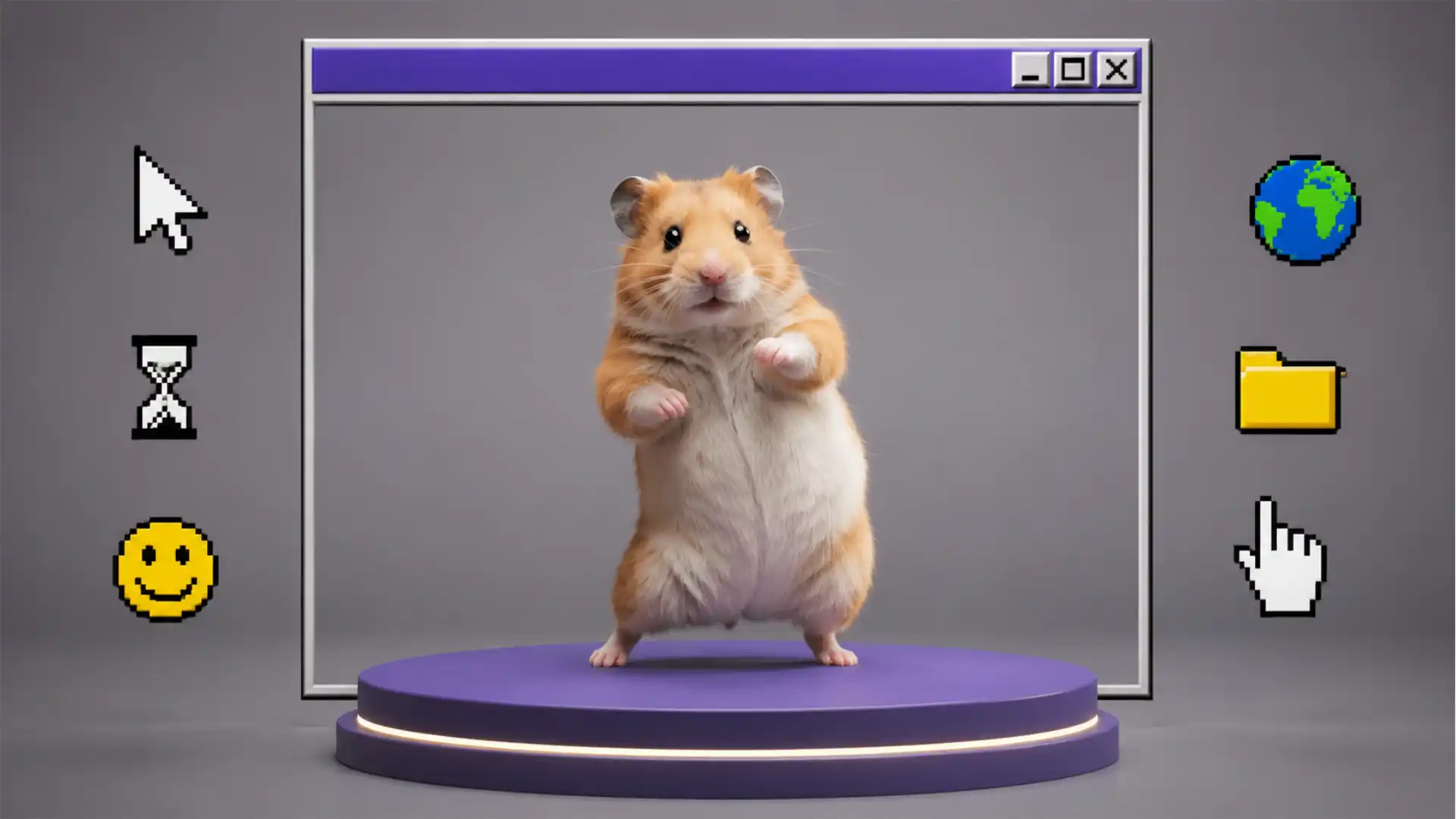
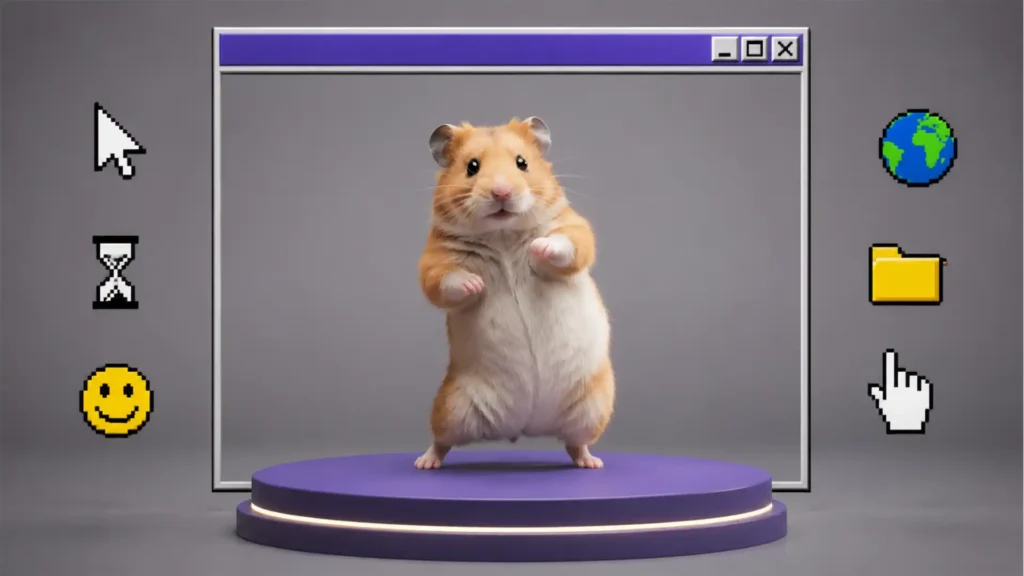
The Hampster Dance looked like nothing and behaved like everything the internet would later become. A blank-ish page, rows of tiny animated rodents, a chirping loop that sounded as if Disney’s Robin Hood had been fed through a sugar machine, and no visible purpose beyond making the visitor laugh, groan, forward it, reload it, and annoy someone nearby. The Web Design Museum describes it as a 1998 creation by Canadian art student Deidre LaCarte, built from dancing hamster GIFs and a sped-up sample of “Whistle Stop” from Disney’s Robin Hood.
Table of Contents
The preserved page is almost comically bare. The 1999 Wayback capture has the title “THE HAMPSTER DANCE,” the line “dance the night away,” a long run of image tags, a copyright note, a help link for the music, a merchandise pre-order link, and very little else. Memory often compresses it into one dancing GIF, because that is how the experience felt: not a page with parts, but one repeated pulse.
That small correction matters. The magic was not a single beautiful animation. It was repetition. The Useless Web’s preservation note reduces the whole thing to “four GIFs” and “nine seconds of sped-up Roger Miller looping forever,” which is a neat obituary for a site that refused to act dead. The page turned almost no material into a full-body reaction. It did not need depth because it had stickiness.
The Hampster Dance is worth opening today because it feels primitive in the wrong way. The obvious primitive parts are the tiny graphics, the visible roughness, the blunt HTML, the built-in audio, the lack of interface polish. The less obvious part is that its social logic still feels current. It was a shareable joke, a sonic prank, a remix seed, a mascot, a brand accident, a copyright headache, and a tiny cultural infection before platforms had learned how to package all of that.
The article follows a strict human writing standard that favors concrete wording, direct sentences, and specific observations over padded explanation. That standard suits The Hampster Dance because the site itself is hostile to grand language. It was not trying to be profound. It became revealing because it was so aggressively small.
A page with almost no interface
Open the archived Hampster Dance and the first shock is how little ceremony there is. No onboarding. No menu worth admiring. No brand promise. No “experience.” Just a command in title form and a swarm of dancing rodents. The archive shows the page doing exactly what it says on the lid: “THE HAMPSTER DANCE,” followed by “dance the night away,” then image after image after image. The page does not explain the joke because explanation would slow the joke down.
This is the first lesson the page still teaches. A web thing does not always spread because it is useful, elegant, or deep. Sometimes it spreads because it produces one clean social action. The Hampster Dance gave people a perfect sentence to say to another person: “You have to see this.” That sentence has powered more internet culture than almost any interface pattern.
The site’s design is funny because it barely behaves like design. The background is empty. The rodents tile across the page with the blunt confidence of clip art. The audio, when it worked, did not sit politely behind the experience. It grabbed the room. In a shared computer lab, office, family den, dorm, or school library, the sound turned private browsing into public embarrassment.
The internet later became very good at hiding its machinery. The Hampster Dance does the opposite. You can feel the page being assembled from scraps: repeated GIFs, a background sound, a hit counter era sensibility, and the joy of discovering that a browser could be made to misbehave. Its crudeness is not a weakness now. It is the artifact.
The page also belongs to a lost moment when websites still felt like rooms built by amateurs. GeoCities, Angelfire, Tripod, and personal hosting turned the web into a neighborhood of handmade signs. The Hampster Dance came out of that culture, not out of a product roadmap. Medium’s oral history notes that LaCarte had a GeoCities account by June 1998 and was copying and pasting the code that became the site. The page feels hand-built because it was hand-built.
That handmade quality is why the site has aged better than many cleaner artifacts from the same period. Corporate dot-com pages from the late 1990s often look trapped by their ambition. The Hampster Dance still looks alive because it never pretended to be respectable. It had no investor deck to embarrass it later. It was an inside joke that accidentally found a distribution system.
The archived page also shows how early web experiences blurred page, toy, and performance. You did not “use” The Hampster Dance in any normal sense. You triggered it. You watched it. You inflicted it. You showed it to someone else. The product was not the page alone; the product was the reaction around the page. The browser became a tiny stage, and the visitor became the prankster.
This is why the site is more than nostalgia. Nostalgia asks us to remember the way the web looked. The Hampster Dance asks us to remember the way the web behaved before it was trained into feeds, apps, and recommendation loops. It was messy, loud, often ugly, and deeply social in ways that did not need a social graph. You could make a crowd with a URL.
The loop was the whole product
The Hampster Dance understood the loop before the web had built an empire on loops. The animation loop made the page visually hypnotic. The audio loop made it physically memorable. The visitor loop made it spread: receive, laugh, forward, annoy, repeat. Nothing about that cycle feels old. The materials are ancient; the mechanics are still everywhere.
The nine-second audio loop did absurd amounts of work. The Useless Web points to the sped-up Roger Miller sample, and the Web Design Museum identifies the tune as a sped-up sample of “Whistle Stop” from Robin Hood. The song is not background decoration. It is the engine. Without that chirping melody, the rodents are cute. With it, they become invasive.
The page had the courage of total repetition. A more cautious designer might have added navigation, jokes, captions, or a little story. The Hampster Dance does not try to “develop.” It starts at maximum silliness and stays there. The result is closer to a ringtone, chant, or playground taunt than to a normal webpage. It becomes memorable because it refuses to change.
That refusal predicted a huge amount of online culture. Reaction GIFs work because they loop one emotional beat. Short videos work because they polish one repeatable moment. Meme templates work because they invite endless variation over a stable base. The Hampster Dance was not doing that with strategy. It stumbled into the power of a repeatable unit.
The loop also solved a technical problem by turning limitation into style. Low bandwidth favored tiny assets. Early browsers favored simple tricks. Amateur pages favored whatever could be copied, pasted, and repeated. The Hampster Dance did not need streaming video, full-screen canvas, or a polished animation engine. Its constraints made it lighter, stranger, and easier to spread.
The sped-up song gave the site a second kind of memory. Visual jokes can fade after the browser closes. Audio burrows. The “dedodedo” quality of the tune made the page portable inside the brain, which mattered before social feeds kept resurfacing the same clip for you. The visitor became the algorithm because the visitor could not forget the sound.
There is something almost unfair about that melody. It is bright, fast, and deliberately childish, but it is not random noise. Roger Miller’s original “Whistle Stop” already had a bouncing cartoon ease. Speeding it up made it feel less like music and more like a small animal running across a keyboard. The sample turned borrowed charm into digital pest behavior.
The Hampster Dance also proved that annoyance and affection can live inside the same click. Many people loved it. Many people hated it. A lot of people did both. That mixed feeling is a powerful internet fuel. If a thing is only delightful, people may keep it to themselves. If it is delightful and unbearable, they send it to friends. The irritation is part of the shareability.
The site’s lack of ending made it perfect for interruption. You did not finish The Hampster Dance. You stopped it, closed it, muted it, or escaped. That made the experience feel slightly alive, as if the page would continue without you. Later platforms would refine endlessness into feeds and autoplay queues. The Hampster Dance got there with a looping WAV file and rodents.
The loop also made the page easy to parody. Once a structure is that simple, anyone can swap the mascot, the tune, the images, or the theme. Medium’s oral history describes the way spoof sites and remixes proliferated by 1999, including dancing cheeseburgers, AOL CDs, and Dick Van Dyke listed in a period article about the craze. The format was small enough to steal instantly.
That theft was part of the site’s cultural force. A meme that cannot be imitated remains a hit, not a language. The Hampster Dance became language because people understood its grammar at once: take a silly animated thing, repeat it too much, attach a sound, let the excess become the punchline. The joke was not only the hamsters. The joke was the pattern.
Before platforms learned to harvest absurdity
The Hampster Dance spread before the web had the machinery now built to detect and amplify such things. Medium’s oral history describes it as a pre-iPhone, pre-social-media phenomenon that moved through email and word of mouth. That detail matters because the site did not ride a centralized feed. It spread through human friction, which made the spread feel stranger.
A person had to choose to send it. A person had to paste the link, write the message, tell someone in a hallway, or make a group load the page at the same time. That manual sharing gave the page a different social texture from a clip pushed by an app. The Hampster Dance was not recommended to you. It was inflicted on you.
This made it ideal for office and school culture. A looping song that hijacked speakers had obvious prank potential. A harmless-looking URL could produce instant noise. A page full of dancing hamsters could puncture the seriousness of almost any shared computer space. The best early viral sites often behaved like whoopee cushions with HTML.
The site also arrived when email still felt like an event. A forwarded link could carry personality. It might come from a friend, sibling, coworker, classmate, or someone who wanted to waste your afternoon. The click carried trust and mischief. Before feeds flattened discovery into a stream, a dumb link could feel like contraband.
The Hampster Dance was perfect for this era because it needed no context. You did not need to know a celebrity, a show, a political scandal, or an inside joke. You only needed to recognize that the page was ridiculous. The lower the explanation cost, the easier the spread. The site was globally legible because it was almost pre-verbal.
The timing was sharp, even if nobody planned it. More households were getting online. More people were learning that web pages could contain personal expression rather than institutional information. More workers and students were discovering the web in shared spaces. The Hampster Dance landed inside that learning curve. It was a tutorial disguised as nonsense.
It taught people several web behaviors at once. Pages could autoplay sound. Pages could be copied. Pages could be forwarded. Pages could become famous without being useful. Pages could produce offline reactions. Pages could be cloned. Pages could attract merchandise. A silly site became a compact education in internet culture.
The Web Design Museum frames the page as an early viral meme, and that word is doing real work here. A fad rises and falls. A meme mutates. The Hampster Dance mutated because its structure was embarrassingly easy to understand. Its cheapness made it fertile.
That fertility made ownership messy. The more a web thing spreads, the less it behaves like a tidy object. The creator made a page, visitors made a phenomenon, copycats made variants, musicians made songs, companies saw licensing, and memory later compressed the whole knot into a single dancing hamster. Medium’s oral history spends much of its energy on that tangle of credit, money, and myth. The future of meme ownership was already ugly.
The Hampster Dance also exposed a fact platforms later monetized with far greater precision. People do not only share what they admire. They share what interrupts the day. They share what gives them a role in someone else’s reaction. They share what lets them say, “Sorry, I had to.” The site’s social use was as strong as its content.
The current web often treats absurdity as inventory. Clips are ranked, measured, split-tested, recycled, monetized, and fed back through creator economies. The Hampster Dance came from a looser and more naive web, but its afterlife points toward that future. Absurdity became a growth format long before anyone used the language of growth.
The page’s numbers are fuzzy in the way early web numbers often are. The Useless Web claims it hit 17 million views by 1999, while Medium notes that period reports disagree on the exact traffic spike, with some accounts saying 30,000 hits in four days and others saying twice that. The uncertainty is fitting because early virality often left messy evidence.
What matters is not a perfect traffic figure. What matters is that a tiny amateur page escaped its expected audience and became shared cultural material. It moved from personal web play into mainstream curiosity, parody, merchandise, music, and memory. That leap is the story.
The joke became a product and lost some of its weirdness
The Hampster Dance is also a warning about what happens when a pure web oddity becomes a commercial object. The original page’s charm came from its uselessness. It did not feel focus-grouped. It did not feel licensed into shape. It felt like someone had discovered a ridiculous browser spell. The more it became a franchise, the less dangerous it became.
That does not mean the later music was uninteresting. The Boomtang Records page for Hampsterdance: The Album lists “The Hampsterdance Song” first, then tracks such as “Hampster Party,” “Even Hampsters Fall In Love,” and “A Hampster’s Life.” The song and album turned the web loop into a pop product. That move is both funny and completely predictable.
A loop wants to become a single. A mascot wants to become merchandise. A hit wants to become a brand. The page already had the core pieces: a name, a sound, characters, repeatability, and a reaction. It was too weird to leave alone and too recognizable to ignore. The market smelled a character universe inside a stupid page.
Yet the product version could never fully reproduce the original feeling. A song has structure. A music video has production. An album has a tracklist. The old site had the thrill of disproportion: so little material, so much impact. The commercial version made the hamster bigger, but bigness was never the source of the spell.
This happens to internet culture constantly. A joke escapes. Brands chase it. The joke becomes merch, ads, collaborations, remixes, interviews, anniversary posts, and licensing arguments. By the time it becomes stable enough to sell, some of its voltage has leaked out. The Hampster Dance went through that cycle before the cycle had become boring.
The EarthLink ad mentioned in Medium’s oral history is a perfect little detail. A page that had spread through amateur channels could now appear in traditional advertising for internet access. The web was no longer only a destination in the ad. The web’s own weird culture had become the ad’s material. The internet was already selling itself through its stupidest miracles.
The merchandise link on the archived 1999 page shows the turn happening in real time. Under the rows of images, the capture includes “Pre-order Your Hampster Dance Merchandise!” That single line is almost too perfect. The amateur page and the product machine sit on the same screen.
The domain story adds another early-web lesson. The Useless Web notes that hamsterdance.com ran from 1998 to 2001 and says it was sold to Abatis Inc. in 2001. Domains, clones, misspellings, and ownership would become recurring problems for web fame. A meme might be weightless, but its URLs are not.
The misspelling itself became part of the brand. “Hampster” looks wrong, which makes it better. Correct spelling would have made the whole thing slightly less memorable. The error gives the name a handmade strangeness, a feeling of pet-name logic rather than dictionary logic. The typo behaves like a logo without needing design.
The Hampster Dance also sits at a crossroads between fan culture, amateur creation, and entertainment licensing. It borrowed a song, repeated images, inspired parodies, became music, caused disputes, and survived through archives and mirrors. The modern web is full of similar knots, but the Hampster case is charming because it happened with such tiny ingredients. A few rodents were enough to expose the whole problem.
The story’s messiness should not make the original page feel less special. It should make it feel more web-native. The internet rarely preserves clean origin myths. It preserves arguments, screenshots, mirrors, broken links, disputed credits, dead domains, and people insisting they remember the “real” version. The Hampster Dance is not a tidy artifact. It is a fossil with glitter stuck to it.
What still makes it worth opening
The Hampster Dance is worth opening because it changes your scale. After years of apps that behave like polished systems, the page reminds you that the web can also be a tiny handmade mechanism. It does one thing, loudly. It does not apologize. It is a small machine for producing disbelief.
It is also worth opening because it makes the old web feel less innocent than people claim. The common memory of the 1990s web is personal pages, guestbooks, under-construction GIFs, and goofy experimentation. All of that is true. The Hampster Dance adds another truth: the early web already knew how to hijack attention, spread annoyance, invite copying, and turn nonsense into a brand. The innocence had teeth.
The site stands out because it is both bad and brilliant. Bad in the sense that no contemporary designer would defend its layout as polished. Brilliant in the sense that it understood the emotional unit of the internet better than many expensive projects. It found a repeatable reaction. That is harder than making something pretty.
The Hampster Dance also reveals how little content a web phenomenon actually needs. A browser, a loop, a mascot, and a reason to send it to someone else can outperform pages loaded with explanation. The original capture’s spare structure makes this plain. The web rewards density of reaction, not density of material.
It is especially useful for anyone who works in digital culture, design, media, or marketing and needs a reminder that polish is not the same as pull. The site’s surface is crude. Its behavioral design is sharp. It creates instant recognition, low-friction sharing, sensory memory, and social use. Those are not visual details; they are distribution details.
The page is also a useful antidote to sterile nostalgia. It was not a noble lost web of pure creativity. It was chaotic, annoying, derivative, funny, opportunistic, and full of copying. That is exactly why it matters. The early web was not better because it was cleaner. It was fascinating because it was less controlled.
Why the Hampster Dance still works as a discovery
| Element | What it did | Why it still matters |
|---|---|---|
| Tiny animated GIFs | Turned repetition into visual rhythm | Shows how small assets can create a strong identity |
| Looped sped-up song | Made the page impossible to forget | Proves sound can carry a meme harder than visuals |
| No real interface | Removed every delay before the joke | Reminds us that some web experiences need almost no explanation |
| Easy imitation | Invited clones, parodies, and remixes | Shows how a format becomes culture when others can copy it |
| Amateur origin | Kept the page strange and unpolished | Gives it a charm commercial versions struggled to repeat |
The table matters because the Hampster Dance is easy to dismiss as “old internet randomness.” Its parts are silly, but their combination is precise. The site joined repetition, audio, speed, copyability, and social prank energy into a format that still feels familiar. It looks like a joke and behaves like a blueprint.
The best reason to open it now is not to laugh at how old it looks. That laugh comes quickly and cheaply. The better reason is to notice how much of the current web is already present in rough form: the loop, the remix, the mascot, the share, the annoyance, the argument over ownership, the archive as afterlife. The page is small, but the shadow is long.
Reader doubts, answered
Is The Hampster Dance really one of the first memes? It is safer to call it one of the earliest widely remembered web memes rather than the absolute first. Internet culture had earlier viral jokes, images, email forwards, Usenet habits, and animated oddities. The Web Design Museum describes it as one of the earliest viral internet memes, which is the stronger claim. Its importance comes from scale, memory, and format, not from winning a purity contest.
Was it really made in 1998? The Web Design Museum credits Deidre LaCarte and gives 1998, while the archived page carries a 1997 copyright line. The safest way to treat it is as a late-1990s GeoCities-era creation that became a visible phenomenon around 1998 and 1999. The exact date is less revealing than the timing: it arrived when the public web was learning how to spread jokes.
Was it one GIF or many? The remembered version often feels like one GIF because the page’s repetition collapses into a single mental image. The preserved records point to multiple images repeated across the page, with The Useless Web summarizing it as four GIFs. The important detail is repetition, not the exact count.
Was the song original? No. The core hook came from a sped-up version of “Whistle Stop,” associated with Disney’s Robin Hood and Roger Miller, as described by Web Design Museum and The Useless Web. Later commercial releases had to deal with the gap between internet borrowing and music licensing. That tension became part of the Hampster Dance story.
Does the page still work the same way now? Not quite. Browsers changed, autoplay norms changed, hosting changed, and the original domain history became tangled. What survives best is the archived structure and the memory of the effect. The Wayback capture and mirror pages preserve the visual form, but the original social setting cannot be fully replayed. You can open the artifact, but you cannot reopen 1999.
Is it still funny? Yes, but not only as a joke. It is funny because it is too much, too thin, too eager, too loud, and too committed to its own tiny premise. It is also funny because the web later spent billions of dollars rediscovering the power of repeatable nonsense. The hamsters were not sophisticated, but neither is most attention.
A relic that still understands the feed
The reason The Hampster Dance still feels current is that the feed did not invent internet absurdity. It industrialized it. The page already had the raw ingredients: a tiny repeatable clip, a sound bite, a mascot, a reason to share, and the ability to mutate. The feed later gave those ingredients analytics, ranking, and money.
The site also reminds us that internet culture often begins as misuse. A browser feature meant to enrich pages becomes a sound prank. Animated GIFs become a crowd. A personal homepage becomes mass entertainment. A borrowed tune becomes a commercial headache. The web gets interesting when people use it slightly wrong.
This is the deepest charm of The Hampster Dance. It is not impressive in the way museums usually ask objects to be impressive. It is not beautifully crafted. It is not noble. It is not subtle. It is a weird little machine that made people click, laugh, complain, copy, and remember. That is enough to earn its place in web history.
Modern internet absurdity often arrives pre-packaged for virality. The camera angle is right. The caption is tuned. The creator knows the format. The platform knows the audience. The Hampster Dance arrived from a more naive direction, which is why it still has bite. It feels discovered, not optimized.
The page’s roughness also gives it an honesty that later meme products lack. Nobody needed to pretend the hamsters were part of a larger cinematic universe. Nobody needed lore. Nobody needed a strategy around engagement. The joke was the whole thing. The lack of depth was clean, almost refreshing.
The afterlife is where the story becomes richer. The page was preserved, mirrored, written about, argued over, and turned into music. It lost its original habitat but gained museum status. Web Design Museum frames it as a defining example of early playful web chaos, and The Useless Web treats it as a lost-site relic worth preserving. A throwaway page became an object of study because throwaway culture became the culture.
The Hampster Dance also shows how web history should be read. Not only through major platforms, protocols, browsers, or companies, but through strange little pages that changed what people expected from a link. A link could be a document. It could be a store. It could be a diary. It could also be a room full of dancing rodents screaming joy into your speakers. That range is the web’s old magic.
There is a temptation to treat The Hampster Dance as a joke we have outgrown. We have not. We have only built better delivery systems for the same impulse. People still want tiny bursts of shared nonsense. People still want loops that say one feeling too many times. People still want to send something pointless because the point is the sending. The hamster never left; it just learned to scroll.
The site’s best legacy is not that it predicted every later meme. It is that it proved a web page could become culture without behaving like serious media. It did not need a publisher, a studio, a platform, or a campaign at the start. It needed a browser, a loop, a joke, and people willing to pass it around. The internet’s absurd future was already dancing in rows.
Open it now and the page may feel tiny, but that tininess is the point. A few repeated GIFs. A sped-up song. A title. A command to dance the night away. That is almost nothing. It was also enough. The Hampster Dance is the rare web relic that looks dumber the longer you stare and smarter the longer you think.
Author:
Jan Bielik
CEO & Founder of Webiano Digital & Marketing Agency
This article is an original analysis supported by the sources cited below
The Hampster Dance in 1999
Web Design Museum’s preserved entry on The Hampster Dance, used for creator attribution, the 1998 framing, and the description of the page as an early viral internet meme built from dancing hamster GIFs and a sped-up “Whistle Stop” sample.
The Hampster Dance archived on April 23, 1999
The Wayback Machine capture of the 1999 page, used to verify the sparse page structure, title, repeated images, music help link, merchandise link, and copyright line visible in the archived HTML.
The Hamster Dance mirror
A preserved mirror of the classic page, used as supporting evidence for the page’s minimal structure and repeated image-grid form.
The Hampster Dance preserved on The Useless Web
The Useless Web’s preservation note, used for the concise summary of the site’s original active period, Deidre LaCarte attribution, four-GIF structure, nine-second loop description, and later domain fate.
The oral history of the Hampsterdance
A later oral history used for context around Deidre LaCarte, GeoCities, the site’s spread through email and word of mouth, parody culture, traffic uncertainty, and the complicated commercial afterlife.
Hampsterdance: The Album
Boomtang Records’ release page, used for the album track listing and the commercial music afterlife of the original web loop.
| Citing this article? Brief excerpts are welcome. Please credit Webiano.digital, name the author where stated, and include a link to https://webiano.digital and to this original article. Full or substantial republication requires prior written permission. Read our Copyright and Content Use Policy. |
This article was prepared with the assistance of artificial intelligence tools. The content underwent expert human review, and Webiano Digital & Marketing Agency assumes editorial responsibility for its final version and publication.