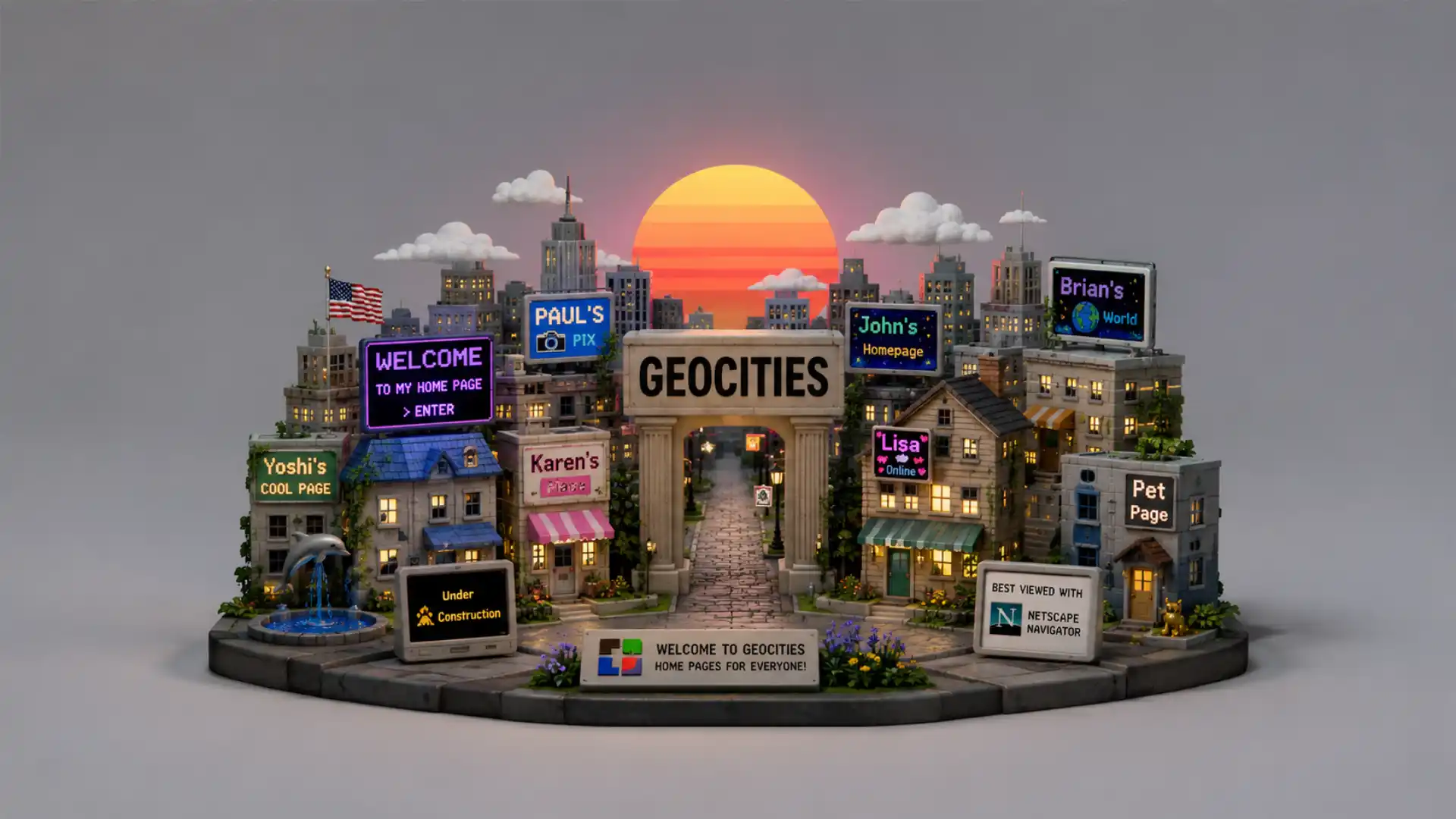
GeoCities feels less like a website than a place someone forgot to demolish properly. You do not open the Internet Archive’s GeoCities collection and find a tidy museum label, a sleek retrospective, or a nostalgia product with rounded corners. You find old personal pages. You find fan shrines, family pages, MIDI ghosts, blinking banners, spiritual essays, dog memorials, anime temples, conspiracy folders, “under construction” signs, and strangers introducing themselves to a web that still felt small enough to answer back.
Table of Contents
A city that should not still be here
The oddity is not that GeoCities existed. The oddity is that so much of it remains reachable at all. Yahoo discontinued GeoCities on October 26, 2009, after almost fifteen years as one of the web’s great outlets for personal expression; the Internet Archive says it ran deep collection crawls in GeoCities’ final months, including public nominations, to make its archive as thorough as possible. The collection is not a perfect resurrection. It is a salvage site. That is exactly why it matters.
The best way to understand GeoCities is not as an old hosting service. It was a city metaphor made literal enough for people to inhabit. Users did not merely create accounts. They became “homesteaders.” They picked neighborhoods based on interests, identities, moods, hobbies, affinities, obsessions, and self-inventions. The Computer History Museum traces GeoCities back to Beverly Hills Internet, started in 1994 by David Bohnett and John Rezner, and describes how its theme-based neighborhoods turned into a virtual land rush before Yahoo bought the company in 1999.
That metaphor still does strange work on the mind. A Facebook profile is a unit in a database. A TikTok account is a feed node. A LinkedIn profile is a credential page dressed as a person. A GeoCities site is a room. Often a messy one. You can feel the owner choosing wallpaper, dragging in images, taping up banners, writing a welcome note, adding links to friends, and deciding whether the cursor should sparkle. The decisions are not frictionless. They are visible. The seams are part of the point.
The Internet Archive’s GeoCities collection makes the dead web feel spatial again. It asks you to search for addresses, neighborhoods, pages, fragments. It does not flatten the material into a commemorative slideshow. The archived pages still carry the stubborn shape of the old web: directories, filenames, broken paths, date stamps, missing graphics, captured moments, and failed retrievals. Some pages appear almost intact. Some arrive injured. Some are nothing but a preserved doorway into a room that has already collapsed.
That imperfection gives the collection its pressure. A smoother restoration would be easier to browse and less truthful. The archived GeoCities pages were made by people using uneven tools, borrowed images, amateur HTML, WYSIWYG builders, shared snippets, link exchanges, guestbooks, counters, and whatever they could learn from “view source.” The Internet Archive did not turn that into a clean heritage object. It preserved a web that was already patched, copied, improvised, and half-broken while it was alive.
The result is one of the most moving web experiences still hiding in plain sight. Not because every page is good. Many are boring. Many are ugly. Many are wrong in all the ordinary ways people are wrong when they talk freely. The point is not quality control. The point is contact. You can still brush against a person’s self-made corner of the internet from 1998, 2002, or 2009 and feel the awkward sincerity of someone publishing without a growth strategy.
GeoCities now looks ancient partly because it was so open about wanting to be seen. The colors shout. The GIFs wave. The counters brag. The welcome pages over-explain. The background tiles repeat without shame. The pages often begin by announcing themselves as pages, which sounds funny until you remember how new that act felt. A personal homepage was not a profile generated by a platform. It was a small public claim: I am here, this is my stuff, and I arranged it myself.
The collection also catches a web before personal expression was fully absorbed by product design. That is the great pleasure of opening it today. You are not browsing a style. You are browsing the moment before style guides swallowed the room. The pages are not “retro” in the commercial sense. They are too uneven for that. They are better than retro because they were not trying to imitate anything. They were people making signs for themselves with the tools at hand.
GeoCities is dead, but its streets still blink. The phrase sounds cute until you start clicking. Then it becomes literal. The Internet Archive’s preserved pages, the GeoCities datasets, the GIF search engines, the art projects, and the neighborhood galleries all circle the same strange fact: a commercial platform died, yet millions of scraps from its users still behave like public memory. At times, it feels less like opening an archive and more like trespassing through a city after evacuation.
The pleasure of opening someone else’s abandoned homepage
A GeoCities page asks for a different kind of attention than modern web content. It does not usually reward skimming for an answer. It rewards looking around. The background might tell you more than the text. The link list might reveal the owner’s world better than the homepage biography. The animated GIFs might show taste, fandom, affiliation, technical skill, or just delight. A page that seems ridiculous after two seconds may become strangely intimate after thirty.
The strongest GeoCities pages have the texture of rooms decorated by people without permission from a designer. One person chooses stars, another marble, another purple roses, another a black background with lime green type. Someone adds a looping MIDI file because silence feels unfinished. Someone writes “welcome to my homepage” because the social grammar of arriving somewhere mattered. Someone apologizes that the page is still under construction, not realizing that half the web would remain under construction forever.
This is why the Internet Archive’s collection is better opened with patience than with irony. It is very easy to laugh at the web’s older clothes. Comic Sans, tiled fire backgrounds, giant buttons, spinning skulls, mailbox GIFs, frames, tables, and visitor counters all invite cheap jokes. The better response is curiosity. Why did people use those devices? Because they made the page feel alive. Because they gave still screens movement. Because the browser window was a stage and the amateur webmaster wanted props.
The preserved pages also show how personal publishing once carried domestic weight. A homepage could be a family album, a local club bulletin, a fan archive, a memorial, a teenage diary, a technical notebook, a hobby cabinet, a ministry, a classroom, a small shop, or a shrine to one actor from one show. The same hosting service held all of it. That mixture feels unruly now because current platforms separate identity, commerce, media, friendship, and fandom into cleaner product categories.
GeoCities was not free of platform logic. It was a business. It had ads, rules, account systems, rankings, templates, and ownership changes. Yahoo bought GeoCities near the peak of dot-com dealmaking for more than $3 billion, and the service later became a famous example of how quickly a dominant online property could become disposable. Still, the pages themselves often feel less platform-shaped than today’s profiles because the user’s hand is so visible.
That visible hand is the collection’s secret engine. You can see someone learning. You can see a table layout fighting back. You can see images stretched wrong. You can see a person discovering how to make a link open, how to make a banner sit centered, how to make a page feel like theirs. The charm is not innocence. It is labor. People spent evenings on these pages. They chose. They copied. They fiddled. They returned.
Modern platforms hide most of that labor behind interface consistency. You upload, crop, caption, tag, post. The system contains your expression inside a familiar frame. GeoCities left more of the frame exposed. A page might break because the author misunderstood a tag. A background might make the text unreadable. A navigation menu might be a handwritten pile of hyperlinks. The result can be annoying, but it is rarely anonymous. Even the mistakes have fingerprints.
Opening these pages now produces a peculiar double vision. You see the page as a browser renders it today, through layers of preservation, missing files, and changed software. You also imagine the page in its original social weather: dial-up patience, desktop monitors, web rings, email links, guestbooks, awards, “best viewed in Netscape,” and the thrill of being reachable by anyone with the URL. The old web was not purer. It was different enough to make our present habits look chosen rather than inevitable.
The Internet Archive’s version deepens that double vision because it is not one single “GeoCities museum.” Its special collection lets you check archived material, search by address, and browse preserved captures through the Wayback Machine, but the Archive notes that its crawls were based on public directories and links rather than a full master list, so some pages were never collected. The holes are not a footnote. They are part of the experience.
A missing page in GeoCities hurts in a specific way. It is not like a vanished corporate landing page or a dead news article. It feels like a locked apartment in an abandoned block. You may know the address. You may even know the neighborhood. But the room is gone, or a capture failed, or the images no longer load. The archive gives you enough continuity to imagine what was lost, which can be more haunting than total absence.
The preserved pages are also a reminder that personal archives rarely look serious while they are being made. A page about a pet, a fan site for a band, a list of favorite jokes, a family recipe collection, a local softball schedule, or a page of “cool links” can seem trivial until it vanishes. Then the triviality becomes evidence. Ordinary people rarely produce formal records of how they used media, language, taste, identity, and time. Homepages did that accidentally.
What the Internet Archive actually saved
The Internet Archive did not save GeoCities by pressing one magic button. Its official collection page describes years of earlier crawls, then special deep crawls in the final months before the October 2009 shutdown, including sites nominated by the public. It also thanks Archive Team and ReoCities, while making clear that the Internet Archive’s GeoCities preservation was an independent project. The story is less heroic simplicity than overlapping rescue attempts under deadline pressure.
That matters because web preservation is often misunderstood as copying a folder. A living website is not a single object. It is a mesh of HTML, images, scripts, server behavior, linked pages, external files, directory structures, browser expectations, MIME types, timestamps, redirects, and social context. GeoCities added another layer because its city metaphor shaped addresses and browsing habits. Saving the files was one task. Making them feel legible later was another.
The Internet Archive’s own page is refreshingly blunt about the limits. Its 2009 special collection content came from crawls between July and October 2009, but the Archive says its crawling was based on publicly available directories and links, not a complete list of every GeoCities page. It warns that pages with few outside links and low visitor traffic were more likely to be missed. That honesty makes the collection more trustworthy, not less.
The scale is still startling. In a 2021 note about early web datasets, the Internet Archive says GeoCities displayed at least 38 million pages before Yahoo terminated it in 2009. The same note describes dataset releases around the GeoCities collection, including domain counts, image graph and web graph data, binary file information, and file-format data for audio, video, text, and image files. That is not just nostalgia. It is material for studying user culture at scale.
The phrase “user culture” sounds dry until you open the pages. Then it becomes specific. The collection lets researchers ask how people linked to each other, how neighborhoods clustered, which file types dominated, how people named images, how fan communities organized, how web graphics circulated, and how amateur authors used layout conventions before platform templates hardened. It also lets casual visitors do something less formal and just as revealing: wander.
Wandering is not a weak use case. It is one of the collection’s native modes. GeoCities was built around themed neighborhoods, not infinite feeds. The Geocities Gallery, an independent Restorativland project, makes that spatial memory easier to see by sorting restored archived sites by neighborhood, with labels such as Area51 for science fiction and fantasy, Athens for education and literature, BourbonStreet for jazz and Southern culture, and Broadway for theater. It feels like a map of interests before interests were machine-ranked.
The collection’s messiness also keeps it from becoming a flattened cartoon of the 1990s. GeoCities did not contain only blinking GIFs and joke pages. It held grief, sexuality, religion, illness, local knowledge, politics, subcultures, hobbies, teenage performance, fandom scholarship, technical experiments, and unpolished autobiography. The same qualities that made many pages look chaotic also made them permissive. People could build a page that no platform manager would have prioritized as a feature.
The Internet Archive’s GeoCities work also sits inside a wider preservation ecosystem. Archive Team’s bulk rescue, independent mirrors, gallery projects, artwork, GIF search tools, and research blogs all make different promises. None replaces the others. The Wayback Machine is the public memory spine. The datasets serve researchers. The mirrors and galleries improve access in selective ways. The art projects make the archive feel graspable. Together, they make GeoCities harder to dismiss as dead junk.
That distributed afterlife fits GeoCities better than a single polished memorial. The original service was already distributed in spirit: millions of users maintaining uneven little worlds inside a commercial host. Its preservation is similar: institutions, volunteer archivists, artists, researchers, and fans all holding pieces of the ruin. The collection is not one monument. It is a city whose surviving streets lead to other maps.
The 2025 update to GifCities is a useful example of how this afterlife keeps changing. Internet Archive describes GifCities as its GeoCities animated GIF search engine, first created for the Archive’s 20th anniversary in 2016, and says the new version adds semantic search, size search, pagination, and shareable “GifGrams,” with GIFs still linking back to the archived GeoCities pages where they appeared. That turns scraps of decoration into portals back to context.
GifCities is not a side attraction. It reveals how much of GeoCities was carried by small moving things. A “new” icon, a torch, a divider, a dancing animal, a spinning globe, a glittering line, a mailbox, a blinking nameplate: these were not just ornaments. They were interface mood, social signal, and handmade atmosphere. Searching those GIFs now is a little like sorting through the vocabulary of a lost vernacular.
What stands out when you open it
| Layer | What you notice | Why it matters |
|---|---|---|
| Addresses | Neighborhoods, directories, old URLs, broken paths | The web once felt mapped, not merely streamed |
| Design | Tiled backgrounds, GIFs, tables, frames, counters | Amateur choices remain visible instead of polished away |
| Content | Fan pages, family pages, tutorials, poems, memorials | Ordinary people left cultural records without meaning to |
| Preservation gaps | Missing images, failed captures, partial pages | The archive shows both survival and loss |
| Afterlives | GifCities, galleries, datasets, art projects | A dead platform keeps producing new ways to browse it |
The compact view matters because GeoCities is easy to misread if you only focus on the loud surface. The blink, glitter, and chaos are real, but they sit on top of older questions about address, authorship, community, memory, and access. The Internet Archive’s collection is not only a place to laugh at old pages. It is a place to watch the public web becoming personal at massive scale.
Why the old web feels strangely alive
GeoCities pages often feel alive because they are full of invitations. “Welcome.” “Sign my guestbook.” “Email me.” “Visit my links.” “Take my banner.” “Join my webring.” “Come back soon.” Current web design often tries to remove friction by predicting the next action. GeoCities pages frequently ask directly. They want a visitor, not merely a metric. They imagine a person arriving, reading, clicking, and leaving a trace.
That imagined visitor changes the writing. Many pages speak from a front porch. The author explains who they are, what they like, why the page exists, which pages are new, which graphics they borrowed, which browser works best, when they last updated, and who deserves credit. The result can be clumsy, but the clumsiness has social warmth. A page knows it is a page and behaves like a host.
The “homepage” was a powerful word because it joined technology to shelter. GeoCities leaned hard into this. People had lots, neighborhoods, cities, homepages, and addresses. The Deleted City, Richard Vijgen’s interactive visualization, draws from that metaphor by depicting the GeoCities file system as a city map, arranging neighborhoods and lots by the number of files they contain. It works because GeoCities was already half architecture, half metaphor.
The Deleted City makes a buried feeling explicit. When you zoom across its map, GeoCities stops looking like a heap of pages and starts looking like a settlement. The official project text calls it a digital archaeology of the web as it entered the 21st century, built from a 650-gigabyte Archive Team backup made on October 27, 2009. That “digital Pompeii” phrase sticks because the sites were not gradually archived after a natural lifespan. They were caught near a shutdown.
Pompeii is an imperfect metaphor, but a useful one. GeoCities was not a city of people killed in place. It was a commercial service abandoned, closed, crawled, mirrored, copied, and partly reconstructed. Still, the feeling of frozen domesticity is real. Pages end mid-project. “Last updated” dates become archaeological labels. “Under construction” signs become permanent. Guestbooks stop. Counters no longer count. The future tense on old pages turns into a kind of dust.
The Computer History Museum framed Deleted City around the question of presenting a digital ruin. Its exhibit page says all 38 million pages of the main English-language GeoCities site were slated to be erased in October 2009, and that the Internet Archive, Archive Team, and volunteers preserved tens of millions of pages before Vijgen turned the 650-gigabyte backup into an interactive visualization. That framing is right: the ruin is not just the content, but the problem of showing it.
A digital ruin behaves differently from a stone one. You can copy it, corrupt it, index it, emulate it, screenshot it, visualize it, search it, remix it, and still fail to recreate the conditions that made it legible. The old browser, the monitor size, the connection speed, the surrounding links, the visitor habits, and the social expectation of building your own page all matter. A preserved HTML file is a body without some of its weather.
One Terabyte of Kilobyte Age understands that weather better than most projects. The Tumblr companion says its screenshots are automatically generated from old GeoCities homepages rescued by Archive Team in 2009 and processed from oldest to newest. The broader research blog by Olia Lialina and Dragan Espenschied is not just collecting curiosities. It studies how these pages worked as living user culture, down to timestamps, software environments, and interpretation problems.
The screenshots matter because the page is not only its source code. Rendering is interpretation. A background tile, a browser font, a broken plug-in, a missing audio file, and an image alignment all change the encounter. One Terabyte’s work treats the look of the page as evidence. That seems obvious only after someone does it carefully. The web is full of old files that technically survive but no longer appear as they did to their intended audience.
GeoCities also feels alive because it resists clean periodization. A site last modified in 2006 may have begun years earlier. A page that looks “1996” may have been updated later by someone who liked old styles or never changed tools. One Terabyte’s blog notes the difficulty of reading last-modified dates and even describes cases where archiving errors caused pages to be marked with misleading dates. The archive does not hand you a timeline. It makes you earn one.
That uncertainty is not a defect. It is how personal web history actually works. People do not update themselves in tidy eras. They leave old banners in place, add new paragraphs, forget a dead link, change an email address, paste a tribute, stop returning, then perhaps come back years later. A homepage is a sedimentary object. GeoCities preserved that layered time better than many later platforms, where design changes sweep across everyone at once.
A modern profile ages differently. The platform changes the frame, compresses the media, hides older posts, removes deprecated features, and makes each account look current even when the person has left. GeoCities pages often age visibly. They yellow in public. Dead links remain as dead links. Old browser badges remain aspirational. The archive keeps that aging process readable. It lets old web time look old.
The collection is messy in the right way
The Internet Archive’s GeoCities collection is not a clean product, and that is a blessing. A clean product would likely offer categories, featured pages, curator picks, a bright timeline, and a handful of polished examples. Those things are useful in moderation, but they can make the old web look smaller than it was. GeoCities needs scale, clutter, repetition, boredom, and dead ends. Without them, the famous weirdness loses its truth.
A city is not only landmarks. It is streets you never take, apartments you never enter, signs you ignore, corners with nothing special on them, local habits, private decorations, and bad taste maintained with conviction. GeoCities had landmark pages, of course. But its historical force comes from ordinary abundance. The Internet Archive’s search-and-capture model respects that abundance better than a greatest-hits approach.
The Archive’s caution about incomplete crawling should shape how we browse. It collected many GeoCities sites before and during the shutdown crawls, but it did not have a full list of every page, and it warns that low-link, low-traffic pages may be missing. That means the archive is not a full city plan. It is a surviving street grid with whole blocks gone. The absence is not evenly distributed.
The missingness matters culturally. Pages with fewer links, fewer visitors, weaker directory visibility, or less external attention were more likely to disappear. That means preservation can repeat old visibility patterns. The pages most deeply isolated may be the ones we most want later: private-feeling family pages, niche hobby pages, teenage experiments, local club sites, pages made by people who did not know how to promote themselves. Archives inherit the biases of links.
Still, partial preservation is not failure. Without the Internet Archive, Archive Team, ReoCities, mirrors, and related projects, the loss would be far worse. The point is not to scold the archive for being incomplete. The point is to browse with a sense of stakes. Every surviving page made it through a chain of technical, social, and institutional contingencies. A dancing GIF on a purple page may look silly. It also survived a platform death.
The collection’s roughness also protects it from easy sentimentality. GeoCities was not a utopia. It contained bad information, ugly politics, abandoned pages, spammy corners, scams, broken design, and all the awkwardness of public self-expression. The web was never pure. The difference is that GeoCities makes its contradictions visible. The same neighborhood logic that let a fan find fellow fans could also cluster delusion, prejudice, or obsession. A preserved city contains its garbage.
That is why the best writing about GeoCities avoids treating it as either paradise or punchline. It was a hosting service, a social space, a publishing tool, a directory system, a design culture, a business asset, a training ground, and a mass amateur archive. Its pages deserve curiosity, not automatic reverence. Some are beautiful. Some are tedious. Some are touching by accident. Some are unreadable. The collection is powerful because it keeps all of those states available.
The Library of Congress blog The Signal made a sharp point about interfaces to digital collections. Writing about GeoCities, Archive Team, Deleted City, and One Terabyte, it argued that making data available lets others invent interfaces, artworks, and modes of access around the collection. GeoCities proves that access is not one door. It is many doors built by people with different reasons to enter.
That idea feels especially right for this material. A researcher wants graphs and metadata. A former GeoCities user wants an old URL. A designer wants visual texture. An artist wants an archive to reinterpret. A historian wants evidence of online domesticity. A teenager wants to see what people mean by “old internet.” A writer wants weird pages. A preservationist wants to know what failed. No single interface can serve all of them gracefully.
The Internet Archive’s collection is the canonical door, but not the only good door. GifCities is the animated doorway. The Deleted City is the spatial doorway. One Terabyte is the screenshot-and-research doorway. The Geocities Gallery is the neighborhood doorway. The datasets are the computational doorway. Each changes what GeoCities seems to be. None is neutral. That is fine. A city always looks different depending on whether you arrive as a resident, tourist, planner, archaeologist, or thief.
The collection also reminds us that preservation is not the same as usability. A captured page may technically exist, yet remain hard to find. A dataset may be public, yet too difficult for casual visitors. A restored gallery may be easier to browse, yet selective. A screenshot may preserve appearance while losing interactivity. A visualization may explain scale while abstracting content. Every access method trades something away.
That trade-off is one reason GeoCities keeps attracting projects. The archive is too large and too strange for a definitive interface. It invites attempts. It defeats them. It invites more. That makes it a perfect Web Radar subject: not just one site worth opening, but a cluster of web afterlives around a platform that should have vanished. The discovery is not merely “old pages exist.” The discovery is that dead platforms can become raw material for new browsing cultures.
What GeoCities reveals about platform memory
GeoCities makes our current platform dependence easier to see. A modern user may post for years on a service without ever touching the structure underneath. The platform supplies the profile, the image handling, the follow graph, the analytics, the feed, the comments, the notifications, and the limits. When that platform changes terms, removes features, bans formats, deprecates archives, or shuts down, the user’s labor may become hard to export or interpret.
GeoCities users were also dependent on a platform, but their pages carried more portable clues. HTML files, image folders, filenames, link structures, and directory paths gave archivists something to grab and later reconstruct. That does not make GeoCities safer by nature. It simply means its output had a certain material plainness. A personal homepage was often a collection of files. Messy files, yes, but files with names, folders, and links.
That plainness is increasingly rare. Much of our online life now sits behind application states, private APIs, dynamic rendering, infinite feeds, database relationships, recommendation systems, and media pipelines that do not preserve well as human-readable pages. A screenshot can capture the look, but not the system. A data export can capture fragments, but not the social surface. A URL may not identify a stable object. GeoCities looks ancient because it remains strangely graspable.
The Internet Archive’s 2021 dataset note points toward another layer of memory. The GeoCities collection is not only browsable through archived pages; it can also be studied through datasets about domains, images, web graphs, file formats, and binary files. That matters because no person can read tens of millions of pages one by one. At a certain scale, memory needs both wandering and computation.
Yet computation alone would miss the feeling. A graph can show linking patterns. A file inventory can show formats. A dataset can show counts. But it cannot fully explain why a blinking “email me” icon feels like a hand waving from another era, or why a page about someone’s dead dog can carry more emotional force than a polished corporate tribute. The archive needs both forms of reading: distant pattern and close encounter.
GeoCities also reveals how wrong the “read-only old web” cliché is. Lialina and Espenschied’s One Terabyte research blog explicitly pushes back against the claim that the pre-platform web was passive, arguing through screenshots that users owned, wrote, organized, and provided things to each other before later services took over those roles. You can see that argument in the pages themselves. People were not waiting for platforms to teach them participation.
They were already participating, just with different affordances. They made indexes, galleries, awards, tutorials, fan archives, support pages, adoption pages for digital pets, memorials, link exchanges, banners, web rings, and local portals. They curated. They introduced. They moderated by hand. They copied code from each other. They credited graphics. They stole graphics. They learned what “online community” meant through visible linking rather than hidden ranking.
The old web was not less social because it looked less centralized. It was social through links, guestbooks, email, forums, webrings, button exchanges, updates, and reciprocal attention. Some of those mechanisms were slow. Some were fragile. Some were exclusionary. But they made the social graph visible in a way that current platforms often do not. On GeoCities, a links page could be a declaration of belonging.
The city metaphor also made belonging legible. If your page sat in Heartland, Area51, SoHo, Hollywood, Athens, or SiliconValley, the address itself spoke before the page loaded. Neighborhoods were imperfect categories, often kitschy and sometimes strange, but they gave authors a sense of placement. The Geocities Gallery’s neighborhood list shows how broad those themes became, from science fiction to education, golf, theater, jazz, Southern culture, off-roading, and more.
Current platforms classify users constantly, but usually invisibly. GeoCities asked users to pick a neighborhood; modern systems infer neighborhoods from behavior and sell the result to advertisers, ranking models, and engagement loops. That old act of choosing a themed address can seem quaint, but it had one advantage: the classification was public and narratable. You knew you had built your home in Area51. The category was part of the fiction you joined.
The archive preserves that fiction after the landlord left. Yahoo may have shut down the service, but the addresses, captures, and related projects still hold the ghost of the city plan. That is why GeoCities is more interesting than many dead platforms. It was already organized as an imaginary place, so preservation turns into urban archaeology. The filenames are artifacts, but so are the metaphors.
Platform memory usually arrives too late. People care when the shutdown notice appears, when export tools are rushed out, when archivists race a deadline, when users suddenly ask where their pages will go. The Internet Archive’s 2009 blog post has that urgency: Yahoo had announced the October 26 closure, and the Archive asked GeoCities users and fans to submit pages to help preserve them before the end date. It reads like a fire alarm for a city of homepages.
That alarm keeps echoing. Every shutdown since has repeated the same pattern in new clothes: a beloved or neglected service closes; users scramble; archivists try to save what policy and technology allow; companies frame closure as product housekeeping; culture disappears as a side effect. GeoCities remains one of the clearest examples because it was massive, personal, and visibly mortal.
The digital Pompeii metaphor earns its dust
Calling GeoCities “digital Pompeii” could sound theatrical, but it holds up better than expected. The metaphor does not work because GeoCities was ancient. It works because the pages often preserve ordinary life at the scale of a settlement. Not official life. Not elite life. Not the polished public record. Ordinary rooms, tools, greetings, hobbies, mistakes, taste, local knowledge, and unfinished plans.
The Deleted City leans into that metaphor without turning it into pure nostalgia. Its official page says the 650-gigabyte Archive Team backup is the subject of an interactive excavation, with the file system depicted as a city map whose neighborhoods and lots reveal more detail as visitors zoom in. That interface is not just a clever visual trick. It respects the original metaphor and makes the archive physically imaginable.
The Computer History Museum’s writing about the project adds a useful warning. It notes that much of the original GeoCities user interface was lost, leaving mostly raw files and screenshots, like saving bricks and beams without the assembled building. That is the core problem of web archaeology. You can save material and still lose the experience. You can preserve a page and still lose the city’s weather.
This is where the Internet Archive’s collection becomes more than a database. It gives the raw possibility of return. You can enter an old URL. You can land on a capture. You can follow a link and hit another capture, or a dead end, or a missing image, or a working fragment. The experience is not smooth, but it recreates something modern interfaces often avoid: uncertainty. You are exploring, not consuming.
The best pages in the collection are not always the most visually loud. Sometimes the strongest page is a plain one where a person explains their hobby with care. Sometimes it is a family page whose photographs may or may not load. Sometimes it is a link list that accidentally documents an entire subculture. Sometimes it is a teenage fan page whose seriousness now feels touching because the stakes were self-made.
The weakest pages still matter because cities are made of weak pages too. A culture made only of masterpieces is not a culture. It is a gallery. GeoCities’ value lies partly in the volume of average expression: ordinary people using a public medium before personal publication became a default condition of life. The Archive preserves not only what was impressive, but what was normal enough to become invisible.
That normality looks strange now because the web has professionalized its surfaces. Even amateur creators often work inside templates created by teams of designers, growth specialists, accessibility auditors, moderation teams, and monetization systems. GeoCities pages were not free from business pressure, but their surfaces were less disciplined. They show an internet before every corner had been pressure-washed into platform legibility.
The resurrection is not complete, and it should not pretend to be. Some audio files are gone. Some images fail. Some scripts break. Some pages were missed. Some captures are from the wrong moment. Some old URLs have become hard to interpret. Some content may be uncomfortable or objectionable. The Geocities Gallery warns visitors that some restored sites may contain objectionable content, which is the right kind of plain notice for a preserved public ruin.
That risk is part of preserving culture rather than decorating it. Archives do not only save charming things. They save evidence. GeoCities contains the tenderness of fan devotion and the ugliness of old prejudices, the innocence of first pages and the calculated weirdness of attention-seeking, the practical generosity of tutorials and the noise of bad information. A preserved web must contain the web as it was, not merely the parts that age well.
The collection is also a quiet rebuke to the idea that only platforms remember us properly. Platforms remember what serves the platform: engagement, identity, advertising value, moderation state, retention, machine-readable preference. A personal homepage remembered differently. It remembered what the author thought deserved a page. That might be a family photo, a favorite poem, a guide to a video game, a UFO theory, a tribute to a horse, or a set of links to other people who cared.
The Internet Archive’s GeoCities collection lets those old acts of choosing remain visible. It does not make them current. It does not make them fashionable. It does not always make them easy. It does something rarer: it keeps them addressable. A dead homepage that still has an address is not exactly alive, but it is not gone either. It occupies a third state, somewhere between memory and infrastructure.
That third state is where the collection becomes addictive. You open one page for the novelty and stay for the human residue. A page about someone’s cat leads to a links page, which leads to a neighborhood, which leads to a broken guestbook, which leads to a GIF search, which leads to an art project, which leads back into the Wayback Machine. The old web was built from links, and its afterlife still works by link-drift.
There is no single correct way to browse it. Search for a remembered URL. Start with GifCities and follow an animated GIF back to its source page. Use The Deleted City to feel the scale. Open One Terabyte for screenshots and commentary. Browse neighborhood galleries. Try old topic words: dragons, dolls, X-Files, genealogy, MIDI, recipes, Sailor Moon, Linux, angels, memorial, guestbook. The collection rewards both intent and accident.
The real surprise is how contemporary it feels after the first wave of nostalgia passes. GeoCities is full of issues we still have not solved: platform shutdowns, user ownership, export formats, interface decay, link rot, amateur creativity, harassment, moderation, identity, discoverability, search, memory, and the power of defaults. The pages look old. The questions are current.
Things readers ask before opening it
No. The Internet Archive says it had collected many GeoCities sites across years of crawls and ran special deep crawls before the 2009 shutdown, but it did not have a full list of every GeoCities page and cannot guarantee that any specific site was captured. That limitation is part of the collection’s truth. You are browsing a major rescue, not a total reconstruction.
No, though nostalgia is one honest doorway in. The collection is also useful for studying early personal publishing, web design habits, fan labor, link culture, file formats, amateur identity, online neighborhoods, and platform death. Internet Archive’s dataset work makes that research angle explicit by releasing GeoCities-related data for computational study. A casual visitor can enjoy the weirdness while a researcher studies the structure.
No. The Deleted City is Richard Vijgen’s interactive visualization based on the 650-gigabyte Archive Team backup, while the Internet Archive’s GeoCities collection is a preservation and access effort through archived pages and related datasets. The Deleted City says images on its map are hosted by Archive.org and available through the Wayback Machine. They are connected afterlives, not the same object.
Because web pages depend on more than text. Images, scripts, audio, external links, browser behavior, plug-ins, and server paths can all fail or age badly. The Internet Archive’s collection captured a huge amount, but not every dependency. Some brokenness comes from incomplete capture. Some comes from the original page already being fragile. Some comes from modern browsers rendering old assumptions differently.
Yes, especially if the visual language of the old web interests you. Internet Archive says the 2025 version of GifCities added semantic search, size search, pagination, and shareable GifGrams, and that each GIF links back to the archived GeoCities page where it originally appeared. It is funny, but not only funny. It is a search engine for the emotional punctuation of early personal pages.
Designers, internet historians, archivists, artists, writers, researchers, former GeoCities users, fandom scholars, media students, and anyone bored by the current sameness of web surfaces. The collection gives you a direct encounter with a time when making a personal website meant choosing visible structure. It is less polished than a documentary and more revealing than a nostalgia thread.
Start with the Internet Archive’s GeoCities Special Collection if you have an old address or want the canonical preservation route. Start with GifCities if you want fast visual pleasure. Start with The Deleted City if you want to feel the scale as a map. Start with One Terabyte of Kilobyte Age if you want restored screenshots with serious cultural reading. Each route gives a different GeoCities.
Because the web keeps forgetting its ordinary people. Companies preserve brand stories, product launches, and executive myths. Users preserve screenshots when they remember. Archivists preserve what they can reach. GeoCities sits at the intersection of all three. It is a dead commercial service, a mass of user-made culture, and a test case for whether the web can remember anything that was not profitable to keep online.
The best reason to open it is not nostalgia but humility. The pages look ridiculous until you notice how much they predicted: personal publishing, fan networks, link curation, profile identity, digital memorials, creator labor, online neighborhoods, and the fight over who owns user expression. GeoCities did not solve those problems. It made them visible in blinking HTML. The Internet Archive kept enough of that visibility alive for us to recognize ourselves in the ruins.
Author:
Jan Bielik
CEO & Founder of Webiano Digital & Marketing Agency
This article is an original analysis supported by the sources cited below
Internet Archive GeoCities Special Collection 2009
The official Internet Archive page for the GeoCities preservation effort, including shutdown context, crawl scope, access notes, limits, and acknowledgements of related archiving projects.
GeoCities, Preserved
The Internet Archive’s 2009 preservation notice asking users and fans to help save GeoCities pages before Yahoo’s scheduled shutdown.
Early Web Datasets & Researcher Opportunities
The Internet Archive’s 2021 note describing public early-web datasets, including the GeoCities collection and its research data.
Keep on GIFin’ — A New Version of GifCities, Internet Archive’s GeoCities Animated GIF Search Engine
The Internet Archive’s 2025 announcement of the updated GifCities search engine, including semantic search and links from GIFs back to archived GeoCities pages.
The Deleted City
Richard Vijgen’s interactive visualization of the Archive Team GeoCities backup, presenting the preserved file system as a city map.
Deleted City
The Computer History Museum’s exhibit page for Richard Vijgen’s Deleted City, with historical context on GeoCities, Yahoo’s acquisition, the shutdown, and the preservation effort.
Interface, exhibition & artwork
The Library of Congress blog post examining GeoCities, Archive Team, Deleted City, One Terabyte of Kilobyte Age, and the role of user-built interfaces around digital collections.
One Terabyte of Kilobyte Age Photo Op
The screenshot stream accompanying Olia Lialina and Dragan Espenschied’s GeoCities research project, built from old GeoCities homepages rescued by Archive Team in 2009.
| Citing this article? Brief excerpts are welcome. Please credit Webiano.digital, name the author where stated, and include a link to https://webiano.digital and to this original article. Full or substantial republication requires prior written permission. Read our Copyright and Content Use Policy. |
This article was prepared with the assistance of artificial intelligence tools. The content underwent expert human review, and Webiano Digital & Marketing Agency assumes editorial responsibility for its final version and publication.