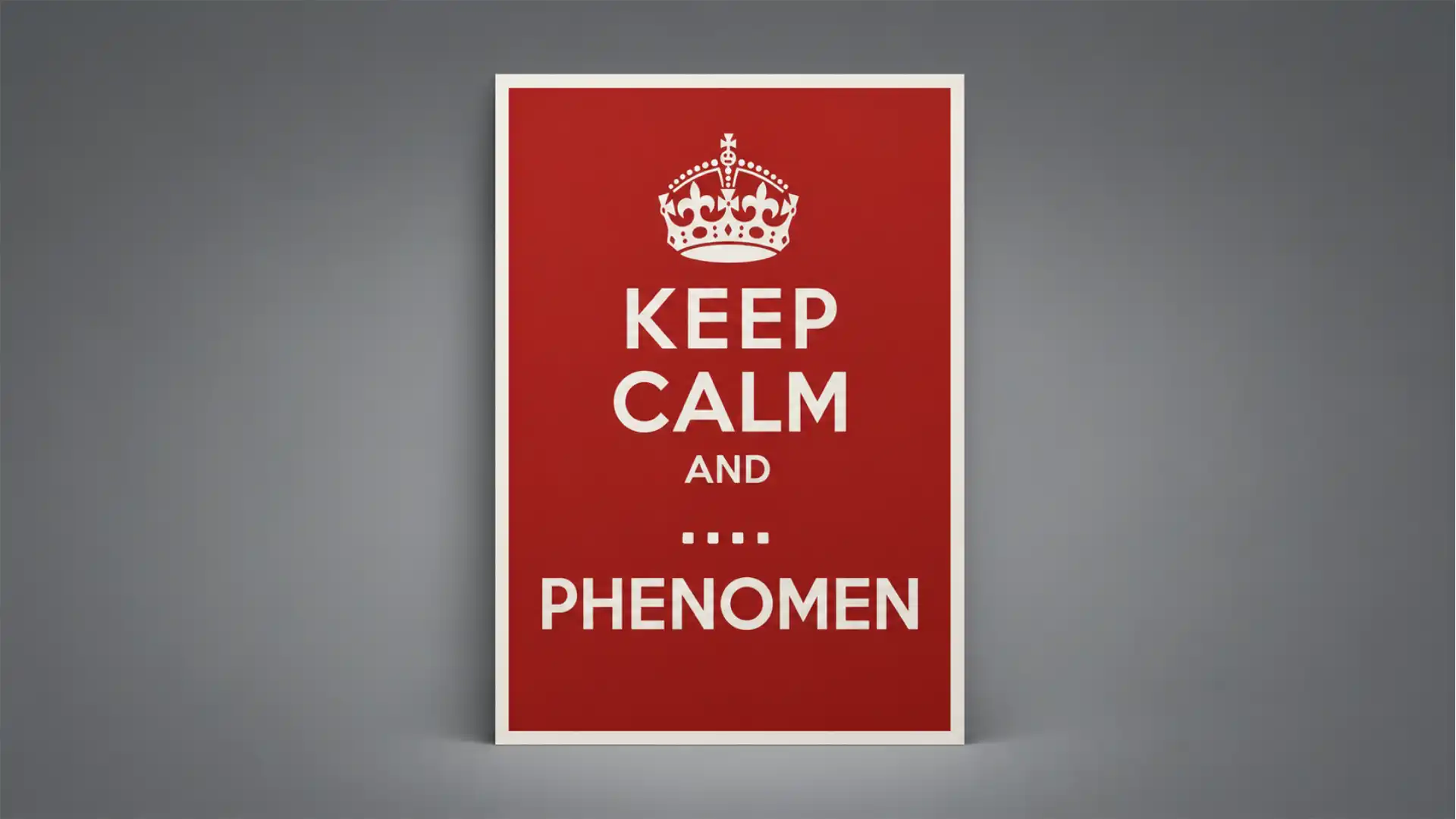
The strangest thing about “Keep Calm and Carry On” is that it became famous after it missed its own moment. The poster was made for wartime Britain, printed in large numbers, and then mostly kept away from public view. Decades later, it reappeared in a second-hand bookshop, where customers treated it less like state messaging and more like a good object: clean, odd, stern, reassuring, funny without trying to be funny.
Table of Contents
The second question is whether the original poster is still worth looking up. Yes, because the original is quieter than the modern flood suggests. Seeing the Imperial War Museums record restores the object’s discipline: red field, crown, white command, strict centered layout. The original has a severity that many later remixes lost.
The third question is whether the meme is dead. It is dead as a fresh joke, but alive as a cultural reference. That distinction matters. Few people will be impressed by a new “Keep Calm and…” variation in 2026. Yet people still recognize the shape instantly, and that recognition keeps the format available for parody, nostalgia, and commentary.
The fourth question is whether the history matters if most users only know the template. It does, because the history changes how the object reads. Without the 1939 origin and later rediscovery, “Keep Calm” is merely a clean slogan. With that story, it becomes a failed state message that found a second life as public remix material. The gap between those lives is what makes it interesting.
The fifth question is whether the overuse ruined the poster. It ruined the freshness, not the object. The original still works when separated from the flood. The web version is tired because it became too easy to copy. That does not erase the design’s strength. It proves it.
The sixth question is why this belongs in Web Radar instead of a design-history essay. The reason is the web behavior around it. The creator, meme archive, product spread, brand borrowing, and ownership fight are all online culture at work. The poster is the center, but the surrounding web trail is the discovery.
The seventh question is who should care. Designers should care because the format shows how constraint drives participation. Marketers should care because it shows how borrowed familiarity can sour. Internet culture people should care because it is a clean case of meme aging. Product people should care because it shows how one narrow template can become a commercial interface.
The final question is whether anyone should still make a “Keep Calm” poster. Probably only with self-awareness. The format is too loaded with cliché to use innocently. But as a study object, it remains excellent. It teaches more now that it is tired than it did when it was everywhere.
What the phenomenon still teaches the web
The clearest lesson is that templates beat blank pages when people want to participate quickly. “Keep Calm” did not ask users to become designers. It gave them a known form with one open gap. That small gap was enough. The web often mistakes more options for more creativity, but participation often grows when the user has fewer decisions to make.
The second lesson is that recognizability is a kind of interface. People could use the “Keep Calm” format because they already understood how it should look and sound. The crown, centered type, red field, and clipped command formed a mental interface before the user touched any creator page. The tool worked because the format was already loaded.
The third lesson is that emotional tone matters more than decoration. The poster is not visually rich. Its power comes from mood: authority, restraint, pressure, composure. Many templates fail because they offer layout without voice. “Keep Calm” had voice before it had users. That voice made the remix feel like a conversation with authority.
The fourth lesson is that overuse does not always mean weakness. Weak formats vanish. Strong formats become annoying. The “Keep Calm” flood happened because the design could absorb endless small substitutions. Its decline into cliché was not a separate failure. It was the late stage of its success.
The fifth lesson is that commerce changes the temperature of a meme. A joke shared by users feels different from the same joke printed by a brand. A gift object feels different from a campaign asset. A creator page feels different from a museum record. The format may be the same, but the speaker changes the meaning.
The sixth lesson is that old objects become powerful online when they leave room for the user. The original poster had enough blankness to survive reinterpretation. It did not show a specific person, place, or event. It had no detailed illustration to protect. That blankness became an invitation. The web entered through the empty space.
The seventh lesson is that public design has a long afterlife when it is visually strict. Strict forms survive mutation better than loose ones. “Keep Calm” could be recolored, re-iconed, reworded, resized, printed, posted, mocked, and sold without fully losing itself. That durability is rare.
The eighth lesson is that every viral format eventually becomes an archive of behavior. At first, users ask what can be made with it. Later, critics ask what the making revealed. “Keep Calm” now reveals a period when online personalization, meme generators, novelty merchandise, and social sharing fed each other openly.
The ninth lesson is that sincerity and irony often share the same container. Some people used the phrase for comfort. Others used it to mock comfort. Brands used it for easy familiarity. Protesters and parody makers used it to flip the command. The format survived because it did not force one reading.
The tenth lesson is that origin stories still matter online. The Barter Books rediscovery gives the phenomenon texture that a purely digital trend would lack. A real shop, a found poster, and customers asking for copies make the spread feel less abstract. The web loves a good find because it gives circulation a beginning.
The creator page remains worth opening because it compresses all of this into a small act. You type an ending, place it inside a known command, and turn it into something that can be posted or printed. The action is simple. The cultural machinery behind it is not.
A lot of current web tools promise broad creative freedom. “Keep Calm” suggests a quieter truth: people often want a recognizable frame more than total freedom. The frame lets them join a shared language. Their small edit becomes readable because everyone else knows the rules.
That is why the phenomenon still feels instructive even after the joke has faded. It shows the difference between a design people admire and a design people use. The original poster is admirable. The template was usable. The web rewards usable forms with repetition, even when repetition slowly damages their charm.
The poster’s modern life also complicates the idea of authenticity. Is the authentic “Keep Calm” the unused wartime print? The Barter Books rediscovery? The first wave of reprints? The meme template? The creator page? The legal battles? The answer is not clean because cultural objects do not remain in one role. The web multiplies roles.
That multiplication is the phenomenon. A poster can be an artifact, a mood, a joke, a template, a product, a dispute, a cliché, and a lesson. “Keep Calm and Carry On” became all of those things because the web kept finding new uses for its shape. Not all uses were good. Enough were easy.
The phrase has also become a way to talk about online exhaustion. It is the kind of meme people remember with a mix of affection and embarrassment. They remember seeing it everywhere. They remember the mugs. They remember the parodies. They remember when it stopped feeling clever. That memory is now part of the object.
A fresher meme might be more exciting, but a tired meme is often easier to understand. The heat is gone, so the structure is visible. With “Keep Calm,” you can see the frame, the slot, the product path, the brand temptation, the ownership tension, and the fatigue. It is almost too neat as a map of internet spread.
The old command still has a pulse because the feeling underneath it never disappeared. People still want calm. People still need to continue. People still turn fear into jokes, stress into objects, and identity into templates. The words have been cheapened by overuse, but the desire they address remains real.
The darker reading remains available too. “Keep calm” can sound like comfort, but it can also sound like suppression. “Carry on” can mean resilience, but it can also mean obedience. The web’s jokes often worked because they sensed that tension. The phrase is never only nice. It is a little bossy, a little cold, and a little absurd.
That tension is what makes it better than a simple motivational slogan. A purely cheerful phrase would have become décor and stayed there. “Keep Calm” had enough authority to invite rebellion. People could obey it, parody it, reject it, personalize it, or sell it. A good meme gives users something to push against.
The final reason to revisit it is that it makes internet culture feel physical. So much online history disappears into dead links and buried posts. “Keep Calm” left objects behind. Posters, mugs, shirts, cards, signs, coasters, cushions, and tote bags became evidence. The meme cluttered real rooms.
That clutter may be its most honest legacy. The web does not only produce discourse. It produces stuff. It fills drawers, walls, cupboards, classrooms, offices, and charity shop shelves. “Keep Calm” is one of the cleanest examples of a digital-era cultural form becoming domestic material.
Open the creator page with that in mind and it becomes stranger than it looks. It is not only a novelty tool. It is a small machine built on top of a failed wartime poster, a bookshop rediscovery, a meme template, a merchandise wave, and a fight over ownership. The interface is simple because the history is doing the work.
The poster told people to carry on. The web did exactly that, but in its own way: by copying, bending, printing, mocking, selling, arguing, forgetting, and remembering. A command became a format. A format became clutter. The clutter became a record. That is the quiet, odd, still-clickable beauty of the “Keep Calm” phenomenon.
A few useful answers before opening it
It worked because it was already shaped like a template. The opening words stayed fixed, the ending could be replaced, and the visual style remained recognizable even when people changed the message.
Not in the way people often assume. The poster was produced in 1939, but its modern fame came much later, after a copy was rediscovered and displayed at Barter Books in Alnwick.
It shows the meme-to-product pipeline very clearly. You can see how a historical poster became a personalization tool for mugs, posters, cards, signs, shirts, and other objects.
No, and that is part of why it is interesting. It is no longer fresh as a joke, but it is useful as a case study in how the web turns a strong visual format into a remix machine.
Designers, meme-culture people, marketers, product thinkers, and anyone curious about internet history. The phenomenon explains how recognition, repetition, templates, merchandise, and fatigue all connect.
Treat it less as a slogan and more as web infrastructure. The poster became a frame that people could fill, print, sell, mock, and keep using long after the original context had faded.
Author:
Jan Bielik
CEO & Founder of Webiano Digital & Marketing Agency
This article is an original analysis supported by the sources cited below
Keep Calm and Carry On by Imperial War Museums
Imperial War Museums collection record for the original poster, useful for the visual description, object context, production date, material details, and confirmation that the design belongs to a wider wartime poster series.
Keep Calm and Carry On the compromise behind the slogan
UK Government History article by Dr Henry Irving explaining the Ministry of Information context, the 1939 slogan development window, and the way modern popularity has obscured the poster’s more complicated wartime history.
Keep Calm and Carry On by Know Your Meme
Meme database entry documenting the online spread of the phrase, the “Keep Calm and X” structure, image macro use, generator culture, and later remix behavior.
Make Keep Calm gifts with the Keep Calm and Carry On Creator
The active creator and product page used as the main Web Radar object for examining how the slogan became a personalization tool and merchandise format.
How Keep Calm and Carry On became a global phenomenon
Digiday article on the slogan’s use by brands, retailers, entertainment marketing, and popular culture, including examples of commercial remixing and product spread.
The vicious trademark battle over Keep Calm and Carry On
Report on the commercial and legal disputes around attempts to control the slogan, useful for understanding the tension between public meme culture and trademark claims.
Keep Calm and Carry On the secret history
Guardian article on Barter Books and the rediscovery story, useful for grounding the modern revival in the physical bookshop setting that helped bring the poster back into public attention.
| Citing this article? Brief excerpts are welcome. Please credit Webiano.digital, name the author where stated, and include a link to https://webiano.digital and to this original article. Full or substantial republication requires prior written permission. Read our Copyright and Content Use Policy. |
This article was prepared with the assistance of artificial intelligence tools. The content underwent expert human review, and Webiano Digital & Marketing Agency assumes editorial responsibility for its final version and publication.