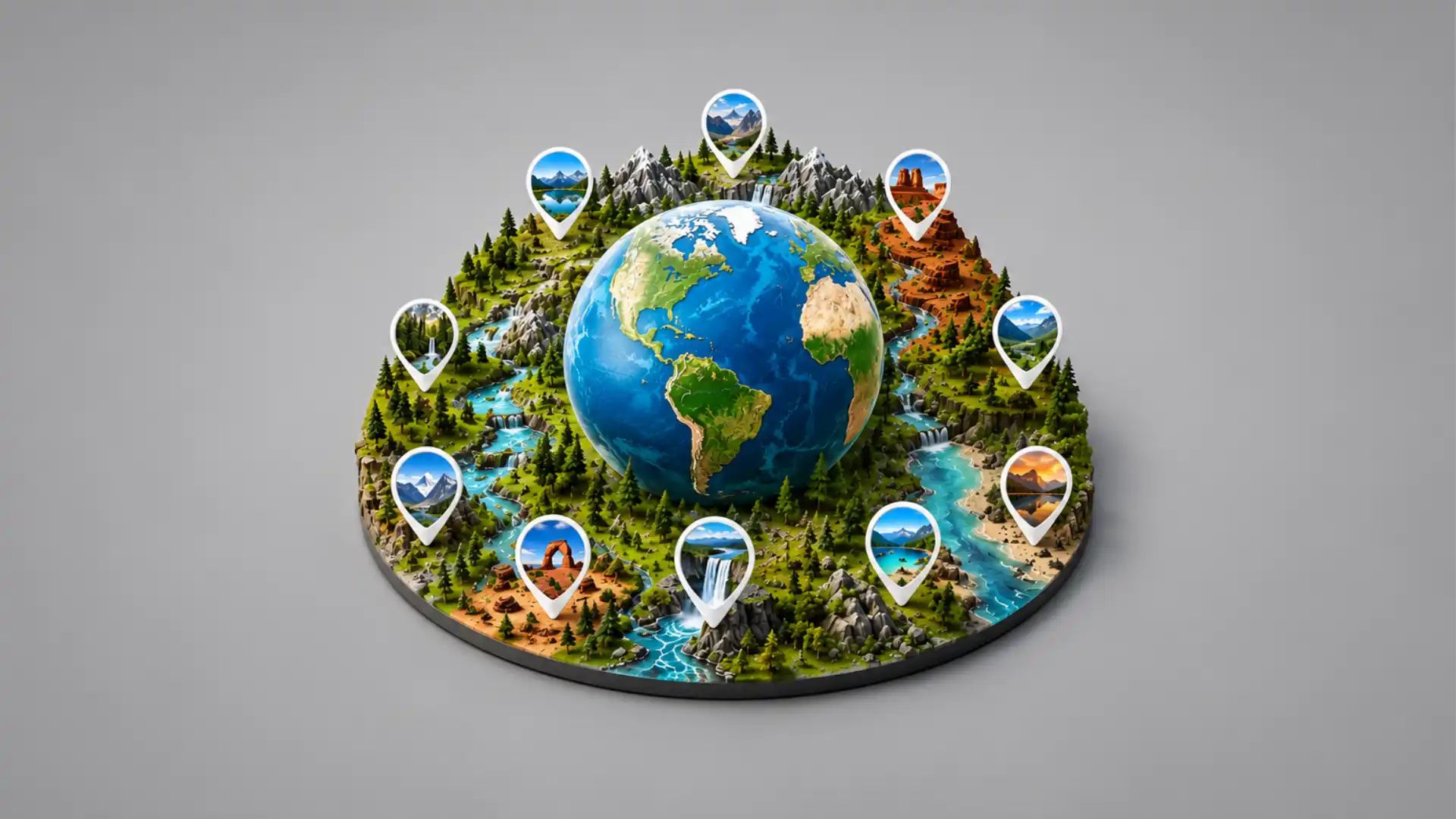
Traveler Map has the kind of premise that sounds almost too obvious once you see it: put national parks on a world map, make them explorable, and let curiosity do the rest. Not a glossy travel magazine layout. Not a “top 25 places to visit before you die” carousel. Not another itinerary generator pretending to know your soul. Just parks, pins, photos, locations, useful links, weather, nearby places, visited markers, ratings, and enough structure to make the map feel alive. The homepage calls it an interactive world travel map for exploring national parks and scenic natural wonders, which is accurate, but undersells the pleasure of the thing. Traveler Map works because it makes outdoor discovery spatial again, and that is rarer on the web than it should be.
Table of Contents
Most travel websites flatten nature into lists. The web loves rankings because rankings are easy to package, but parks are not made for that format. Yellowstone does not become more interesting because it sits above Yosemite in a numbered post. Banff does not need a headline about “hidden gems” to be worth opening. A national park is a place in relation to other places: mountains beside towns, lakes near borders, trails beside roads, protected land next to older protected land. Traveler Map understands that instinctively. It gives the reader a map first, then lets the details unfold through place pages. The result feels less like consuming travel content and more like looking around.
The site is also charming because it does not arrive dressed as a venture-backed travel platform with forced polish and suspiciously perfect copy. It feels made by people who actually like maps and outdoor places. The About page names Kacper Goliński as co-founder for software and Oskar Goliński as co-founder for SEO and marketing; it describes the project as a place for finding inspiration for the next adventure and exploring natural and heritage wonders through interactive maps. That personal maker energy matters. It gives Traveler Map a slightly unfinished, human texture that suits the subject. A map of parks should feel open-ended, because the point is not to complete a funnel. The point is to wonder where to go next.
There is a small but important tension inside the product. Traveler Map wants to be both a discovery surface and a practical planning companion. The global parks page says it lists parks from around the world with names, locations, and brief descriptions or Wikipedia links, and it says 150 national parks are currently listed with more information being added. That is not the whole planet yet, no matter how global the ambition sounds. But that partialness is not a failure. It gives the site a readable scale. You can open it without drowning in data. It is big enough to wander, small enough to understand, and that makes it more inviting than many giant map databases built for specialists.
The map starts where travel content usually gives up
The most interesting thing about Traveler Map is not that it has park pages. The interesting thing is where the experience begins. Many travel sites start with prose, then use maps as decoration. Traveler Map starts with the shape of the world and lets the prose sit behind the pins. That changes the behavior of the person using it. You do not only search for a park you already know. You notice clusters. You notice that a famous place is close to another place you have never heard of. You follow geography rather than a writer’s ranking. That shift is the whole product idea.
Travel discovery has become strangely cramped. Search engines answer direct questions well, but they are poor at browsing without a target. Social feeds are good at making one waterfall look irresistible for five seconds, then terrible at helping you understand where it is, what is near it, or whether it belongs in a trip. Booking platforms care about lodging and inventory. Government park sites are authoritative but scattered by country, agency, and jurisdiction. Traveler Map sits in a gentler middle: not official enough to replace park authorities, not commercial enough to feel like a trip funnel. It gives you the “where is that and what else is nearby” layer, which is often the layer people actually need first.
The homepage picks the right emotional language without overcomplicating the interaction. It says the map helps people find scenic and natural wonders “right in the palm of your hand”, then immediately points to exploring USA parks and world national parks. It also features famous parks such as Banff, Jasper, Grand Teton, Yellowstone, Yosemite, and Grand Canyon near the top of the page. Those names are not obscure, but they serve a useful purpose. They give the user recognizable anchors. A discovery product needs familiar handles before it can lead people into less familiar territory.
That is where Traveler Map is smarter than it first appears. It does not pretend every park is equally known or equally ready for a first-time visitor. It lets the famous parks do the onboarding. Then the world parks index widens the field. The page includes names from the United States, Canada, the United Kingdom, Poland, South Africa, Tanzania, Malaysia, Bolivia, and elsewhere, with the site’s own copy noting both famous examples and lesser-known parks. You start with Yellowstone because you know Yellowstone. You stay because you realize the map can point you toward parks that never show up in your feed. The product’s discovery value lives in that second click.
The experience also pushes against the strange sameness of travel writing. Most destination pages on the commercial web are written to rank, not to orient. They repeat the same phrases about breathtaking views, must-see spots, unforgettable memories, and perfect escapes. Traveler Map is not immune to soft travel copy; some descriptions lean that way. But the map changes the reading mode. A paragraph about Banff feels less like a sales pitch when it is tied to nearby parks, weather tables, photos, links, and a place marker. The page becomes a node, not a brochure. That distinction makes the site more useful than its plain copy alone would suggest.
A good web discovery project often has this quality: the interface teaches you how to think about the subject. Traveler Map teaches parks as connected geography. The Banff page, for example, includes the park’s location in Alberta, its establishment in 1885, its area, photos, useful links, average weather, user reviews, and nearby parks such as Yoho and Kootenay. That is not glamorous, but it is exactly the kind of structure that supports real curiosity. The site does not only tell you Banff is beautiful; it places Banff inside a small system of decisions.
This is also why the site is more interesting than a static “world national parks list.” A list rewards completion; a map rewards wandering. Lists ask you to scan from top to bottom. Maps invite lateral movement. You can jump from Canada to Utah, from the United Kingdom to Poland, from a famous canyon to a park you only know by name. The format creates its own rhythm: click, zoom, open, compare, drift, bookmark mentally. That rhythm is close to the way people daydream about travel, which is not usually a straight line from need to booking. It is more like staring at the globe and noticing a coastline.
The map-first approach also makes the project feel calmer than the modern travel internet. There is no immediate pressure to buy a flight, reserve a hotel, or download an app. You can create an account, sign in, add reviews, mark places as visited, and follow newsletter updates, but the public browsing layer remains simple. The Terms page says an account is needed for certain features, while viewing the website does not require one. That matters. Traveler Map’s best use case begins before commitment, when someone is still in the “show me what exists” stage.
The small product feeling is the charm
Traveler Map does not feel like a platform pretending to have solved travel. It feels like a useful web object built from a specific obsession. That obsession is visible in the founder trail. On Travel Massive, Kacper Goliński introduced TravelerMap as a website for exploring national parks around the world using big interactive maps, and he framed the project as a reaction to travel blogs and marketing sites that show only the “good parts.” He wrote that TravelerMap aims to provide real, no-fluff information for nature adventures and mentioned plans for user accounts and social features. That original maker note explains the site better than most homepage copy could.
The product has grown in the direction hinted there. User accounts, visited places, reviews, ratings, and photo uploads are exactly the features that turn a map from a directory into a shared travel memory surface. Open Makers records an update saying TravelerMap added user accounts and park reviews, with photos and detailed descriptions for all national parks in the United States and Canada at that time. Travel Massive comments from the founder also mention users marking places as visited, seeing them on their own map, reviews with ratings, and work on user photo uploads. That is a sensible path for a small travel product: start with places, then let people attach evidence of having been there.
The visited marker is more important than it may sound. Travel memory is spatial, not only chronological. People remember trips by routes, loops, borders crossed, lakes reached, weather survived, roads taken by mistake. A map of visited parks turns that memory into something visible. It also gives the product a reason to exist after planning. Many travel tools are abandoned once the trip is booked. Traveler Map can sit before, during, and after the trip: discover the park, check the basics, mark it visited, leave a rating, add a photo, compare nearby places. That loop is modest, but it is coherent.
The site’s public pages show the outlines of that loop. The Banff page includes “Add photo” and “Visited” controls near the top, then review prompts lower down. A review from July 28, 2025 appears on the page, which suggests the community layer is not only theoretical. The page also links to official websites, Wikipedia, Google Maps, and a data reporting form. This is not a closed ecosystem trying to trap the user. It behaves more like a dashboard for park curiosity, sending people to stronger sources when the task requires authority.
That outward-linking habit is one of the site’s best editorial choices. Nature travel is one of the worst categories for overconfident unofficial advice. Conditions change, fees change, closures happen, routes wash out, fires affect access, wildlife rules differ, permits sell out. Traveler Map does not need to become the final source for everything. It becomes more trustworthy when it sends the user to official park pages and other reference sources. The Terms page even states that information on the website may not be fully accurate or current. That disclaimer is not a weakness; it is a realistic boundary for a small map project.
The maker character also appears through the technical notes around Kacper Goliński’s own site. He describes TravelerMap as built with Elixir and Phoenix LiveView, with TypeScript, Maplibre, Postgres/PostGIS, and custom AWS S3 plus Lambda work for image processing. For most users, that stack does not matter directly. For Web Radar, it matters because it explains why the project feels interactive rather than static. Live search, map movement, place data, photos, reviews, and visited states all require a product mindset, not only content publishing. Traveler Map is not a blog with a map widget; it is a small software product wearing travel clothes.
There is a difference between polish and care. Traveler Map has care even where it lacks polish. Some copy has typos. Some pages use phrases that could be tightened. Some data is incomplete. Some place descriptions feel imported or lightly edited. Yet the underlying shape is thoughtful. The map, place pages, country sections, weather blocks, nearby parks, reviews, and external links all point toward a useful mental model. The site respects the fact that outdoor decisions are messy, and it tries to gather the first layer of that mess in one place.
Small web tools often beat larger products by refusing to solve too much. Traveler Map does not try to become a full trip planner, social network, guidebook, booking site, route builder, climate dashboard, conservation portal, and personal journal all at once. It gestures toward several of those roles, but its center remains plain: explore parks. That restraint keeps it from collapsing under ambition. The homepage even promotes VeloPlanner, a related cycling-route map project, rather than stuffing cycling routes into Traveler Map itself. The separation is healthy; each map gets to stay focused.
The site also has that wonderful quality of being useful while still feeling slightly hand-built. The best web gems often live between a spreadsheet and a startup. They have more structure than a personal blog, more personality than a database, and more patience than a feed. Traveler Map sits in that zone. It is organized enough to browse, but not so optimized that it becomes sterile. It still has the energy of someone adding parks, improving pages, answering community feedback, and making the next feature because they want to use it themselves. That is exactly the kind of internet object Web Radar exists to notice.
What Traveler Map actually gives you
At the surface level, Traveler Map is easy to explain. It is an interactive map and directory for national parks and outdoor destinations, with country pages, place pages, photos, basic descriptions, useful links, average weather, reviews, ratings, visited markers, and nearby place suggestions. The world index says it currently shows 150 national parks with detailed descriptions and that more information is being added. The homepage frames the site around exploring national parks worldwide, finding scenic and natural wonders, and planning hikes, picnics, walks, or outdoor trips. The promise is broad, but the interaction is concrete: open the map, pick a park, see what surrounds it.
The park page format is the best place to understand the product. Banff’s page reads like a template for the whole experience. It starts with rating and action controls, then a description, photos, useful links, common practical questions, average weather, nearby parks, and user reviews. The weather table is not a throwaway feature. A park page with month-by-month temperature, rain, and snow turns casual browsing into seasonal planning. You may not need a full forecast when daydreaming, but you do need to know whether a place is a summer hiking idea, a winter survival idea, or something in between. That small weather block quietly makes the page more actionable.
The About page says weather data comes from Open-Meteo, and Open-Meteo describes itself as a free weather forecast and historical weather API with many models, historical weather from 1940, and no API key required. That pairing makes sense for a small travel map, because weather is one of the few data layers that immediately improves outdoor discovery. The site does not need complex itinerary logic to add value. It only needs to answer the first practical doubt: “What is this place like across the year?” Average weather turns a pretty map pin into a planning prompt.
What stands out on the site
| Feature | Why it matters |
|---|---|
| Map-first browsing | Places are discovered by geography, not by ranking. |
| Park pages | Each location gets photos, description, links, weather, and nearby parks. |
| Visited markers | The site becomes a personal travel memory map, not only a directory. |
| Reviews and ratings | Visitors add lived experience around official and reference links. |
| Nearby parks | The map encourages side trips, clusters, and better route thinking. |
| Weather tables | Seasonal conditions become part of discovery before deeper planning. |
The table matters because Traveler Map’s value is cumulative rather than flashy. No single feature is shocking. The charm comes from the way small pieces reinforce each other: map, photo, place page, nearby suggestion, weather, visited state, review. The site does not need a cinematic interface to be useful. It wins by joining familiar pieces around a clear outdoor browsing habit.
The search feature also deserves attention. A map without search becomes a toy once the user has a specific destination in mind. The homepage exposes a “Find something” prompt with a keyboard hint, and the founder’s technical notes mention real-time features such as live search. For a national parks map, search has two roles. It handles known intent, such as “Banff” or “Yosemite.” It also supports half-remembered curiosity, where someone recalls a place name from a conversation and wants to locate it quickly. Search gives the map a spine.
The country sections give another kind of structure. Traveler Map links to USA parks, Canada parks, United Kingdom parks, Poland parks, and all world national parks from the main navigation. This matters because a fully global map can become visually and cognitively noisy. Country-level entry points help users browse at a scale that matches actual trip planning. A person planning a road trip in the American West does not need every pin in Europe visible at once. A person based in Poland may want parks near them first. The navigation respects the way travel desire narrows from globe to region to route.
The place pages also make good use of “nearby” suggestions. Nearby parks are where map products become more than lookup tools. Banff’s page lists Yoho National Park at 20.5 miles away and Kootenay National Park at 40.2 miles away, among other nearby protected places. That is exactly the kind of detail that changes a trip. A person who came for Banff may realize the region has a cluster, not a single stop. A traveler who had one day in mind may start seeing a loop. Traveler Map’s strongest planning value is not telling you what to do; it shows proximity clearly enough that better ideas appear.
The site’s photo layer is useful in a different way. Outdoor places are visual before they are logistical. A photo of Grand Teton’s grasslands and mountains or Grand Canyon’s desert peaks gives the user immediate texture. But Traveler Map avoids making photos the whole interface. The images serve the map; they do not swallow it. The About page credits sources including Unsplash, Zack/Cora Frank photography, Wikimedia, OpenMoji, Heroicons, and Open-Meteo. Those attributions make the site feel assembled from the open web’s useful parts, which suits a project about public natural places.
The review system adds a layer that official sources usually lack. Official park pages are authoritative, but they rarely capture ordinary traveler texture in a lightweight way. Reviews can tell future visitors whether a page matches lived experience, whether a park felt crowded, whether a viewpoint was worth the detour, whether a visit was family-friendly, or whether the weather made the place harder than expected. Traveler Map is not yet a giant review platform, and that is fine. Even a small number of reviews can give a park page a pulse, especially when paired with ratings and photos.
There is also a subtle product bet in letting users add photos and mark places as visited. The best travel communities are built around proof, memory, and aspiration. People want to remember where they have been. They want to compare routes. They want to show the shape of their outdoor life. They want a reason to return to the map after the trip. Traveler Map’s feature set points toward that behavior without turning the site into a noisy feed. A personal map of visited parks is more durable than a social post, because it remains useful years later.
Why national parks work so well as a map
National parks are perfect material for a web map because they sit at the intersection of awe, public access, planning friction, and geography. People know the category. The phrase “national park” carries a promise: protected land, scenery, wildlife, trails, boundaries, rules, and a civic sense that the place belongs to more than one person. But the category is also slippery. Different countries use different designations, legal systems, management models, and visitor expectations. A map cannot resolve all of that, but it can give the category a readable shape. Traveler Map turns a messy global idea into something you can touch.
The global context is much larger than Traveler Map’s current index. Protected Planet describes the World Database on Protected Areas as the most comprehensive global database of terrestrial and marine protected areas, with government and other authoritative submissions behind it. That is the heavyweight data universe: conservation categories, legal designations, boundaries, OECMs, management records, and global reporting. Traveler Map is not trying to be that. It is doing something softer and more editorial. It takes one popular doorway into protected nature, the national park, and makes it browseable for ordinary travelers.
That distinction matters. A conservation database answers institutional questions; a travel discovery map answers human ones. Where is this park? What does it look like? What country or state is it in? What is nearby? What season might work? Have other people visited? Where is the official site? Is there a Wikipedia page? Can I remember that I went there? Those are not trivial questions. They are the questions that move someone from vague interest to possible movement. Traveler Map’s editorial strength is reducing the first layer of uncertainty.
National parks also invite collection behavior. Some people want to visit every U.S. national park, every Canadian national park, every park in a region, or simply every wild place they can reach by train, car, or bike. A map is the natural interface for that urge. It turns a list into a board of possible marks. The Travel Massive discussion around TravelerMap included the idea of marking parks as visited and making that map visible, and the founder later described that feature as released. That feature fits the psychology of parks almost perfectly, because park travel already has a badge-like quality.
But the map also keeps the collection instinct from becoming too abstract. A checklist can make parks feel interchangeable; geography restores their difference. A park in Alaska is not the same kind of commitment as a park near a major highway. A desert park asks for different preparation than a mountain park. A Canadian Rockies cluster creates different trip logic than a scattered set of protected islands. Traveler Map’s place pages and nearby lists let those differences show up gradually. The user is not only collecting names; they are noticing terrain, distance, climate, and route shape.
National parks are also full of boundaries, and boundaries are easier to understand visually than verbally. The word “park” hides scale. Some places are compact enough for a half-day visit. Others are vast landscapes where roads, trails, campgrounds, and weather divide the visitor experience. Traveler Map currently works more as a pin-and-place discovery map than a full boundary explorer, but even that is enough to reframe the subject spatially. The mind sees the pin, then starts asking the right next questions: How far from the city? What else is close? Which region does this belong to? A pin is often the beginning of geographic literacy.
The site also makes the web feel better because it restores serendipity. Serendipity has been squeezed out of many travel products by intent capture. A booking site wants dates and destination. A search engine wants a query. A social feed wants engagement. Traveler Map lets the user begin with no exact plan. You can open it because you like parks. You can drift until a place catches you. The map gives enough order to avoid chaos, but enough openness to invite accidental discovery. That is a rare balance on a web increasingly built around immediate conversion.
There is a bigger cultural point here. The internet is now very good at making places look famous and strangely bad at making them feel situated. A reel can make a viewpoint go viral without showing the road, region, season, neighboring towns, or other nearby parks. A list article can praise a place without showing what it connects to. Traveler Map pushes back by making location unavoidable. You cannot encounter the park as pure image. You encounter it as a point in a real geography. That is healthier for travel imagination, and probably healthier for travel behavior.
The site’s limits also reveal a useful truth about park discovery. No single project can own the full truth of a natural place. Official agencies own rules and closures. Conservation databases own formal protected-area records. Local guides know conditions. Travelers know lived experience. Weather APIs know climate and forecast patterns. Maps know proximity. Traveler Map is interesting because it does not try to flatten these sources into one voice. It links outward, uses attributions, adds user input, and keeps the map as the organizing layer. Its value is not authority alone; its value is orientation.
The maker trail behind the site
Traveler Map becomes more interesting when you follow the person behind it. Kacper Goliński’s own site presents him as a software engineer who likes cycling, maps, and outdoor technology, with projects including VeloPlanner, TravelerMap, Velomapa, and bicycle infrastructure maps. The pattern is clear: maps are not a random feature choice. They are the maker’s native medium. TravelerMap is listed as a site showcasing national parks and other outdoor destinations, built with Elixir and Phoenix LiveView, TypeScript, Maplibre, Postgres/PostGIS, and image-processing work. That background explains why the site feels more like an interface than a content farm.
This matters because travel content is often divorced from product craft. A lot of travel websites are publishing operations with maps bolted on later. Traveler Map appears to come from the opposite direction: a map builder making a travel discovery surface. That may sound technical, but users feel the difference. The page structure is not only “article plus image.” It is data plus interaction plus memory. Even the related projects reinforce this. VeloPlanner is described on the homepage as an interactive map for signposted cycling routes and points of interest such as campgrounds, shelters, viewpoints, and historic points, with OpenStreetMap powering the project. The maker’s interest is not travel in the abstract; it is outdoor movement through mapped space.
The Travel Massive thread gives the project an even more human origin story. Kacper introduced himself as a software engineer from Poland who loves coding and the outdoors, then positioned TravelerMap against travel marketing fluff. That is a sharp enough thesis for a small product. The web does not need another “inspiring destinations” site. It needs tools that make a place easier to understand before the inspirational layer takes over. Traveler Map’s best pages are not poetic; they are orienting. That is why the founder’s “no-fluff information” line feels like the project’s real north star.
The community feedback in that thread is also revealing. A Travel Massive commenter suggested metadata, comparison tools, visited parks, rankings, and a newsletter, and Kacper responded that metadata, comparison, and marking visited places were on his mind. Later in the same discussion, he listed released features: user accounts, visited places on a personal map, and reviews with ratings, while user photo uploads were under development. That is exactly how good niche web tools often mature. They do not leap from grand strategy; they grow from a few users saying what would make the thing more useful.
The Open Makers update from February 2023 adds another clue. TravelerMap announced accounts, reviews, and ratings, plus photos and detailed descriptions for U.S. and Canadian national parks. That update is modest, but it shows the product crossing from directory into participation. The difference between “we list parks” and “people can mark, review, rate, and add photos” is the difference between a catalog and a community tool. Traveler Map is still closer to a catalog than a major community, but the direction is visible. The product wants personal travel history to sit beside public place data.
There is a risk in that direction, of course. Travel review systems can become noisy, shallow, and repetitive. A park does not need thousands of ratings saying “beautiful place.” A map product built around nature has to avoid turning wild places into consumable trophies. Traveler Map has an advantage because its current scale is still small. It can nudge users toward practical, specific, experience-based contributions before habits harden. Reviews that mention trail conditions, access, seasonality, crowds, accessibility, wildlife etiquette, transit, or nearby alternatives would make the site far stronger than generic praise. The community layer should deepen the map, not decorate it.
The same goes for photos. User photos can make a park page feel alive, but they can also push the site toward Instagram sameness. The trick is to make photos serve planning and memory, not only spectacle. A cloudy trailhead photo may be less glamorous than a sunset, but more useful. A campsite access photo, a winter road closure sign, a crowded parking area, a boardwalk surface, or a viewpoint with scale can say more than another perfect lake reflection. Traveler Map’s current photo system is a foundation. Its future quality will depend on whether the product rewards useful images as much as pretty ones.
The site’s privacy and terms pages also show a normal but relevant trade-off. Accounts bring email collection, usernames, optional profile data, public submitted content, approximate IP-based location for statistics, usage data through Google Analytics, and error tracking through Sentry. That is not unusual for a modern web app, but it matters because a visited-places map can become personal. The Terms page says reviews, photos, and forum messages may be used on the website and promotional materials, while the Privacy Policy says submitted content may be displayed publicly. People should treat their travel history as public when they choose to share it.
None of that makes the project suspect. It simply places Traveler Map in the real web, where even charming tools have data policies. A user can still browse without an account, which is the right default. Creating an account makes sense for visited maps, reviews, and uploads. The important point is that the public browsing experience remains open. The site earns trust by letting people see the map before asking them to become users. That is a small product decision with a large emotional effect.
The web taste of a good niche map
The internet has no shortage of maps, but most maps on websites behave like supporting actors. They show a hotel location, a store address, an event venue, a route preview, or a neighborhood boundary. Traveler Map uses the map as the main editorial object. That is why it belongs in a discovery format. It is not merely showing where content is; the content exists because the map gives it shape. The site asks the reader to browse the world as a set of outdoor possibilities.
This is a different kind of curation from a travel magazine. The editor is partly the database, partly the interface, partly the person clicking. Traveler Map chooses the category and adds the structure. The user chooses the route through it. That makes discovery feel self-directed. You are not being told that one park is “the best.” You are being shown enough connected places to form your own appetite. That is a more generous model of curation, and it suits nature better than rankings do.
The best hidden web tools often have a narrow enough subject to feel complete even when they are not finished. Traveler Map benefits from choosing national parks as its visible anchor. “Outdoor destinations” could become endless and vague. “Travel” could mean anything. “National parks around the world” is concrete. It has enough global scale to feel rich, but enough category focus to keep the interface legible. The site may later add mountains, trails, and more place types, as the founder suggested in Travel Massive comments, but the current center should not be diluted too quickly. The national park frame is the reason the map makes immediate sense.
The project also shows how much value remains in simple public web pages. Each park page is indexable, linkable, and readable without installing anything. That should not feel remarkable, but it does. A lot of travel discovery has moved into apps, feeds, closed platforms, and algorithmic recommendation surfaces. Traveler Map is still a website. You can open a park URL, send it to someone, search it, and move around from there. The open-web texture is part of the appeal.
There is also a pleasant refusal of excess personalization. Traveler Map does not need to know your entire preference profile before it shows you anything. You can begin with the map. The site may personalize through visited places once you sign in, but the base layer is shared. That matters because the outdoors itself is shared. A national park should not feel like a private recommendation bubble. The default view should be public geography, not predicted desire. Traveler Map gets that right.
The product’s rough edges are worth naming because they are fixable. The copy could use editorial tightening, especially on repeated travel phrases and occasional spelling errors such as “informations.” The global index could clarify its scope more confidently: 150 parks is a curated starting set, not a comprehensive world database. Some descriptions could be more factual and less promotional. The user review system could encourage practical details. The map could eventually expose filters for season, activity, region, accessibility, transit, entrance fee, protected-area type, and official data freshness. None of these issues damage the core idea; they point toward where the product could become sharper.
The strongest potential feature would be comparison without turning parks into commodities. A good comparison tool could show climate, region, nearby parks, typical season, terrain type, and official links side by side. The Travel Massive thread already raised metadata and comparison as ideas, and the founder responded positively. Done badly, comparison would become another ranking machine. Done well, it would help people decide between, say, two mountain parks in different seasons or two desert parks on a road trip. Traveler Map should compare practical conditions, not pretend to score wonder.
Another promising direction is route-aware discovery. Nearby parks already hint at clusters, but route planning could make those clusters more useful. If someone is moving from Calgary through Banff, Yoho, Kootenay, Jasper, and beyond, the map could help them see a natural sequence. If someone is planning a U.S. Southwest loop, the site could expose parks along the corridor without forcing a full itinerary. This should stay lightweight. The magic is not automation; the magic is showing enough geography for a human to plan better.
The site’s related cycling projects suggest the maker already thinks this way. VeloPlanner focuses on signposted cycling routes and points of interest, while Traveler Map focuses on parks and outdoor destinations. Both deal with movement, orientation, and public geography. That shared DNA could lead to strong cross-project thinking without merging everything into one bloated product. A cyclist browsing VeloPlanner may care about parks near routes. A park traveler may care about nearby cycling infrastructure. The web gets better when focused tools can talk to each other without losing their shape.
Traveler Map also feels timely because people are tired of travel content that looks abundant but says little. The more AI-generated destination pages flood the web, the more useful map-based and community-grounded interfaces become. A map with real place pages, official links, weather data, visited markers, and user photos has a structure that generic prose cannot fake as easily. It still needs careful data and moderation, but the interface itself resists some of the blandness of automated travel writing. Geography is a useful antidote to generic content.
Small questions before you open it
No. It is an independent website for exploring national parks and outdoor destinations. The global parks page says it includes names, locations, and descriptions or Wikipedia links, while individual place pages often link to official park websites. Use it for discovery and first-pass orientation, then confirm rules, closures, permits, fees, and safety details through official sources.
Not yet, and the site’s own index makes that clear by saying it lists 150 national parks with more information being added. Treat the global map as a growing curated surface rather than a finished encyclopedia. That makes the product more enjoyable anyway. It is better used as a place to wander than as an audit tool for global protected-area completeness.
Browsing does not appear to require one, while certain features do. The Terms page says users need an account for certain website features but do not need one to view the site. That is the right split for a discovery product: open map first, account only when you want personal actions such as reviews, photos, or visited places.
Open the world parks map, then search for a park you already know. Use that familiar park as a jumping-off point into nearby parks and country sections. Banff is a good example because its page shows description, photos, useful links, monthly weather, reviews, and nearby parks. The site becomes easier to understand when you start with one known location and let the surrounding geography widen.
Traveler Map is best for people who like outdoor places, road trips, national park collecting, light trip planning, geography browsing, and map-based daydreaming. It is less useful for someone who needs authoritative permit instructions or live closure status, because those details belong with official agencies. Its sweet spot is the moment before detailed planning, when you know you want nature but do not yet know the shape of the trip.
The biggest gains would come from clearer data freshness, stronger filters, better copy editing, richer practical reviews, and thoughtful comparison features. The product should keep its map-first calm and resist becoming a noisy travel feed. Traveler Map’s appeal is not volume. Its appeal is that it makes parks feel placed, connected, and open to exploration.
A web radar verdict
Traveler Map is worth opening because it restores one of the web’s simplest pleasures: pointing at a map and wondering what is there. That pleasure has been buried under feeds, rankings, booking funnels, and search snippets. The site does not need to be perfect to be memorable. It only needs to make national parks feel visible in relation to one another, and it does that well. You open it for a famous place, then drift into the less obvious nearby names. That drift is the product.
The project is also a reminder that small maps can have editorial taste. A good interface is a form of recommendation. Traveler Map recommends that you think geographically. It recommends that you look at nearby parks instead of isolated destinations. It recommends that you treat weather, official links, user experience, and memory as part of the same browsing surface. That is more interesting than a list of “best parks,” because it gives the reader a way to form their own path. The map does not shout; it nudges.
There is an internet-culture lesson in the site too. The open web still produces useful, specific, slightly odd tools made by people with real interests. Traveler Map did not need a huge brand to justify itself. It needed someone who cared about maps, parks, and practical outdoor discovery. The About page, founder comments, Open Makers updates, and technical notes all point to that same maker pattern. The best version of the web is full of projects like this: narrow, browsable, personal, and quietly useful.
Traveler Map’s current form is not the final version of the idea. The site could become a richer outdoor atlas if it improves data depth without losing simplicity. It could add better filtering, clearer source freshness, more practical user reviews, trip clusters, route hints, and useful comparison. It could also become too broad if it adds every outdoor object under the sun. The editorial challenge is focus. National parks are strong enough to remain the center of gravity.
The important thing is that the site already earns the click. Open Traveler Map when you are not ready to plan, only ready to look. Open it when a place name is stuck in your head. Open it before a road trip. Open it after visiting a park and wanting to mark it somewhere more durable than a social post. Open it when travel content starts to feel like the same five adjectives wrapped around different photos. Traveler Map makes the world’s protected wonders feel browseable again, and that is enough reason for Web Radar to keep it on the map.
Author:
Jan Bielik
CEO & Founder of Webiano Digital & Marketing Agency
This article is an original analysis supported by the sources cited below
Traveler Map homepage
The official homepage describing Traveler Map as an interactive world travel map for exploring national parks and scenic natural wonders, with links into USA parks and world national parks.
About Traveler Map
The official About page explaining the project’s purpose, naming the co-founders, and listing attributions for photos, icons, emojis, and weather data.
National Parks worldwide
The official global parks index, used to verify the site’s map-based national parks directory, current listed count, and stated scope.
Banff National Park page on Traveler Map
A representative park page showing the site’s place-page format, including description, photos, useful links, weather, nearby parks, visited controls, and reviews.
Traveler Map on Travel Massive
A maker-community post where Kacper Goliński introduced TravelerMap, explained its purpose, discussed early product thinking, and described later feature releases.
TravelerMap on Open Makers
A maker update documenting the release of user accounts, reviews, ratings, photos, and expanded descriptions for U.S. and Canadian national parks.
Kacper Goliński personal site
The founder’s project page describing TravelerMap’s technical stack and related map-based outdoor projects, including VeloPlanner and Velomapa.
Open-Meteo
The weather API source referenced by Traveler Map, used to understand the weather-data layer behind the park pages.
| Citing this article? Brief excerpts are welcome. Please credit Webiano.digital, name the author where stated, and include a link to https://webiano.digital and to this original article. Full or substantial republication requires prior written permission. Read our Copyright and Content Use Policy. |
This article was prepared with the assistance of artificial intelligence tools. The content underwent expert human review, and Webiano Digital & Marketing Agency assumes editorial responsibility for its final version and publication.