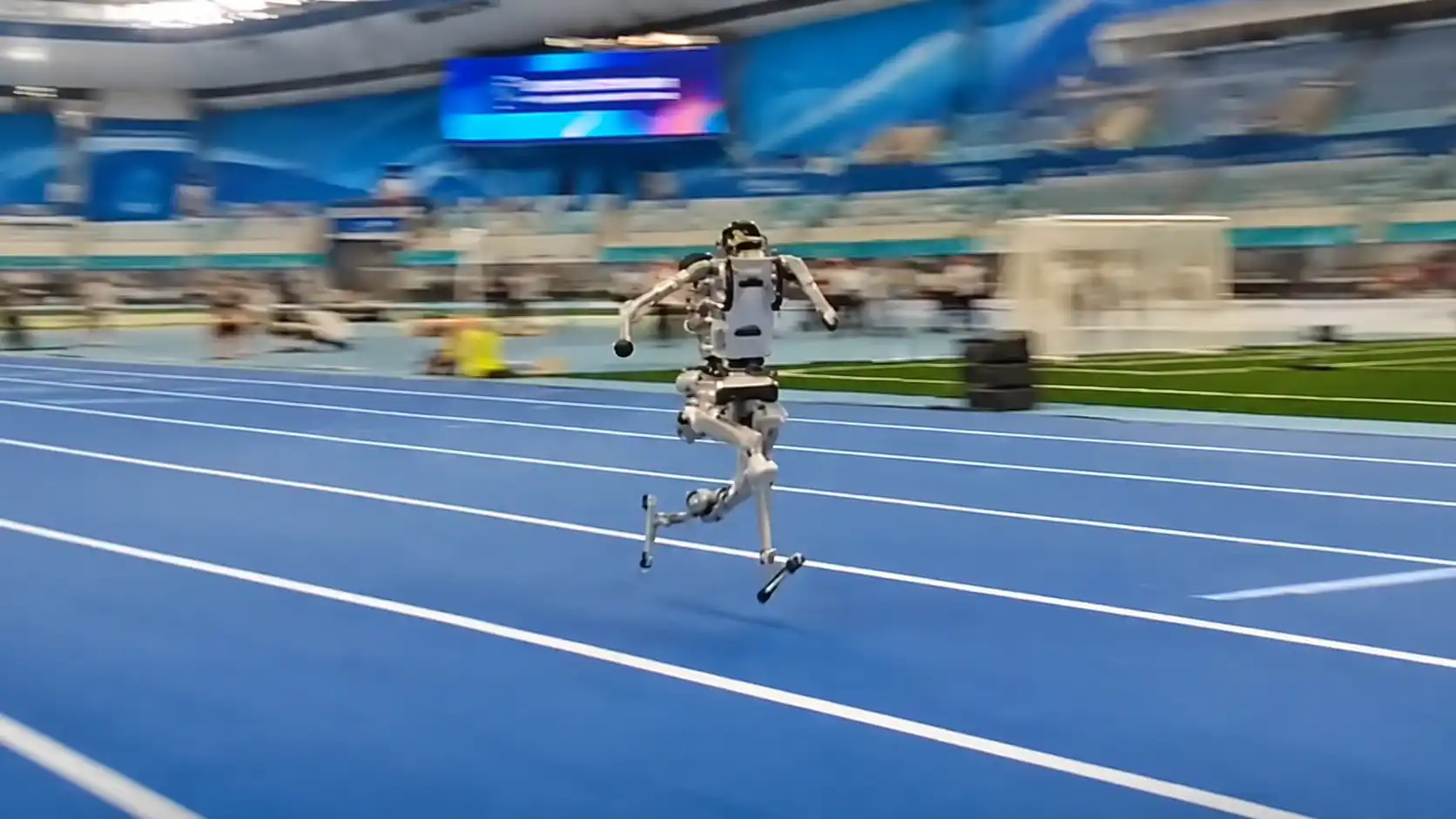
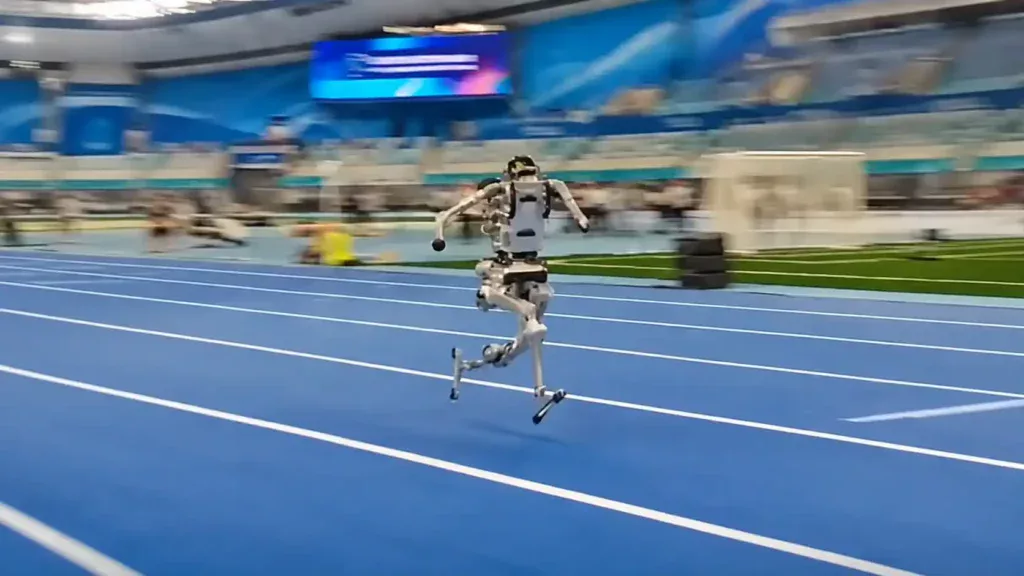
Unitree says its Superman prototype ran at 12.66 metres per second and jumped two metres from standing. Usain Bolt’s world record is a time, not a speed, and no federation ratifies peak velocity. Strip away the comparison and what remains is a handless machine, an undisclosed measurement method and a 905 million dollar listing forty-eight hours away.
Unitree Robotics published a short video on 17 August 2026 showing a humanoid prototype it calls Superman, and claimed the machine had reached 12.66 metres per second and jumped two metres from a standing start. Two days later its shares were due to begin trading on Shanghai’s STAR Market after an offering that raised roughly 6.1 billion yuan. Much of the coverage that followed reported that a robot had broken Usain Bolt’s 100-metre world record.
It did not. Bolt’s record is a time, 9.58 seconds, set in Berlin on 16 August 2009, and no athletics federation ratifies a world record for peak running velocity at all. The figure Unitree published is an instantaneous speed of unstated duration, obtained by an undisclosed method over an undisclosed distance, and released by the party that profits from it. The comparison filling headlines sets a sanctioned race result against a marketing metric.
That mismatch is the more useful story. Unitree produced its number by stripping out the components industrial customers actually buy, released it forty-eight hours before a listing priced near nine billion dollars, and has not published footage of the machine coming to a controlled stop. Each of those three claims can be checked. Read together, they describe how humanoid robotics is being financed in 2026.
A peak velocity is not a hundred-metre record
The 100 metres is scored by elapsed time from gun to torso crossing the line. Bolt’s 9.58 seconds implies an average velocity of 10.44 metres per second across the full distance, including a standing start, roughly 0.15 seconds of reaction and about 60 metres of acceleration. Any machine that wants the record has to average that figure from zero, not touch it briefly in the middle of a run.
Unitree published no time, no distance and no start protocol. On the evidence released, Superman’s 12.66 metres per second is a peak reading. A robot can hit a high instantaneous speed while covering 100 metres far slower than 9.58 seconds, exactly as a sprinter who false-starts and runs through the line does not hold a record. The quantity Unitree beat is a number extracted from Bolt’s race by researchers afterwards, not a mark any body awards.
The distinction is not pedantry, because the two numbers behave differently under engineering pressure. Sustained average velocity over 100 metres is bounded by acceleration from rest, thermal limits in the actuators, and control stability through the transition from acceleration to steady running. Peak velocity is bounded mainly by leg length, stride frequency and the length of the window in which nothing goes wrong. Optimising for the second is a much narrower problem, and it is the problem Unitree appears to have solved.
Unitree’s own executives have used the harder framing in the past. Chief executive Wang Xingxing told the 2026 Yabuli Entrepreneurs Forum that humanoids could break ten seconds over 100 metres by mid-2026, surpassing Bolt. That is a claim about a race. The August video is not evidence for it, and no timed 100-metre run by Superman has been published.
Three published figures for Bolt, and only one gets beaten
The human benchmark is less settled than the coverage suggests. A 2023 study in Bioengineering reanalysed the Berlin race using three laser distance systems sampling at 100 hertz and put Bolt’s maximum velocity at 12.32 metres per second, reached at 52.51 metres. The biomechanical report from the championships, by Graubner and Nixdorf, is the source of the widely quoted 12.42 metres per second, and that figure is a mean velocity across the fastest 20-metre section, from 60 to 80 metres, not an instantaneous peak. Gizmodo, covering the Unitree claim, used 12.2 metres per second.
The spread between those published human figures is 0.22 metres per second. The margin Unitree claims over the highest of them is 0.24. In other words, the claimed advantage is roughly the same size as the disagreement among sports scientists about what Bolt actually did, and the two figures being compared are not even the same kind of measurement: a 20-metre section average against an undisclosed peak.
Comparing a section mean to a peak systematically favours the peak, because instantaneous maxima always exceed the average of the interval containing them. If Superman’s 12.66 is a peak and Bolt’s 12.42 is a 20-metre mean, the honest comparison is 12.66 against the laser peak of 12.32, or Superman’s own 20-metre section average against 12.42. Unitree published neither.
None of this makes the robot slow. Against Bolt’s race average of 10.44 metres per second, 12.66 is about 21 per cent higher, and that is a real engineering result if the reading is sound. It simply does not establish the thing the headlines assert. The available evidence supports the statement that a Unitree prototype briefly moved faster than the fastest instantaneous speed recorded in a human 100-metre race. It does not support the statement that a robot beat Bolt.
Subtraction dressed up as an advance
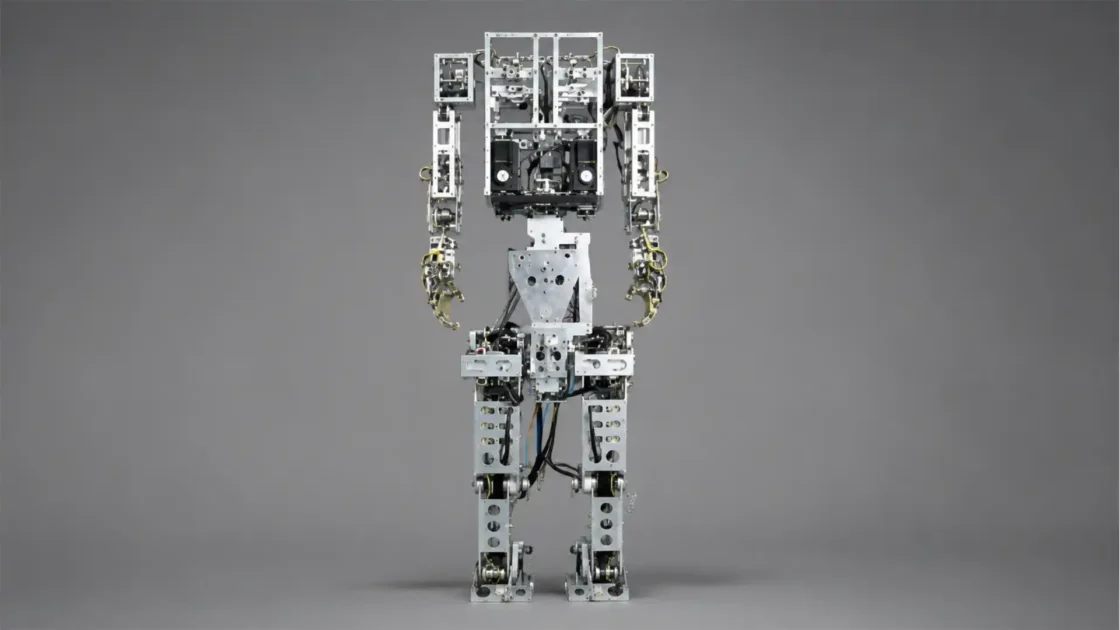
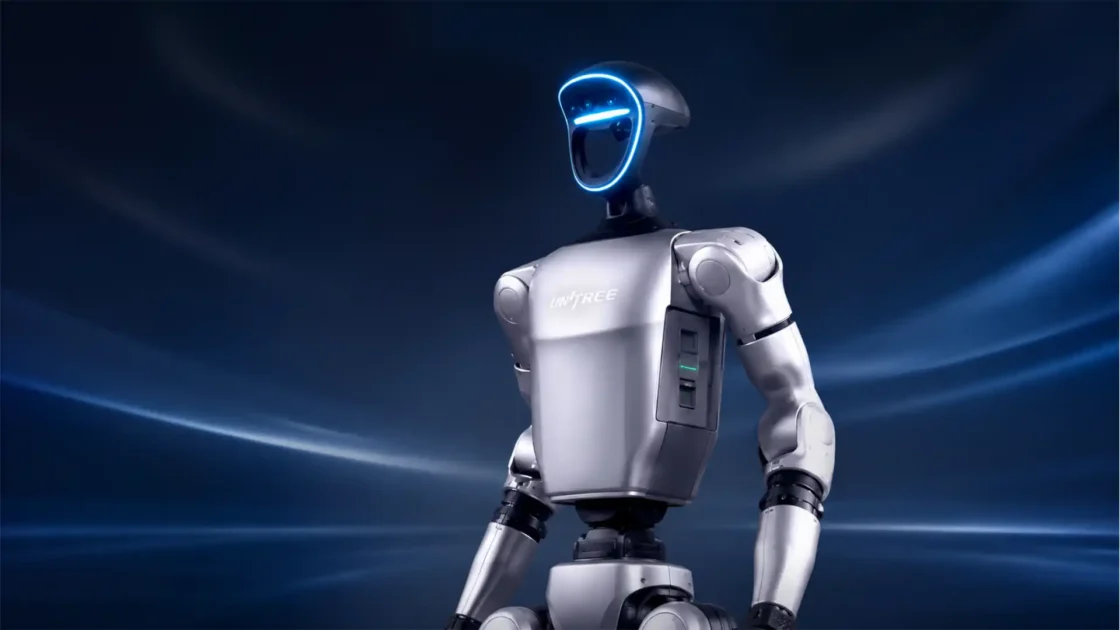
The Superman prototype in the video has no hands, no grippers and no upper-body manipulators, and appears to lack the head-mounted sensor arrays fitted to Unitree’s commercial models. Its combined thigh and calf length is 0.85 metres, longer than the 0.80 metres on the H1 platform, which lengthens stride at a given cadence. Unitree said the machine had been in development for a little over three months, with “significant room for further improvement”, and framed it as an experimental platform for studying highly dynamic movement rather than a product.
That is a coherent research programme, and it is also a subtractive one. Every gram of hand, wrist, sensor mast and payload capacity competes with locomotion dynamics, so removing them raises top speed. The engineering that produced the record is the direct inverse of the engineering that produces a useful robot: Superman cannot lift, carry, press, grip or open anything.
The pattern is visible in Unitree’s own progression. In April 2026 a modified H1 was recorded at 10.1 metres per second on an athletics track, and the accompanying text acknowledged that the measuring equipment might be subject to error. The standard commercial H1 weighs about 62 kilograms and keeps its arms. At the inaugural World Humanoid Robot Games in Beijing in August 2025, where 280 teams from 16 countries competed under timed conditions, the fastest speed logged by any machine was 4.78 metres per second.
That competition figure is the only one in the sequence produced under an external protocol, and it is 38 per cent of the number Unitree published sixteen months later. The jump claim invites the same scrutiny. Unitree says Superman cleared two metres from standing, above both Rune Almén’s 1.90-metre standing high jump from 1980 and the 1.70-metre Guinness mark for highest standing jump set by Chris Spell in 2021. Neither of those human marks is measured the way a robot’s centre-of-mass rise would be, and Unitree did not say what its two metres refers to.
Two days, 6.1 billion yuan and a thirty-second video
Unitree priced its STAR Market offering at 150.80 yuan a share, selling 40.45 million shares for about 10 per cent of post-offering capital, raising roughly 6.1 billion yuan and implying a valuation near 61 billion yuan, or about nine billion dollars. Retail investors subscribed more than 8,000 times over, a record for the board. Trading was set to open on Wednesday 19 August 2026, the same day the World Robot Conference opened in Beijing. The Superman video landed on 17 August.
A prospectus cannot promise future speed records, but a video posted two days before the bell can imply them, and it carries no liability. That timing is the incentive worth naming. Unitree’s filing shows revenue rising from 392 million yuan in 2024 to about 1.708 billion in 2025, growth of roughly 336 per cent. The company’s own first-half 2026 forecast is 1.052 to 1.128 billion yuan, growth of 35.6 to 45.4 per cent, and adjusted net profit attributable to shareholders of 236 to 283 million yuan, a year-on-year decline of 6.4 to 22.0 per cent.
Those are the numbers a rational buyer of 688836 has to reconcile: revenue growth decelerating by roughly an order of magnitude, profit falling in absolute terms, and a speed claim arriving at the moment of maximum price sensitivity. The filing earmarked about 4.2 billion yuan across four programmes, most of it research and development on embodied intelligence models and robot hardware. The offering raised about 1.9 billion yuan more than that plan.
Bolt-beating speed claims since 2012
| Claim | Figure | How obtained | Independently verified |
|---|---|---|---|
| Boston Dynamics Cheetah, 2012 | 28.3 mph (12.65 m/s) | Treadmill run, DARPA noted the treadmill advantage | No |
| Bolt, Berlin 2009 (race result) | 9.58 s, 10.44 m/s average | Electronic timing, ratified | Yes |
| Bolt, Berlin 2009 (peak) | 12.32 m/s at 52.51 m | Three laser systems at 100 Hz, peer-reviewed reanalysis | Yes |
| Bolt, Berlin 2009 (section mean) | 12.42 m/s over 60–80 m | Championship biomechanics project | Yes |
| Humanoid Robot Games, 2025 | 4.78 m/s fastest logged | Timed competition, 280 teams | Yes |
| Unitree H1, April 2026 | 10.1 m/s | Trackside device, company flagged possible error | No |
| Unitree Superman, 2026 | 12.66 m/s | Method undisclosed, company video | No |
The two unverified robot figures are the two that generated global coverage, and the 2012 entry is within a hundredth of a metre per second of the 2026 one — the same 28.3 mph, framed the same way, fourteen years apart.
Deceleration is where the physics pushes back
Videos circulating after the announcement showed the prototype colliding with an electrical box after sprinting a curve at Beijing’s National Speed Skating Oval, the venue that hosted the 2025 robot games. Observers noted that the machine appeared unable to brake once it reached speed. Unitree has not published a technical account of that run; its founder described Superman as a prototype that has not reached its final stage of development. The crash footage is user-circulated rather than company-documented, and should be read as such.
The constraint behind it is not a software bug. Horizontal deceleration on legs is bounded by the friction available at the foot, and a robot cannot brake harder than the friction cone permits without slipping or pitching forward over its own contact point. Work on bipedal platforms designed specifically for rapid acceleration and braking, including Blom’s 2019 University of Cape Town study, found that optimised trajectories sit on the friction cone during both phases, and that some solutions perform small leaps mid-manoeuvre purely to raise the normal force available for braking. Stopping is an active, costly manoeuvre in its own right.
Kinetic energy scales with the square of velocity, so a machine moving at 12.66 metres per second carries about seven times the energy of one moving at 4.78, assuming equal mass. That calculation follows directly from the two published figures and the standard expression for kinetic energy; Unitree has not disclosed Superman’s mass, so the absolute energy is unknown. What the ratio establishes is that the control problem, the structural loads on landing, and the consequences of a failed stop have all grown by roughly an order of magnitude relative to the fastest speed any humanoid has hit under competition conditions.
For anyone thinking about deployment, that is the binding limit. A warehouse or hospital corridor does not reward top speed; it rewards a guaranteed stopping distance around unpredictable humans. Unitree has demonstrated the first and, on the public record, not the second.
Customers who need hands rather than sprint times
Unitree is the largest humanoid maker by sales and had delivered about 18,000 bipedal humanoids cumulatively as of July 2026. Humanoid sales brought in 867.8 million yuan in 2025, about 52 per cent of revenue, at a segment gross margin near 63 per cent. Those are the figures of a company selling research platforms to laboratories and demonstration units to integrators, at margins that would be extraordinary for an industrial equipment vendor and are ordinary for a supplier of instruments.
The gap between that business and the labour market it is valued against is wide. One analysis of the 5,500-plus units shipped in 2025 put the share in active industrial work at under 5 per cent by mid-2026. A humanoid that cannot grip is not a partial product; it is a different product, and the market for it is universities and video. The actuators that deliver Superman’s speed illustrate the trade-off directly: the quasi-direct-drive designs on Unitree’s commercial platforms, with gear ratios around 6:1 to 9:1, favour high-speed torque bandwidth over sustained load, and continuous payload on those machines runs in the low single-digit kilograms.
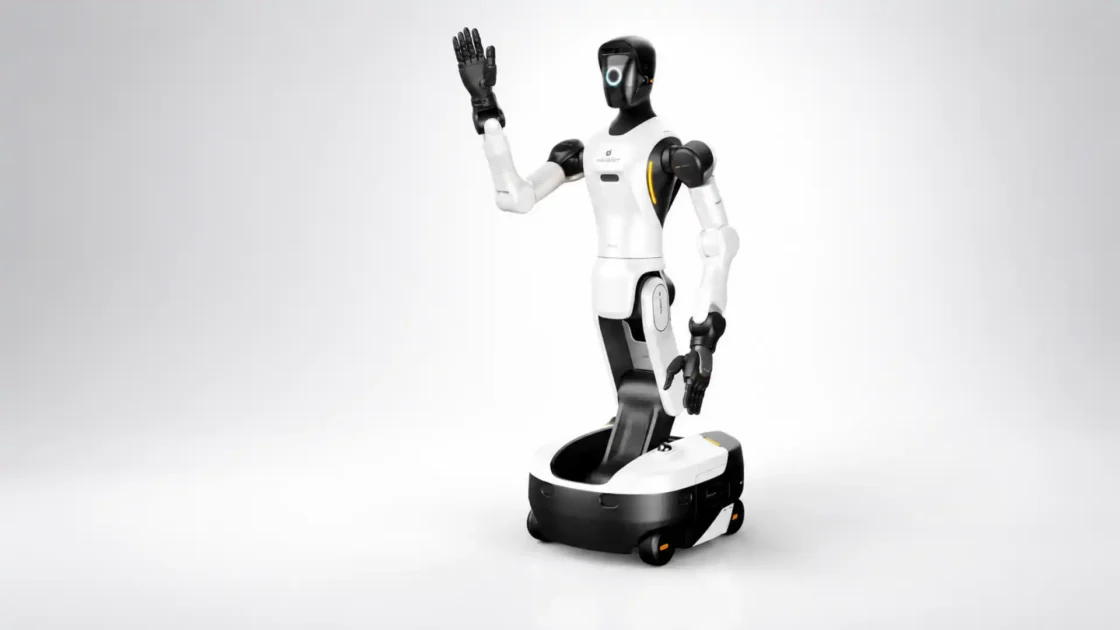
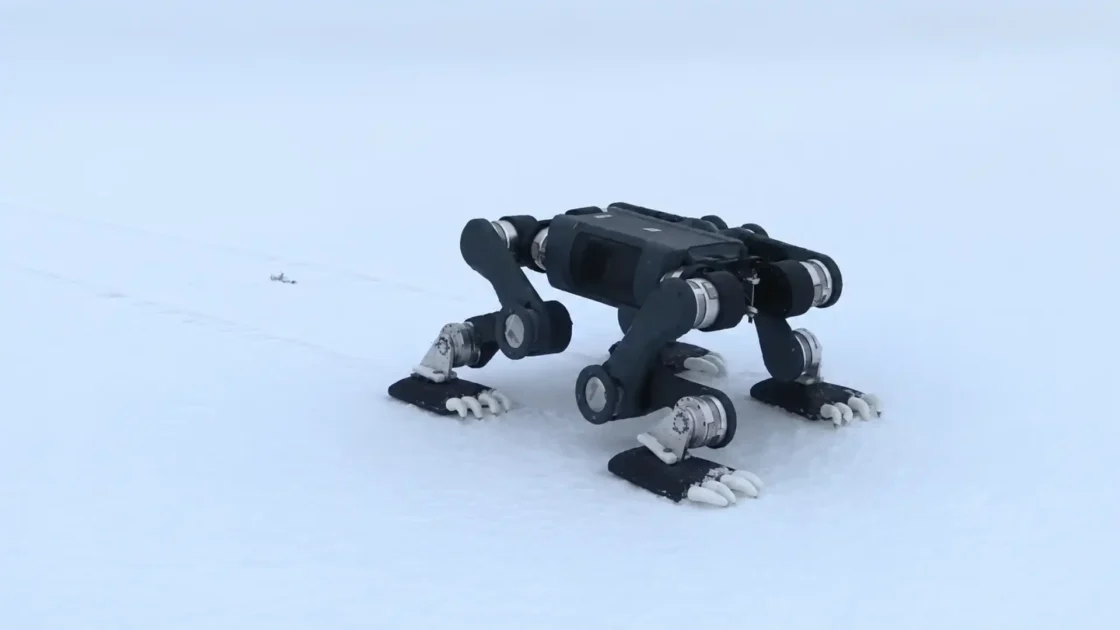
The most revealing detail of the 17 August announcement is what else was in it. Alongside Superman, Unitree showed As2W, a wheeled-leg quadruped rated for a 16-kilogram payload, more than 30 kilometres of range, six metres per second and IP54 ingress protection. That is a specification sheet written for buyers. The humanoid got the headlines; the quadruped got the payload rating.
Unitree is not alone in facing that arithmetic. More than 140 Chinese firms now build humanoids, the rival AgiBot is pursuing a Hong Kong listing, and Unitree’s own filing names Tesla’s Optimus, XPeng and BYD among the launches it expects to compete against. Speed videos are cheap in a field that crowded. Verified duty cycles are not.
Regulation is closing on the same hardware from two directions. The Department of Defense added Unitree’s parent entity, Hangzhou Yushu Technology, to its Section 1260H list of Chinese military companies on 8 June 2026, one of 17 new parent-level designations, triggering a contracting prohibition from 30 June 2026 and a procurement prohibition on its goods and services from 30 June 2027. On 28 July 2026 the Federal Communications Commission’s Public Safety and Homeland Security Bureau, in Public Notice DA 26-786, added foreign-produced advanced robotic devices to the Covered List under the Secure and Trusted Communications Networks Act of 2019, citing among other things a September 2025 exploit publicly reported as affecting fleets of Unitree robots.
The strongest case for taking Superman seriously
The sceptical reading can be pushed too far. Something real happened between August 2025 and August 2026, and dismissing it as theatre would be its own error. A machine that logged 4.78 metres per second under competition rules a year ago and is now plausibly running above ten is not fabricating an order of magnitude; the April H1 run at 10.1 metres per second was a separate event with its own footage, and the trend across both is steep. Locomotion control on legs has improved faster than most robotics researchers expected in 2022.
The two-metre standing jump is the more technically impressive claim, and the one hardest to fake in a continuous shot. It requires peak power density in the leg actuators, airborne attitude control, and a landing that absorbs the impact without buckling or toppling. The released footage shows the robot landing upright. Balance recovery on landing is a harder control problem than straight-line speed, and it is the capability that transfers most directly to walking over rubble, stairs and loading docks.
There is also a legitimate research argument for building a machine that does nothing but move. Extreme-envelope prototypes stress hardware, thermal management and controllers in ways that task-level testing does not, and lessons found at the limit tend to propagate downward into products that never approach it. Formula One serves the same function for road cars. Unitree said as much: an experimental platform for studying highly dynamic movement, explicitly not a commercial product.
Where the argument fails is in the leap from that framing to the record claim. A company entitled to say “we built a research platform that moves faster than any humanoid has moved” instead said it had surpassed the running speed records of all humans worldwide, two days before a listing, with no method disclosed. The engineering deserves credit. The claim, as worded, is not supported by the evidence the company itself released.
Reading the next batch of robot numbers
For institutional investors holding 688836 after the debut, the question is not whether Superman is fast but whether locomotion research converts into recurring revenue. The observable test arrives in the second-half 2026 accounts. If humanoid revenue grows while segment gross margin falls toward industrial-equipment norms, the company is moving into real deployment. If margin stays above 60 per cent, it is still selling instruments to laboratories, and the valuation is priced against a labour market it has not entered.
For procurement teams, the FCC listing changes the calculus rather than ending it. New foreign-produced advanced robotic devices cannot obtain the equipment authorisation needed to import, market or sell in the United States, but authorisations already granted are not retroactively stripped, and certain Class I and Class II software and firmware permissive changes remain available through a multiyear window while hardware changes require a separate waiver. Anyone running a Unitree fleet in the US should treat the current hardware generation as the last one they will be able to buy, and plan replacement cycles on that assumption.
For research groups and integrators outside the United States, the practical filter is narrow. Ask for a timed 100-metre run from a standing start with an external timekeeper, a published stopping distance from top speed, a continuous payload figure at duty cycle, and a mean time between failures under load. None of those appeared in the Superman announcement, and all four are standard for industrial equipment.
The second World Humanoid Robot Games take place in Beijing from 22 to 26 August 2026, days after the listing. Unitree won four golds at the 2025 edition, in the 400 metres, 1,500 metres, 100-metre hurdles and 4×100-metre relay, while X-Humanoid took the 100 metres. A timed sprint there, under someone else’s clock, would settle in five minutes what the video cannot.
A machine that outruns its own supervision
The evidence supports a narrower and more interesting claim than the one in circulation. Unitree has built the fastest legged humanoid on the public record, by removing the parts that make a humanoid useful, and has published the result through a channel that permits no verification, at a moment when unverified good news was worth the most. Bolt’s record stands, untouched, because nothing in the announcement is a 100-metre time.
The unresolved question is not speed. It is whether high-dynamic locomotion research at Unitree’s current burn rate produces machines that stop reliably around people, because that single capability gates every application outside a laboratory. The braking problem is bounded by friction and geometry, not by compute, which means it will not fall to the same scaling that delivered the speed.
Three developments would change this assessment. A timed 100-metre run by a Unitree humanoid under external supervision, in under about 11 seconds from a standing start, would show that peak velocity has become sustained performance. A published stopping distance from top speed, with the control method described, would show the braking constraint being engineered rather than avoided. Second-half accounts showing humanoid gross margin compressing toward 40 per cent alongside unit growth would show the company selling labour rather than instruments.
Absent those three, the reasonable conclusion is that Unitree ran a very good demonstration two days before a listing, and that the record it beat was one nobody keeps. The company that eventually wins this market will be the one that publishes a stopping distance.
Questions readers are asking about Unitree’s speed claim
No. Bolt’s record is a time of 9.58 seconds set in Berlin on 16 August 2009. Unitree published a peak velocity of 12.66 metres per second with no time, distance or start protocol, and no athletics body ratifies records for peak running speed.
Published figures differ by measurement method. A peer-reviewed laser reanalysis of the Berlin race put his instantaneous maximum at 12.32 metres per second at 52.51 metres. The championship biomechanics report gives 12.42 metres per second as his mean velocity over the fastest 20-metre section, from 60 to 80 metres. His average over the whole race was 10.44 metres per second.
About 45.6 kilometres per hour, or 28.3 miles per hour. Boston Dynamics’ Cheetah robot was reported at the same 28.3 miles per hour on a treadmill in 2012, with DARPA acknowledging that the treadmill gave it an advantage over Bolt.
No. The figures come from a company video posted on 17 August 2026. Unitree did not disclose the measurement method, the instrument, the distance covered or the duration at peak speed. It had previously flagged that the equipment used in its April 2026 H1 run might be subject to error.
Mass at the extremities competes with locomotion dynamics, so removing hands, grippers and head sensors raises attainable speed. Unitree describes Superman as an experimental platform for studying highly dynamic movement, not a commercial product. It has no payload capacity and cannot grip, lift or press anything.
Videos circulating after the announcement show the prototype hitting an electrical box after sprinting a curve at Beijing’s National Speed Skating Oval, and observers noted it appeared unable to brake. That footage is user-circulated, not company-documented. Unitree’s founder said the machine is a prototype that has not reached its final stage of development.
Deceleration is limited by the friction available at the foot and by the risk of pitching forward over the contact point. Research on bipeds built for rapid acceleration and braking found that optimised trajectories sit on the friction limit in both phases, and that some solutions add small leaps mid-manoeuvre to increase the normal force available for braking.
Shares priced at 150.80 yuan and were due to begin trading on Shanghai’s STAR Market on Wednesday 19 August 2026 under the ticker 688836. The offering raised about 6.1 billion yuan, roughly 905 million dollars, implying a valuation near 61 billion yuan, or about nine billion dollars. Retail subscription exceeded 8,000 times, a record for the board.
Not new models. On 28 July 2026 the FCC added foreign-produced advanced robotic devices to its Covered List, which blocks the equipment authorisation needed to import, market or sell them in the United States. Existing authorisations were not revoked, so already-authorised units may continue in use. Separately, the Department of Defense added Unitree’s parent to its Section 1260H list on 8 June 2026.
A timed 100-metre run from a standing start, measured by an external timekeeper under a published protocol. The second World Humanoid Robot Games, held in Beijing from 22 to 26 August 2026, offers exactly that setting.
Author:
Jan Bielik
CEO & Founder of Webiano Digital & Marketing Agency
This article is an original analysis supported by the sources cited below
China’s Unitree unveils ‘Superman’ robot as fervour builds ahead of Shanghai debut
Carried the Reuters wire report establishing the 12.66 metres per second and two-metre jump claims, the three-month development timeline, the 6.1 billion yuan raise, the record retail oversubscription and Unitree’s statement that the robot remains a work in progress.
Unitree Claims Bolt-Beating Sprint Speed: Superman Has No Hands and No Verification
Documented the absence of hands, grippers and payload capacity, the 0.85-metre leg length, the quasi-direct-drive gear ratios and continuous payload limits, the 2025 humanoid segment revenue and margins, the As2W specifications, and the estimate that under 5 per cent of 2025 shipments were in active industrial work.
Unitree Unveils “Superman” Robot, Claims to Shatter Human Speed and Jump Records
Established the 17 August 2026 announcement date, Unitree’s verbatim claim to have surpassed the running speed and standing high jump records of all humans, and the absence of independent verification.
Watch: Unitree’s ‘Superman’ humanoid can vertically outjump any person
Provided the metric conversions for the speed claim, the leg-length specification, the description of the robot landing upright after the two-metre jump, and the observation that extreme-performance tests function as hardware stress tests rather than proof of deployability.
It’s Official: No Man Can Outrun Our Robot Overlords
Supplied a third and lower figure for Bolt’s peak speed, noted that the reading is a single measurement rather than a sustained sprint, and established the 4.78 metres per second competition baseline and the two-day gap before the Shanghai debut.
Unitree Humanoid Robot ‘Superman’ Breaks Usain Bolt’s Record Before Crashing Into Electrical Box
Reported the circulating footage of the collision with an electrical box at the National Speed Skating Oval, the observation that the robot appeared unable to brake, and the founder’s description of Superman as a prototype not yet in its final stage of development.
Multicomponent Velocity Measurement for Linear Sprinting: Usain Bolt’s 100 m World-Record Analysis
Peer-reviewed reanalysis of the Berlin race using three laser distance systems at 100 hertz, establishing Bolt’s instantaneous maximum velocity of 12.32 metres per second at 52.51 metres and his race average of 10.44 metres per second.
Kinematics of Usain Bolt’s maximal sprint velocity
Established that the widely quoted 12.42 metres per second from the Berlin championships biomechanics project is a mean velocity across the fastest 20-metre section, from 60 to 80 metres, and provided comparable section figures from Beijing 2008, London 2012 and Zagreb 2011.
Unitree’s H1 robot hits 10 m/s sprint speed, getting close to Usain Bolt’s 100m world record
Documented the April 2026 H1 run at 10.1 metres per second, the explicit caveat that the measuring equipment might be subject to error, the H1’s 80-centimetre leg length and 62-kilogram mass, and Wang Xingxing’s forecast that humanoids would break ten seconds over 100 metres by mid-2026.
Unitree dominates inaugural humanoid robot games with four golds
Established the 2025 competition results, the 4.78 metres per second fastest logged speed under timed conditions, the 280 teams from 16 countries, the National Speed Skating Oval venue and the events Unitree won.
Cheetah robot ‘runs faster than Usain Bolt’
Established the 2012 precedent of a 28.3 miles per hour legged robot framed as beating Bolt, including DARPA’s acknowledgement that the treadmill test gave the machine an advantage.
Pentagon Adds 65 New Entities to the 1260H List of Chinese Military Companies
Confirmed the 8 June 2026 designation of Hangzhou Yushu Technology among 17 new parent-level listings, and the 30 June 2026 contracting prohibition and 30 June 2027 procurement prohibition.
FCC Adds Foreign-Produced Advanced Robotic Devices to the Covered List: Five Things to Know
Established the 28 July 2026 Public Notice DA 26-786, the statutory basis under the Secure and Trusted Communications Networks Act of 2019, the block on new equipment authorisations, the treatment of existing authorisations, and the permissive-change window for software and firmware.
Unitree Robotics to Launch IPO on August 10, Aiming to Raise 4.2 Billion Yuan on STAR Market as First-Half Revenue Growth Plunges to 40%
Provided the filing financials used throughout: 2024 and 2025 revenue, the first-half 2026 revenue and profit forecasts including the year-on-year profit decline, and the four-programme use-of-proceeds plan totalling about 4.2 billion yuan.
Unitree Launches STAR Market IPO Issuance Process, Subscriptions Open August 10
Established the 40.45 million share offering representing 10 per cent of post-offering capital, the August subscription timetable, CITIC Securities as sponsor and the allocation of proceeds across embodied intelligence and hardware programmes.
Unitree unveils Superman robot beating Usain Bolt’s speed days before IPO
Confirmed the 19 August 2026 trading debut, the 150.80 yuan issue price and the framing of the reveal as high-visibility publicity two days before listing, alongside the observation that the performance figures had not translated into industrial orders.
Standing high jump
Established that the standing high jump was an Olympic event only from 1900 to 1912 and that the best recorded mark is 1.90 metres by Rune Almén in 1980, giving the human comparison for Unitree’s two-metre jump claim.
Athlete’s 67-inch standing high jump breaks world record
Documented the Guinness “highest standing jump” record of 67 inches, about 1.70 metres, set by Chris Spell on 7 February 2021, and the floor-to-platform method by which it is measured.
| Citing this article? Brief excerpts are welcome. Please credit Webiano.digital, name the author where stated, and include a link to https://webiano.digital and to this original article. Full or substantial republication requires prior written permission. Read our Copyright and Content Use Policy. |
This article was prepared with the assistance of artificial intelligence tools. The content underwent expert human review, and Webiano Digital & Marketing Agency assumes editorial responsibility for its final version and publication.