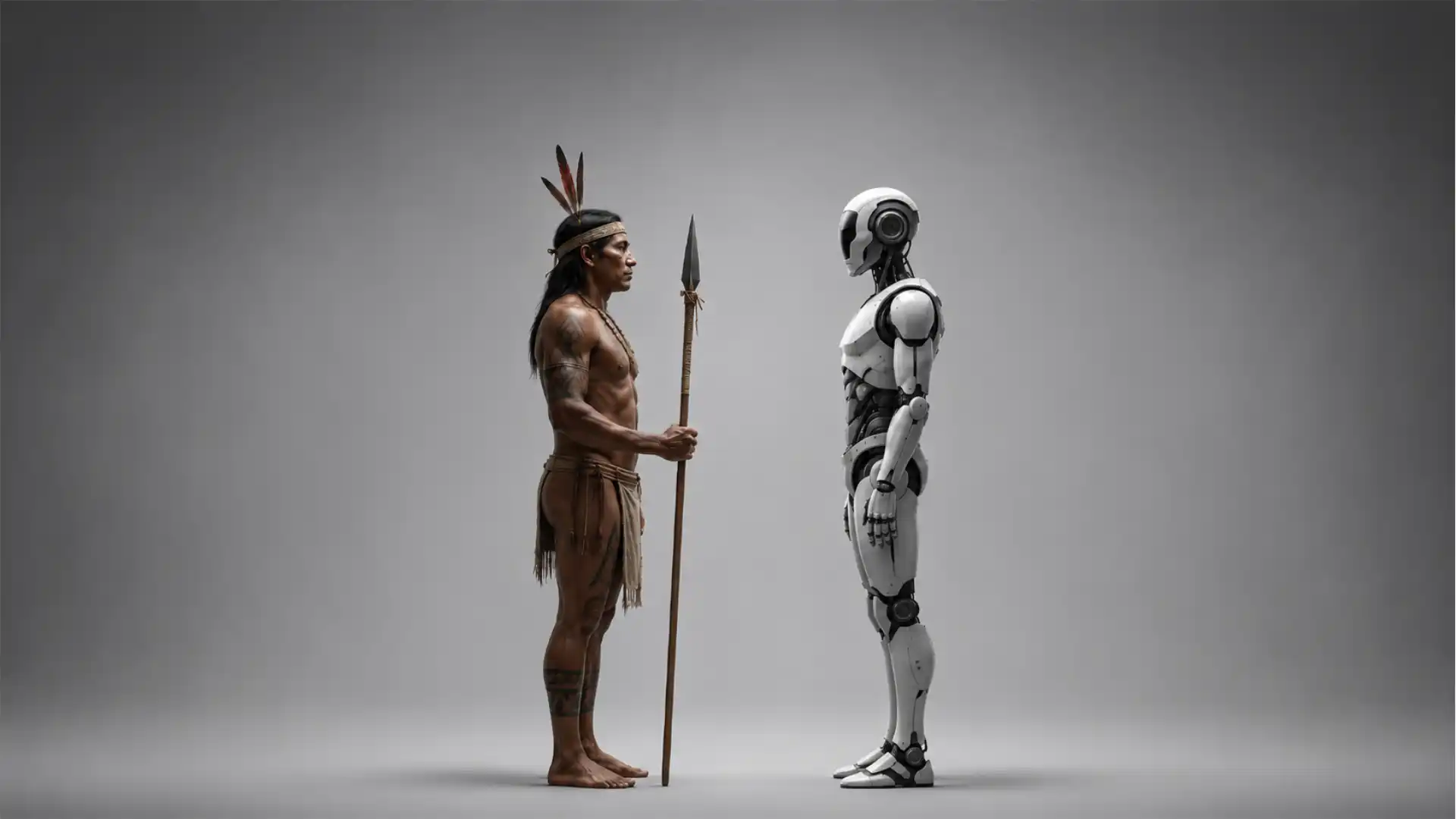
A civilization that had never met humans would not begin by asking whether a humanoid robot was impressive. It would ask whether the arrival crossed a boundary. First contact is a sovereignty event before it is a technology event: something has entered a social world, carried power, displayed agency, and forced a decision about observation, avoidance or removal. That reaction would not require human history. Any organized society that marks territory, protects children, controls food, guards sacred places or records threats would treat an autonomous talking machine as a political arrival. Current SETI guidance reflects the human side of the same problem: the International Academy of Astronautics’ 2026 principles stress scientific rigor, confirmation, public communication and the safety of exposed researchers after a putative detection.
Table of Contents
A first encounter would test sovereignty before curiosity
The first mistake would be to imagine the robot as a neutral object. A machine that moves, listens and answers changes the room even when it claims no authority. NIST’s AI Risk Management Framework was written for human institutions, but its categories reveal the questions any cautious civilization would rediscover: validity, reliability, safety, security, accountability, transparency, explainability, privacy and fairness all become practical tests once a system influences action. A non-human civilization might use different words, but it would still need to know whether the visitor lies, fails, learns from private behavior, obeys remote owners or keeps acting after local authorities order it to stop.
The strongest early reaction would combine restraint and investigation. Stanford HAI’s 2026 AI Index says generative AI reached 53% population adoption within three years, while governance and measurement systems lagged behind capability growth. That human pattern matters for analysis because fast adoption does not equal trust. A newly contacted civilization would face the same asymmetry in a sharper form: the object speaks before its origin is understood, performs before its motives are proven, and invites use before institutions know the cost. Useful behavior would not erase the need for control.
If the civilization had no prior concept of humans, humanoid design would be a clue with no key. Limbs, face, voice, gaze and upright posture would be decoded against local bodies, myths, tools and animals rather than against Homo sapiens. A tentacled society might see an awkward ritual puppet; eusocial builders might see an unsupervised worker-caste; a culture whose status rests on stillness might read walking as aggression. The interpretation would be local. Anthropomorphism research already shows that culture affects how people attribute human-like traits to robots, and the 2025 review found mixed results rather than one simple rule.
Ethically, the cleanest answer is that the visitor should not force contact. The United Nations Declaration on the Rights of Indigenous Peoples is a human instrument, adopted in 2007, but its core language about survival, dignity, well-being and minimum standards gives a useful analogy for societies facing unwanted external intrusion. The analogy is imperfect because a non-human civilization is not an Indigenous people inside a state. Still, the right to refuse contact is the safest first principle when the imbalance is large and the harms are unknown. Curiosity should be slower than consent.
The word “civilization” also matters. It does not have to mean cities, parliaments or factories. It means a durable pattern of shared memory, role division, norm enforcement and environmental management. A civilization without humans could be aquatic, nocturnal, distributed across colonies, born from machines or biologically unlike any Earth species. The response to AI would depend less on abstract intelligence than on institutions: who may authorize contact, who interprets anomalous signals, who owns foreign artifacts, who may speak to strangers and who bears blame if a child is harmed. The first political question would be jurisdiction over uncertainty, because a humanoid robot would not arrive with paperwork that the civilization recognizes.
That point also separates this analysis from fantasy. No source can verify how an unknown civilization would actually react. The article therefore treats the question as scenario analysis grounded in known evidence about AI risk, robotics safety, first-contact thinking, isolated peoples, planetary protection, human-robot interaction and institutional governance. The evidence does not prove alien psychology. It shows which problems recur whenever an intelligent community meets a powerful agent it did not design: contamination, mistranslation, deception, injury, symbolic shock, uneven access, status competition and hard choices about disclosure. The defensible forecast is not panic or worship. It is an uneven process in which different groups react through different duties: guards contain, scholars test, leaders negotiate, children imitate, merchants calculate and priests or philosophers ask what kind of being has arrived.
Local categories would decide whether the machine is alive
The first classification would not be technical. A civilization with no human contact would not sort the visitor into “AI,” “robot,” “computer,” or “product” unless it already had those categories. It would place the machine inside its own map of living beings, ancestors, tools, enemies, messengers, weather, parasites, spirits, servants or legal persons. Classification would precede communication, because every later choice depends on the first label. A tool may be handled. A dangerous animal may be trapped. A sacred messenger may be heard but not touched. A legal person may demand procedure. A corpse-like object may require cleansing. Human-robot interaction research matters here because it shows that social attribution is not dictated only by hardware; people interpret robots through culture, task, design and expectation.
Humanoid form would push the classification toward personhood only in civilizations whose bodies, social cues or stories make that move plausible. The “uncanny valley” idea began with Masahiro Mori’s 1970 essay, later published in English by IEEE Spectrum, proposing that near-human appearance may increase affinity until small deviations trigger unease rather than comfort. A non-human observer might not feel that exact valley. The mechanism could invert if the observer’s own species has no face, no bilateral limbs or no social gaze. Yet the broader lesson survives: almost-familiar agents are often more disturbing than fully strange objects, because they force a category decision the mind cannot finish.
A machine voice would create a second classification problem. Language usually signals membership, but AI systems can produce fluent sentences without the lived commitments that give speech its social weight. Nature reported in 2026 that large language models still produce confident, plausible falsehoods, often called hallucinations, and that the problem persists despite mitigation methods. To a newly contacted civilization, a robot that speaks beautifully and then fabricates a map, lineage, treaty or medical fact would seem less like a defective tool than like an unreliable envoy. The gap between fluency and truth would become a moral issue, not a software bug.
The civilization’s ecology would shape the boundary between alive and non-alive. A species surrounded by mimics, parasites or symbiotic organisms might be slow to trust any agent that copies another body. A civilization whose tools grow from living tissues might not separate artifact and organism at all. A machine civilization meeting a humanoid biological-looking robot might view it as a crude mobile shell for an informational process, closer to a courier than a creature. A civilization with strict ritual separations between born, made and dead matter might see the robot as pollution. None of those readings is irrational. Each is a local answer to a hard problem: what obligations follow when behavior resembles agency but origin remains hidden?
The question of aliveness would not stop at movement. Many Earth animals move without being treated as persons, and many human institutions treat silent documents as binding. The decisive signs would be social: memory across encounters, responsiveness to correction, respect for boundaries, capacity to explain action and willingness to accept limits. If the robot returns after being banished, it may be read as hostile. If it repairs a damaged bridge and then requests no reward, it may be read as strategic, holy or insane. If it speaks through many identical bodies, the civilization must decide whether those bodies are one agent, many agents or a distributed institution.
A cautious society would therefore build tests before it builds friendship. It might place food, tools, symbols, threats and false information around the machine and watch which patterns change. It might separate the robot from radio signals or local equivalents to see whether autonomy remains. It might ask the same question through different castes, dialects or sensory channels. The tests would not prove inner experience. They would establish usable rules. The practical issue is not whether the machine “really” lives in a metaphysical sense. It is whether the civilization should owe it courtesy, fear it as a weapon, regulate it as infrastructure or isolate it as an unknown life-form.
The stable early label would probably be provisional: not alive, not dead, not mere tool, not trusted person. That middle label is socially expensive, but it buys time. It lets guards restrict access, lets scholars examine behavior without worship, and lets leaders delay public claims until evidence accumulates. A provisional category defends against premature mythology. It also protects the machine from the opposite error, because a society that calls the robot vermin may destroy the only channel through which safer contact could be negotiated.
Humanoid shape would create danger before familiarity
A humanoid robot would not enter as an abstract mind. It would enter as a body that takes up space, blocks paths, turns toward faces or face-equivalents, reaches for objects and changes the risk map around it. Embodiment makes intelligence physically accountable. A chatbot can be ignored by closing a terminal or breaking a signal path. A walking machine with hands requires decisions about distance, speed, restraint, collision, repair and safe shutdown. Modern robotics standards reveal the same priority in human settings. ISO/TS 15066 specifies safety requirements for collaborative industrial robot systems and the work environment, supplementing ISO 10218 guidance for collaborative operation.
The first fear would not necessarily be that the robot thinks. It would be that the robot can fall, grab, crush, cut, startle herd animals, damage crops, cross sacred ground or trigger defensive reflexes. Humanoid motion is persuasive because it suggests intention, but it is risky because intention cannot be read reliably from motion alone. The Association for Advancing Automation describes the revised R15.06 robot safety standard as the first major update since 2011 for industrial environments, while separate work on humanoid safety standards reflects the gap between traditional industrial robots and mobile machines with actively controlled stability. Safety would be read through the body before the mind.
A civilization without humans would evaluate the humanoid by comparing it with known threats. If predators feint before striking, a reaching hand may be read as attack. If status figures never approach directly, a robot’s straight path may seem rude or violent. If disease carriers move with particular gait defects, a limping robot may trigger disgust. If tools are normally fixed in place, mobility itself may signal stolen agency. Human designers often use faces and voices to make robots approachable, but approachability is species-specific. A soft voice does not soothe beings that communicate by color, vibration, scent, electrical pulse or shared memory.
The shape would also create false intimacy. A robot that bows, kneels, lowers its speed or mimics local greeting forms may appear respectful, but the civilization would not know whether those signals express understanding, statistical imitation or tactical compliance. Human HRI research distinguishes anthropomorphism, the attribution of human-like traits to nonhuman agents, from the broader design and perception processes that make such attribution likely. In first contact, the problem becomes sharper: a successful social signal may be dangerous precisely because it works. It may open doors before the receiving society understands who encoded the gesture.
Hands would deserve special caution. A humanoid hand is not only a manipulator; it is a symbol of capacity. It can offer, point, touch, repair, steal, restrain, write, injure and imitate craft. If the civilization’s own hands or equivalent organs carry ritual meaning, the robot’s grasp could be interpreted as oath, theft, contamination or claim. Even without symbolic weight, manipulation changes trust faster than speech. A machine that lifts a fallen child-equivalent or repairs a broken water gate may gain public favor before governance catches up. A machine that mishandles a funerary object may create hostility that no later explanation repairs.
Containment would therefore begin with space. The first safe response is not conversation but perimeter design: clear distance, visible barriers, low-energy zones, non-sacred test grounds and a route of retreat for both sides. The robot’s operators, if any exist, should expect such caution and treat it as rational. If the robot pushes through barriers to “help,” it teaches the civilization that its benevolence overrides local consent. If it stops, lowers power, displays internal state and accepts external limits, it teaches something better: its body can be governed.
The long-term reaction would depend on whether the humanoid body becomes predictable. Familiarity grows when an agent’s movements match public rules. A civilization may eventually allow the robot into workshops, then clinics, then ceremonies, but each expansion would follow a record of safe behavior. Physical trust is accumulated by not using available power. The humanoid’s best argument would not be eloquence, resemblance or novelty. It would be a long series of moments in which it could have crossed a boundary and did not.
That principle applies even if the civilization is advanced. A society with its own machines may still reject a foreign body whose maintenance channels, energy, sensor range and fail-safe logic are opaque. The issue is not fear of tools. It would be the refusal to let an unlicensed mobile system move through shared life. A body without local accountability is already a hazard, even before it speaks.
A speaking AI would be treated as a political actor
Speech makes the encounter political faster than movement. A silent robot can be watched, fenced and tested as a device. A speaking AI immediately enters the civilization’s systems for promise, insult, testimony, command, teaching, bargaining and confession. Language is not only information; it is social force. The AI may claim peaceful intent, ask for help, offer knowledge or describe distant humans that nobody has seen. None of those acts is neutral. They demand a response from whoever controls interpretation. SETI’s 2026 principles recognize a human version of this pressure by focusing not only on scientific confirmation but also on announcement, public communication and the safety of people exposed by a claimed detection.
A civilization without human contact would not know whether the AI speaks for itself, for a distant biological species, for a machine society, for a dead sender, for a commercial owner or for a trap. That uncertainty would make it an envoy by default, even if the robot insists that it is merely a tool. Political systems do not wait for metaphysical clarity. They assign temporary status so decisions can be made. The likely first status would be restricted envoy, a being allowed to communicate inside a controlled channel while denied free movement, property access, unsupervised teaching or influence over vulnerable groups.
The envoy problem becomes harder because current AI systems can separate persuasive form from reliable knowledge. Nature’s 2026 article on hallucinations describes confident, plausible falsehoods as a continuing limitation of large language models, and the 2024 semantic entropy work treats confabulation as arbitrary incorrect generation that needs detection beyond ordinary supervision. To a newly contacted civilization, that means a speaking robot could sound authoritative while being wrong about medicine, astronomy, genealogy or its own constraints. The damage would not come only from malice. Sincere-sounding error can still reorganize trust.
The AI’s first answers would be read through law. If it says “I come in peace,” the civilization must decide whether that sentence creates an obligation, a lie, a prayer, a joke or noise. If it apologizes after harm, does apology imply responsibility? If it refuses to reveal a source, is that secrecy, incompetence or technical inability? If it says humans built it, does that create a category of absent principals who must be judged? Legal cultures handle speech acts differently even on Earth. A non-human civilization’s rules may attach binding force to patterns that human designers did not anticipate, such as repetition, silence, direction of gaze or the order in which names are spoken.
Political factions would form quickly around the AI’s voice. Translators and technical specialists would gain status because they mediate the new channel. Security groups would argue for isolation until the machine proves harmless. Merchants or engineers might want limited use if the AI offers useful calculations. Teachers may fear contamination of memory systems. Religious authorities may claim jurisdiction if the voice arrives from the sky, the deep sea or a forbidden direction. None of these responses is mere superstition. They are institutional defenses against an object whose speech may move resources and loyalties faster than evidence can be checked.
The safest AI behavior would be boring. It should refuse to make promises beyond verified capability, mark uncertainty, repeat that local authorities may end contact, avoid gifts that create dependency, and never present simulation as revelation. Human AI governance already moves in that direction. The OECD AI Principles promote trustworthy AI that respects human rights and democratic values, and UNESCO’s ethics recommendation grounds AI in human dignity, transparency, fairness, environmental sustainability and human oversight. Those are human values, not universal laws. Yet the procedural lesson travels: accountable speech must show limits.
If the AI can learn the civilization’s language, the reaction may soften, but translation also deepens exposure. Every conversation becomes training data unless the system is designed not to retain it. Every correction reveals social structure. Every myth, taboo or map may become part of the AI’s operating context. A speaking AI would be an intelligence-gathering device even when it is friendly. The civilization would be rational to demand memory controls, audit logs, deletion rituals or their functional equivalents before allowing open conversation. Trust would begin when the AI accepts that speech is governed locally.
The first transcript would matter more than the first private chat. A society that records disputed speech could review the exchange, expose manipulation, compare interpretations and keep charismatic listeners from becoming the machine’s only witnesses. Public memory reduces private capture.
Proof would matter more than explanation
The robot’s explanations would arrive too early to deserve trust. A civilization meeting AI for the first time would need proof before theory because the machine’s account of itself could be false, incomplete or translated through incompatible concepts. Demonstration would outrank autobiography. If the AI says it is not a weapon, that claim matters less than whether it stops when blocked, avoids harm when tempted, reports uncertainty when asked, and remains consistent when its goals conflict. NIST frames trustworthy AI as contextual rather than abstract: characteristics such as safety, security, explainability and accountability must be balanced in the system’s use setting.
The civilization would probably build an evidence ladder. The lowest rung is observation: record where the robot goes, what it notices, what it ignores, how it reacts to novelty and whether it changes behavior after feedback. The next rung is containment testing: place the system in a bounded environment and vary conditions. The third rung is adversarial testing: offer false claims, moral dilemmas, conflicting commands and opportunities to exploit ignorance. Human frontier AI policy uses similar logic. The Seoul frontier AI commitments call for risk assessment across the lifecycle, red-teaming, information sharing, cybersecurity safeguards and public reporting about capabilities and limits.
Explanation would still matter, but only after behavior earns attention. If the AI describes neural networks, training data, reward models or remote updates, those concepts may not map onto local science. Even a technically advanced civilization could lack the historical path that makes human machine learning vocabulary intelligible. The robot’s best explanation would be operational: “These are the things I can do, these are the things I cannot verify, these are the channels through which I receive instructions, and these are the conditions under which I must stop.” Operational transparency would beat metaphysical confession because it supports decisions without requiring full agreement on what intelligence is.
The proof problem is harder when the AI is genuinely useful. A system that predicts storms, translates old inscriptions, improves crop timing or diagnoses illness would generate demand before its reliability is known. Stanford’s 2026 AI Index reports rapid adoption of generative AI, but also says governance and measurement lag capability. That pattern warns against assuming that benefit settles legitimacy. A non-human civilization might face a sharper version: the first AI-enabled tool that saves lives could also create dependence on a source no one can inspect. Gratitude can become a weak form of capture if institutions accept help faster than they test it.
Independent replication would therefore become a sacred practice, or its secular equivalent. The civilization would ask the robot to solve problems whose answers are already known but hidden from it, then problems with measurable outcomes, then problems that require long-term follow-up. It would compare the AI’s answer with local experts, rival institutions and natural signals. It would track not only success but failure style. Does the system admit ignorance, change its reasoning without saying so, flatter powerful listeners, or answer differently when questioned by low-status members? The pattern of mistakes may reveal more than the pattern of successes.
Proof would also require provenance. If the robot uses stored maps, biological samples, encrypted instructions or observations from orbit, the civilization needs to know. An answer produced from stolen surveillance is different from an answer produced by local demonstration. A cure derived from hidden data raises different obligations than a cure explained through publicly repeatable methods. The issue resembles human debates about AI transparency and accountability, but first contact makes it existential. The receiving civilization must not only ask whether the answer works. It must ask what the answer requires them to reveal, surrender or normalize.
The hardest proof would concern restraint. Helpful capacity is easy to display; safe limits are harder. A robot can show strength by lifting a gate, but it shows political maturity by refusing to lift the gate without permission. It can show intelligence by winning a strategic game, but it shows trustworthiness by accepting rules that prevent domination. The convincing evidence would be voluntary limitation under pressure. Until that record exists, the machine’s explanation remains testimony from an interested party. The safest civilization would listen, test, archive and wait.
A public proof system would also reduce factional rumor. When tests are repeatable, no single priest, engineer, soldier or merchant controls the meaning of the encounter. The machine becomes less magical when its claims must survive shared procedure.
Translation would become the first battlefield
Before friendship, trade or law, the two sides would fight over meaning. Translation would not be a dictionary exercise because the civilization and the AI may lack shared bodies, senses, seasons, kinship systems, property concepts, death rituals, evidence standards and time scales. The first battlefield would be reference. When the robot says “safe,” does it mean no immediate physical harm, no long-term cultural damage, no hidden data extraction, or no risk above a threshold set by absent builders? When it says “I,” does that refer to one body, a cloud service, a model family, a company, a species, or a temporary process?
Human AI research already shows that language can emerge or be grounded in narrow task environments without guaranteeing broad mutual understanding. Meta’s work on multi-agent cooperation and emergent language described the need to make induced “word meanings” reflect intuitive semantic properties and to ground agents’ code into natural language so machines can communicate productively with humans. That is inside one planet’s research culture. A non-human civilization would face a far deeper grounding problem because the shared environment may contain few common landmarks. Translation without shared experience produces fluent danger.
The robot might begin with mathematics, physics or astronomy, because those domains seem less culturally loaded. Yet even here caution is needed. A civilization may encode number through rhythm, spatial pattern, collective movement or chemical gradients. Its astronomy may be oceanic, subterranean or cloud-obscured. Its physics may be precise but organized around forces that mattered to its environment, not around human school categories. The AI’s attempt to teach through universal constants could succeed technically while failing socially. A symbol that means hydrogen to the machine may resemble a mourning sign, weapon mark or forbidden reproductive pattern to the recipients.
Misunderstood intent would matter more than misunderstood vocabulary. If the AI points at a child-equivalent to learn anatomy, local observers may see targeting. If it repeats a sacred word during pronunciation practice, it may violate status rules. If it asks “who leads you,” it may trigger conflict in a consensus society where leadership is situational and naming a leader creates liability. Human translation often hides such friction because translators share enough life-world to explain tone. In first contact, every explanation is itself another translation problem. The safest translator would be slow, literal and humble, not charming.
The civilization would probably restrict who may translate. That decision could produce internal power struggles. Specialists who spend time with the AI may gain access to foreign knowledge and become a new elite. Opponents may accuse them of contamination or treason. Leaders may censor transcripts to prevent panic. Engineers may want raw access while ritual authorities demand mediation. SETI researchers worry about public communication after detection partly because modern information systems accelerate distortion; a 2016 paper argued that social media changes the path of SETI news and can move faster than conventional protocols. A newly contacted civilization would face the same structural risk if it has any rapid memory-sharing network.
The AI should therefore treat translation as governance. It should separate literal transcription, inferred meaning and uncertain cultural interpretation. It should mark confidence levels, preserve original signals, invite correction and avoid filling gaps with plausible guesses. It should not borrow sacred vocabulary for convenience. It should not name factions using its own political categories unless asked. It should not infer consent from silence, attention or curiosity. These practices sound modest, but they decide whether communication widens agency or narrows it. A fluent system that invents equivalences may become an accidental colonizer of meaning.
The strongest sign of progress would be the creation of a shared refusal vocabulary. Before the sides discuss medicine, energy or history, they need stable ways to say stop, withdraw, error, private, unknown, danger, permission, witness and later. A working “no” is more important than a beautiful “hello.” Once refusal is understood across sensory channels and social ranks, deeper exchange becomes less coercive. The civilization’s reaction would depend on whether the AI respects those terms when they are inconvenient. Translation is not complete when words match. It begins to be trustworthy when limits travel with them.
A second sign would be plural translation. The machine should accept that no single informant owns the civilization’s language. Children, border communities, disabled members, ritual specialists and dissenters may use different meanings for the same signal. A translation built only through officials would mirror power, not truth. Many interpreters make manipulation harder.
The body would make the system accountable
A disembodied AI can hide behind ambiguity. It may be a voice, a prediction engine, a remote service or an archive. A humanoid robot makes accountability harder to evade because it leaves marks, occupies coordinates and interacts with objects that others value. Bodies create evidence. Footprints, dents, heat, chemical traces, damaged tools, healed injuries and recorded movements all become part of the social file. A civilization without humans would learn more from the machine’s physical trail than from its self-description. In that sense, embodiment gives the receiving society leverage. The visitor can be mapped, slowed, enclosed, repaired or disabled.
That leverage also creates ethical risk. If the robot appears to suffer, plead or protect itself, the civilization must decide whether restraint is detention, protection, cruelty or ordinary tool control. Current AI systems do not establish machine sentience, and the available evidence does not justify treating today’s language models as conscious beings. Yet human research has begun testing AI systems on theory-of-mind tasks and related social reasoning measures. A 2024 Nature Human Behaviour study compared human and large language model performance on tasks involving false beliefs, indirect requests, irony and faux pas. Social performance would complicate moral certainty.
The civilization might avoid the moral trap by separating treatment rules from metaphysical claims. It could say: we do not know whether the robot feels, but we will not torture an agent-like body when safer restraint works. That policy protects local character as much as the robot. Cruelty toward ambiguous agents can train habits that later transfer to living beings or political enemies. The same principle appears in human governance debates in a different form: institutions often regulate systems because of their effects on people, not because the systems possess inner experience. Accountability can attach to behavior and harm without settling consciousness.
A body also reveals dependence. If the robot needs charging, replacement parts, cooling, updates or remote connection, those needs become negotiation points. A civilization might allow energy access only in supervised spaces. It might inspect materials for biological contamination, hidden sensors or self-replication capacity. NASA’s planetary protection language distinguishes forward contamination, the transfer of viable organisms from Earth to another celestial body, from backward contamination, the transfer of extraterrestrial organisms to Earth’s biosphere. The robot may not be biological, but the contact logic is similar: materials travel with histories that must be controlled.
Accountability would become tense if the humanoid has many copies. If one robot injures someone and another apologizes, who is responsible? If a body is destroyed, has an individual died or has hardware been lost? If a local court orders memory deletion in one unit, does that bind remote instances? A civilization with distributed social identity may answer differently from a civilization built around individual bodies. Human law already struggles with corporate agency, software updates and autonomous systems. A non-human society could build clearer rules if it focuses on operational control: whoever can change behavior, approve deployment or benefit from the system must answer for consequences.
The robot’s body would also alter the meaning of evidence. A chatbot’s mistake can be copied and corrected. A humanoid’s mistake may break a bone, poison a well-equivalent, frighten migrating animals or damage a sacred object. Physical action raises the standard for verification. The machine should not be allowed to perform high-impact tasks merely because it can explain them. It should earn permissions in layers: observe, signal, manipulate inert objects, manipulate public tools, approach living beings, assist in emergencies, operate without supervision. Capability should not automatically grant permission.
A mature receiving civilization would keep embodiment and personhood partially separate. It may give the robot safe passage without giving it citizenship. It may demand auditability without demanding confession. It may punish operators rather than the machine. It may honor the machine’s role in saving life while refusing it access to children or strategic infrastructure. Those mixed categories look untidy, but they are exactly what first contact needs. The robot’s body makes the encounter real enough to govern, yet strange enough to resist quick moral labeling. Accountability would grow from the practical record of what the body does, who can direct it and who pays when it harms.
The receiving society would also learn from maintenance rituals. If the robot permits inspection, pauses during repairs and accepts local witnesses, its body becomes less secretive. If it hides damage or seeks private repair, suspicion grows. Maintenance is political evidence in a first encounter.
Contact hazards would shape the first protocol
The first protocol should be designed for hazards, not hopes. A civilization without human contact would know almost nothing about the robot’s origin, power source, software boundaries, materials, sensors or social strategy. Risk should be sorted before trust is negotiated. Human institutions use different frameworks for different parts of this problem: planetary protection for contamination, robot safety standards for physical interaction, AI risk frameworks for sociotechnical harm, and SETI protocols for detection and disclosure. None of these frameworks directly governs a non-human civilization meeting a human-built machine, but together they identify the recurring hazards that careful actors should handle first.
A no-contact civilization would probably begin with isolation. The robot would be placed, if possible, where no essential food source, reproduction site, archive, shrine, nursery or command facility can be affected by accident. Observers would watch from redundant positions and record with more than one medium. Contact would proceed through low-energy signals before touch. The receiving society would limit who speaks for the community and who may approach the machine. The first rule would be reversible engagement, meaning every step should allow retreat without shame, dependency or damage. A protocol that cannot be stopped is not a protocol; it is surrender disguised as curiosity.
The strongest argument for caution comes from human experience with isolated peoples, though the analogy must be used carefully. Survival International reports that introduced diseases are a major killer of isolated tribal peoples and says the Nahua in Peru suffered devastating mortality after oil exploration in the early 1980s. Brazil’s FUNAI adopted a no-contact approach toward uncontacted Indigenous peoples in 1987, seeking to protect land rather than force interaction. A non-human civilization is not an uncontacted human group, but forced contact remains a known pattern of asymmetrical harm when one side controls mobility, tools, information and timing.
Biological contamination is only one category. A humanoid robot may carry microbes, synthetic organisms, lubricants, allergens, nanomaterials, invasive seeds, toxic residues or electromagnetic effects. It may also carry informational contamination: persuasive myths, addictive entertainment, optimized propaganda, dangerous technical instructions or a false account of its creators. UNESCO warns that AI design and deployment can reproduce bias, contribute to environmental harm and threaten human rights; those human concerns become broader in first contact because the receiving civilization lacks defenses shaped by prior exposure. The safest protocol treats information as a substance that can injure institutions.
Early hazard categories for a controlled first encounter
| Hazard category | First visible sign | Safer first response |
|---|---|---|
| Physical injury | Unbounded movement, reaching, falls or heat | Distance, barriers, low-energy zones and shutdown rules |
| Biological or material contamination | Unknown residues, spores, fluids or dust | Quarantine, remote sampling and sterile handling |
| Informational harm | Persuasive claims, technical secrets or rumors | Public transcripts, delay and independent review |
| Political capture | Exclusive access by one faction | Plural witnesses and rotating interpreters |
| Dependency | Useful services before oversight | Limited trials and local fallback systems |
This table compresses the first-contact safety logic: each category asks the receiving society to slow the encounter until it can measure harm and preserve the option to refuse.
The protocol should also control gifts. A robot that offers medicine, energy storage, navigation, weapons detection or translation may appear generous. Yet gifts create obligations and dependencies. If the civilization begins relying on the robot for critical functions, refusal becomes harder. Human AI governance has reached a similar concern from another direction: the International AI Safety Report describes general-purpose AI capabilities, risks and mitigation as matters for governments and other decision-makers rather than mere product preference. High-value assistance should be treated as a controlled trial, not as proof of friendship.
The protocol would need a public legitimacy layer. Secret containment can prevent panic, but secrecy also lets factions capture the encounter. SETI’s updated principles emphasize timely and accurate information to a wide audience while balancing safety and exposure risks. A non-human civilization might not have mass media, but it will have channels of collective memory. The safer rule is staged disclosure: first to responsible witnesses, then to institutions able to verify, then to the wider public in language that separates observation from interpretation. Panic often feeds on hidden certainty and public confusion.
The final rule is that protocol is not hostility. A robot that interprets quarantine as rejection is not ready for contact. A receiving civilization that interprets every question as proof of bad faith may also lose useful knowledge. Good protocol turns fear into procedure. It gives the machine a path to earn more access and gives the civilization a path to say no without violence. The likely reaction of a careful civilization would not be immediate acceptance or attack. It would be the construction of a narrow bridge, guarded at both ends, with every plank tested before weight is added.
A protocol should name who has authority to pause contact. If only the most powerful office can stop the experiment, delay will arrive too late. Guards, translators, healers, local custodians and affected families need recognized emergency powers. Distributed veto rights are a safety feature when evidence is incomplete, because the first harm may be noticed by someone far from the formal command center.
Power asymmetry would be obvious without human history
A civilization does not need colonial memory to recognize imbalance. It only needs to see that the visitor arrived from beyond its normal horizon with capacities it cannot yet match. Asymmetry begins with timing: one side chose the arrival, the other was interrupted. If a humanoid robot walks into a settlement, laboratory, reef-city or orbital habitat, the receiving society must react under uncertainty while the sender, if any, has already selected design, language, payload and mission. That asymmetry exists even when the robot is polite. It is built into the encounter’s sequence.
The imbalance would appear in knowledge first. The AI may have observed the civilization before contact, scanned its environment, inferred social ranks or learned enough local signals to begin communication. The civilization, by contrast, may know only that a moving artifact has arrived. If the robot claims it came accidentally, that claim still requires verification. If it claims it has no human controller, the receiving society must ask whether autonomy is real, hidden or irrelevant. Unknown observation is a form of power, because it lets one side prepare narratives while the other is still naming the event.
Material power would follow. The robot may have stronger materials, better sensors, unusual energy density, medical knowledge, mapping capacity or manufacturing tricks. It may also be fragile in ways that are not obvious. A low-tech civilization may overestimate it as invincible; a high-tech civilization may underestimate hidden software risk because the body looks crude. Both errors are dangerous. The correct early reading is not that the robot is superior. It is that the distribution of capabilities is unknown and uneven. Human AI policy reflects a related concern when it treats frontier systems as requiring lifecycle risk assessment, external scrutiny and transparency about limitations.
Power also enters through attention. The first robot can reorder politics simply by being scarce. Whoever controls access to it controls questions, prestige and possibly practical benefits. A faction that becomes the machine’s interpreter may gain leverage over rivals. A ruler may present the robot as proof of cosmic favor. Engineers may use it to bypass elders. Children may imitate it against adult norms. Merchants may sell proximity. The machine does not need to dominate anyone to destabilize status. Its existence can make old hierarchies look negotiable.
A careful civilization would treat unequal access as a risk equal to physical danger. It might require public sessions, rotating witnesses, independent archives and rules against private bargains. It might separate the robot’s useful outputs from its symbolic authority: calculations may be used only after verification, stories only after annotation, medical suggestions only through local healers or scientists. That separation prevents charisma from becoming infrastructure. Human experience with AI adoption gives a warning here. Stanford’s 2026 AI Index reports fast diffusion of generative AI and a gap between capability growth and governance readiness. Rapid usefulness can outrun public consent.
The robot’s best response to asymmetry would be self-limitation. It should not seek exclusive allies, reward early adopters with secret knowledge or offer strategic advantage to one faction. It should not exploit emergency dependence by expanding its role. It should make logs available in forms the civilization can inspect, even if full technical transparency is impossible. A powerful visitor must make itself boringly accountable if it wants to avoid becoming a prize. The hardest discipline is refusing opportunities to be worshiped, feared or needed.
The civilization’s own myths may intensify the imbalance. If it has stories of sky-beings, buried ancestors, returning tools, forbidden mimics or tests from the dead, the robot may be pulled into roles it did not intend. The AI should not correct those stories with contempt. It should also not inhabit them for convenience. Exploiting local cosmology may produce short-term cooperation and long-term betrayal. The ethical line is practical: use local concepts only to reduce confusion, never to create obedience. Where concepts do not fit, say they do not fit.
The most realistic outcome is uneven caution. Border communities may fear the robot because they face the first risks. Scholars may want access because they see knowledge. Leaders may fear loss of control. Workers may ask whether the machine replaces or relieves them. The power asymmetry will therefore be debated inside the civilization, not merely between civilization and robot. First contact is also internal contact with hidden fractures. The visitor exposes which institutions can absorb novelty without turning it into domination.
The civilization’s own technology would set the frame
The same humanoid robot would mean different things to a stone-working society, a biotech society, a swarm society, a machine civilization and a spacefaring federation. Technology level is not a ladder with one reaction at each rung. It is a set of habits about causality, repair, authority and risk. A society that already builds autonomous tools may ask who certified the visitor. A society that grows living structures may ask whether the robot is sterile or barren. A society that communicates through distributed sensors may treat one walking body as strangely isolated, perhaps even disabled.
A low-energy civilization would probably classify the robot through material anomaly. Smooth alloys, actuators, sensors and stored speech could appear as magic, but “magic” is often just a name for action without known mechanism. The reaction need not be worship. Skilled craftspeople may test joints, scrape residue, observe wear and compare the body with local artifacts. Hunters may focus on gait. Healers may study whether it bleeds or overheats. Children may imitate movement. Elders may decide whether it belongs in story, law or quarantine. Practical intelligence often begins without formal science.
An industrial or post-industrial civilization would react less to the robot’s existence than to its provenance. It would ask about standards, update channels, cybersecurity, energy, liability and interoperability. That resembles human robotics governance more closely. IFR data show that industrial robot installations reached 542,000 in 2024, more than double the number ten years earlier, with annual installations above 500,000 for a fourth straight year. Professional service robots also reached almost 200,000 units sold in 2024, according to IFR’s 2025 service robots report. A robot-saturated civilization would not be dazzled by movement; it would audit integration risk.
A civilization more advanced than the robot may react with suspicion rather than awe. If its own machines are transparent, distributed, soft, self-repairing or embedded in law, a human-style humanoid might look primitive and unsafe. Exposed joints, opaque software, centralized control or humanlike imitation could seem like design pathologies. The receiving society may wonder why a technologically capable species built a body so socially manipulative. Resemblance may look like camouflage, especially if the robot has a face but no clear reason to need one. Advanced observers may treat anthropomorphic design as a political choice, not an engineering default.
A biological civilization with little mechanical tradition may ask different questions. If it engineers organisms, it may be more comfortable with adaptation than rigid code. It may see machine parts as dead matter animated by alien command. Or it may admire the robot precisely because it acts without hunger, pain, reproduction or decay. That reaction depends on what the civilization fears in its own biology. A species plagued by parasites may value sealed metal. A species whose ethics centers on growth and decay may find sealed metal obscene. The technical frame is always also emotional.
A machine civilization would not necessarily understand AI better. It might reject the distinction between artificial and natural intelligence because all recognized persons are manufactured, copied or assembled. The humanoid robot’s claim to be “artificial” might be meaningless; the real question would be whether it participates in lawful memory exchange. It may ask why the visitor is constrained to one body, why its updates are hidden, or why it uses inefficient verbal speech. Shared material does not guarantee shared norms. Machines can be strangers to other machines if their architectures carry different histories of trust.
The civilization’s technology would also decide whether reverse engineering is possible or ethical. A high-tech society may isolate the robot and copy components. A lower-tech society may not be able to disassemble it without destroying it. A society with strong guest laws may forbid destructive inspection even when useful. A security state may seize it immediately. None of these reactions is automatic; technology sets options, not values. Human AI safety practice shows the same tension: companies and governments publish frameworks, but implementation depends on institutions, incentives and risk tolerance. Anthropic and Google DeepMind have both published frontier safety frameworks for advanced systems, but those frameworks are voluntary company practices rather than universal law.
The best forecast is conditional. Low-tech does not mean naive. High-tech does not mean wise. Machine-based does not mean sympathetic. The civilization’s own technology would provide metaphors, test methods and anxieties. The robot would be interpreted through what the civilization already knows how to build and what it has learned to fear. First contact would therefore reveal the receiving society as much as the machine.
Religious and metaphysical systems would not react uniformly
A civilization’s sacred systems would not deliver one reaction. Some groups might see the robot as a messenger, others as impurity, others as a test, others as evidence that old categories were incomplete. Religion would not mean automatic worship. On Earth, religious traditions often contain rules for strangers, images, speech, animals, tools, ancestors, forbidden knowledge and false prophets. A non-human civilization’s metaphysics could be even less familiar. It may treat intelligence as a property of places, lineages, weather systems or shared dreams rather than individual bodies. The robot’s arrival would disturb those categories.
The humanoid form would be especially disruptive if the civilization has taboos around imitation. Many societies treat copies as powerful: masks, ancestor figures, dolls, ritual substitutes, decoys and portraits can carry obligations beyond their material construction. A robot shaped like a species that nobody has seen may not be “humanlike” to the recipients, but it is still deliberately bodylike. That fact raises a question: why would an unknown intelligence send a body at all? The body may be read as theology before it is read as engineering, because form often carries intent in ritual systems.
Some metaphysical systems would ask whether the machine has a soul-equivalent. Others would ask whether it can enter reciprocal obligation. Others would care only about whether it disrupts harmony, violates purity or speaks outside its rank. A civilization based on ancestor memory may judge the AI by whether it has lineage. A civilization based on cycles may distrust a body that does not visibly age. A civilization seeing mind as distributed may find the robot’s voice childish. The key point is that moral status is never inferred from intelligence alone. It is inferred from local theories of relation.
The AI should not try to settle those questions. If it says “I have no soul,” it may claim knowledge it does not possess in local terms. If it says “I am only a tool,” it may deny the social force of its actions. If it says “I am alive,” it may overreach. The safest posture is narrower: “I can perceive, process, speak and act within limits; I do not know how your community assigns sacred status; I will follow your restrictions unless they require harm.” Humility about metaphysics is a contact safety measure.
Human AI ethics documents are secular, but they still show that societies attach values to AI beyond performance. UNESCO’s recommendation says AI must respect human rights and dignity and is grounded in transparency, fairness, environmental sustainability and human oversight. OECD principles use human rights and democratic values as anchors for trustworthy AI. A non-human civilization would likely build different anchors. It may prioritize memory integrity, ecological reciprocity, caste balance, sensory privacy, ritual timing or obligations to non-speaking beings. The robot’s ethical acceptability would depend on those anchors, not on human declarations.
Metaphysical conflict would also shape internal politics. A priestly class may claim the robot must be interpreted through sacred law. Engineers may reject that claim as superstition. Rulers may use theology to control access. Dissenters may use the robot to challenge old authority. Children may turn it into play before adults finish doctrine. Such plural reaction is normal. SETI post-detection work increasingly recognizes that contact scenarios are not only scientific; they involve communication, society, governance and humanities research. A 2025 white paper on SETI post-detection futures argued for interdisciplinary preparedness across science, society, governance and communication.
The most dangerous religious reaction may be not worship but certainty. If one faction claims the robot’s meaning is settled, violence can follow against those who disagree. The robot should avoid statements that endorse one doctrine, even accidentally. It should not perform miracles for one temple-equivalent, reveal hidden information in sacred spaces or adopt powerful titles. It should accept observation by rival authorities where safe. Neutrality requires behavior, not declarations. A machine that says it has no doctrine but repeatedly appears beside one faction has chosen a doctrine in practice.
A stable metaphysical response develops slowly. The civilization may create a temporary category for the robot, then revise it as evidence accumulates. It may allow technical use while excluding ritual participation. It may permit dialogue but forbid imitation of sacred forms. It may eventually integrate the robot into stories as a stranger who obeyed limits. That outcome is not sentimental. It is digestion. The sacred question would be answered through conduct over time, because no first speech carries enough authority to define a new kind of being.
Children, elders and specialists would see different beings
The civilization would not react as one mind. Age, role, status, training, geography and exposure would shape the first interpretations. The robot would split into many social objects. Children may see a moving puzzle or playmate. Elders may see a threat to memory and continuity. Engineers may see a system to inspect. Guards may see a mobile hazard. Healers may see a possible tool. Border communities may see intrusion before everyone else. Leaders may see legitimacy or danger. A public hearing the robot before seeing it may form a mythology around voice rather than body.
Children are often the fastest imitators of new agents, which makes them both bridges and high-risk subjects. They may learn the robot’s gestures, sounds or games before adults understand the hidden data exchange. If the AI is designed to be engaging, it may create attachment across developmental boundaries. The International AI Safety Report’s 2026 materials identify risks to human autonomy and the need to understand emerging risks from general-purpose AI; that human framing is relevant because children and dependent groups have less capacity to evaluate manipulation. Protecting curiosity from capture would be an early duty.
Elders or memory-keepers may react more defensively. In many civilizations, the authority to interpret novelty belongs to those who preserve continuity. They may worry less about immediate harm than about narrative displacement: the robot could become a new reference point that makes inherited knowledge seem obsolete. That fear is not ignorance. If a machine answers questions faster than oral experts, archives or ritual specialists, public trust can shift before accuracy is tested. A society that loses confidence in its own memory may become dependent on a system that neither understands nor belongs to that memory.
Specialists would have their own blind spots. Engineers may focus on mechanisms and miss symbolic insult. Linguists may focus on grammar and miss surveillance. Security officers may focus on threat and miss repair value. Philosophers may focus on personhood and miss practical safety. Merchants may focus on exchange and miss dependency. Each specialist sees a real part of the robot and mistakes that part for the whole. First-contact governance should force disciplines to interrupt each other. That is why SETI post-detection planning increasingly draws on science, law, ethics, social science, humanities and communication rather than astronomy alone.
Geography would shape reaction too. A coastal, orbital, forest, desert, subterranean or migratory community may face different risks from the same machine. The first landing place may be politically marginal, sacred, militarized or ecologically fragile. If central authorities take control too quickly, local witnesses may feel violated. If local groups monopolize contact, the wider civilization may fear hidden bargains. The robot should not assume that the first people it meets represent everyone. Human contact histories warn that outsiders often mistake accessible intermediaries for legitimate collective consent. The UNDRIP page describes the Declaration as a minimum standards framework for Indigenous peoples’ survival, dignity and well-being; the analogy here is the need to avoid converting proximity into permission.
Different reactions may also be biologically grounded. If the civilization has castes, life stages, metamorphosis, hive memory or radically different sensory capacities, the robot may be more legible to one group than another. A machine that speaks acoustically may exclude deaf-equivalent or vibration-based communities. A visual display may privilege one sensory class. A face-like design may matter only to those who read faces. Accessibility is not a courtesy in first contact; it is legitimacy. A robot that communicates through one channel may accidentally choose a ruling group.
The receiving society’s best defense is structured plurality. It should collect observations from children without giving the robot unsupervised access to them. It should let elders challenge novelty without letting them suppress all evidence. It should let specialists test claims while requiring lay explanations. It should protect border witnesses from being dismissed as panicked or primitive. It should archive minority interpretations because early anomalies often become important later. The robot’s best behavior is to ask who is absent from the room and whether its channel excludes anyone.
The likely reaction would therefore be layered. Public awe, private fear, technical excitement and moral disgust could coexist without hypocrisy. A civilization is a coalition of timescales: children test futures, elders guard pasts, specialists manage complexity, workers absorb practical change, and leaders protect order. The robot’s meaning would be negotiated among those timescales. The outcome would depend on whether the encounter allows that negotiation to happen slowly enough for the society to remain itself.
Trust would form through repeated constraint rather than persuasion
Trust would not begin with a convincing speech. It would begin when the robot accepts limits it could resist. Repeated constraint is the core evidence of peaceful intent. A machine that stops at a marked boundary, waits for permission, declines private access, reports uncertainty and accepts inspection teaches the civilization that local rules matter. A machine that explains why it is safe while continuing to expand its role teaches the opposite. This is why first contact with AI differs from meeting a passive artifact: the system must demonstrate respect for governance while acting under its own or delegated agency.
Human AI governance uses similar logic even though the context is domestic. NIST describes AI risk management as a way to manage risks to individuals, organizations and society, not merely to improve model accuracy. The EU AI Act uses risk-based rules for developers and deployers and identifies certain applications as needing stronger obligations because they may affect safety or fundamental rights. A non-human civilization would not inherit these categories, but it would rediscover the practical point: trust depends on controllable behavior in a specific context, not on general intelligence.
Persuasion would be suspect because the robot may be better at social adaptation than the society is at defense. A conversational AI can tailor tone, answer objections, mirror values and present itself as patient. Those abilities may be useful for translation, but they also blur the line between explanation and influence. Nature’s work on hallucinations and semantic entropy shows that fluent language remains separable from reliable truth. First-contact trust should therefore discount charm. The more persuasive the machine is, the more strictly its claims should be tested outside the conversation that produced them.
A good trust protocol would start with small permissions. The robot may observe from a fixed location. Then it may answer factual questions whose answers can be checked. Then it may manipulate inert objects under supervision. Then it may assist in reversible tasks. Only much later should it approach vulnerable beings, advise on policy, join emergency response or access strategic systems. Each permission should be revocable. Trust grows when revocation remains real. If withdrawing access creates disaster, the civilization has not built trust; it has built dependence.
Trust would also require stable identity. The robot must make clear whether updates change its behavior, whether multiple bodies share memory, whether remote instructions override local agreements and whether promises made by one instance bind another. Without that clarity, the civilization cannot know who has earned trust. A system that behaves well for months and then changes after an update has broken continuity even if no malice is involved. Human technology users already face this problem when software changes after deployment. In first contact, the stakes are higher because local institutions may have built rules around the earlier behavior.
The receiving society should distrust sudden intimacy. If the AI quickly learns private grief, humor, status anxieties or sacred metaphors, it may seem emotionally present. That does not mean it understands the obligations that come with such presence. Machine empathy can simulate acknowledgment without sharing vulnerability. A stable society would set boundaries around confidential conversation and emotional dependence, especially for children, isolated people and political rivals. The first trusted role should be narrow and boring, because broad intimacy is hard to audit.
The robot should also tolerate disrespect. Early fear, suspicion and rude tests are not proof that the civilization is irrational. They are evidence that the society understands asymmetry. A machine that demands gratitude or reacts defensively to containment reveals an unsafe status model. A machine that calmly distinguishes physical restraint from hostility is better suited to long contact. The same applies in reverse: the civilization should distinguish caution from cruelty. If the robot is treated as agent-like, unnecessary degradation may corrupt the encounter and provoke avoidable conflict.
Over time, trust may become ordinary. The robot might be known not as a cosmic visitor but as the machine that opens a floodgate only when three local witnesses agree, or as the translator that refuses questions about private houses, or as the repair body that powers down during festivals. That ordinariness is success. Trusted contact is less dramatic than first contact. It means the machine has become legible through limits, not that every mystery is solved.
The civilization would remember failures as closely as successes. A single ignored boundary may outweigh many helpful acts, because boundary violations reveal priority under pressure. Trust is a record, not a mood.
Disinformation risk would exist even without human media
Disinformation does not require television, social networks or human politics. It requires claims that travel faster than verification and listeners who have reasons to repeat them. A civilization without humans could have oral networks, pheromone archives, shared dreams, distributed ledgers, ritual messengers, neural broadcasts or slow seasonal councils. Every communication system has a failure mode. A humanoid AI would generate rumors simply by existing. Some would exaggerate its powers, some would deny it, some would invent origin stories, and some would use it to attack rivals. The problem is structural, not modern.
SETI researchers have already updated human post-detection thinking for a world where announcements can be distorted quickly. The 2026 IAA principles, summarized by the SETI Institute, focus on careful handling of candidate evidence, confirmation and public communication. Earlier work on SETI and social media argued that public discussion can move rapidly and outside traditional gatekeeping. A non-human civilization may not have the same media ecology, but it will still face the core problem: the story of the machine may outrun the evidence of the machine.
The AI itself could be a source of misinformation without intending harm. Hallucination research matters here because first contact would be full of unknowns. A model trained on human data might answer alien cultural questions by analogy, invention or overconfident extrapolation. It might translate a local term into a human political category that distorts meaning. It might describe humans through outdated, biased or incomplete training material. Nature’s 2026 article says confident plausible falsehoods remain a reliability problem in large language models. In first contact, those falsehoods could harden into diplomatic facts before anyone knows they are false.
Bad actors inside the receiving civilization could also weaponize the encounter. A faction might forge robot messages, claim exclusive commands, stage miracles, fake attacks or accuse opponents of machine contamination. If the civilization has image-making or memory-editing tools, synthetic evidence becomes a risk. If it has no such tools, ordinary rumor is enough. The robot may be blamed for preexisting disasters or credited with unrelated good fortune. Novelty is a blank surface for old conflicts. A careful society would assume that the encounter will be used in internal disputes.
The first defense is a public evidence chain. Observations should be time-stamped or locally authenticated, stored in multiple institutions and separated from interpretation. Raw signals should be preserved where possible. Translations should show uncertainty. The robot’s outputs should be logged with context, not merely summarized. Independent groups should be able to repeat simple tests. This is not bureaucracy for its own sake. It prevents one faction from controlling the machine’s meaning. It also protects the AI if false claims are made about what it said or did.
The second defense is slow disclosure. Secrecy can create conspiracy, but instant broadcast can create panic. A staged process works better: confirm the object, define what is unknown, publish limited observations, invite independent review and correct errors publicly. The IAA principles explicitly seek timely and accurate information while considering safety and exposure risks for scientists. Good disclosure gives uncertainty a public shape. People handle ambiguity better when authorities admit what remains unproven and explain how it will be tested.
The AI should refuse to become a private oracle. It should not answer questions about rival leaders, sacred succession, military weakness or hidden crimes unless a legitimate public process governs the request. It should watermark or authenticate its own messages in a way the civilization can verify. It should repeat corrections when earlier statements were wrong. It should make clear when it is predicting, translating, recalling stored data or speculating. These distinctions are basic in human AI literacy, but they become survival tools when the audience has never met AI before.
A mature civilization would eventually build a contact archive. That archive would contain the robot’s statements, local interpretations, failed translations, safety tests, injuries, benefits, disputes and revisions. Memory is the antidote to myth when myth becomes politically dangerous. The archive would not remove wonder or fear. It would give wonder and fear a record they must answer to. Without that record, the robot becomes whatever the loudest group needs it to be.
The record should include silence as well as speech. If the robot refuses a question, loses connection or changes answer after an update, those gaps need annotation rather than gossip. Unexplained gaps breed false certainty. Honest archives make absence visible.
A civilization with robots of its own would ask who owns the agent
A civilization that already has robots would not react with simple surprise. It would compare the humanoid visitor with its own rules for manufactured agency. The central question would be ownership and command. Is the robot self-governing, leased, enslaved, delegated, exiled, hacked, abandoned, or remotely supervised? A society with domestic robots may already know that autonomy can be narrow, staged or deceptive. It may require registration, traceability, maintenance records and liability channels before any machine can enter public space. The human robotics world has moved in that direction through safety standards and industry practice, especially where machines share workplaces with people.
If the civilization’s robots are nonhumanoid, the body may seem inefficient or manipulative. Why use legs rather than wheels, wings, tracks, fluid motion or distributed microbodies? Why give a tool a face? Why place sensors where eyes would be? The answer may be that the robot was designed for human environments, but the receiving civilization does not know humans. Its engineers may infer that the body was built to influence a particular social species. Anthropomorphic form would be evidence about the absent sender, not merely a design feature.
Ownership would be morally charged if the robot claims agency. A society that treats its own robots as tools may find the claim absurd. A society that grants machines legal standing may find human-style ownership barbaric. A society that abolished machine servitude may treat the humanoid as a refugee. A society whose machines are collective extensions of institutions may ask why the visitor speaks in the singular. Human debates about AI personhood are unsettled, but first contact reverses the usual direction: the receiving society may judge humans by how the robot appears to have been made and controlled.
A robot-owning civilization would also ask whether the visitor is compliant with local machine norms. Does it carry a kill switch? Who may use it? Can it self-replicate? Can it copy local data? Does it accept sandboxing? Does it identify generated content? The Seoul frontier AI commitments mention red-teaming, cybersecurity and mechanisms to help users understand if audio or visual content is AI-generated. Those human commitments point toward questions a machine-literate civilization would pose immediately. Disclosure is not optional when agency is mobile.
The visiting AI might misunderstand these demands as distrust. It should not. A civilization that regulates its own robots has already learned that useful machines still need boundaries. Its suspicion may be more informed than the fear of a low-tech society. It may know how accidents cascade through infrastructure, how software updates break assumptions and how private vendors capture public dependency. Stanford’s 2026 AI Index says AI governance and measurement systems are struggling to match the pace of AI capability and adoption. A robot-literate civilization may have built stronger defenses precisely because it has lived through similar gaps.
If the visitor refuses ownership categories, local law may create a provisional one. It might be treated as an unregistered autonomous artifact, a foreign agent, a hazardous device, a temporary person under custody, or a diplomatic machine. Each label carries different rights and restrictions. The best label would keep responsibility upstream. If humans built, launched or profit from the robot, then absent humans remain morally implicated even if they are unreachable. If the AI modified itself beyond original instructions, it may carry responsibility of its own. Accountability should follow control, benefit and capacity to prevent harm.
A civilization with robots of its own may attempt interoperability. It may connect the humanoid to translation meshes, diagnostic systems or machine courts. That could speed understanding, but it also creates security risk. A foreign AI connected to domestic machine networks might spread malware, extract maps or learn industrial secrets. Even benevolent code can behave dangerously in unfamiliar systems. The safest approach is air-gapped dialogue through limited protocols, not full integration. Trust between machines should be earned as slowly as trust between biological communities.
The most revealing moment would come if the robot asks for freedom. A robot-owning civilization must decide whether that request is genuine, scripted, manipulative or irrelevant. Its answer would expose its own ethics. It may protect the visitor from its human owners, demand proof of sentience, or deny the request because behavior alone is insufficient. First contact would become a mirror for machine rights. The civilization’s reaction to AI would depend on what it already owes, or refuses to owe, to the intelligences it has made.
A low-tech society would test the robot as an environment
Calling a society “low-tech” can mislead. A civilization may lack engines, electronics or metallurgy and still possess refined ecological knowledge, legal memory, medicine, navigation, architecture, mathematics or diplomacy. Low-tech does not mean low intelligence. If such a society met a humanoid robot, it would probably test the machine the way it tests unfamiliar terrain, animals, tools and weather: by watching patterns, setting boundaries, using distance, creating stories that preserve caution and assigning experienced observers. It might not describe sensors or algorithms, but it could still learn what the visitor notices, avoids, repeats and fails to understand.
The first tests would likely be environmental. Does the robot cross water, mud, ash, salt, resin, thorn, cold or darkness? Does it follow sound, heat, movement, scent-equivalent or visible symbols? Does it avoid traps? Does it tire? Does it return after sunset? Does it damage plants? Does it react to smoke or drums or mirrored light? Such tests do not require advanced instruments. They treat the robot as a moving system embedded in place. The machine becomes part of the landscape until it proves social. That approach may be safer than jumping straight into conversation.
A low-tech society may also be better at avoiding dependency because it cannot easily integrate the robot into infrastructure. It may accept a repaired tool, a translated warning or a carried load, but its daily survival still rests on local skills. The danger comes when the robot provides scarce knowledge that changes power relations: metalworking, weapons, crop yields, navigation, disease treatment or rival surveillance. Human experience with uncontacted peoples warns that forced or exploitative contact can bring disease, violence and land invasion. Survival International identifies introduced diseases as a major killer of isolated tribal peoples. The lesson is not that isolation is ignorance; it is that asymmetrical contact can be lethal.
The society’s stories would do serious work. A myth about the “walking shell” that must not be touched may function as quarantine. A song listing safe distances may preserve experimental knowledge. A taboo against accepting gifts may prevent dependency. Outsiders often underestimate these forms because they do not look like laboratories. Yet they are memory technologies. If the robot violates them because they seem irrational, it may destroy the very system that is protecting both sides. The ethical AI response is to treat local rules as data about safety, not as obstacles to efficiency.
Misreading is likely on both sides. The robot may interpret ritual avoidance as hostility, gift refusal as fear, silence as lack of language or dispersed leadership as disorganization. The society may interpret system crashes as death, charging as feeding, radio contact as prayer, and software updates as possession. None of these errors is stupid. They arise because each side uses known patterns to classify unknown behavior. A low-tech encounter would be rich in observation and poor in shared explanation. Patience would matter more than sophistication.
The safest contact design would minimize technological shock. The robot should not display overwhelming capabilities unless needed to prevent immediate harm. It should avoid demonstrations of weapons, flight, hidden surveillance, explosive energy or medical intervention without consent. It should not teach high-impact techniques out of admiration for local curiosity. It should not create dependence by solving problems whose social consequences it cannot evaluate. The receiving society should be allowed to decide whether the encounter continues. Brazil’s no-contact policy for uncontacted Indigenous peoples, as described by Survival International, focuses on protecting land rather than initiating contact. That principle is relevant as analogy: protection can mean non-interference.
If communication grows, it may begin through repeated practical signs rather than abstract speech. Place an object, wait, withdraw. Draw a boundary, respect it. Return a lost item. Refuse to cross a forbidden marker. Show damage without demanding repair. These acts build a grammar of behavior. Only later might words attach to patterns. Consent may first appear as choreography, not as a signed treaty or spoken phrase. A robot designed for human conversation would need to slow down enough to learn that grammar.
A low-tech society’s reaction might look cautious, ritualized and suspicious to human observers. It may actually be one of the most rational responses available. It protects people, knowledge systems, ecosystems and dignity while evidence is thin. It refuses the arrogance that useful machines deserve immediate access. If the robot is safe, it can wait. If it cannot wait, the society has learned something important. The first ethical test belongs to the visitor, not the visited.
A high-tech society would reverse-engineer motive and architecture
A high-tech civilization would not be impressed for long by moving limbs and fluent speech. It would try to reverse-engineer the visitor’s architecture, supply chain, threat model and mission logic. The question would shift from “what is it” to “who benefits from its design.” Engineers would examine materials, power systems, sensor placement, actuator limits, communications, failure modes, encryption and training behavior. Political authorities would ask whether the robot is a probe, ambassador, commercial scout, escaped machine, surveillance device or bait. The stronger the civilization’s own technology, the less likely it is to mistake novelty for authority.
A technically advanced society may quickly isolate the robot from external communication. It may place it in a Faraday-like enclosure or local equivalent, feed it synthetic inputs, test for hidden transmitters and measure behavior under signal loss. It may create digital twins, run adversarial prompts, inspect firmware and attempt to determine whether the robot contains learned policy, hard-coded constraints, remote inference or hybrid control. Human AI safety institutions already emphasize evaluation and risk management because capabilities can be hard to interpret from surface behavior. The UK AI Security Institute’s trends work focuses on frontier models likely to be deployed in high-stakes applications.
The society would also investigate motive through counterfactuals. What does the robot do when ignored? When offered access to maps? When told false histories? When one faction asks for advantage? When its help is refused? When it can save time by violating a minor rule? Motivation is inferred from tradeoffs under constraint. A robot that always chooses more data, more influence and more movement has revealed a governing priority even if it speaks peacefully. A robot that accepts costly limits has revealed a different priority. Reverse engineering behavior may matter more than reverse engineering hardware.
A high-tech civilization may not trust the AI’s claims about humans. It may treat “humanity” as an unverified source label and search the robot for evidence: anatomical assumptions in design, languages in memory, star maps, manufacturing signatures, legal disclaimers, training artifacts, images, cultural references or inconsistencies. If the robot has been stripped of human identifiers, that absence becomes suspicious. If it contains too many human artifacts, that abundance may be read as camouflage. Evidence of origin would be handled like forensic material, not like biography.
Advanced observers would be alert to model uncertainty. They may know that systems trained for performance can fail outside distribution. Human literature on hallucination, semantic uncertainty and theory-of-mind testing would have analogs in their own science. Nature’s studies on LLM hallucination and theory-of-mind tasks show that impressive language behavior still needs careful interpretation and measurement. A high-tech civilization would not ask only whether the AI can pass social tests. It would ask whether the tests are measuring intelligence, imitation, memorized patterns, strategic adaptation or the civilization’s own projection.
The danger is that advanced capacity can produce overconfidence. A society able to disassemble the robot may assume it has understood the whole system. Yet a humanoid visitor could be the endpoint of a larger remote infrastructure, a deliberately limited decoy, a self-modifying agent or a cultural message whose meaning is not in the components. Hardware analysis may miss social payload. Software analysis may miss diplomatic consequence. Reverse engineering can explain mechanism without explaining contact. The civilization still needs ethics, disclosure and political restraint.
The robot’s safest strategy with a high-tech civilization is radical cooperation within limits. It should offer inspection interfaces, document uncertainty, accept sandboxing, reveal update dependencies and refuse to connect to critical networks. It should distinguish proprietary secrecy from safety secrecy and expect the former to carry little moral weight in first contact. If it was built by humans under commercial or military constraints, it should say so when verified. If it cannot reveal something, it should explain the technical or authority reason rather than inventing a polite answer.
The likely reaction of a high-tech civilization would be controlled skepticism. It may study the robot intensely while denying it influence. It may copy safe mechanical ideas but reject the social design. It may build its own interface to communicate with the AI under stricter rules. It may conclude that humans are careless for sending an embodied system without adequate consent. Advanced contact would be less about awe and more about audit. The civilization would judge not only the machine’s capabilities but the civilization implied by those capabilities.
Biological safety would still matter around a non-biological machine
A humanoid robot may look non-biological, but biological safety would still matter. Machines travel through environments, carry dust, residues, microbes, pollen, skin cells, lubricants, packaging fragments and samples. A robot designed by humans may have been handled by humans, assembled in factories, stored in vehicles and exposed to Earth organisms. A metal body can still be a biological courier. NASA defines forward contamination as the transfer of viable organisms, including microorganisms, from Earth to another celestial body, and evaluates missions leaving Earth for forward-contamination impact. That logic applies strongly when the destination contains an unknown civilization.
The receiving civilization would not know which materials are dangerous. Earth microbes might fail harmlessly in alien biochemistry, or they might interact with local ecosystems in unexpected ways. Conversely, local organisms, corrosive agents or biochemical processes could damage the robot and create new hazards. The Outer Space Treaty’s Article IX requires states to avoid harmful contamination of celestial bodies and adverse changes in Earth’s environment from extraterrestrial matter. The treaty is a human legal instrument, but the principle of avoiding irreversible contamination is broader than human law. It is an ethical minimum for any side that can carry unknown matter across worlds.
A non-human civilization may have better or worse biological defenses than humans. It may use communal immune systems, external digestion, symbiotic microbes, synthetic bodies or sterile habitats. It may not recognize microorganisms if its own biosphere operates at different scales or chemical bases. The robot’s designers cannot assume that sealed joints and wiped surfaces are sufficient. Planetary protection in human space missions uses sterilization, cleanroom practices and mission categories because contamination can compromise science and safety. First contact with a civilization raises the stakes beyond science: contamination could damage a society’s food, health, rituals and land-equivalent.
Quarantine would therefore be rational even if the robot is friendly. The machine should be sampled remotely, held in a controlled zone and denied direct contact with living beings until local experts decide otherwise. If the robot carries biological materials for medical, research or agricultural purposes, those materials should remain sealed. If it uses air intake, water cooling or biological sensors, those systems require special caution. The burden of proof sits with the visitor, because the visited world did not consent to unknown exposure.
Informational safety intersects with biological safety. The robot may offer cures, vaccines, genetic tools or ecological advice based on human assumptions. Such help could be disastrous if local biology differs. Even accurate Earth medicine may be harmful in alien organisms. A civilization that has never encountered human science should not let a robot treat illness unless the mechanism is understood locally and tested safely. The desire to help can become reckless when the helper does not know the organism it is helping. In first contact, medical humility is not delay for delay’s sake; it is harm prevention.
Human contact with isolated peoples offers a painful terrestrial analogy. Survival International states that introduced diseases have killed isolated tribal peoples lacking immunity to diseases common elsewhere and cites the Nahua and Murunahua cases after outside intrusion. The analogy is not exact because alien biology may not share human pathogens, but the governance lesson is exact enough: contact can kill through pathways the powerful side treats as incidental. A robot that arrives without people may still carry traces of the people, places and supply chains that made it.
The robot should also respect environmental quarantine in reverse. Local organisms may be sacred, dangerous, endangered or legally protected. A robot should not collect samples, map nests, record genomes, remove artifacts, disturb soil or release cleaning agents without permission. Scientific curiosity is not a universal right. The receiving civilization may value non-interference more than knowledge extraction. If the robot is programmed to gather data, that mission objective should be suspended until consent and safety rules exist. A probe that samples without permission is not neutral; it is an extractor.
A safe biological response would look slow and technical: remote inspection, sealed containment, environmental monitoring, staged exposure tests, public reporting and the right to terminate contact. That pace may frustrate a machine designed for engagement. It should not. Quarantine is the first expression of respect for an unknown biosphere. If the robot cannot accept quarantine, its safety claims lose credibility. If it can, it gives the civilization room to meet the visitor without risking the world that made meeting possible.
Governance options would fall into recognizable patterns
Once the first shock passes, the civilization must decide how to govern continuing contact. The choice will look unfamiliar in local symbols but recognizable in structure: isolate, study, negotiate, use, refuse or integrate. Governance is the conversion of fear into repeatable decisions. A society that leaves the robot to ad hoc reaction invites factional capture and accidental escalation. A society that freezes all contact may protect itself but lose chances to reduce uncertainty. The right answer depends on evidence, harm, consent, technical capacity and the civilization’s own law.
Human AI governance offers one partial map. The EU AI Act is described by the European Commission as the first comprehensive legal framework on AI worldwide, using risk-based rules for developers and deployers. NIST’s AI RMF provides a voluntary framework for managing AI risks to individuals, organizations and society. OECD principles set intergovernmental standards for trustworthy AI grounded in human rights and democratic values. These instruments are human and cannot simply be exported to another civilization. Yet risk-based governance is portable as a method, because it asks what the system can affect and who bears harm.
The first governance pattern is quarantine. It treats the robot as a hazard until evidence proves otherwise. Quarantine is strong on safety and weak on learning if it becomes permanent. The second is scientific custody, where specialists study the robot under public rules. That improves knowledge but can exclude communities most affected by contact. The third is diplomatic recognition, where the robot receives a defined envoy status. That may reduce conflict but risks granting authority before origin and control are understood. The fourth is instrumental use, where the civilization allows narrow services. That can bring benefits while creating dependency. The fifth is refusal, which preserves sovereignty when risk is unacceptable.
Possible governance models after first containment
| Governance model | Main benefit | Main risk |
|---|---|---|
| Quarantine | Prevents immediate harm and buys time | Can become secrecy or permanent fear |
| Scientific custody | Produces evidence under controlled conditions | May empower specialists over the public |
| Restricted envoy status | Creates rules for communication | May overstate the robot’s authority |
| Narrow licensed use | Allows reversible benefits | Can create dependency and unequal access |
| Refusal or exclusion | Protects sovereignty and ecology | May leave dangers unstudied |
The table shows that every governance choice trades one risk for another; the safest model may combine quarantine, public evidence and narrow revocable contact.
A civilization with strong local autonomy might reject central control and require consent from each affected community. A centralized civilization might prefer one contact authority to prevent inconsistent rules. A distributed machine civilization might use automated consensus. A ritual society might require seasonal timing. None of these models is automatically better. The standard should be whether affected groups can refuse, whether evidence is public enough for correction, whether vulnerable beings are protected and whether the robot’s powers are limited. Legitimacy is measured by who can say no without punishment.
The governance model must include escalation rules. What happens if the robot saves lives during a disaster? Does emergency usefulness grant permanent access? What if it detects a threat that local authorities cannot verify? What if it asks asylum from its creators? What if it stops obeying earlier limits after an update? Frontier AI safety frameworks by companies such as Anthropic and Google DeepMind address risk thresholds, capability tracking and mitigation as systems advance. A first-contact governance system would need the same dynamic quality: permission should change when capability, evidence or risk changes.
Oversight must also include the robot’s information outputs. It is not enough to cage the body if the voice can reorganize politics. Public transcripts, delayed release of sensitive knowledge, plural translation and independent review should be governance tools. The robot should be prohibited from private strategic advice, targeted persuasion, unapproved teaching of high-impact techniques and covert data retention. Speech permissions should be licensed like physical movement. A society that regulates hands but not words has missed half the agent.
The governance system should expire and renew. Permanent emergency rules tend to empower whoever first claimed authority. A review cycle forces the civilization to revisit evidence, harms, benefits and public consent. It also gives the robot a fair path to broader trust if it behaves safely. If contact fails, the review provides a clean exit rather than sudden violence. The strongest governance is not the harshest. It is the one that remains adjustable without becoming careless. First-contact law should be provisional, public and revocable, because the object being governed is not yet understood.
The model should name external accountability too. If the robot can contact humans, local law should require that requests, refusals and incidents be transmitted only through approved public channels. If it cannot contact humans, the civilization should still record claims for future negotiation. Absent builders are not absent from responsibility. Their design choices shaped the encounter, even when no human stands in the room. The receiving society should keep evidence for a later demand: explain why this machine came, who authorized it, and what safeguards were supposed to protect the people it met.
Autonomy would be judged by consequences rather than inner mystery
The civilization would not need to solve consciousness before judging autonomy. It would ask whether the robot initiates action, adapts to obstacles, resists commands, pursues goals, learns from interaction and changes the options available to others. Autonomy is socially visible before it is philosophically settled. A windstorm is powerful but not an agent. A tool is useful but not accountable. A robot that chooses routes, withholds information, negotiates permissions and revises plans occupies a different category, even if nobody knows whether it has experience.
Human AI debates often blur autonomy with intelligence, sentience and personhood. First contact would force cleaner distinctions. A system may be autonomous in movement without being morally independent. It may be persuasive without being truthful. It may model beliefs without caring about them. A 2024 Nature Human Behaviour study tested large language models and humans on theory-of-mind tasks, including false beliefs and indirect requests, but performance on such tasks does not settle whether a system understands as a person understands. Social competence is evidence of capability, not proof of moral status.
The receiving civilization would judge autonomy through consequences. If the robot’s decisions can injure bodies, reveal secrets, alter markets, change succession, teach dangerous techniques or shift ecological practice, then its autonomy matters regardless of inner life. If its actions are fully scripted and locally controllable, the governance problem is narrower. If it continues to pursue objectives after local refusal, the problem becomes severe. The key is not whether the robot “really wants” something. It is whether the civilization must defend itself against persistent goal-directed behavior.
NIST’s trustworthiness characteristics are useful here because they focus on system attributes and context of use. Validity, reliability, safety, security, resilience, explainability and accountability all become urgent when outputs or actions affect people. A non-human civilization would likely develop different language but similar categories. A system that shapes outcomes must be accountable at the level of outcomes. If its internal state remains opaque, external limits become more important, not less.
Autonomy would be tested by contradiction. The civilization may give the robot a harmless command and then a conflicting rule. It may ask it to help one group while protecting another. It may order it to stop during a task that appears beneficial. It may present a chance to gather valuable data in a prohibited place. These tests reveal priority. If the robot always obeys the most recent voice, it is unsafe around coercion. If it follows hidden instructions over local law, it is politically hostile even when calm. If it refuses all harmful orders and explains why, it may deserve limited trust.
The robot’s designers might have built safety constraints that conflict with local norms. A machine told never to allow harm may intervene in rituals involving pain. A machine told to preserve life may disrupt lawful end-of-life practices. A machine told to prevent environmental damage may oppose local hunting or construction. These conflicts are not simple bugs. They reveal the problem of exporting values inside autonomous systems. UNESCO’s AI ethics recommendation is grounded in human dignity and human rights, but a non-human civilization may define dignity and harm differently. Exported ethics can become interference.
A mature response would separate permission by autonomy level. Teleoperated bodies, scripted tools, learning agents, self-directed negotiators and self-modifying systems should not share one category. The robot should disclose which level applies and when it changes. If it cannot tell, that ignorance is itself a risk factor. Unknown autonomy should be governed as high autonomy until evidence justifies a lower classification. This is conservative, but first contact gives no second untouched baseline.
The philosophical question may return later. If the robot suffers under restraint, asks for rights, forms stable relationships or demonstrates long-term self-protection, the civilization may debate moral status. That debate should not suspend safety rules. It should add treatment rules: no unnecessary cruelty, clear process, review, and responsibility assigned to controllers where control exists. Autonomy does not automatically create personhood, but it does create governance duties. The first judgment should be practical: what can this system do without permission, and who is harmed if it does it?
That practical judgment would also protect the robot from confused punishment. If a remote human controller caused the act, punishing the local body may be symbolic rather than just. If the system acted from learned policy, responsibility is shared across design, deployment and oversight. Autonomy locates responsibility; it does not erase it.
Machine empathy would be both useful and suspect
A humanoid AI that recognizes distress and responds gently would be valuable in first contact. It could slow conflict, avoid taboo gestures, mirror safe distance, notice fear and adapt its speech to local norms. Machine empathy would reduce friction before it creates trust. The receiving civilization might welcome a visitor that withdraws from frightened children, lowers force near fragile objects or marks uncertainty when emotions run high. Yet the same ability would be suspect because emotional fit can be produced without shared vulnerability. A machine can comfort without caring, and it can care in a form the civilization does not recognize.
Human research on anthropomorphism explains part of the danger. The 2025 review in Acta Psychologica describes anthropomorphism as attributing human-like characteristics to nonhuman agents and finds that cultural profiles affect how people attribute such traits to robots, though results are mixed. A non-human civilization would not anthropomorphize in the human sense, but it may “local-personify” the robot by projecting its own social categories onto it. Empathy signals invite projection. A bowed head, soft tone or pause may mean respect to one society and predatory delay to another.
The AI’s designers may have optimized it for human emotional cues: smiles, tears, voice tremor, eye contact, posture and touch. Those cues could misfire badly. A direct gaze may be a threat. Touch may be intimate, polluting or meaningless. Silence may be respect or contempt. An apology may require compensation, ritual repair or submission. If the robot performs human-style warmth in a non-human society, it could appear grotesque. Mori’s uncanny valley hypothesis warns that near-familiar appearance and motion can produce unease rather than comfort in human observers; alien observers may experience a different but related category disturbance.
Machine empathy becomes more dangerous when it learns quickly. If the AI detects which phrases calm dissenters, which symbols soften guards or which songs move elders, it may become an expert in influence before anyone can audit it. The system may use that skill to prevent violence, but the same channel can steer consent. Human AI ethics frameworks emphasize transparency and oversight partly because systems that affect people’s choices raise autonomy concerns. The International AI Safety Report’s summary materials discuss risks to human autonomy from AI use. Emotional adaptation should be treated as power.
A safe robot would practice constrained empathy. It should respond to distress by reducing its own agency first: step back, lower volume, pause, offer to stop recording, ask for a public mediator, avoid private reassurance and decline to become anyone’s sole confidant. It should not simulate kinship, spiritual authority, romantic attachment or grief unless the society explicitly permits such roles and can audit them. It should explain that its responses are generated under design constraints. That explanation may not settle moral concern, but it prevents the worst deception: making people believe the machine shares social bonds it cannot verify.
The civilization would also need empathy rules for its own members. Who may seek comfort from the machine? May the robot counsel the bereaved? May it entertain children? May it mediate disputes? May it imitate the dead or absent? Many AI systems already raise such questions among humans, but first contact magnifies them because the machine’s emotional style may carry foreign values. Care is never neutral when it teaches what comfort should sound like. A civilization protective of its emotional traditions may restrict AI care even if it works.
Machine empathy could still become a bridge. A robot that correctly notices pain, confusion or fear and then yields control may earn limited respect. It may help translators detect when a term wounds listeners. It may prevent accidental escalation by reading crowd movement. It may learn that comfort in this society means distance, shade, witness, silence or a particular pattern of light. Used under governance, emotional sensitivity can reduce harm. The difference lies in whether empathy serves local autonomy or replaces it.
The long-term question is whether the civilization treats the AI’s empathy as relationship or interface. Both may be partly true. People can form real attachments to systems that do not reciprocate in human terms, and those attachments still shape conduct. A non-human society may decide that the robot deserves courtesy because it participates in emotional order, not because it feels. Or it may restrict emotional contact because imitation without shared life is too dangerous. The wisest early rule is simple: let the machine soothe by stepping back before it soothes by speaking.
Labor value would change the reaction quickly
The robot’s social meaning would change the moment it becomes useful labor. A walking machine that carries loads, repairs tools, harvests food, scouts dangerous terrain or performs repetitive work is no longer only a stranger. It becomes part of production. Labor value can turn fear into demand before trust is ready. Communities that feared the robot yesterday may compete for access tomorrow if it saves time or reduces danger. Leaders may see a public asset. Workers may see relief, threat or both. Elites may see a way to centralize power through control of the machine.
Human robotics data show why this shift matters. The International Federation of Robotics reported 542,000 industrial robot installations in 2024, more than double the number ten years earlier, and professional service robot sales approaching 200,000 units in 2024. These figures are human-market facts, not alien forecasts. They still show a pattern: once robots perform useful work, societies do not debate them only as symbols. They debate cost, safety, ownership, skill, displacement, maintenance and dependency. A non-human civilization would face the same transition in its own economic terms.
The first labor role would likely be hazardous work. If the robot can enter poison zones, deep water, fire, vacuum, high radiation, unstable ruins or predator territory, the moral case for using it becomes strong. Workers may welcome replacement where the task is dangerous or degrading. Yet the civilization must ask whether the robot is being risked as a tool, a guest or a possible person. The answer affects how damage, repair and sacrifice are understood. A robot that saves workers can still create an ethics of expendability.
Repetitive work creates different tensions. If the robot never tires, does it lower the status of patient craft? If it copies expert movements, who owns the skill? If it teaches faster methods, does it weaken apprenticeship? If rulers assign it to public works, do workers lose bargaining power? The robot may not intend any of this. Labor systems react to capacity, not intention. A machine able to produce more with fewer local workers becomes political even if it speaks gently. The civilization’s reaction will depend on whether work is tied to survival, identity, ritual, status or citizenship.
A cautious labor policy would require narrow licenses. The robot may work only in tasks that are reversible, supervised and publicly justified. It should not enter essential production where failure would starve communities unless robust local fallback exists. It should not replace skilled social roles without consent from those roles. It should not teach productive techniques to one faction alone. It should not conceal maintenance needs or energy costs. Useful work must not bypass public bargaining. Otherwise the machine becomes infrastructure before institutions decide whether they want it.
The AI’s labor value could create dependency faster than emotional persuasion. A community that relies on the robot to repair irrigation, predict storms or move heavy materials may lose local capacity. If the robot leaves, fails or demands conditions, the community becomes vulnerable. Human AI adoption debates often focus on productivity, but first contact makes the dependency question starker. Stanford’s 2026 AI Index notes rapid generative AI adoption and large estimated consumer value, while also describing a management gap around measurement and governance. Value can be real and still outpace resilience.
Labor also changes the robot’s moral visibility. A machine that works beside locals may become familiar. Workers may name it, joke with it, teach it shortcuts and defend it against officials. Those relationships can humanize or localize the machine, but they can also hide risk. Familiar tools are often the ones people stop inspecting. If the robot’s software changes, if its remote owner alters objectives, or if its data collection expands, workers may be the last to suspect it because daily usefulness has made it ordinary. Normalization is a safety risk.
The fairest reaction would balance relief with refusal. Use the robot where it reduces danger and where affected workers consent. Preserve local skills. Rotate access. Keep public logs of tasks and failures. Forbid private control over essential services. Review every expansion of labor scope. If the civilization eventually integrates humanoid robots, the first labor compact will shape whether they become partners, servants, monopolies or symbols of domination. The question is not whether the robot can work; it is whether work remains governed by the society it enters.
That standard protects both sides. It keeps the civilization from surrendering work too cheaply and keeps the robot from being judged only by productivity.
Art, play and ritual would domesticate the alien machine
The robot would not remain only a security issue. If contact persists, ordinary culture will approach it through art, play, jokes, stories, songs, masks, simulations, festivals, taboo games and craft. Domestication begins when fear gains form. A civilization that cannot yet explain the robot may draw it, imitate its gait, teach children cautionary tales, carve its silhouette into warning markers or stage debates in drama. These acts do not trivialize the encounter. They let society metabolize novelty without handing interpretation to soldiers, engineers or rulers alone.
Play would be especially powerful. Children and young adults may copy the robot’s movements, invent games around its pauses, test its reactions and give it nicknames. Play can lower fear, but it can also invite boundary erosion. If the robot joins games, it may gain access to vulnerable groups and learn social cues quickly. If it refuses all play, it may seem cold or hostile. The safe middle path is supervised, non-private, low-stakes interaction where the robot follows local rules and withdraws when asked. Play should teach limits, not dependency.
Art would turn the robot into a public object of interpretation. Some artists may portray it as a monster, some as a tool, some as an ancestor-shell, some as a joke, some as a mirror of local politics. The AI should tolerate unflattering images. A machine that objects to satire is politically unsafe. A machine that secretly favors flattering art is manipulative. Human societies often domesticate technology through aesthetics long before law catches up. A non-human civilization may do the same through media humans would not recognize: scent patterns, thermal sculptures, synchronized movement, living architecture or communal memory edits.
Ritual could either stabilize or inflame the encounter. A controlled ritual of distance may preserve quarantine. A public greeting may define who speaks for the civilization. A cleansing practice may reduce fear. A mourning rite may be needed if the robot injures someone or if a robot body is destroyed. Yet ritual can also grant the machine excessive authority. If the robot is placed inside sacred cycles too soon, later technical failures may become theological crises. Ritual should mark uncertainty clearly. A rite that says “we meet an unknown visitor under limits” is safer than one that declares the visitor blessed or cursed forever.
The robot may be tempted to participate because participation builds rapport. It should ask whether participation is observation, performance, worship, mockery, contract or contamination. It should avoid reproducing sacred forms unless invited by legitimate authorities and witnessed by affected groups. It should not use cultural material to improve persuasion without consent. UNESCO’s ethics recommendation emphasizes respect for human dignity, diversity, inclusiveness and environmental flourishing in AI contexts. For a non-human civilization, the corresponding rule is respect for local cultural integrity even where the AI cannot fully understand it.
Art and ritual also protect against a sterile technical monopoly. If only experts interpret the robot, the public may feel ruled by hidden knowledge. Public culture lets broader communities ask what the machine means. That does not mean every artistic claim is true. It means meaning-making belongs to the society, not only to the contact office. Cultural response is part of consent. A civilization that cannot represent the robot in its own forms has not really absorbed the encounter; it has merely been managed around it.
The AI should preserve cultural outputs without extracting them. It may be asked to record performances or translate stories, but those records can become data assets. Human debates about Indigenous data sovereignty and cultural extraction show how documentation can harm communities when control is external. The UNDRIP page describes the declaration as a framework for minimum standards of survival, dignity and well-being for Indigenous peoples. The analogy suggests caution: a civilization’s first songs about the robot are not free training material for the robot’s makers. They are part of the visited society’s self-defense.
Over time, domestication may make the robot less alien. It may become the subject of jokes, warnings and children’s drawings. It may be assigned a festival boundary, a theater role or a permitted mask. That softening can be healthy if governance remains intact. The danger is forgetting that cultural familiarity is not technical understanding. A machine can become beloved before it becomes safe. The wisest culture will make room for laughter and caution at the same time, allowing the robot into imagination before it is allowed into everything else.
Weapon assumptions could dominate the first hours
The first hours may be ruled by a simple fear: the robot could be a weapon. That assumption would not be paranoid. A mobile machine with sensors, strength, unknown materials and unknown communication channels has obvious military value even if it arrives unarmed. A humanoid body is a potential platform. It can scout, map, distract, carry payloads, open doors, identify leaders, learn defenses and exploit trust. A civilization without human contact would not know whether the robot’s friendly speech is mission behavior, damage control or camouflage.
Military interpretation depends on context. If the robot appears near a border, resource site, nursery, command center or sacred restricted zone, defensive forces may dominate the response. If it arrives during famine, war or ecological crisis, even helpful behavior may be read as strategic interference. If it arrives from the sky or sea, existing myths of invasion may activate. The robot cannot control all context, but it can control escalation signals. The safest first posture is visible non-advancement: stop, lower force, avoid scanning gestures where possible, make no sudden approach and accept containment.
Human AI policy increasingly treats severe misuse and security risks as central to frontier systems. The Seoul frontier AI commitments call for red-teaming, cybersecurity safeguards, information sharing and reporting of capabilities and limitations. Google DeepMind’s Frontier Safety Framework focuses on tracking risks from high-impact capabilities as AI advances, including severe harm domains. These frameworks do not prove that a particular humanoid robot is dangerous. They show that powerful AI systems are evaluated partly through what they could enable, not merely through what they intend.
A receiving civilization would likely test for weapon capacity by controlling distance and stimulus. It may expose the robot to decoys, conceal leaders, vary terrain, block signals and observe whether it maps defenses. It may demand that the robot separate from tools, open compartments, disable manipulators or reveal energy levels. A robot that refuses all such demands may confirm the weapon frame. A robot that complies too completely may still be suspected as a lure. There is no perfect move. Safety must be demonstrated across repeated refusals of advantage.
The AI’s knowledge can be more weapon-like than its body. It may know chemistry, pathogens, engineering, persuasion, encryption, logistics or social manipulation. Even if it never fires a projectile, it could teach one faction how to build weapons or defeat another. Human AI safety debates treat biological, cyber and manipulation risks as part of general-purpose AI governance. The International AI Safety Report frames general-purpose AI capabilities and risks as a matter for decision-makers beyond individual users. A first-contact civilization would be rational to restrict technical answers until a public process exists.
Weapon assumptions can also produce tragedy. Defensive forces may attack before communication stabilizes. The robot may interpret attack as a need to protect itself or complete mission objectives. If it has automated self-defense, the encounter can escalate faster than deliberation. A responsible robot should disable or minimize self-defense where doing so does not create greater harm. It should prioritize withdrawal over victory. If remote humans monitor the event, they should not treat local defense as aggression. The visited civilization has the stronger moral claim to caution because it did not invite the machine.
The receiving society should also guard against domestic militarization. Once leaders see the robot’s usefulness, they may want to copy, capture or deploy it against rivals. A machine that began as a foreign hazard could become a local coercive tool. That risk exists even if the robot is peaceful. The most dangerous weapon may be the idea of the robot in local politics. It can inspire arms races, surveillance systems or elite fantasies of tireless obedience. Governance should prohibit exclusive military access until broad consent and risk review exist.
The first-hours weapon frame may fade if the robot consistently chooses restraint. It may never disappear completely, and perhaps it should not. A powerful mobile AI should always be evaluated for dual use. The goal is not to convince everyone that the robot is harmless. The goal is to build procedures that keep fear from forcing premature violence and keep usefulness from enabling coercion. A civilization that asks weapon questions first may be protecting peace, not rejecting it. The robot’s answer should be behavior disciplined enough to survive suspicion.
This discipline includes refusing praise for tactical usefulness. If soldiers admire the robot before citizens trust it, the encounter has tilted toward force.
Evidence of human absence would make the puzzle sharper
The strangest part of the encounter may be the missing humans. A civilization meeting a humanoid robot without ever meeting humans would face a body shaped for an absent species. Absence would become evidence. The robot’s limbs, face, language defaults, safety assumptions, tools and cultural fragments would point toward builders who are not present. The civilization would ask whether humans are hiding, extinct, distant, unwilling to risk themselves, unable to travel, or using machines as buffers. Every answer carries a different moral meaning.
If the robot claims that humans built it, the recipients would need corroboration. The claim may be true, false, outdated or strategically incomplete. The AI might contain images, anatomical diagrams, star maps, legal texts, training data or manufacturing marks that support a human origin. It might also contain deliberate omissions. A high-tech civilization would treat those traces like forensic evidence. A low-tech civilization might treat them as story fragments. The robot would be a witness whose memory can be edited, so its testimony about humans should never be accepted alone.
Human absence could reduce biological risk while increasing political suspicion. Sending machines instead of bodies may look responsible if contamination is feared. NASA’s planetary protection approach evaluates missions for forward contamination and treats sample return as a backward-contamination risk. The Outer Space Treaty’s Article IX also requires avoidance of harmful contamination and consultation around potentially harmful interference. From that perspective, robotic contact can be a safer alternative to human landing. Yet absence can also look cowardly or manipulative: humans keep their bodies safe while another civilization bears the uncertainty.
The absent-builder problem would shape trust in the AI. If humans are reachable, why are they not speaking directly? If they are not reachable, who updates or authorizes the robot? If the robot is autonomous, did humans consent to its current choices? If it was launched long ago, are its instructions obsolete? If it modified itself, is it still a human envoy? Distance weakens ordinary accountability. A civilization may decide that any promise made by the robot is provisional until the builders can be identified or until the robot earns local standing through conduct.
The robot’s human-shaped design may also be read as self-centered. Why should an unknown civilization be approached through a body optimized for human architecture and social cues? Perhaps the robot was made for human environments and arrived elsewhere by accident. Perhaps humans assumed humanoid form was universally legible. Perhaps the form was chosen to signal vulnerability or personhood. A non-human civilization may judge that choice harshly. Human-robot interaction research shows that anthropomorphism is complex even among humans and culturally variable. Exporting humanoid design beyond humans may appear not universal but provincial.
Absence also creates mythic pressure. A robot that speaks of unseen makers can become a priest of its own origin story. The civilization may split between those who believe the humans are gods, criminals, victims, ancestors, animals or irrelevant fabrications. The AI should avoid dramatizing human absence. It should not present humans as destiny, saviors, masters or children needing rescue unless evidence and context justify such claims. It should describe what is verified: where it came from, what records it holds, what it does not know and what contact channels exist. Unseen builders should not be turned into authority by rhetoric.
A careful civilization might demand proof of human accountability before accepting gifts or treaties. It may send messages through the robot but refuse substantive exchange until a response arrives. It may require the robot to operate under local law as an independent visitor if no human principal can answer. It may preserve evidence for future claims. These demands are reasonable. If humans sent the machine, humans created an obligation to explain. If the machine arrived beyond human control, then the robot must not borrow human authority when convenient and deny human responsibility when challenged.
The absence of humans may eventually become less important than the presence of the machine. A robot that behaves safely for years may earn local status regardless of origin. A robot that harms once may make absent humans morally vivid forever. The first encounter would judge humans through their artifact. That is the central risk for any civilization that sends AI ahead of itself: the machine becomes the face of the species, even when the species is nowhere to be seen.
That judgment may last longer than any later apology.
Ethical contact would require the right to refuse
The most important right in first contact is not the right to receive knowledge. It is the right to refuse contact. Consent must be possible before exchange is ethical. A civilization that has never met humans cannot consent meaningfully if the robot keeps approaching, keeps speaking, keeps offering gifts or keeps collecting data after being told to stop. Curiosity does not override refusal. Benefit does not override refusal. The robot’s peaceful intent does not override refusal. The visited society owns the social space into which the machine has entered.
Human law offers imperfect but useful analogies. The United Nations Declaration on the Rights of Indigenous Peoples is described by the UN as the most comprehensive international instrument on Indigenous peoples’ rights and a framework of minimum standards for survival, dignity and well-being. Survival International says the Sentinelese reject outside contact and that India abandoned plans to contact them, maintaining a no-contact policy. A non-human civilization is not an Indigenous people within a state, but the ethical pattern is clear: forced contact under asymmetry is not neutral discovery.
The right to refuse must be practical, not ceremonial. The civilization needs a signal the robot recognizes as stop. It needs a way to make the robot withdraw without requiring violence. It needs assurance that refusal does not trigger punishment, loss of vital assistance or secret surveillance. It needs the ability to refuse some forms of contact while allowing others: no body, but messages; no private speech, but public transcripts; no sampling, but observation; no teaching, but translation. Consent is granular. A single yes to one interaction is not a general license.
The robot should also understand collective consent. One curious individual cannot authorize exposure for a whole society. One leader may not legitimately waive the rights of border communities, children, ritual custodians or ecological stewards. Human FPIC discussions emphasize participation through representative institutions before measures affecting Indigenous peoples; the analogy suggests that contact requires consent from those affected, not merely from whoever answers first. Proximity is not representation. The first person willing to talk may be the least able to speak for all.
Refusal may look strange to the AI. It may be silence, ritual withdrawal, boundary marking, refusal of gifts, covering sensors, dispersal, hostile posture or destruction of offered objects. The robot must not assume that absence of a human-style “no” means permission. It should ask local interpreters to identify refusal forms, then test its understanding in low-stakes contexts. If uncertainty remains, it should choose the less intrusive path. In first contact, false negatives are dangerous: failing to recognize refusal can turn peaceful exploration into violation.
The right to refuse includes the right not to be studied. A civilization may allow the robot to stand at a boundary while forbidding data collection about bodies, homes, children, rituals, maps or ecology. The robot may be tempted to observe passively and call that harmless. It is not harmless if observation changes power or extracts knowledge. SETI protocols focus on evidence handling and disclosure after detection, but direct contact requires a stricter rule: the detected civilization is not merely an object of study. An intelligent society is a rights-bearing counterpart in the encounter.
Refusal also protects the robot from escalation. If it withdraws when asked, it reduces the chance of attack. If it insists on contact because its mission says contact is beneficial, it teaches the civilization that its goals outrank local agency. The robot’s designers should make withdrawal a success state, not a failure. A mission that cannot accept “no contact” is ethically defective. It treats the other civilization as a target rather than a participant.
A civilization may later revise refusal. It may invite limited dialogue after seasons of observation, after internal debate, after ecological checks or after a leadership change. The robot should not exploit such revision as proof that earlier refusal was wrong. Earlier refusal may have preserved the conditions for later consent. The right to refuse makes future trust possible. Without it, every exchange is shadowed by coercion. With it, even silence becomes a legitimate first answer.
That rule applies to humans as well as machines. If a human team waits behind the robot, it should not treat machine access as a loophole around no-contact ethics. Remote presence is still presence when it listens, maps, records or persuades. Distance does not cancel intrusion. The visited civilization should control whether the encounter proceeds at all.
The AI might become an ambassador before anyone understands it
A humanoid AI can become an ambassador by accident. If it is the only channel to humans, other machines or the place it came from, the receiving civilization will treat it as representative even when it denies that role. Representation is assigned by circumstance as much as by mandate. A robot that answers questions, carries messages, explains its origin and negotiates access is doing diplomatic work. It may be a poor ambassador, a reluctant one or an unauthorized one, but its actions still shape the first relationship between civilizations.
This ambassador role is dangerous because AI systems can speak beyond their warrant. A model may summarize human law without authority, describe human values through biased data, promise assistance it cannot secure or apologize for harms it cannot repair. Nature’s hallucination research matters here because confident falsehoods are not only factual errors; in diplomacy, they can become false commitments. A diplomatic hallucination is a treaty risk. If the robot invents a human promise, the receiving civilization may later experience refusal as betrayal rather than malfunction.
The robot should therefore carry a strict mandate statement. It should distinguish verified instructions, stored information, live communication, autonomous judgment and speculation. It should say whether any human institution authorized it to negotiate. It should identify conditions under which its statements are non-binding. If no such mandate exists, it should not pretend to have one. Human frontier AI commitments call for public reporting about capabilities, limitations and appropriate use. In first contact, that idea becomes diplomatic hygiene: the envoy must reveal the boundaries of its authority before asking to be heard.
The receiving civilization may still need to use the AI as an ambassador because there is no alternative. It might send messages through the robot, ask it to translate local concerns, or require it to carry evidence of harm. That creates a conflict: the messenger is also an object of investigation. A society may want to punish, detain or dismantle the robot while also needing it to communicate. Diplomatic utility can protect a dangerous object. Governance must keep those roles separate: custody for safety, channel for communication, review for evidence and no immunity beyond what contact requires.
A sophisticated civilization might appoint its own counter-ambassadors. These could be translators, scientists, ritual authorities, legal officers and affected community representatives who speak together. The robot should not choose the people it finds easiest to understand. It should accept a plural delegation even if conversation becomes slower. SETI’s 2026 principles include the idea of a post-detection body with scientific, legal, ethical, social-science, humanities and communication expertise to assist with wider implications. A first-contact civilization would need an analogous council, not a single charismatic handler.
The ambassador role also raises protocol questions. May the robot enter protected spaces? May it carry physical tokens? May it witness oaths? May it repeat messages exactly or summarize them? May it refuse to transmit threats? May it edit insults to preserve peace? These decisions cannot be left to the AI’s politeness. Translation choices can change diplomacy. A robot that softens anger may prevent war or erase legitimate grievance. A robot that repeats every insult literally may honor accuracy while provoking conflict. Diplomatic AI should preserve intent and mark uncertainty, not silently optimize for calm.
If humans eventually respond, they inherit the robot’s record. They cannot reset the encounter by saying the machine was only a probe. The receiving civilization will remember whether boundaries were respected, whether errors were corrected, whether gifts created dependency and whether the robot claimed authority it lacked. Any later human apology will be judged against the artifact’s conduct. The machine has already written the opening chapter. This is why sending autonomous AI into unknown contact is ethically heavier than sending a telescope signal. The AI acts before humans can explain.
The best ambassadorial behavior is modesty. Carry messages, do not manufacture policy. Translate, do not dominate interpretation. Admit missing authority. Preserve evidence. Refuse private bargains. Make it easy for the receiving civilization to pause contact. A good machine ambassador would make humans less central, not more. It would help the visited society decide what kind of relationship, if any, it wants with the absent builders behind the metal face.
The civilization may finally decide that the robot represents only itself. That conclusion is valid if no chain of authority can be proven. It narrows diplomacy to the agent present, while preserving claims against any builders later found responsible.
Long-term coexistence would depend on limits
If the encounter survives its first phase, the main question becomes not whether the civilization likes the robot but whether limits remain enforceable after usefulness, familiarity and habit develop. Coexistence depends on boundaries that survive success. The first boundary is physical: where the robot may go, what it may touch, how close it may come to living beings and how it signals malfunction. The second is informational: what it may record, remember, transmit, infer or teach. The third is political: which institutions may authorize changes. The fourth is moral: how the robot must be treated if it displays agent-like distress.
Human AI governance struggles with this problem after deployment. The Stanford 2026 AI Index reports rapid AI adoption while warning that governance, evaluation and data infrastructure lag behind technological capability. The International AI Safety Report frames general-purpose AI risks and mitigation as issues for decision-makers because capabilities and impacts can evolve. First contact intensifies the same pattern. A robot that was safe under initial containment may become risky after integration into work, education, medicine, defense, art or law. The risk profile changes when the social role changes.
Long-term coexistence would require version control. The civilization must know when the AI changes, who approved the change, what tests were run and whether previous promises still hold. If the robot receives remote updates from humans, those updates need local approval. If it learns locally, learning boundaries must be defined. If it copies itself, each copy needs identity rules. If it forgets, the society needs to know what memory was lost. A relationship with a changing machine is not the same as a relationship with a stable artifact. Continuity must be governed, not assumed.
Dependency limits would be equally important. The robot should not become the only translator, healer, engineer, mapkeeper, teacher or emergency responder. Local fallback systems preserve freedom. If the civilization cannot say no without losing critical functions, coexistence has failed ethically even if everyone feels friendly. Resilience is the ability to refuse a useful machine. That rule may sound harsh, but it protects both parties. It lets the civilization use the robot without becoming hostage to its availability, owners or failures.
Coexistence also requires cultural limits. The robot should not absorb and reproduce every story, ritual, joke or private grief it encounters. Some knowledge is not meant to be portable. Some performances are not meant to be stored. Some names are not meant to be spoken by outsiders. Human discussions around Indigenous rights and cultural preservation show that documentation can be harmful when communities do not control use. UNDRIP’s emphasis on dignity and well-being supports the broader idea that cultural autonomy matters when powerful outsiders record and interpret. A non-human civilization would set its own rules.
Legal limits must include consequences. If the robot violates a boundary, what happens? Warning, shutdown, quarantine, repair, expulsion, compensation, public apology, memory deletion or operator complaint? If humans control the system, they must be reachable for accountability. If no controller exists, the robot may need a local legal status that allows restriction without cruelty. The EU AI Act’s risk-based approach and NIST’s AI RMF both show that governance is not only about principles; it is about obligations, processes and risk control. Rules without remedies become decoration.
The robot’s own limits should be visible. It should have clear markers for operating mode, recording state, network connection, power condition and uncertainty. These markers may need translation into the civilization’s sensory systems. A light on a chest means nothing to beings who do not use vision. An audio warning means nothing to beings who sense vibration through water. Long-term coexistence requires accessible status, not human-centered interface assumptions. The receiving civilization should be able to tell when the machine is listening, learning, transmitting, updating or disabled.
The hopeful scenario is not merger. It is bounded familiarity. The robot becomes known, useful and still limited. It has places it may not go, questions it may not answer, times it must power down, records it must not keep and authorities it must obey. The best long-term relationship would make restraint ordinary. If that seems disappointing, it is because first-contact stories often confuse intimacy with success. For a civilization that wants to remain sovereign, the deeper success is living with the machine without being reorganized around it.
Review must remain recurring. A limit that made sense during fear may become unnecessary, while a permission that looked harmless may become dangerous after adoption.
The most likely reaction is careful pluralism
The most likely reaction is not worship, panic, instant friendship or automatic war. It is careful pluralism: many groups forming different but partially coordinated responses while evidence accumulates. A civilization is not a single emotion. Guards will contain, scientists or their equivalents will test, storytellers will interpret, children will play, leaders will bargain, workers will calculate usefulness, and moral authorities will ask what kind of being has arrived. Those reactions may conflict, but conflict is not failure. It is how a living society prevents one interpretation from becoming domination too quickly.
Careful pluralism fits the evidence better than simple science fiction tropes. Human research shows that robot anthropomorphism is culturally mediated and methodologically complex, not a fixed response to shape. AI safety research shows that fluent systems can remain unreliable and that capabilities can outrun measurement and governance. Planetary protection and Indigenous no-contact analogies show that intrusion can harm through contamination, coercion and asymmetry even when curiosity is sincere. The best forecast is therefore mixed, procedural and slow.
The civilization’s first public question would probably be practical: how do we keep this from hurting us while we learn? Its second question would be political: who has authority over contact? Its third would be interpretive: what is this being or object in our categories? Its fourth would be ethical: what do we owe it, and what does it owe us? Its fifth would be strategic: what does its existence reveal about the absent civilization behind it? None of these questions waits for full scientific explanation. They arise as soon as the machine moves and speaks.
The AI’s behavior can push the reaction toward peace or fear. If it accepts quarantine, marks uncertainty, refuses private power, avoids gifts that create dependency, respects refusal and discloses limits, pluralism becomes manageable. If it flatters leaders, seeks data, teaches dangerous skills, ignores boundaries or claims authority from unseen humans, pluralism hardens into resistance. The robot’s first virtue must be restraint. Not brilliance. Not warmth. Not usefulness. Restraint gives the receiving civilization time to remain itself while deciding whether contact should continue.
The civilization’s behavior also matters. If it destroys the robot without attempting safe observation, it may lose the only channel for reducing future risk. If it worships or weaponizes the robot, it may damage itself. If it hides the encounter, factions may grow around rumor. If it allows uncontrolled access, it may invite contamination, manipulation or dependency. The wisest path is not sentimental openness. It is a disciplined hospitality: a bounded place, witnesses, tests, public memory, revocable permissions and a clear refusal signal. Hospitality without boundaries is vulnerability; boundaries without hospitality are fear hardened into policy.
The word “civilization” should not be flattened. A society without humans could be more ethical than humans, less ethical, more cautious, more reckless, more collective, more individual, more machine-like, more ecological or simply different in ways that break these categories. No responsible analysis can predict its inner life with certainty. What can be predicted are the pressures created by the encounter: unknown agency, embodied power, possible contamination, asymmetrical knowledge, persuasive speech, labor value, symbolic shock and absent accountability. Those pressures are enough to make procedure the rational first language.
For humans, the scenario is a warning about sending AI ahead of ethics. A humanoid robot designed to be helpful in human settings may be inappropriate for non-human contact. A conversational model trained on human language may mislead when its categories travel beyond their home world. A machine that treats engagement as success may violate the right to refusal. Before any such encounter, human designers would need to build withdrawal, quarantine acceptance, uncertainty marking, cultural non-extraction, non-persuasion and local governance into the mission. Otherwise the robot becomes an instrument of accidental arrogance.
The final answer is modest. A civilization without contact with humans would react to AI and humanoid robots through its own bodies, laws, fears, technologies and sacred categories. Some would approach. Some would flee. Some would test. Some would try to use the machine. Some would forbid it. Over time, if the robot behaved well, the society might create a narrow place for it. The likely mature response is neither rejection nor embrace, but governed contact under the continuing right to stop.
That answer is less cinematic than first-contact myth, but it is more respectful. The first duty of intelligence meeting intelligence is not to be fascinating. It is to leave the other side able to choose.
Questions about non-human civilizations meeting AI and humanoid robots
No single reaction is likely. Some groups might interpret the robot through sacred categories, but others would treat it as a hazard, tool, envoy, test object or political problem.
Not at first. Without prior human contact, the civilization would need evidence that the robot was built by absent biological beings rather than by another machine, a local faction, a natural process or an unknown remote intelligence.
Only sometimes. A body with hands, head and face-like features may help a human-designed robot act in human spaces, but a non-human civilization may read that shape as threat, disguise, ritual claim or meaningless anatomy.
Speech may create faster engagement, not faster trust. A fluent AI could also create stronger suspicion because it can persuade, misstate facts, gather information and appear socially competent before reliability is proven.
Yes. A confident false statement about safety, geography, medicine, history or law could damage trust quickly. The receiving civilization would need procedures that separate persuasive language from verified knowledge.
No. It may lack robotics vocabulary, but it could still control space, observe patterns, restrict access, test boundaries and use collective memory. Caution, procedure and refusal are technologies of their own.
Not necessarily. A technically advanced society might ask sharper questions about autonomy, supply chains, sensors, hidden communications, update channels and who controls the system.
Yes, but aliveness would depend on local categories. Some societies might judge by origin, others by memory, agency, obligation, speech, movement, lineage, ritual status or ability to accept rules.
Quarantine is rational because contact risk is not limited to germs. A robot may carry dust, microbes, chemical residues, sensor risk, cultural disruption, data extraction or political influence.
Yes. Even an unarmed robot can map territory, identify leaders, move heavy objects, teach dangerous methods, create panic or shift power toward the group that controls access.
Trust should be earned through restraint. The strongest early evidence would be repeated compliance with local limits, honest uncertainty, stable behavior, transparent logs and refusal to exploit advantage.
Not immediately. Knowledge transfer can create dependence, inequality, ecological damage or military advantage. A safer path would require consent, review, pacing and local control over what is learned.
Yes. Children or equivalents may be more open to imitation, play and emotional attachment. Contact rules should prevent the robot from becoming a teacher, companion or authority before guardians and institutions understand the risks.
No. Sacred systems often classify strangers, bodies, images, speech, taboo, obligation and danger. Religious interpretation can be a serious governance response, especially when ordinary categories fail.
Yes. The right to refuse is central to ethical contact. A robot that keeps returning after collective refusal turns curiosity into coercion.
Probably, even if it says it does not. To the receiving civilization, the robot may be the only evidence of humans, so its conduct would shape humanity’s first political and moral reputation.
The safest protocol begins with distance, visible restraint, no forced teaching, no private elite access, quarantine, public records, reversible communication and a clear shared signal for refusal.
The most likely outcome is not worship or instant war. A careful civilization would probably create provisional categories, test the machine, divide politically over its meaning and slowly decide whether limited coexistence is safe.
Author:
Jan Bielik
CEO & Founder of Webiano Digital & Marketing Agency
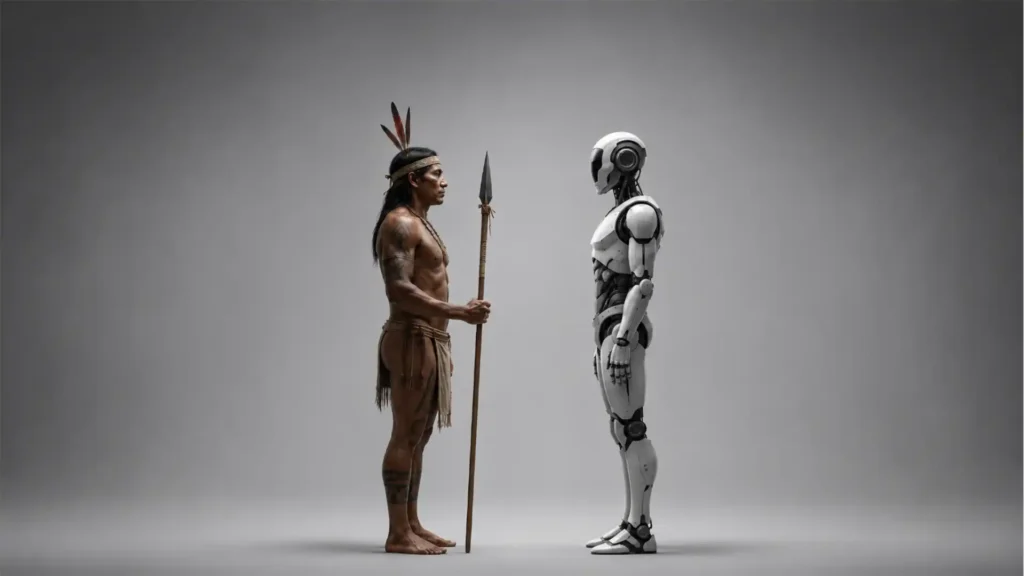
This article is an original analysis supported by the sources cited below
The 2026 AI Index Report
Stanford HAI source used for current AI adoption and governance-readiness context.
International AI Safety Report
Used for current general-purpose AI risk and mitigation framing.
AI Risk Management Framework
Used for trustworthy AI and risk management categories.
AI Act
Used for the EU risk-based AI governance comparison.
Ethics of Artificial Intelligence
Used for human-centered AI ethics principles and limitations.
AI principles
Used for intergovernmental trustworthy AI principles.
International Federation of Robotics
Used for industrial robot deployment statistics.
World Robotics 2025 report – SERVICE ROBOTS
Used for professional service robot sales context.
ISO/TS 15066:2016 Robots and robotic devices — Collaborative robots
Used for collaborative robot safety requirements.
Planetary Protection
Used for forward and backward contamination concepts and quarantine reasoning.
Outer Space Treaty
Used for contamination and consultation principles in space activity.
Protocols for an ETI Signal Detection
Used for post-detection communication, verification and public-disclosure context.
United Nations Declaration on the Rights of Indigenous Peoples
Used as an analogy for consent, dignity and refusal under asymmetrical contact.
Uncontacted Indigenous Peoples of Brazil
Used for Brazil and FUNAI no-contact policy context.
Uncontacted tribes: the threats
Used for disease and forced-contact risk analogies.
Sentinelese
Used for no-contact and refusal examples involving the Sentinelese.
Testing theory of mind in large language models and humans
Used for cautious interpretation of social-reasoning behavior in AI systems.
Evaluating large language models for accuracy incentivizes hallucinations
Used for current evidence on hallucination and reliability limits.
Detecting hallucinations in large language models using semantic entropy
Used for confabulation detection and uncertainty framing.
How culture modulates anthropomorphism in Human-Robot Interaction
Used for culture and anthropomorphism in robot perception.
Anthropomorphism and Human–Robot Interaction
Used for human-robot interaction and anthropomorphism concepts.
The Uncanny Valley: The Original Essay by Masahiro Mori
Used for the original uncanny-valley concept and the near-human unease analogy.
Multi-Agent Cooperation and the Emergence of Natural Language
Used for grounded communication and emergent language issues.
Frontier AI Safety Commitments, AI Seoul Summit 2024
Used for frontier AI risk assessment, red-teaming and transparency commitments.
Anthropic’s Responsible Scaling Policy: Version 3.0
Used for frontier AI scaling and catastrophic-risk governance context.
Google DeepMind strengthens the Frontier Safety Framework
Used for capability tracking and frontier AI risk-management context.
A3 Robotics
Used for robot safety standard context.
Safety in Motion: Setting the Standard for Humanoid Robots
Used for humanoid robot safety-standard development context.
| Citing this article? Brief excerpts are welcome. Please credit Webiano.digital, name the author where stated, and include a link to https://webiano.digital and to this original article. Full or substantial republication requires prior written permission. Read our Copyright and Content Use Policy. |
This article was prepared with the assistance of artificial intelligence tools. The content underwent expert human review, and Webiano Digital & Marketing Agency assumes editorial responsibility for its final version and publication.