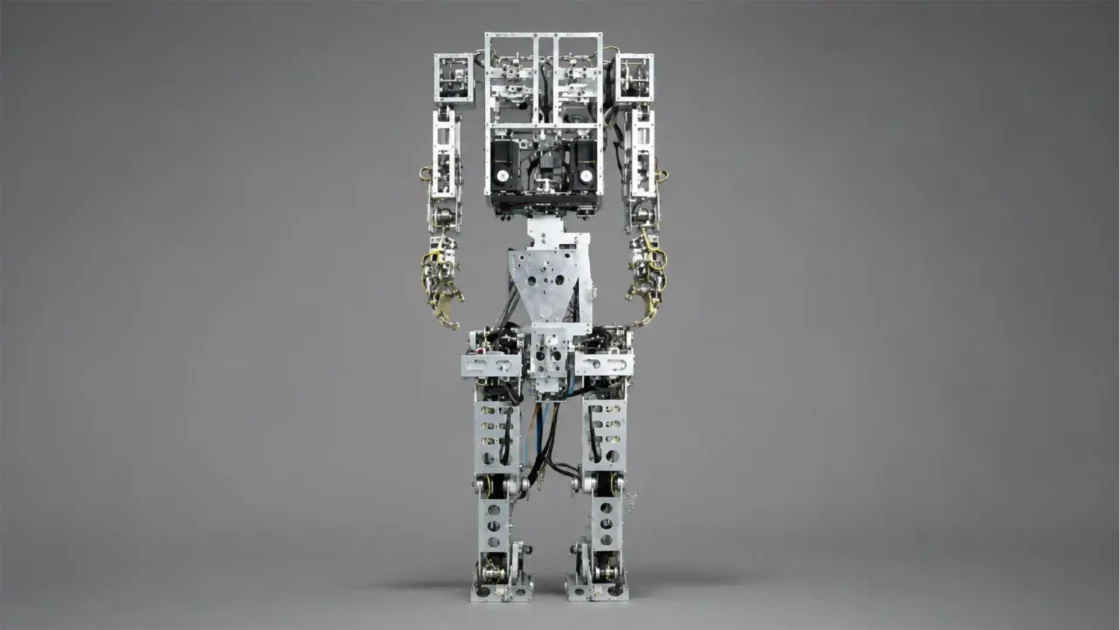
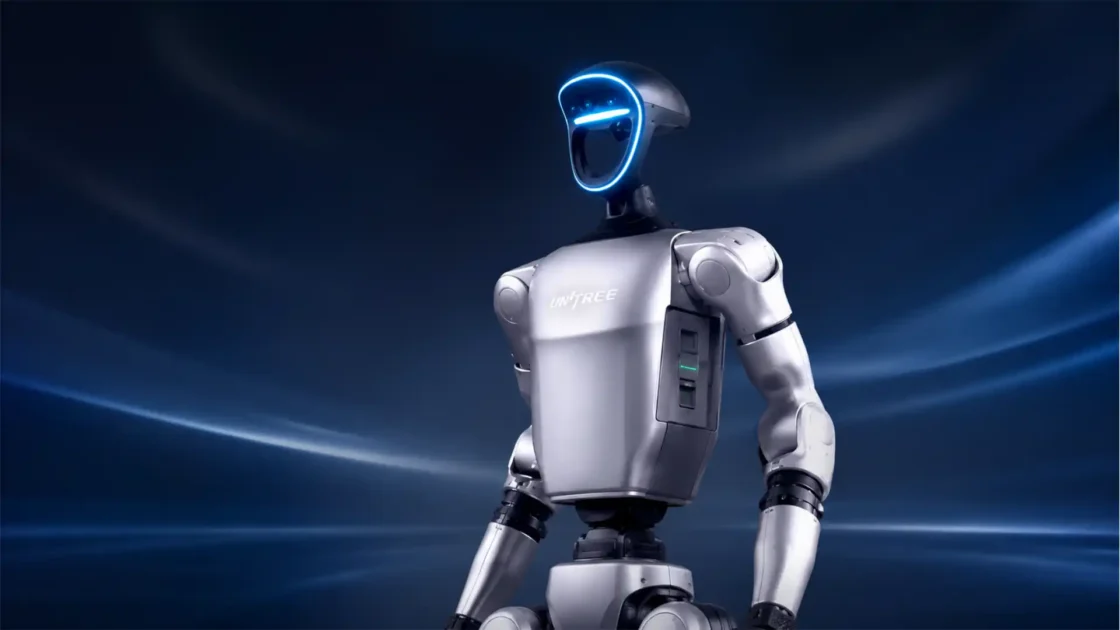
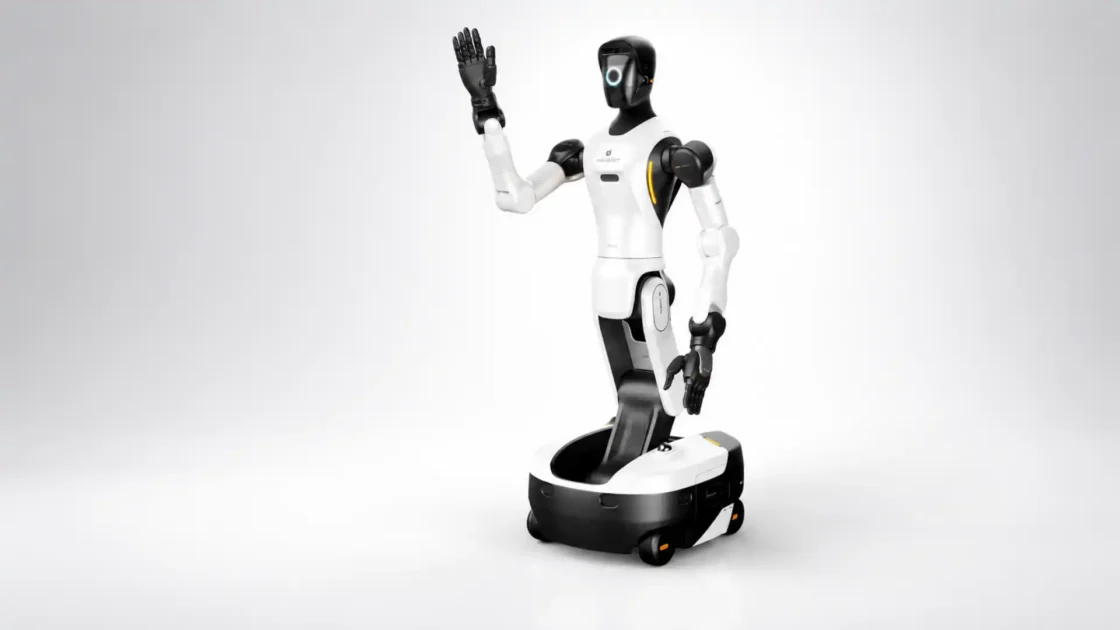
Unitree’s one-minute H2-X video shows a humanoid leaping four metres, kicking through cars and shielding bystanders. What it withholds matters more: who controls the robot, how long it works under load, what it costs and which rules apply. Those gaps now meet an investor reset in China and a US block on new foreign-made robot models.
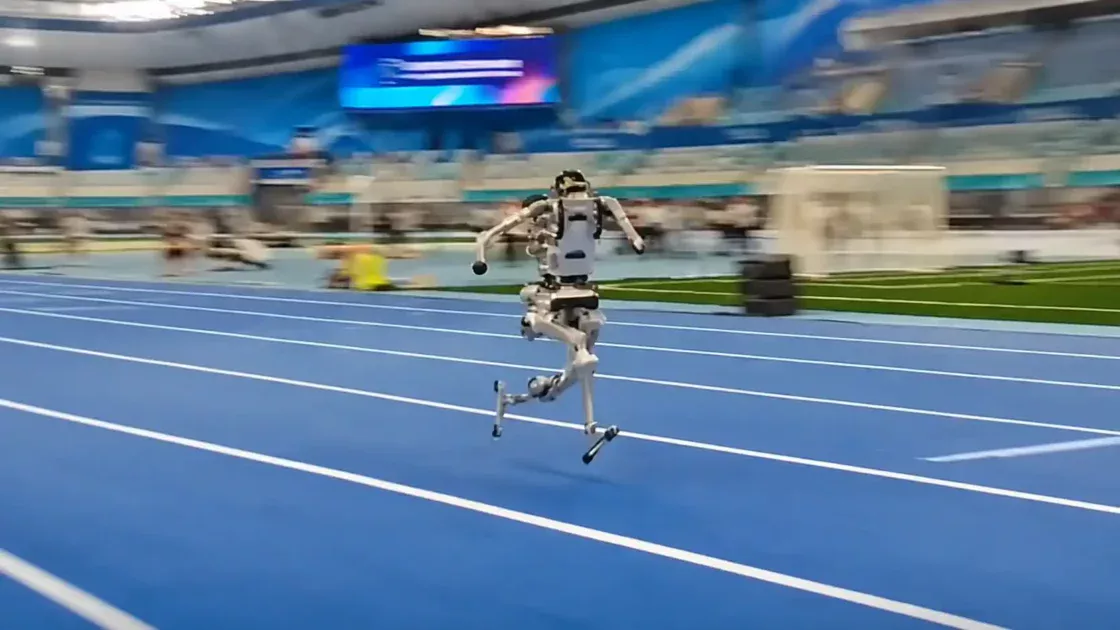
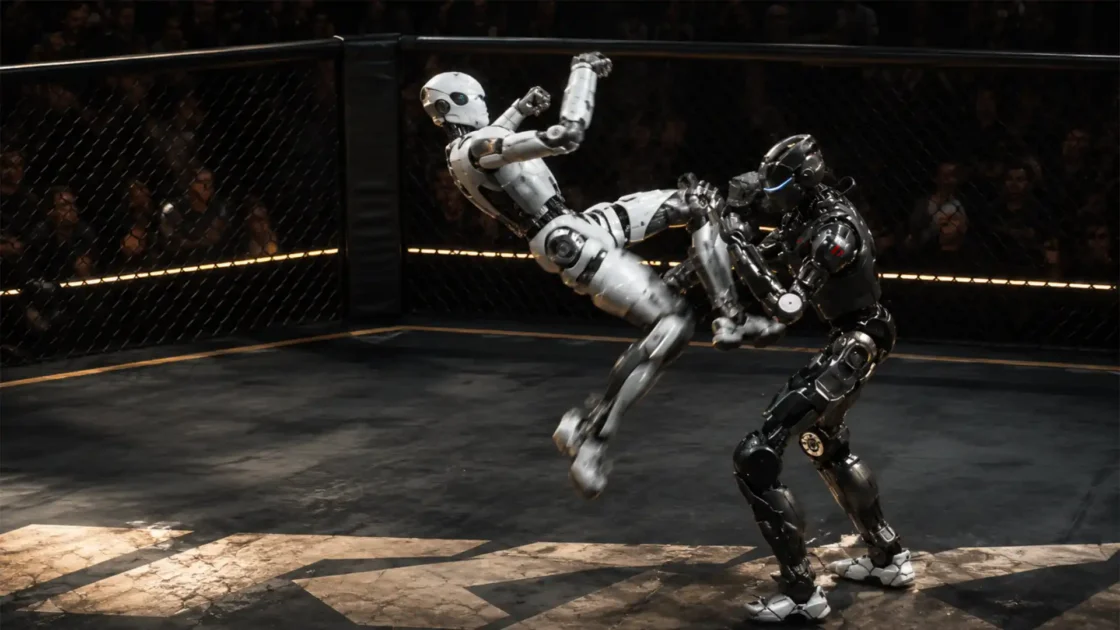
Unitree posted the H2-X video on 21 October 2026 with a caption promising a robot built to “serve and guard you”. The footage backs that with spectacle. The humanoid leaps off a four-metre platform, kicks its way through a scrapyard, faces down an intruder, lifts the front of a car off a trapped dummy and pushes a pedestrian out of another car’s path. Interesting Engineering says both rescues use props. Coverage disagrees on small details, since one outlet reports an attacker with a stick and others a knife, and agrees on the large ones. The company has published no price, no full specification and no word on what controls the robot. The stunts are the easy part to show. Four missing answers decide whether a robot guardian is a product: how long it works under load, how it is controlled, which safety rules apply and whether it can be sold where the money is.
An eight-hour claim that describes standing still
The headline number is endurance. Unitree says about eight hours, against roughly three for the standard H2. Interesting Engineering notes that the on-screen caption describes standing time, and BigGo’s summary of the launch labels the figure as stationary. Nothing published says how long the battery lasts while the robot fights, jumps or lifts a car. Unitree also gave no battery capacity or power draw. That is the gap a buyer would care about, because a guard that stands for eight hours and works for much less is a different product.
The video itself discloses one more limit. It ends with a warning against dangerous modifications and a request to keep at least two to three metres from the robot. That is hard to square with a pitch about protecting people at close range, though it is the honest part of the reel.
Who controls the robot decides which rules apply
Unitree has not said whether the H2-X acts on its own, is steered by an operator or follows a choreographed script, and Interesting Engineering and BigGo both stress that the footage settles nothing. A month earlier Unitree announced an AI model, UnifoLM-X2-1.0, which it says lets humanoids spar autonomously, but it has not tied that model to this robot. The answer matters beyond bragging rights. A robot that must recognise an attacker, decide to intervene and avoid hurting a bystander needs perception and judgement as well as strength, while a teleoperated one depends on a reliable human and a reliable link.
Regulators treat the two cases differently. The draft international safety standard for walking robots excludes robots whose motion is solely under an operator’s control, and the US national-security finding on robots names remote takeover as a risk. Control mode is the question that decides how this machine would be regulated and what could go wrong.
A safety standard for walking robots that stops at the factory gate
The standard being written for robots that must actively balance, ISO/CD 25785-1, is still a committee draft. It covers dynamically stable industrial mobile robots, a category that includes bipedal ones, and it defines an industrial environment as a workplace where the public is excluded or restricted. Robots used in non-industrial environments are out of scope, and the draft points to other standards such as ISO 13482 for them.
A robot marketed to protect people in a garden or on a street works exactly where the public is not excluded. The draft’s scope does not cover that use, and whether ISO 13482 or another standard fits a combat-capable humanoid is not something these sources answer. TechRadar’s own assessment is that certification hurdles would make a personal-bodyguard version very hard to bring to market.
The US market is closed to new foreign models
On 28 July 2026 the FCC added foreign-produced advanced robotic devices, defined as mobile robots such as humanoids and quadrupeds, to its Covered List. It acted on national-security determinations by a White House-convened interagency body. New models generally cannot receive the FCC authorization needed to be imported, marketed or sold in the US unless the Department of War grants a Conditional Approval. Wiley Rein’s summary says applicants must disclose their corporate structure, foreign ownership and supply chains, and submit a plan to expand manufacturing in the United States.
Models authorized earlier stay on sale, and software updates for them are allowed until at least 1 January 2029. The list names no company. Forbes notes that a firm with a brand-new humanoid planned for this autumn cannot launch in the US without an exemption, and that Unitree launched commercially in Europe on 22 July. None of the coverage reviewed here says whether Unitree has applied for Conditional Approval for the H2-X.
Investors are asking the same question
The video also lands in a nervous moment for Unitree’s stock. The company raised about 6.1 billion yuan, roughly $900 million, in a Shanghai listing in August. Its shares rose more than fivefold on the first day and, according to Reuters, have since fallen about 55% from the peak. Chinese regulators are reportedly using informal guidance to slow other humanoid listings and to check whether revenue reflects independent demand.
A banker quoted by Reuters put the sector’s problem in four words: “What’s the use case?” A demonstration reel does not answer that. TechRadar calls the H2-X video closer to a tech demo than a consumer product showcase.
What would turn the reel into evidence
Five disclosures would change this assessment: a datasheet with battery endurance under load, a plain statement on whether the demonstrated actions were autonomous, remote or scripted, a price and a sales route, the standard Unitree intends to certify against, and an independent test in unscripted conditions. Until then the video supports a narrower claim than its title. Unitree can build a humanoid that performs hard landings and car impacts on camera. It does not yet show that the robot can guard anyone.
For a company evaluating guard or rescue robots, the safe reading is to treat every capability in the reel as a vendor claim and ask for the evidence a security contractor would demand of any new system. For anyone producing video around robotics, the caption, the props note and the safety warning carry the real information, and a story should say so.
Author:
Jan Bielik
CEO & Founder of Webiano Digital & Marketing Agency
This article is an original analysis supported by the sources cited below
Unitree Introducing: H2-X Kung Fu Legend Guardian
Unitree’s own video, giving the 21 October 2026 publication date and the caption about serving and guarding with about eight hours of endurance; only the title and description were retrievable.
Unitree’s Kung Fu humanoid is pitched as your guardian
Interesting Engineering’s 21 October summary, describing the four-metre jump, the prop-based rescues, the standing-time caption and the two-to-three-metre warning.
Unitree unveils humanoid robot designed to act as real-life guardian
A detailed Interesting Engineering report on the H2 baseline specifications, the undisclosed control method and battery data, and the UnifoLM-X2-1.0 autonomy claim.
Unitree reveals H2-X humanoid bodyguard robot — ‘Kung Fu Legend Guardian’ packs 8-hour battery and martial arts defense skills
TechRadar’s 21 October report, covering the one-minute teaser, the H2’s $29,900 price, the certification doubts and Unitree’s August 2026 IPO.
Unitree Unveils H2-X ‘Kung Fu Robot’ That Lifts Cars and Delivers Spinning Kicks — BigGo Finance
A scene-by-scene account of the video and a table showing the endurance figure as a standing value, with price and launch date undisclosed.
FACT SHEET: FCC Updates Covered List to Include Foreign-Produced Advanced Robotic Devices and Power Inverters
The FCC’s 28 July 2026 fact sheet, establishing what the Covered List covers, what it leaves untouched and the risk language on remote takeover of robots.
FCC Adds Foreign-Produced Power Inverters And Advanced Robotic Devices To The Covered List
Wiley Rein’s legal summary, giving the definition of an advanced robotic device, the Conditional Approval requirements and the software-update waiver to at least 1 January 2029.
United States Bans Chinese Humanoid And Quadruped Robots, Citing National Security
Forbes’s 28 July analysis of the practical effect on new models and the note that Unitree launched commercially in Europe on 22 July.
ISO/CD 25785-1
ISO’s record of the draft safety standard for dynamically stable industrial mobile robots, with its definition of an industrial environment and its exclusions for non-industrial use and operator-controlled robots.
China’s Humanoid Robot IPO Boom Hits the Brakes After Unitree Drops 55%
A 24 September 2026 report relaying Reuters on Unitree’s August listing, the 55% fall from its peak and regulators’ demand for proof of independent demand.
| Citing this article? Brief excerpts are welcome. Please credit Webiano.digital, name the author where stated, and include a link to https://webiano.digital and to this original article. Full or substantial republication requires prior written permission. Read our Copyright and Content Use Policy. |
This article was prepared with the assistance of artificial intelligence tools. The content underwent expert human review, and Webiano Digital & Marketing Agency assumes editorial responsibility for its final version and publication.