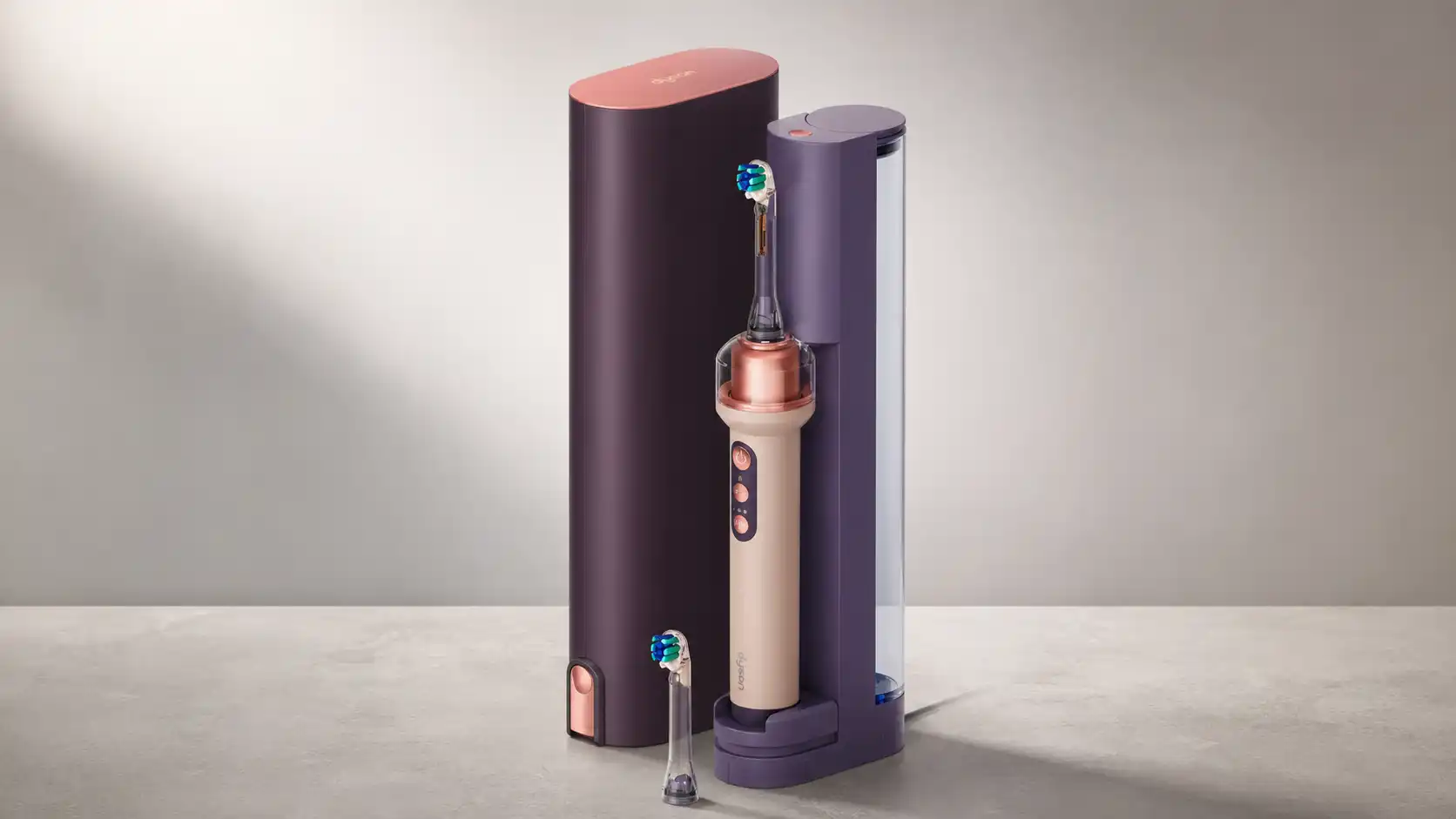
Dyson’s $499.99 CameraJet combines a 100,000-pixel intraoral camera, machine learning and a targeted mouthrinse jet in its first electric toothbrush. The eye-catching live view is only the surface. The more consequential bet is that machine vision can automate interdental cleaning, fold several oral-care steps into one routine and support a premium hardware-and-consumables business.
Table of Contents
Dyson unveiled the CameraJet in Paris on September 1, 2026, after six years of development. In the United States, Dyson lists the electric toothbrush and flosser at $499.99; the company says its 1mm, 100,000-pixel macro camera analyzes 28 images a second, while a machine-learning system identifies gaps between teeth and triggers a conical jet of mouthrinse.
The obvious story is the camera in a toothbrush. The more important one is the control loop behind it. Dyson is not mainly asking people to become amateur dental videographers. It is using vision to decide where a cleaning action should happen, then firing liquid into that space while brushing continues. The camera is valuable because it controls a physical intervention. That makes CameraJet less like a connected toothbrush with another dashboard and more like a small, sensor-driven appliance for automating a neglected part of oral hygiene.
That distinction also defines the risk. Dyson can prove that the mechanism is technically elaborate; it still has to prove that the full system produces enough real-world benefit, convenience and repeat use to justify a price far above ordinary brushes and a new stream of replacement heads, toothpaste and mouthrinse. Independent dental evidence supports cleaning between teeth, but it does not yet settle whether this specific, camera-guided approach is worth the premium.
Dyson’s oral-care entry is bigger than a camera gimmick
CameraJet is Dyson’s first electric toothbrush, but it arrives with the familiar logic of the company’s other category entries: identify an everyday task, re-engineer the physical system around it and charge for the resulting complexity. Dyson says 661 engineers worked on CameraJet, 38 patents were filed, and the machine runs on 16 million lines of code. Those are company figures, not evidence of clinical superiority, but they show the scale of the engineering bet.
The product is also broader than brushing. The head combines two bristle types; a reservoir in the handle carries mouthrinse; a diaphragm-and-pressure system is designed to keep liquid flowing when the handle tilts; Wi-Fi and Bluetooth connect the brush to MyDyson; and the app can show live video, brushing guidance and coverage maps. Dyson says a replaceable lithium-ion battery and RFID-enabled heads are part of the system.
The commercially relevant shift is from a toothbrush to an oral-care system. Dyson launched CameraJet alongside its own non-foaming toothpaste and low-foaming mouthrinse, both formulated so foam does not obstruct the camera. Its Ireland oral-care page explicitly promotes subscriptions for replacement brush heads, toothpaste and mouthrinse. Business Insider also reported the subscription model and noted that users are not strictly locked into Dyson’s toothpaste.
That architecture matters more than the novelty of seeing molars on a phone. A connected product with replaceable heads and consumables creates more points of contact after the initial sale than a stand-alone appliance. Editorial analysis: Dyson is therefore testing two markets at once: whether consumers will pay luxury-device prices for oral care, and whether the brand can turn a durable bathroom tool into a continuing relationship built around refills, app use and consumables.
The launch also puts Dyson into a category where technical differentiation already exists. Smart toothbrushes with sensors, apps and coaching are established enough that a screen or Bluetooth connection alone would not create much distance. CameraJet’s entry point is narrower and more defensible: use the sensor to control a cleaning action rather than merely score behavior.
The camera closes the loop between seeing and jetting
Dyson calls the vision system Gap Optical Targeting. According to the company, the 100,000-pixel macro camera captures 28 live images a second, the machine-learning algorithm identifies and predicts interdental gaps, and the brush can trigger a jet within 100 milliseconds after seeing one. Dyson says the model was developed with more than 470,000 dental images.
That is a different use of artificial intelligence from the generic “AI” labels attached to many consumer products. The algorithm is not presented as diagnosing decay, gum disease or other pathology. Dyson’s public materials describe it as a targeting system: detect a geometric feature, decide whether the nozzle is over a gap, then activate the jet. The camera can also provide a live intraoral view through the app, but the automated targeting function is the core machine task.
The fluid system is equally central. Dyson uses a 12.5ml reservoir and says the diaphragm system minimizes air pockets so the brush can jet while upright, angled or horizontal. Its support page describes the tank as removable and refillable, with the dock able to refill it; the company says the tank uses 12.5ml of liquid per clean.
Dyson also says it spent five years collaborating with the National University of Singapore’s Faculty of Dentistry to develop a proxy plaque for laboratory testing. It argues that its broad conical jet removes that material more effectively than a narrow, needle-type jet. That evidence is useful for engineering comparison, but it should be read as a company laboratory claim about a test material, not as proof that CameraJet will outperform every interdental-cleaning method in everyday mouths.
A toothbrush now behaves more like a control system
CameraJet’s design can be understood as a feedback loop. The sensor observes the mouth, software classifies the gap, the pump acts, and the user keeps moving the brush. That closed loop is why the camera has a functional reason to be there. Without the jet, the camera would mostly add visualization. Without the camera, the jet would depend on the user manually aiming it. Together they let Dyson claim that interdental cleaning can be partly automated.
The app adds a second loop around behavior. Dyson says MyDyson can show guided cleaning, coverage mapping, live viewing and personalized feedback. On its US experience page, sample screens track brushing duration, coverage, overpressure and overscrubbing; the same page says camera images are deleted immediately after viewing and not stored or shared. The product page similarly says live-view images are not stored by Dyson, the app or the cloud.
Privacy is therefore part of the product proposition, not a side issue. A camera placed in the mouth creates an obvious sensitivity that a pressure sensor does not. Dyson’s stated mitigation is to limit camera activation to functions that need it, show a white light when it is active, stream live images directly to the app and avoid cloud storage. Those are Dyson’s documented design claims; they are not an independent security audit.
The larger design lesson is that connected oral care is moving from measuring what the user did toward acting during the routine. Existing smart brushes already use apps, sensors and guidance; TechRadar notes products from Oclean, Philips, Oral-B and Feno in that broader smart category. CameraJet’s differentiation is the combination of intraoral vision and an automatically aimed liquid jet.
That change also shifts some responsibility from technique to system performance. A conventional flosser asks the person to identify each space and aim correctly. CameraJet asks the software and nozzle to do part of that work. If the targeting is reliable, the product converts a skill problem into an automation problem—a potentially important trade, because automation can make a routine easier while making trust in the device more important.
Premium hardware creates a recurring consumables business
The US list price puts CameraJet firmly in luxury personal-care territory. Dyson lists the device at $499.99, while TechRadar reports launch pricing of £419.99 in the UK and AU$799 in Australia. The same review says a pack of two brush heads costs $29.99 in the US and reports UK and Australian pricing for Dyson toothpaste and mouthrinse.
Those follow-on products are not incidental. Dyson’s toothpaste is non-foaming and its mouthrinse is low-foaming because the camera needs a clearer view. The company says its formulations contain sodium fluoride and are designed to work with CameraJet; its subscription page offers recurring deliveries of heads, toothpaste and rinse. The optical system therefore creates a technical reason for a branded consumables ecosystem.
That does not amount to a hard lock-in. Independent reporting indicates that other products can be used, although heavy foam may reduce camera visibility. The more subtle commercial advantage is preference rather than prohibition: the hardware is engineered around characteristics Dyson can control in its own toothpaste and rinse.
There is also evidence of early curiosity, though not enough to infer durable demand. Business Insider reported on September 3 that the Ceramic Ultra Blue version had sold out in the UK. The early sellout does not establish durable demand, repeat usage or attractive unit economics. It shows launch attention, not the size of the long-term market. Launch buzz can be strong even when long-term category economics are uncertain.
Editorial analysis: the business case will depend less on first-week sellouts than on retention. If owners keep using auto-jet, replace RFID-tracked heads and buy compatible rinse, CameraJet can behave economically like a platform. If the camera becomes a novelty and users drift back to simpler routines, the premium hardware model weakens quickly.
That makes repeat behavior a commercial metric as well as a health metric. A brush used twice daily creates far more opportunities for refill and accessory revenue than an occasionally used gadget. But that advantage only exists if the integrated routine remains easier than the alternatives after the novelty fades. The same friction Dyson removes from flossing cannot reappear as refill, cleaning or app fatigue.
The evidence supports caution, not dismissal
Dyson’s clinical claims deserve separation from its engineering claims. The company’s current US CameraJet category page cites a clinical study of 204 participants over six weeks, with twice-daily use in Brush and Auto-jet mode compared with a manual toothbrush. Yet Dyson’s UK launch page cites a different description: 71 participants after four weeks, using Dyson formulations versus a manual toothbrush with Dyson toothpaste. The public pages reviewed here do not explain the relationship between those study descriptions.
Dyson also advertises laboratory results, including up to 69% more plaque removal than market-leading premium electric toothbrushes in hard-to-reach areas. Its own footnote says that comparison was a laboratory test in brush-only variable mode. That is narrower than a clinical claim about long-term oral health, and buyers should not collapse the two.
Independent evidence gives the category some support but does not validate CameraJet specifically. A Cochrane review of 51 trials with 4,624 participants found powered toothbrushes reduced plaque and gingivitis more than manual brushes, while also saying the clinical importance of the differences was unclear. The American Dental Association says interdental cleaning helps remove plaque between teeth and lists water flossers among possible interdental cleaners.
Evidence on oral irrigation is more mixed. A 2024 scoping review covering 275 sources concluded that oral irrigators reduce periodontal inflammation, while plaque-reduction findings were inconsistent and better trials are still needed. A separate 2024 systematic review and meta-analysis in orthodontic patients found no statistically significant improvement when water jets were added to manual or automatic toothbrushes, although its evidence quality was low to very low.
That uncertainty is why outside dental scrutiny matters. The Washington Post quoted Andrew Eder, an emeritus professor of restorative dentistry at University College London, saying he wanted to see more studies and noting the device’s price and size. The Guardian quoted British Dental Association chair Eddie Crouch warning that expensive gadgets are no substitute for a proper routine.
Convenience is the real clinical bet
The strongest case for CameraJet may ultimately be behavioral rather than mechanical. Interdental cleaning is useful only when people actually do it. ADA guidance emphasizes cleaning between teeth as part of oral care and notes that the right method can vary with the patient, including floss, interdental brushes and water flossers.
CameraJet tries to reduce the number of separate actions required. The brush holds the rinse, detects gaps and jets while brushing; the dock refills the reservoir; the app can guide timing and coverage. In that sense, Dyson is attacking friction. If automation turns an often-skipped step into something that happens during an existing habit, adherence could matter more than a small laboratory advantage in plaque removal. That is an inference from the product design, not a proven outcome.
The same convenience could also create dependency on a more complex routine. The user has to keep the camera clear enough to work, maintain the tank, replenish rinse, charge the device and replace brush heads. TechRadar’s week-long test found the product comfortable despite its larger body, but also described a learning curve and splashing in auto-jet mode. Those are early review observations, not population-level evidence.
A useful comparison is therefore not “CameraJet versus doing nothing between teeth.” It is CameraJet versus the best routine a particular user will sustain. For someone who already brushes well and reliably uses floss or interdental brushes, automation may add convenience without transforming outcomes. For someone who routinely skips interdental cleaning, the integrated jet could be more valuable—provided the cost and complexity do not create a new reason to stop using it. That is the behavioral hypothesis Dyson now has to prove.
This is also where broad evidence on oral irrigators should be handled carefully. Reviews suggest some benefits for gingival inflammation, but plaque results and effects across populations are inconsistent. CameraJet may improve the practical delivery of irrigation, yet a better targeting mechanism does not automatically establish a better long-term clinical result.
Price, bulk and evidence gaps cap the first market
The $499.99 price is the most obvious constraint, but not the only one. Dyson’s US specifications list a weight of 0.51lb, a 12.5ml anti-gravity tank, IPX7 water resistance and up to 10 days of battery life under the company’s stated use conditions. A product combining a motor, camera, fluid reservoir, pump, wireless hardware and replaceable head is inevitably more complex than a conventional electric brush.
Complexity creates more potential failure and maintenance points even when each component works as intended. The tank needs cleaning, the camera needs visibility, and the fluid system needs refill. Dyson has made the battery swappable, which can extend hardware life, and the anti-gravity tank is itself replaceable. Those are positive design choices, but they also underscore that this is a small appliance ecosystem rather than a simple toothbrush.
The evidence gap is more important than the component count. Dyson has made study-size and laboratory claims public, but the material reviewed here does not provide enough detail to independently assess the full clinical protocols, effect sizes, confidence intervals or long-term outcomes behind every marketing claim. The absence of that public detail does not mean the product is ineffective; it means the strength of the clinical case is harder to evaluate than the engineering case.
That distinction should keep expectations grounded. A camera-guided jet may be an elegant way to solve targeting. It does not make basic oral-care principles obsolete. The ADA still recommends interdental cleaning, and the British Dental Association’s public warning quoted by the Guardian is that expensive tools cannot substitute for consistent routine and professional advice.
Privacy adds another adoption threshold. Dyson says images are not stored or uploaded to the cloud, but some buyers will still judge whether an in-mouth Wi-Fi camera is worth having. TechRadar’s reviewer explicitly described some unease about the camera despite Dyson’s assurances. Trust in data handling becomes part of product usability, even when the company’s architecture is designed to minimize retention.
Buyers should judge the system, not the specification sheet
For a buyer, the 100,000-pixel number is one of the least useful ways to judge CameraJet. Resolution matters only insofar as it helps the system identify gaps reliably in a wet, moving, foamy environment. The better questions are whether auto-jetting reaches the areas a user misses, whether the brush is comfortable enough for twice-daily use, whether maintenance feels routine rather than burdensome and whether the app adds behaviorally useful feedback.
A second test is economic. The purchase price is only the entry cost; replacement heads and rinse matter because the device is designed as a continuing system. Dyson’s subscription offer makes that model explicit. Prospective buyers should compare the total routine, not just the handle: hardware, heads, preferred toothpaste or rinse, app dependence and the value of combining brushing with interdental cleaning.
A third test is evidentiary. Dyson’s clinical footnotes should be treated as promising vendor evidence, not as a final verdict. Independent dental literature supports powered brushing and interdental cleaning in general, while research on water irrigation shows benefits in some measures and populations but mixed plaque findings. The product-specific question remains whether vision-guided targeting improves adherence or outcomes enough to justify the premium over a good electric brush plus an established interdental method.
For people with braces or specific periodontal needs, product choice is even more individual. Dyson itself tells users with braces to use Brush-only mode followed by manual jetting and to follow their orthodontist’s advice. That caveat is a useful reminder that automation does not erase clinical context.
The sensible buying horizon is therefore months, not minutes. A showroom demonstration can prove that the jet fires and the video looks sharp; it cannot show whether the owner will still use auto-jet regularly, tolerate the larger handle or keep buying rinse. For a $499.99 device, durability of habit is part of value.
Dyson’s real test is whether precision changes behavior
CameraJet is a credible piece of engineering with a clear internal logic: see the gap, classify it, jet it, then use software feedback to make the routine more consistent. It is also a premium consumer product entering a health-adjacent category where the burden of proof is higher than in hair styling or floor care. The novelty can win attention; lasting value requires measurable behavior and health outcomes.
Editorial judgment: the camera is not the breakthrough on its own. The meaningful innovation is the coupling of sensing and action inside a familiar daily habit. If that coupling makes interdental cleaning happen more reliably for people who otherwise skip it, CameraJet could justify a place beyond the gadget market even if cheaper tools can perform the underlying tasks separately. If users stop using the jet, ignore the app or decide the refill ecosystem is too expensive, the 100,000-pixel camera becomes an unusually sophisticated way to watch a routine that has not materially improved.
The evidence that would strengthen Dyson’s case is straightforward: transparent, independently reviewable clinical results comparing CameraJet not only with a manual toothbrush but with strong modern alternatives; longer-term adherence data; and evidence that the automated jet produces durable improvements across relevant user groups. The evidence that would weaken it would be equally clear: high abandonment, little incremental benefit over simpler interdental methods, or reliability problems created by the added complexity.
For now, CameraJet’s most important claim is behavioral, not computational. Dyson has built a toothbrush that can decide when to act. The market will decide whether that action is valuable enough to become habit.
Questions buyers are asking about the CameraJet
The Dyson CameraJet is Dyson’s first electric toothbrush and a combined brushing-and-liquid-flossing system. It uses an intraoral camera and machine learning to identify gaps between teeth and trigger targeted jets of mouthrinse while brushing.
Dyson lists the CameraJet at $499.99 in the United States. TechRadar reported launch prices of £419.99 in the UK and AU$799 in Australia.
The 1mm macro camera analyzes 28 images per second. Dyson’s Gap Optical Targeting system uses those images to identify interdental gaps and trigger the liquid jet; the camera can also provide a live view in the MyDyson app.
Dyson’s public launch and product materials describe the camera as a targeting and live-view tool, not as a system for diagnosing cavities, gum disease or other dental conditions. Users should still rely on dental professionals for diagnosis and treatment.
Dyson says live-view images are streamed to the MyDyson app and are not stored by Dyson, in the app or in the cloud. The company also says a light indicates when the camera is active.
It is designed to perform interdental cleaning with targeted liquid jets while brushing, but the best interdental method varies by person. The ADA recognizes several options, including floss, interdental brushes and water flossers.
Dyson cites clinical and laboratory tests, including a US footnote describing a 204-participant, six-week study and a UK launch footnote describing a 71-participant, four-week test. Independent evidence supports powered brushing and interdental cleaning generally, but public product-specific evidence remains incomplete.
Dyson designed non-foaming toothpaste and low-foaming mouthrinse to keep the camera view clear. Independent reporting indicates users are not strictly locked into those products, although foaming products may interfere with visibility.
That depends on whether its integrated auto-jetting makes a user more consistent with interdental cleaning and whether the convenience is worth the hardware and refill costs. The engineering is distinctive, but current public evidence does not establish that it is the best-value oral-care option for everyone.
Author:
Jan Bielik
CEO & Founder of Webiano Digital & Marketing Agency
This article is an original analysis supported by the sources cited below
Established the September 1, 2026 launch and provided Dyson’s specifications for the CameraJet camera, machine-learning targeting system, liquid-jet mechanism, development programme and privacy design.
Discover the Dyson CameraJet electric toothbrush
Provided the US launch price and Dyson’s published clinical and laboratory claims for CameraJet.
Dyson CameraJet electric toothbrush Ceramic pink
Provided detailed camera specifications, battery information, privacy statements, product features and guidance for users with orthodontic appliances.
Dyson CameraJet electric toothbrush
Documented MyDyson app functions, live camera viewing, brushing feedback, coverage tracking and Dyson’s statements about image processing.
Anti-gravity tank CameraJet toothbrush
Confirmed the CameraJet reservoir capacity and documented its refill, cleaning and replacement process.
Provided UK launch information and Dyson’s UK clinical-testing description, including the participant count and study duration cited in the article.
Established Dyson’s oral-care subscription model covering replacement brush heads, toothpaste and mouthrinse.
Dental Floss and Interdental Cleaners
Provided American Dental Association guidance on cleaning between teeth and the role of floss, interdental brushes and water flossers.
Powered electric toothbrushes compared to manual toothbrushes for maintaining oral health
Provided systematic-review evidence comparing powered and manual toothbrushes for plaque and gingivitis outcomes.
Oral Irrigation Devices: A Scoping Review
Provided evidence on the effects of oral irrigators on periodontal inflammation and the limitations of current evidence on plaque removal.
Provided counterevidence on the incremental effects of water-jet irrigation among orthodontic patients and documented the low certainty of the available evidence.
Efficacy of inter-dental mechanical plaque control in managing gingivitis—a meta-review
Provided broader evidence on the effectiveness and evidentiary limitations of different interdental plaque-control methods.
Dyson launches £420 toothbrush that films live cleaning footage inside your mouth
Provided independent reporting on the CameraJet launch, UK pricing and the British Dental Association’s response to the product.
Dyson’s $500 toothbrush puts a high-tech camera in your mouth
Provided independent reporting on CameraJet and outside dental commentary concerning its price, physical design and need for further evidence.
Provided hands-on observations about the device’s size, comfort, auto-jet operation, app experience, launch pricing and replacement-head costs.
Dyson’s new $500 AI toothbrush puts a camera in your mouth
Provided independent reporting on the CameraJet consumables strategy, compatibility with non-Dyson toothpaste and early UK product availability.
| Citing this article? Brief excerpts are welcome. Please credit Webiano.digital, name the author where stated, and include a link to https://webiano.digital and to this original article. Full or substantial republication requires prior written permission. Read our Copyright and Content Use Policy. |
This article was prepared with the assistance of artificial intelligence tools. The content underwent expert human review, and Webiano Digital & Marketing Agency assumes editorial responsibility for its final version and publication.