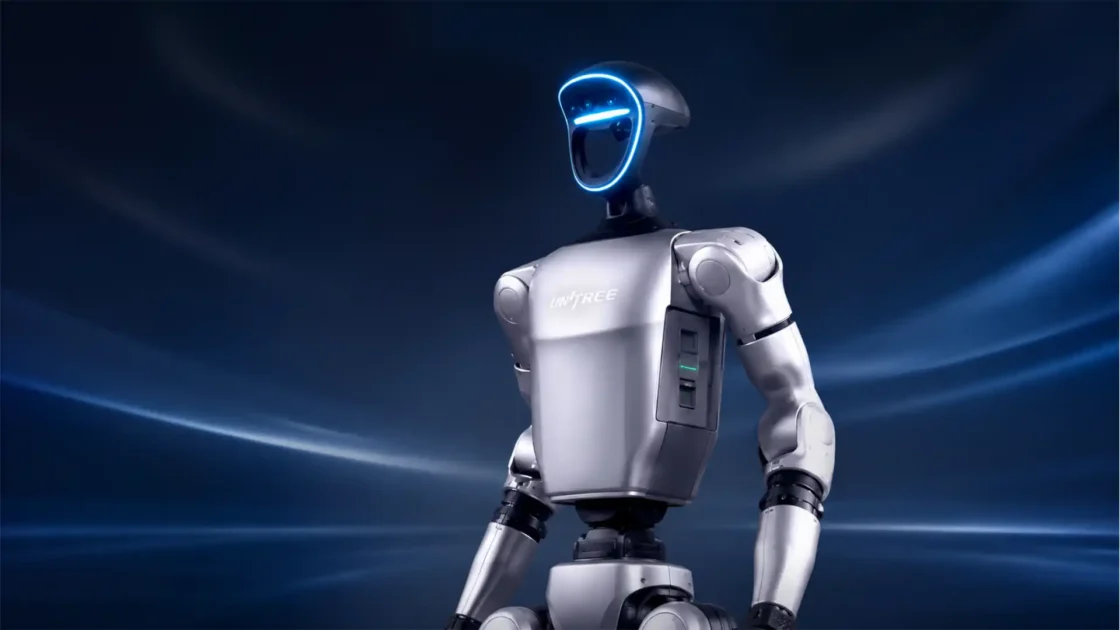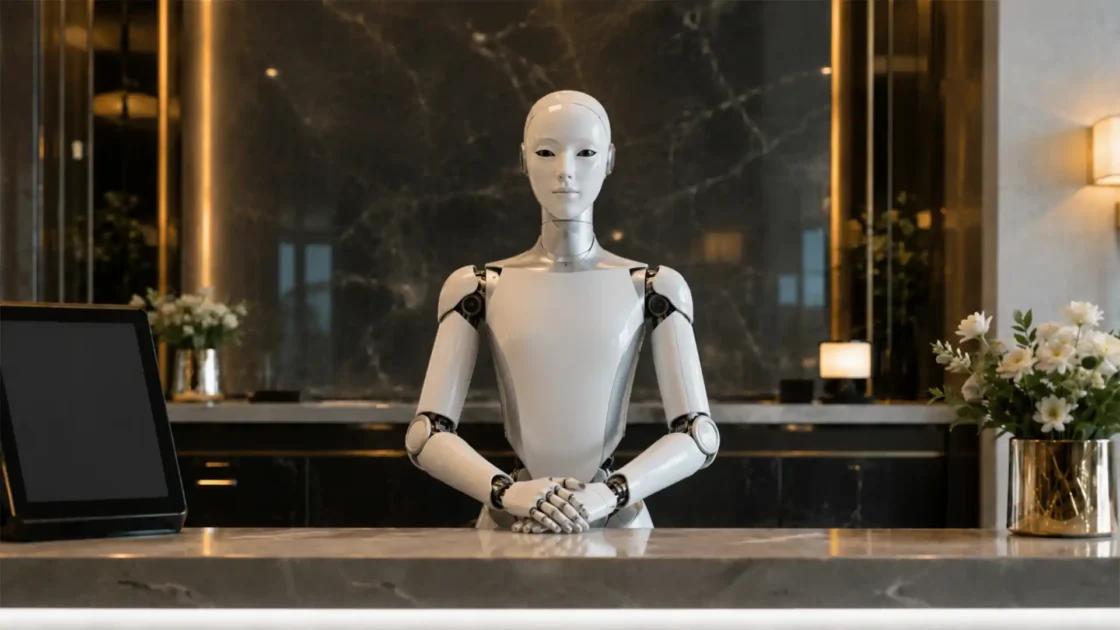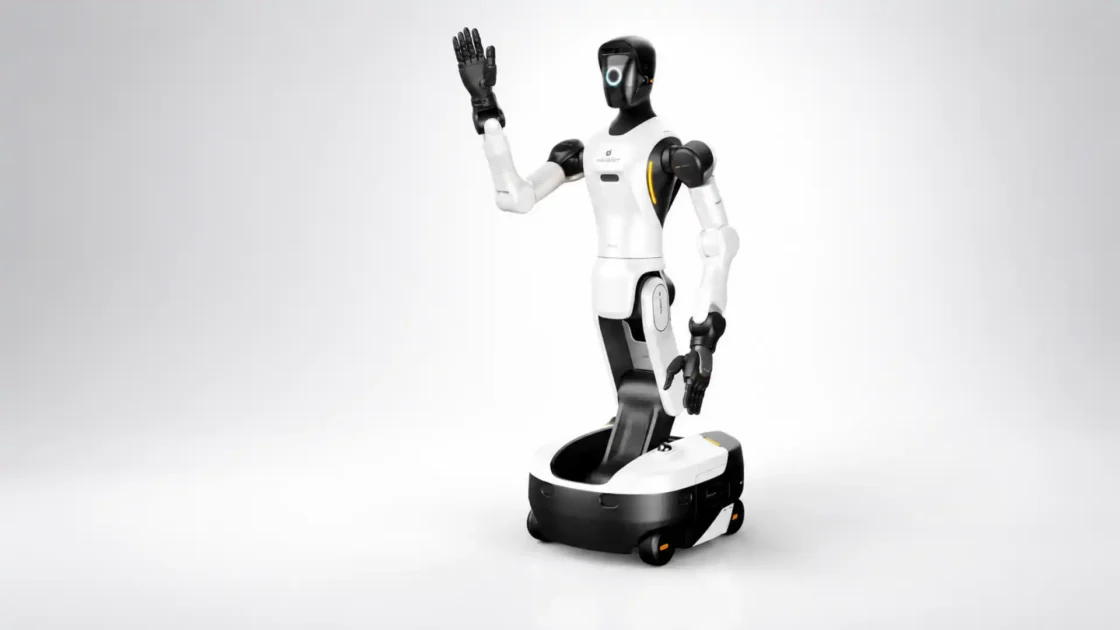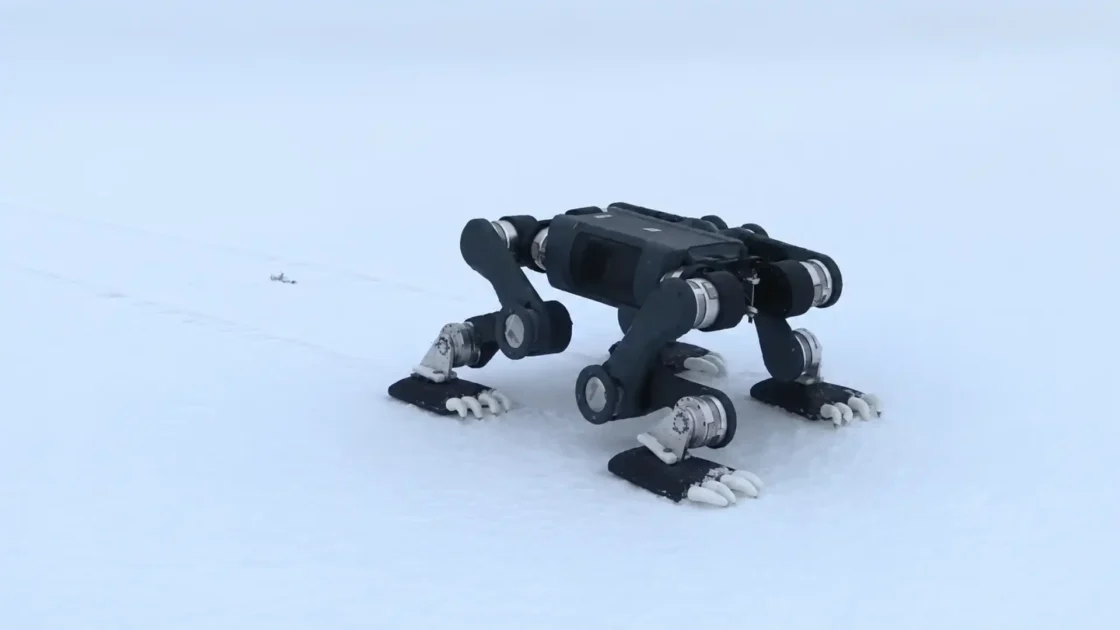
South Korea’s humanoid-robot push is no longer a collection of laboratory demonstrations, venture-capital rounds and polished videos. It is becoming an industrial proposition. The country already knows how to build electric motors by the millions, qualify components for brutal duty cycles, run high-volume assembly plants, manage supplier quality across continents and treat manufacturing data as a commercial asset. Those capabilities matter more to humanoid robots than the public debate usually admits.
Table of Contents
Goldman Sachs Research now estimates that Korean companies could command 30% of global humanoid-robot production, directly and indirectly, by 2035. Its estimate is not that South Korea will build every one of those machines inside its borders. It is a supply-chain forecast: Korean firms could provide the finished robots, joints, actuators, electronics, modules, factory capacity, software integration or industrial demand that sits behind roughly 412,000 humanoid units a year by 2035. Goldman Sachs puts the nearer 2030 figure at about 74,000 units. Those numbers are forecasts, not orders on a production schedule, but they explain why Korean manufacturers, ministries and investors are moving at the same time.
The decisive question is not whether a Korean company can make a bipedal machine walk across a stage. Many companies around the world can produce a demonstration. The question is whether a robot can work for thousands of hours in a plant, survive vibration and dust, be repaired quickly, receive spare parts on predictable terms, meet worker-safety rules and produce a return that a factory manager can defend. Humanoids will be won or lost through repeatability, field service and cost discipline long before they are won through choreography.
South Korea has a strong claim on that terrain. Its electronics and automotive sectors grew up under unforgiving requirements. A vehicle supplier cannot treat an actuator as a clever prototype. The part must meet torque specifications, thermal limits, crash-related constraints where relevant, noise targets, supply continuity rules and quality documentation. A company shipping robotic joints to an industrial customer will face a different standard, but the institutional habits overlap. That is why the country’s automotive background is more than a historical footnote in the humanoid story.
The distinction also keeps the current moment in proportion. South Korea is not yet the world’s humanoid-robot factory in the sense that it dominates actual global unit shipments. Most humanoid projects remain early, pilots remain selective and much of the industry is still learning which tasks are commercially viable. Korea is becoming a serious candidate to supply that future factory base. The opportunity lies in turning existing industrial competence into a new category before rival ecosystems lock in the component standards, data loops and customer relationships.
The forecast has a narrow but consequential meaning
The 30% Goldman Sachs estimate can be misunderstood if it is reduced to a national scorecard. It does not mean three in every ten humanoids will carry a Korean brand. A humanoid is a stack. It includes structural parts, high-power motors, reducers, encoders, motor drivers, battery systems, force sensing, cameras, compute hardware, operating software, simulation tools, safety systems, hand mechanisms, production tooling, logistics and service support. A company can command value and influence without owning the robot’s logo.
That matters because Korea’s strengths sit in several layers of the stack. Hyundai Motor Group brings an internal customer, a global manufacturing system and ownership of Boston Dynamics. Hyundai Mobis is preparing to supply actuators when Atlas enters mass production. LG Electronics has introduced LG Actuator AXIUM, a robot-joint module that combines a motor, drive and reducer. Samsung has made Rainbow Robotics a subsidiary and explicitly tied the move to future robot development, including humanoids. ROBOTIS has spent decades selling integrated smart actuators and is now presenting quasi-direct-drive hardware for humanoid platforms. Doosan Robotics is building its humanoid and AI-software capability out of a business rooted in collaborative industrial robots.
A supply-chain share is therefore more plausible than a finished-robot share. Korea does not need to beat every American, Chinese or European company in foundation models, vision systems, hands or bipedal locomotion at once. It needs a position in the high-value elements that become hard to replace after a platform reaches production. The best example is the actuator. A humanoid might use dozens of them. Their design affects power draw, balance, payload, speed, thermal behavior, control precision, safety and cost. Once a robot maker qualifies a joint module and builds software, tooling and service procedures around it, switching suppliers becomes expensive.
The forecast also rests on a familiar pattern in Korean industry. South Korea’s largest groups often enter a new hardware field through adjacent capability rather than through a single clean-sheet bet. Memory semiconductors grew from process engineering, capital spending and manufacturing discipline. Electric-vehicle components grew from automotive supply chains, batteries, power electronics and vehicle integration. Humanoids are different, but they contain the same kind of industrial logic: a complicated product becomes a market only when components, production processes and customer deployment all mature together.
There is a warning inside the same logic. Hardware advantage does not automatically produce control over robot intelligence. A factory may source a Korean joint, an American or Chinese AI stack, an Nvidia compute platform, Japanese precision reduction gears and locally built frames. The value chain can fragment. Korea’s realistic ambition is not self-sufficiency in every layer. It is strategic weight in enough layers that global robot makers need Korean suppliers, factories and deployment sites.
A second warning concerns the size of the market itself. Goldman Sachs’s underlying global projection is a scenario, not a certainty. It expects a humanoid market worth as much as $38 billion by 2035, but demand depends on whether machines become reliable enough and cheap enough for repetitive industrial work. The market could develop more slowly, or it could concentrate in wheeled mobile manipulators, cobots and purpose-built automation instead of two-legged generalists. A country can prepare well for a market that still fails to arrive on schedule.
Korea’s advantage begins below the robot’s skin
Most public attention goes to the robot’s face, hands and gait. The industrial economics sit lower down. A useful humanoid requires joints that deliver force without wasting too much energy, transmit motion without excessive backlash, survive repeated shocks, report their position accurately and stay cool in a compact package. It needs power electronics that can react fast enough for stable movement. It needs structural parts that are light but not fragile. It needs cable routing that tolerates constant flexing. It needs batteries and power-management systems that do not turn a work shift into a sequence of long charging pauses.
Those are not unfamiliar problems for South Korean manufacturers. Automotive suppliers already work with traction motors, electric power steering, brake-by-wire systems, inverters, sensors, battery packs, thermal-management equipment and high-volume electronics. The specifications differ, but the underlying disciplines are adjacent. A robot actuator is not an electric-vehicle traction motor. It tends to prioritise compactness, torque density, fast control response and integration in a way a vehicle motor does not. Yet the companies that understand electromagnetic design, machining, sealing, embedded control and production quality start far closer to the problem than a software-only entrant.
The automotive connection is especially strong because both products combine mechanical, electrical and software systems under safety and reliability pressure. A humanoid’s knee, hip or shoulder is an electromechanical system with a controller, sensor feedback and physical consequences when it fails. The physical system must also work under uncertainty. A robot that lifts a bin may encounter a misaligned object, an unexpected human, a slippery surface or a battery state that differs from the nominal case. Automotive engineering has spent decades building verification and failure-analysis cultures around systems where software interacts with motion.
Korea’s factory experience is another part of the advantage. Humanoid production will initially be low-volume and labor-intensive. As designs stabilise, the commercial winners will need to shift toward modules, standardised testing, supplier qualification, automated calibration and fast repair. South Korean electronics and automotive groups know that transition. They have run the passage from prototype to volume repeatedly, often under pressure from global customers that expect tight delivery windows and exact quality metrics.
The country’s position in industrial robotics strengthens the base. The International Federation of Robotics reports that South Korea recorded the world’s highest industrial-robot density in 2024, at 1,220 robots per 10,000 manufacturing employees. It installed 30,600 industrial robots in 2024, making it the fourth-largest market by annual installations. Those are mostly not humanoids. They are fixed industrial robots, cobots and automation systems. Still, they matter because they create integrators, maintenance teams, safety specialists, software staff and factory managers who already understand that an automation purchase is a long-term operating decision rather than a gadget purchase.
Humanoids do not replace this installed base. They are trying to solve the residual problem: tasks where a conventional robot is too fixed, a custom automation cell takes too long to engineer or the work environment was designed for a human body. That is a narrower target than the marketing suggests. It is also a target that suits Korea, because Korean manufacturers have a large installed population of conventional machines and know their limits.
A humanoid factory is an actuator factory first
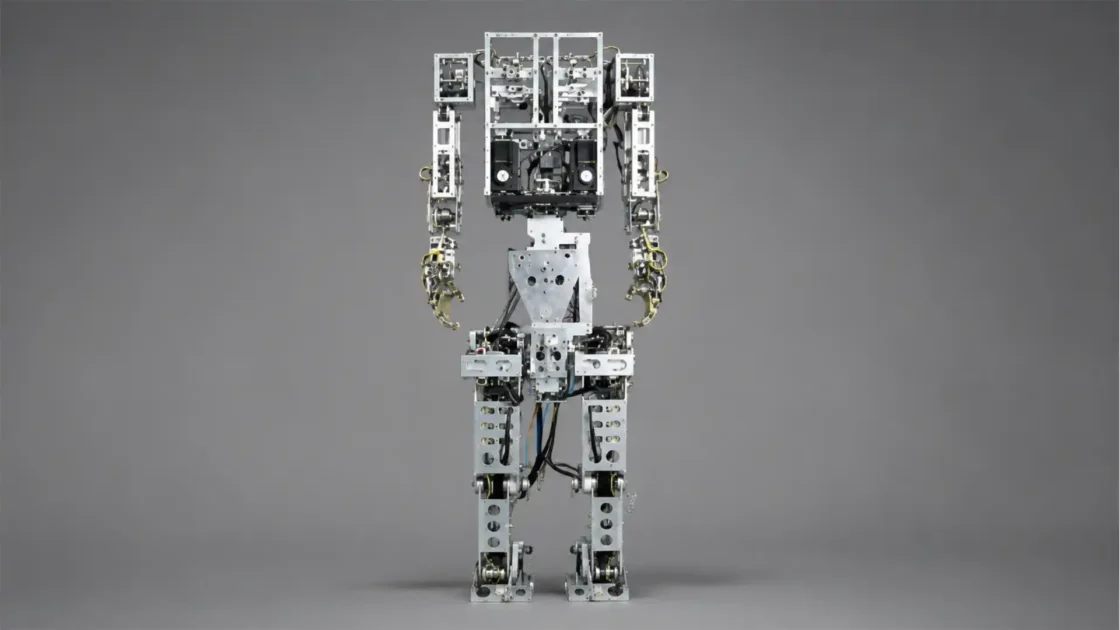
A humanoid robot is often described as a computer with a body. For industrial planning, it is closer to a network of expensive joints wrapped around compute. Every leg, arm, wrist, torso and hand function depends on actuation. Poor actuators make a good AI model irrelevant because the machine cannot execute the action accurately enough. Overbuilt actuators make the robot too heavy, too hot or too expensive. Weak actuators limit payload. Slow actuators create unstable motion. An actuator with poor sensing turns contact-rich work into a guessing exercise.
The economics become clearer when a robot contains 20, 30 or more active joints. A small improvement in the cost, mass or failure rate of one module compounds across the machine. A manufacturer that can reduce the price of a qualified joint by hundreds of dollars, improve heat dissipation or cut service time has not made a marginal improvement. It has changed the commercial envelope of the entire robot. The centre of gravity in humanoid manufacturing may sit less in the head than in the hips, knees, wrists and hands.
LG’s AXIUM launch deserves attention for that reason. LG describes the product as a compact robotic actuator integrating a motor, drive and reducer, the three elements required for a robotic joint. The company is not merely showing an interest in robots. It is trying to package a hard-to-source subsystem into a product that robot builders can buy and qualify. This is the same commercial move that helped component firms become indispensable in other Korean hardware industries: turn a complicated internal engineering problem into a repeatable module.
Hyundai Mobis’ announced framework with Boston Dynamics follows a similar path. The stated plan is to supply Atlas actuators when mass production begins, then expand toward grippers, sensors and controllers. This matters because Mobis is not entering an abstract market. It sits within a group that owns the robot developer, operates vehicle factories and has deep experience in global component quality systems. The arrangement creates the sort of closed learning loop that young robot companies usually lack: component design, vehicle-grade manufacturing knowledge, robot testing, factory deployment and feedback from real operators.
ROBOTIS offers a different route. Its DYNAMIXEL line has long bundled motors, gears, control electronics and communications into robot-ready smart actuators. Its newer DYNAMIXEL-Q platform is aimed at dynamic humanoid motion and uses quasi-direct-drive architecture, where lower gear reduction and a high-torque motor aim to improve responsiveness and contact behavior. The company’s current humanoid platform may not be the final commercial winner, but the actuator work places it in a valuable part of the stack. Suppliers that become familiar to researchers, developers and system integrators often gain an advantage when those teams move from experimentation to procurement.
The technical trade-offs are difficult. High reduction ratios make it easier to generate torque, but they can add friction, backlash and resistance to external forces. Lower ratios improve backdrivability and force control but demand more from the motor and electronics. A humanoid that shares space with people needs joints that react safely to contact; a humanoid that carries heavy parts needs enough torque and stiffness to complete the task. The right answer may differ by joint and use case. A hip joint in a warehouse machine does not need the same design as a finger in a dexterous hand.
Korea’s opportunity lies in treating these trade-offs as a manufacturing programme, not only a research topic. Winning suppliers will have to provide validated performance, stable volume pricing, documentation, firmware support and repair procedures. They will need test rigs that replicate years of loading in months. They will need to manage rare-earth exposure, magnet supply, bearings, gear machining and power semiconductors. That is hard work, but it is work that aligns closely with the country’s existing industrial muscle.
Automotive manufacturing has supplied the operating discipline
There is a temptation to describe South Korea’s advantage as cheap labour, government subsidies or corporate ambition. None captures the deeper point. The country’s industrial groups have learned how to run complex manufacturing systems at scale. They build products that require tens of thousands of parts, global supplier coordination, quality traceability, warranty management and continuous incremental improvement. Humanoids will demand the same habits, though at a more immature stage and with a much higher software burden.
A car factory has long dealt with machine vision, robotic welding, automated inspection, material handling, digital work instructions and line balancing. It has measured cycle times, defect patterns, downtime, quality escapes and maintenance intervals. A humanoid deployment needs these same operational concepts. A plant manager will ask whether the robot completes a task on time, whether it fails safely, whether it disrupts takt time, whether it needs a human attendant, whether it can be reprogrammed after a model change and whether spare parts are available overnight. The novelty of the machine does not remove the discipline of the factory.
Hyundai Motor Group’s ownership of Boston Dynamics therefore carries more weight than a typical corporate investment. Boston Dynamics brings decades of mobility and control research. Hyundai brings a global manufacturing network, a customer with difficult internal use cases, procurement power and experience turning engineering programmes into industrial operations. In January 2026, Hyundai Motor Group said it aimed for annual production capacity of 30,000 robot units by 2028 and planned phased Atlas deployment across manufacturing tasks. It describes Atlas as a 56-degree-of-freedom industrial humanoid designed for material sequencing, assembly and machine tending.
The value of internal demand should not be understated. Early humanoid companies face a brutal customer-acquisition problem. A potential buyer must trust a machine that has limited field history, may require site changes and may not have a clear payback period. An owner-operated factory network changes the first phase. Hyundai can test Atlas in its own environment, learn where it breaks, quantify the task economics and absorb some early adoption cost as strategic research. That does not guarantee commercial success. It does create a faster feedback loop than a startup trying to convince a sceptical third party to become its first test bed.
Boston Dynamics has said its initial industrial focus is part sequencing in automotive manufacturing. Its public material describes training through simulation, teleoperated demonstrations and testing at Hyundai’s Georgia metaplant. The choice is revealing. Part sequencing is not glamorous. It is structured enough to define performance metrics, varied enough to test perception and manipulation, and costly enough to offer a credible economic case. It is a more believable starting point than the claim that a general-purpose humanoid will soon tidy homes or replace broad categories of workers.
The Korean advantage becomes sharper if these factory lessons flow back into component design. A robot that fails because a cable chafes, a joint overheats or a gripper misreads a part needs more than an AI fix. It needs redesign, validation and production change control. Automotive organisations know this reflex. They have engineers for root-cause analysis, suppliers for fixtures and inspection equipment, and production systems for implementing corrections. A humanoid business becomes durable only when the machine improves after each failure without creating a fresh failure somewhere else.
Hyundai and Boston Dynamics are building the clearest Korean route to volume
Hyundai’s position is not just that it owns a famous robotics company. It is that it can connect product development, internal deployment and component production inside one industrial group. This offers a route to volume that is hard for independent humanoid startups to match. Startups may move quickly on software, capital raising and prototypes. They often struggle with long-duration reliability, factory engineering, distribution and service. Hyundai has the reverse risk: it may move more slowly and carry more internal complexity. The combination with Boston Dynamics is an attempt to join research depth to manufacturing discipline.
Atlas is the centrepiece of that attempt. Boston Dynamics shifted Atlas from a hydraulic research machine to an all-electric industrial platform in 2024. In 2025 it described future deployment at Hyundai Motor Group Metaplant America. Its 2026 material says the production version is designed for real industrial work and that 2026 deployments were already committed, including fleets for Hyundai’s robotics application centre. Each announcement should be read cautiously. A committed deployment is not the same as a fleet proving a profitable, autonomous work cycle. It does show that Hyundai and Boston Dynamics have moved beyond the language of vague future pilots.
The group’s current timetable also reveals that commercial adoption will not be instantaneous. Hyundai Motor Group and Kia have described broader Atlas deployment beginning in 2028 at the Georgia metaplant, moving to Kia’s Georgia site later and expanding across other facilities after that. The same strategy talks about selective initial use across 16 core manufacturing processes. This is closer to the expected industrial path: narrow tasks first, controlled sites, measured expansion, then a search for repeatable applications. Investors who expect a sudden wave of thousands of machines in every factory are likely to be disappointed.
The target of 30,000 annual robot units by 2028 is much larger than the initial needs of any one plant. It signals an intention to build a robot-manufacturing platform, not merely an internal automation programme. Yet capacity targets should be handled carefully. A facility capable of producing a number of units is not proof of demand at that number. It is a declaration about the company’s desired learning curve and supply-chain preparation. Real demand will depend on cost, reliability, task performance and labour acceptance.
Hyundai’s group structure creates an unusual advantage in the parts that often slow a hardware company. Hyundai Mobis can contribute actuators and vehicle-component experience. Hyundai WIA has robotics and manufacturing equipment experience. Hyundai AutoEver and other group units provide software and factory systems. Hyundai Glovis brings logistics. Boston Dynamics supplies the robot platform and control expertise. A company that can combine these pieces may be able to shorten the distance between a prototype and a deployable product. Coordination inside a conglomerate is not frictionless, but it can be more manageable than negotiating with a dispersed set of outside suppliers.
The strategy is also exposed to a specific risk: Hyundai’s strongest initial deployment sites are not necessarily in Korea. The Georgia metaplant is a natural location because it is newly built, highly automated and connected to the group’s U.S. manufacturing expansion. That could mean Korea supplies more of the components, engineering and intellectual property than the first units of factory labour. It would still support the country’s place in the humanoid value chain, but it weakens any simple story that Korean factories will immediately become the primary deployment market.
Labour politics add another constraint. Hyundai’s Korean union has publicly raised concerns about job security and demanded a say over humanoid deployment. Reuters reported in January that the union warned the technology could cause employment shocks without a labour-management agreement, while the Financial Times reported a later strike vote linked partly to automation fears. The dispute is not a side story. It could shape deployment speed, task selection and the social licence for industrial humanoids. A factory robot succeeds only when it is technically acceptable and politically governable.
LG is trying to turn a household-electronics strength into robot joints
LG Electronics’ robot strategy is broader than humanoids, and that is partly its strength. The company has experience in home appliances, compressors, motors, connected devices, displays, commercial systems and service robots. Its public presentation of LG CLOiD, a home-focused AI robot, has attracted attention because it sits close to LG’s smart-home business. Yet the more strategically telling move is its actuator business. An appliance and motor company entering robot joints is not chasing a science-fiction product image. It is moving into a component category where existing engineering knowledge has a direct commercial use.
AXIUM is designed as an integrated actuator module. The package combines a motor, drive and reducer, making the unit functionally closer to a ready-to-install joint than a collection of parts. That integration is crucial for humanoids. A robot builder that buys separate motors, gears, encoders and power electronics must solve packaging, thermal management, control compatibility and quality validation by itself. A joint module reduces that burden. It does not eliminate the hard work of robot design, but it gives the robot maker a component with known specifications and support.
LG’s central challenge is that robot actuators are not a simple extension of appliance motors. Household appliances reward quiet operation, energy use, cost control and high production volumes. Humanoids demand torque density, rapid response, high precision, force awareness and durability under complex loads. The commercial opportunity will depend on whether LG can meet those requirements at a price that makes a machine economical. The company’s motor scale offers a starting advantage, not a guaranteed outcome.
The company also has an unusually direct view of the service-robot market. Its appliance business gives it access to the kind of environments in which consumer robots must eventually operate: kitchens, laundry rooms, living spaces, hospitality settings and commercial buildings. Those environments are messy, variable and unforgiving. A factory robot may work with defined bins and parts. A domestic robot must deal with clutter, pets, reflective surfaces, changing lighting and people who do not follow instructions. LG’s home-robot programme is therefore useful even if its near-term revenue is limited. It creates a test bed for perception, connectivity, user trust and maintenance.
For the wider Korean ecosystem, LG matters because it can be both supplier and customer. A firm that sells robot joints to outside builders may also use the technology in its own service robots, appliance-adjacent systems and commercial automation. That produces internal demand and field data. It also reduces the risk of a component business that depends on one flagship humanoid programme. A healthy humanoid supply chain needs customers beyond humanoid brands, because the first years of demand will be uneven and project-based.
There is a competitive limit. Chinese component makers are also racing to package motors, reducers and controllers into lower-cost modules. Japanese firms remain strong in precision components. American robot companies may choose vertically integrated designs. LG will need more than corporate scale. It will need a clear performance and cost position, credible reliability evidence and relationships with developers that influence future standards. Still, its entry shows the Korean ecosystem is growing from the joint outward, not merely from the robot’s visible shell inward.
Samsung’s Rainbow Robotics deal adds a software-and-platform path
Samsung’s decision to become the largest shareholder in Rainbow Robotics was a clear declaration that robotics had moved closer to the group’s strategic core. In December 2024, Samsung said it would exercise a call option that increased its ownership to 35%, making Rainbow Robotics a subsidiary. Samsung stated that the move would accelerate future robot development, including humanoids. The corporate logic is easy to see. Samsung has global strength in semiconductors, devices, consumer electronics, AI research and manufacturing. Rainbow brings robot-development expertise, platforms and a smaller organisation able to work directly on embodied systems.
The value of the acquisition is not that Rainbow has already won the humanoid market. It is that Samsung can now connect robotics with its wider hardware portfolio. Humanoids require sensing, memory, processing, cameras, displays, batteries, wireless connectivity, edge AI and manufacturing systems. Samsung participates in many of those fields. It also has a global brand, retail reach and experience shipping complex electronic products at volume. A robot company inside that structure can draw on resources that a standalone developer would find difficult to fund.
There are dangers in this corporate fit. Consumer-electronics companies are skilled at fast product cycles, but humanoids have slower reliability cycles. A phone can be replaced after a few years. A factory robot may need to operate, receive parts and stay safe for much longer. The business model is closer to industrial equipment and fleet service than consumer retail. Samsung will need to decide whether its robotics unit is an extension of its device business, an industrial automation platform or an internal strategic laboratory. Each approach demands different sales channels, support structures and investment horizons.
Rainbow’s importance also lies in Korea’s research and developer pipeline. Smaller robotics companies often form links with universities, labs and engineers that large groups cannot easily replicate. They tend to work with open or semi-open hardware, robotics middleware and developer tools. Those communities matter because embodied AI still needs rapid experimentation. A robot team has to test controllers, collect demonstrations, tune locomotion, revise hands and compare simulation against physical behavior. A large company that absorbs a robotics specialist can either strengthen that work with resources or suffocate it with process. The management choice will affect the result.
Samsung has a second reason to care about humanoids: the future demand for AI hardware. If physical AI becomes a real market, every robot fleet will need compute in the robot, compute at the edge, training infrastructure and memory bandwidth. Korea’s leading position in memory semiconductors does not automatically translate into a humanoid advantage, but it gives Samsung a way to benefit from the category even if it does not sell the leading robot. The same logic applies to image sensors, displays, connectivity chips and factory automation systems.
The group’s approach will be judged on deployment, not strategic narrative. A credible next step would be a robot platform that performs a limited industrial task repeatedly, under measured conditions, while using components and software that Samsung can support. The target should not be an all-purpose household machine. The first commercial test is whether Samsung and Rainbow can turn their combined resources into a robot that creates usable data and reliable work inside a real operating environment.
ROBOTIS occupies a quieter but valuable part of the market
ROBOTIS does not have the brand visibility of Hyundai, Samsung or LG, but its position in smart actuators gives it relevance far beyond its size. Its DYNAMIXEL systems have been used by developers, researchers and robot builders for years because they bundle the basic mechanics and electronics of a robotic joint into a module. That matters in a field where teams cannot afford to engineer every motor controller and communication protocol from scratch.
The company’s move toward quasi-direct-drive hardware is a response to the demands of dynamic robots. Traditional high-reduction servos are useful for controlled motion, but they can become less suitable when a machine must absorb contact, react quickly to disturbance and use torque feedback in real time. DYNAMIXEL-Q is positioned for those conditions. ROBOTIS says its AI Sapiens K1 platform uses the new actuator architecture for locomotion, whole-body control, reinforcement learning, imitation learning and sim-to-real development.
The product claim should not be confused with proof of industrial leadership. Early platforms are often research tools, and specifications can change. Yet research platforms are commercially valuable when a market is forming. They shape the habits of engineers, create data, establish software interfaces and help developers learn what works in hardware. A company that supplies many of those teams may gain a view into future demand before larger competitors do.
ROBOTIS is also a reminder that humanoids do not have to be built only by national champions. The Korean ecosystem includes specialist firms with expertise in components, controls and education. Those firms can sell into global markets without carrying the full cost of a finished robot. Their route to success is different. They do not need to win a branding contest with Tesla, Unitree or Boston Dynamics. They need to make a component that becomes trusted, available and difficult to replace.
The hard commercial question is whether a research-familiar actuator can move into a factory-grade supply chain. Industrial customers will ask about field failures, lifecycle support, certification, lead times, cybersecurity updates and repair availability. They will not accept a humanoid joint because it is popular in a lab. ROBOTIS will need to show that its hardware survives the transition from development platform to deployed machine. The company’s product direction suggests it understands the technical demand. The commercial proof remains ahead.
There is also a broader strategic benefit for Korea. A deep actuator supplier base reduces the chance that the country’s robot makers become assemblers dependent on imported core modules. The goal should not be blanket localisation. Global supply chains are normal in robotics. The goal is to retain technical competence in components that determine performance and economics. When actuators, controllers and hands are locally understood, a domestic robot ecosystem has more room to experiment, repair and improve without waiting for a foreign supplier’s roadmap.
Doosan’s route runs through cobots and factory relationships
Doosan Robotics comes at humanoids from a different starting point. Its business has focused on collaborative robots and industrial automation, not bipedal research machines. That background may prove more useful than it looks. Cobots are built to work near people, handle variable tasks and fit into production environments where a full fenced-off robot cell is not practical. Those are closely related commercial problems to the ones humanoids will face.
The company has said it is establishing dedicated AI/software and humanoid-development teams, while building an integrated research and development centre for next-generation robots. Its public statements also connect its work to physical AI and industrial humanoid solutions. The language should be read as strategic positioning, not evidence that Doosan has already built a production humanoid. Still, it shows that a major Korean industrial-robot maker does not intend to sit outside the category.
Doosan’s strongest immediate asset is its installed-base knowledge. It sells automation into real factories, where customers care about uptime, interfaces, task programming, safety and the availability of field engineers. In March 2026, Doosan said it would supply more than 100 manufacturing robot solutions to automotive-components maker Kwangjin Group through 2027, following earlier deployments in riveting, assembly and inspection. Those systems are not humanoids, but they create customer relationships and process expertise that can later support more capable machines.
Humanoids may initially appear in factories as an extension of the cobot market rather than a replacement for it. A mobile biped or wheeled humanoid can move between workstations, pick from flexible locations or work in spaces designed for human operators. A cobot can perform a stable repetitive action at one station. In many sites, the right answer will be both: fixed robots for high-volume repeatability, cobots for collaborative cells and humanoids only where mobility and human-oriented layout justify the added cost.
Doosan’s strategic test will be whether it finds the right boundary. The company should not try to build a humanoid merely because public markets reward the word. It has a chance to develop robots that work with existing factory equipment, use established safety practices and solve tasks customers already describe. That is a sharper route than chasing a general-purpose machine with no clear buyer. The winning Korean companies may be those that treat humanoids as an addition to automation portfolios, not as a theatrical replacement for every existing robot.
The company’s presence also makes the domestic ecosystem less dependent on the Hyundai-Boston Dynamics axis. Competition inside a national supplier base matters. It encourages different approaches to hardware, software, distribution and customer deployment. It also gives component suppliers more than one possible buyer. A country that depends on one champion risks a bottleneck; a country with several plausible routes to market has a better chance of building a durable industry.
Government money is an accelerant, not a substitute for demand
The Korean government is now treating humanoids as part of a larger physical-AI agenda. In March 2026, the Ministry of Trade, Industry and Resources convened the AI Robot M.AX Alliance, bringing together companies, research bodies and other organisations around a plan to build an industrial humanoid foundation model by 2028 and begin producing at least 1,000 humanoids a year from 2029. The alliance approach is familiar in Korean industrial policy: bring major firms, component suppliers, institutions and end users into a coordinated effort, then use public funding and targets to reduce the risk of early investment.
Goldman Sachs says the alliance includes ₩700 billion of investment in 2026, roughly $500 million at the cited exchange rate, alongside the 1,000-units-a-year ambition. That figure deserves careful language. It is funding attached to a national manufacturing alliance and related activity, not proof that the government has written a single blank cheque to a single robot company. Its role is to support the ecosystem: research, equipment, component independence, standards, demonstrations, training data, regulatory work and production preparation.
The value of public spending is highest where private companies are unlikely to invest enough on their own. Humanoid robots need shared infrastructure. A small company may not be able to fund test facilities, common safety protocols, benchmark datasets, simulation assets or a national programme for training technicians. A consortium can. It can also coordinate demand from hospitals, manufacturers, logistics operators and public institutions, which reduces the risk that every developer builds a robot for a different speculative application.
The risk is that targets become theatre. A country can announce an annual-production goal before the industry knows what it will produce, who will buy it and how much autonomy it will achieve. A target of 1,000 machines a year by 2029 sounds modest next to global forecasts, but it still requires stable designs, qualified suppliers, a trained workforce, factory equipment and real customers. Government policy cannot create a useful humanoid market by decree. It can make it cheaper and faster for companies to discover whether one exists.
Korea’s policy programme has expanded beyond one announcement. The Ministry of Science and ICT has separately outlined ₩50.4 billion over five years for core technologies related to a Korean-style AI humanoid, involving universities, companies and hospitals. The plan has included a goal to test more than 20 humanoids in medical and care settings from 2029. The smaller project highlights a necessary distinction: industrial humanoids and care robots are not interchangeable. They need different safety rules, interfaces, business models and levels of trust.
The policy question is not whether Korea should fund humanoids. Every major industrial power now sees physical AI as strategic. The more demanding question is what public money should demand in return. Good conditions include open benchmarks, measured reliability data, domestic training capacity, clear worker-protection rules, public testbeds and intellectual property that does not become trapped in one corporate group. Bad conditions include inflated production counts, weak procurement discipline and subsidy races disconnected from operating performance.
The M.AX alliance is trying to solve the missing middle
A humanoid industry needs more than research and more than a factory. It needs a missing middle: the organisations that convert research into repeatable products. That middle includes component suppliers, system integrators, simulation providers, test labs, contract manufacturers, insurance providers, repair technicians, safety assessors and customer engineering teams. Korea’s M.AX alliance is an effort to create that connective tissue before the market becomes dominated by foreign platforms.
The alliance’s stated aim includes an industrial humanoid foundation model by 2028. That phrase refers to a general AI model trained to perceive environments and produce actions across many tasks rather than a separate controller written from scratch for every movement. The attraction is obvious. A robot that learns a new task from demonstrations, language instructions or simulation could be deployed more quickly than one that needs custom programming. The difficulty is equally obvious. In the physical world, a wrong action can drop a part, damage equipment or injure someone. The model needs grounding in real robot dynamics, not only fluency with text and images.
Korea’s large industrial firms offer an unusually valuable source of task environments. Automotive and electronics plants include repetitive but variable jobs, structured parts, existing quality controls and strong incentives to reduce manual burden. They are also rich in data: camera feeds, process records, work instructions, quality outcomes and simulation models. Much of that data cannot be shared freely because of trade secrets, worker privacy and cybersecurity concerns. The alliance will need governance that allows useful data access without turning factories into uncontrolled data pools.
The model itself may not be Korean in every respect. The global physical-AI stack is already influenced by Nvidia’s simulation and compute tools, American AI labs, Chinese robot developers and open-source robotics communities. Korea’s more realistic goal is to build domestic capability around deployment-specific data, robot integration and safety rather than trying to recreate the full global AI ecosystem alone. An industrial foundation model trained on Korean factory tasks could still be commercially powerful even if it uses international chips, libraries or research ideas.
A strong alliance would also avoid treating every member as equal. A motor company, a robot builder, a hospital and a university contribute different assets. The programme should identify bottlenecks and fund them accordingly. If actuators are expensive, support test equipment and joint-module development. If hands are weak, build shared manipulation benchmarks. If software lacks data, support teleoperation and carefully governed demonstration collection. If deployment is slow, subsidise early factory pilots with clear performance reporting.
This is where the Korean model has a chance to be more practical than a pure venture-capital model. Startups often race to show capability. Industrial alliances can pay for boring infrastructure: durability testing, certification, repair training, factory integration and standards. Those activities do not create viral videos. They determine whether a robot remains working after the cameras leave.
Physical AI makes data the scarce resource
The phrase “physical AI” has become popular because it captures the difference between a model that produces language and a system that acts in the world. A humanoid needs to understand visual scenes, interpret instructions, plan movements, control its body, respond to force and recover from errors. Each task produces data, but good data is difficult to obtain. A video of a person assembling a component is useful only after it is connected to the robot’s geometry, gripper limits, timing, forces and environment.
Humanoid companies are pursuing several paths. They use simulation to generate many scenarios cheaply. They collect human teleoperation demonstrations, where an operator guides the robot through a task. They use motion capture, video, reinforcement learning and vision-language-action models. Boston Dynamics has described a mix of simulation, teleoperation and reinforcement learning for Atlas. ROBOTIS presents its current platform as a link between simulation, training and deployment. These are not interchangeable methods. Simulation can create volume, but it struggles with the messy details of friction, contact and object variation. Teleoperation provides real data, but it is expensive and slow.
Korea may have an advantage in collecting industrial task data because it has so many manufacturing environments. The advantage is conditional. A factory does not automatically produce robot-ready data. Cameras need placement. Tasks need annotation. Error cases need to be preserved rather than discarded. Work instructions need to be translated into action representations. The data must reflect the true distribution of conditions: worn parts, empty bins, wrong orientations, lighting changes, unusual materials and human interventions. A model trained only on clean successful examples will fail at the moment a plant needs it most.
The problem extends to safety. A language model can make a plausible statement without immediate physical harm. A robot policy that guesses wrong can exert force. The system needs layers of control: perception checks, workspace limits, speed limits, collision detection, fallback behaviours, human override and detailed logging. This is one reason industrial humanoids will arrive in narrow tasks before broad autonomy. The more bounded the environment, the easier it is to collect data, define failure modes and prove that the robot stays inside limits.
Data ownership will become a commercial battleground. If Hyundai trains Atlas on years of factory work, who owns the resulting task model: Boston Dynamics, Hyundai Motor Company, a plant operator, a supplier or a joint venture? If a component maker supplies an actuator that streams performance data, who can use it to improve future designs? Korea’s policy programme should address these questions early. Companies will not share high-value industrial data without clear rights, security and commercial terms.
The strategic interpretation is simple: the country with the most robot videos may not win; the country with the most useful, legally governable and deployment-linked task data may. South Korea has access to environments where such data can be created. Turning that access into a shared advantage requires trust between conglomerates, suppliers, workers and government.
Factory deployment will be slower than the headlines imply
Humanoids are arriving in factories first because the commercial argument is strongest there, not because factories are easy. A factory is structured, but it is also demanding. Cycle times are exact. Safety is non-negotiable. A machine that pauses unexpectedly can disrupt upstream and downstream work. Parts vary more than design documents suggest. Human workers improvise around problems that a robot may not even recognise.
The first viable tasks will have narrow characteristics. They will involve objects that can be identified reliably, motions that can be repeated, environments that are relatively controlled and a payoff that justifies the machine’s cost. Part sequencing, material handling, machine tending, inspection support, bin movement, simple assembly preparation and tool transport are plausible targets. The robot may work behind a safety boundary at first, with a human nearby. It may operate only during certain shifts. It may be teleoperated during exceptions. This is normal in early automation.
The economic metric is not “replaces a worker.” It is task-level value. A humanoid might reduce ergonomic injuries, cover a hard-to-staff night shift, stabilise a volatile process, improve quality documentation or free skilled workers from repetitive handling. It might also fail to deliver any of those benefits once supervision, maintenance and downtime are included. Factory managers will compare it against fixed automation, conveyor changes, mobile robots, cobots and better tooling. A humanoid wins only where its human-like form avoids costly site redesign or handles enough task variation to offset its complexity.
A useful comparison is the custom automation cell. A custom cell can be highly reliable for one task, but it takes engineering time and becomes less flexible when a product changes. A humanoid promises a more general machine that moves through a human-designed environment and learns new tasks through software. The promise is not free. Generality means more joints, more sensors, more failure modes and a higher purchase price. The market will form where the cost of building a dedicated system is high and task variation is frequent enough to reward flexibility.
Humanoids may also work alongside other machines rather than alone. A fixed robot can perform precise repetitive welding. An autonomous mobile robot can move pallets. A humanoid can handle the awkward transitions between them: loading a tray, opening a door, moving parts through spaces built for people or responding to a small change in layout. This mixed fleet model is more credible than the image of one robot replacing a full production line. It also suits Korean factories that already have dense automation installed.
The early deployment record will matter more than marketing. Companies should publish task definitions, uptime, intervention rates, safety events, cycle times and repair requirements where possible. A robot that works 95% of the time but needs a trained operator for every exception may be useful in some settings and uneconomic in others. Humanoid adoption will depend on the exception rate, because factories can tolerate planned work but not endless surprises.
The components that determine cost are not all Korean
South Korea has a substantial industrial base, but it should not assume it controls every critical input. Humanoid robots depend on components with global supply chains: high-performance magnets, bearings, reducers, encoders, semiconductors, sensors, batteries, high-speed connectors and specialised materials. Japanese firms remain prominent in precision motion components. Chinese manufacturers have deep scale in motors, magnets, batteries and electronics. American firms are strong in AI compute and software. European companies retain expertise in industrial automation, controls and safety.
The Korean strategy should therefore focus on controllable dependencies. Actuators are a natural priority because they combine many inputs into a high-value module. Motor drivers and power electronics are another. Cameras, image sensors and memory connect to domestic electronics competence. Battery management, thermal systems, manufacturing automation and vehicle-grade testing are adjacent strengths. Korea does not need to produce every bearing or every chip to have a strong position. It needs to avoid a situation where its robot firms are merely final assemblers buying all performance-defining parts abroad.
The rare-earth issue is a reminder of the problem. High-performance permanent magnets are central to many compact electric motors. Supply concentration can create cost and geopolitical risk. A humanoid programme that assumes unlimited access to low-cost magnets may face pressure when demand rises across electric vehicles, wind systems, drones and robots. Korean companies will need sourcing strategies, alternative motor designs, recycling options and inventory planning. These are not glamorous research topics, but they can determine whether a production line runs.
Power semiconductors matter for the same reason. Every joint needs electronics capable of translating control signals into precise motor behaviour. The component must manage heat, power loss and rapid switching. Korea has broad semiconductor competence, but humanoid motor-control chips, edge compute and high-performance AI inference systems form different markets with different leaders. The country’s memory strength is valuable, but a robot also needs processors, sensors and networking hardware chosen for real-time performance and safety.
A mature supply chain will also need specialised manufacturing equipment. Joints must be assembled and calibrated. Gearboxes need precision testing. Sensors require validation. Batteries need safety handling. Hands need reliability tests for repeated grasping. These processes may create opportunities for Korean machine-tool makers, testing-equipment companies and automation integrators. The result would be a wider industrial ecosystem than the small list of headline robot brands.
The danger is duplication. If every large Korean group develops a private actuator, private simulation stack, private hand and private data pipeline, the country may spend heavily without reaching enough volume in any one component. Shared standards and compatible interfaces could reduce that waste. Competition should remain, but common requirements for safety, communication and test data would lower the cost of building around Korean components.
China is the cost competitor Korea cannot ignore
China’s humanoid push is the most immediate competitive pressure on South Korea’s factory ambition. Chinese companies have access to enormous electronics supply chains, dense manufacturing clusters, aggressive domestic competition, public support and a growing base of robot developers. Firms such as Unitree, AgiBot, UBTECH and others are working across different price and capability levels. China also has a huge internal market for industrial automation and a government agenda that treats embodied intelligence as strategic.
The Korean advantage cannot be based on assuming Chinese robots will be crude. China’s manufacturers have already shown that low-cost hardware can improve rapidly when local suppliers, capital and demand align. A country with fast-turning motor, gearbox, battery, camera and electronics ecosystems can reduce costs in ways that are difficult to match from outside. Price will matter enormously because humanoids contain many expensive modules and the return on investment narrows quickly when unit prices stay high.
Korea’s response should be different, not merely defensive. It can compete through reliability, industrial quality, component integration, global customer trust and manufacturing systems designed for demanding automotive and electronics environments. Hyundai’s relationship with Boston Dynamics offers a way to blend Korean production capacity with an established robotics research brand. Samsung and LG can connect hardware depth to global electronics reach. Specialist firms can supply modules into international platforms. The strategy is not to produce the cheapest possible biped. It is to produce or supply machines that a multinational manufacturer can deploy with confidence.
There is also a geopolitical angle. Global customers may prefer diversified supply rather than dependence on any one country. A Korean actuator supplier, robot manufacturer or systems integrator can offer an alternative source for companies concerned about trade restrictions, intellectual-property exposure or single-country risk. This is especially relevant in sectors such as automotive, electronics, defence-adjacent manufacturing and critical infrastructure, where procurement decisions increasingly include resilience as well as price.
Yet diversification alone is not a product strategy. Customers will not pay a premium for a Korean robot merely because they want alternatives to China. They will pay when performance, service and cost make sense. Korean companies must establish field evidence, not rely on national branding. A robot fleet that works safely in a Hyundai, Kia, Samsung or LG environment offers much stronger proof than a policy announcement.
China’s speed may also pressure Korea’s policy timelines. If Chinese manufacturers reach low-cost volume first, Korean firms will face a market where hardware margins are already compressed. The Korean answer could be to focus on high-end modules, industrial integration and software tied to local factory data. That is not a retreat. In many technology markets, the most durable profit pools sit in components, tools and services rather than in the final branded device.
The United States owns much of the software and platform narrative
The United States has a different kind of advantage. It has deep pools of AI research, venture capital, cloud infrastructure, chip design, simulation tools and robotics talent. Companies such as Tesla, Figure, Apptronik, Agility Robotics and Boston Dynamics compete across different forms of humanoid or human-oriented robotics. Nvidia has become central to the physical-AI story through compute, simulation and development tools. American AI labs are also shaping the models that may eventually control perception, planning and language interaction.
Korea’s connection to this ecosystem is already visible. Hyundai owns Boston Dynamics, which announced a partnership with Google DeepMind around AI for robotics. Hyundai has also described investments in AI infrastructure and partnerships involving Nvidia and DeepMind as part of its strategy. This is not a weakness. Humanoids will likely be built through cross-border stacks. The risk comes only if Korean firms provide low-margin hardware while the higher-value software, data and customer relationship remain elsewhere.
The answer is to build Korean capability around deployment. A robot intelligence system trained for a generic environment may come from a global partner. The final task policy, factory integration, safety layer, data pipeline and service model can still be Korean-led. Consider an industrial robot deployed in a Korean automotive plant. The base compute might use international chips. The foundation model might be adapted from global research. The commercially decisive work could be local: mapping the plant, integrating with work instructions, validating safety, tuning the gripper, managing exceptions and supporting operators.
Korea also needs to avoid false choices between domestic and foreign technology. Insisting on a fully domestic stack could slow progress and isolate developers. Relying entirely on external platforms could limit strategic control. The practical route is selective sovereignty: own the layers that define industrial value and maintain enough knowledge in the rest to avoid dependency. That might mean domestic actuators, factory data governance, robot integration, testing infrastructure and customer support, while still using leading global compute or model tools.
The Boston Dynamics case is especially instructive. It gives Hyundai a U.S.-based robotics company with deep technical credibility and global relationships. It also gives Korea a bridge into American AI and robotics ecosystems. If managed well, that bridge could draw talent, supplier relationships and export demand toward Korean manufacturing. If managed poorly, the technology may remain globally branded and commercially anchored elsewhere, with Korea serving only as one supply location.
The wider lesson is that a humanoid factory cannot be separated from a software platform. Hardware determines whether the machine moves. Software determines how quickly it learns, how safely it behaves and how cheaply it is adapted for a customer. Korea’s industrial advantage becomes much stronger when it owns the factory-specific intelligence wrapped around the robot, not only the metal and motors inside it.
Japan and Europe show that precision alone does not settle the race
Japan has long been associated with robotics, industrial automation and precision motion control. European firms have strong positions in factory automation, safety systems, machine tools and engineering software. Both regions have deep technical assets that will matter in humanoids. South Korea should not assume the contest is only against China and the United States.
Japan’s strengths include components, materials, factory equipment and a culture of industrial reliability. Its demographic pressures also create demand for automation in care, logistics and manufacturing. Yet the humanoid market differs from the traditional industrial-robot market. It rewards rapid AI iteration, software experimentation, new business models and the willingness to tolerate early field learning. Korea may be able to move faster if its large groups make coordinated bets and use their own factories as test environments.
Europe’s advantage is often strongest in industrial integration. German, Swiss, Italian and Nordic firms have deep expertise in machine safety, motion control, industrial software and specialised manufacturing. European regulation may also shape global expectations around workplace safety, AI governance and liability. Korean firms seeking export markets will need to meet those standards. They cannot rely on domestic testing alone.
The presence of Japanese and European suppliers also creates an opportunity. A Korean humanoid programme can use world-class foreign components where that makes sense, while building domestic alternatives over time. The goal is not an autarkic robot. It is a competitive one. Supply chains in advanced machinery are international by nature. The companies that win are often those that integrate the best available components into a product with superior reliability and support.
South Korea’s particular edge may be its combination of attributes rather than superiority in one category. It has an advanced electronics base, a globally competitive automotive industry, large manufacturing groups, high robot density, strong digital infrastructure, active public policy and a domestic population facing labour constraints. Few countries have that full mix. The challenge is execution: these assets sit in different companies and institutions, and humanoids require them to work together.
The comparison with Japan and Europe also cuts against exaggerated expectations. Both have spent decades automating industry without replacing the need for people. Humanoids will extend automation, not abolish human labour. The most successful machines may remain specialised, carefully deployed and integrated into teams. Korea’s policy and investor rhetoric should reflect that reality. A serious industrial strategy does not need to promise a near-term robot society to justify investment.
The robot’s human shape is a business decision, not a destiny
The appeal of humanoids is straightforward. Human factories, warehouses, hospitals and homes were built for human bodies. Doors, ladders, stairs, shelves, tools, workstations and containers assume a person with arms, hands and a certain height. A robot with a similar form can theoretically operate without expensive changes to the environment. It can use the same corridors, reach the same shelves and handle tools designed for workers.
The word “theoretically” matters. Legs, hands and a torso also add complexity. A wheeled robot is cheaper, more stable and more energy-efficient on a flat factory floor. A fixed arm is faster and more reliable for a repetitive task. A humanoid becomes compelling only when the human form removes enough integration cost or task limitation to justify its greater mechanical burden. The correct form may be a full biped, a wheeled torso with two arms, a mobile manipulator or a hybrid designed for one sector.
Korean companies should resist treating bipedal motion as the definition of progress. A mobile machine with arms may produce revenue sooner in factories and logistics sites. A humanoid upper body could be useful in care environments without needing to walk long distances. A robot hand may be valuable as a component even if the full robot never reaches volume. The market will reward useful morphology, not ideological loyalty to two legs.
This point affects the national manufacturing thesis. Korea’s motor, actuator, battery and electronics strengths apply across many robot forms. A country that builds excellent joint modules can sell them into cobots, mobile manipulators, inspection robots, exoskeletons and medical systems as well as humanoids. That wider market reduces risk. It lets suppliers build volume and field experience while the full humanoid category remains uncertain.
The same is true for software. Vision-language-action systems, teleoperation tools, simulation environments and safety monitors can support many embodied machines. A policy programme that focuses too narrowly on one silhouette could miss the economic value of the wider physical-AI market. The Korean government’s 2026 agenda increasingly uses that broader phrase, which is a sensible framing. Reuters reported on June 29 that the government’s current strategy includes commercialising humanoid robots for 10 major industries by 2028, but the work sits within a much larger physical-AI programme.
The shape question will be settled by customers. A plant manager will choose the machine that moves parts safely and cheaply. A hospital will choose the machine that supports staff without creating risk. A consumer will choose the machine that works reliably in a home. Korean firms can build a strong industry even if the leading product in 2035 is not a classic human-shaped robot.
Demography gives Korea a reason to automate, not a free pass
South Korea’s demographic challenge is a real driver of robotics demand. The OECD reports that the country’s working-age population, defined as ages 15 to 64, fell from 36.64 million in 2020 to 35.62 million in 2024 and projects an 8.1% fall in employment-to-population between 2023 and 2060. A shrinking labour pool creates pressure in manufacturing, logistics, care work and service jobs. Robots become more attractive when employers cannot fill difficult shifts or when physically demanding work drives people away.
The demographic story should not be oversimplified. A labour shortage does not mean any robot will be welcomed or economical. Employers still compare capital cost, maintenance, training, energy use and operational risk against wages and other options. Workers may oppose automation if they believe it reduces jobs, weakens bargaining power or shifts responsibility without sharing productivity gains. The Korean debate around Hyundai’s humanoid plans shows that demographic necessity does not erase labour politics.
Ageing also creates demand in areas where humanoids are technically hardest to deploy. Care environments are unstructured, emotionally sensitive and safety critical. A robot that assists an older person with mobility, medication, lifting or daily tasks needs high reliability and clear accountability. The 2029 Korean plan to test humanoids in medical and care settings reflects the potential, but it should be seen as a cautious validation effort rather than a promise of autonomous care workers.
The more immediate demographic case may sit in factories and warehouses. Repetitive lifting, awkward postures, night shifts and exposure to heat or noise are difficult to staff. A well-designed robot can reduce the physical burden even when it does not replace a worker. It may move heavy parts so a technician performs skilled finishing. It may handle a simple night task while a smaller human team supervises exceptions. The productivity gain comes from redesigning work, not simply subtracting headcount.
Korea’s high robot density suggests manufacturers already accept this logic. Industrial robots have grown alongside employment rather than producing a simple collapse in factory work. The new issue is whether humanoids extend automation into tasks that were previously too variable for machines. If they do, the labour-market effect will vary by occupation, company and region. The OECD’s work on AI in Korea warns that impacts are not uniform and that gains may accrue unevenly across skill groups.
A credible humanoid strategy must include skills policy. Technicians will be needed to install, inspect and repair robots. Operators will need training to supervise systems, manage exceptions and understand safe handovers. Engineers will need expertise in controls, perception, manufacturing integration and cybersecurity. Korea’s government has said it aims to train 10,000 AI robotics experts over five years as part of its physical-AI plan. The number is useful only if training is tied to jobs, apprenticeships and real deployment environments.
Labour relations will decide the speed of domestic adoption
Humanoid robots are often discussed as though labour resistance is a communications problem. It is not. Workers have direct interests in who benefits from automation, who bears the risk when a machine fails, whether headcount falls through attrition, whether productivity gains raise wages and whether safety rules are enforced. Korea’s highly organised manufacturing labour force makes these questions impossible to ignore.
Hyundai’s union reaction is a warning for every Korean robot developer. The union has argued that new technology should not enter the workplace without labour-management agreement and has linked humanoid deployment to concerns about job security. The company says robots will take on hazardous and repetitive work, a familiar and often credible rationale. But the terms matter. A worker who sees a robot assigned to a task previously done by a colleague may reasonably ask whether the next step is a smaller workforce, a higher production target or a weakened negotiating position.
The best response is not vague reassurance. It is a deployment compact. Companies can define which tasks robots will handle first, publish safety procedures, involve workers in task selection, provide retraining, share productivity gains and create clear escalation routes when a system creates unsafe conditions. Workers often understand operational problems better than engineers because they deal with variation every day. Their knowledge can improve robot design if companies treat it as data and expertise rather than opposition.
There is a commercial reason to do this. A hostile workforce can slow deployment, reduce data access and create reputational risk. A workforce that participates in pilot design can identify sensible tasks, exception cases and ergonomics problems before they become expensive failures. The goal is not to pretend that automation has no distributive effects. It is to govern those effects openly.
Korea’s government also has a role. Public funding for humanoids should include labour-impact assessment and training commitments. Procurement programmes could require firms to report whether robots changed injury rates, overtime, staffing levels and wage outcomes. This would create better evidence than broad claims that robots are either job destroyers or job saviours. The reality will be mixed.
There is a wider political issue. South Korea is trying to respond to demographic decline while young workers face pressure over wages, housing and career stability. A technology programme framed only as a way to reduce labour costs may provoke backlash. A programme framed as a way to make difficult jobs safer, preserve industrial capacity and create higher-skill work has a better chance of earning support, but only if workers see the benefits in practice.
Safety, liability and cybersecurity are part of the product
A humanoid moving through a workplace creates risks that fixed industrial robots often avoid. Fixed machines can be isolated behind cages, programmed for a limited motion and stopped through known procedures. A mobile humanoid shares space with people, carries objects, uses force and may receive software updates that change its behaviour. Its safety case is therefore more complicated.
The basic rule remains simple: speed, force, workspace and task design must stay within validated limits. In practice, the system needs sensing, emergency stops, collision detection, safe states, communication with nearby workers and clear instructions for manual intervention. A robot that falls, drops an object or misidentifies a person must respond predictably. Factory owners will also need procedures for battery incidents, network outages and corrupted software.
Liability is unsettled. If a humanoid injures a worker, responsibility may involve the robot maker, component supplier, AI provider, system integrator, factory operator and maintenance contractor. The answer may depend on whether the failure came from design, installation, training data, a software update or operator misuse. Korean companies seeking global customers will need contracts, records and traceability strong enough to manage this chain. The same documentation discipline that supports automotive recalls may become an advantage.
Cybersecurity adds a less visible threat. A connected robot is an industrial endpoint with cameras, sensors, control systems and access to physical space. A compromised robot can become a safety problem, a production outage or an espionage tool. Researchers have noted that humanoid systems depend on conventional operating systems, robotics middleware and over-the-air updates, creating vulnerabilities across hardware, software and human interaction layers. The research is early, but the concern is obvious. A factory should not accept a general-purpose machine that exposes sensitive production data or can be remotely manipulated through weak security.
Korean firms have relevant experience. Automotive companies increasingly manage connected-vehicle cybersecurity. Electronics groups handle secure devices, software updates and global privacy requirements. The challenge is to adapt those practices to machines with physical agency. A robot may need to receive model updates, but each update should be tested, versioned and reversible. A plant should know which software ran during a given incident. A supplier should be able to isolate a faulty fleet update quickly.
Safety also affects cost. A machine that requires a wide exclusion zone, constant human supervision or long validation cycles loses much of its economic advantage. The best humanoid is not merely capable; it is predictable enough that a site can integrate it without rebuilding the entire safety regime. Predictability is a commercial feature.
The first return on investment will come from dull tasks
The public imagination expects humanoids to become general household assistants. The nearer business case is duller and more credible. It is likely to begin with repetitive movement of parts, handling of containers, loading and unloading, inspection support, machine tending and simple material preparation. These jobs are not glamorous, but they are measurable. A customer can count how many tasks were completed, how many interventions were needed and whether the robot changed labour, quality or injury costs.
Korean manufacturers are well placed to identify these tasks because they run the plants themselves. Hyundai’s focus on part sequencing is a good example. The job sits at the intersection of mobility, perception and manipulation. It is difficult enough to test a humanoid, yet constrained enough to create a measurable deployment. Boston Dynamics has described the task as the focus of its 2025 factory learning.
A humanoid’s financial case may improve where product variation is high. A fixed automation cell is attractive when the same part moves the same way for years. It becomes less attractive when models change, batch sizes shift or workstations need frequent reconfiguration. A robot that can be taught a new sequence through demonstrations could reduce engineering time. The claim needs proof, but the logic is sound. Flexibility has value when factories are under pressure to make more variants with shorter product cycles.
The cost of supervision will be decisive. A robot that completes one thousand moves but needs an operator to intervene every ten minutes is not autonomous in the way a factory manager cares about. Its labour cost may simply move from a material handler to a robot attendant. Early systems may still be worthwhile for data collection, safety learning or ergonomic relief, but the commercial hurdle is higher. Companies should report intervention rates alongside uptime.
Maintenance will be another determinant. Humanoids have many joints, sensors and moving cables. A small failure can stop the whole machine. A component supplier that designs for fast replacement, accessible diagnostics and predictable spare parts may create more value than one that wins on headline torque figures. Korea’s automotive service culture could be useful here. Vehicle makers understand that a product’s reputation depends on what happens after it leaves the factory.
Energy use also deserves attention. A bipedal robot moving through a plant consumes energy for balance, actuation and compute. If it needs frequent battery changes, it may require extra machines, chargers and floor space. Hyundai and Boston Dynamics have highlighted automatic battery replacement as part of Atlas’s industrial design. The feature matters because uptime is tied to energy logistics. A robot that needs to stop often is less competitive against a fixed machine plugged into the wall.
The new ETF boom is real but often misdescribed
Korean investors have become enthusiastic about robotics and physical AI. New funds have appeared, legacy robotics ETFs have drawn money and products tied to Hyundai’s broader physical-AI ecosystem have grown quickly. This is a meaningful market signal. It shows that local investors see robotics as a route into the country’s AI and manufacturing story. It also creates financing conditions that can support listed suppliers and future capital raising.
The language around pension money needs correction. Reports have described roughly ₩3 trillion in inflows into Korean robotics ETFs and referred to a “pension trio” investment theme. That expression commonly describes retirement-oriented household investing, not a confirmed multi-billion-won allocation by the National Pension Service to humanoid ETFs. Korea’s National Pension Service is increasing its target allocation to domestic stocks, but that broad portfolio decision is not evidence that it is funding the humanoid-robot sector through these specific funds.
The distinction matters because it changes the interpretation. Retail and retirement-account enthusiasm can raise valuations quickly. It does not provide the patient, concentrated industrial capital needed to build factories, qualify components and sustain years of loss-making deployment. An ETF purchases listed equities. It rarely funds a private robot startup directly, and even when it boosts a supplier’s market value, the benefit depends on whether the company can issue equity or borrow on better terms.
One notable product is KB Asset Management’s RISE Hyundai Motor Fixed Physical AI ETF. The fund allocates 25% to Hyundai Motor and distributes the rest across 14 domestic physical-AI companies; its official page showed assets of roughly ₩760 billion shortly after its May 2026 launch. The structure illustrates the investment thesis: investors are not buying a pure humanoid maker. They are buying a basket that spans cars, components, software, automation and robotics.
This broad exposure makes sense because the revenue path is uncertain. Hyundai may benefit through Boston Dynamics and factory productivity. Hyundai Mobis may benefit through actuators. LG may sell joints or service robots. Samsung may benefit through Rainbow Robotics and semiconductors. ROBOTIS and Doosan may benefit through components and industrial automation. Yet the same breadth makes valuation difficult. A fund’s performance can be driven by car sales, chip prices or a general Korean equity rally rather than progress in humanoids.
Investors should treat the funds as thematic exposure, not a direct measure of robot adoption. The real signals are unit economics, supply agreements, production capacity, component margins, customer pilots and recurring service revenue. A rising robot ETF can finance optimism; it cannot prove that a humanoid has found a profitable job.
Capital markets can speed up the race and distort it
Robotics stocks often move ahead of revenue because investors price a future category. This is common in emerging hardware markets. The promise of a large addressable market encourages capital to seek the companies that could own important bottlenecks. South Korea’s listed market makes it easier for component firms, robot makers and large industrial groups to attract attention when robotics becomes a national theme.
The upside is real. Higher valuations allow companies to raise equity, hire engineers, acquire suppliers and fund long development cycles. Korea’s robotics firms have already used strong market sentiment to raise capital for expansion, according to local reporting. A small company with an actuator technology may have a better chance of surviving the expensive path from prototype to qualification when public markets value its future role.
The downside is that valuation pressure can encourage premature claims. A company may rebrand a conventional automation product as physical AI. A fund may include broad technology names because there are not enough listed humanoid plays. Investors may mistake a government target for revenue. This can create a cycle in which share prices reward announcements more than deployment. The eventual correction can be harsh if factory pilots move slowly.
Korea’s corporate structure adds complexity. Large conglomerates can fund robotics internally, reducing reliance on public markets. They can also obscure the economics because a robot initiative may sit inside a much larger automotive, electronics or component business. Investors need to ask whether the humanoid programme has defined milestones, dedicated capital, customer commitments and an accountable operating unit. A press release about future robotics is not the same as a disclosed business line.
The better capital-market story is not that every Korean robotics stock will become a winner. It is that a public ecosystem gives different parts of the supply chain a chance to finance themselves. One company may supply motors, another sensors, another controls, another integration services. The finished robot may be produced by a global joint venture. This kind of distributed value chain is more realistic than a single national champion capturing everything.
Market discipline will eventually improve the sector. Investors will demand evidence on gross margins, order books, warranty provisions, service revenue and customer concentration. The firms that survive will be those that can convert technical capability into repeatable economic value. South Korea’s advantage will be stronger if capital markets reward that conversion rather than only the language of humanoids.
The 30% scenario depends on a chain of difficult conditions
Goldman Sachs’s 30% projection gives Korean industry a useful directional target, but it should be treated as a conditional scenario. For Korea to support 412,000 humanoid units a year by 2035, several things must happen at once. The global humanoid market must reach scale. Korean suppliers must win important roles in it. Component costs must fall. Factory demand must materialise. Robotics software must become capable enough to reduce programming and supervision costs. Policy support must persist long enough to bridge the early years without preventing commercial discipline.
The first condition is global demand. A 412,000-unit Korean supply-chain role is impossible if humanoids remain expensive prototypes used by a few technology firms. Demand must emerge in manufacturing, logistics, perhaps care and selected services. The cost of machines must fall toward levels that make a multi-year payback plausible. That may require standardised joints, more efficient motors, lower-cost compute, better batteries and higher production volume.
The second condition is Korean execution. Hyundai and Boston Dynamics must demonstrate repeatable industrial use. LG must show that its actuator modules meet real robot requirements. Samsung and Rainbow must turn corporate alignment into products and deployments. Hyundai Mobis, ROBOTIS, Doosan and other suppliers must prove their parts and systems in commercial environments. Government programmes must produce shared infrastructure rather than fragmented projects.
The third condition is international acceptance. A Korean supplier may build excellent components but still need foreign customers. This requires certifications, global service capability, export financing, local integration partners and trust. Automotive supply chains provide a template. Korean firms already serve manufacturers around the world. Robot components and platforms could follow that path if they meet quality and support expectations.
The fourth condition is software progress. A cheap actuator does not solve the problem of grasping an unfamiliar object or recovering from a failed action. Robotics needs better perception, planning, control and data efficiency. The advance may come from global models, Korean labs or joint efforts. Korea’s industry must be prepared to absorb it quickly.
The final condition is that competitors do not lock the market first. Chinese firms could win on cost and speed. American firms could win on models and developer ecosystems. Japanese and European suppliers could retain high-value components. The humanoid market may fragment by region or use case. A 30% share is possible, but it is not a baseline. It is a challenge that requires Korea to move faster than the inertia of its own conglomerates and more carefully than the hype cycle encourages.
Korea’s industrial policy should measure deployment, not declarations
The most useful government metrics are not the number of alliance members or press events. They are deployment metrics. How many robots complete paid work? What tasks do they perform? What is the intervention rate? How long do they operate between failures? How much does maintenance cost? Which components are domestic? How many technicians have been trained? What safety incidents have occurred? Which small suppliers have secured orders?
A policy programme built around those measures would push firms toward commercial truth. It would make it harder to count prototypes as production. It would also create data that helps regulators and investors separate promising technology from promotional noise. Korea has the institutional capacity to collect such evidence through its ministries, research institutes and industrial associations.
Public procurement could be particularly useful. Government-supported hospitals, logistics facilities, public-service sites and research centres can host controlled pilots. The goal should be learning, not forced deployment. A care robot that creates confusion or risk should be withdrawn. A factory robot that reduces injuries and works reliably should be expanded. Procurement contracts can require data sharing, worker consultation and clear exit conditions.
Standards work deserves more funding than it usually receives. Korea can influence international markets by contributing to common interfaces for actuators, safety documentation, robot logs, task descriptions and cybersecurity updates. Companies prefer to build for markets that have clear rules. A domestic standard that aligns with international practice can lower export barriers. A proprietary standard trapped inside one conglomerate cannot.
Training should be practical. A country does not need only AI researchers. It needs people who can install a robot, diagnose a joint fault, configure a safety zone, manage a battery system, collect a demonstration and explain the machine to a production supervisor. Vocational programmes, community colleges, universities and corporate academies all have roles. The 10,000-experts target will mean little if it produces only degrees without deployment experience.
Industrial policy should also support failure. Early humanoid pilots will fail. A robot may be too slow, a hand may be unreliable or a task may not justify the cost. Companies need a way to report those lessons without turning every setback into a political embarrassment. The country that learns fastest will have an advantage over the country that announces most loudly.
A Korean robot factory will not look like a car factory at first
The phrase “humanoid robot factory” suggests an automated line producing identical machines at automotive volumes. That is not the near-term reality. Early production will resemble advanced equipment manufacturing: modular assembly, testing stations, calibration, quality checks, software loading, burn-in periods and frequent engineering changes. The design will evolve while production is underway. Suppliers will adjust parts. Service feedback will influence the next batch.
The production model will mature in stages. First come prototypes and pilot units, often assembled with heavy engineering labour. Then come low-volume fleet builds, where companies learn which components fail and which processes can be standardised. Next come modular subassemblies: legs, arms, hands, torso modules, battery packs and joint families. Only after designs stabilise does high-volume automation make sense. Korea’s existing production systems can support this progression, but companies should not pretend they can skip the learning phase.
Testing will be a major part of the factory. Each joint must be calibrated. Sensors need verification. Batteries need safety checks. The robot’s body needs to be tested under load. Software needs a known baseline. A machine may need to run through repeated motions for hours before shipment. The factory’s most valuable asset may be its test data, because it reveals variations that a design team never saw in the lab.
Supply-chain resilience will matter. A single delayed reducer, encoder or power module can stop a high-value robot shipment. Korean companies are experienced in supplier management, but humanoids introduce new vendors and smaller-volume parts. They will need dual sourcing, design alternatives and careful inventory policies. The relationship between robot maker and component supplier will be closer than in consumer electronics because performance depends on joint optimisation.
Service design must enter early. A robot that needs a day of disassembly to replace a shoulder actuator will be expensive to operate. A robot designed with accessible modules, diagnostic software and stocked spares will have a better chance of commercial success. Korea’s automotive experience with dealer networks and parts logistics could become a real asset. A global customer will ask not only where the robot is made, but where it can be repaired.
The factory of the future may also assemble robots for non-Korean brands. This is an underappreciated opportunity. South Korea could become a contract-manufacturing and component hub for global humanoid companies, much as it has played critical roles in electronics and vehicle supply chains. In that model, Korean firms do not need to win every robot logo. They win production, modules, testing and service capability. The Goldman Sachs forecast is compatible with that outcome.
Hardware margins may matter more than robot branding
The global smartphone industry offers a useful warning. Many companies built branded devices, but the most durable value often accrued to firms that controlled chips, displays, cameras, operating systems, manufacturing processes or distribution. Humanoids may follow a similar pattern. The final robot brand will be visible, but the long-term profit pool could sit in actuators, hands, compute modules, sensing, safety software, fleet management and service contracts.
Korea is naturally positioned for this possibility. LG’s actuator module, Hyundai Mobis’ planned Atlas actuators and ROBOTIS’s smart-joint portfolio all point toward component-led strategies. Samsung’s semiconductor position gives it exposure to the compute side. Hyundai’s industrial network creates demand and service opportunities. Doosan’s automation relationships provide an integration channel. These roles are less spectacular than a humanoid robot dancing at a launch event, but they are closer to how industrial value is usually captured.
A component strategy also reduces the risk of betting on one robot architecture. The market may choose bipeds, wheeled systems, dual-arm manipulators or other forms. Most will still need motors, drivers, sensors, batteries and control systems. A Korean supplier can serve several winners. This is especially useful when the final platform remains uncertain.
The risk is commoditisation. As volume rises, basic motors and controllers may become price-competitive. Chinese suppliers could compress margins. Korean firms will need to differentiate through performance, reliability, integration support and intellectual property. A joint module that performs well only in a lab will become a commodity. A module supported by tools, diagnostics, certification and a service ecosystem has more defensible value.
Branding still matters for Hyundai, Samsung and LG because it creates customer trust and internal demand. But the national strategy should not be measured by how many Korean-branded humanoids appear on magazine covers. It should be measured by how much of the global robot bill of materials, production process and service value is linked to Korean companies.
The care market is strategically attractive and commercially treacherous
Korea’s ageing society makes care robotics an obvious policy target. A robot that can support nurses, move supplies, assist with repetitive tasks or help older people live independently could address staffing pressure and improve service capacity. The government’s plan to test humanoids in medical and care sites from 2029 shows that officials see this potential.
Care is also one of the hardest places to deploy a humanoid. Patients vary in mobility, cognition, size and needs. The consequences of error are high. Privacy is sensitive. A robot may need to understand emotional cues without pretending to provide human care. It must operate around family members, medical equipment and unpredictable spaces. A machine that works in a controlled factory can fail badly in a hospital corridor or a home.
The first useful care robots may be less humanoid than the public expects. They may move supplies, guide visitors, carry meals, monitor rooms, assist with logistics or provide simple physical support under supervision. These are valuable tasks, but they do not require a general autonomous companion. Korean companies should separate the near-term operational market from the long-term aspiration of home humanoids.
Regulation will be decisive. Medical-device rules, data privacy, safety requirements and liability standards can slow deployment. They should. A rushed care-robot programme could create avoidable harm and public distrust. The right path is controlled testing, clear human oversight and transparent performance reporting. A robot should earn access to more sensitive tasks through evidence.
For Korea’s humanoid manufacturing strategy, care still matters even if adoption is slow. It creates demand for safe actuators, compliant hands, navigation, perception, telepresence, battery management and human-machine interfaces. These technologies can also serve industrial products. The sector’s real contribution may be to push Korean firms toward reliability and trust, not merely to create a large early revenue pool.
Export markets will judge Korea by service, not slogans
South Korean manufacturers are accustomed to selling globally, but humanoids will require a different kind of export relationship. A car buyer can visit a dealer. A semiconductor customer can integrate a chip into a product. A robot customer needs installation, training, safety validation, maintenance, software support and often site-specific engineering. The sale is only the start of the relationship.
Korean companies will need regional service networks. They will need local integrators who understand factory rules in North America, Europe and Southeast Asia. They will need to comply with labour, safety and data regulations that vary by market. They will need multilingual documentation and parts inventories. The cost is high, but it is also a barrier to entry that can protect serious suppliers from low-cost imitators.
Hyundai’s global footprint may be an advantage. Its factories and dealer-like service culture create channels for testing and support. Samsung and LG have global commercial networks. Doosan has industrial customers abroad. Component suppliers can use existing automotive and electronics relationships. The challenge is to coordinate these channels around robotics rather than assume they automatically transfer.
Export demand may first emerge in countries with similar labour pressures: Japan, parts of Europe, Singapore, Taiwan and North America. Each market will have different standards and procurement practices. A Korean robot designed around domestic factory conditions may need adjustments for local work rules, languages, parts bins or safety expectations. The firms that build adaptable deployment playbooks will move faster.
There is an opportunity in trade politics. Manufacturers seeking to diversify automation supply may welcome Korean alternatives to Chinese systems, particularly in sensitive sectors. The offering must be credible. Buyers will ask for evidence on cybersecurity, data residency, component origin and update policies. Korea’s firms should prepare these answers early rather than treat them as legal paperwork after a sale.
The environmental case is more complicated than it sounds
Robots are often presented as inherently clean because they are electric. The claim is incomplete. A humanoid uses metals, magnets, batteries, sensors, chips and energy. Its environmental footprint depends on how it is made, how long it lasts, how often parts are replaced and what electricity powers its operation. A machine that reduces waste, improves quality and stays in service for years may have a strong case. A short-lived fleet with frequent battery and actuator replacement may not.
Korea’s electronics and automotive industries already face pressure around supply-chain emissions, battery recycling and product lifecycle management. Those lessons should enter humanoid design. Actuators should be repairable. Batteries should be replaceable and recyclable. Modules should be designed for refurbishment. Software support should extend the useful life of the machine rather than force hardware replacement.
The strongest environmental benefit may come from process improvement rather than direct labour substitution. A robot that prevents defects, reduces material loss, improves inspection or allows more local production could reduce waste. These effects need measurement. Companies should not assume that automation is green simply because it is advanced.
A circular component programme could become a Korean advantage. Automotive suppliers know how to manage remanufacturing, warranty returns and parts logistics. Applied to humanoids, that could mean certified refurbished actuators, recovered magnets, repaired battery modules and second-life research platforms. This would lower operating costs and reduce supply risk at the same time.
The next three years will decide whether Korea has a platform or only a theme
The period from 2026 to 2029 is likely to be more important than the 2035 forecast horizon. Korea’s government wants 1,000 domestically built humanoids annually by 2029. Hyundai wants capacity for 30,000 robot units by 2028 and phased Atlas deployment. LG, Samsung, ROBOTIS, Hyundai Mobis and Doosan are placing pieces on the board. The next stage is not another round of announcements. It is proof.
The first proof will be component proof. Can Korean actuators meet torque, heat, cost and life targets in real robot bodies? Can suppliers deliver them consistently? Can hands, sensors and controllers survive industrial use? The second proof will be system proof. Can a humanoid complete a defined task for a long enough period with an acceptable intervention rate? The third will be economic proof. Does the customer see a return after maintenance, support, safety and downtime are counted?
Policy should facilitate this testing but not hide failure. A 2028 foundation model is a useful objective only if it performs better in factory tasks than today’s task-specific systems. A 2029 production target is useful only if the robots have buyers and service plans. Numbers without task evidence will not persuade industrial customers.
Korea has an edge in moving from bench research to factory testing. Its challenge is software and data, where global leaders are moving fast. It also faces the risk of corporate fragmentation, labour conflict and an overheated investor narrative. These risks do not invalidate the strategy. They define the work required to make it credible.
The country may not become the largest branded humanoid market. It does not need to. A more realistic and potentially more lucrative goal is to become one of the places where the world’s humanoid robots are designed for production, equipped with critical modules, tested in demanding factories and supported over their working life. That is what a real humanoid factory economy looks like.
The measure of success is industrial permanence
The strongest argument for South Korea’s humanoid ambition is not a forecast number. It is the fit between the technology’s needs and the country’s industrial capabilities. Humanoids need motors, actuators, electronics, batteries, factory data, quality systems, service networks and demanding internal customers. South Korea has all of them in meaningful depth. Its automotive and electronics history gives it a practical starting point that many AI-heavy competitors lack.
The biggest error would be to assume this starting point guarantees the outcome. Humanoid robotics remains an unsettled field. The machines are still expensive. Software reliability is incomplete. Safety and labour acceptance are not solved. Global competitors have formidable strengths. Korea’s advantage will disappear if its corporate groups move in isolation, its policy programme rewards declarations over data or its firms treat factory deployment as a marketing stage rather than a learning process.
A better view is that South Korea has earned a place in the first serious group of contenders. Goldman Sachs’s 30% supply-chain scenario is plausible because Korea’s companies can participate across the robot’s body and its industrial setting, not because any one company has already won. The country’s task is to convert an unusually strong collection of adjacent capabilities into coherent production capability.
The next headlines should be less cinematic and more useful: a qualified actuator contract, a measured factory pilot, a repair network, a labour agreement, a published reliability result, a component standard adopted by foreign customers. Those developments will tell us more about Korea’s future in humanoids than a robot walking under bright lights at a trade show.
The questions that will shape Korea’s humanoid robot decade
No. South Korea is still early in finished humanoid production. Its present strength is its potential role in the component, manufacturing and deployment supply chain.
The estimate refers to a direct and indirect share of global humanoid production supported by Korean companies and supply chains by 2035, not necessarily a 30% share of robots branded or assembled entirely in South Korea.
Goldman Sachs estimates roughly 412,000 units a year by 2035, up from around 74,000 in 2030. These are forecasts rather than confirmed production orders.
Actuators create motion in the robot’s joints. Their cost, torque, precision, heat management, sensing and reliability affect almost every aspect of the machine’s performance and economics.
Hyundai Motor Group and Boston Dynamics, Hyundai Mobis, LG Electronics, Samsung Electronics and Rainbow Robotics, ROBOTIS, and Doosan Robotics are among the most visible names. Their roles range from complete robots to actuators, components, AI and industrial deployment.
Hyundai owns Boston Dynamics, plans to deploy Atlas in its manufacturing network and is building a broader robotics supply chain with group affiliates such as Hyundai Mobis.
Hyundai’s public plans point to global production and deployment, including the United States. Korea may capture value through components, engineering, software, testing and supply-chain work even when early deployment is abroad.
It is LG Electronics’ integrated robotic actuator brand. The modules combine a motor, drive and reducer into a compact robot-joint system.
Samsung said the acquisition would accelerate future robot development, including humanoid robotics, by combining Samsung’s AI and software resources with Rainbow Robotics’ robot technology.
ROBOTIS supplies smart actuators and is developing quasi-direct-drive actuator systems for dynamic humanoid robotics and physical-AI platforms.
Doosan is building dedicated AI/software and humanoid-development capabilities, but its established business remains collaborative industrial robots and automation solutions.
Goldman Sachs cites ₩700 billion in 2026 through a national manufacturing alliance, while other government programmes support core AI-humanoid technology and testing. The spending is spread across initiatives rather than concentrated in one company.
Korea’s industrial policy aims to begin producing at least 1,000 humanoid robots annually from 2029. The target depends on successful product development, suppliers and actual customer demand.
Some tasks may be automated, especially repetitive or hazardous work. The actual effect will depend on deployment choices, labour agreements, productivity gains and whether companies retrain workers for new roles.
Workers fear job losses, changed work conditions and reduced bargaining power. Hyundai’s union has demanded labour-management agreement before new humanoid robots enter production environments.
Robotics ETFs have attracted strong inflows, including retirement-oriented household investment. That is not the same as confirmed National Pension Service allocation to humanoid-robot ETFs.
The obstacle is not one thing. Robots need reliable perception, manipulation, balance, force control, battery management, safe behavior and low intervention rates in real environments.
Likely early tasks include part sequencing, material movement, machine tending, simple logistics, inspection support and handling jobs that are difficult to automate with fixed systems.
No. Wheeled mobile manipulators, dual-arm systems and other forms may be cheaper and more practical in many sites. Human-like shape matters only when it offers a clear operational advantage.
Evidence would include qualified component orders, repeatable factory deployments, published reliability data, strong service systems, global customer contracts and worker-supported operating models.
Author:
Jan Bielik
CEO & Founder of Webiano Digital & Marketing Agency
This article is an original analysis supported by the sources cited below
South Korea’s growing role in humanoid robot development
Goldman Sachs Research forecast covering Korea’s potential direct and indirect humanoid supply-chain share, unit estimates and policy context.
The global market for robots could reach $38 billion by 2035
Goldman Sachs Research analysis of the projected global humanoid-robot market.
MOTIR maps out the future of K-humanoid robotics
Korean Ministry of Trade, Industry and Resources announcement on the AI Robot M.AX Alliance and national humanoid plans.
South Korea aims to enter mass production of humanoid robots
Invest Korea account of the country’s industrial alliance and mass-production ambition.
Hyundai Motor Group announces AI robotics strategy at CES 2026
Hyundai Motor Group’s 2026 plan for Atlas, industrial tasks and targeted annual robot capacity.
Boston Dynamics unveils new Atlas robot to revolutionize industry
Boston Dynamics announcement describing the production version of Atlas and scheduled customer deployments.
Atlas humanoid robot
Boston Dynamics product information on the industrial purpose and capabilities of Atlas.
Boston Dynamics and Hyundai Motor Group expand collaboration
Details on Hyundai and Boston Dynamics deployment plans and manufacturing cooperation.
CES 2026 Hyundai Motor Group’s connected future
Hyundai Motor Group account of cross-affiliate robotics work, including Hyundai Mobis’ actuator supply framework.
LG Electronics showcases affectionate intelligence in action at CES 2026
LG Electronics announcement introducing LG Actuator AXIUM and its robotics direction.
LG Actuator AXIUM
LG technical and commercial information on its integrated robot-actuator modules.
Samsung Electronics to become largest shareholder in Rainbow Robotics
Samsung’s official statement on acquiring control of Rainbow Robotics and its humanoid ambitions.
DYNAMIXEL-Q
ROBOTIS product material on quasi-direct-drive actuators and the AI Sapiens humanoid development platform.
Doosan Robotics launches intelligent robot solutions and accelerates transformation
Doosan Robotics announcement on dedicated AI, software and humanoid-development programmes.
Doosan to supply large-scale robot solutions to Kwangjin
Doosan Robotics account of automotive manufacturing deployments and its industrial customer base.
World robotics 2025 report industrial robots
International Federation of Robotics data on Korea’s industrial-robot installations.
Robot density surges in Europe, Asia and Americas
International Federation of Robotics data showing South Korea’s world-leading robot density.
Artificial intelligence and the labour market in Korea
OECD analysis of AI exposure, work quality, skills and distributional effects in Korea.
OECD Employment Outlook 2025 Korea country note
OECD figures on Korea’s shrinking working-age population and projected employment pressures.
Key facts on South Korea’s three chip and AI mega projects
Reuters report on the government’s current physical-AI and humanoid commercialisation targets.
South Korea pension fund to invest more in local stocks as KOSPI rallies
Reuters report clarifying the National Pension Service’s broad domestic-equity allocation policy.
Robotics ETFs draw 3 trillion won as 100-year growth sector rises
Korean market reporting on local robotics ETF assets, inflows and investor demand.
RISE Hyundai Motor Fixed Physical AI
Official KB Asset Management fund page detailing its Hyundai weighting, physical-AI holdings and assets.
Hyundai workers in South Korea vote to strike over fears of robots replacing them
Financial Times reporting on labour concerns surrounding Hyundai’s humanoid plans.
Hyundai Motor’s Korean union warns of humanoid robot plan
Reuters report on the union’s demand for a labour-management agreement before deployment.
SoK Cybersecurity assessment of humanoid ecosystem
Research review of cyber-physical attack surfaces and defences relevant to connected humanoid robots.
| Citing this article? Brief excerpts are welcome. Please credit Webiano.digital, name the author where stated, and include a link to https://webiano.digital and to this original article. Full or substantial republication requires prior written permission. Read our Copyright and Content Use Policy. |
This article was prepared with the assistance of artificial intelligence tools. The content underwent expert human review, and Webiano Digital & Marketing Agency assumes editorial responsibility for its final version and publication.