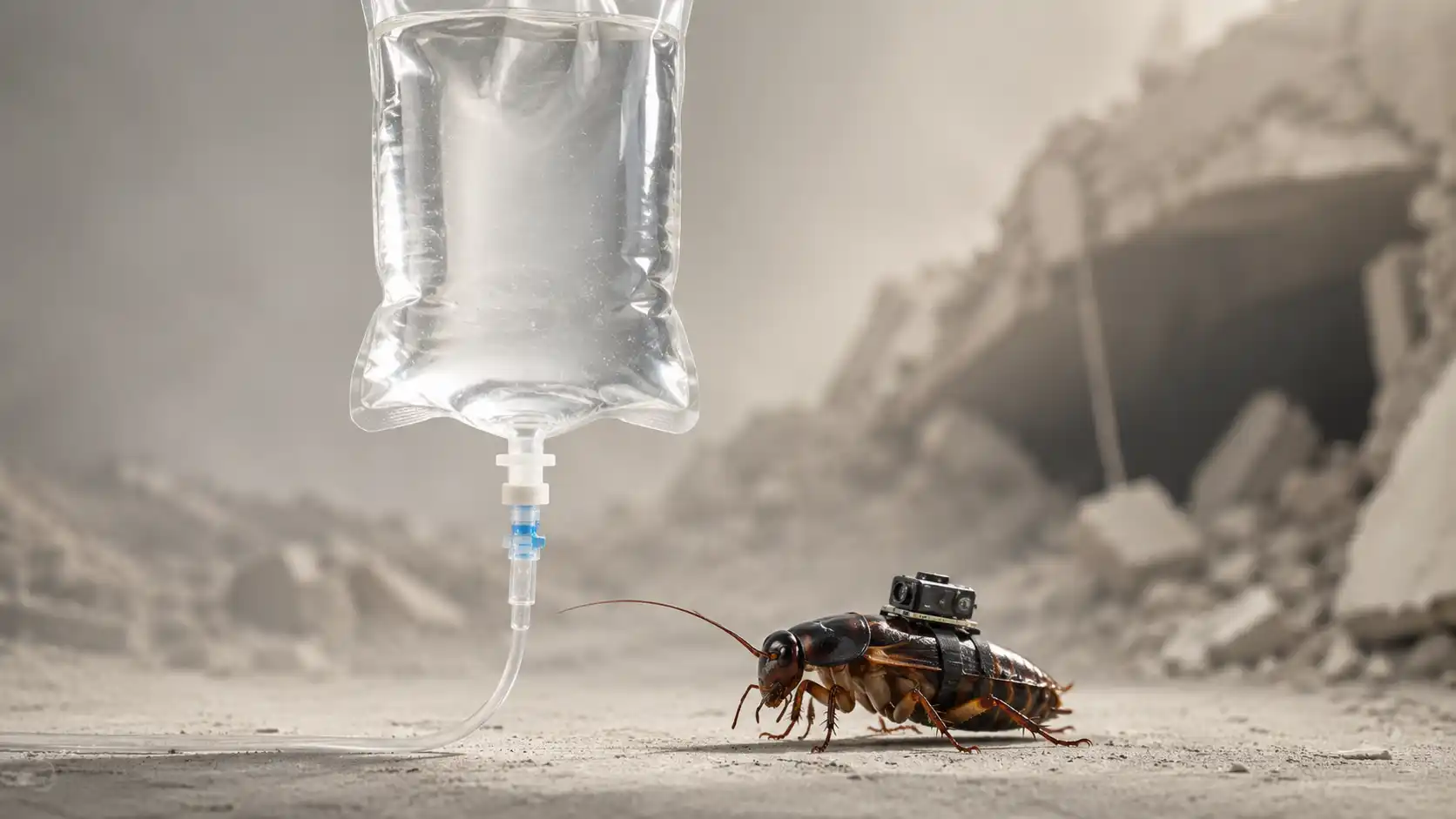
A University of Queensland team has fitted giant burrowing cockroaches with remotely fired auto-injectors and reported a 95 per cent hit rate at close range. The engineering is real; the framing around it is not. Every field guideline for crush injury points to intravenous volume started before extrication, which is precisely the payload an insect-scale platform cannot carry.
On 27 August 2026 the University of Queensland announced that its biorobotics lab, working with the UNSW Medical Robotics Lab, had fitted North Queensland giant burrowing cockroaches with remotely triggered syringes and steered them onto injection targets. The paper behind it, Paraborg: Paramedic Cyborg Insects for In Situ Emergency Drug-Delivery, ran in Advanced Science. Its headline number is roughly 95 per cent injection success at target distances inside 150 millimetres.
The engineering earns the attention it got. The description wrapped around it does not. Nothing here involves training, and no medicine reached a patient: the insects are teleoperated through electrodes in their antennae and cerci, and the injector was fired into raw pork belly. The deeper problem is clinical. The intervention that decides whether an entrapped person lives is not a single bolus. Field guidance for crush injury converges on intravenous volume — isotonic saline at 1,000 millilitres an hour, begun before extrication — which is a payload measured in kilograms and delivered continuously.
What the Queensland team built is a genuine advance in teleoperated actuation at insect scale. It is not paramedicine. The distance between those two descriptions is where the commercial and ethical questions actually live.
Four numbers, and the one the press release quietly rewrote
The study reports four distinct performance figures, and they are not interchangeable. The auto-injection mechanism itself, once triggered, launched its injector and delivered liquid into the target in 90 per cent of attempts. The manual control strategy reached designated checkpoints in 100 per cent of runs. Holding a cockroach still enough for aimed injection worked 72 per cent of the time. Close-range injection, with the insect already inside 150 millimetres of the target, succeeded in up to 95 per cent of cases.
Read in sequence, those numbers describe a system whose weakest link is stability, not aim and not steering. That matters because stability is the part hardest to reproduce in rubble, where the substrate shifts and the operator has one camera view.
The university’s own announcement stated that the complete navigation-and-injection task succeeded in 72 per cent of trials. The published abstract attributes the same 72 per cent to stabilising the cockroaches for targeted injection. Those are different claims about different subtasks, and the more flattering one travelled. The Register, working from the paper, reported the stabilisation reading, while most general coverage repeated the university’s phrasing. Neither is careless. The discrepancy sits in the source material.
Two further limits belong beside the headline. The injector was demonstrated against raw pork belly rather than tissue in a living body, so nothing in the work establishes injection depth, absorption, or what happens when the recipient moves. And the paper’s stated use case is trapped and unconscious victims, a population that cannot describe its symptoms, cannot consent, and cannot correct an operator who has misread a camera feed.
Electrodes in the antennae do the steering, not the cockroach
The word “trained” has attached itself to this story and it is wrong in a way that changes the analysis. The cockroaches learn nothing. Under anaesthesia, electrodes are implanted into the antennae and the cerci, the paired sensory appendages at the rear of the abdomen. Antennal stimulation turns the insect, cercal stimulation governs speed and forward movement, and the same channels can be used to hold it still. An operator works a gaming controller. The insect is an actuated chassis with a legged locomotion system already solved by evolution, and the decision layer is entirely human.
The paper adds two control refinements to that older repertoire. One is a U-turn counter, needed because antennal stimulation sometimes produces no response at all. The other is a combined rule set — antenna and cerci stimulation timed alongside the injector trigger — to hold the animal steady while a spring-loaded needle fires. Both exist to compensate for the same underlying fact: a living insect is a noisy actuator.
Keeping a human in the loop is presented as an ethical choice, and it is also an engineering one with a price. A supervised system needs a live video feed out of the rubble and a control channel back in, both through debris that attenuates radio badly, and it needs one attentive operator per insect at the moment of the injection decision. Autonomy would relax all three constraints, which is exactly why the pressure to add it will come from whoever is paying. The Queensland design draws the line where a clinician would want it drawn; nothing in the hardware enforces that line.
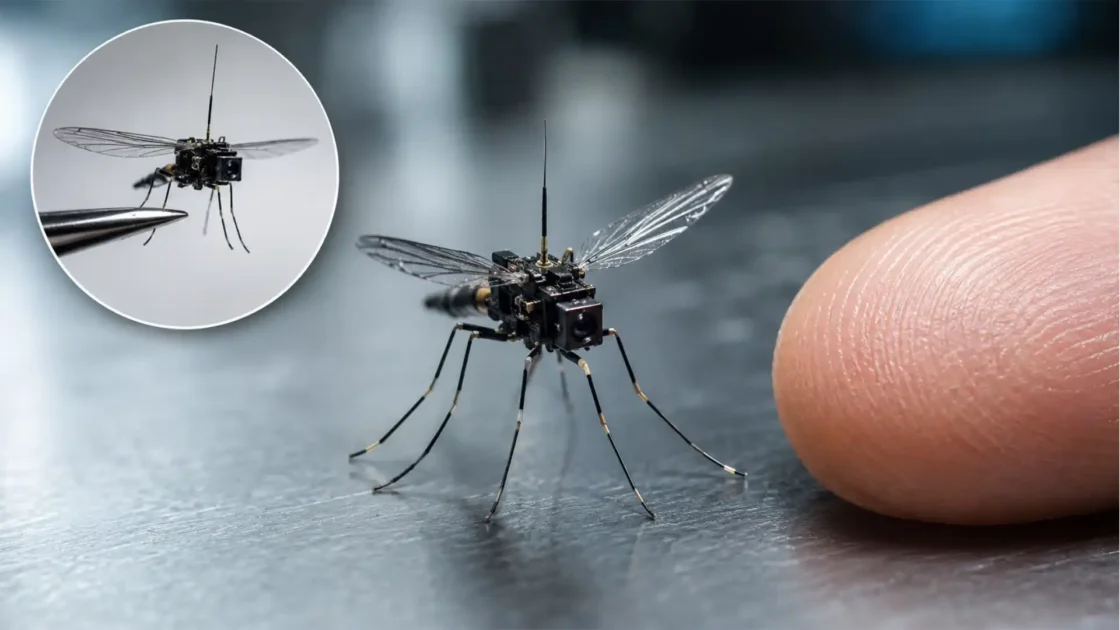
Species choice follows from payload. Macropanesthia rhinoceros is the heaviest cockroach in the world, reaching around 8 centimetres, and the team selected it because centimetre-scale hardware has to fit somewhere. Earlier Queensland work used beetles for controlled climbing; the cockroach was chosen for carrying capacity, not for cognition.
The case for insects over insect-sized robots has always been power and mechanics. A cockroach generates its own locomotion, so the electronics only have to steer, sense and communicate. RIKEN’s 2022 ultrathin organic solar module for cyborg cockroaches — four micrometres thick, 17.2 milliwatts output — exists because battery mass is the binding constraint on anything this small. Biology solves the actuator problem cheaply. It does not solve the payload problem at all.
Litres, not millilitres, keep entrapped patients alive
Crush syndrome is what kills people who survive the collapse. Muscle compressed for hours releases potassium, myoglobin and muscle enzymes into the circulation once perfusion returns, and the result is hyperkalaemia, arrhythmia and acute kidney injury. Reported incidence among earthquake survivors runs from 2 to 15 per cent, with mortality in some series reaching 48 per cent. Deaths that follow the moment of release have their own name in the field literature, rescue death, and early fluid administration is the stated means of preventing them.
After direct trauma, crush syndrome is the second most common cause of earthquake death, and the reviews are blunt that no evidence-based treatment has been established. What has been settled for decades is timing: the immediate start of treatment is the single most important factor in reducing mortality. The short field version of the International Society of Nephrology recommendations, chaired by Mehmet Sukru Sever and Raymond Vanholder, is unambiguous: begin medical evaluation as soon as contact is established, and start intravenous isotonic saline through a large-bore cannula in any accessible vein at 1,000 millilitres an hour in adults, 15 to 20 millilitres per kilogram per hour in children. The early target is 3 to 6 litres within the first six hours of contact. Potassium-containing solutions are to be avoided.
A paraborg carries one small-volume injector and fires it once. The mismatch is not a matter of degree. Even the guidelines’ fallback for cases where no vein can be reached — hypodermoclysis, subcutaneous saline at 1 millilitre a minute — implies a continuous line and a reservoir, which is 60 millilitres an hour of fluid the insect is not carrying.
The single drug class a paraborg could plausibly deliver is analgesia, and there the same document is specific: give morphine intravenously, because the response to intramuscular morphine is unpredictable in these patients. A needle fired into whatever tissue the operator can see is, at best, an intramuscular or subcutaneous route. The one intervention the platform can physically perform is the one the crush guidelines warn is unreliable in exactly this population.
Reaching a casualty is already an intervention
None of that makes the work useless. It relocates the value. The same nephrology guidance that demands litres of saline also instructs responders to begin medical evaluation the moment contact is established, and lists the things that follow from contact: a dust mask against inhaled particulate, protection from hypothermia, an assessment of whether the airway is patent, a judgement about whether analgesia would help someone with broken ribs breathe.
Almost all of that depends on knowing a person is there, where they are, what position they are in and whether they are conscious. A camera-carrying insect that can enter a void too small for a search dog delivers exactly that. In the Queensland demonstrations the labour was split between two animals: an observer carrying a wireless camera to locate the target, and a second insect carrying the injector. The observer is the medically defensible half of the pair; the injector is the half that produced the headlines.
Guideline requirement against demonstrated paraborg capability
| Entrapment task | What field guidance requires | Demonstrated paraborg capability |
|---|---|---|
| Fluid resuscitation | Isotonic saline, 1,000 ml/h, before extrication | None; payload is one small-volume injector |
| Fluid without venous access | Hypodermoclysis, subcutaneous, 1 ml/min | None; single bolus, no infusion line |
| Analgesia | Morphine intravenously; intramuscular response unpredictable | Needle fired into accessible tissue, route not intravenous |
| Airway, oxygen, hypothermia | Maintain patency, dust mask, cover the casualty | None |
| Evaluation on contact | Begin as soon as contact is established | Wireless camera feed and two-way presence |
The rows are drawn from the International Society of Nephrology field recommendations and the reported paraborg results; the right-hand column records only what the study demonstrated, not what the team hopes to add.
Contact also feeds triage, which is the decision that allocates everything else. The same field guidance instructs responders in mass disasters to steer casualties with low survival potential towards non-active treatment, and offers inferences a remote observer could actually use: a person trapped for many hours who is still alive probably has no major active bleeding, while the airway should be assumed compromised and ventilation impaired by inhaled dust until checked. Those are judgements about a specific body in a specific void, and they currently depend on a responder physically reaching it. A camera on an insect changes who can make them and how early — a far more defensible claim than anything involving a needle.
Framing the platform as a paramedic invites a comparison it loses. Framing it as the smallest available reconnaissance unit invites one it wins, against ground robots that stall in rubble and drones that cannot enter a void at all.
Naypyitaw remains the only field record anyone has
Cyborg insects have been deployed once in a real disaster, and the record is instructive rather than encouraging. Following the magnitude 7.7 Myanmar earthquake of 28 March 2025, Singapore’s Home Team Science and Technology Agency sent ten cyborg Madagascar hissing cockroaches, developed with Nanyang Technological University and Klass Engineering and Solutions, to join the Singapore Civil Defence Force’s Operation Lionheart contingent. The prototypes had been intended for field use from 2026 and were fast-tracked.
HTX’s own account of the mission records five deployments across twelve sites in Naypyitaw, working alongside an 80-strong SCDF contingent. It describes the deployment’s return as invaluable data for improving the technology. It reports no survivor located by the insects, and neither does NTU’s account, which frames the mission as the first field deployment of insect-hybrid robots rather than as a rescue. The earthquake killed more than 3,400 people.
That is a fair result for a first outing and a poor basis for a five-year deployment forecast. Two structural constraints showed up. The first is manufacturing. The insects that went to Myanmar carried first-generation backpacks fitted by hand, a task NTU describes as time-consuming and heavily dependent on operator skill; its vision-guided assembly robot, published in Nature Communications in July 2025, automates electrode placement and cuts preparation time and human error. A capability whose throughput is set by individual surgical skill cannot scale to a collapsed district; an assembly line might.
The second is endurance and control burden. Each insect needs an operator, a camera feed and a wireless link through rubble that attenuates radio badly. Ten insects meant two HTX robotics engineers plus industry partners managing them on site. A swarm large enough to matter across a collapsed district implies either autonomy the field does not yet have or an operator headcount no civil defence force will fund.
Bundeswehr contracts arrive before ambulance contracts
Follow the money and the rescue framing looks like the friendly face of a dual-use technology. DARPA began funding controllable insect platforms two decades ago under its Hybrid Insect Micro-Electro-Mechanical Systems programme. The commercial pull now comes from defence.
SWARM Biotactics, a German defence-technology startup, says its cyborg Madagascar hissing cockroaches have been field-tested and deployed with paying NATO customers including the Bundeswehr. Chief executive Stefan Wilhelm made the claim in a statement dated 25 February 2026; no customer has independently confirmed it, and the company also describes operational pilots with emergency-response agencies. It reports raising roughly 13 million euros, comprising a 10 million euro seed round and 3 million euros pre-seed, and states current system weight at about 15 grams with engineering work aimed at 10. Trade coverage describes the intended mission as last-50-metres reconnaissance inside cluttered, GPS-denied spaces where small drones are detected or fail.
That is the same capability the paraborg paper describes, minus the syringe. A remotely triggered mechanism that launches a payload from an insect’s back is a payload-delivery demonstration, and payload delivery generalises in directions nobody in the Queensland lab is proposing. The team’s framing keeps a human in every consequential loop, which is the right design choice and also the choice that a different customer would be free to reverse.
The asymmetry is commercial as much as ethical. Reconnaissance sells into procurement systems with money, urgency and a tolerance for prototypes. Emergency medicine sells into a therapeutic-goods regime that will demand clinical evidence, device conformity assessment, dose accuracy data and a defensible answer to who administered a scheduled medicine to an unconscious person. Insect-scale teleoperation will therefore mature under defence funding and arrive in civil rescue afterwards, carrying whatever design assumptions defence paid for.
Blattodea falls outside the code that governs research animals
The Australian code for the care and use of animals for scientific purposes defines an animal as any live non-human vertebrate, plus cephalopods. Insects are outside that definition. The code does add that institutions are responsible for deciding when a species it does not cover requires animal ethics committee approval, taking into account emerging evidence of sentience and the ability to experience pain and distress. That is a delegation, not a standard.
The emerging evidence points at cockroaches specifically. Applying the eight-criterion framework that the United Kingdom used to bring octopuses and decapod crustaceans under the Animal Welfare (Sentience) Act 2022, Matilda Gibbons and colleagues found that cockroaches and flies satisfy six of the eight criteria, which the framework treats as strong evidence for pain. That framework produced statutory protection for octopuses, crabs and lobsters; the order used to build paraborgs clears its strong-evidence threshold and has no protection at all. The authors’ own recommendation is that insect research be brought under the legislation that regulates procedures on protected animals.
The Queensland team’s welfare position is that the cockroaches are anaesthetised during electrode and microchip fitting and live as long as other cockroaches once harnesses are removed. That is a reasonable claim about lifespan. It is not a claim about experience during implantation or during hours of antennal and cercal stimulation, and no oversight body was obliged to test it.
This is where the analysis has to stay honest about its own limits. Insect sentience has no scientific consensus, the pain framework is explicitly precautionary, and lifespan data is real evidence that the procedure is survivable. The point is narrower and harder to argue with: the platform with the strongest recent evidence for nociception is also the platform facing the lightest ethical review, and that gap exists because a 2013 definition has not caught up with a 2022 literature.
Rescue agencies should buy the camera and leave the syringe
The strongest case against this reading comes from crush medicine itself. Clinical reviews concede that continuous large-volume fluid, diuresis and dialysis are often unfeasible at a large disaster site, and that on-site mortality stays high partly because no drug exists to substitute. That gap is being worked on: zinc chelators, sodium nitrite, salvianolic acid B, astragaloside-IV and anisodamine have all improved survival in rat crush models, and the stated ambition is on-site use before or during decompression. If any of that pipeline produces a milligram-dose crush drug, small-volume delivery stops being the wrong payload and becomes the right one. That is the scenario in which the paramedic framing turns out to have been early rather than wrong.
Three conditions still have to hold together — a casualty reachable only by insect, a condition treatable by one small bolus, and an operator able to identify that condition through a camera. Naloxone, adrenaline and tranexamic acid already fit the dose constraint. Entrapped casualties are nonetheless dehydrated, hypothermic and crushed far more often than they are anaphylactic, and none of the crush candidates has reached human trials. The team’s own five-to-ten-year horizon is honest about how much remains unbuilt.
For urban search and rescue agencies, the near-term procurement decision is a sensing decision. An insect-scale camera platform competes against acoustic listening devices, borescopes, thermal imaging and search dogs, and its case rests on reaching voids none of those can enter. That is testable now, in collapsed-structure training facilities, against measurable outcomes: time to first contact, void coverage, false-negative rate. Injection capability should be evaluated separately and later, because bundling it inflates the case for the whole system.
For research funders, the useful question is whether the money buys locomotion or medicine. Insect-scale locomotion and teleoperation is a live problem with a defensible funding case; insect-scale drug delivery is a solution circling for a clinical indication. For anyone underwriting the commercial version, the disclosure risk is unusual. A device that fires needles from a living animal into an unconscious person will be assessed by regulators, insurers and the public on grounds that have nothing to do with its 95 per cent figure.
Payload mass, not squeamishness, sets the ceiling
The researchers volunteered that people may not welcome the sight of a giant cockroach coming towards them. It is a good line and a misdirection. Squeamishness is the least of the obstacles here, and disaster survivors have accepted stranger help than an insect. What limits the paraborg is grams.
A backpack of 10 to 15 grams on an 8-centimetre insect leaves room for a controller, a radio, a camera and a spring-loaded needle with a fraction of a millilitre behind it. Nothing about that budget improves by an order of magnitude. Batteries, radios and cameras will keep shrinking; a therapeutic dose of crystalloid will not. So the technology’s trajectory is towards better sensing, longer endurance, more autonomy and larger coordinated groups — and away from the medical framing that carried it into the news.
Two developments would change that judgment. The first is a demonstration in live tissue, with dose accuracy and absorption data, for a named drug and a named indication that survives a clinical review. The second is a field deployment in which insect-scale platforms locate a casualty that other tools missed. Neither has happened. Until the second one does, every capability claim in this field rests on laboratory trials and a single mission in Naypyitaw that gathered data and found no one.
The honest description of the Queensland result is that teleoperated actuation at insect scale now works well enough to do a precise mechanical thing in a place no machine could previously reach. That is a real engineering milestone, and it will find its market in reconnaissance. The paramedic is a metaphor, and metaphors do not carry saline.
Reader questions about paraborg cockroaches and emergency care in rubble
Two kinds of remotely piloted cockroach. One carries a wireless camera and acts as an observer; the other carries a spring-loaded auto-injection mechanism that an operator can trigger from a distance. Both are North Queensland giant burrowing cockroaches fitted with removable electronics and implanted electrodes.
No. Nothing was trained. The insects are teleoperated through electrical stimulation of their antennae and cerci, and every decision — where to go, whether to fire — is made by a human operator with a controller and a camera feed.
The paper reports 90 per cent success for the injection mechanism itself, 100 per cent success in reaching designated checkpoints, 72 per cent success in holding the insect stable for aimed injection, and up to 95 per cent injection success once inside 150 millimetres of the target.
No. The Queensland work is a laboratory proof of concept tested against raw pork belly, not living tissue. The only field deployment of cyborg insects anywhere was a search mission in Myanmar in 2025, which involved cameras and sensors, not medicine.
Fluid. Field guidance for crush injury calls for intravenous isotonic saline at 1,000 millilitres an hour started before extrication, with a target of 3 to 6 litres in the first six hours, and for potassium-containing solutions to be avoided. Airway protection, dust protection and prevention of hypothermia come alongside it.
No. A backpack in the 10 to 15 gram range carries a controller, radio, camera and a single small-volume injector. Even the guidelines’ fallback route when no vein is available — subcutaneous saline at 1 millilitre a minute — needs a reservoir and a continuous line rather than one bolus.
Macropanesthia rhinoceros, the giant burrowing cockroach native to north Queensland and the heaviest cockroach in the world at around 8 centimetres. The team selected it for carrying capacity, because centimetre-scale hardware has to sit somewhere.
Not directly in Australia. The national code for animals used for scientific purposes defines an animal as a live non-human vertebrate or a cephalopod, which leaves insects out, and delegates to institutions the decision on whether uncovered species need ethics approval. Cockroaches meet six of the eight criteria in the framework the United Kingdom used to recognise pain in octopuses and crustaceans, which that framework counts as strong evidence.
A German company, SWARM Biotactics, states that its cyborg cockroach systems have been field-tested and deployed with paying NATO customers including the Bundeswehr, for close-range reconnaissance. That claim comes from the company rather than from any customer, and no independent confirmation has been published.
The researchers name five to ten years, conditional on funding and field testing. Nothing in the published record supports a firmer date, and no demonstration in live tissue, dose-accuracy study or regulatory submission has been reported.
Author:
Jan Bielik
CEO & Founder of Webiano Digital & Marketing Agency
This article is an original analysis supported by the sources cited below
Paramedic cockroaches: cyborg care when rescuers can’t reach
The University of Queensland announcement of 27 August 2026, source for the paraborg concept, the researchers named, the 95 per cent close-range and 72 per cent task figures as the university stated them, the raw pork belly injector demonstration, the anaesthesia and lifespan claims and the five-to-ten-year horizon.
Paraborg: paramedic cyborg insects for in situ emergency drug-delivery
The Advanced Science paper by Le, Phan, Fitzgerald, McAree, Do and Vo-Doan, whose abstract establishes the 90 per cent auto-injection rate, 100 per cent checkpoint arrival, 72 per cent stabilisation figure, the U-turn counter and antenna-and-cerci control rules, and the multi-insect teamwork design.
Cyborg cockroaches may soon deliver life-saving drugs to disaster victims
Trade coverage read against the paper, source for the breakdown of which figure covers which subtask, the electrode functions of turning, speed and immobilisation, and the species size and selection rationale.
Recommendations for the management of crush victims in mass disasters, short field version
The International Society of Nephrology field guidance chaired by Sever and Vanholder, source for isotonic saline at 1,000 millilitres an hour before extrication, the 3 to 6 litre early target, hypodermoclysis at 1 millilitre a minute, avoidance of potassium-containing solutions, the instruction to begin evaluation on contact, and the warning that intramuscular morphine response is unpredictable.
Crush syndrome: a review for prehospital providers and emergency clinicians
Usuda and colleagues in the Journal of Translational Medicine, source for crush syndrome incidence of 2 to 15 per cent among earthquake survivors, mortality up to 48 per cent, its rank as the second most common cause of earthquake death, the absence of established evidence-based treatment, and the animal-model drug candidates intended for on-site use.
Operation Lionheart: a hero’s welcome home
The Home Team Science and Technology Agency’s own account of the Myanmar mission, source for the ten cyborg cockroaches, the five deployments across twelve sites in Naypyitaw, the framing of the outcome as data gathering and the absence of any reported survivor located by the insects.
AI-powered robot assembles search and rescue cyborg insects
Nanyang Technological University’s release on its automated assembly system published in Nature Communications in July 2025, source for the 30 March 2025 deployment date, the first-field-deployment claim and the reduction of backpack fitting time from over an hour.
Myanmar earthquake: Singapore deploys cyborg cockroaches in rescue efforts
Reporting that established the prototypes were still in development and were fast-tracked for the mission, the 80-strong Operation Lionheart contingent and the HTX, NTU and Klass Engineering partnership.
Australian code for the care and use of animals for scientific purposes
The National Health and Medical Research Council code, source for the definition of an animal as a live non-human vertebrate or cephalopod and for the delegation to institutions of decisions on species the code does not cover.
Insects may feel pain, says growing evidence
An account by the authors of the 2022 review, establishing that flies and cockroaches satisfy six of the eight criteria in the framework the United Kingdom used to bring octopuses and decapod crustaceans under the Animal Welfare (Sentience) Act 2022, and their recommendation that insect research be regulated.
NATO deploys German programmable cyborg insect swarms for urban and tunnel reconnaissance
Defence trade coverage of the SWARM Biotactics claims, source for the last-50-metres reconnaissance mission framing in cluttered, GPS-denied environments and for the company’s stated deployment with the Bundeswehr.
Cyborg cockroach swarms for reconnaissance tested in US and European environments
Coverage of the 25 February 2026 statement by SWARM Biotactics chief executive Stefan Wilhelm, source for the roughly 13 million euro funding total comprising a 10 million euro seed round and 3 million euros pre-seed.
German startup SWARM Biotactics deploys cyborg insect swarms for NATO forces after securing 13 million euro funding
Defence trade reporting of the company’s stated specifications, source for the approximately 15 gram system weight with a 10 gram engineering target, the sensor payload options and the claim of operational pilots with defence and emergency-response agencies.
Scientists create remote-controlled cyborg cockroaches fitted with tiny solar-powered backpacks
Reporting on the RIKEN work, source for the ultrathin organic solar module figures of 17.2 milliwatts output and 0.004 millimetre thickness that illustrate the power and mass constraint on insect-scale electronics.
Scientists have created a 3D-printed remote-controlled cyborg cockroach equipped with IR cameras
Coverage placing the current work two decades after DARPA began funding cyborg insects under its Hybrid Insect Micro-Electro-Mechanical Systems programme.
| Citing this article? Brief excerpts are welcome. Please credit Webiano.digital, name the author where stated, and include a link to https://webiano.digital and to this original article. Full or substantial republication requires prior written permission. Read our Copyright and Content Use Policy. |
This article was prepared with the assistance of artificial intelligence tools. The content underwent expert human review, and Webiano Digital & Marketing Agency assumes editorial responsibility for its final version and publication.