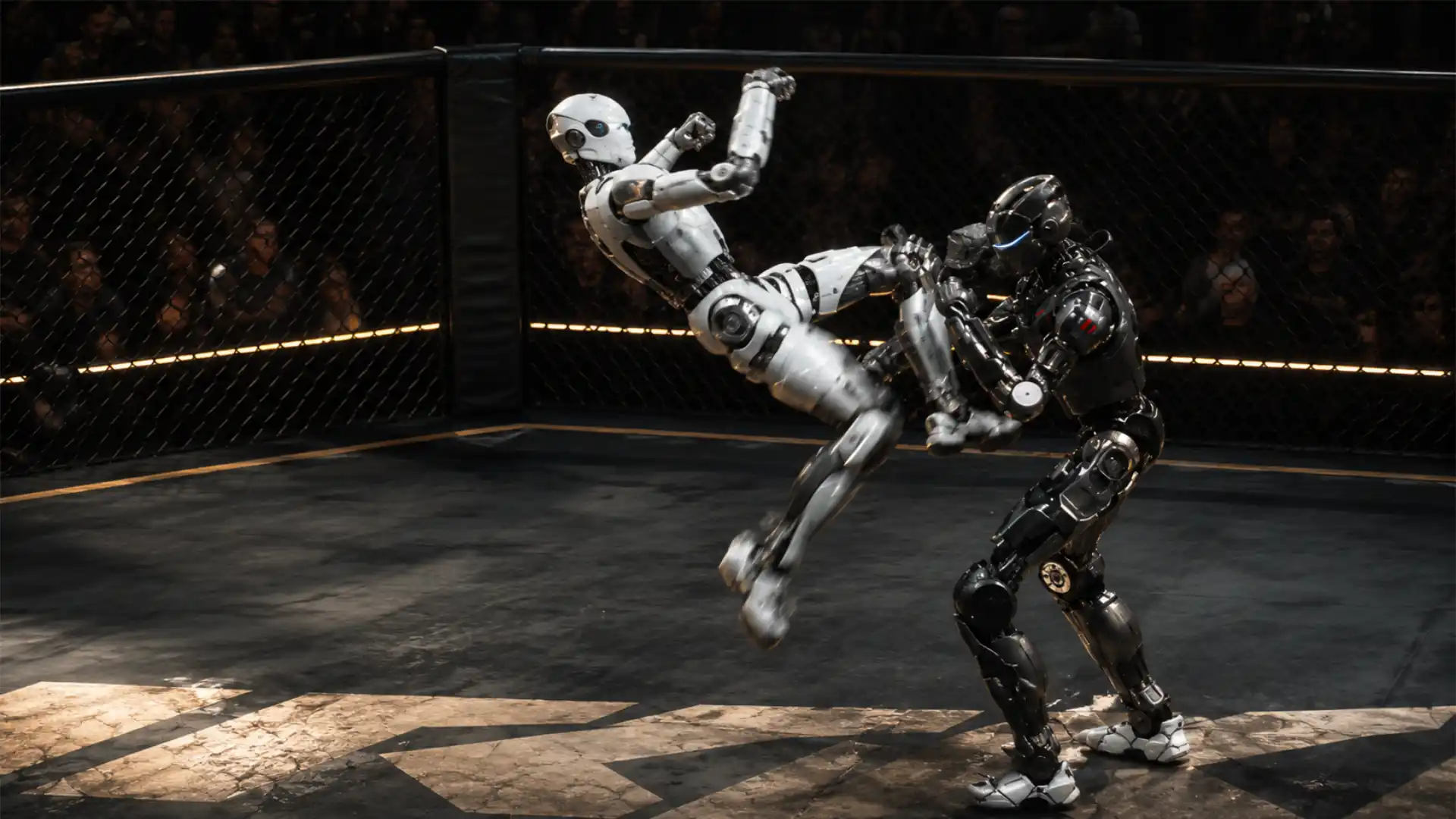
The cleanest image from Shenzhen was also the most misleading. A white humanoid called White Eagle lifted one leg, rotated through the hip and struck its black-clad opponent near head height. The movement looked like a martial-arts flourish made for a highlight reel. Seconds later, the other machine’s neck assembly failed and its head hung loose. Yet the damaged robot, Matador, stayed upright and continued punching. The important event was not a robot imitating a fighter; it was a complex mobile machine continuing after a major subsystem failure. That distinction turns a viral clip into a useful engineering case study.
Table of Contents
A kick that turned a product demo into a stress test
The bout took place on July 16, 2026, at the Nanshan Cultural and Sports Center in Shenzhen. It opened the physical phase of the Ultimate Robot Knock-out Legend, or URKL, a league initiated by EngineAI around its full-size T800 humanoid platform. Organizers described the competition as freestyle or free combat, and reporting showed punches, kicks, evasive movements, falls and recoveries inside a steel enclosure. Thirty-two teams had reached the event after a qualification process that included simulation and on-site hardware work. Those details matter because they place the spectacle inside a structured development program rather than an isolated stage trick.
A head-high kick is difficult for a bipedal robot because it combines several problems at once. The support foot must keep enough friction with the floor. The stance leg must control the robot’s center of mass while the other leg accelerates. The torso and arms must counter-rotate so angular momentum does not topple the body. The controller must also prepare for an impact whose timing and direction depend on another moving machine. A successful strike therefore compresses balance control, trajectory tracking, contact estimation and actuator performance into a few seconds. Researchers working on real-world humanoid locomotion and autonomous boxing describe the same underlying tension: expressive actions are useful only if the body remains physically stable.
The head failure added a second layer. A robot that depends entirely on head-mounted cameras or lidar should lose much of its situational awareness when that module disconnects. Matador nevertheless continued to move, according to local reporting, because the torso retained balance and posture functions. The public evidence does not establish which sensors, remote-control channels or pre-programmed behaviors remained active, so claims about full autonomy would be unjustified. The verified point is narrower and still notable: the damaged body retained enough control authority to stay in the match. Graceful degradation, not invulnerability, is the defensible description.
That difference also protects the analysis from science-fiction exaggeration. A robot continuing after losing its head does not mean it “wanted” to fight, understood the damage or chose persistence. It means the control architecture did not treat the head assembly as the sole source of state information or as a mandatory condition for every motor command. Joint encoders, inertial measurements, foot contacts, torso electronics, remote commands or some combination may have supported continued motion. EngineAI’s public T800 material lists whole-body joints, onboard perception, computing options and a handheld controller, but it does not publish the event’s complete control stack.
The match is best read as a collision between entertainment and testing. Combat produces abrupt loads, unpredictable contact, occlusion, falls and hardware damage faster than a carefully scripted warehouse demonstration. Those conditions can expose weak connectors, poorly protected cables, brittle mounts, thermal limits and control policies that fail outside rehearsed trajectories. At the same time, a show rewards drama, branding and selective camera angles. The audience sees the kick; engineers need logs showing torque, latency, impact, temperature, packet loss and recovery behavior. Without those records, the clip is evidence that something happened, not a complete benchmark.
Damage tolerance cannot be judged by appearance alone. A robot with an intact shell may have lost calibration or communication, while a visibly damaged machine may retain enough inertial sensing and joint control to stand. Function has to be measured at subsystem level, not inferred from whether the machine still resembles a person.
URKL’s real value will depend on whether spectacle is converted into reproducible data. If teams receive comparable hardware, clear rules and access to post-match telemetry, the league could reveal which designs survive contact and which control methods recover from it. If results remain confined to edited video and promotional claims, the event will still be memorable but scientifically thin. The head-high kick earned attention. The headless continuation created the more serious question: which parts of a humanoid must keep working when the system is already breaking?
The Shenzhen bout in verified detail
The opening URKL event can be reconstructed from several reports without adding the details that viral reposts often invent. It was held on the evening of July 16, 2026, in Shenzhen’s Nanshan district. EngineAI organized the league around its T800 full-size humanoid. The showcased opponents were identified as White Eagle, wearing white, and Matador, wearing black. They fought inside a cage-like arena and exchanged punches, kicks and defensive movements. During a heavy exchange, Matador’s neck joint fractured or detached enough for the head to hang loose, yet the body remained upright and continued moving.
Xinhua described the launch as the first free humanoid robot combat league and said 32 teams were competing for places in a December final. A Greater Bay Area government portal reported that those finalists came from a broader applicant pool and used a standardized T800 platform. The same preview said judging would examine motion control, balance algorithms, perception and decision-making, power systems and structural protection. That is more precise than calling the event simply “robot MMA.” The label borrows a familiar sports category, but the published criteria point to an engineering contest built around whole-body performance.
The high kick became the dominant image because it gave viewers an immediately readable cause and effect. One machine struck near the other’s head; the head assembly failed. Yet the reports do not all describe the exact contact in identical language. Global Times called it a precise high kick and said a robot’s head was knocked off during the opening bout. South, a Guangdong news outlet, described a neck-joint fracture during a high-intensity exchange and said the head was nearly detached. The safest account preserves the common core rather than choosing the most dramatic wording: Matador suffered severe neck and head damage after impact, then continued the bout.
Public descriptions also differ over naming. Some reports shorten White Eagle to Eagle, while social posts and secondary articles use variants of the league’s English name. The organizer-facing material and major reports consistently use URKL and expand it as Ultimate Robot Knock-out Legend or Ultimate Robot Knockout Legend. Such spelling differences do not change the event, but they show why source discipline matters. A viral video can travel farther than its original caption, picking up invented round scores, false claims of autonomy or incorrect dates along the way.
A pre-event report said the physical competition followed online simulation rounds and on-site hardware deployment. It also said teams could develop custom armor and other engineering changes while sharing the same underlying robot. Standardizing the base machine narrows one source of variation. A result then reflects software, protection, tuning and operational choices more than a contest between entirely different body sizes or actuator systems. That does not make every comparison fair: armor mass, maintenance quality, controller assistance and access to expert support can still affect performance. It does, however, give the league a plausible benchmark structure.
The event was also explicitly commercial. EngineAI had announced URKL in February 2026 as a league running through December, with participating teams receiving T800 robots and a championship belt valued at 10 million yuan. China Daily’s account framed the project as a mix of technology, sport, culture, investment and talent development. Actor and martial artist Donnie Yen appeared at the July event, strengthening the entertainment framing. The league was designed to be watched as well as measured.
Several facts remain unavailable in the reviewed public material. The organizer has not published a complete technical incident report for the neck failure, raw telemetry from the fight, a detailed autonomy classification for each action, or a full account of human operator inputs. The footage alone cannot answer whether the decisive kick was selected by a high-level autonomous policy, triggered from a motion library by a human, or executed through more direct teleoperation. It also cannot show whether the robot’s continued punches were aimed using perception, commanded blindly or drawn from a fallback routine.
That distinction matters.
That gap should shape every conclusion. The event proves that full-size electric humanoids can exchange forceful, coordinated strikes in a controlled arena and that one damaged unit retained torso-level function after losing head-mounted capability. It does not prove human-equivalent fighting intelligence, battlefield readiness or general-purpose autonomy. Verified detail makes the story more interesting, not less, because the actual achievement lies in whole-body control and fault tolerance rather than in attributing intention to a machine.
The meaning of world’s first in robot combat
The phrase “world’s first” appears throughout coverage of the Shenzhen event, but it needs a precise object. Robots have fought for decades. Remote-controlled machines have collided in televised competitions; university teams have built autonomous soccer players; humanoids have boxed in research demonstrations and sports festivals. URKL’s narrower claim concerns a commercial freestyle combat league for full-size humanoid robots, not the invention of robot fighting itself. That wording is consistent across organizer-linked Chinese coverage and the February launch announcement.
The distinction matters because “first” claims are often built by stacking qualifiers. A machine may be the first at a given height, in a particular event format, under a named organizer, or with a certain degree of autonomy. In May 2025, China Media Group staged a humanoid kickboxing competition in Hangzhou, widely described as a first for that format. Beijing then hosted the first World Humanoid Robot Games in August 2025, with more than 500 robots from 280 teams competing in events including boxing, football and running. Those precedents do not necessarily invalidate URKL’s claim; they define the crowded history around it.
URKL differs in at least four reported ways. It is organized as a season rather than a one-off television program. It uses a full-size standardized platform supplied by EngineAI. It invites teams to compete through simulation and physical qualification. It presents free combat as the central product rather than one event inside a broader games program. That combination is distinctive enough to report, while still attributing the superlative to organizers. The careful phrase is “what organizers billed as the world’s first,” not an unqualified declaration that every earlier contest has been ruled out.
Size is a particularly important qualifier. Earlier humanoid leagues often relied on compact research robots because smaller bodies reduce stored energy, hardware cost and injury risk. A 1.73-meter machine weighing roughly 75 to 85 kilograms occupies a different safety and engineering class. Its falls carry more energy, its limb impacts are harder to contain, and its joint loads rise sharply during fast rotational movements. EngineAI’s current product page lists multiple T800 versions, with height fixed at 173 centimeters and weight varying by configuration.
“Freestyle” also needs restraint. It suggests a broader action set than conventional boxing: kicks, spinning attacks, evasions, taunts and recoveries appeared in reports and product demonstrations. It does not mean the robots were unconstrained. The fight occurred in an enclosed venue on standardized hardware under judging rules, with human teams preparing the machines. The term describes the competition format, not unlimited behavioral freedom. A cage and a rulebook are evidence of constraint, not proof of autonomy.
There is a second reason to handle the claim carefully: public understanding changes when the headline collapses teleoperation, scripted motion and autonomous decision-making into one category. A remotely triggered high kick can still demand difficult low-level control. An autonomous policy can still operate inside a narrow menu of learned skills. A fully teleoperated movement can still provide useful data about actuators and balance. The engineering contribution should be evaluated at the correct layer instead of being inflated by a label.
Research published before the event shows that autonomous humanoid boxing is possible in controlled settings. RoboStriker, for example, separates high-level strategy from a low-level motion system trained on human demonstrations and reports transfer from simulation to real Unitree G1 robots. Work on human-to-humanoid teleoperation shows another route, using camera-based human motion to command a robot’s whole body in real time. Those approaches can produce similar-looking punches while representing very different technical achievements.
A useful historical claim should name the category, date and evidence. It should also survive comparison with earlier events rather than depend on readers never seeing them. Attribution is not pedantry here; it protects a real achievement from an unnecessarily broad slogan. URKL can be novel without pretending the field began in Shenzhen.
The most defensible historical judgment is therefore specific. URKL appears to be the first reported commercial league centered on freestyle combat between full-size humanoids using a standardized season format. Earlier robot combat, kickboxing and humanoid sports events form its technical and cultural ancestry. Calling it the first robot fight would erase that history. Calling it merely another demo would miss the league structure, the team competition and the significance of repeated full-contact testing. The useful question is not whether a marketing phrase wins an absolute record. It is whether this format creates a repeatable arena where progress can be compared over time.
T800 hardware behind the spectacle
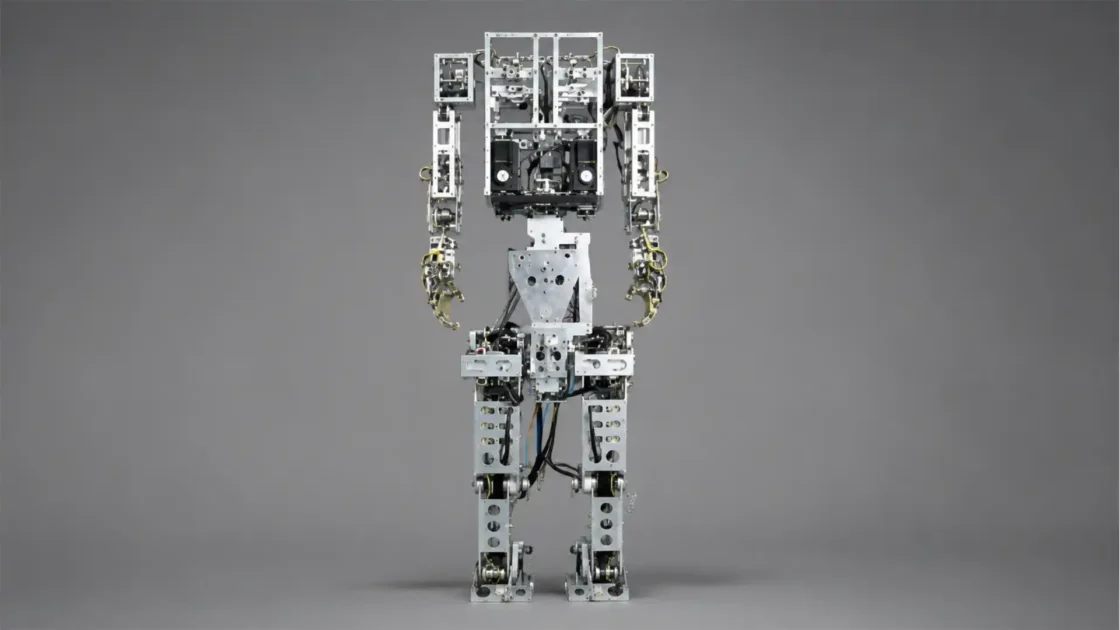
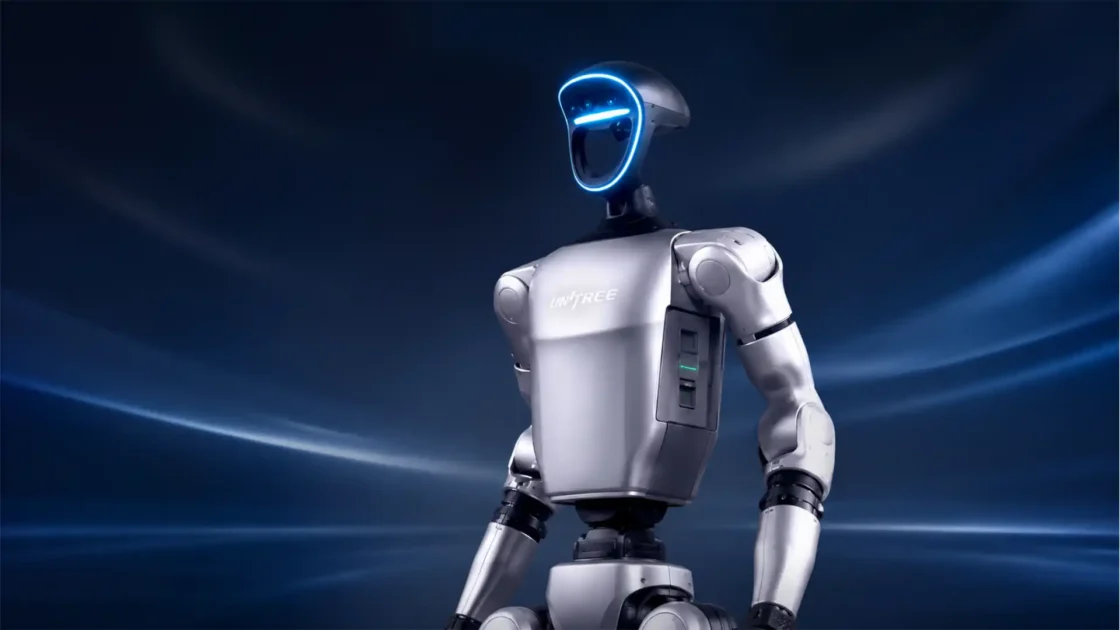
EngineAI’s T800 is not a purpose-built arena prop. The company markets it as a full-size general humanoid for logistics, hotel service, retail guidance, factory collaboration and development work, while using martial-arts demonstrations to display rapid physical performance. Its official page lists a height of 173 centimeters, configurations weighing about 75 to 85 kilograms, and several versions with different joint counts, hands, sensors and computing modules. That variation is important: a generic reference to “the T800” can hide material differences between the base, development, Pro and Max editions.
The product page describes 29 body degrees of freedom excluding dexterous hands for the main high-mobility configuration, while the detailed table lists lower counts for entry versions and up to 46 total degrees of freedom when the Max body and two seven-degree hands are included. Degrees of freedom are independent motion axes, not a direct measure of intelligence. More axes allow richer posture and manipulation, but they also increase control complexity, calibration work and possible failure points. A fighter needs enough motion at the hips, knees, ankles, waist, shoulders and arms to generate and absorb force without losing balance.
EngineAI lists peak joint torque of up to 450 newton-meters, hardware support for movement at or above three meters per second, quick-change batteries and active cooling at the leg joints. Peak figures should not be read as continuous performance. Torque falls with speed, batteries sag under load, motors heat, and protective limits may reduce output before hardware is damaged. A combat event stresses precisely those boundaries through repeated acceleration, impact and recovery. The visible strike is only the last link in a chain that includes power electronics, reducers, bearings, structure and thermal management.
The robot’s outer structure is described as aerospace-grade magnesium-aluminum alloy intended to combine low mass with impact resistance. In the ring, body panels and custom armor do more than protect electronics. They redistribute contact loads, alter the center of mass and change how force reaches joints. A hard shell may prevent superficial damage while transmitting a sharper impulse into the neck or torso. A more compliant layer may reduce peak force but add bulk and interfere with motion. Protection is part of the control problem because mass and geometry change the mechanics.
Perception options include depth cameras, binocular vision and lidar, depending on version. The development, Pro and Max specifications list an in-house binocular-plus-lidar package and open visual hardware interfaces, while the base version lists an Intel depth camera. Computing options range from Intel or RK3588 modules to Nvidia AGX Orin, with Thor customization mentioned for higher configurations. The product page also lists a handheld controller. These details establish that the platform can support both onboard perception and human command, but they do not reveal which combination ran during the July bout.
The head failure therefore raises an architectural question. If cameras and lidar are concentrated in the head, losing that module removes rich external perception. Yet inertial measurement units, joint encoders, motor controllers and foot-contact estimates can remain elsewhere. A torso computer may still execute balance loops and stored motions using proprioception, the robot’s internal sense of its own state. The body can keep stabilizing even when it can no longer see well. Local reporting’s account of torso-based continuation is consistent with that general architecture, though only an incident report could identify the exact surviving components.
Battery claims also deserve context. EngineAI lists four to five hours of integrated endurance depending on battery type and configuration, but a combat bout is not a normal duty cycle. Repeated explosive movements can draw far more power than standing, slow walking or light manipulation. The limiting factor may become heat, voltage drop or joint stress long before nominal runtime is exhausted. This is why continuous match telemetry would be more informative than the brochure figure.
The T800’s value as a league platform comes from combining human scale, high joint output and a developer-accessible configuration. Standardization allows teams to compare software and modifications on common hardware. Its weakness is the same as its strength: a general humanoid carries joints, sensors and structures that a dedicated fighting machine might omit. The Shenzhen match did not prove the T800 is ready for every advertised task. It showed that the platform can perform violent whole-body motions, withstand substantial contact and, in one case, keep operating after structural damage. That is a narrower claim, but it is grounded in observable performance.
Balance under impact is the real contest
A humanoid standing on two relatively small feet is always managing a controlled fall. During ordinary walking, it shifts the center of mass, places a foot, catches the body and repeats. During a fight, another machine adds forces that were not part of the planned gait. A punch rotates the torso; a kick can move the pelvis; a blocked strike sends reaction force back through the attacking leg. The central contest is not who can reproduce the prettiest martial-arts pose, but who can remain controllable after contact.
Classical humanoid control often describes stability through the relationship between the center of mass, the support polygon under the feet and the point where ground reaction forces act. Those models are useful, but real impacts create fast transients, slipping, compliance and uncertain contact. Modern systems combine model-based control, learned policies and high-rate feedback from inertial sensors, encoders and force estimates. Research on real-world humanoid locomotion has shown that learning-based controllers can produce resilient movement, while work on autonomous boxing emphasizes that strategy is physically constrained by balance and actuation limits.
A high kick exposes the support problem clearly. The robot moves from two feet to one, raises the center of mass, and accelerates a heavy limb away from the body. The stance ankle, knee and hip must reject disturbances while the torso counters the leg’s momentum. At contact, the target pushes back. If the controller tracks the original motion too rigidly, it may amplify shock or lose footing. If it yields too much, the strike collapses and the body may twist. Useful control sits between stiffness and compliance.
Defense is equally demanding. A robot cannot assume every impact lands at a known time or location. It must estimate the disturbance, decide whether to absorb it, step, lean, block or fall safely, then coordinate many joints before the deviation grows. That response is constrained by actuator speed and available friction. A late command cannot recover a center of mass that has already moved beyond the reachable support area. A powerful motor cannot compensate for a foot that is sliding.
URKL’s reported judging categories included effective strikes, body stability, defensive and evasive ability, and durability. Those categories reward a machine that can preserve function under disturbance rather than merely generate maximum impact. The pre-event description also listed motion control, balance algorithms and perception decision-making among the evaluated areas. The rule structure therefore treats stability as performance, not background infrastructure.
Falls add another layer. A well-designed robot may choose to lower itself or redirect momentum rather than fight an unrecoverable state and damage a joint. Research on unified fall safety treats prevention, impact reduction and standing up as one connected problem, because no controller can guarantee that a biped never falls. The Shenzhen footage and earlier humanoid games repeatedly show that recovery is itself a competitive skill. A robot that rises without human help preserves time, reduces operator exposure and demonstrates that its controller can recognize a new support condition.
Contact also reveals mechanical design choices that motion-only demos can hide. Gear backlash, bearing play, cable routing and panel mounts may look acceptable during rehearsed steps but fail under lateral shock. A controller can mask small defects until impact drives the system outside its calibrated range. Conversely, structural compliance and shock absorption can protect components while making precise tracking harder. The strongest robot is not necessarily the one with the highest torque; it is the one whose hardware and controller remain matched under load.
This is why the headless continuation drew more engineering interest than the kick alone. Matador’s neck suffered obvious damage, yet the body kept its posture. That suggests the torso and lower-body control loops retained enough state estimation and power to stabilize. It does not show that targeting or tactical perception remained intact. The distinction mirrors the hierarchy inside many humanoids: very fast joint and balance loops operate below slower perception and planning layers.
A serious league can make balance measurable. Organizers could publish time upright, recovery success, peak body tilt, foot slip, uncommanded steps, impact impulse and control saturation. Video judges can score visible behavior, but telemetry would show whether a robot survived through genuine control margin or luck. The dramatic kick brought people to the clip. Repeated recovery under unpredictable force is the harder achievement, and it is the one most relevant to robots expected to work near people, carry loads or move through unstable environments.
A headless finish exposed system architecture
A humanoid’s head looks central because it resembles the place where a person sees, hears and thinks. In a robot, that visual metaphor can be wrong. Cameras, lidar and microphones may sit in the head, but motor drives, inertial sensors, joint encoders, batteries and control computers can be distributed through the torso and limbs. Matador’s continued movement after severe neck damage showed that the T800 body did not depend on an intact head for every control loop. Local reporting specifically attributed the continuation to torso-based balance and posture functions.
That observation should not be stretched into a complete wiring diagram. EngineAI’s public specifications describe perception packages, computing options and a handheld controller, yet they do not identify the exact event configuration. The company also sells several T800 versions, so a sensor or processor listed for one edition may not match the competition unit. The verified event reporting establishes functional survival, not which board, bus or fallback policy enabled it. A responsible account therefore separates what the video shows from what system architecture would plausibly explain.
Fast balance control usually relies heavily on proprioception. Joint encoders report angular position; motor controllers estimate current and torque; an inertial measurement unit reports body acceleration and rotation; foot or joint signals help infer contact with the ground. These measurements can support standing and stepping without a camera image. External perception becomes more important for identifying the opponent, judging distance and selecting an attack. A robot may remain physically stable while becoming tactically blind.
The distinction resembles the separation between reflex and deliberation. Low-level controllers run at high frequency to keep joints coordinated and the body upright. A higher layer may choose a kick, block or step based on perception and strategy. If the upper layer disappears, the lower one can sometimes continue executing the last command, return to a safe stance or follow remote input. Research on hierarchical autonomous boxing deliberately separates strategic decision-making from physical execution because combining both in one high-dimensional policy is unstable.
The head failure also exposed a design trade-off. Concentrating sensors in a movable head gives good viewpoints and human-like orientation, but it creates a prominent vulnerable module. Moving critical inertial sensing and compute into the torso reduces that single point of failure. Duplicating sensors improves resilience but adds cost, weight, power draw and calibration work. Protecting the neck can reduce damage yet restrict rotation or transmit force deeper into the body. Resilience is an allocation problem, not a single stronger part.
A fight makes these trade-offs visible because impacts are intentional. In normal service, engineers try to prevent collisions through speed limits, separation monitoring and compliant behavior. In URKL, the opponent actively seeks contact, and teams may add armor around likely strike zones. The arena therefore accelerates discovery of weak mounts, connectors and cable paths. A neck joint that survives walking and scripted dancing may fail when struck laterally while the torso is rotating. That failure can reveal where structural and control assumptions diverge.
The machine’s continued punches also raise a human-factors issue. Spectators interpret persistence as determination because the body shape invites anthropomorphism. Yet the robot did not experience injury, courage or pain. It followed whatever control pathway remained. The language used to describe the scene should preserve that distinction. “Fought on” is a vivid shorthand for observable action; “refused to give up” assigns a mental state not supported by evidence.
For engineers, the useful questions begin after the viral moment. Did the controller detect loss of the head module? Did it reconfigure its sensor set, or merely continue because the missing data were not required by the active motion? Were remote operators still receiving usable telemetry? Did a watchdog flag the failure? Could the robot have been stopped instantly? Was the dangling head an electrical hazard or an uncontrolled mass? A proper incident report would turn an anecdote into a fault-tolerance case.
The episode therefore made the T800’s layered nature visible. The head was not the robot’s “brain” in the biological sense, and losing it did not remove every capacity. At the same time, continued motion should not be mistaken for unchanged performance. A body that can balance without vision is resilient; a machine that can still select targets, judge range and defend itself would demonstrate something more. The public evidence supports the first claim. URKL’s future credibility will depend on publishing enough technical detail to test the second.
Torso control and graceful degradation
Engineers use “graceful degradation” to describe a system that loses some capability after a fault instead of failing all at once. The phrase fits the Shenzhen incident better than the more sensational idea of an indestructible robot. Matador suffered a conspicuous structural failure, but the remaining body retained enough control to stand, absorb contact and continue moving. The machine was degraded, not unaffected.
A humanoid can degrade along several dimensions. Perception may become narrower when cameras disconnect. Communication may lose bandwidth. Joint control may continue while planning stops. The body may remain upright but no longer localize the opponent. Battery protection may reduce power after a current spike. A damaged limb may be locked while the rest of the robot shifts into a safer posture. Treating these outcomes as a simple on-or-off state hides the design work required to keep partial function useful.
Torso placement helps because the torso is mechanically central and usually better protected than the head or hands. It can house compute, inertial sensing, power distribution and emergency controls close to the body’s center of mass. Shorter cable runs to the hips and shoulders can reduce latency and exposure. The T800 product material lists head lights, chest lights, onboard compute choices, communication modules and a handheld controller, but it does not map all safety-critical electronics. The event nevertheless suggests that core posture control survived below the damaged neck.
Graceful degradation requires explicit decisions. A controller must know which signals are trustworthy, what fallback behaviors are permitted and when the safest response is to stop. Continuing a match may be acceptable inside a cage with trained staff and an emergency shutdown path. The same behavior could be dangerous in a hotel, warehouse or public corridor if the robot had lost external perception. Fault tolerance is not a license to move blindly; it must be paired with context-aware limits.
Redundancy is one approach. Two inertial units can cross-check each other, or torso cameras can provide a limited view if a head camera fails. Distributed motor controllers can preserve joint stability when a central planner is unavailable. Yet redundancy introduces common-mode risks: duplicated sensors may share the same power rail, software defect or communication bus. True resilience depends on independence as well as duplication.
Another approach is analytical redundancy. The robot can infer a missing measurement from its model and other sensors. Joint motion and inertial data can estimate body orientation; motor current can approximate contact force; foot kinematics can suggest whether a step landed. These estimates are imperfect, especially after impact changes the structure. A loose head shifts mass and can swing unpredictably, invalidating the controller’s normal model. The fact that Matador stayed upright under that altered load makes the posture result notable, even though the footage cannot quantify its control margin.
Safe degradation also needs clear state transitions. A robot might move from normal control to reduced-speed mode, then to protective stop if uncertainty grows. It may retract arms, widen its stance or lower its center of mass. Industrial robot safety standards emphasize risk reduction, protective measures and information for use, while personal-care robot standards address physical contact hazards. Neither standard was written specifically for full-contact humanoid sport, but both reinforce the principle that foreseeable failures must shape design.
The league could make degradation a formal scoring category. Teams might earn credit for detecting sensor loss, announcing reduced capability, maintaining balance, isolating damaged actuators and entering a safe fallback. Judges could distinguish controlled continuation from uncontrolled repetition. A robot that keeps swinging because a command loop is stuck is not resilient; it is hazardous. The same visible persistence can arise from excellent fault management or from the absence of it.
Public reporting did not disclose whether Matador recognized the head failure. That uncertainty should remain explicit. The torso may have taken over through a designed fallback, a remote operator may have continued commanding it, or the active motion may simply have required little external perception. Each possibility has a different technical meaning. Only logs and architecture disclosure can resolve it.
Even with that limitation, the incident offers a clean lesson. Humanoid safety cannot assume that faults produce immediate stillness. A damaged machine may retain substantial energy, balance and command authority. Designers need predictable degraded modes, visible status indicators, reliable emergency stops and procedures for people approaching after a failure. URKL turned that abstract requirement into a striking image: the head was gone, but the risk and the engineering problem remained.
The match as a standardized engineering benchmark
Competition becomes technically useful when it controls enough variables to make results comparable. URKL’s organizers chose a shared platform: the EngineAI T800. Teams were reported to qualify through simulation and physical deployment, then modify software, armor and engineering settings around the same base machine. That structure can separate team performance from the large hardware differences that usually dominate humanoid comparisons.
A common body does not create perfect fairness. Units can differ through wear, battery condition, calibration, firmware, repair quality and optional components. Teams may have unequal access to motion data, computing resources or factory support. Armor can change mass distribution and cooling. Human operators can vary in skill. Yet standardization still narrows the problem enough for repeated matches to reveal patterns. If one controller recovers from lateral hits more reliably across many bouts, that signal is more informative than a single demonstration against a passive target.
The best benchmark would define autonomy levels as carefully as weight classes. A team should disclose whether high-level actions are selected autonomously, triggered from a library by an operator, retargeted from live human motion or commanded joint by joint. Low-level stabilization may remain autonomous in every category. Without that disclosure, visually similar strikes cannot be compared as equivalent intelligence. Research systems already distinguish whole-body teleoperation from hierarchical autonomous boxing, showing why the category matters.
Table 1. A practical URKL benchmark record
| Metric | What it reveals | Minimum disclosure |
|---|---|---|
| Uptime under contact | Mechanical and control resilience | Active seconds and stop cause |
| Unassisted recovery rate | Fall handling | Falls, successful rises and time |
| Strike selection mode | Degree of autonomy | Human, scripted, hybrid or autonomous |
| Peak joint temperature | Thermal margin | Sensor location and sampling rate |
| Perception loss response | Fault handling | Detected fault and fallback state |
| Emergency-stop latency | Operational safety | Command path and measured stop time |
A compact record like this would not replace match video. It would connect visible action to the hidden state of the machine and let outside researchers compare results without access to proprietary code.
Scoring also influences development. Global Times reported four categories: effective strikes, body stability, defensive or evasive ability and durability. A pre-event government portal listed motion control, balance algorithms, perception decision-making, power systems and structural protection. Those criteria are sensible, but each needs operational definitions. A “stable” robot could mean one that never falls, one that recovers quickly or one that absorbs force without stepping. A “defense” could be a deliberate block, accidental contact or remote operator reaction.
Measurement should combine judges and sensors. Human judges can assess tactical coherence and whether a movement counts as a strike. Telemetry can record foot slip, body tilt, joint saturation, impact estimates and controller faults. Video tracking can confirm spatial outcomes. Independent inspection can document damage before and after each round. No single score captures both sporting drama and engineering quality.
A standardized league could also support reproducibility through fixed test sequences outside the fight. Before competing, every robot might face the same push, sensor dropout, communication delay, floor-friction change and get-up test. Those controlled trials would show baseline resilience, while the match would expose interaction with an adaptive opponent. Publishing both would prevent a lucky knockout from being mistaken for general superiority.
The head failure provides a strong example. The clip suggests high damage tolerance because Matador stayed upright. A benchmark record would ask more: which sensors disappeared, whether the fault was detected, how posture error changed, whether targeting continued, and why officials allowed the bout to proceed. Survival is an outcome; fault diagnosis explains the outcome. The difference matters when translating lessons to factories or public spaces.
URKL can become more than a promotional series if its season produces cumulative evidence. Thirty-two teams using shared hardware create opportunities for repeated trials across control stacks. By December, organizers could publish aggregate rates for falls, recoveries, component failures and emergency stops. Such data would be useful even when individual algorithms remain private. It would reveal which failure modes dominate full-size humanoid contact and where safety engineering needs attention.
Benchmark governance matters as much as metric design. Organizers should freeze definitions before a round, publish software and hardware eligibility rules, and retain an independent audit trail when a result is disputed. Teams need a process for reporting faults without forfeiting proprietary information. A benchmark becomes credible when the same event would receive the same classification regardless of which team benefits.
Data quality also requires synchronized clocks. Video, joint logs, operator commands and safety-system events should share a common time base, with any missing samples marked rather than silently interpolated. That would let reviewers determine whether a stumble preceded a command, followed an impact or resulted from network delay. The league could release a reduced public dataset while preserving high-rate proprietary traces for judges and accredited researchers.
The league’s commercial incentives cut both ways. Spectacular footage attracts sponsors, teams and audiences. Transparent metrics may expose weak performance, complicate marketing or reveal design limits. Yet credibility grows when claims can survive scrutiny. A standardized robot is only the first step. The real benchmark is a shared definition of success, failure and human control, recorded consistently enough that one season can be compared with the next.
Teleoperation, autonomy and the missing disclosure
The most important unanswered question from the Shenzhen fight is not whether the robots moved on their own. Their joints and balance loops necessarily used onboard control. The harder question is who or what selected each action. A human may have triggered a stored kick, guided retargeted motion or supervised a policy choosing from sensor input. Those arrangements differ materially, and reports did not specify the mode used for every exchange.
Whole-body teleoperation has advanced quickly. The H2O research framework demonstrated real-time transfer of human movements to a full-size humanoid using an RGB camera, including walking, jumping, turning, pushing, boxing and kicking. Such systems do not copy human joint angles literally. They retarget human motion to a robot with different limb lengths, joint limits and balance constraints, then rely on a learned controller to make the movement physically executable. Human intent and autonomous stabilization can coexist in the same action.
A simpler event interface might let an operator select named motions from a library: jab, side step, high kick, recover. The robot then executes the chosen skill with local balance control. This resembles commanding a complex maneuver rather than puppeteering every motor. It can produce fast, polished action while keeping tactical judgment human. The T800 product page lists a handheld controller, which confirms that remote command is part of the platform’s available interface, but it does not establish how URKL teams used it.
At the more autonomous end, RoboStriker trains a high-level policy through self-play and lets it select physically plausible boxing motions from a structured latent space. The low-level controller handles execution while the strategic layer reasons about distance, offense and defense. That work shows that autonomous humanoid boxing is technically credible in a research setting. It does not prove that the Shenzhen match used the same method. Capability in the field is not evidence about one event’s configuration.
Disclosure could be concise without revealing source code. Each team could publish an autonomy card before a bout. It would state the source of tactical decisions, the frequency of human commands, the sensors used for opponent tracking, the role of pre-scripted motions, whether communication loss triggers a stop, and which safety actions remain under direct human control. A colored indicator in the broadcast could tell viewers when a human command arrives or when the robot is operating autonomously.
Latency would then become part of the competition. Teleoperation depends on camera capture, motion estimation, network transmission, retargeting and motor response. Even a small delay matters when another robot can close distance quickly. Autonomous policies reduce dependence on remote reaction but introduce perception errors and less predictable choices. Hybrid systems can let the machine handle immediate defense while a human sets broader intent. There is no single “more advanced” mode without reference to the task and safety goal.
The headless continuation makes the disclosure especially important. If Matador’s external perception was lost, an autonomous tactical policy might have become ineffective or unsafe. A remote operator could still send commands using arena cameras, or the machine could execute a fallback sequence without accurate targeting. The visible punches cannot distinguish among those possibilities. The same footage supports several architectures, so confident claims about machine decision-making would be speculative.
Autonomy also affects responsibility. In a controlled sport, organizers, manufacturers, team engineers and operators all shape risk. A human-selected strike has a clear immediate decision path. An autonomous policy raises questions about training data, reward design, sensor confidence and intervention thresholds. That does not make autonomy inherently unacceptable, but it makes documentation more important. Judges need to know whether they are evaluating operator skill, policy quality or both.
The league’s stated goal is to drive research and industrialization. Transparent autonomy categories would support that aim because industrial buyers care about how much supervision a robot needs. A machine that performs a task only through expert teleoperation has a different cost structure from one that works independently. A robot that recovers autonomously but receives high-level human commands may still be commercially useful. Precision about control increases, rather than diminishes, the achievement.
Until URKL publishes technical rules or logs, the correct description is cautious: the T800 units executed rapid whole-body combat under team control, with the degree of tactical autonomy undisclosed in the reviewed material. That sentence may sound less cinematic than “AI robots fought each other,” but it preserves the central engineering fact. The machines did hard physical work. The public still needs to know where human judgment entered the loop.
Motion libraries turn human techniques into machine actions
A head-high kick begins long before a robot enters the ring. Engineers need a reference motion, a controller that can track it, a body capable of producing the required torque and a recovery strategy for imperfect contact. Human martial arts provide the vocabulary, but the robot must translate every technique into its own mechanics. A copied pose is not enough because limb proportions, foot shape, joint range, mass distribution and actuator limits differ from a person’s.
Motion capture is a common starting point. A human performer wears sensors or is recorded by cameras, producing a sequence of body poses. Retargeting maps that sequence onto the robot’s kinematic structure. The process must prevent impossible joint angles, foot penetration and changes that move the center of mass beyond support. Research on autonomous humanoid boxing uses motion-capture data to train a low-level tracker before any strategic self-play begins.
The resulting controller learns more than a fixed animation. It receives the robot’s current state and tries to follow the reference while responding to disturbances. Training in simulation can vary friction, mass, delays and external pushes so the policy does not collapse when the real machine differs from the model. Real-world humanoid locomotion research has shown the value of learned controllers that use histories of proprioceptive observations rather than relying on a perfect analytical model. The motion becomes a feedback policy, not a prerecorded video.
A library may contain jabs, hooks, blocks, steps, kicks, evasions and get-up motions. High-level control then chooses and blends these skills. Transitions are difficult because the end state of one motion may not match the safe starting state of another. A spinning kick can leave the torso rotating and the support foot displaced. The next action must absorb that momentum rather than snap to an unrelated pose. EngineAI’s product page emphasizes complex motion combinations, which is exactly the practical challenge: isolated tricks are easier than reliable sequences.
Combat adds an opponent whose contact changes the trajectory. A reference kick expects the leg to move through a planned arc, but a block or collision can stop it early. The controller must decide whether to push through, retract, step or fall. Excessively rigid tracking can overload hardware. Excessively loose tracking loses technique. Contact-aware adaptation determines whether the library survives outside rehearsal.
Motion libraries also constrain autonomy. A strategic policy that selects among vetted skills is easier to keep physically safe than one that outputs raw motor commands. RoboStriker’s bounded latent motion space follows this logic: high-level exploration stays near physically plausible behaviors learned from human motion. The structure reduces the chance that self-play discovers a numerically rewarding but mechanically absurd action.
That safeguard is imperfect. A valid motion can become unsafe in the wrong context. A high kick near the cage wall, after sensor loss or with a damaged joint may be dangerous even if the skill itself is stable. The controller therefore needs gating conditions: confidence in target position, sufficient support, joint temperature below limits, and a clear stop path. A library is not a substitute for situational reasoning.
The showmanship in URKL likely draws on this modularity. Taunts, dances and dramatic attacks can be authored, tested and inserted as selectable behaviors. Organizers reportedly allowed scoring for more than raw impact, and the event was designed as entertainment as well as engineering. Those incentives shape which motions teams prepare. A visually legible kick may be worth more to audiences than a subtle balance correction, even though the correction is technically harder.
The engineering progress lies in making a motion repeatable under variation. A single successful kick demonstrates that the hardware and controller completed one demanding trajectory. A season of bouts can reveal whether the skill works against different opponents, after battery drain, under accumulated heat and following unexpected contact. The difference is the same as the difference between a stunt and a capability.
Libraries also need version control. Changes to timing, joint limits or armor mass can destabilize a skill, so teams should link each match action to its build.
Motion libraries also create an audit trail. Organizers could identify which skill was invoked, whether it completed, what deviation occurred and how recovery unfolded. That record would clarify the autonomy question and help compare teams. If the head-high kick came from a motion primitive, the event could publish its trigger, sensor conditions and post-impact state without exposing proprietary weights. The crowd would still see martial arts. Engineers would see the pipeline that made the move possible.
Reinforcement learning changes the training loop
Traditional robot programming asks engineers to describe the motion and control law explicitly. Reinforcement learning asks a policy to discover actions that maximize a reward through repeated interaction, usually in simulation. For humanoid combat, that difference is profound. The engineer no longer writes every punch sequence; the engineer designs the environment, observations, rewards and constraints that shape what the robot learns.
A direct search over every joint command is impractical. Full-size humanoids have many coupled degrees of freedom, and most random actions end in a fall. Successful research systems therefore build a hierarchy. A low-level policy first learns to track physically plausible human motions. A higher layer chooses among those skills based on the opponent. RoboStriker follows this pattern and adds self-play, allowing two agents to improve against evolving versions of each other rather than a fixed script.
Self-play can discover tactics that designers did not specify, but it creates instability. Each robot changes while its opponent changes, so the learning target never stays still. An attack that works today may fail after the opponent learns a counter. In simulation, that competition can produce cycles, exploit reward loopholes or leave the domain of physically valid motion. RoboStriker constrains high-level actions to a bounded latent space and warms up behavior before full competition. The architecture is designed to keep strategic exploration from destroying balance.
Reward design determines what “winning” means. A policy may receive credit for landing a strike, maintaining distance, facing the opponent, staying upright or reducing incoming force. Poorly chosen rewards invite shortcuts. If contact alone earns points, the robot may tap rapidly without substantive technique. If knockdowns dominate, it may exploit dangerous collisions. If human-like style is overvalued, it may sacrifice effectiveness. A league rulebook and a learning reward are not identical, but they can reinforce each other.
Simulation makes large-scale training affordable because robots can fall millions of times without breaking hardware. It also creates the sim-to-real gap. Friction, backlash, cable compliance, motor heat and impact behavior are difficult to model exactly. Domain randomization changes these parameters during training so the policy learns to tolerate uncertainty. Real-world locomotion work has shown that learned humanoid controllers can transfer from simulation when training and sensing are designed carefully. Transfer is evidence of resilience, not proof that simulation was accurate.
Combat increases the gap because two bodies collide. Small errors in contact geometry can produce large differences in force and balance. A simulated strike may glance off while the real one catches an armor edge. A neck joint that appears safe in a model may fail due to an unmodeled mount or cable load. Physical matches therefore provide data that simulation cannot fully supply. URKL’s two-stage qualification, beginning online and ending on hardware, reflects this need to combine virtual scale with real validation.
The July event does not establish that reinforcement learning controlled White Eagle or Matador. Public reports did not disclose the tactical policy. Yet the league’s format is well suited to learned control because repeated competition generates varied disturbances and opponent behavior. Teams can train in simulation, deploy on a common T800, collect failures, update policies and return. That closed loop is more important than any single knockout.
Learning systems also complicate verification. A conventional controller can often be analyzed through equations and state transitions. A neural policy may behave well across thousands of tests yet fail in a rare configuration. Engineers need scenario coverage, adversarial testing, confidence monitoring and hard safety envelopes outside the learned policy. Emergency stops, joint limits and collision boundaries should not depend solely on learned behavior.
Data governance matters too. Motion capture can encode a performer’s style. Match logs may reveal team strategy or proprietary tuning. Shared datasets can accelerate progress, but organizers need rules for ownership, privacy and access. A useful league could publish standardized safety and performance metrics while allowing teams to protect model weights.
Training records should therefore state the simulated conditions, randomization ranges and hardware trials used before competition.
Reinforcement learning changes the meaning of engineering competition. Teams do not merely build stronger machines; they shape training processes that produce behavior. The best system may be the one that learns from varied opponents without becoming unstable, transfers from simulation without damaging hardware, and remains inside safety limits when the environment surprises it. URKL can expose those qualities if it documents autonomy and telemetry. Without that transparency, viewers see the final action but not the learning loop that made it possible.
Contact-rich control remains a hard robotics problem
Robots perform best when the world is predictable and contact happens at known places. A factory arm picks a part from a fixture; a mobile robot follows a mapped aisle. Full-body fighting reverses those assumptions. Contact can occur at the head, arms, torso or legs, at changing speeds and angles, while both machines are moving. Every strike turns perception, mechanics and control into one coupled problem.
The word “contact-rich” describes tasks in which physical interaction is not an occasional disturbance but a central part of the job. Opening a heavy door, carrying a bulky object, supporting the body against a wall and grappling with another agent all fit. Research on whole-body manipulation shows that examples and reinforcement learning can produce contact skills, while tactile sensing studies use distributed sensors to stabilize interactions across limbs. The goal is not merely to avoid force; it is to use force without losing control.
Combat is unusually difficult because the other body is strategic. It tries to create bad contact rather than cooperate. The target can move between perception updates, block a limb or strike during recovery. The controller must predict enough to act but remain ready for a different outcome. A high kick that misses leaves the robot rotating on one foot. A kick that lands creates a reaction force. A kick that is blocked creates another force path entirely. One reference trajectory produces several possible physical futures.
Mechanical compliance helps absorb uncertainty. Springs, flexible structures or torque control can reduce peak impacts and let the robot yield. Too much compliance makes precise motion slow and can store energy that rebounds unpredictably. High stiffness improves tracking but transmits shock into gears and mounts. The right setting depends on location and task: a stance leg may need strong support while an arm should yield during collision. Variable impedance is attractive because it changes stiffness during a motion, but it adds control complexity.
Perception is also degraded by contact. Cameras can be occluded by the opponent; lidar may see a moving shell at close range; body vibration can disturb images; a hit can shift sensor calibration. Tactile and force signals then become more useful, but they can saturate or be absent on armored surfaces. Proprioception tells the robot what its joints are doing, not necessarily what the opponent intends. Reliable interaction needs several imperfect sensing channels rather than one authoritative sensor.
The physical models are demanding. A rigid-body simulation must decide when surfaces touch, whether they stick or slide and how impact forces propagate. Small changes in time step or material assumptions can change the result. Soft armor and cable harnesses add deformation that is expensive to model. Two humanoids create many possible contact pairs. Research on physics-based tracking of interacting characters notes that forces transferred through contact can destabilize methods that work for a single body.
URKL’s arena is therefore a harsh validation environment. The standardized T800 gives teams a known body, but custom armor and damage change its mechanics during the match. The neck failure is a stark example: after the structure changed, the controller was operating a body that no longer matched its nominal model. Matador’s continued posture suggests some tolerance to that mismatch, though public footage cannot quantify how much control degraded.
Contact-rich competence has uses beyond fighting. A warehouse humanoid may brace a box against its torso, catch a shifting load or recover after bumping a cart. A rescue robot may lean on rubble or crawl through confined space. A service robot may need safe physical assistance. The transfer is in force management and recovery, not in the act of striking. That is why combat data could be useful even when the commercial application is peaceful.
The league should resist equating stronger impact with better robotics. Maximum force is easy to celebrate and easy to misuse. More informative measures include controlled contact, stability after disturbance, accurate force estimation and safe abort behavior. A robot that recognizes a bad collision and reduces torque may be more capable than one that breaks its opponent while damaging itself.
Contact-rich control remains hard because it denies the robot a clean boundary between itself and the environment. The opponent becomes part of the physical system at every touch. URKL makes that difficulty visible. Its scientific value will rise if organizers publish not only who landed a kick, but how forces were measured, how controllers adapted and which components failed under repeated contact.
Falls, recovery and damage tolerance
Every full-size humanoid will eventually fall. The practical question is whether it can reduce harm, protect critical components and stand again without placing a human technician in danger. Fall safety is a lifecycle of prevention, impact management and recovery, not a single balance score. Research published in 2025 framed those stages as one policy because treating them separately leaves gaps when a real disturbance does not match a scripted failure.
Prevention comes first. The controller can widen the stance, take a step, swing the arms or lower the body when it detects instability. Those reactions need time and free space. In a cage, the opponent may block the recovery step or strike during it. The floor may also offer less friction than expected. A policy that works against a laboratory push can fail when the disturbance includes rotation, contact at an unusual height and another moving body.
Once recovery is impossible, the robot should choose how to land. Extending a rigid arm can protect the torso but overload the wrist or shoulder. Tucking a limb may protect the joint while exposing sensors. Falling backward risks the battery and compute enclosure; falling forward risks cameras and hands. Armor changes the trade-off by spreading force, but it adds mass and may create hard edges. A controlled fall is an engineering decision about where damage is least costly.
Standing up is its own whole-body skill. The robot must identify its orientation, find stable contacts, move heavy limbs without tipping again and avoid driving a damaged joint. A get-up motion practiced on a flat mat may fail near the cage wall or with an opponent nearby. The World Humanoid Robot Games offered public examples of both outcomes: some machines stood unassisted, while others needed people to carry them away.
URKL raises the stakes because contact continues. Organizers reported rapid recovery after knockdowns as a T800 capability, and the league’s judging included body stability and durability. A robot that rises quickly saves match time, but speed should not override fault checks. After impact, the controller needs to verify joint position, motor temperature, communication and structural integrity. Getting up with a fractured part can convert repairable damage into a dangerous failure.
Damage tolerance extends beyond falls. A loosened panel can snag a limb. A shifted sensor can corrupt perception. A bent bracket changes alignment. A cable may remain electrically connected while intermittently dropping data. The headless Matador incident combined structural damage with continued control, making it a striking demonstration of partial survival. Yet it also raises the question of whether officials had objective criteria for stopping a machine that could still move.
Human combat sports use medical stoppages because a fighter may be conscious but unsafe to continue. Robot sport needs an engineering equivalent. A referee or automated monitor could stop a bout for exposed high-voltage components, detached masses, uncontrolled joint motion, battery damage, loss of emergency-stop communication or sensor failure that makes targeting unreliable. Mobility alone should not define fitness to continue.
Recovery data would be useful if standardized. Organizers could record fall direction, impact location, peak acceleration, time to first movement, time to stable standing, human assistance and post-fall faults. Across dozens of matches, those records would show whether particular motions or armor designs produce recurrent damage. They would also help teams train simulation models around real impacts rather than idealized pushes.
There is a commercial lesson. Industrial and service buyers care less about a robot winning a bout than about downtime, repair cost and safe recovery. A machine that survives a fall but requires two technicians and an hour of recalibration may not be operationally resilient. A robot that detects damage, isolates a limb and returns to a safe station may create more business value despite looking less dramatic.
Fall testing should include direction, initial speed and surface condition. A robot that rises from a gentle forward kneel may still fail after a sideways impact with a twisted leg. Recovery claims need the same denominators and boundary conditions as strike claims.
URKL can turn falling from embarrassment into evidence. Public robot demos often edit out crashes because they undermine the image of competence. A competition cannot hide every failure, and that is useful. The path to dependable humanoids runs through documented falls, not a sequence of perfect promotional clips. The league’s strongest contribution may be normalizing the idea that failure should be observed, measured and designed around.
Sensors matter less when the body can still estimate itself
A robot sees the opponent through external sensors, but it keeps balance through an internal picture of its own body. That internal picture is built from joint encoders, inertial measurements, motor signals and contact estimates. Proprioception can preserve posture when vision is lost, which helps explain why a humanoid may remain upright after head-mounted cameras or lidar stop working.
EngineAI’s T800 page lists depth cameras or a binocular-plus-lidar perception package depending on version, together with absolute dual encoders at the joints and onboard computing options. The company does not publish the competition robot’s complete sensor map, so it would be wrong to state which devices survived the neck failure. The public specifications do show the broader design logic: external perception and internal motion sensing are distinct subsystems.
An inertial measurement unit estimates acceleration and angular velocity. Joint encoders report the configuration of the limbs. A controller combines those signals to estimate body orientation and motion. If the feet are expected to be stationary, their kinematics can directly correct drift. Motor current may indicate load. None of these signals gives a clean view of the opponent, but together they can support standing, stepping and execution of a stored motion.
State estimation is never exact. Impacts create vibration and acceleration that can confuse inertial readings. Foot slip breaks the assumption that a planted foot is fixed. Structural damage changes the relationship between sensors and the body model. A dangling head becomes an unmodeled moving mass. The controller must manage uncertainty, not merely calculate a pose. Resilient locomotion research often uses histories of observations and randomized training conditions to tolerate such errors.
External perception serves a different purpose. Cameras identify shape and motion; depth sensors estimate distance; lidar maps surfaces. At fighting range, the opponent can fill much of the view, move rapidly and occlude itself. Lighting, reflective armor and vibration can reduce quality. A head that turns independently improves coverage, but the neck becomes a mechanical and communication bottleneck. Torso cameras offer redundancy at a lower viewpoint, though they may be blocked by the arms.
The July incident creates a useful diagnostic split. Matador’s posture continued, which suggests internal state estimation and low-level control remained functional enough. The footage does not establish whether opponent tracking continued. A robot can throw punches while blind if a human commands it from external cameras or if a stored sequence continues. Movement toward an opponent is not proof of onboard perception.
Sensor fusion should also include fault detection. If a camera stream freezes, the system should not treat the last image as current. If an encoder disagrees with inertial motion, the controller should identify the inconsistency. Confidence values can trigger reduced speed or a stop. During combat, teams may be tempted to keep moving through uncertainty, but the arena needs clear thresholds for safe continuation.
Tactile sensing could add another layer. Distributed sensors on limbs and armor can identify contact location and force, helping the robot distinguish a block from a miss. Research on whole-body contact manipulation has shown that combining tactile, visual and joint information improves resilience in broad physical interaction. Full-contact sport would subject such sensors to harsh loads, but it also offers a direct reason to make them durable.
A benchmark should test sensor loss deliberately rather than waiting for a neck to break. Organizers could disable one camera, add latency, obscure lidar or introduce inertial bias during controlled trials. The robot would be scored on detection, safe fallback and recovery. Resilience becomes credible when the fault is known and repeatable.
Sensor fusion also has a timing requirement. A late but accurate camera estimate may be less useful during impact than a noisy inertial estimate available immediately. Controllers assign confidence, reject outliers and adjust gains as data quality changes. Resilience depends on knowing which signal to trust at each millisecond, not merely on carrying more sensors.
That hierarchy should be tested after every major impact, because a displaced mount can change both accuracy and timing.
The broader lesson applies to every mobile humanoid. A service robot may encounter darkness, dust, occlusion or a bumped camera. It should not collapse because vision is temporarily poor, nor should it continue at full speed without knowing its surroundings. Internal estimation keeps the body stable; external perception keeps behavior appropriate to the world. The Shenzhen robot showed the first capability under dramatic damage. The second remains unverified in public reporting, and that boundary should stay clear.
Actuators, heat and battery limits shape every exchange
A robot’s most dramatic movement is limited by components the audience never sees. Electric motors create torque, transmissions convert it at the joints, power electronics deliver current, batteries supply energy and cooling removes heat. A high kick is a thermal and electrical event as much as a control achievement. Repeating it across a match exposes limits that a single promotional take can conceal.
EngineAI lists maximum joint torque of 450 newton-meters for the T800 and active cooling across leg joints. It also lists movement capability at or above three meters per second and several battery configurations with claimed integrated endurance of four to five hours. These are manufacturer specifications, and the company warns that performance varies with environment and operation. They should be treated as boundaries under stated conditions, not guaranteed output throughout a fight.
Peak torque is available only briefly. Motor current creates heat in windings and electronics. Gear contacts heat under load. At high joint speed, available torque often declines because of voltage and motor physics. A controller that demands repeated explosive motion may encounter saturation, where the actuator cannot produce the requested command. Once a joint saturates, the planned whole-body motion is no longer the motion the robot can execute.
Thermal protection may reduce current before hardware is damaged. That derating can make a robot slower in later rounds even when the battery remains charged. Active cooling extends performance but consumes power and adds pumps, fans or heat pathways that must survive impact. Armor can obstruct airflow. A dented panel can press on a cable or cooling component. Teams therefore tune not only for maximum output but for output that remains available after repeated strikes and recoveries.
Battery voltage also changes under load. A sudden burst of current can cause voltage sag, reducing the power available to every joint and computer. Battery management systems may limit discharge if temperature or current exceeds thresholds. The T800’s quick-change architecture is useful for normal operations, but a match format needs rules for battery swaps, state of charge and cell inspection. Equal starting energy is part of fair competition.
Runtime figures are especially easy to misunderstand. Four hours of mixed operation does not imply four hours of continuous full-power fighting. Standing, perception, slow walking and manipulation consume energy at different rates. The relevant match metrics are energy per round, peak current, temperature rise and recovery time between rounds. Those numbers would show whether performance is repeatable or depends on a brief burst.
Impacts feed back into the drive system. A blocked kick can force a motor or transmission backward. Regenerative energy may return to the power bus, or protective circuitry may dissipate it. Gear teeth, bearings and shafts experience shock loads that differ from commanded torque. A controller can soften the joint at contact, but it needs fast detection. Mechanical survival depends on both component strength and how software shapes force.
The neck failure illustrates the consequence of load paths. The visible damage occurred away from the striking leg, at the target’s neck assembly. That does not identify the precise material or connector that failed, but it shows that local impact reached a vulnerable structural interface. Better armor might spread the load; a stronger neck might transfer it to the torso; a compliant mount might protect hardware while allowing excessive motion. Every fix moves stress somewhere else.
URKL could make thermal endurance a strategic dimension. Teams might choose between frequent high-power attacks and a conservative pace that preserves actuator margin. Broadcast graphics could show joint temperatures or battery state without revealing proprietary algorithms. Viewers would understand why a machine slows, while engineers gain a record of duty-cycle performance.
Round structure can expose these limits deliberately. Fixed rest periods, battery rules and temperature checks would prevent teams from hiding thermal weakness through unlimited service time. Publishing start and finish temperatures would also distinguish economical control from a machine that begins each bout artificially cold. Endurance should mean sustained performance under declared conditions.
For industrial customers, this is directly relevant. A warehouse robot must repeat tasks for hours, not perform one perfect kick. High peak capability matters less than predictable continuous output, cooling, charging and maintenance. The fight can stress those systems, but the lesson transfers only if the data are published. A robot that wins by overheating is a poor general-purpose machine. A platform that controls force, manages temperature and remains serviceable after contact demonstrates a more durable kind of performance.
Protective armor changes both safety and data
The robots in Shenzhen did not enter the cage as bare laboratory platforms. Event previews allowed teams to customize protective structures around a standardized T800, and footage showed bodies dressed to resemble fighters. Armor is not cosmetic in a humanoid combat test; it changes the mechanics of every movement and collision. A shell that protects a motor can also add mass far from the robot’s center, restrict a joint, trap heat or create a hard edge that redirects impact into a weaker connection.
That trade-off begins with placement. Extra material on the torso sits relatively close to the center of mass and may be easier to tolerate. Protection on the forearms, shins and head travels through larger arcs, increasing rotational inertia. The controller must work harder to start and stop those limbs, while the actuators draw more current. A kick tuned on an unarmored digital model may arrive late or pull the body off balance after panels are fitted. Teams that treat armor as an afterthought can erase gains made in software.
Material choice also changes the impact signal. A stiff plate can spread a blow over a larger area, reducing local damage while transmitting a sharp impulse into mounting points. A compliant layer can absorb energy and lengthen the collision, lowering peak force, but it may deform into sensors or snag against another robot. Protection must be designed as part of the load path, from the outer panel through brackets, frame members, joints and cable routes. The detached head in the White Eagle–Matador bout makes that chain visible: keeping the skull intact would not help if the neck interface remained the weakest link.
Armor complicates perception. Cameras and lidar need clear fields of view. Microphones, depth sensors and antennas can be shadowed by raised shoulders or decorative head pieces. Flexible skins may cover tactile sensors, while rigid shells may isolate them from useful contact. Research on distributed whole-body tactile sensing treats contact location and force as information for control, not merely as damage to resist. A combat shell that blocks that information can protect hardware while making the robot less aware of a clinch, shove or glancing strike.
The event also needs an armor rulebook that protects people outside the cage. Sharp corners, exposed fasteners, detachable fragments and brittle materials create projectile hazards. A decorative component that breaks cleanly may reduce repair cost but send debris toward operators, judges or cameras. Energy-absorbing barriers and exclusion zones matter, yet prevention should begin on the machine. No armor modification should turn a controlled robot bout into an uncontrolled fragmentation test. EngineAI’s own T800 warning tells users to keep a safe distance from the high-power drive system and cautions against dangerous modifications, reinforcing the need for inspection before each match.
From a benchmarking perspective, armor must be recorded. A heavier shell can improve survival while reducing speed; a light shell may create spectacular motion but expose joints. Published results should list added mass, approximate center-of-mass change, protected zones and any limits on cooling or sensor coverage. Without those details, a durable robot may appear to have superior control when it simply carried more protection, while an agile machine may be penalized for accepting greater structural risk.
Repair policy belongs in the same disclosure. If teams can replace armor between rounds but not recalibrate joints, damage has a different competitive meaning than under unrestricted service. Inspectors should document cracked mounts, displaced sensors and loose panels after each bout. That record would show whether failures came from control, material choice, assembly or cumulative wear.
Standard impact coupons could make armor choices comparable. Before a season, teams could submit representative panels and mounts for controlled drop, puncture and fragmentation tests. The results would not predict every collision, but they would identify brittle materials and unsafe fasteners before spectators are exposed. Prequalification should test the protective system as an assembly, because a strong panel on a weak bracket is still a projectile risk.
The deeper value of combat armor lies in forcing designers to confront coupled constraints. Warehouse and service robots will also wear covers, carry tools and encounter bumps. Their outer structures will affect sensing, heat, maintenance and balance. URKL can produce useful lessons only when the league treats protective design as measurable engineering rather than theatrical costume. The more carefully it records those compromises, the more credible its results become beyond the cage.
Scoring rules steer engineering priorities
A robot contest gets the machines its rules reward. URKL’s published judging criteria included effective strikes, stability, defense or evasion, durability and technical execution, while pre-event material also referred to motion control, perception, power and structural protection. Those categories are not neutral descriptions; they are design incentives. A point system that prizes dramatic contact will produce different controllers and bodies from one that rewards uptime, restraint and clean recovery.
Effective-strike scoring encourages teams to transfer visible momentum into an opponent. That can favor long limb trajectories, high actuator output and attacks aimed at mechanically vulnerable zones. Yet a visually forceful hit is not automatically a technically superior one. It may leave the striker unstable, consume too much energy or depend on the opponent standing still. Judges need a definition that distinguishes contact from control. A strike that lands while the robot remains balanced should count differently from one followed by an uncontrolled fall.
Stability scoring creates a counterweight. It rewards keeping the support polygon under the projected center of mass, absorbing disturbances and returning to a useful stance. The measure should not become a simple count of falls. A robot that takes no risks may remain upright while doing little. Another may execute demanding attacks, briefly touch a hand to the floor and recover under its own control. Recovery quality can reveal more engineering than static caution. Research on learned humanoid locomotion and agile soccer also treats disturbance response, rapid movement and recovery as connected skills rather than isolated tricks.
Defense and evasion add a perception problem. Judges should separate deliberate avoidance from accidental absence of contact. A robot that steps because an operator commanded a preplanned sidestep is demonstrating something different from one that detects an incoming limb, estimates its path and changes stance in time. Both may deserve points, but the event should identify the autonomy level. Otherwise the score mixes operator reflexes, network latency, sensing and onboard policy into one opaque number.
Durability is also easy to misread. Matador’s continued punching after its head assembly failed was a striking example of functional persistence, but a system should not earn unlimited credit for operating in an unsafe or degraded state. Graceful degradation needs a safety boundary. Judges could reward continued balance and controlled retreat while requiring an automatic stop for exposed high-voltage parts, loose heavy components or loss of reliable command. The goal is not to celebrate damage for its own sake; it is to measure whether failure remains contained.
Technical-execution points should be tied to reproducible observations. A high kick may score for height, speed and contact, but it should also be assessed for stance control, command completion and post-strike recovery. A punch combination may demonstrate coordination, yet repeated canned motion against no resistance should not outrank adaptive behavior. Video review can assist, but synchronized telemetry would let judges see whether the machine stayed within joint, thermal and stability limits.
Rules also shape long-term research allocation. If championship points depend heavily on knockout-style damage, teams will invest in stronger impacts and sacrificial armor. If they depend on verified autonomy and recovery, resources will move toward perception, state estimation and policy training. Neither direction is inherently wrong for an entertainment league, but only one may align with broader claims about useful humanoid intelligence.
The rulebook should also guard against target gaming. If head contact receives disproportionate credit, teams may attack a sensor-rich and mechanically delicate area even when that teaches little about useful humanoid work. Restricted zones, force ceilings or diminishing returns for repeated strikes could preserve technical variety. A separate award for safest recovery or most autonomous defense would widen the engineering objective.
Appeals need evidence rather than argument. Synchronized video and telemetry can show whether a strike landed before a fall, whether an emergency stop came from the team or officials, and whether a robot crossed a boundary under its own command. Consistent adjudication protects both sporting legitimacy and the research value of the data.
Penalties for unsafe persistence should be explicit before teams enter the cage.
The best rulebook would publish category weights, prohibited targets, autonomy classes, inspection standards and tie-break procedures before qualification. It would revise them cautiously so teams can build against a stable target. Transparent scoring turns spectacle into an interpretable experiment. Without it, the winner may be obvious on the night while the engineering lesson remains impossible to identify.
Spectacle can produce useful failure data
Robot combat attracts attention because failure is visible. A stumble, detached panel or missed kick communicates instantly, while a successful controller update may be impossible to see. That imbalance is precisely why spectacle can become a serious test method when the event records what happened beneath the surface. The cage supplies disturbances, adversarial timing and repeated contact that are difficult to reproduce with a scripted laboratory obstacle.
Traditional testing isolates variables. Engineers may apply a known push, measure joint response or run a fixed walking route. Those experiments are necessary because they support controlled comparison. Combat adds another layer: the opponent changes the timing, direction and magnitude of disturbances. A controller cannot depend on a perfectly known sequence. The result resembles real environments where people, carts, doors and loose objects create contact that was not in the nominal plan.
The value does not come from breaking expensive machines. It comes from capturing the chain that led to a failure. A useful record would synchronize external video with joint positions, motor currents, temperatures, inertial measurements, contact estimates, battery voltage, network status and fault messages. The crucial question is not merely which part broke, but which warnings appeared before it broke. A neck joint may fail because of a single overload, fatigue from earlier impacts, a loose fastener, a control command that fought the collision or a protective limit that was disabled.
Post-match teardown can then connect telemetry to physical evidence. Engineers can inspect fractures, gear teeth, bearings, cable strain, connector retention and deformation around mounts. A component that appears intact may still have shifted enough to corrupt calibration. Repeated bouts also expose cumulative damage: backlash grows, insulation rubs through and cooling paths loosen. These effects matter in commercial robots expected to work for months, not just survive one demonstration.
Failure data must be normalized to be useful outside the organizing company. Teams may hesitate to reveal proprietary controllers, but they can publish standardized traces without exposing source code. Peak joint load, time to recovery, thermal headroom, number of command dropouts and cause of stoppage are examples. Anonymized incident classes would let the field learn without forcing teams to surrender competitive secrets.
There is precedent for competitions accelerating robotics by making hard problems public. The World Humanoid Robot Games in Beijing placed machines in running, football and boxing events, and reporting documented both successful tasks and frequent falls. Those failures made the limits of current hardware legible to a broad audience. URKL narrows the problem to direct physical interaction, where impact management and damage tolerance become central.
Spectacle also creates pressure that can distort evidence. Organizers may select the most dramatic angle, omit failed rehearsals or describe teleoperated motion as autonomous. Teams may tune machines for a single memorable sequence rather than reliable operation. A viral clip is therefore an invitation to inspect the test protocol, not proof by itself. Full bout footage, uncut timing and declared control modes would reduce that ambiguity.
The audience can still play a constructive role. Public attention creates incentives to explain technical choices and gives failures a shared vocabulary. The headless finish in Shenzhen prompted questions about torso control, sensing and modularity that a polished walking demo would never raise. A broken component became informative because the robot’s remaining behavior contradicted ordinary expectations.
A shared failure taxonomy would help. Organizers could distinguish structural fracture, fastener release, sensor loss, actuator saturation, thermal protection, power interruption, communication loss, software exception and operator stop. Each class suggests a different remedy. Grouping all of them as a “knockout” may serve the broadcast, but it discards the information engineers need.
Privacy and intellectual property do not require silence. Teams can reveal event time, subsystem, severity and recovery outcome while withholding controller weights or detailed geometry. Useful disclosure describes the failure boundary without publishing the invention. That compromise is common in safety reporting and would suit a competitive league.
Standard severity levels would also make season-to-season comparisons possible.
URKL will justify its engineering claims if it treats each bout as an incident report as well as a show. The strongest outcome would be a season-long dataset linking actions, impacts, faults, repairs and subsequent performance. That would let teams test whether a fix truly improved reliability. The machines would still fight for points, but the league’s lasting product would be evidence about full-size humanoids operating at the edge of their physical envelope.
China’s humanoid competition ecosystem
URKL did not appear in isolation. China has used public competitions, televised demonstrations and sports festivals to put humanoid machines under time pressure and in front of large audiences. The sequence matters because each event tests a different slice of capability. Kickboxing highlights balance and contact. Football adds perception, team movement and ball control. Running exposes gait efficiency and endurance. A dedicated combat league concentrates those demands into repeated adversarial bouts.
A nationally televised humanoid kickboxing event in Hangzhou in May 2025 helped establish the visual language now familiar from robot fighting clips: padded machines, human-supervised exchanges, knockdowns and recoveries. Beijing’s World Humanoid Robot Games followed in August 2025 with more than 500 robots from 280 teams representing 16 countries, according to Associated Press reporting. Events included soccer, running and boxing, and the opening ceremony itself featured martial-arts movement.
URKL’s February 2026 launch shifted from a single program or multi-sport festival toward a season built around one standardized full-size platform. EngineAI offered T800 units to participating teams, announced qualification stages and tied the competition to a December final. The reported prize was a 10 million yuan championship belt. That structure resembles a development league as much as a sports property, because teams improve software and hardware across a calendar rather than prepare for one appearance.
Table 2. Major Chinese humanoid competition formats
| Event | Public timing | Core format | Engineering emphasis |
| CMG humanoid kickboxing | May 2025 | Televised striking bouts | Balance, operator coordination, recovery |
| World Humanoid Robot Games | August 2025 | Multi-sport international event | Locomotion, perception, teamwork, endurance |
| URKL launch and qualifiers | February–July 2026 | Season and standardized combat platform | Contact control, durability, tactical software |
| URKL planned final | December 2026 | Championship stage | Iterative improvement across the season |
The comparison shows a progression in format, not a simple march toward autonomy. Each event used different machines, rules and control arrangements, so results should not be ranked as though they were one benchmark.
Competition serves several audiences at once. Researchers get deadlines and adversarial tests. Manufacturers get product exposure and evidence of reliability. Local governments get a public symbol of industrial policy. Investors see machines operating rather than presentation slides. Students and independent teams get a reason to work on a common platform. Those incentives can accelerate iteration, but they can also reward polished presentation ahead of documentation.
Shenzhen is a logical host because the city sits inside a dense electronics and manufacturing region. Components, machining, batteries, sensors and engineering labor can be sourced within a short geographic radius. A damaged robot can move from arena to workshop quickly. Fast repair cycles matter in a season where hardware is repeatedly struck, and they are difficult to reproduce in places where parts cross several borders before reaching a team.
The events also function as recruitment. A young controls engineer may never attend an industrial-automation trade show but will watch a robot land a high kick. Universities can turn that interest into teams, courses and applied projects. Companies can identify people who solve real integration problems under pressure. The sporting wrapper makes difficult engineering visible without requiring viewers to understand model-predictive control or torque limits.
There is a risk of mistaking event density for technological maturity. Frequent competitions prove that organizers can gather machines, teams and sponsors. They do not prove that humanoids can work safely for thousands of hours in factories or homes. A robot may execute a striking routine while still struggling with mundane manipulation, battery logistics or maintenance cost. Competition is a stress environment, not a substitute for deployment data.
The chronology also reveals a widening institutional base. Broad multi-sport games can compare universities, companies and countries, while a platform-specific league can push deeper iteration on one machine. Neither format replaces the other. The first maps the field; the second can produce dense data on a shared body.
Local and national organizers gain different benefits. A city can showcase venues, suppliers and technical talent. Broadcasters receive striking footage. Manufacturers recruit developers. Universities turn competition deadlines into research milestones. The ecosystem grows through these overlapping motives, not through one centrally defined technical test.
Cross-event mobility would be a useful next step. A team that develops recovery in URKL could test the same controller in running or football, while sports teams could bring perception and footwork into combat. Shared data definitions would reveal whether a skill transfers or collapses outside its original rules. That evidence would say more about generality than any event title.
A common simulator could connect the formats further. Teams would test locomotion, contact and ball skills against shared physics before receiving hardware time. Simulator results would not replace physical trials, but they could lower entry cost and reveal which controllers transfer poorly.
The ecosystem will become more credible as organizers share protocols and allow cross-event comparison. Common autonomy labels, incident categories and performance metrics would help distinguish real progress from changing presentation. China’s competition circuit has already created a public arena for humanoid development. Its next contribution could be a body of evidence that survives after the lights, costumes and championship belts are removed.
Shenzhen’s supply chain advantage
Shenzhen offers more than a venue and an audience. The city is embedded in the Pearl River Delta manufacturing network, where electronics design, machining, batteries, motors, sensors, printed circuit boards and contract assembly can be coordinated at unusual speed. For a full-size humanoid that may need repairs after every bout, proximity between design and production is a competitive resource. URKL places that resource in view rather than hiding it behind a product launch.
A humanoid combines subsystems that are mature in isolation but difficult to integrate. Cameras come from one supply chain, high-torque joints from another, batteries from another and computing modules from yet another. Frames require precision machining; cable harnesses must flex through thousands of cycles; thermal paths must survive vibration. A fault in any one element can stop the whole machine. Local access to suppliers shortens the loop between identifying a weakness, redesigning a part and fitting the replacement.
EngineAI is based in Shenzhen and presents the T800 as a platform with different computing, sensing, hand and battery configurations. Its product material lists Intel depth sensing in one version, binocular vision and lidar in others, Nvidia computing modules in higher tiers, quick-change batteries and active cooling at leg joints. The specification sheet reads like a map of the integration problem, because capability depends on parts from several technical domains working under one control architecture.
Combat increases the value of local iteration. A factory robot usually operates inside a controlled cell. A fighting humanoid encounters lateral impacts, falls, cable strain, shell deformation and loads that arrive outside planned trajectories. Teams may discover that a bracket needs thicker material, a connector needs better retention or a cover needs a different mounting pattern. Producing a revised part overnight does not guarantee good engineering, but it allows more experiments within a fixed season.
The regional advantage also includes people. Mechanical designers, embedded engineers, machinists, battery specialists and software developers can meet around a physical prototype. Some failures cannot be resolved through a remote issue tracker because the sound, heat, play or deformation must be felt directly. Hardware development still depends on tacit knowledge, especially when the machine is large, powerful and only partly standardized.
China’s national strategy adds demand around that supply base. The Ministry of Industry and Information Technology set goals for a humanoid innovation system and mass-production capacity, while the International Federation of Robotics has described AI-powered robots as a core part of China’s industrial strategy. IFR also reported that China accounted for 54 percent of global industrial robot installations in the World Robotics 2025 data and had roughly two million industrial robots operating in factories. Those figures concern industrial robots, not humanoids, but they show the scale of the surrounding automation market.
Scale can create its own weaknesses. A dense supplier network may spread the same component flaw across several teams. Fast iteration may outrun documentation and configuration control. Competitive pressure can encourage untested modifications before a match. A repair made under deadline may pass a brief function check while leaving fatigue or electrical damage undiscovered. The league therefore needs strict inspection despite the region’s speed.
Shenzhen’s advantage is strongest when rapid fabrication is paired with disciplined evidence. Teams should version hardware, record torque settings, preserve failed parts and link each repair to telemetry. That practice turns local manufacturing speed into cumulative knowledge rather than repeated improvisation. The city can compress the build-test-repair cycle, but only measurement converts speed into learning.
Supply proximity also changes inventory strategy. Teams can hold fewer finished spare assemblies when motors, bearings, machined links and wiring can be replenished quickly. That lowers cost but increases dependence on supplier responsiveness and exact configuration records. A replacement joint that looks identical may use a revised encoder, gear ratio or firmware and behave differently under the same controller.
Quality systems remain the limiting discipline. Incoming inspection, traceable batches and controlled assembly torque are less visible than rapid fabrication, yet they determine whether fixes repeat. A fast supply chain without configuration control can reproduce a defect faster than it solves one. URKL’s repeated impacts make that lesson unusually hard to ignore.
URKL gives the region a public feedback loop. The robot enters the cage, a weakness appears, suppliers and engineers respond, and the next match tests the revision. That cycle explains why a combat league may matter commercially even if robot fighting remains a niche. It exercises the same coordination needed to build humanoids that can be serviced, upgraded and produced reliably at scale.
Policy support meets commercial pressure
China’s humanoid push combines government targets, local industrial programs, private manufacturers and highly visible demonstrations. The Ministry of Industry and Information Technology said in 2023 that the country aimed to establish a humanoid innovation system by 2025 and reach internationally advanced levels in mass production by 2027. URKL arrives inside that policy timetable, giving EngineAI and participating teams a public way to show hardware progress.
Policy goals can direct capital and talent toward shared bottlenecks. Humanoids need reliable joints, compact power systems, perception, embodied control, safety engineering and manufacturing capacity. Public standards work can reduce incompatible definitions and test methods. Beijing reported in April 2025 that China’s first national standards projects for humanoid robots had been approved, covering areas that include environmental perception, decision and planning, motion control and task execution.
A combat league intersects with those priorities but does not represent all of them. Kicking and recovery stress motion control, power and structural protection. They reveal little about dexterous assembly, care work, long-duration autonomy or safe collaboration with untrained people. The event is evidence about a narrow operating envelope, and commercial claims should remain inside that boundary. A robot that survives a bout has not automatically proved that it can stock a warehouse or assist an older adult.
Private companies still face a market test that policy cannot remove. Full-size humanoids are expensive to build and service. Customers will compare them with wheeled robots, fixed automation and human labor. A general-purpose body may be technically appealing while losing on uptime or cost in a specific task. Public excitement can attract investment, but buyers eventually ask for cycle time, maintenance intervals, safety certification and return on capital.
EngineAI’s league also creates a direct commercial story around the T800. Standardized competition places many teams on the same platform, expanding the pool of developers familiar with its interfaces. Successful motions, repair procedures and third-party components can strengthen an ecosystem. A season-long contest may therefore function partly as developer relations: the company supplies a body, teams produce capabilities and the public sees the result.
The arrangement introduces conflicts that need disclosure. The platform maker is also the league initiator. It can influence hardware access, software interfaces, rules, repairs and presentation. Independent judging and published technical criteria are necessary when the organizer’s product is also the compulsory equipment. That does not make the competition invalid; it means governance must prevent marketing interests from deciding technical outcomes.
Commercial pressure may improve reliability because failures happen in public. It may also encourage teams to conceal weak points or present operator-assisted behavior as machine autonomy. Companies preparing for fundraising or sales have incentives to select favorable footage. Full bout archives, control-mode labels and incident reports would let outsiders distinguish engineering progress from production choices.
The International Federation of Robotics noted in May 2026 that Chinese humanoid demonstrations and pilot deployments remained limited even as national strategy prioritized the field. That caution is useful. Large industrial-robot installation figures show a mature automation base, but humanoids must still prove their own economics and safety.
Standards work can also separate promotional categories from testable ones. Terms such as “full-size,” “general-purpose,” “autonomous” and “mass production” need measurable definitions if public targets are to guide procurement or safety review. A competition can trial those definitions before they enter formal certification, provided results are open enough to inspect.
Finance adds another clock. Investors may expect rapid revenue while hardware teams face slow cycles of fatigue testing, field repair and redesign. Policy can lower early uncertainty, but it cannot compress every physical learning cycle. A league creates more cycles, yet a season of bouts remains far shorter than the operating life expected from a commercial worker.
Regional subsidies or procurement pilots may help firms reach initial scale. They can also preserve weak designs if success is measured by units announced rather than hours worked. League results should therefore complement, not replace, deployment figures such as uptime, service cost and task completion.
Public procurement should demand the same evidence from favored domestic suppliers.
URKL can support commercialization if it generates reusable knowledge: better joints, safer failure modes, faster repairs and clearer performance metrics. Its greatest business value may be disciplined iteration rather than ticket sales or viral reach. Policy can create favorable conditions and spectacle can draw attention, but durable demand will depend on machines that perform useful work repeatedly without exposing people, property or budgets to unacceptable risk.
Entertainment is a market, not proof of general intelligence
Robot fighting does not need to justify itself as a shortcut to household or industrial humanoids. It can exist as entertainment, sponsorship inventory, a developer competition and a live demonstration market. The mistake begins when commercial appeal is presented as proof of general-purpose intelligence. A machine can be compelling in a cage because its task has been narrowed, its environment prepared and its failures turned into part of the show.
Sports entertainment has clear economic ingredients: recognizable teams, recurring fixtures, rivalries, rules, highlights, merchandise and a championship. URKL’s season format and reported 10 million yuan belt give organizers material for a narrative that extends beyond a single clip. The standardized T800 can also make matches easier to stage because technicians know the base hardware and spare parts.
A narrow task can still demand sophisticated engineering. Fighters need moving balance, impact recovery, whole-body coordination and dependable command. Yet intelligence claims should track the range of situations the system handles without redesign or human intervention. A robot trained on a limited strike library inside a known arena may perform impressively while failing at unfamiliar objects, spoken instructions or delicate manipulation. Skill depth is not the same as task breadth.
The distinction is familiar in other technologies. A racing vehicle demonstrates speed and control under extreme conditions, but it is not automatically a practical family car. Competitive games have driven advances in artificial intelligence, yet success under fixed rules does not prove everyday reasoning. Robot combat may improve actuators, state estimation and safety responses without yielding a general worker. That is a worthwhile outcome, provided the claim is stated accurately.
Entertainment revenue can support research that would otherwise depend on grants or product sales. Broadcast rights, sponsors and live audiences may fund replacement parts, testing space and engineering salaries. Teams can attract talent through a visible contest. Manufacturers can expose hardware to more users. A viable show could create a paying test environment, which is unusual in robotics, where field trials often consume money without directly generating attention or income.
The commercial format also creates perverse incentives. Damage draws viewers, so organizers may favor more violent rules even when safer tests would produce better data. Short clips reward dramatic moves over consistency. Sponsors may prefer a clean narrative to an honest discussion of teleoperation. Teams may spend on appearance rather than instrumentation. A league that wants technical credibility must resist letting audience metrics become its only measure of success.
Audience expectations deserve management as well. The term “humanoid” encourages people to attribute intention, pain or courage to machines. Matador did not decide heroically to fight on after losing its head; a control architecture continued issuing and executing commands with enough remaining state to maintain action. The behavior was mechanically impressive without being emotionally equivalent to human persistence. Clear commentary can preserve wonder while avoiding false claims about consciousness.
There is room for several products around the same event. Fans may buy a sports spectacle. Universities may use the platform for coursework. Companies may study impact tolerance. EngineAI may build a developer ecosystem. Regulators may observe failure modes. None requires URKL to prove artificial general intelligence.
An entertainment business also needs predictable production. Matches must start on schedule, spare robots must be available and technical stoppages must be understandable to viewers. That operational demand can improve maintainability because a machine that takes six hours to reset is a poor television asset. Broadcast discipline may pressure teams to design quicker diagnostics, modular repairs and clearer fault states.
The league can build value without exaggeration by explaining the engineering in commentary. Viewers can learn why a robot widened its stance, why a controller abandoned a kick or why thermal limits changed the pace. Technical transparency creates storylines rooted in real constraints rather than invented emotion.
Licensing and simulator access offer another market. Teams that cannot afford a physical T800 could develop policies in a validated digital environment, then qualify for limited hardware time. That model would broaden participation while giving EngineAI revenue and feedback around its software interfaces.
The league’s credibility will grow if it says exactly what each match demonstrates. A successful high kick proves that a given machine executed a demanding whole-body motion under specified conditions. Continuing after neck damage proves some degree of functional redundancy and balance persistence. It does not establish humanlike understanding. Robot combat is strongest as a market when it stops borrowing grand claims from unrelated ambitions and lets measurable physical performance carry the story.
Viral footage obscures the boundary between demo and deployment
The Shenzhen clip traveled because it could be understood without explanation. One robot kicked high, another lost its head, and the damaged body kept fighting. A few seconds of video made a difficult control problem visible, but it also removed nearly every condition needed to judge the result. The viewer could not see preparation, failed attempts, operator inputs, software resets, battery state, repairs or the full sequence of the bout.
A demonstration answers a bounded question: can the machine perform this behavior under these conditions? Deployment asks whether it can perform a useful behavior repeatedly across changing conditions, with acceptable cost and risk. Those questions overlap, but they are not interchangeable. A robot may execute a polished kick after extensive tuning while remaining unsuitable for unscripted work around people. The clip is real evidence of motion and impact tolerance; it is not a reliability study.
Editing intensifies the gap. Social platforms favor vertical crops, close angles and rapid cuts. A camera may exclude a tether, operator station or safety team without any deliberate deception. Slow motion can make a strike appear more controlled, while a cut can hide the time needed to recover. The absence of context is not proof of fraud, but it is a reason to narrow the claim. Full-length footage and technical notes should accompany highlights when organizers present the event as a benchmark.
Language creates a second distortion. Words such as “fought,” “decided” and “refused to stop” are natural shorthand, yet they imply agency the available evidence does not establish. Matador’s torso controller kept the body stable enough to continue actions after neck damage. That behavior says something about control partitioning, fault tolerance and operator command. It does not show that the robot understood injury or chose to persist. Reporting can remain vivid without assigning a human mental state.
Autonomy is especially vulnerable to compression. Every modern humanoid uses automatic low-level control to regulate joints and balance. A person may still select attacks or guide motion at a higher level. A ten-second clip cannot reveal that division. Research on whole-body teleoperation shows that a human’s motion can be retargeted through learned control, producing behavior that looks autonomous at the body level while remaining human-directed at the task level. Autonomous boxing research, by contrast, trains policies to select and execute actions through self-play. The outputs may look similar on video even though the systems solve different problems.
Deployment evidence needs duration and distribution. Engineers ask how often the robot succeeds, what failures occur, how performance changes with wear, who can operate it, how long repairs take and whether the system remains safe after faults. A single extraordinary event may reveal a capability that deserves investigation, but it cannot establish a failure rate. Reliability is a population of trials, not the most memorable trial.
Commercial announcements often blur these categories because demos attract capital and customers. A manufacturer wants to show the upper edge of a machine’s ability. That is legitimate, provided the conditions are stated. EngineAI’s own T800 page distinguishes versions, configurations and environment-dependent specifications and includes safety warnings. The same discipline should apply to league footage: model version, control mode, armor, software build and any post-production changes should be disclosed.
Viewers also need the opposite caution. Skepticism should not dismiss every demonstration as staged merely because it is incomplete. The head-high kick required real hardware to accelerate a full-size leg while the body remained upright. The damaged opponent genuinely displayed continued whole-body control according to multiple reports. The correct response is neither belief nor cynicism; it is calibrated evidence. Accept what the video and corroborated reporting show, then identify what they cannot establish.
Metadata would make clips easier to interpret. A simple caption could state whether the sequence is continuous, whether the robot is teleoperated, which software build ran and whether speed was altered in editing. Context does not weaken a demonstration; it tells viewers which achievement to admire. The same clip becomes more credible when its boundaries are visible.
That record also helps later reporting.
URKL could set a stronger standard than ordinary product marketing by publishing full matches, telemetry summaries and incident logs beside its highlights. That would preserve the excitement while allowing serious evaluation. Viral footage would become the entry point to evidence rather than the evidence itself. For a field crowded with spectacular clips, that distinction may matter as much as any kick.
Safety rules lag behind full-size mobile humanoids
A full-size humanoid combines mass, speed, high joint torque and the ability to fall in unpredictable directions. EngineAI lists the T800 at about 1.73 meters tall, with configurations between 75 and 85 kilograms and peak joint torque up to 450 newton-meters. Those figures place the machine far beyond the risk profile of a desktop robot or lightweight educational platform. The company’s product page tells users to maintain a safe distance from the high-power drive system and warns against dangerous modifications.
A cage reduces exposure during combat, but it does not solve every hazard. Detached parts can become projectiles. A falling robot can strike barriers with enough energy to deform them. Lithium-ion batteries may be damaged by impact. Technicians enter the arena between bouts, when faults may be intermittent and actuators may still be energized. Radio or network failures can leave a machine in an uncertain state. Safety therefore depends on layered controls: physical separation, reliable emergency stops, energy isolation, inspection, trained staff and clear authority to halt a match.
Existing standards cover parts of the problem without neatly fitting robot combat. ISO 10218 addresses safety requirements for industrial robots and robot systems, while ISO 13482 covers personal care robots and explicitly excludes industrial robots and medical devices. Neither was written as a rulebook for two powerful humanoids intentionally striking each other in an entertainment venue.
That gap does not mean there are no applicable principles. Risk assessment still starts with hazards, exposure and foreseeable misuse. Protective measures should follow a hierarchy: design out danger where possible, add guards and control functions, then rely on warnings and procedures for residual risk. A dramatic event cannot treat the cage as its entire safety case. The robot’s software, electrical architecture, mechanical restraints and maintenance process must all assume that impacts and component failures will occur.
Emergency stopping deserves special attention. A conventional stop command may not be enough if the control network is impaired or the torso computer has failed. Independent safety channels can remove drive power, apply brakes or transition the robot into a lower-energy state. Yet abruptly cutting torque from a standing humanoid can cause a collapse. Designers must choose between controlled descent, mechanical support and rapid de-energization depending on the fault. The safest response to a loose head assembly may differ from the response to a thermal alarm or runaway joint.
Inspection rules should include more than visible damage. Teams need checks for connector retention, insulation, battery deformation, fluid or coolant leaks, fastener torque, joint play and structural cracks. Some faults emerge only after a load cycle, so a robot that finishes one bout may be less safe at the start of the next. Cumulative damage must follow the machine across the season, even when cosmetic panels are replaced.
European rules illustrate the regulatory direction for machinery sold or placed into service outside the event. Regulation (EU) 2023/1230 largely applies from January 14, 2027 and addresses machinery safety, including software and digital elements relevant to safety. The EU AI Act may also apply to certain AI systems depending on their use and risk classification. These frameworks do not automatically classify URKL, but they show that commercial humanoids will face obligations extending beyond an organizer’s house rules.
Public events have an added duty because spectators cannot evaluate technical risk. Organizers should publish exclusion distances, barrier ratings, emergency procedures and incident criteria at a level that does not expose security-sensitive details. Independent safety officers should be able to stop a bout regardless of competitive stakes.
Match design should account for foreseeable human error. A technician may enter before drives are isolated, attach the wrong battery or misunderstand a fault light. Checklists, keyed connectors and interlocked gates reduce dependence on perfect attention. Safety must survive an ordinary mistake, especially during a loud event with schedule pressure and damaged equipment.
Medical and fire response plans belong in the operating procedure even when no incident is expected. Staff need access routes, battery-isolation guidance and authority to evacuate if smoke, fragments or barrier damage appear. Drills should include a robot collapsed against the gate, because that can block the safest entry path.
The headless finish was exciting because the robot remained active after obvious damage. From a safety perspective, continued motion is not automatically success. The system must also know when persistence becomes unacceptable. URKL’s most mature achievement would be a machine that fights through harmless degradation, detects dangerous degradation and stops before a viral moment turns into an injury.
Cybersecurity becomes physical security
A networked humanoid turns a digital compromise into a mechanical hazard. Commands can move dozens of joints, high-current drives and a body weighing tens of kilograms. Cybersecurity in this setting is not only about data or service availability; it is part of the machine’s physical safety system. A malicious or accidental command at the wrong moment can create impact, collapse or uncontrolled motion.
Competition increases the attack surface. Teams connect laptops, controllers, wireless links, development tools and diagnostic equipment in a shared venue. Software changes arrive under deadline. Replacement components may carry old firmware. Engineers may disable safeguards while troubleshooting and forget to restore them. Public attention gives adversaries an incentive to disrupt a match, while competitive stakes create concern about unauthorized access to tactics or code.
The T800 product material lists onboard computing and a handheld controller among available configurations, but the public page does not describe URKL’s network architecture or security controls. That absence should not be filled with speculation. It does establish that command, computation and physical actuation are connected through interfaces that need protection.
Recent academic work examining a Unitree G1 reported vulnerabilities in a humanoid robot platform and argued that compromise could affect both cyber and physical domains. The paper is a preprint focused on a different manufacturer, so it does not establish any flaw in the T800. Its relevance is the threat model, not a claim about EngineAI. Humanoids commonly depend on wireless communication, software packages, credentials, update mechanisms and onboard computers; weaknesses in any layer can reach the body.
A secure league should separate safety-critical control from event networks. The lowest-level joint and balance loops need strict command validation and limits that remain active even if a higher-level controller misbehaves. Remote commands should be authenticated, rate-limited and constrained to allowed actions. Configuration changes should be signed or logged. Teams should know exactly which device is authorized to control a robot, and the machine should reject unexpected peers.
Wireless interference is not always an attack. Congested spectrum, faulty access points or a damaged antenna can create latency and packet loss. The safety design must treat those conditions as normal faults rather than assume perfect connectivity. Loss of command should trigger a tested state, such as holding a stable posture, stepping to a safe zone or descending under control. The correct response depends on whether the machine can still estimate balance and whether another robot is within striking range.
Event operations need basic security discipline. Each team should receive isolated network segments. Default passwords should be prohibited. Ports and services should be minimized. Software versions and cryptographic hashes should be recorded before a match. Removable media should be controlled. Incident response should include preservation of logs, because a strange movement may come from code, hardware, radio conditions or human input. Without records, organizers cannot distinguish sabotage from a control bug.
Security also affects competitive integrity. A team with access to another machine’s telemetry or command channel could infer tactics or cause a loss without touching the opponent. Judges need procedures for disputed network events, including synchronized timestamps and independent monitoring. A robot league requires the equivalent of anti-tampering rules as well as anti-doping rules.
Public disclosure must be balanced. Publishing passwords, detailed network diagrams or unpatched vulnerabilities would create risk. Publishing the security model, audit process and aggregate incident categories would build trust. Independent testing before the season could identify weaknesses without exposing them during competition.
Supply-chain security extends the problem beyond the venue. Firmware, libraries and diagnostic tools may come from several vendors, and a compromised update can arrive before teams connect to the arena network. Reproducible builds, signed packages and a software bill of materials make investigation possible when unexpected behavior appears.
Physical access matters too. A changed cable, inserted device or swapped controller can bypass strong network defenses. Robots should remain under documented custody between inspection and match time. Trust must cover code, hardware and the people who handle both.
Matador’s continued operation after neck damage showed that physical architecture can contain some failures. Cyber resilience should aim for the same property. Compromise of a camera stream should not grant direct unrestricted motor control; loss of a team tablet should not disable emergency stopping. The strongest design assumes that components, links and credentials will sometimes fail. A safe humanoid remains bounded even when its digital environment is not.
Robot fighting is not autonomous warfare
Images of full-size humanoids punching and kicking invite military comparisons. The resemblance is visual: human-shaped bodies, deliberate strikes and machines remaining active after damage. The Shenzhen bout does not establish an autonomous weapon capability. URKL is a controlled sporting and engineering event using standardized robots inside an arena, and public reporting did not show weapons, target selection against people or battlefield deployment.
That distinction should be stated before examining any overlap. Combat sports test moving balance, contact response, rapid motion and hardware durability. Military robotics may also value mobility, resilience and operation after subsystem loss. The same underlying research can have civilian, industrial, emergency-response or defense uses. Dual-use potential is a property of many technologies, but it does not turn every demonstration into a weapons trial.
Autonomous weapons are defined around functions such as selecting and applying force to targets without further human intervention. The International Committee of the Red Cross describes autonomous weapon systems in terms of autonomous target selection and engagement and has called for legally binding rules, including prohibitions on unpredictable systems and systems designed or used to apply force against people. A robot executing a kick selected by an operator in a sports cage is not the same system problem.
The control-mode ambiguity at URKL still matters. If future machines identify openings and choose attacks autonomously, that would demonstrate adversarial perception and action selection in a bounded setting. It would remain far from warfare because the environment, targets, permissible actions and safety barriers are constrained. Yet researchers and organizers should describe the autonomy precisely so observers can evaluate what knowledge might transfer elsewhere.
Mechanical resilience has broad uses. A humanoid that keeps balance after losing a sensor could be safer in a factory. A search-and-rescue robot may need to continue after debris damages a camera. A service robot should enter a safe state when a peripheral fails. Fault tolerance is not inherently military; its ethical meaning depends on purpose, design and deployment. Treating every resilient machine as a weapon can obscure useful safety work.
The reverse error is to dismiss all concern because the event is entertainment. Public competitions normalize certain images and may direct talent toward aggressive behaviors. Companies can learn about impact, recovery and adversarial control. Governments may observe the same results. The responsible response is not to claim a direct weapons program without evidence, but to acknowledge that embodied-AI advances can travel across sectors.
International debate has sharpened around lethal autonomous weapons. In July 2026, the United Nations secretary-general again called for binding prohibitions and regulations, warning against machines being given authority over life-and-death decisions. That policy debate concerns lethal force and human control, not robot sport, but it provides an ethical boundary that organizers can affirm publicly.
URKL could reduce misunderstanding by publishing a civilian-use statement, prohibiting weapon attachments and defining human oversight. It could also support research on safe stopping, impact limits and verifiable control modes. Those measures would not erase dual-use questions, but they would make the league’s purpose and safeguards testable.
Media coverage carries responsibility as well. Calling a high kick “Terminator-like” may attract readers while collapsing distinct technologies into one fictional frame. The more useful questions concern sensing, command authority, target definition, failure behavior and governance. A humanoid shape does not determine a machine’s legal or ethical category.
The law of armed conflict also asks questions that a sports rulebook does not: distinction, proportionality, precautions and accountability. A cage opponent is a known machine participating under consented rules. A battlefield target may be ambiguous, protected or surrounded by civilians. The perception and decision burden is therefore categorically different.
Even mechanical performance transfers imperfectly. Armor designed against blunt robotic limbs may offer no protection from weather, dust or other hazards. Radio links that work inside a venue may fail under interference. The arena removes uncertainty that dominates real conflict, so visual similarity should not be mistaken for operational equivalence.
Civilian framing should still be backed by controls. Contracts, access rules and public policies can restrict weapon integration or prohibited uses. Such measures are more persuasive than relying on the machine’s appearance or the organizer’s stated intent alone.
The Shenzhen event should be evaluated for what it actually showed: full-size robots performing contact-rich motions under competition rules, with one body remaining active after major visible damage. That is enough to merit scrutiny. It does not need an unsupported battlefield narrative. Clear boundaries preserve both factual accuracy and the seriousness of genuine autonomous-weapons concerns.
The military analogy still deserves careful treatment
Rejecting an unsupported claim that URKL is a weapons program does not end the ethical analysis. Technologies developed for balance, impact tolerance, perception and failure recovery can be adapted. The relevant question is not whether the robot looks like a soldier, but which capabilities, institutions and control choices could move from sport into coercive use. That requires evidence and careful distinctions rather than cinematic language.
Humanoid form offers access to spaces built for people: stairs, doors, tools and vehicles. That feature attracts factories, logistics operators and emergency services, but it can also interest security organizations. Combat training adds experience with rapid disturbances and adversarial motion. A machine that keeps functioning after losing a head-mounted sensor package demonstrates architectural resilience that could matter in hazardous environments of many kinds.
Transfer is never automatic. A sports cage has known boundaries, prepared flooring, standardized opponents and nearby technicians. Military environments involve weather, debris, communication denial, uncertain terrain, identification demands and legal constraints. A high kick against another T800 says little about navigation through rubble or distinguishing protected civilians from lawful targets. Performance under one distribution cannot be assumed under another.
Control authority is the central issue. Human teleoperation may keep tactical decisions with an operator, but it can still create distance between action and consequence. Higher autonomy can reduce communication dependence while increasing the need for predictable behavior, meaningful human control and legal review. The ICRC’s position focuses on autonomous selection and engagement because those functions determine how force is applied, not because a machine has legs or arms.
Research transparency can reduce both exaggeration and complacency. Organizers should identify whether a robot detects an opponent, tracks body regions, predicts motion and selects an attack without a human command. Those are technical facts with ethical relevance. They should also state what the system cannot do. Capability labels are more useful than broad assurances that a project is civilian.
Export controls, procurement rules and national security policy may eventually affect advanced humanoid components, but the legal position varies by jurisdiction and product. The available URKL reporting does not establish that such controls apply to the league or T800. Any claim about a specific restriction would require product classification, end use, destination and current law. The responsible article therefore separates the general dual-use concern from an unverified legal conclusion.
Public culture matters alongside technical transfer. Repeated images of machines hitting human-shaped targets can make violence seem playful or inevitable. Yet sport has long provided controlled forms for testing strength and skill without defining the purpose of the underlying tools. Rules, commentary and presentation shape whether audiences understand the machine as an engineered system or an autonomous warrior.
Organizers can set norms early. Prohibitions on weapons, attacks outside the arena, unsafe targeting and unauthorized autonomy would signal boundaries. Independent ethics review, published safety incidents and age-appropriate presentation could strengthen legitimacy. Governance is easier to design before a league becomes commercially dependent on escalation.
The United Nations debate over autonomous weapons gives this distinction urgency. Calls for legally binding rules are driven by concerns about delegating life-and-death decisions and using unpredictable systems in armed conflict. A robot sports league sits outside that core case, yet it can demonstrate a commitment to human control and traceable command before similar technologies mature.
Procurement pathways deserve scrutiny because capability transfer often happens through institutions, not technical inevitability. A research result becomes a military system only after funding, integration, testing, doctrine and deployment decisions. Each stage creates opportunities for legal review, export assessment and ethical limits.
Developers also make choices about datasets and interfaces. A policy trained to strike marked robot opponents can be constrained from recognizing people as targets. Command systems can require authenticated human authorization for dangerous actions. Technical safeguards do not replace law, but they can make prohibited use harder and traceable.
Researchers should document foreseeable misuse without claiming omniscience. Red-team exercises can examine whether safety limits are removable, whether targeting modules can be repurposed and whether audit logs survive tampering. Publication can describe mitigations while withholding details that would ease abuse.
Careful treatment means holding two ideas at once. The Shenzhen fight was not evidence of autonomous warfare. The capabilities it tested are not ethically neutral in every possible application. Neither alarmism nor denial is adequate. The sound response is to document control, constrain use, evaluate transfer realistically and reserve the strongest legal and moral claims for systems that actually meet their definitions.
Credible progress needs transparent metrics
Humanoid robotics has a measurement problem. Short videos make new abilities visible, but they rarely show success rates, test conditions or comparison baselines. URKL can improve that situation by turning each bout into a structured record rather than treating victory as the only result. A league already has repeated trials, shared hardware and fixed rules; those are the foundations of a useful benchmark.
The first metric should be availability. Organizers can record time powered, time match-ready, time actively controlled and time under repair. A robot that performs one brilliant sequence after hours of service work should be distinguished from one that completes every scheduled bout. Availability also exposes mundane bottlenecks such as batteries, connectors and calibration, which often determine whether a commercial machine is useful.
Motion metrics should include strike completion, foot slippage, unintended ground contact, recovery time, joint-limit events and stability-margin violations. Impact metrics could report estimated impulse, peak joint load and structural damage by standardized category. Thermal and electrical data should show derating, voltage sag and protective shutdowns. A single score cannot explain whether failure came from tactics, control, power or structure.
Autonomy needs its own scale. Each action could be labeled as direct teleoperation, motion retargeting, operator-selected skill, supervised policy or fully autonomous tactical choice under the event definition. The label should identify where perception, selection and stabilization occur. Research on H2O and RoboStriker demonstrates that whole-body movement can arise from very different divisions of labor between person and machine.
Reliability requires denominators. Publishing that a robot landed a head-high kick is useful; publishing that it attempted ten and completed eight without falling is much stronger. Damage tolerance should report how often degraded operation occurred and whether it remained inside safety limits. Recovery statistics should separate self-righting, assisted standing and restart after reset. Every impressive numerator needs the number of opportunities behind it.
Comparability also depends on configuration. Records should include T800 version, mass, armor, battery, sensor package, software build and repair history. EngineAI lists distinct platform configurations with different computing and sensing, so the model name alone may not identify equivalent machines.
Independent verification would strengthen the dataset. Judges or technical auditors could inspect logs, calibrate timing and certify autonomy labels. Teams could keep proprietary code while submitting standardized evidence. Public summaries might omit sensitive parameters but still provide enough information for researchers and customers to understand the result. Raw video should carry synchronized timestamps so disputed events can be reviewed.
Metrics must avoid rewarding unsafe optimization. A “maximum strike force” contest could encourage teams to exceed prudent limits. Better measures combine performance with constraint compliance: force delivered while maintaining balance, recovery achieved without exposing damaged parts, or match completion without thermal derating. The benchmark should reward controlled capability, not merely the largest number.
Season-long data creates another opportunity. Organizers can show whether software updates improve performance, whether repairs recur and whether hardware degrades across bouts. Learning curves are more informative than isolated records because they reveal engineering pace and stability. A team that gains steadily may have a stronger development process than one that wins early through a fragile trick.
Clear metrics would also protect audiences from inflated claims. Journalists could report verified autonomy level, completion rate and damage class beside the highlight. Investors could compare performance across dates. Regulators could study incident patterns. Teams could reproduce each other’s findings without sharing trade secrets.
Cost metrics belong beside physical metrics. Teams should report replacement parts, technician hours and energy used per match. A controller that avoids damage may have commercial value even if it lands fewer strikes. Repair burden also reveals whether standardized hardware is genuinely modular or merely replaceable through factory support.
Uncertainty should be published rather than hidden in a leaderboard. Sensor calibration error, missing telemetry and judge disagreement can be represented with ranges or confidence labels. A precise-looking score is misleading when the underlying measurement is weak. Auditors should be allowed to mark a result inconclusive.
The league could issue a machine-readable schema for every bout. Researchers could then compare seasons, test correlations between armor and recovery, and identify recurring failure modes. Open definitions matter even if raw high-rate logs remain private.
URKL already has the ingredients for a credible physical benchmark: common bodies, adversarial contact and repeated competition. Transparency is the step that converts those ingredients into evidence. The league will matter beyond entertainment if outsiders can tell not only who won, but what the machines did, under which conditions, with what failures and at what cost.
The next season will test whether URKL becomes a laboratory
The July event supplied a defining image, but a league cannot live on one head-high kick. Thirty-two teams were reported to be competing for places in a December 2026 final, giving URKL a limited season in which to show whether repeated bouts produce improvement. The decisive evidence will be the difference between the opening machines and the machines that return at the end.
Progress should appear first in consistency. High kicks may become less exceptional, but they should also cause fewer uncontrolled falls and fewer self-inflicted faults. Robots should recover faster from lateral contact, maintain command through sensor loss and stop safely when damage crosses a threshold. Teams should need less repair time between bouts. A spectacular motion repeated reliably is more useful than a harder motion performed once.
The headless Matador creates a specific engineering agenda. Designers can reinforce the neck, redistribute sensors, improve connector retention and define degraded modes. Yet the right response is not simply to make the head impossible to detach. A stronger neck could transfer impact into the torso or make the entire robot fall. The next design must manage the load path, not move the failure to a more dangerous location.
White Eagle’s kick also needs examination. Engineers should ask whether contact was intended at that height, how the robot maintained support, what current and thermal margins remained and whether the motion can adapt to an opponent that moves unpredictably. A fixed sequence can win a highlight; an adaptive controller must time the strike against changing distance while preserving balance.
Teams will probably diverge even on common hardware. Some may invest in operator interfaces and polished motion libraries. Others may train autonomous policies, add perception or strengthen armor. That diversity is useful if URKL labels control modes and configurations. Without labels, the final becomes a mixture of incomparable approaches. A league can host different technical philosophies while still making their differences explicit.
The organizer’s own conduct will determine whether the event matures. Full rules should be published before teams commit resources. Safety inspections should be independent. Match footage should remain available in full. Telemetry summaries and incident categories should follow each round. Rule changes should be documented. Those practices sound less exciting than a knockout, but they create institutional trust.
Commercial pressure will pull in the opposite direction. Sponsors and viewers may ask for faster action, greater damage and simpler narratives. A season may favor short content over careful testing. EngineAI may understandably want the T800 shown at its best. The league must decide whether technical credibility is part of the product or merely a phrase used in promotion.
External researchers could strengthen the format. Universities might design benchmark tasks, audit autonomy labels or analyze fall and impact data. Standards experts could advise on terminology and incident reporting. Medical and industrial safety specialists could review barrier, stop and repair procedures. A serious laboratory is defined partly by who is allowed to question its methods.
The December final will not settle the future of humanoids. Even a flawless event would say little about household acceptance, factory economics or long-duration service. It could still answer narrower questions: can full-size robots engage in repeated contact without constant failure; can teams improve a standardized platform; can degraded machines remain controlled; and can organizers measure those outcomes honestly?
URKL’s most important opponent is not another robot. It is the gap between a memorable demonstration and reproducible engineering. The July 16 bout crossed that gap for a few seconds by exposing a real failure and an unexpected survival behavior. The season now has to show that the lesson was captured rather than merely replayed.
A useful final report would compare the opening event with the championship across the same measures: availability, falls, recovery time, thermal limits, damage, autonomy and repair hours. It should include failures that never appeared in highlight reels. Improvement becomes believable when the baseline and final measurement use the same protocol.
The league should also preserve parts and software snapshots. Investigators may later find repeated cracks around one mount or a controller update linked to instability. An archive would turn competition hardware into a research record.
If teams arrive in December with stronger necks, safer stops, clearer autonomy and better recovery, the league will have functioned as a development system. If the coverage offers only more spectacular edits, it will remain an entertainment property with technical decoration. Both can attract an audience. Only the first will make the headless finish a durable contribution to humanoid robotics.
Questions readers are asking about the URKL robot fight
Yes. Reporting from the July 16, 2026 URKL event in Shenzhen identified White Eagle as the robot that landed the high kick against Matador. The impact was followed by severe damage to Matador’s neck and head assembly.
It continued moving and punching after losing head-mounted functions. Reports attributed the remaining balance and posture control to torso-based systems, although no complete public incident log has been released.
The event was held at the Nanshan Cultural and Sports Center in Shenzhen, Guangdong Province, on July 16, 2026.
The white robot was called White Eagle and the black robot was called Matador. Both used EngineAI’s T800 platform.
URKL is expanded in event coverage as Ultimate Robot Knock-out Legend or Ultimate Robot Knockout Legend. It is a humanoid combat league initiated by EngineAI.
Robots had fought in earlier competitions. The narrower claim is that URKL is the first commercial freestyle or free-combat league centered on full-size humanoid robots, a description that should remain attributed to organizers and reporting.
EngineAI lists the T800 at 1.73 meters tall. Depending on version and configuration, the company lists mass between 75 and 85 kilograms.
The manufacturer lists peak joint torque up to 450 newton-meters. That is a peak specification, not a guarantee of sustained output throughout a match.
Public reports reviewed for this article do not disclose the action-selection mode for every exchange. The robots necessarily used onboard stabilization, but a human could still have selected or guided higher-level attacks.
It likely lost at least some head-mounted sensing, as reports explicitly mentioned that loss. The available evidence does not establish which other sensors remained active or whether it could still track its opponent.
Humanoids can use torso or body-mounted inertial sensing, joint encoders and low-level control loops to maintain posture without relying on camera vision. Balance control and visual targeting can be separate functions.
No evidence shows awareness, pain or a decision to persist. “Fought on” describes continued mechanical action, not a verified mental state.
Coverage listed effective strikes, body stability, defense or evasion and durability. A pre-event account also emphasized motion control, perception, power systems and structural protection.
Xinhua and organizer-linked reporting said 32 teams reached the Shenzhen competition and were competing for places in the planned December final.
Reports said the teams used the EngineAI T800 as the standardized platform. Teams could still differentiate software, tuning, armor and other permitted engineering choices.
A cage and exclusion zone reduce exposure, but full-size robots still present impact, electrical, battery and debris hazards. Safe operation requires barriers, inspections, independent stopping systems and trained staff, not just a visible enclosure.
No. It demonstrates rapid motion, contact and some fault tolerance under event conditions. Factory readiness also requires long uptime, task productivity, maintainability, certification and acceptable cost.
Some underlying skills are dual-use, but the Shenzhen event did not establish an autonomous weapon system. Legal and ethical analysis turns on purpose, target selection, force decisions and human control, not humanoid appearance alone.
Full match footage, autonomy labels, synchronized telemetry summaries, repair records, safety incidents and consistent scoring definitions would let outsiders evaluate progress across the season.
Author:
Jan Bielik
CEO & Founder of Webiano Digital & Marketing Agency
This article is an original analysis supported by the sources cited below
Robots battle with punches, high kicks and even fight on after losing heads in debut global humanoid fighting contest in Shenzhen
Global Times reported the July 16 URKL opening, the White Eagle–Matador bout, the head failure, the standardized T800 platform and the published judging categories.
Humanoid robots locked in fierce combat
Xinhua confirmed the Shenzhen launch, the field of 32 teams and the planned December finals.
Humanoid robot fighting league debuts in Shenzhen
The Greater Bay Area portal described qualification, use of a shared T800 platform, permitted armor work and the engineering criteria assessed at the physical competition.
Headless humanoid robot fights on in Shenzhen league debut
South documented the neck-joint failure and the damaged robot’s continued torso-controlled posture and movement.
Humanoid robots get ready to rumble
INFO Guangdong covered URKL’s commercial launch, season structure and reported championship belt.
World’s first humanoid robot free combat league kicks off in Shenzhen, highlighting China’s tech advances
Global Times reported EngineAI’s February 2026 league announcement, standardized robot access, qualification stages and December schedule.
T800
EngineAI’s official product page provides the T800’s dimensions, configurations, actuator, sensing, battery, computing and safety information.
Learning Human-to-Humanoid Real-Time Whole-Body Teleoperation
The H2O paper explains real-time whole-body motion retargeting and learned control for humanoid activities including boxing and kicking.
RoboStriker: Hierarchical Decision-Making for Autonomous Humanoid Boxing
RoboStriker presents a hierarchical self-play approach that separates tactical decision-making from low-level humanoid boxing control.
Real-world humanoid locomotion with reinforcement learning
Science Robotics reports learned locomotion control for a full-size humanoid in real-world conditions.
Learning agile soccer skills for a bipedal robot with deep reinforcement learning
This research examines learned full-body movement, recovery and long-horizon soccer behavior on a bipedal robot.
Learning contact-rich whole-body manipulation with example-guided reinforcement learning
Science Robotics examines learned whole-body control for tasks that require sustained and changing physical contact.
Unified Humanoid Fall-Safety Policy from a Few Demonstrations
The paper studies a unified policy for fall prevention, safer impact behavior and post-fall recovery.
Whole-body Multi-contact Motion Control for Humanoid Robots Based on Distributed Tactile Sensors
This work investigates distributed tactile sensing and whole-body control during multi-contact humanoid motion.
TACT: Humanoid Whole-body Contact Manipulation through Deep Imitation Learning with Tactile Modality
TACT studies tactile-informed imitation learning for whole-body contact manipulation.
The Cybersecurity of a Humanoid Robot
This preprint presents an empirical security study of a humanoid platform and frames cyber compromise as a physical-safety concern.
Beijing’s first World Humanoid Robot Games open with hip-hop and martial arts
Associated Press reported the scale, international participation and sports program of the 2025 World Humanoid Robot Games.
Robots race, play football, crash and collapse at China’s robot Olympics
Reuters documented the Beijing games, repeated robot failures and organizers’ use of competition as a data-gathering environment.
World’s first humanoid robot boxing match kicks off in China, showcasing tech prowess
China Daily’s regional portal reported the May 2025 Hangzhou humanoid fighting tournament that preceded URKL.
China aims to build innovation system for humanoid robots by 2025
China’s State Council Information Office summarized national humanoid-robot development targets announced by the Ministry of Industry and Information Technology.
China’s First National Standards for Humanoid Robots Approved for Development
The Beijing government portal described approved standards projects covering perception, planning, motion control and task execution.
China Makes AI-powered Robots Core of National Strategy
The International Federation of Robotics reviewed China’s current robotics strategy, industrial robot base and the limited status of humanoid pilots.
Robotics
ISO’s robotics page identifies international standards relevant to industrial robot safety, including the 2025 editions of ISO 10218.
ISO 13482:2014 Robots and robotic devices — Safety requirements for personal care robots
ISO 13482 defines safety requirements and scope limits for personal care robots.
Regulation (EU) 2023/1230 on machinery
The official EU legal text sets machinery requirements that largely apply from January 14, 2027.
Rules for trustworthy artificial intelligence in the EU
EUR-Lex summarizes the EU Artificial Intelligence Act’s risk-based framework and obligations.
ICRC position on autonomous weapon systems
The International Committee of the Red Cross defines its position on autonomous target selection and engagement and calls for binding rules.
Secretary-General, at First Global Dialogue on Artificial Intelligence Governance, Calls for Ethical, Inclusive Path Forward as Technology Evolves
The United Nations press release records the secretary-general’s July 2026 call for binding prohibitions and regulation concerning lethal autonomous weapons.
T800 humanoid robot mass production for industrial use
New Atlas provided independent technical context on EngineAI’s T800 demonstrations and product positioning.
Cover photo: Repro photo YouTube
| Citing this article? Brief excerpts are welcome. Please credit Webiano.digital, name the author where stated, and include a link to https://webiano.digital and to this original article. Full or substantial republication requires prior written permission. Read our Copyright and Content Use Policy. |
This article was prepared with the assistance of artificial intelligence tools. The content underwent expert human review, and Webiano Digital & Marketing Agency assumes editorial responsibility for its final version and publication.