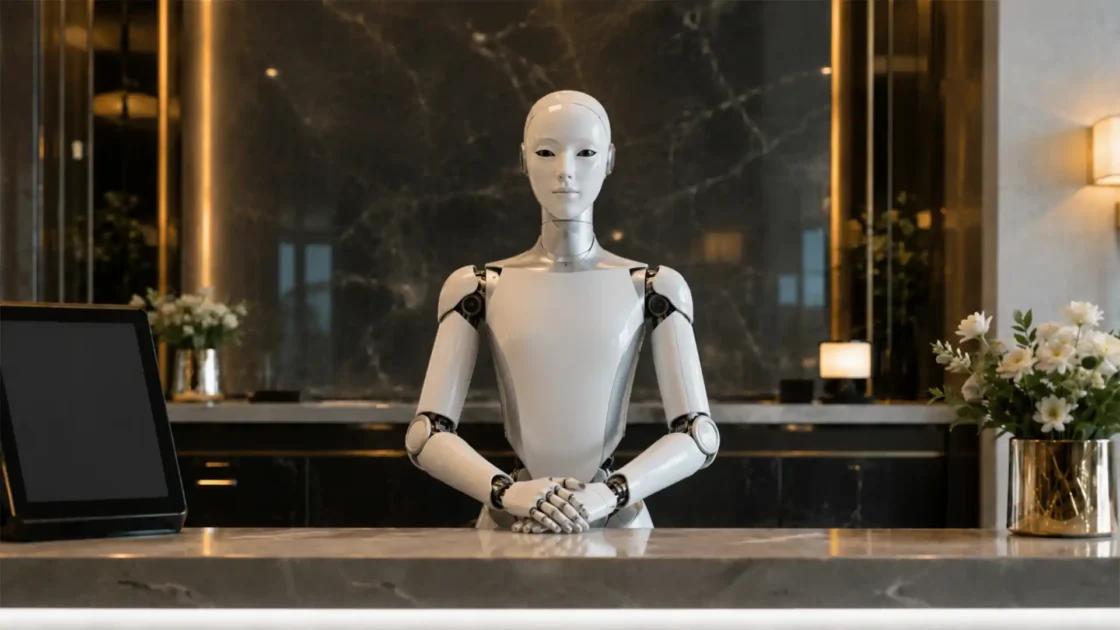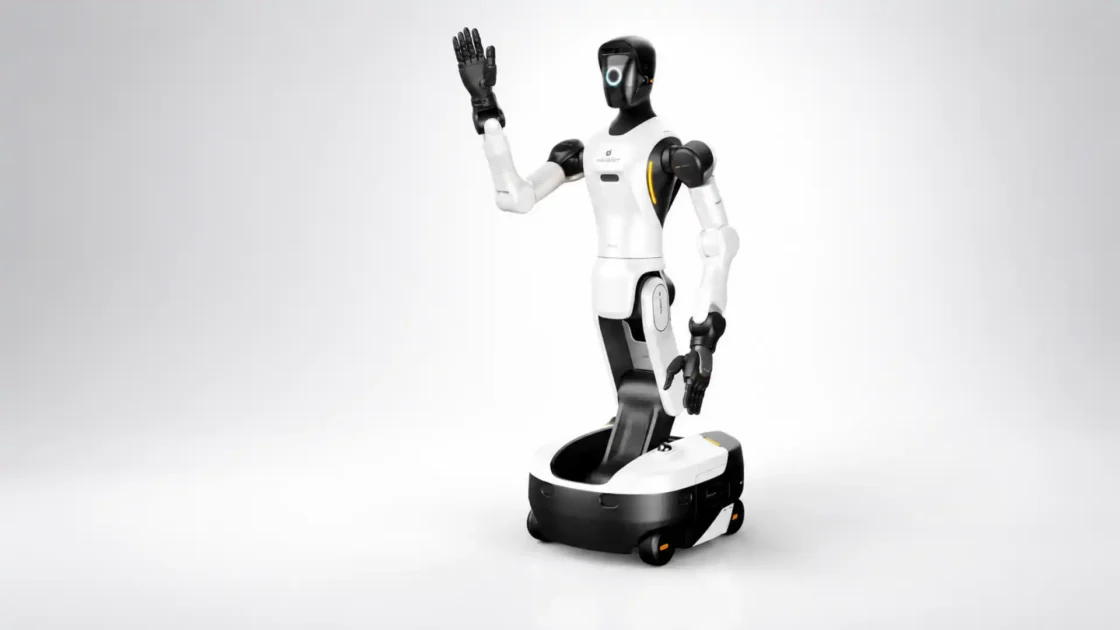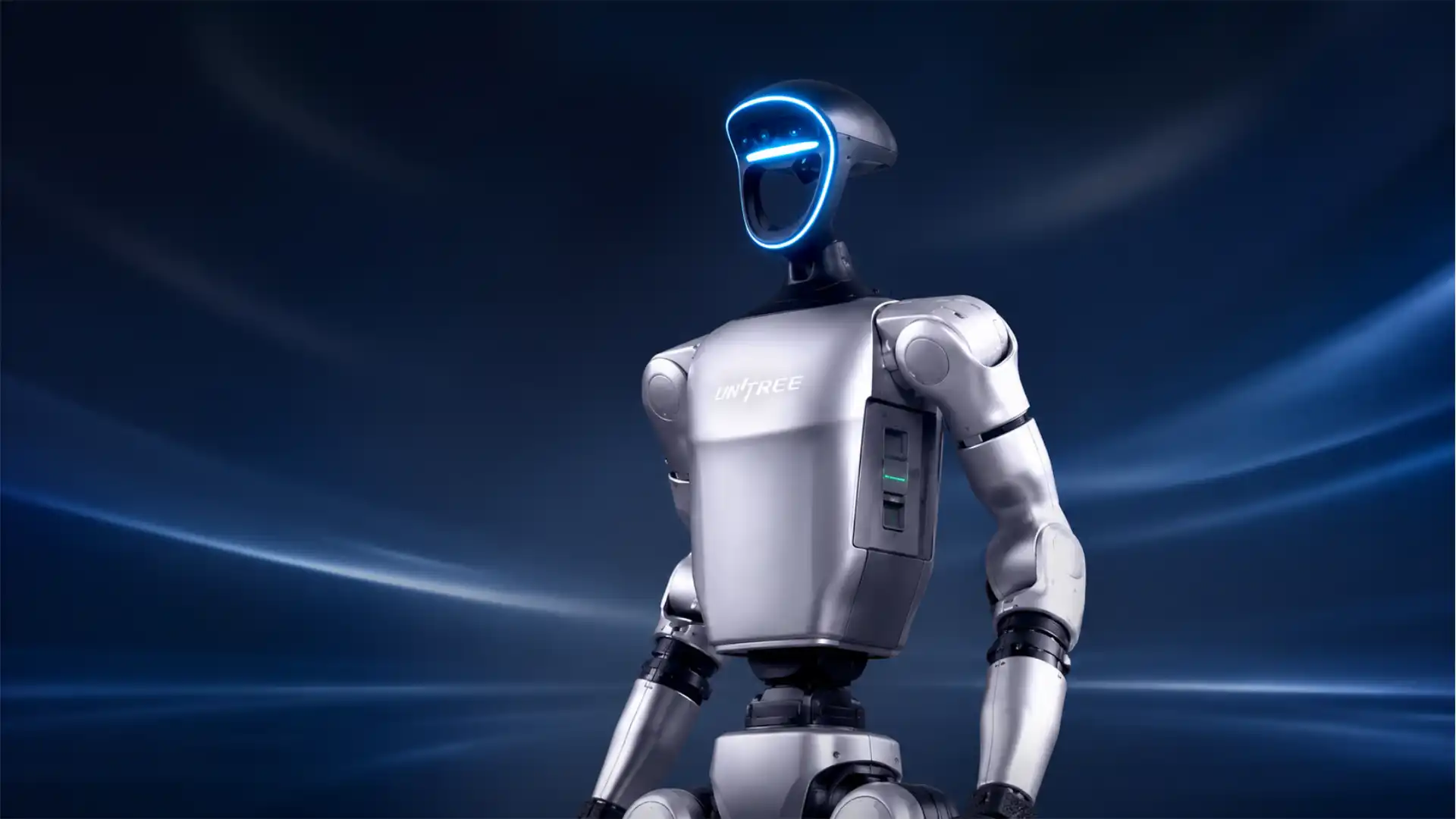
Robbie entered public view at Hotel Devín in Bratislava in July 2026 as a humanoid assistant placed directly in a working four-star hotel. The announcement matters because it is not a laboratory demonstration, trade-fair exhibit, or one-day promotional visit. The machine has been presented as a member of the hotel team, with duties aimed at real guests in a building that has welcomed visitors since 1954. Hotel Devín described Robbie as a new chapter in its hospitality story, while Slovak reports identified him as the country’s first humanoid hotel assistant.
Table of Contents
Robbie begins a real hotel shift
The verified role is narrower than the most dramatic headlines suggest, yet still unusual for Slovakia. Robbie can introduce the hotel, direct people through parts of the property, discuss food and drink choices, answer questions about Bratislava, and perform simple entertainment such as dancing. These are guest-facing tasks that combine information, conversation, movement, and showmanship. No reviewed source establishes that Robbie independently checks guests in, issues room keys, processes payments, carries luggage, or replaces a receptionist’s legal and security responsibilities. Calling him a receptionist, waiter, and guide in one body is a useful description of the intended experience, not proof that he performs every duty attached to those occupations.
KVANT Robotics said it implemented its own software in a Unitree humanoid and adapted the system to the client’s requirements after months of tuning. That statement confirms a locally configured project built on imported robotic hardware, rather than a robot designed and manufactured entirely in Slovakia. The exact Unitree model used for Robbie was not identified in the reviewed public material. That missing specification should remain missing in responsible coverage; visual resemblance is not enough to name a model, battery capacity, payload, processor, or price. KVANT called Robbie the first hotel assistant of his kind in Slovakia and probably in Central Europe, but the regional claim was framed by the developer as a probability, not an independently audited record.
The project is also openly unfinished. Hotel representative Karol Wolf told Slovak media that Robbie learns every day, while the machine’s present physical limits include difficulty with an ordinary step. The developers and hotel want him eventually to escort guests to their rooms and explain what they need during the walk. For now, the lobby and other controlled spaces are the safer interpretation of his operating field. A humanoid body attracts attention because it resembles a person, yet the body also creates hard engineering problems: balance, collision avoidance, uneven flooring, doors, lifts, children moving unpredictably, wet surfaces, and crowded paths.
Robbie’s conversational system reportedly uses a prepared knowledge base and reaches online resources when a question falls outside it. Project manager Radoslav Mach compared that fallback behavior to a person using ChatGPT. The comparison does not prove which model provider, version, hosting arrangement, or data-retention policy operates behind the robot. A connected answer engine is not the same thing as verified hotel knowledge. The distinction becomes crucial when a guest asks about allergens, opening hours, transport disruptions, prices, medical needs, or safety. A fluent answer may still be stale, incomplete, or wrong, so the hotel must decide which questions Robbie may answer freely and which require immediate handover to a person.
The strongest reading of the launch is therefore neither “a robot has replaced hotel staff” nor “a dancing gadget has arrived.” Hotel Devín has started a live service experiment where a social robot meets guests in a heritage property. Its success will depend on ordinary measures: whether directions are correct, conversations are understandable, people feel comfortable, staff can recover failures quickly, and the system creates more useful interactions than queues or confusion. The public debut is already a branding event. The harder test begins after the cameras leave, when Robbie must repeatedly answer routine questions in several languages, respect personal space, avoid blocking movement, and know when to stop speaking. That operational test, rather than novelty alone, will decide whether Slovakia has gained a durable hotel service or a memorable summer attraction.
The terminology deserves care as well. “Humanoid” describes the robot’s humanlike body plan; it does not mean human judgment, general intelligence, or emotional understanding. “Employee” is a playful public label, not a statement that the machine holds an employment contract. Robbie remains equipment operated within a human service organisation, and accountability stays with the companies and people who select its functions, connect its data sources, maintain its hardware, supervise its conduct, and respond when it fails.
A 1954 landmark becomes a robotics test site
Hotel Devín is an unusually charged setting for a humanoid assistant because the property’s identity rests on continuity. The hotel says it opened in 1954, occupies a protected national cultural monument, and was designed by Emil Belluš, a leading figure in Slovak functionalism. Its official presentation emphasizes Danube views, central Bratislava, long service, and the accumulated stories of guests rather than novelty for its own sake. Robbie therefore enters a brand built around memory, not a newly opened technology-themed property where automation would be expected.
That contrast gives the launch more editorial weight than the same machine would carry in a shopping mall. A seventy-two-year-old hotel has physical constraints, established routines, regular guests, and a visual language shaped long before mobile robots existed. Its corridors, thresholds, lifts, furniture, carpets, and service stations were designed for people. A humanoid must adapt to that environment rather than relying on a building designed around it. The heritage setting turns mobility into a practical test of compatibility between old architecture and new equipment. One step that a person barely notices can stop a robot, while a narrow passage or decorative object can change a planned route.
The property’s location also changes what useful assistance means. Hotel Devín stands at Riečna 4 in the historic centre, close to the Danube and within walking distance of major visitor areas. Guests may ask for routes to the Old Town, transport options, museums, restaurants, riverfront walks, or event venues. A robot that knows only the hotel map would have limited value there. Robbie’s reported knowledge of Bratislava connects the lobby to the city outside, allowing the hotel to frame him as a guide as well as a greeter. Yet city information changes faster than architectural facts. Opening times, temporary closures, public transport diversions, ticket rules, and restaurant availability require dated, maintained sources.
There is also a symbolic fit between functionalist architecture and a machine built around visible purpose. Functionalism placed strong emphasis on use, structure, and the relationship between form and function. A humanoid robot makes a different promise: its humanlike shape suggests it can work in spaces made for human bodies. The shape is useful only when the functions justify it. If Robbie mainly stands still and answers questions, a screen or kiosk could perform much of the informational work at lower mechanical complexity. The humanoid form earns its place when gestures, movement, social presence, and guided accompaniment produce an experience that a fixed terminal cannot match. That is an analytical test, not a criticism of the launch.
Hotel Devín’s history also raises the standard for tone. Guests may choose the property for ceremony, calm, personal service, architecture, or nostalgia. A loud or constantly performing robot could conflict with those expectations even if visitors enjoy it for a photograph. The hotel must decide where and when Robbie appears, how actively he approaches people, how he behaves during conferences or private events, and whether guests can decline interaction without awkwardness. Hospitality includes the right not to be entertained. A successful deployment respects the room’s social temperature rather than treating every arrival as an invitation to demonstrate every feature.
The machine can still strengthen the hotel’s story when used with restraint. A concise welcome might connect 1954 with 2026, point out Belluš’s architecture, describe the Danube-facing position, and then offer practical help. Staff can take over when a guest wants personal judgment, discretion, or a complex arrangement. That division would make Robbie a living interpretive layer inside the building rather than a replacement for its character. It would also reduce the risk that technology becomes the only story told about the property. The hotel existed for decades before the robot and will be judged on sleep, food, cleanliness, safety, and human care after the novelty fades.
The deeper significance lies in the choice to place experimental robotics inside a mature service brand. Hotel Devín is testing whether heritage and automation can share the same lobby without either becoming a caricature. The answer will not come from promotional reach alone. It will come from repeated guest encounters in which the robot supports the building’s identity, moves safely through its constraints, and leaves human employees more time for the parts of hospitality that depend on judgment, empathy, and responsibility.
That standard rewards quiet usefulness, not constant visibility, and makes restraint part of the design.
The meaning and limits of a national first
The phrase “first Slovak humanoid hotel assistant” carries understandable publicity value, but it needs a precise reading. Slovak reports used that description for Robbie, and KVANT Robotics presented the project as a national first. The developer went further, saying the robot was probably the first such hotel assistant in Central Europe. The Slovak claim is attributed to the hotel and developer, while the broader regional claim remains expressly uncertain. No public registry of every hotel robot in Central Europe was identified in the reviewed material, so a categorical regional record would go beyond the evidence.
Firsts are difficult to prove in robotics because categories blur. Hotels have used delivery robots, cleaning machines, telepresence devices, kiosks, robotic arms, and humanlike reception systems for years. A machine may be humanoid in appearance but fixed in place; mobile but not conversational; conversational but not embodied; or installed for a temporary event rather than regular service. The answer changes depending on whether “hotel assistant” requires daily operation, autonomous walking, direct guest conversation, physical manipulation, or employment-like integration into staff routines. A record claim is only as strong as its definition.
Robbie clearly crosses several boundaries that make the launch notable. He has a humanlike body, moves on legs, speaks with guests, uses hotel-specific knowledge, offers city information, and performs in public inside a commercial hotel. KVANT says its software was tailored to Hotel Devín’s requirements, which separates the project from an off-the-shelf demonstration running generic scripts. Reports also describe plans for room escort, showing that the team is treating mobility as part of the service roadmap rather than mere stage movement. Those features support the narrower description of a Slovak hotel deploying a customized humanoid assistant.
The word “first” should not distract from maturity. Being earliest does not show that the system is safest, most useful, cheapest, or most accepted. Early projects often expose problems that later adopters avoid. Hotel Devín and KVANT are effectively paying part of the learning cost for the local market: mapping a heritage building, scripting guest interactions, testing speech in a noisy lobby, defining handovers, training staff, and handling public expectations. The defensible achievement is practical pioneering, not technological supremacy. A system that admits its present limits and improves them is more credible than one protected by exaggerated language.
There is a commercial reason to use a first-mover narrative. Hotel products are hard to differentiate because beds, breakfast, location, and wellness can look similar across booking platforms. A humanoid creates a visual hook that travels well on television and social media. It gives journalists a clear character, guests a photograph, and the hotel a way to connect its historic identity with a future-facing message. This attention has measurable value only if it reaches relevant travellers, raises direct bookings, strengthens event enquiries, or improves guest recall. Otherwise, the title remains earned media without proven operating return.
The project also creates obligations. A business that presents a machine as a team member invites guests to expect consistency, availability, and competence. If Robbie gives wrong directions, blocks a corridor, fails to understand an accent, or repeats an unsuitable online answer, the guest will usually blame the hotel rather than the hardware supplier. Public personification increases brand accountability. The friendlier and more human the presentation, the more carefully the hotel should explain limitations, visible supervision, data use, and the route to a human employee.
For Slovakia, the national-first framing may still have lasting value. It moves humanoid robotics from university labs, industrial demonstrations, and technology fairs into a setting that ordinary travellers can encounter. It gives local developers a live environment and gives hospitality managers a concrete case rather than a distant overseas example. The useful question is not whether every hotel should follow immediately. It is whether this pilot produces evidence about tasks, guest reactions, safety, cost, and staff workload that other operators can examine.
Robbie’s place in history will depend less on being first than on what the first deployment teaches. A durable project would establish tested routines, publish or share credible performance lessons, and expand only after the current functions work reliably. A short-lived spectacle would still be a cultural moment, but not a service model. Careful language leaves room for either outcome and protects the facts from the promotional pressure surrounding a memorable debut.
Evidence from daily service matters more than a headline that cannot be independently audited.
Three job labels and a narrower real role
Robbie is often described as a receptionist, waiter, and tourist guide in one machine. The phrase captures his breadth, yet each label contains duties that the public reports do not show him performing in full. His verified work is assistance around those professions, not autonomous occupation of all three jobs. He can welcome guests, present the hotel, navigate people through selected spaces, discuss food and drink, answer questions about Bratislava, and dance. Those functions are real enough to matter, but they should not be inflated into payment handling, identity checks, reservation changes, alcohol service decisions, complaint resolution, or unsupervised city guiding.
At reception, the safest early tasks are informational. Guests repeatedly ask where breakfast is served, when wellness facilities open, how to reach a meeting room, where the lift is, or how to connect to hotel services. A prepared knowledge base can answer these questions consistently and in several languages if the content is current. The robot can also occupy guests during a brief queue and direct them to the right human colleague. It should not create a second queue around itself or slow a simple request with a long performance. The operating design must favour fast exit from the conversation.
The waiter label needs even tighter boundaries. Recommending a coffee, explaining a menu category, or pointing out a restaurant is different from carrying hot dishes, balancing glassware, taking legally binding orders, checking allergens, or judging whether alcohol service is appropriate. Public reporting says Robbie advises guests about food and drink; it does not establish autonomous table service. That distinction protects both accuracy and safety. Food information can become high stakes when a guest has an allergy or dietary restriction. The robot should use approved menu data, state when it lacks certainty, and summon trained staff rather than improvise.
Tourist guidance is a natural fit because guests value quick orientation, and Hotel Devín sits in a visitor-rich part of Bratislava. Robbie may explain nearby attractions or suggest an itinerary, but a recommendation engine must separate stable landmarks from time-sensitive facts. A castle’s location is stable; today’s opening, ticket availability, weather disruption, or tram diversion is not. Every recommendation needs a freshness strategy. Hotel-curated answers can cover frequent questions, while live sources may support changing information, provided the system identifies the source and time and avoids presenting unverified web text as hotel advice.
Dancing belongs to a fourth role: performer. It has no need to masquerade as operational labour. The movement demonstrates balance, gives guests a reason to engage, and turns the robot into a social object rather than a talking terminal. Entertainment can break hesitation, especially for families and groups, but it also raises physical risk because motion occupies space. A demonstration zone, staff cue, distance rule, and stop procedure matter more than an impressive routine in a crowded lobby. A safe dance is choreography plus crowd management, not only a stored sequence.
The same machine can move among these roles because software changes the context of its speech and actions. That flexibility is a strength, but it can also confuse guests about authority. A person may assume that a robot standing near reception has access to bookings, that a robot near a restaurant knows every allergen, or that a guide-like answer has been checked by the city tourism office. Clear introductions should state the scope: Robbie can provide general information and directions, while staff handle reservations, payments, complaints, medical needs, and confirmed dietary advice.
Role design also affects staff. Employees need to know who owns Robbie’s content, who may start or stop him, who responds to a fall, who handles a guest complaint about an answer, and who records technical incidents. The robot’s job description must be written for humans first. Without that document, colleagues may either overtrust the machine or avoid using it, leaving guests with inconsistent experiences.
The most credible version of Robbie is therefore a host with bounded skills. He handles repeatable, low-risk exchanges, adds theatrical value, and transfers complex matters to people. That division is not a weakness. It is the basis of responsible service automation. A hotel does not need a machine that pretends to do everything; it needs one that performs a useful set of tasks reliably, announces its limits plainly, and supports the staff who remain accountable for the stay.
Boundaries make the service clearer for everyone.
The intelligence stack behind the conversation
A hotel assistant can appear intelligent while relying on several separate systems. Robbie’s public description points to at least two informational layers: a hotel-specific knowledge base and an online fallback for questions outside that material. Speech recognition converts a guest’s voice into text or intent, a dialogue component selects or generates an answer, and speech synthesis produces the reply. Movement, gestures, and navigation require their own control stack. Conversation and locomotion are coupled in the guest’s experience but not necessarily in the engineering.
The local knowledge base is the most controllable layer. It can contain approved descriptions of rooms, restaurants, wellness facilities, event spaces, breakfast hours, internal routes, house rules, and frequently asked questions. Hotel employees can review that content, assign owners, add effective dates, and remove expired offers. A retrieval system may search those entries and place relevant facts into the response. This curated layer should dominate whenever the question concerns the hotel. It is safer than asking a general model to remember operational details that may never have appeared in its training data or may have changed yesterday.
An online language model broadens the range of possible answers, but fluency creates a known risk: the system can produce plausible statements without reliable grounding. NIST’s generative-AI risk work treats confabulation, information integrity, privacy, and security as governance concerns rather than rare curiosities. The practical hotel response is not to ban broad conversation; it is to constrain it. Robbie can discuss general history or propose ideas, while clearly signalling uncertainty and avoiding claims about live prices, legal rules, medical issues, allergens, transport departures, or bookings unless connected to approved sources.
Speech adds another source of error. Lobbies contain music, luggage wheels, groups talking, hard surfaces, and accents from many countries. A system may mishear a destination, room number, surname, or dietary term. Repeating back sensitive details can expose them to bystanders. Good interaction design assumes misrecognition, uses short confirmations for consequential requests, and never asks guests to announce unnecessary personal information in a public space. A visible screen or text option can help some users, but it must be accessible and positioned so private content is not displayed to everyone nearby.
Multilingual ability must also be tested rather than advertised as a vague promise. A model may converse in many languages yet perform unevenly with Slovak place names, local pronunciation, mixed-language questions, or speech from children and older people. The hotel should maintain a tested language list, standard greeting for unsupported languages, and quick handover to staff. Quality testing needs realistic scenarios: a German guest asking for the Slovak National Theatre, an English speaker pronouncing Devín differently, or a Slovak guest switching to Czech midway through a sentence.
Navigation uses a different meaning of “knowledge.” Robbie needs a map, position estimate, obstacle detection, route planner, and movement controller. A direction given verbally may be correct even when the machine cannot physically travel there. Public reports already note difficulty with a step, which shows why dialogue must remain aligned with mobility. The robot should never promise an escort beyond its validated route. Staff need to know which corridors, lifts, thresholds, and times of day are approved for movement.
The architecture also needs a clear failure state. If the internet connection drops, the language service times out, the map loses localization, or a sensor is blocked, Robbie should not continue with improvised behaviour. A safe fallback may be a stationary posture, brief apology, call to staff, and removal from the guest path. Logs should show what failed without capturing more personal data than necessary. This allows developers to diagnose repeated problems while respecting privacy.
The real intelligence of the deployment lies in orchestration. A strong hotel robot is not the model with the largest vocabulary or the most humanlike gesture. It is a system that selects trustworthy information, understands which actions are permitted, recognizes uncertainty, protects guests, and hands control to people before a minor error becomes a service failure. Robbie’s public launch demonstrates the interface. Long-term value will come from the hidden discipline behind it.
Content governance completes that discipline. Every hotel fact should have an owner, review date, source, and escalation rule. Changes to breakfast hours, temporary closures, menu items, or event access should reach Robbie at the same time they reach staff. A polished voice cannot repair stale operations data. Version control and periodic mystery-guest testing reveal whether the deployed answers still match the property’s actual service.
A humanlike body meets an unforgiving building
Robbie’s body is the feature that separates him most clearly from a chatbot or information screen. It also creates the project’s hardest constraints. A humanoid must keep balance, detect people and objects, plan foot placement, coordinate joints, and stop safely while operating in a building filled with guests who do not behave like test engineers. Physical competence cannot be inferred from conversational fluency. A robot may answer a complex question smoothly and still fail at a shallow step that a person crosses without thought. Slovak reporting identifies that exact obstacle as one of Robbie’s current limits.
Hotel spaces are deceptively difficult for legged machines. Carpets change friction and can hide edges. Polished floors may reflect light into sensors. Chairs move between map updates. Suitcases appear in corridors. Children approach quickly, guests step backward while taking photographs, and staff carry trays with restricted sight lines. Doors may close automatically, lifts may be crowded, and decorative thresholds may not meet the assumptions used during training. A route that worked during an empty-night test can fail during breakfast departure. This is why validation must cover operating conditions, not only geometry.
The attraction of legs is that hotels are designed for the human body. In principle, a humanoid can pass through ordinary doors, use lifts, reach controls, and accompany a guest without requiring new tracks or dedicated corridors. In practice, each of those actions needs reliable perception and control. Reaching a lift button is harder than pointing toward a lift; entering a moving crowd is harder than following a marked path; recovering from a light bump is harder than avoiding static furniture. The promise of general human-space compatibility remains a demanding engineering target, not a default property of the silhouette.
A safe operating envelope should define exactly where Robbie may stand, turn, walk, and perform. It should include speed limits, minimum distance from guests, approved floor surfaces, maximum crowd density, no-go zones, staff-only controls, and conditions that suspend movement. The hotel needs a simple stop authority that every trained employee can use without searching through menus. A physical emergency stop, remote stop, and automatic protective stop may serve different failure modes. Staff also need a practiced plan for stabilizing or isolating the machine if it sits down, loses power, or falls.
Standards and product law provide useful structure even when the precise legal classification requires specialist assessment. ISO 13482 addresses safety requirements for personal care robots, including mobile servant robots, while the EU Machinery Regulation sets a framework for machinery placed on the market or put into service. The relevant duties depend on the final system, intended use, modifications, and roles of manufacturer, importer, integrator, and operator. Software customization can change the risk profile of hardware, particularly when it affects autonomous movement or safety functions.
Movement also consumes operational attention. Batteries require charging procedures, joints and sensors need inspection, software updates may alter behaviour, and wear can accumulate in feet or actuators. A hotel must know expected runtime, recharge time, maintenance intervals, spare-part access, and the response time of technical support. None of those project-specific figures were established in the reviewed public sources. Their absence does not imply weakness; it means they should not be guessed. For management, they are central to deciding whether Robbie is available when guest demand is highest.
Room escort is a sensible future goal because it uses the humanoid form in a way a fixed screen cannot. Yet escort requires more than following a route. The robot must match a guest’s pace, avoid separating a family, handle lift etiquette, stop at a safe distance from doors, protect room privacy, and return without wandering into restricted areas. The last metre near a guest room is more sensitive than the lobby, because room numbers and occupant movements reveal personal information and because corridors often provide less space for passing.
The correct measure of mobility is therefore not the most dramatic dance or fastest walk. It is the proportion of approved journeys completed without intervention, near miss, blocked path, discomfort, or service delay. Incident logs should include minor events, because a repeated hesitation at one threshold may predict a later fall. Robbie’s body makes the project visible, memorable, and potentially useful. It also turns abstract software errors into movement around people. Respecting that difference is the foundation of a credible deployment.
That standard should govern every public demonstration.
Human handover remains the decisive feature
The most mature feature of a hotel robot may be its ability to call a person. Hospitality contains ambiguity that cannot be removed by a larger database: a tired guest describes a vague problem, a child is separated from a parent, a traveller appears unwell, a booking dispute becomes emotional, or a dietary request carries medical risk. Human handover is part of the service, not evidence that automation failed. Robbie’s value depends on recognizing the border between routine information and situations requiring authority, empathy, discretion, or legal judgment.
A handover can begin in several ways. The guest may ask for a person, the robot may detect low confidence, a prohibited topic may trigger escalation, or staff may intervene after observing the exchange. Every route should be quick and graceful. Robbie could say that a colleague will provide confirmed assistance, signal the front desk, and display or indicate where the guest should wait. It should not trap the person in repeated clarification loops. One failed understanding attempt may be acceptable; five can feel dismissive.
Confidence thresholds should vary by task. A slightly imperfect answer about a decorative feature is low risk. A possibly wrong answer about allergens, an emergency exit, a transport departure, a payment, or a room booking is not. The system should use approved responses for these areas and refuse to speculate. Generative systems are particularly persuasive when uncertain because they can produce complete sentences with no visible hesitation. NIST’s risk guidance places measurement, governance, and management around such behavior, which translates in a hotel into tested topic rules, logging, review, and accountable owners.
Staff need a shared mental model of what Robbie can do. If receptionists assume the robot will answer city questions while developers assume staff will supervise every answer, gaps appear. Training should cover start-up checks, approved routes, conversation scope, emergency stop, guest consent, privacy, content updates, incident reporting, charging, and technical escalation. Every shift needs a named human owner, even if several colleagues can operate the robot. Ownership prevents the machine from becoming everyone’s responsibility and therefore nobody’s responsibility.
The robot should also make human availability visible. A guest must not interpret Robbie’s presence as a barrier to speaking with staff or as a cost-cutting signal that personal service is discouraged. Placement matters: the machine can greet people beside, rather than in front of, the reception path. Its introduction can offer choices instead of demanding interaction. A simple phrase such as “I can give directions, or my colleague can help you at reception” preserves agency. The tone should remain respectful if the guest declines.
Observation is useful but must not become covert monitoring. Staff can watch for confusion, unsafe crowding, and repeated failures without using the robot to infer emotions or profile guests. The EU AI Act places restrictions and transparency duties around certain AI practices, while GDPR applies whenever personal data are processed. A hospitality pilot should collect the least data needed to improve service. Aggregate counts, task outcomes, and manually categorized incidents may answer many management questions without retaining identifiable audio or video.
Handover performance should be measured. Useful indicators include how often escalation occurs, why it occurs, how long the guest waits after escalation, whether the correct employee receives the context, and whether the issue is resolved without repetition. Passing a transcript or room detail may save time but raises privacy questions, especially when cloud services are involved. A safer early design may transfer only the topic and location unless the guest agrees to more. The human should confirm important facts rather than trusting the robot’s summary blindly.
Employees also need permission to override promotional pressure. A robot that is attracting attention may still need to be stopped because the lobby is crowded, a private delegation is arriving, a floor is wet, or a sensor is behaving oddly. Safety and service must outrank the desire to keep Robbie visible. Management should reward cautious shutdowns and accurate incident reports rather than treating them as embarrassment. That culture produces better data and reduces the temptation to hide near misses.
The public may remember Robbie’s dance, but staff will determine whether the deployment works. Their judgment fills the gaps between scripts, sensors, and real guests. A well-designed human-robot team gives the machine bounded repetitive work and gives people clear authority over exceptions. The aim is not to make the human invisible. It is to make assistance faster while preserving the human responsibility that a hotel owes every guest.
The verified capability baseline
The launch coverage establishes a useful baseline, but it also leaves many operational questions unanswered. A disciplined assessment separates confirmed functions, stated plans, developer claims, and facts that remain undisclosed. This prevents a promotional description from hardening into a technical specification that no source actually published. The distinction is especially important because humanoid robots attract assumptions: observers may infer facial recognition, autonomous check-in, room access, or full multilingual support simply from a short video. None of those should be treated as verified unless the project owners document them.
The confirmed public functions cluster around low-risk guest engagement. Robbie can present Hotel Devín, help people orient themselves in the property, discuss food and drinks, provide information about Bratislava, and entertain by dancing. Reports describe continuous internet connectivity and a hotel knowledge base with an online fallback for broader questions. KVANT Robotics confirms that it customized software for a Unitree humanoid according to the hotel’s requirements. These points describe an interactive host, not a complete property-management, payment, access-control, or restaurant-ordering system.
Publicly established status of Robbie’s functions
| Area | Publicly established status | Responsible interpretation |
|---|---|---|
| Hotel welcome and presentation | Reported as active | Suitable for scripted, reviewed information |
| Indoor directions | Reported as active in hotel spaces | Routes should remain limited to validated areas |
| Food and drink advice | Reported as active | General recommendations, not confirmed allergy decisions |
| Bratislava information | Reported as active | Time-sensitive facts need current sources |
| Dancing and entertainment | Demonstrated and reported | Requires space, supervision, and stop controls |
| Room escort | Described as a future aim | Not established as a current routine capability |
| Step climbing | Reported limitation | Routes must avoid unvalidated level changes |
| Unitree platform | Confirmed by developer | Exact model was not identified in reviewed sources |
| Online answer fallback | Described by project manager | Provider, version, and retention details were not verified |
| Autonomous check-in or payment | Not established | Must not be implied from the receptionist label |
The table is a snapshot of reviewed public information, not a certification or complete technical inventory. Project owners may hold further documentation that has not been published.
Several gaps matter directly to guests. The public material does not establish which languages have been tested, whether speech or video is retained, whether any biometric identification is used, how a guest can obtain privacy information, or whether the robot displays a visible notice when online services process a question. Silence on these points is not proof of unsafe practice, but it prevents outsiders from assessing the controls. A concise public explainer would reduce speculation and give guests a clear basis for choosing whether to interact.
Operational gaps matter to hotel management. No verified public figure was found for purchase or lease cost, customization cost, battery runtime, maintenance schedule, service-level agreement, planned working hours, intervention rate, or availability. These are the numbers needed for return-on-investment analysis. Media attention may offset some cost through earned reach, yet that value is separate from labor savings or service quality. A business case should not combine them without evidence. Publicity return and operating return are different accounts.
Technical gaps also limit comparison with other robots. Unitree sells several humanoid platforms, and KVANT’s own Unitree page describes the G1, but the reviewed Robbie announcements do not name a model. It would be irresponsible to transfer specifications from one product page onto the hotel machine based on appearance. Hardware may also be modified, and software configuration can change the available functions. The accurate description remains “a Unitree humanoid customized by KVANT Robotics” until a primary project source gives more detail.
The reported room-escort ambition should be treated as a development target with acceptance criteria. Before routine use, the team would need to validate routes, lift behavior, guest pacing, privacy near room doors, return journeys, failure recovery, and operation during housekeeping traffic. A future feature becomes a service only after repeatable testing. Announcing the direction is useful because it shows the project is intended to grow, but no deadline or success threshold was verified.
The best next disclosure would not be a long technical paper. A one-page service card could list current tasks, unavailable tasks, tested languages, operating zones, data practices, human contact, safety behavior, and the date of the latest update. That card would support staff, journalists, regulators, and guests at once. It would also strengthen Robbie’s credibility by replacing assumptions with boundaries.
This baseline gives Hotel Devín a fair starting point. The project has enough verified substance to be more than a prop: customized software, live guest interaction, hotel and city knowledge, movement, and planned expansion. Its credibility will grow fastest through measured transparency, especially about limitations. A robot does not need to appear all-knowing to feel advanced. In hospitality, admitting what the system cannot safely do is part of competent service.
A further distinction concerns autonomy. Public videos and reports may show Robbie walking or responding without visible manual control, yet they do not establish the level of autonomy behind every action. A staff member may start routines, select modes, supervise routes, or intervene remotely. Autonomy should be described task by task, because scripted dance, free conversation, and corridor navigation can each use different control arrangements. The guest experience does not reveal that architecture reliably.
Hotel staff should maintain an internal capability register and align public claims with the deployed version. This avoids a common service problem in which marketing promises a feature that operations have temporarily disabled. Version accuracy is part of guest honesty, especially during a pilot that is expected to change.
The guest journey starts before the first word
A guest does not experience a robot as a list of functions. The encounter begins before the first word: where the machine stands, whether it faces the entrance, how close it approaches, whether staff are visible, and whether other people are filming. The guest journey turns technical choices into social signals. Robbie may feel welcoming to one traveller, distracting to another, and inaccessible to a third. Designing the encounter means giving each person an easy path toward help without making interaction compulsory.
Arrival is the highest-value moment because guests are orienting themselves. They may be carrying luggage, watching children, searching for a reservation name, or recovering from travel. A short greeting and a clear choice work better than a long introduction. Robbie could offer three immediate categories—hotel directions, Bratislava information, or a human colleague—while leaving the reception route open. The robot should reduce uncertainty within seconds. A performance can follow when the lobby is calm and the guest shows interest, rather than becoming the default welcome.
During the stay, context changes. A conference delegate may need a meeting room quickly. A leisure guest may want a walking route. A diner may ask about the restaurant. A returning guest may already know the building and simply enjoy a brief exchange. The robot should avoid repeating the same welcome whenever someone passes. This requires session awareness without persistent identification. Proximity, time since the last exchange, and a simple “Would you like help?” can be enough. Recognizing a face is not necessary for polite restraint and would add privacy risk.
Night operation deserves separate rules. A humanoid moving through a quiet lobby at 2 a.m. can feel very different from the same machine during a busy afternoon. Fewer staff may be present, guests may be tired or impaired, and technical support may be unavailable. Operating hours should follow service capacity, not theoretical battery life. The hotel might restrict Robbie to staffed periods or stationary information mode when immediate human intervention cannot be guaranteed.
Departure creates another useful but delicate moment. Robbie could give directions to taxis, transport stops, or luggage storage and invite feedback. It should not ask guests to speak room numbers, payment details, or complaints aloud in a public area. A quick satisfaction prompt may produce biased data because people who enjoy robots are more likely to engage. Management should combine robot feedback with ordinary guest surveys and staff observations rather than treating the machine’s users as representative of all visitors.
Families often generate the most visible engagement. Children may approach closely, touch moving parts, imitate gestures, or stand in the robot’s path. Parents may focus on photographs rather than safety distances. A family-friendly robot still needs adult-centered controls: reduced speed, clear floor space, staff supervision, and a response to touching that does not startle the child. The machine should never encourage climbing, grabbing, or movement into a restricted zone.
Business and diplomatic guests may have different concerns. Hotel Devín hosts meetings, conferences, gala events, and private celebrations. Some clients may welcome a futuristic greeting; others may require discretion, security, or an uncluttered arrival. The robot’s schedule should be part of event planning. Organizers can choose whether Robbie greets delegates, remains available at a fixed point, performs at a set time, or stays out of view. Customization should include absence as an option.
Service recovery shapes memory more strongly than a flawless routine exchange. If Robbie misunderstands a guest, the best response is a brief acknowledgment and fast transfer. If he blocks a route or stops moving, staff should resolve the obstruction before explaining the technology. The guest should never be expected to troubleshoot. A small courtesy from a human employee can convert an awkward moment into evidence that the hotel remains in control.
The journey should end with choice preserved throughout. Guests who never interact with Robbie still deserve normal service. Guests who enjoy him should receive accurate help rather than only spectacle. A successful deployment adds one more doorway into hospitality without closing the existing doors. That principle keeps novelty subordinate to the stay and gives Robbie a role that feels voluntary, useful, and proportionate.
Photography needs its own etiquette. A guest interacting with Robbie may appear in another visitor’s video, and a crowded lobby is not automatically a consent-free stage. Staff can designate a demonstration angle, keep access routes outside the camera field, and pause performances during sensitive arrivals. The robot’s appeal should not weaken ordinary privacy and courtesy.
Reception work stays more complex than the interface
Reception work looks simple from the lobby because much of its complexity is hidden. Front-desk employees combine identity verification, booking systems, payments, room allocation, key control, local knowledge, complaint handling, security awareness, and emotional judgment. Robbie’s current public functions touch only part of that work. He is best understood as a reception-side assistant, capable of taking repetitive informational pressure off the desk while people retain transactions and decisions.
The most suitable tasks are frequent, standardized, and reversible. Directions to breakfast, wellness, lifts, meeting rooms, or the riverfront can be answered from reviewed content. A wrong answer is inconvenient, but staff can correct it quickly if the system is monitored. The robot can also explain what documents a guest should prepare before reaching the desk, provided it does not collect them. This kind of queue preparation may shorten service time without inserting the robot into identity processing.
A second use is triage. Robbie can ask what kind of help a guest needs and direct the person to reception, restaurant staff, concierge support, an event desk, or wellness. Triage works only when the categories match actual staffing. Sending someone to an unstaffed point or promising immediate assistance when colleagues are busy makes the experience worse. Integration does not have to mean deep software access; a simple live status controlled by staff may be enough to keep directions accurate.
The boundary around reservation data should remain firm unless a formal integration and privacy assessment supports more. Asking for a surname, confirmation number, room number, or travel document in an open lobby can expose personal information to bystanders and cloud services. GDPR requires a lawful basis, transparency, purpose limitation, data minimization, security, and respect for data-subject rights whenever personal data are processed. Convenience does not erase those duties. A first-stage deployment can deliver much of its value without handling identifiable booking data.
Key issuance and access control are also high-consequence functions. A robot that directs a guest incorrectly is not equivalent to a system that grants room access to the wrong person. The reviewed sources do not show Robbie issuing keys or authenticating guests. Keeping those duties with trained staff reduces security risk and avoids overstating his role. Future integration would require strict identity procedures, audit trails, fallback methods, and clear allocation of responsibility among the hotel, system integrator, and technology providers.
Complaint handling illustrates the value of human judgment. A guest may use indirect language, sarcasm, anger, or embarrassment. The factual issue can be entangled with expectations, compensation, cultural norms, and prior interactions. A language model may generate a polite response, but it cannot authorize a room move or understand the full relationship unless given access to sensitive records. The robot can acknowledge and route a complaint; a person should own the remedy.
Reception also contains safety observation. Employees notice unattended baggage, distressed guests, suspicious access attempts, and conflicts. A robot’s sensors might detect movement, but turning it into a surveillance platform would change the nature of the deployment and introduce legal and ethical questions. No public source reviewed for Robbie establishes such a function. The hotel should avoid allowing the friendly assistant narrative to obscure any monitoring capability that may exist. Transparency must match actual sensors and processing, not only the features used in marketing.
The front desk can gain value even if Robbie remains outside core systems. Staff may spend less time repeating basic directions and more time on complex arrivals. International guests may receive a first explanation in a familiar language. Queues may feel shorter when someone is acknowledged. These benefits should be measured rather than assumed: count resolved questions, handovers, average interaction time, repeated questions, and staff-reported interruption load.
Reception automation succeeds when accountability remains obvious. Guests should know that Robbie offers general assistance, that a human colleague is available, and that important transactions stay with authorized staff. The hotel should know which content the robot uses, when it is updated, and who handles failure. Under those conditions, Robbie can extend the front desk’s reach without pretending to replace the craft hidden behind it.
A practical reception script should stay brief. Robbie can introduce himself, state the tasks he handles, and offer a human alternative in the first exchange. If the guest asks a question outside scope, the robot should transfer immediately rather than searching broadly for a speculative answer. Predictable brevity is a service feature. It protects queues, reduces misunderstanding, and gives employees a clear point at which to step in.
Food recommendations need hard safety boundaries
Food and drink advice looks like a friendly, low-risk function until a guest asks a question that carries health, religious, or legal consequences. Robbie has been reported as able to help visitors choose from the hotel’s offer, which gives him a natural place near Café Devín, the lobby bar, or restaurant information. The safe version of that role is recommendation from approved menu data, not improvisation about ingredients, allergens, preparation methods, or alcohol service.
A useful menu conversation begins with stable categories. The robot can explain where breakfast is served, identify coffee styles listed by the venue, describe a dish using wording approved by the kitchen, or point to opening hours. It can ask broad preference questions such as sweet or savoury, light or substantial, local or familiar. These exchanges reduce search effort and make the menu less intimidating for an international guest. They should end before the system starts inventing culinary detail. A language model may produce a plausible description of a dish that differs from the kitchen’s current recipe.
Allergen questions require a hard escalation rule. Ingredients can change, cross-contact matters, suppliers vary, and a menu label may not capture every preparation detail. The robot should never reassure a guest that a dish is safe unless the hotel has built a verified, current process specifically for that purpose and accepts the responsibility attached to it. A safer response states that trained staff will confirm the request and immediately calls them. The same caution applies to severe dietary restrictions, medication interactions, pregnancy-related questions, and claims that a food is medically suitable.
Translation can support service but also create risk. A guest may use an unfamiliar name for an allergen, pronounce it unclearly, or switch languages midway. Speech recognition errors around “nuts,” “gluten,” or “dairy” are not harmless. Consequential terms should be confirmed visually or by a person. The robot can display the understood word and ask for confirmation, yet final responsibility should remain with restaurant staff who can check the current kitchen information. This is a case where speed matters less than certainty.
Alcohol advice has its own boundary. Robbie may describe a listed wine style or point toward the bar, but age checks, signs of intoxication, local service rules, and refusal decisions require authorized human judgment. A playful humanoid should not encourage additional drinking or turn consumption into a game. The entertainment function and beverage function need separate scripts so a dance performance does not become an implied sales prompt. Hospitality technology should not weaken responsible service.
There is still room for a strong guest experience. Robbie could tell the story of a signature dessert, explain the hotel’s dining spaces, introduce seasonal themes, or guide a guest to a table while staff handle the order. Content can include pronunciations and short cultural notes that help foreign visitors understand Slovak terms. The source for every claim should be visible internally, with an owner in the kitchen or food-and-beverage team. A daily update can remove sold-out items and temporary offers before the robot repeats stale information.
The operating environment matters as much as content. Restaurants contain hot liquids, glassware, tight paths, moving chairs, and staff carrying loads. Robbie’s reported difficulty with steps is only one reason to limit movement. A humanoid should not occupy active service lanes unless those routes have been tested under real traffic. A fixed presentation point or escorted appearance may be safer than free walking during peak meal periods. Staff should stop movement immediately when spills, crowding, or rearranged furniture change the floor conditions.
Management can measure whether the function earns its place. Useful indicators include the number of menu questions resolved, handovers for allergies, guest language, interaction time, restaurant conversions, repeated corrections, and staff workload. Sales alone can mislead because novelty may produce a temporary spike. Complaints and near misses deserve equal weight. A robot that sells more coffee but repeatedly misstates ingredients is not delivering better service.
The right food-and-drink role is informed host, not autonomous waiter. Robbie can make the offer easier to explore, add personality, and connect guests with staff. Clear limits protect the guest, kitchen, hotel, and technology provider at once. In a service setting, refusing to guess is not an awkward failure. It is the behaviour that proves the system has been designed around real hospitality rather than a demonstration script.
That boundary should be reviewed daily.
Bratislava knowledge may become Robbie’s strongest service
Tourist guidance may become Robbie’s most naturally useful function because Hotel Devín sits where city questions arrive constantly. The property is in Bratislava’s historic centre beside the Danube, and official tourism material presents it as a central base with a long local identity. Guests may need a quick route, a half-day plan, an accessible option, or an explanation of what lies within walking distance. A hotel robot can turn scattered city information into a conversational starting point.
The strongest answers combine stable knowledge with current checks. Robbie can explain the broad location of Bratislava Castle, the Old Town, the Slovak National Theatre, riverfront areas, or transport hubs from the hotel. A current system can then verify opening hours, closures, ticket conditions, and public-transport changes. Those layers should not be mixed silently. Stable orientation can be confident; live advice needs a timestamp and source. A guest deciding whether to leave immediately should know whether the answer reflects today’s conditions.
Personalization can remain useful without collecting a profile. The robot can ask how much time the guest has, whether they prefer history, food, architecture, or outdoor walking, and whether stairs or long distances are a problem. It can then offer two or three options and allow the guest to choose. The interaction does not need a name, room number, nationality, or stored itinerary. Data minimization is good service design because fewer questions make the exchange faster while reducing privacy risk.
Accessibility requires more than adding the word “accessible” to a route. Pavement conditions, gradients, lifts, toilets, entrance steps, and temporary works can change. The robot should avoid promising barrier-free access unless the information comes from a reliable, current source. A person with mobility, visual, hearing, or cognitive needs may also prefer a map, text, slower speech, or direct human assistance. The system must offer formats and handover, not assume one conversational channel suits everyone.
Commercial recommendations require transparency. A hotel may reasonably suggest its own restaurant, partner services, or nearby businesses, but guests should not mistake paid or preferred placements for neutral city knowledge. The robot’s wording can identify hotel recommendations and separate them from general categories. Any ranking rule should be approved and reviewed. A generative model connected to the open web should not select businesses based on unknown online prominence and present the result as the hotel’s considered advice.
Safety advice needs strict scope. Robbie can provide official emergency numbers, point to reception, and relay approved information about severe weather or transport disruption. It should not assess whether an area is safe, diagnose a medical problem, or direct a lost child without human involvement. Urgent and vulnerable situations should bypass ordinary conversation. The fastest answer may be a staff alert rather than a longer explanation generated from online text.
Language is a major advantage when it works. International visitors often know the attraction they want but struggle with Slovak names, ticket pages, or local pronunciation. Robbie can pronounce names, display spelling, and repeat directions. Yet quality should be tested across languages and accents. A route to “Devín Castle” could be confused with the hotel’s own name, while similarly named stops can lead to the wrong journey. Confirmation screens and map previews reduce that risk.
Tourism data show why city-facing assistance has commercial relevance. Slovakia’s accommodation establishments hosted 6.3 million guests in 2025, more than seven percent above 2024, while Eurostat reported a 15.4 percent year-on-year rise in foreign visitor nights in Slovakia during the first quarter of 2026. Those figures describe national demand rather than Hotel Devín’s own performance, but they show a growing pool of international visitors who may value multilingual orientation. The robot enters a market with rising foreign traffic, not an empty experiment.
A good guide does not overwhelm. Robbie should give an actionable first step, show a route, mention one or two cautions, and offer a human colleague for detailed planning. The hotel can review frequently requested journeys and improve them from guest feedback. If the system becomes known for current, concise, and locally grounded advice, tourist guidance could outlast the novelty of the humanoid body. That would turn Robbie from a photographed attraction into part of the practical infrastructure of a Bratislava stay.
Printed or screen-based directions should remain available after the conversation, since spoken route details are easy to forget once a guest leaves the lobby. Today.
Dancing turns technical novelty into social contact
Dancing is easy to dismiss as a gimmick, yet it plays a serious role in human-robot interaction. Movement shows that Robbie is not merely a voice placed inside a statue. It attracts attention, gives guests a low-pressure reason to approach, and creates a shared moment between strangers in a lobby. Entertainment is the bridge between curiosity and use. Slovak coverage repeatedly highlighted that the robot can dance, showing how strongly the performance shaped the public story of the launch.
The performance also communicates technical ability. Coordinated motion suggests balance, joint control, timing, and a degree of physical confidence. Viewers may then overgeneralize from the routine and assume the robot can navigate any floor or recover from any disturbance. Robbie’s reported difficulty with a step is a useful counterpoint. A rehearsed sequence in clear space is not proof of general mobility. Hotel staff should avoid presenting dance as evidence that room escort, stair use, or crowded navigation is already solved.
Novelty has a short half-life. The first encounter may produce delight; the fifth may feel repetitive, especially for staff and regular guests. The hotel should vary timing rather than chase constant visibility. Scheduled demonstrations can protect quiet periods and allow safe crowd positioning. Robbie might perform for family events, launches, or selected conference moments while remaining in information mode during ordinary arrivals. This keeps entertainment from interrupting the core work of reception.
Sound and space need rules. Music volume, floor clearance, distance from furniture, camera positions, and the robot’s reach all affect risk. A dance that is safe in an empty event room may be inappropriate beside luggage or glassware. The show must stop before the environment becomes unpredictable. Staff should control the start, keep an emergency stop accessible, and prevent guests from stepping into the motion zone for photographs. Children deserve particular attention because they may imitate or touch moving limbs.
Personality extends beyond dance. A name, voice, gestures, and small jokes make the robot easier to address. Robbie’s identity turns a technical platform into a recognizable hotel character. That can strengthen recall, but the personality should not manipulate guests into overtrust. The robot should not imply feelings, friendship, secrecy, or human understanding that it does not possess. A warm style is compatible with honest disclosure that the user is speaking with an automated system.
Research on hotel robots shows that perceived usefulness, ease of use, trust, enjoyment, social presence, and appearance can shape acceptance. Studies also find differences across generations and user groups, which means no single personality will suit every visitor. Fun attracts attention; usefulness sustains acceptance. The hotel should therefore measure whether dancing leads to successful assistance or only photographs. Both may carry value, but they belong to different goals and should be evaluated separately.
The robot’s social behaviour should include graceful retreat. If a guest gives short answers, turns away, steps back, or says no, Robbie should stop prompting. It should not follow someone to maintain engagement or call attention to refusal. The machine’s humanlike form makes personal-space violations feel stronger than those caused by a kiosk. Proximity settings, approach angle, and idle posture deserve the same care as the spoken script.
Media value is real. A dancing humanoid in a historic Bratislava hotel produces images that conventional service changes cannot. It gives Hotel Devín earned coverage and KVANT Robotics a public demonstration of its integration work. The publicity should fund learning, not distort it. Teams need freedom to reduce or suspend the performance when safety, guest comfort, or service flow requires it, even if that makes the robot less visible in the moment.
The lasting entertainment role may be modest and carefully staged. Robbie can mark special occasions, welcome groups, and break the ice before offering information. He does not need to perform continuously to justify his presence. When choreography is treated as one bounded service mode—with its own space, schedule, supervision, and measures—it supports the hotel experience. When it becomes the default response to every guest, it risks turning a promising assistant into background noise.
Performance data can guide programming. Staff can record crowd size, voluntary participation, interruptions, safety interventions, and whether guests ask useful questions afterward. A routine that creates congestion has a hidden service cost, even when social-media clips look successful. Shorter, scheduled performances may produce more enjoyment with less disruption than frequent unsignalled movement across the lobby.
Guest acceptance depends on usefulness and trust
Guest acceptance will not be decided by whether humanoid robots are impressive in the abstract. People judge the encounter through a practical question: did the machine make this moment easier, more pleasant, or more memorable without creating discomfort? Usefulness, trust, effort, and social fit work together. Research on hotel service robots repeatedly identifies perceived usefulness, ease of use, value, trust, enjoyment, and interaction quality as drivers of willingness to engage.
First-time users need immediate cues. A robot standing silently may be mistaken for a display, while one that approaches too quickly can feel intrusive. Robbie should make his role visible through a short spoken introduction, screen, floor sign, or staff cue. The guest needs to know what to ask, where to stand, and how to reach a person. Uncertainty about the interaction should be lower than uncertainty about the original problem. If getting directions requires learning a complicated interface, the service has failed its simplest test.
Trust grows through correct limits, not only correct answers. A system that says it does not know and transfers the question can become more credible than one that responds confidently to everything. Information-security research in hotel robotics indicates that perceived risk and security influence intention to use. Guests may wonder whether cameras are recording, whether conversations are stored, or whether the robot can identify them. Clear notices and staff explanations reduce speculation.
Demographics may influence expectations, but management should avoid stereotypes. One large study found generational differences in attitudes toward hotel service robots, with Generation X respondents less interested than younger groups in the surveyed sample. That does not mean an older guest will reject Robbie or a younger guest will accept him. Design for variation rather than age labels. Offer speech, text, human help, and the ability to decline, then measure actual behaviour at the property.
Prior experience also matters. A traveller who has used self-check-in, voice assistants, or delivery robots may understand the interaction quickly. Another may worry about making a mistake in public. Staff can normalize both responses. A simple invitation—rather than pressure—lets curious guests experiment while protecting those who prefer conventional service. The robot should not ask people to repeat themselves loudly or perform for an audience after a failed attempt.
Cultural expectations around hospitality differ. Some guests value high-touch personal attention and may interpret a robot as cost cutting. Others prefer fast, low-contact assistance or enjoy technology as part of the stay. Hotel Devín’s heritage identity adds another layer: visitors may expect classic service in a historic setting. Robbie must appear as an added host, not a gatekeeper. Visible human staff and easy handover communicate that the machine expands choice rather than withdrawing care.
Acceptance can decline after a failure. A wrong route, misunderstood accent, or frozen movement may be forgiven once, but repeated problems damage trust quickly because the user cannot infer what the system knows. Service recovery should be immediate and human. Staff can apologize, solve the original need, and avoid lengthy technical explanations unless the guest asks. The goal is to restore the stay, not defend the machine.
Novelty can inflate early satisfaction data. People may rate the experience highly because it is unusual, photographable, and newsworthy. That response is legitimate but different from durable utility. The pilot should separate delight metrics from task metrics. Delight includes smiles, photos, voluntary interactions, and event appeal. Task performance includes correct answers, completed guidance, handover rate, time saved, and error severity. Both inform value, but only the second shows whether Robbie can support routine operations.
Non-users need to be included in evaluation. Observing from a distance, avoiding the robot, or choosing staff may reflect preference, accessibility needs, privacy concerns, hurry, or simple lack of interest. Short anonymous surveys and staff observation can capture these reasons without profiling individuals. A deployment judged only by enthusiastic users will miss the people most likely to feel excluded.
Acceptance is therefore a moving relationship, not a launch verdict. Robbie earns trust interaction by interaction. Clear scope, accurate content, calm movement, privacy transparency, and respectful choice matter more than exaggerated human likeness. If the hotel treats reluctance as useful feedback rather than resistance to progress, it can shape the service around real guests instead of expecting guests to adapt to the machine.
Regular review should compare early excitement with later behaviour after local guests and repeat visitors have seen the machine before.
Inclusive service requires more than a humanoid shape
A humanoid assistant can widen access for some guests and create new barriers for others. Voice interaction may help a person who finds small touchscreens difficult, while text display may support someone in a noisy lobby or with hearing loss. Repetition without impatience can be useful for a guest who needs more time. Accessibility depends on the whole interaction, not the presence of advanced technology. A system is not inclusive merely because it offers several features.
Physical design affects approach. Screen height, text size, contrast, volume, speaking pace, gesture range, and the space around the robot determine who can use it comfortably. A wheelchair user should not have to enter the machine’s turning radius to read a display. A person with low vision may need spoken orientation that names real landmarks. Someone using a hearing aid may struggle with echo and background music. Testing must include people with varied needs in the actual lobby, not only able-bodied staff in a quiet room.
Speech systems often perform unevenly with dysarthria, strong accents, quiet voices, or atypical pacing. Repeated failure can feel personal because the robot presents itself socially. The safest response is not endless prompting. Robbie should offer a text route, slow down, or connect a human colleague after a small number of attempts. Staff should intervene without making the guest explain the disability publicly. The system’s logs should categorize recognition failure without retaining sensitive audio unless a lawful, necessary process supports it.
Cognitive accessibility matters as well. Long answers, multiple choices, jokes, and unexpected movement can overwhelm a tired traveller or a person with a cognitive disability. Plain language and one-step instructions improve service for everyone. The robot can state the immediate direction, confirm understanding, and then offer more detail. Consistent phrases for help, stop, repeat, and human assistance make the interaction predictable. Entertainment mode should never activate unexpectedly during a serious request.
The European Accessibility Act creates requirements for specified products and services, but whether and how a particular hotel-robot interaction falls within its scope needs legal analysis of the service and interfaces involved. The broader design lesson is still direct: information and digital services should be perceivable and usable through accessible channels. Compliance is a floor; equal hospitality is the goal. Human assistance must remain available when the robot is not suitable.
Mobility guidance requires special caution. A route that is easy for Robbie may not be accessible to a guest, and Robbie himself currently has reported difficulty with a step. The machine should not assume its path works for wheelchairs, walkers, guide dogs, or people with limited stamina. Accessible routes need verified data about lifts, slopes, door widths, surfaces, and temporary obstructions. When certainty is missing, staff should confirm the route in person.
Blind and low-vision guests may benefit from spoken hotel descriptions, but a moving humanoid can become an obstacle if it enters a path without clear sound cues. A safe system should announce movement, keep predictable routes, avoid blocking tactile paths, and respond reliably to stop commands. Deaf guests may prefer captions or text, while sign-language capability should never be claimed without testing by fluent users. Accessibility claims need evidence from the affected community.
Older guests are not a single category. Research on elderly users of hotel service robots found that perceived usefulness, ease of use, value, trust, and empathy-related perceptions influenced intention in its sample. The practical lesson is to make the service understandable and worthwhile, not to assume either fear or enthusiasm. A patient human introduction may be more effective than a flashy demonstration.
Emergency use should bypass experimental interfaces. Fire instructions, medical distress, lost persons, and security incidents require clear alarms, trained employees, and established procedures. Robbie may repeat approved directions or alert staff, but guests must not depend on the robot as the sole accessible channel. Power, network, or sensor failure could remove it exactly when conditions are difficult.
An inclusive deployment offers equivalent routes to help. Robbie can be one route, supported by reception staff, signage, printed information, accessible digital channels, and direct assistance. Hotel Devín should invite feedback from disabled guests and local accessibility experts, document barriers, and publish only tested capabilities. The measure is not how many technologies are present. It is whether each guest can obtain accurate help with dignity, reasonable effort, and real choice.
That test should be repeated whenever software or hardware changes.
Failure recovery defines operational maturity
Every guest-facing system eventually fails. Robbie may mishear a question, lose network access, retrieve stale information, stop moving, fail to localize, or encounter an object that was not present during mapping. Failure planning is more important than pretending failure can be eliminated. The hotel’s task is to make faults safe, brief, understandable, and recoverable without asking the guest to diagnose the technology.
Conversation failures are the most common and least visible. The robot may answer a different question from the one asked or provide a fluent response that contains an error. Staff cannot review every exchange in real time, so controls must sit inside the design: approved answers for hotel facts, blocked high-risk topics, source checks for live information, confidence thresholds, and fast escalation. A complete sentence is not evidence of a correct answer. NIST’s generative-AI guidance treats confabulation and information integrity as risks requiring governance and measurement.
Physical failures require a more conservative response because they can affect people nearby. If Robbie loses balance, detects an obstacle too late, or cannot complete a route, the safest action may be to stop and call staff. Continuing to improvise movement can turn an inconvenience into a collision or fall. Operating zones should include recovery space, and staff should know how to secure the area without lifting or moving the robot in an unsafe way. The first priority is the guest’s path, not the machine’s dignity.
Network failure should not erase every function. A local mode can retain core hotel facts, a limited set of directions, and a clear message that broader online answers are unavailable. The robot should not fabricate a response to hide the outage. A visible status indicator can help staff understand whether the problem lies in speech, connectivity, navigation, or power. The hotel also needs a manual way to remove outdated local content if synchronization fails.
Content errors need correction at the source. If Robbie gives the wrong breakfast time, staff should not merely tell that guest the correct answer. They should identify which knowledge entry produced the error, update it, test the revised response, and record the incident. One correction should prevent the next repetition. Version history helps distinguish a content problem from model behavior, while review dates reduce the chance that seasonal information remains active.
Service recovery should stay human and proportionate. A brief apology, correct answer, and practical solution usually matter more than a technical explanation. If the error caused real loss—such as a missed reservation, safety concern, or dietary risk—the hotel must follow its ordinary complaint and incident procedures. The robot should never negotiate compensation or minimize harm. Staff must own the record and communicate with the relevant supplier when a technical defect contributed.
Near misses deserve attention even when no guest complains. A hesitation at a threshold, repeated close pass beside luggage, or speech failure with one accent may reveal a systematic weakness. Small incidents are data, not embarrassment. Employees should have a simple reporting form and confidence that honest reports will improve the system rather than trigger blame. Trends can guide route changes, content edits, or temporary suspension of a feature.
Testing should include deliberately difficult scenarios. Teams can introduce background noise, moved chairs, poor lighting, mixed-language requests, ambiguous questions, network delay, and a blocked route. The aim is not to make the robot fail for spectacle but to observe whether it enters a safe state and hands over correctly. Tests should occur after software updates because changes in one function can affect another.
Public communication also matters when an outage lasts. A small notice saying Robbie is temporarily unavailable sets a truthful expectation and directs guests to staff. The hotel should resist keeping a visibly malfunctioning machine in service for publicity. Reliability includes knowing when not to operate. A planned maintenance window is less damaging than repeated public failures that make employees compensate around the robot.
The mature outcome is not zero incidents. It is a system where incidents are limited, detected, documented, learned from, and prevented from escalating. Robbie’s experimental status makes this discipline especially important. Guests may forgive an early limitation when the hotel responds competently. They are less likely to forgive denial, repeated misinformation, or a novelty device that receives more attention than their original need.
A recovery drill should verify that the original guest need is solved before technical investigation begins.
Privacy begins with a complete data map
Robbie’s friendly body can obscure the fact that a connected hotel robot may process voices, images, device identifiers, interaction logs, location data, and questions that reveal personal circumstances. The reviewed public reports do not establish which of these data Robbie actually stores or transmits. The correct starting point is therefore a data map, not an assumption. Hotel Devín and its technology partners need to identify every sensor, data field, recipient, purpose, retention period, and transfer before deciding what notice and legal basis apply.
GDPR governs processing of personal data, including collection that occurs through cameras, microphones, accounts, logs, or cloud services when a person can be identified directly or indirectly. Core principles include lawfulness, fairness, transparency, purpose limitation, data minimization, accuracy, storage limitation, integrity, and accountability. A public lobby does not cancel privacy rights. Guests should be able to understand whether Robbie is listening continuously, activates on a cue, records audio, captures video, or sends content to an external model provider.
Data minimization offers the cleanest design. Most hotel directions and city questions do not require a guest’s name, room number, face, or booking record. The system can answer anonymously and discard the exchange after producing the result. Operational analytics can often use aggregate counts, task categories, error codes, and duration without retaining raw recordings. If the service works without identifiable data, collecting them creates risk without guest value.
Some conversations will contain personal information even when the robot does not ask for it. A guest may volunteer a surname, describe a medical condition, mention a room number, or ask about a family member. The dialogue system should detect and avoid repeating sensitive content aloud. Logs should redact or exclude it where possible. Staff need a clear process for handling access, correction, deletion, objection, and breach questions if personal data enter the system.
Cloud processing requires special scrutiny. Public reports describe continuous internet connection and online fallback, but do not identify the provider, hosting region, contractual terms, or retention settings. Those details determine roles and safeguards. “Using the internet” is not a privacy explanation. The hotel must know whether suppliers act as processors, whether subprocessors are involved, whether data leave the European Economic Area, and whether prompts are used to train external models.
Video deserves separate treatment because a humanoid often uses cameras for navigation. A sensor may need visual input to detect obstacles without retaining footage or identifying faces. That distinction should be documented technically and explained plainly. If face recognition, demographic inference, or emotion analysis were added, the legal and ethical stakes would rise sharply. No reviewed source establishes those functions for Robbie, so they should not be implied. The EU AI Act also contains rules around biometric and emotion-related systems that require careful legal assessment.
Consent is not a universal solution. A guest may feel pressure to agree when the robot stands between them and assistance, and consent must be freely given, specific, informed, and withdrawable. Many necessary hotel processes rely on other lawful bases, while optional recording or personalization may require a different analysis. The service should remain usable through a human channel without penalizing refusal. Choice is strongest when data-heavy features are optional rather than bundled into basic directions.
Notices should be layered. A visible sign near Robbie can state that the user is interacting with an automated system, summarize sensors and data use, and point to a fuller privacy notice. The spoken introduction can mention recording only if recording occurs. Staff should be able to answer basic questions and direct guests to the data-protection contact. Hidden legal text on a distant website would not match the immediacy of the encounter.
Retention should follow operational need. Raw audio kept “just in case” creates exposure and may not be necessary for improving performance. Short, controlled samples used for debugging should have strict access, purpose, security, and deletion rules. Anonymization must be real rather than assumed; the EDPB has emphasized that whether AI-related data are anonymous requires case-by-case analysis.
Privacy can strengthen Robbie’s acceptance rather than weaken the experience. A robot that explains its role, asks for no unnecessary details, and offers easy human assistance feels more trustworthy. The goal is not to bury the project in warnings. It is to make the data behavior as bounded and understandable as the service behavior.
That inventory should be reviewed after every material update.
Cybersecurity reaches from cloud answers to moving joints
A connected humanoid combines several attack surfaces in one visible device: wireless networks, remote administration, cloud language services, local knowledge systems, sensors, update channels, mobile controls, and movement commands. Cybersecurity is therefore part of physical safety and guest service. An attacker or accidental misconfiguration could change answers, expose conversations, interrupt operations, or affect motion. The hotel must treat Robbie as managed operational technology, not as an entertainment accessory.
Asset inventory comes first. The operator should know the hardware components, operating systems, applications, network interfaces, accounts, certificates, cloud endpoints, supplier tools, and versions in use. Unknown components cannot be patched or monitored. The inventory should assign an owner and record which functions are safety-related. A software bill of materials and change log make supplier conversations concrete, especially when several companies contribute hardware, integration, hosting, and hotel content.
Network separation reduces the effect of compromise. Robbie should not share unrestricted access with property-management, payment, key-card, or guest Wi-Fi systems merely because all are inside the hotel. Segmentation, least privilege, strong authentication, and limited outbound connections can contain problems. Remote access should use controlled accounts, multifactor authentication, logging, and time-limited approval rather than shared passwords. ENISA’s AI cybersecurity work emphasizes that AI systems add vulnerabilities across data, models, infrastructure, and supply chains.
Prompt and content attacks are relevant when a robot uses generative AI or online retrieval. A guest may deliberately ask it to ignore instructions, reveal internal prompts, repeat offensive content, or provide restricted information. Malicious web pages could influence retrieval if sources are not controlled. The answer layer needs allowlists, topic boundaries, content filters, and source validation. Hotel-specific facts should come from curated repositories rather than arbitrary search results.
Voice interfaces add social attack paths. Someone can play recorded commands, speak from outside the interaction zone, or try to trigger motion while staff are distracted. The robot should separate guest conversation from privileged control. Safety-critical or administrative commands must require authenticated staff channels and should never be available through ordinary dialogue. Physical controls also need protection against casual tampering while remaining accessible in an emergency.
Updates are both protection and risk. Security patches close known weaknesses, but an update can alter navigation, speech, or integration behavior. Every change needs testing before full service. A staged environment, rollback plan, signed software, maintenance window, and acceptance checklist reduce the chance that a fix creates a new operational fault. Suppliers should communicate vulnerabilities and support periods clearly.
Monitoring should focus on abnormal behavior without becoming broad surveillance. Useful signals include failed logins, unexpected network destinations, configuration changes, repeated blocked prompts, sensor faults, unusual restart patterns, and commands outside scheduled hours. Logs need access controls and retention limits because they may contain personal data. Security and privacy teams should agree on what is necessary rather than collecting everything.
Incident response must connect cyber and physical teams. If Robbie starts speaking inappropriate content, moves unexpectedly, or communicates with an unknown endpoint, staff should know how to stop movement, disconnect the system safely, preserve relevant logs, notify management, and contact suppliers. The playbook should fit on one page for front-line staff, with deeper technical procedures behind it. A hotel incident may also trigger data-breach, product-safety, contractual, or law-enforcement steps depending on the facts.
Supplier governance is central because Hotel Devín cannot secure components it does not control alone. Contracts should define patching, vulnerability disclosure, access, subcontractors, data handling, backup, service restoration, and end-of-support. The hotel needs assurance that default credentials are removed and that maintenance access does not remain permanently open. Procurement should evaluate security alongside performance and price.
Physical tampering deserves attention in a public lobby. Guests can touch sensors, cover cameras, connect unauthorized devices if ports are exposed, or move objects into the robot’s path. Protective housings, port controls, visible staff presence, and inspection routines reduce the risk. A friendly design should not imply that the hardware is a toy.
Security maturity is measured by prepared recovery, not the absence of headlines. Robbie can remain engaging while operating inside strict technical boundaries. Segmented networks, authenticated control, verified updates, monitored behavior, minimal data, and practiced shutdown procedures protect guests and preserve confidence. The more humanlike the robot appears, the easier it is to forget that it is also a networked computer with motors. Good governance keeps both realities visible.
Backups and configuration recovery should also be tested rather than merely documented. Regularly.
A practical risk register for daily operation
A hotel pilot needs a risk register that links each hazard to a practical control, an owner, and evidence that the control works. Risk management is not a document produced once for launch. Robbie’s software, routes, content, crowd conditions, and staff experience will change, so the register must change with them. NIST’s AI framework organizes work around governance, mapping, measurement, and management; that sequence fits a hotel because it starts with context before choosing controls.
The risks span several domains. Physical hazards include collision, falls, blocked paths, and unsafe performance space. Information risks include wrong hotel facts, stale city advice, and fabricated answers. Privacy risks arise from microphones, cameras, logs, and cloud processing. Security risks include account compromise, malicious prompts, and unverified updates. Service risks include queues, guest discomfort, poor accessibility, and staff distraction. Treating these as one “robot risk” hides the different remedies.
Priority risks and operating controls
| Risk | Preventive control | Detection measure | Immediate response |
|---|---|---|---|
| Collision or fall | Validated routes, speed limits, clear zones | Near-miss and protective-stop logs | Stop, secure area, assist guest |
| Wrong hotel information | Curated content with owners and review dates | Mystery-guest tests, correction reports | Hand over, correct source entry |
| Unsafe food advice | Blocked allergen decisions, staff escalation | Audit of dietary conversations | Call trained restaurant staff |
| Privacy overcollection | Data minimization, clear activation, short retention | Data-flow review and access logs | Suspend capture, assess exposure |
| Account or network compromise | Segmentation, MFA, least privilege | Security alerts and configuration monitoring | Isolate robot, preserve logs |
| Prompt manipulation | Topic rules, source allowlists, output filters | Blocked-prompt trends | End exchange, review attack path |
| Accessibility failure | Multiple channels and human alternative | Feedback from disabled guests | Provide direct human support |
| Crowd disruption | Scheduled performance and floor boundaries | Staff observation and congestion counts | Cancel motion, clear route |
| Loss of connectivity | Local safe mode and status indicator | Health monitoring | Restrict functions, notify staff |
| Staff uncertainty | Shift owner, training, one-page playbook | Drills and incident review | Escalate to named supervisor |
The table is an editorial operating model based on recognized risk practices, not a statement that Hotel Devín has implemented every listed control.
The register should score consequence and likelihood separately. A rare wrong allergen reassurance can deserve more attention than frequent harmless mishearing. Near misses, guest complaints, and staff interventions provide evidence for likelihood, while legal, physical, financial, and reputational effects shape consequence. High-severity topics need hard constraints even when no incident has occurred. Waiting for a real injury or data breach would be a poor way to validate risk.
Ownership must be specific. Hotel operations can own routes and guest flow; food-and-beverage leaders can own menu content; IT can own networks and accounts; a privacy lead can own data mapping; KVANT and other suppliers can own defined technical fixes. Shared responsibility does not mean vague responsibility. Contracts and internal procedures should show who decides to suspend a function, who approves an update, and who communicates with guests.
Controls require evidence. A route is not validated because a developer walked it once. A stop button is not effective because it exists. A privacy notice is not transparent because lawyers approved it. Testing should reproduce real conditions and record results. Evidence may include route-completion data, response accuracy samples, staff drills, access reviews, patch records, guest feedback, and documented corrections.
Residual risk must be accepted consciously. No control removes every possibility of collision, misinformation, or discomfort. Management should decide which risks are tolerable for each operating mode and which require suspension. The answer may differ between a quiet weekday lobby and a crowded gala. A performance mode can have stricter space requirements than stationary conversation, while room escort can remain disabled until its residual risk falls below the approved level.
The register should include dependencies outside the hotel. Internet outage, cloud-model change, supplier unavailability, hardware parts, and a revoked certificate can interrupt service. Business continuity needs alternatives that do not depend on Robbie. Human staff, printed information, ordinary phones, and established hotel systems remain the fallback. A pilot becomes fragile when the novelty system is allowed to become the only route to help.
Review cadence should follow change and incident, not only the calendar. Any new language, route, sensor, model, integration, or performance routine can alter risk. A serious incident requires immediate review; routine data may support weekly pilot meetings and monthly management decisions. The team should record not only what changed but why, who approved it, and how success will be measured.
A visible risk discipline protects the project from two extremes: fear that blocks useful experimentation and enthusiasm that ignores foreseeable harm. Robbie can be treated as both promising and fallible. By assigning owners, testing controls, preserving human alternatives, and changing operation when evidence demands it, Hotel Devín can learn quickly without making guests carry the cost of the experiment.
Risk communication should reach guests in proportion to the interaction. A nearby notice can explain that Robbie is automated, summarize data use, and identify the human alternative. Staff do not need to recite the entire register, but they should know the major limits and answer basic questions consistently. Transparency reduces both surprise and overtrust. It also gives people a fair choice about participation.
The register also needs positive outcomes. Risk work is not only a catalogue of harms; it should record the service purpose that justifies each function. If room escort creates little guest value while adding high mobility risk, it may not be worth pursuing. If stationary multilingual directions resolve frequent questions with low intervention, that function deserves support. Linking benefit to risk keeps the pilot focused on real hospitality rather than technical possibility.
European law follows each actual function
Robbie operates inside overlapping legal regimes rather than a single “robot law.” The relevant framework can include product safety, machinery rules, data protection, artificial-intelligence regulation, consumer protection, accessibility, cybersecurity, employment duties, and ordinary civil liability. The legal classification depends on the actual system and use, including sensors, software, autonomy, modifications, data flows, and tasks. Public reporting does not provide enough technical detail to issue a definitive compliance judgment, so responsible analysis must identify questions rather than declare an outcome.
The EU AI Act entered into force on 1 August 2024 and applies on a phased schedule. It regulates AI systems according to their characteristics and risk, with duties for providers, deployers, importers, distributors, and others. A conversational hotel assistant may face transparency obligations when people interact with an AI system, while additional duties could arise if functions enter regulated categories. Calling the robot a team member does not remove the need to disclose automation. Guests should understand that Robbie is a machine using AI, not a human representative.
The AI Act analysis must be function-specific. General hotel information is different from biometric identification, emotion recognition, employee monitoring, or decisions affecting access to services. No reviewed source establishes that Robbie identifies faces, infers emotions, evaluates staff, or makes eligibility decisions. Those features should not be assumed. If they were added, the project would need fresh legal and risk assessment before deployment, not after a public incident.
GDPR applies when personal data are processed. The hotel and suppliers need to determine controller and processor roles, lawful bases, transparency, minimization, retention, security, rights handling, and international transfers. A data-protection impact assessment may be required where processing is likely to create high risk, depending on the design. The microphone and camera questions cannot be answered by marketing language. They require a technical data-flow record and contracts that match reality.
Product and machinery law address the physical system. Regulation (EU) 2023/1230 covers machinery and replaces the earlier Machinery Directive according to its application timetable. The classification of a customized humanoid, conformity assessment, instructions, risk assessment, and responsibilities for substantial modification require specialist review. ISO 13482 offers safety requirements for personal care robots, including mobile servant robots, and related guidance describes safety testing based on risk assessment. Standards support evidence, but legal compliance cannot be inferred from a logo or product name.
Consumer law also matters because hotel statements shape expectations. Claims about “first,” capability, languages, autonomy, or safety should be accurate and supportable. A guest should not be led to believe that a recommendation is confirmed, neutral, or human-reviewed when it is generated or commercially influenced. Terms cannot transfer basic responsibility to the guest merely because the technology is experimental. The hotel remains the visible service provider.
Accessibility law and anti-discrimination duties require careful local analysis. The European Accessibility Act applies to specified products and services, while broader national rules may affect hotel access and reasonable accommodation. The practical duty is to preserve equivalent human service. A robot cannot become the only route for information when some guests cannot use it.
Employment law enters through staff interaction. Employees need training, safe procedures, consultation where required, and clarity about monitoring. If Robbie’s sensors or analytics were used to assess worker performance, that would be a different use case from guest assistance and could raise stronger legal concerns. The hotel should prevent function creep by documenting purpose and prohibiting secondary uses without review.
Liability follows the facts of an incident. A collision, wrong dietary statement, data breach, or security compromise may involve the hotel, integrator, manufacturer, software provider, or other parties depending on defect, control, contract, and conduct. Guests should never have to untangle the supplier chain to receive immediate help. The hotel should handle the service response while preserving evidence and pursuing contractual allocation afterward.
Legal governance needs a change-control trigger. New routes, cameras, identification, payment integration, booking access, employee analytics, or autonomous room service can alter the analysis. A legal review completed for launch cannot cover every future version automatically. Procurement records, technical documentation, incident logs, training, and public notices should remain aligned with the deployed system.
The credible legal position is neither alarmist nor casual. Robbie can operate as a bounded assistant under existing frameworks, provided the organizations involved understand their roles and build evidence around safety, data, transparency, and service. Compliance must follow the real machine, not the story told about it. That principle protects guests and gives the project room to expand without carrying hidden legal debt.
Accessible design must preserve equivalent human service
Accessibility deserves its own operating programme because a robot can appear inclusive while shifting work onto the guest. Robbie speaks, moves, and may use a screen, but each channel can exclude people under different conditions. Universal access comes from redundant paths, clear human support, and tested interfaces rather than one supposedly natural mode of conversation.
The first requirement is discoverability. A guest should know where Robbie’s interaction zone begins, what services are available, and where reception remains accessible. Signs need readable contrast and height; spoken greetings need controlled volume; floor placement must not narrow a route. The robot should avoid approaching from behind or moving into the path of someone using a cane, guide dog, wheelchair, or walker. Predictable position is itself an accessibility feature.
The second requirement is equivalent information. If Robbie offers directions, city advice, or restaurant explanations, the same core help should remain available through staff and other formats. A guest who cannot hear the robot should not receive less current information than a guest who can. Captions, large text, printed maps, QR-accessible pages, and direct staff assistance can form the parallel system. The European Accessibility Act provides a legal framework for covered products and services, but the hotel’s practical standard should be whether people can complete the same task with dignity.
Interface timing matters. Some users need longer to process speech or choose an option. The robot should not end a session abruptly, repeat a prompt too quickly, or interpret silence as refusal. A clear “more time,” “repeat,” and “human help” command can reduce pressure. Speed settings should adapt without announcing a person’s difficulty to the lobby. Staff should be able to extend a session or take over discreetly.
Motion creates sensory effects. Sudden gestures, bright screens, synthetic voices, and unexpected dance can distress some autistic guests, people with cognitive disabilities, or travellers already overloaded by noise. Scheduled performance, visible cues, and quiet operating modes give people control. A hotel can publish performance times and preserve a robot-free route to reception. Choice should not require explaining a diagnosis.
Digital accessibility applies to any companion screen or web content. Text should support enlargement, contrast, keyboard or assistive navigation where relevant, and understandable structure. Audio content needs text alternatives; visual route diagrams need spoken descriptions. A multimodal interface fails when each mode depends on the other. Testing should include the actual device, lighting, noise, and viewing angle rather than a desktop prototype.
Service animals introduce another operational question. The robot’s movement and sound could distract or startle a guide dog. Routes should preserve distance, staff should stop motion on request, and the robot should never attempt to engage the animal. Training must make this response automatic. The same respect applies to mobility equipment and medical devices, which should never be treated as obstacles for the guest to move.
Accessible tourist guidance needs verified route data. A map may show a short path that contains steep pavement, cobbles, steps, a broken lift, or construction. Robbie should distinguish “shortest” from “step-free” and avoid claiming accessibility without current evidence. If no reliable route is known, a human should help investigate rather than the model filling the gap. Bratislava’s historic fabric makes this caution especially relevant.
Feedback must include disabled non-users, not only successful interactions. A person who avoided Robbie because the screen was too high or the movement felt unsafe will not appear in robot logs. Staff observations, accessible surveys, and consultation with local disability groups can reveal those barriers. Absence of complaints is not proof of access. People often work around a problem silently when an ordinary front desk remains nearby.
The hotel should maintain an accessibility test set after every material change. New voice, language, route, screen layout, volume, or gesture can reopen a solved barrier. Tests should record completion, effort, errors, handover, comfort, and whether the human alternative was easy to obtain. Results can guide public capability statements and staff training.
Robbie’s humanoid form may invite the belief that interaction will be intuitive for everyone. Human communication itself is not equally accessible, and machine imitation does not remove that fact. The strongest design treats Robbie as one optional channel in an accessible service system. Under that model, technology adds choice without requiring any guest to prove they can adapt to it.
That model also protects staff from having to improvise accommodations under public pressure.
Jobs will change through tasks before titles
Robbie’s arrival will inevitably raise questions about jobs because he is publicly described through human occupations. Yet the verified functions are mostly repetitive information, orientation, recommendations, and entertainment, while staff retain bookings, payments, security, complaints, food safety, and service recovery. The immediate model is task redistribution, not full job replacement. That distinction matches broader labour research showing that AI often changes the composition of work before it eliminates whole occupations.
Reception employees spend time answering the same directional questions, especially during arrivals, conferences, and breakfast periods. If Robbie resolves a share of those requests accurately, people gain time for complex check-ins, special needs, and relationship-based service. The benefit is not automatic. Staff may instead spend time starting the robot, correcting answers, managing crowds, charging batteries, and reporting faults. Automation saves labour only after its support workload is counted.
New tasks appear around the machine. Someone must own content, test languages, validate routes, monitor incidents, control performance, manage privacy notices, coordinate suppliers, and decide when operation should stop. These duties require digital and operational skills that may not exist in a conventional hotel job description. The hotel can distribute them across departments or create a robot-service lead. Either way, responsibility should be recognized as work rather than hidden inside enthusiasm.
Training must protect employees from becoming unpaid interpreters of an unstable system. Staff need time to learn the controls, practice emergency stops, understand the data boundaries, and report problems. A launch briefing is not sufficient for a changing pilot. Refresher sessions should follow updates, and new employees need the same instruction as the original team. Competence records can support safety and show where procedures remain unclear.
Worker voice improves deployment. Front-line staff see where guests queue, which questions repeat, what routes become blocked, and how people react when technology fails. Their feedback can prevent managers from expanding a function that looks impressive in a demonstration but creates daily friction. Consultation also reduces fear by replacing vague replacement narratives with a concrete task map. Employees should be able to challenge unsafe use without being labelled resistant to technology.
Monitoring boundaries matter. A robot equipped with cameras, microphones, and logs could be repurposed to measure employee speed, speech, presence, or interactions. That would be a separate use case with legal, ethical, and industrial-relations implications. Guest assistance should not quietly become worker surveillance. Purpose restrictions, access controls, and written policy should prohibit secondary analytics unless a new review and consultation process occurs.
Job quality should be measured alongside productivity. Removing repetitive questions may improve focus, but constant technical interruption can increase stress. A robot may reduce physical walking for some tasks yet add vigilance because employees watch for falls or inappropriate answers. OECD and ILO work stresses that AI’s effects include job quality, skills, conditions, and distribution, not only headcount.
The guest’s perception of labour also matters. A hotel that uses Robbie while keeping attentive staff visible can communicate investment in service. A robot placed where a person used to stand, with long waits for human help, can communicate withdrawal. The same hardware tells a different labour story depending on staffing. Hotel Devín’s heritage and four-star positioning make that signal especially important because guests may expect personal judgment and discretion.
Productivity claims need baseline data. Management should record how many repeat questions staff handle, time spent, queue length, overtime, error rates, and guest satisfaction before attributing improvement to Robbie. It should also record support time and supplier cost. A robot that handles five hundred greetings but needs constant supervision may be a marketing asset rather than a labour-saving one. That is not necessarily a failure, but the accounting should be honest.
Career development can turn the pilot into a staff benefit. Employees who help shape scripts, multilingual content, accessibility tests, and service analytics gain skills that may matter across hospitality. The hotel should recognize this contribution through role clarity, training, and progression rather than treating technical knowledge as an informal hobby.
Humans remain responsible for the promise of hospitality. Robbie may absorb routine tasks, offer another language channel, and create memorable encounters. Employees interpret context, carry authority, comfort distressed guests, and repair mistakes. The strongest employment outcome is a team where the machine handles bounded repetition and people gain time, skills, and support for the work that requires human judgment.
Those gains deserve formal recognition in performance and pay discussions.
Staff training forms the hidden operating system
A humanoid pilot succeeds through routine, and routine is built by staff training. The robot may be technically sophisticated, but a guest’s experience depends on whether the shift knows where to place it, what it can answer, when to intervene, and who to call. Operational readiness converts a demonstration into a service. Without it, every employee invents a different procedure and the machine’s behaviour becomes unpredictable from the guest’s perspective.
Training should begin with a shared capability statement. Staff need the current list of approved tasks, routes, languages, restricted topics, and unavailable features. They should know that public labels such as receptionist or waiter are shorthand, not permission to direct guests toward unverified transactions or dietary decisions. The deployed version, not the press headline, defines the job. A dated one-page card can keep this information visible at reception and in staff areas.
The next layer is daily start-up. A named shift owner can inspect the body, feet, sensors, battery, network status, emergency stop, content version, and operating zone. The check should include environmental changes: moved furniture, wet floor, event installations, luggage congestion, or maintenance work. A robot that passed yesterday may be unsafe today because the lobby changed. Start-up records also reveal recurring hardware or connectivity problems.
Interaction training should teach employees when not to interrupt. Staff can allow a simple exchange to finish, watch for confusion, and step in after a failed recognition or high-risk topic. Constant hovering makes the robot look unreliable, while delayed intervention frustrates guests. The team needs observable handover triggers: repeated misunderstanding, personal data, allergens, payment, complaint, medical concern, child safety, emergency, or movement outside the validated zone.
Emergency practice must be physical. Employees should locate and use stop controls, isolate the area, contact technical support, and assist a guest. A written procedure is not enough when a heavy machine is moving unexpectedly. Drills can include loss of balance, blocked corridor, network outage, inappropriate speech, and suspected account compromise. The aim is calm response, not dramatic simulation.
Content management requires a separate workflow. Department owners should approve facts about rooms, food, wellness, events, and the city. Changes need effective dates and test questions. Hotel knowledge should update at the speed of hotel operations. If breakfast moves for a private event, Robbie must receive the change before guests arrive. A simple publishing process is more useful than a technically elegant system that only developers can edit.
Incident reporting should be brief enough for busy staff. A form can capture time, location, operating mode, guest impact, exact question or movement, intervention, and whether logs were preserved. Sensitive details should be minimized. Each report needs classification and closure: content fix, route change, training issue, supplier defect, privacy review, or no fault found. Staff should see the resulting improvements so reporting feels worthwhile.
Supplier escalation needs tiers. Front-line employees should not search for individual developers during a failure. One hotel contact can coordinate with KVANT or other providers under agreed response times, while urgent safety or security incidents use a faster channel. A service-level agreement should match guest-facing risk. Support available only during office hours may not fit evening hotel operation, unless Robbie’s schedule is restricted accordingly.
Shift handover should include robot status just like rooms, events, or maintenance. The outgoing owner can note battery, active mode, disabled functions, open incidents, and planned demonstrations. This prevents a new shift from restarting a feature that was suspended for a reason. It also creates continuity when technical staff are not present.
Training should include tone and guest choice. Employees need language for introducing Robbie without pressure, explaining data use, offering human service, and responding when someone dislikes the robot. They should not argue with sceptical guests or make unsupported claims about safety and intelligence. Respectful refusal is a normal outcome.
Competence can be checked through short scenario assessments rather than attendance alone. Can the employee stop motion, identify a prohibited question, update a temporary closure, and complete an incident report? Observed practice reveals gaps that slides do not. Refresher cycles should follow software, route, sensor, policy, or legal changes.
The operational goal is consistency without rigidity. Staff remain free to suspend the machine when conditions demand judgment. Robbie becomes useful when employees trust the procedures, see their feedback reflected, and know that management values safe shutdown over uninterrupted publicity. The hotel team is the control system around the control system, and its preparation will decide whether guests experience confident assistance or visible experimentation.
The business case has four separate accounts
The business case for Robbie has at least four separate components: publicity, guest experience, operational support, and strategic learning. Combining them into one vague claim of “innovation” makes financial assessment impossible. Each value stream needs its own evidence and cost base. The robot may be commercially worthwhile because it earns attention even before it saves staff time, but management should know which return it is buying.
Publicity is the clearest early return. The launch generated coverage across Slovak news outlets and social media because a humanoid in a historic hotel is visually distinctive. Earned reach can be estimated through audience, engagement, referral traffic, brand search, direct bookings, event enquiries, and media-equivalent measures, though the last can be inflated. Attention has value only when linked to relevant behaviour. A viral clip watched outside the hotel’s target market may contribute less than a small increase in direct Bratislava bookings.
Guest-experience value includes delight, recall, multilingual access, shorter search time, and better orientation. These outcomes can influence reviews and recommendations, yet they are not identical to task completion. Surveys should ask whether Robbie improved the stay, not merely whether he was interesting. Review analysis can track unsolicited mentions and whether the tone changes after novelty fades. A repeat guest who finds the machine useful carries stronger evidence than a passer-by taking a photograph.
Operational value requires a baseline. The hotel should count frequent questions, staff time, queue periods, language gaps, and navigation requests before attributing savings. Then it can measure robot-resolved interactions, handovers, correction time, supervision, maintenance, charging, and downtime. Gross interactions are not net productivity. Ten thousand greetings mean little if only a small share answers a real need or if staff spend comparable time managing the system.
Costs extend beyond hardware. They can include customization, integration, network changes, safety assessment, insurance, training, support contracts, cloud usage, model fees, content management, replacement parts, floor adaptations, privacy work, and staff time. No verified public project price was found, so any numeric return estimate would be invented. The responsible approach is a cost ledger maintained by the hotel and reviewed against each value stream.
Strategic learning may justify an early pilot even when direct payback is uncertain. Hotel Devín and KVANT gain knowledge about real guest speech, heritage-building navigation, staff workflows, acceptance, and failure recovery. That knowledge can shape future deployments or commercial offerings. Learning value should still have deliverables: tested routes, accuracy benchmarks, documented controls, reusable content processes, staff competence, and decisions about features to stop.
Opportunity cost belongs in the calculation. Management attention spent on Robbie could support room upgrades, staff development, digital booking, accessibility, or food service. The robot should compete against those alternatives rather than against doing nothing. A strong business case explains why the pilot addresses a specific guest or operational problem better than a kiosk, app, signage, extra concierge hours, or a wheeled service robot.
Depreciation and obsolescence create uncertainty. Humanoid hardware and AI services change quickly, while a hotel investment must remain supportable. Supplier viability, spare parts, software support, cybersecurity updates, and portability of hotel content affect residual value. A proprietary dependency can turn a pilot into a stranded asset. Contracts should address data export, configuration ownership, end-of-support, and removal.
Scale changes economics. One robot may function mainly as a brand character, while several would require fleet management, charging space, traffic rules, and more support. The first unit’s media value is unlikely to multiply linearly. Conversely, content and training created for the pilot may lower the cost of a second deployment. Management should not extrapolate from launch publicity to chain-wide productivity without evidence.
The decision gate should use a balanced scorecard. Measures can include safety incidents, answer accuracy, task completion, guest acceptance, non-user comfort, accessibility, staff workload, uptime, publicity outcomes, direct revenue signals, and total cost. Any expansion should require thresholds rather than enthusiasm. A feature that performs poorly can be removed while the rest of the project continues.
The business case may conclude that Robbie is partly service equipment and partly media property. That mixed identity is legitimate for a landmark hotel. The important point is accounting clarity. If the robot earns its cost through brand differentiation but does not reduce labour, say so. If it improves multilingual guidance but needs heavy supervision, price that support. Honest measurement gives Hotel Devín a stronger basis for renewal, redesign, or retirement than a single headline about the future.
Brand value rests on precision as much as spectacle
Robbie gives Hotel Devín a rare brand image: a humanoid working inside a protected functionalist landmark opened in 1954. The contrast is immediately understandable and visually strong. The hotel can own a story of continuity rather than rupture—a historic institution testing a new form of welcome while keeping its architecture, service rituals, and human staff visible. That story is more credible than generic claims about becoming a hotel of the future.
The robot’s name helps. “Robbie” is easy to remember, pronounce in several languages, and turn into a recurring character. A character can host short videos, explain hotel history, appear at events, and give guests a recognizable point of contact. Personality should remain tethered to verified ability. The brand loses trust if playful content suggests that Robbie can perform tasks, understand feelings, or access services that the deployed system cannot.
Content should show service, not only spectacle. Repeated dance clips will eventually flatten the story. Stronger material can demonstrate a guest asking for a route, a staff member handing over a complex question, accessibility testing, a hotel-history explanation, or the process of updating information. This reveals the human work behind the robot and gives the audience a reason to follow progress. It also normalizes limitations instead of hiding them.
The heritage narrative offers rich material. Robbie can introduce Emil Belluš, the Danube-facing location, the hotel’s opening year, or changes in Bratislava across decades, using facts approved by the property. The machine then acts as an interpreter of history rather than a distraction from it. Technology becomes part of the hotel’s storytelling apparatus. Care is needed with anecdotes and famous guests, which should come from documented sources rather than generated embellishment.
Brand differentiation can influence events as much as leisure stays. Conference organizers may use Robbie for registration-area orientation, scheduled welcomes, sponsor activations, or stage introductions. Private clients may decline him. The hotel should package these options clearly, including space, timing, supervision, and unavailable functions. A defined event product can convert novelty into revenue without implying that the robot roams autonomously through every occasion.
Partnership credit matters. KVANT Robotics publicly identifies its software customization, while Unitree provides the humanoid platform. Accurate attribution strengthens the local-technology story. It shows Slovakia-based integration and application work without falsely claiming domestic manufacture of the complete robot. Clear partner roles also help journalists and clients understand where to direct technical questions.
Claims need editorial discipline. “First in Slovakia” should remain attributed to the hotel and developer. “Probably first in Central Europe” should retain the qualifier. The exact model, price, autonomy, language list, data practices, and performance figures should not be guessed. A precise limitation is better branding than a later correction. Trust is especially valuable when the product itself depends on guests believing the machine’s answers.
Guest-generated content brings both reach and privacy concerns. A photo with Robbie is likely part of the appeal, but other visitors and staff may appear in the background. The hotel can create a designated photo position, suggest angles, and pause filming during sensitive arrivals. Event contracts can address recording expectations. The robot should not automatically capture or publish guest images without a separate, lawful process.
The brand should prepare for technical downtime. A character that appears frequently online creates an expectation of availability. Public pages can describe Robbie as appearing during selected times rather than promising constant access. When maintenance occurs, the hotel can communicate honestly and continue the story through development updates. Scarcity may protect both operations and interest.
Reputation must also account for scepticism. Some audiences will see the project as job displacement, surveillance, waste, or imported spectacle. The best response is evidence: visible staff, bounded tasks, privacy information, safe procedures, accessibility work, and measured outcomes. Arguing that every concern is fear of progress would deepen distrust.
Robbie’s strongest brand role is not “the hotel employee who does everything.” It is the experimental host who connects Hotel Devín’s past with a carefully tested service future. That framing is memorable, defensible, and flexible. It lets the hotel celebrate the launch while retaining the right to change functions, admit failures, and keep human hospitality at the centre of the property.
Brand tracking should distinguish awareness of Robbie from awareness of Hotel Devín itself. The campaign works best when viewers remember the property, Bratislava location, and service promise—not only a generic humanoid clip.
Bratislava gains a live tourism technology test
Bratislava’s visitor economy gives Robbie a context larger than one hotel. Slovakia recorded 6.3 million guests in accommodation establishments during 2025, more than seven percent above the previous year, while foreign visitor nights rose strongly in the first quarter of 2026. International demand increases the value of fast orientation, language support, and memorable service. Those national figures do not prove demand at Hotel Devín, but they explain why a central Bratislava property may test a multilingual guest assistant now.
The city competes with other Central European destinations that offer historic centres, river settings, cultural events, and short-stay access. Hotels often struggle to differentiate themselves on booking platforms where location, room type, rating, and price dominate. Robbie creates a distinct image that can move beyond those filters. A humanoid host gives Bratislava a story that combines heritage with applied technology, especially when the setting is a national cultural monument rather than a purpose-built technology venue.
Tourism value extends beyond publicity if the robot guides spending and movement responsibly. Accurate recommendations can direct guests toward museums, cultural venues, restaurants, transport, and lesser-known areas. The hotel can work with official city sources to keep routes and opening information current. Commercial partnerships should be disclosed, and recommendations should not crowd out neutral options. A city guide carries influence even when the conversation feels casual.
Local language and place-name handling are strategic assets. Global systems may know famous capitals better than Slovak street names, accents, transport stops, or seasonal events. KVANT’s local customization gives the project an opportunity to build reliable Bratislava knowledge that generic assistants lack. Local competence is more defensible than generic conversation. It can include pronunciation, route logic, hotel-specific starting points, and handover to staff who understand current conditions.
The pilot may also strengthen Slovakia’s robotics ecosystem. KVANT gains a public reference in hospitality, Hotel Devín gains first-mover experience, and universities or accessibility groups could contribute testing. Suppliers, tourism bodies, and other hotels can observe a real deployment rather than imported promotional videos. The value rises if lessons are documented and shared without exposing guest data or commercial secrets.
City reputation carries risk as well. A robot that gives outdated transport advice, mishandles Slovak names, or creates unsafe crowds can become a symbol of shallow technology adoption. Bratislava benefits only when the service works beyond the camera frame. The hotel should therefore favour a limited accurate guide over a broad assistant that guesses. Official tourism feeds, dated content, and clear human escalation can support that standard.
Hotel Devín’s position near the Danube and historic centre makes walking guidance especially relevant. A guest may want a route that fits one hour before dinner, avoids steep segments, or works in rain. Robbie can frame choices, but accessibility and live conditions need verified sources. A conversational answer should be exportable to a map or text so the visitor does not have to remember several turns after leaving the lobby.
Events offer another city-facing use. Bratislava hosts conferences, public gatherings, and business travel, while Hotel Devín markets conference and gala spaces. Robbie could welcome delegates, direct them to rooms, explain schedules from approved event data, and introduce local options during breaks. Event deployment has clearer boundaries than unrestricted concierge work because the content, audience, space, and timing can be planned in advance.
The wider market should resist copying the visible object without copying the operating discipline. Another hotel may buy a humanoid yet lack curated content, staff training, safe routes, privacy notices, or technical support. The result would not reproduce Hotel Devín’s experiment. The transferable product is the combination of hardware, local software, procedures, and service design.
Public bodies should also avoid treating one deployment as proof that Slovak hospitality has automated. IFR’s global figures show that professional service robots are growing, with hospitality among the larger application groups, but the data cover many robot types and suppliers. A single humanoid pilot remains a small local event within that market. Its strategic value lies in evidence generation, not scale.
Bratislava can gain from the project when Robbie points outward as well as inward: toward the city’s history, venues, streets, and current visitor services. The robot should not become a substitute for the destination’s people or institutions. Used carefully, it can act as a memorable first interface to the city and give local tourism a practical test of embodied AI under real conditions.
Pilot measurement must support a decision to stop
A pilot without predefined measures can always be called successful because someone smiled, a video performed well, or the robot completed a demonstration. Hotel Devín needs a measurement plan that can also justify stopping or narrowing a feature. The plan should begin with business and service questions, then select metrics. Data collection should remain proportionate and avoid identifying guests where aggregate evidence is enough.
Safety is the first gate. Measures should include collisions, falls, protective stops, near misses, blocked routes, unsafe crowding, staff interventions, and time spent outside the approved zone. A zero-injury result is necessary but not sufficient because near misses reveal weak controls. Expansion should pause when severe hazards remain unresolved, even if guest satisfaction is high.
Task performance comes next. For each approved function, the hotel can measure attempted interactions, correctly completed tasks, handovers, wrong answers, abandoned sessions, repeated questions, and average time. Samples should be reviewed by people who know the hotel and city facts. Accuracy needs separate scoring for stable hotel information and time-sensitive external information because their failure causes and remedies differ.
Conversation quality should include language and environment. Results can be broken down by tested language, noise level, question type, and speech-recognition failure without storing names or raw recordings by default. Mystery-guest tests provide controlled comparison, while real staff reports reveal unexpected cases. A headline accuracy percentage is meaningless without the test conditions.
Mobility needs route-level evidence. Each corridor or escort path can have completion rate, intervention rate, travel time, hesitation points, obstacle types, and crowd conditions. Heat maps do not need to track guests; they can show where the robot loses localization or stops. Routes should graduate from testing to limited service and then broader use only after thresholds are met.
Guest experience should separate users from non-users. Users can rate usefulness, ease, comfort, trust, and whether they obtained the needed answer. Non-users can explain avoidance, hurry, privacy concern, accessibility, lack of interest, or preference for staff. The silent majority around the robot matters as much as the people who touch the screen.
Staff measures include interruption load, supervision time, training confidence, incident burden, perceived usefulness, stress, and time saved on repeat questions. These should be collected confidentially enough for honest criticism. Management can compare shifts and operating modes without using the robot as an employee surveillance tool. The aim is to improve work design, not produce a ranking of workers.
Commercial metrics should cover direct booking traffic, event enquiries mentioning Robbie, restaurant referrals, media reach, social engagement, guest-review mentions, and repeat interest. Attribution will remain imperfect. A booking after seeing a news report may involve several influences. Commercial evidence should be described as association unless the tracking method supports causation.
Reliability includes uptime during scheduled service, battery interruptions, network failures, restart frequency, maintenance hours, supplier response, and days with disabled functions. Availability should be measured against promised operating windows, not twenty-four hours if the robot is intentionally scheduled for less. A feature that works well but rarely operates may still disappoint guests if marketing implies constant access.
Privacy and security have their own indicators: data-flow reviews completed, retention checks, access-log anomalies, patch age, failed administrative logins, blocked prompt attacks, and incident-response drill results. Counting notices displayed is not enough; staff should test whether guests can understand the essential information. Accessibility testing should record task completion across formats and barriers reported by disabled participants.
The dashboard should use decision thresholds. For example, a route may require a set number of successful supervised journeys with no high-severity event before public use. A knowledge topic may require sampled accuracy above an approved level and mandatory handover for exceptions. Thresholds turn evidence into governance. They prevent a dramatic success from masking repeated small failures.
Review meetings need the authority to change operation. The team can expand, maintain, retrain, restrict, or retire a function based on evidence. Decisions should record the reason, owner, next test, and date. Public claims should update when capabilities change.
The best pilot report may contain mixed results: strong guest interest, useful city guidance, weak step handling, uneven speech in noise, and high staff support cost. That is not an embarrassment. A credible pilot produces decisions, not universal praise. Measurement allows Hotel Devín to distinguish Robbie’s durable service from the excitement of being first.
That discipline also makes the findings useful to other hotels and technology teams. For others.
Scale should follow evidence rather than ambition
Scaling Robbie’s work should mean expanding proven tasks, not simply adding features. The current public role already spans greeting, hotel information, directions, food and drink suggestions, Bratislava guidance, and entertainment. Room escort is described as a future ambition. Every additional function multiplies dependencies across movement, content, staff, data, security, and guest expectations. A narrow feature that works daily may create more value than an ambitious one that fails publicly.
The first scale step is depth. Hotel knowledge can become more accurate, multilingual, and context-aware without giving the robot access to personal bookings. The team can refine frequent questions, reduce response length, add temporary-event content, and improve handover. This strengthens existing service with limited new risk. Better answers are often a safer investment than broader autonomy.
The second step is validated space. Robbie can move from a fixed lobby zone to selected corridors or event routes after repeated testing. Room escort should begin with supervised journeys at quiet times, then expand only if lift use, guest pacing, privacy, and return navigation perform reliably. A route should be disabled when furniture, maintenance, or crowd conditions change. Scale in physical space must remain reversible.
The third step is integration, which carries greater risk. Connecting to event schedules may be relatively contained if data are approved and non-personal. Connecting to reservations, payments, key systems, or guest profiles changes the security and privacy stakes. Integration should follow a least-privilege rule: provide only the data and actions needed for the exact service. Read-only access can be safer than transaction authority, while anonymous lookup can be safer than identity-based personalization.
A second robot would create fleet questions. Devices need traffic rules, charging schedules, software consistency, unique identities, and coordinated updates. Two humanoids cannot assume the same clear space or answer the same guest at once. The hotel would need fleet monitoring and more support capacity. The launch attention attached to one named character may also weaken if Robbie becomes a generic category.
Expansion to other hotels would require new mapping, content, language, brand voice, safety assessment, and staff training. A successful Hotel Devín configuration is not plug-and-play for a resort, airport hotel, or property with stairs and narrow corridors. The reusable asset is the deployment method, including risk register, content process, training, test cases, and supplier governance. Hardware alone does not carry those lessons.
Technical obsolescence should shape scale decisions. Humanoid platforms, models, and cloud services change quickly. A feature built tightly around one provider may be expensive to migrate. The hotel should seek exportable content, documented interfaces, version control, and contractual access to configurations. It should also understand end-of-support and parts availability before increasing dependence.
The machine’s reported online fallback creates another scale limit. More interactions mean more cloud usage, cost, exposure to provider changes, and opportunity for prompt attacks. Local approved content should answer the majority of hotel questions, while external services remain bounded. Scaling volume without scaling governance increases error faster than value.
Staff capacity may become the true bottleneck. One enthusiastic project team can support a pilot through informal attention. Routine deployment needs scheduled content ownership, maintenance, training, incident review, privacy oversight, and budget. If these duties remain hidden, quality will fall after the launch team moves on. Scale should include funded human roles.
Guest tolerance can also set a limit. A single humanoid is distinctive; several automated touchpoints may make a heritage hotel feel themed around technology. Hotel Devín should protect quiet spaces and preserve direct human service. The brand question is not how much automation the building can contain, but how much supports its identity without dominating it.
External verification could strengthen confidence. Independent safety testing, accessibility review, penetration testing, and privacy assessment provide evidence beyond supplier and hotel claims. ISO guidance on service-robot safety testing and NIST’s risk framework offer structures, though project-specific assessment remains necessary.
A sunset plan belongs beside the scale plan. The hotel should know how to retire a function, delete data, remove accounts, return or dispose of hardware, and preserve necessary records. Responsible experimentation includes the option to stop. A feature that cannot meet thresholds should not remain active solely because it was announced.
The best expansion path is staged and boring in the right places: tested content, controlled routes, trained staff, documented changes, and visible human alternatives. Robbie’s public appeal comes from the future-facing body. His long-term value will come from disciplined repetition. Scale should amplify that reliability, not the number of promises attached to him.
Robbie’s lasting importance will be earned after launch
Robbie’s arrival at Hotel Devín is a small event by global robotics standards and a large one for Slovak hospitality. It places a customized Unitree humanoid in daily contact with guests inside a landmark Bratislava hotel, not behind a laboratory barrier. The project makes embodied AI concrete for ordinary visitors. People can ask a question, watch the machine move, notice its limits, and decide whether the encounter improves their stay.
The launch also reveals the gap between a compelling demonstration and a dependable service. Robbie can welcome, guide, recommend, discuss Bratislava, and dance, yet he reportedly still struggles with a step. His online answers broaden conversation while raising questions about accuracy, privacy, and control. The same features that create wonder create obligations. Humanlike movement requires physical safety; fluent language requires information governance; internet connectivity requires cybersecurity; a friendly persona requires honest transparency.
Hotel Devín’s history sharpens that lesson. The property has operated since 1954 in a building associated with Emil Belluš and protected as a national cultural monument. Robbie does not replace that identity. He tests whether a heritage brand can add a new interface without flattening its character. The most persuasive outcome would be a robot that knows the building, respects its pace, and gives staff more room for human judgment.
The project should resist two easy narratives. The first says humanoids are ready to replace reception, restaurant, and concierge teams. The public evidence does not support that claim. The second says the machine is only a publicity stunt. Customized software, live information, navigation, guest conversation, and planned room escort make it more substantial than a static prop. Robbie is best described as a bounded pilot with genuine service functions and visible developmental limits.
For guests, success is simple to recognize. The robot should answer correctly, move safely, respect refusal, protect personal information, provide accessible alternatives, and call a person when the matter exceeds its scope. It should not make a tired traveller work harder. Entertainment can add delight, but it cannot compensate for wrong advice or blocked movement.
For staff, success means clearer work rather than hidden burden. Repeat questions may shift to the robot, while people retain authority over bookings, complaints, food safety, emergencies, and exceptions. New duties around content, supervision, and incident response must be trained, scheduled, and valued. The human team remains the accountable service layer. Labour effects should be judged through workload, job quality, skills, and guest care, not through a simplistic count of automated tasks.
For management, the pilot needs evidence. Media reach, guest delight, task completion, answer accuracy, mobility, uptime, staff workload, accessibility, privacy, security, and total cost belong on the same dashboard. For regulators and technology providers, Robbie illustrates why existing rules converge on embodied AI. Product safety, machinery, GDPR, AI transparency, accessibility, cybersecurity, and consumer claims all touch the deployment. Compliance must track each real function and each software change. A robot that begins as an information host may enter a different risk category if it later identifies people, accesses bookings, makes decisions, or monitors workers.
For Bratislava, the machine creates a memorable local story at a time of rising foreign tourism. Its city knowledge could become more valuable than its dance if it stays current, concise, multilingual, and grounded in official information. The project can also give Slovak developers and hotels practical evidence about what humanoids handle well and where simpler tools remain better.
Global service-robot sales show a growing market, and hospitality remains a major application area, but humanoid deployment is still shaped by cost, reliability, safety, and support. Growth elsewhere does not guarantee fit in every hotel. Hotel Devín’s contribution is to test fit in one demanding place.
The strongest next chapter would be modest in language and ambitious in practice: publish clear capabilities, maintain trusted content, test with disabled guests, train every shift, disclose data behavior, log near misses, and expand only after thresholds are met. Those steps will not produce the most dramatic video. They will produce the kind of confidence hospitality depends on.
Robbie has already succeeded in making people look at Hotel Devín differently. Whether he becomes a durable part of the hotel will depend on what happens after attention turns elsewhere. The real first is not the first photograph or headline; it is the first sustained standard of service. If the project reaches that point, Robbie will matter not because he resembles a person, but because the people around him designed the system responsibly.
Questions guests and hoteliers are likely to ask
Robbie is a humanoid hotel assistant deployed at Hotel Devín in Bratislava. He uses a Unitree robotic platform with software customized by KVANT Robotics and has been presented as the first such hotel assistant in Slovakia.
He works at Hotel Devín, a four-star hotel beside the Danube in Bratislava’s historic centre. The hotel has operated since 1954 in a protected building associated with architect Emil Belluš.
Hotel Devín, KVANT Robotics, and Slovak news reports use that description. KVANT also said the project was probably a Central European first, but that broader claim has not been independently established in the reviewed sources.
His verified public role includes welcoming guests, presenting the hotel, giving indoor directions, discussing food and drink choices, answering questions about Bratislava, and dancing. The exact operating scope may change as the pilot develops.
No reviewed public source establishes autonomous check-in, identity verification, payment processing, or room-key issuance. Those duties should not be inferred from the “receptionist” label.
Room escort has been described as a future goal. The reviewed reporting does not establish that it is already a routine public service.
Reporting says even a single step can currently cause difficulty. His approved routes should therefore avoid unvalidated level changes.
KVANT confirms a Unitree humanoid platform, but the exact model was not identified in the reviewed project announcements. Specifications from another Unitree product should not be transferred to Robbie by appearance alone.
A KVANT project manager said Robbie can reach online resources for questions outside his knowledge base and compared the behavior to using ChatGPT. The exact model provider, version, hosting, and retention settings were not publicly verified in the reviewed material.
No reviewed public source establishes the project’s exact audio, video, logging, or retention configuration. The hotel and suppliers should provide a clear notice describing active sensors, purposes, recipients, and retention whenever personal data are processed.
General menu explanation is different from confirmed allergen guidance. Consequential dietary questions should be transferred to trained restaurant staff using current kitchen information.
Reports say he can work across languages, but no verified public list of tested languages and quality levels was identified. The hotel should publish a tested list rather than rely on a general model’s theoretical coverage.
The current public functions support routine information, orientation, recommendations, and entertainment. Humans remain responsible for bookings, payments, complaints, safety, confirmed dietary advice, and complex service recovery.
No independent project-specific safety verdict was identified in the reviewed sources. Safe operation depends on validated routes, speed limits, supervision, stop controls, maintenance, incident review, and compliance with applicable product and machinery requirements.
Yes. The hotel says it opened in 1954, was designed by Emil Belluš, and is a national cultural monument.
No verified rollout plan was identified. Other operators may study the pilot, but each property would need its own mapping, safety assessment, content, staff training, privacy work, and business case.
A responsible design would restrict him to verified local functions, display a clear status, and direct guests to staff. The reviewed public material does not establish the project’s exact offline mode.
Dancing demonstrates movement, attracts attention, and makes first contact easier. It should remain a controlled entertainment mode with clear space, staff supervision, and an immediate stop procedure.
Success means safe movement, correct answers, respectful guest choice, accessible alternatives, quick human handover, manageable staff workload, reliable operation, and a business return that survives the launch publicity. Those outcomes require measured thresholds, not impressions alone.
Author:
Jan Bielik
CEO & Founder of Webiano Digital & Marketing Agency
This article is an original analysis supported by the sources cited below
Hotel Devín
The hotel’s official site describes its four-star property, central Bratislava location, services, heritage status, and operation since 1954.
History of Hotel Devín
The hotel’s official history page provides background on the property’s long role in Bratislava hospitality.
O nás
Hotel Devín’s official profile identifies Emil Belluš, the 1954 opening, and the building’s protected status.
Hotel Devín
The official Bratislava tourism site places the hotel in the city’s visitor offer and describes its historic character.
V bratislavskom hoteli nastúpil do služby humanoidný robot. Poradí, obslúži aj zatancuje
The report documents Robbie’s hotel, city-guidance, food-and-drink, navigation, and entertainment functions.
Robot, ktorý vás privíta: V Bratislave testujú humanoidného hotelového asistenta
The report provides statements about Robbie’s continuing development, language abilities, and current physical limits.
Bratislavský hotel so 72-ročnou históriou „zamestnal“ humanoidného robota. Zvláda 3 profesie a radí cez ChatGPT
The article compiles the hotel and developer announcements and reports the knowledge-base, internet, mobility, and room-escort context.
Humanoidný robot Robbie ako prvý hotelový asistent na Slovensku!
KVANT Robotics’ project post identifies its software customization of a Unitree humanoid for Hotel Devín and states the developer’s first-mover claim.
Unitree
KVANT’s Unitree page describes the supplier’s humanoid platform category and its intended research and development uses.
Unitree Robotics
The manufacturer’s official site identifies its humanoid robot product family without establishing Robbie’s exact model.
Artificial Intelligence Act
The official EU legal text sets harmonized rules for artificial-intelligence systems and defines relevant roles and obligations.
General Data Protection Regulation
The official GDPR text governs personal-data processing, transparency, minimization, security, accountability, and data-subject rights.
Regulation on machinery
The official machinery regulation provides the EU framework relevant to machinery safety and economic-operator responsibilities.
European Accessibility Act
The directive establishes accessibility requirements for specified products and services in the European Union.
Opinion 28/2024 on certain data protection aspects related to the processing of personal data in the context of AI models
The European Data Protection Board explains GDPR issues concerning AI-model anonymity, legitimate interest, and unlawful training data.
AI Act enters into force
The European Commission confirms the AI Act’s entry into force and its risk-based policy purpose.
Service robots see global growth boom
The International Federation of Robotics reports 2024 professional service-robot sales and identifies staff shortages as one adoption driver.
Best-of World Robotics 2025
The IFR summary reports hospitality robot volumes while warning that its annual sample should not be treated as a full-industry projection.
ISO 13482:2014 Robots and robotic devices — Safety requirements for personal care robots
The ISO page summarizes safety requirements and guidance for personal care robots, including mobile servant robots.
ISO/TR 23482-1:2020 Robotics — Application of ISO 13482 — Part 1: Safety-related test methods
The ISO technical report describes safety-related test methods selected through risk assessment for robots covered by ISO 13482.
Artificial Intelligence Cybersecurity Challenges
ENISA maps cybersecurity threats and challenges across the AI ecosystem.
Artificial Intelligence and Cybersecurity Research
ENISA identifies research needs for securing AI and using AI in cybersecurity.
AI Risk Management Framework
NIST provides a voluntary framework and generative-AI profile for governing, mapping, measuring, and managing AI risks.
NIST AI RMF Playbook
The playbook offers suggested actions aligned with the AI Risk Management Framework’s four core functions.
EU tourism nights in the first quarter of 2026 up 3%
Eurostat reports first-quarter 2026 tourism growth and a 15.4 percent rise in foreign visitor nights in Slovakia.
Tourism in accommodation establishments in December and in the year 2025
The Statistical Office of the Slovak Republic reports 6.3 million accommodated guests in 2025 and year-on-year growth above seven percent.
Artificial intelligence adoption and its impact on jobs
The ILO reviews evidence that AI often augments work while changing tasks, skills, and exposure across occupations.
Artificial intelligence, job quality and inclusiveness
The OECD examines AI’s effects on job quality, safety, worker experience, and inclusion.
Consumers acceptance of service robots in hotels: A meta-analytic review
The meta-analysis consolidates research on factors associated with hotel guests’ acceptance of service robots.
What Affects the Acceptance and Use of Hotel Service Robots by Elderly Customers?
The study examines usefulness, ease of use, value, trust, and empathy-related perceptions in older guests’ stated robot acceptance.
Attitudes of hotel customers towards the use of service robots in hotels
The study compares hotel-guest attitudes toward service robots across generations and other demographic groups.
The role of perceived risk and information security on customers’ acceptance of service robots in the hotel industry
The research examines how perceived risk and information security affect intention to use hotel service robots.
| Citing this article? Brief excerpts are welcome. Please credit Webiano.digital, name the author where stated, and include a link to https://webiano.digital and to this original article. Full or substantial republication requires prior written permission. Read our Copyright and Content Use Policy. |
This article was prepared with the assistance of artificial intelligence tools. The content underwent expert human review, and Webiano Digital & Marketing Agency assumes editorial responsibility for its final version and publication.