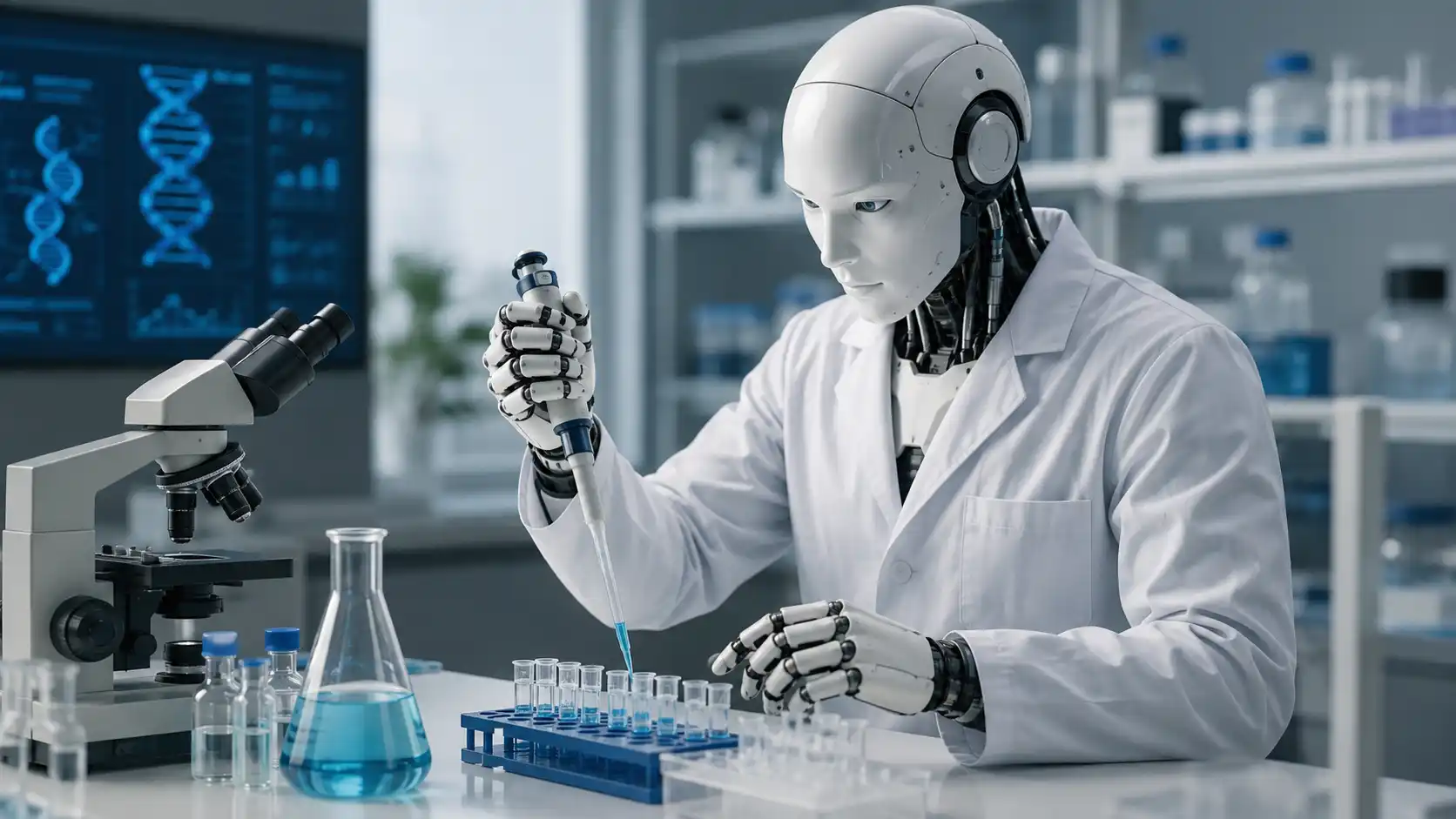
Anthropic’s Model Hardware Standard gives AI agents a shared interface to microscopes, liquid handlers, robotic arms and lasers. Early pilots show striking gains, but the strongest lesson is not that Claude has become an autonomous scientist. It is that lab automation’s expensive integration layer may be becoming programmable, making validation, physical safety and institutional trust the next constraints.
Table of Contents
Anthropic crossed an important boundary on August 27, 2026, when it opened a research preview of the Model Hardware Standard, or MHS: a specification that lets AI agents read from and operate programmable physical equipment. The early demonstrations span Genentech lab robots, Carnegie Mellon dose-response experiments, HHMI Janelia microscopes, a University of Washington workflow, QuEra quantum-computer lasers and Tetsuwan’s automated biology lab. Reuters and the Financial Times independently reported the launch as Anthropic’s move from software agents toward physical scientific systems.
The eye-catching numbers are real, but several viral summaries overstate what happened. At QuEra, an unattended Claude-driven development loop improved a laser-recovery program overnight; the final production candidate was then tested as deterministic code, not as a language model improvising every recovery. At Washington, a plate-handoff demo ran without the researcher touching the instruments, but an all-night end-to-end autonomous workflow remains a stated future direction, not a demonstrated result. The real breakthrough is narrower and potentially more consequential: MHS attacks the integration problem that has kept many already-robotic labs from becoming flexible, agent-operated systems.
A research preview crossed the software-to-hardware boundary
Anthropic describes MHS as a shared specification for agents to operate physical devices, and the official MHS site is explicit that the system remains a limited research preview, with access by application while partners develop safety evaluations and best practices. The standard is intended to work with devices that expose a programmable interface, and Anthropic says it is model-agnostic rather than Claude-exclusive. That matters because the proposal is less a new robot than an interoperability layer between models and existing machinery.
The move follows a longer Anthropic strategy of giving models structured access to external systems. In November 2024, the company introduced Model Context Protocol, or MCP, as an open standard for connecting AI applications to software and data sources. MHS extends that architectural idea to machines with states, limits and physical consequences: microscopes, liquid handlers, robot arms, plate readers, lasers and other programmable equipment. The conceptual shift is from “Claude can use a tool” to “an agent can discover and coordinate a roomful of tools through one control vocabulary.”
This is also a continuation of Anthropic’s life-sciences push rather than an isolated robotics experiment. When it launched Claude for Life Sciences in October 2025, Anthropic said its ambition was to support the research process from early discovery onward and eventually enable AI models to make discoveries autonomously. The new hardware layer supplies something that earlier software integrations lacked: a route from protocol reasoning and analysis into experiment execution.
Independent coverage has focused on the same boundary. WIRED described MHS as a framework for letting agents use physical systems while specifying what those agents should and should not do; the Financial Times reported that Anthropic had tested it with organizations including HHMI, Carnegie Mellon, Genentech and QuEra. That combination of access and constraint is the product thesis. The difficult part is not merely making an actuator move. It is creating a general interface through which an agent can understand what a device can do, what state it is in and which actions are forbidden.
The QuEra result is stronger and narrower than the viral version
QuEra provides the cleanest quantitative result. Its neutral-atom quantum computers depend on lasers held at extremely precise frequencies. A bespoke automated recovery script previously took about 150 seconds per attempt and succeeded roughly 58% of the time, while a human recovery could take five to ten minutes. QuEra then gave Claude, through MHS, access to a testbed and a goal: improve the relocking controller. Four fresh Claude instances cycled through proposing changes, editing code, running the updated script against the live laser and evaluating the logs. The loop repeated hundreds of times unattended overnight.
By morning, the development run was recovering the laser in about six seconds with 96% success. QuEra then evaluated the finished controller separately across 700 randomized disturbance trials. It recovered the correct lock 695 times, or 99.3%, with easier failures taking 0.9 to 5.4 seconds and the hardest taking roughly 10 to 14 seconds. QuEra also reported 43 naturally occurring mode hops during the pilot, all automatically recovered.
The qualification is important. The 99.3% figure does not mean Claude itself was sitting in the control loop and reasoning in real time for every production recovery. QuEra says the product of the agent’s work was a deterministic, inspectable program. Anthropic makes the same distinction: when online reasoning would be too slow or unnecessary, an agent can package learned behavior into code files that the equipment executes directly. That design is arguably more interesting than a permanently improvising model, because it turns an agent into a developer and optimizer of control logic whose final behavior can be inspected and tested.
Nor did the pilot eliminate expert involvement. Anthropic’s account says Claude struggled when problems required understanding the physical rig rather than its programmatic interface, sometimes stopped for human confirmation on actions it considered risky, and needed substantial context about the task. The result is evidence for accelerated controller development, not proof of a self-sufficient quantum engineer.
MHS turns fragmented instruments into an agent-readable control surface
Laboratory automation has had capable machines for decades. The stubborn problem is that an automated workstation can still be a collection of proprietary islands. One instrument accepts a vendor API, another runs through an older Windows interface, another exposes only a graphical application, and researchers carry status and samples between them. Reviews of self-driving laboratories identify software integration, workflow orchestration and generalizability as persistent infrastructure problems even as robotics and optimization improve.
MHS tries to standardize that boundary. Anthropic says an MHS driver exposes a device through simple primitives such as reading a value or writing a setting, makes the device discoverable in a common format, and can attach natural-language metadata describing capabilities and safety limits. An agent can then sequence operations, watch state, alter parameters and, where appropriate, generate code that calls several devices without reasoning through every low-level step. The hidden mechanism is abstraction: MHS attempts to make physical equipment legible to agents in the same way software protocols make services legible to programs.
Carnegie Mellon’s preview illustrates why that matters. Researcher Sina Barazandeh reported a setup in which a liquid handler, plate reader, robotic arm and cameras were distributed across three computers with incompatible control styles. MHS presented those devices to the agent as a shared set of states and procedures. Barazandeh says he built drivers and the orchestration layer in about eight hours; the resulting closed-loop serial-dilution workflow ran about three times faster than the prior process. MHS itself was not the scientific instrument. It was the layer that stopped the agent from having to learn a new control language for every instrument.
That architecture mirrors the broader direction of self-driving laboratories. A 2026 Nature Reviews Chemistry review describes the field’s next phase around scalability, generalizability and provenance-complete experimentation, while a 2025 Nature Communications perspective called for tools that effectively automate the act of automation itself. MHS is best understood as one proposed answer to that infrastructure problem, not as the invention of autonomous experimentation.
The economics hinge on integration work, not cheaper robots
The business case begins with labor and utilization. A liquid handler or robotic arm can already perform repetitive tasks with high precision, but a new assay often requires an automation engineer to translate the protocol into machine-specific logic, configure each interface, test edge cases and maintain the resulting stack. That cost makes fixed, high-volume workflows easier to justify than constantly changing research. Tetsuwan’s account says translating a single experimental configuration into an automated workflow can take weeks to months, which is why much biological experimentation remains manual despite decades of laboratory robotics.
Genentech’s BCA protein-assay pilot exposes the target. Claude orchestrated a liquid handler, robotic arm and plate reader through MHS. In a closed-loop test, it varied pipetting flow rates, compared its transfers with an expert-performed ground truth using root mean square error, and adjusted the settings. It converged on roughly 140 microliters per second for water and 10 microliters per second for viscous bovine serum albumin, values Genentech’s automation experts considered reasonable for that setup. If such calibration loops generalize, the economic prize is not the robot’s purchase price; it is the engineering time between a scientific idea and a reliable automated run.
The Carnegie Mellon example points in the same direction: eight hours to create drivers and orchestration in the preview versus the weeks of per-instrument integration that motivated the work. Anthropic makes a broader claim that MHS can reduce some integrations from weeks or months to hours or minutes, but that remains a vendor claim based on early partner projects, not a benchmark across laboratories. The evidence is promising precisely because it attacks an expensive bottleneck; it is still too early to assign a universal savings figure.
The U.S. Department of Energy’s autonomous-laboratory program frames the same economic and scientific problem at institutional scale: combine robotics, edge AI, real-time analysis, intelligent feedback and data systems to increase experimental throughput and repeatability. The strategic value of MHS will depend on whether it becomes shared infrastructure rather than another integration layer that each lab must customize heavily. That requires stable drivers, vendor participation, auditability and a sufficiently neutral governance model to persuade labs that their automation investments will not be stranded.
Closed loops are moving from optimization to orchestration
Genentech’s experiment shows the classic closed loop: choose a parameter, run the physical test, score the result, update the parameter and repeat. That pattern is already familiar in self-driving laboratories, which combine automated execution with algorithms that select or refine experiments. The 2025 Nature Communications perspective describes an SDL as a joint digital and physical system working toward a human-defined objective, with experiment selection and adaptation distinguishing it from conventional high-throughput automation.
What MHS adds is a route to coordinate heterogeneous hardware inside that loop. At Carnegie Mellon, the agent prepared dilution series, checked plate placement through cameras, moved plates with a robotic arm, read measurements and decided whether to adjust the concentration range. At HHMI Janelia, Anthropic reports that MHS has exposed lasers, mirrors and sensors on custom microscopes so Claude can align beams, tune optics and check results; a separate open-source Janelia project, Gently, documents an agentic microscopy harness with device limits, restricted actions, process isolation and automatic cleanup. The agent is becoming an orchestration layer across instruments, not merely an optimizer attached to one machine.
Tetsuwan extends that idea into wet-lab scheduling. Its ResearchOS uses Claude to translate natural-language experimental intent into a domain-specific representation, while MHS coordinates connected robots and exposes state. In the San Pedro Creek project, Tetsuwan used qPCR to test species-specific markers associated with fecal contamination and reported preliminary results consistent with prior local testing that pointed to humans as the primary source. Independent CBS reporting in May 2026 had already described volunteer testing that found human-source contamination in the creek, so the MHS work should be read as corroborating an existing finding rather than discovering the contamination from scratch.
This distinction matters because automation and scientific discovery are not synonyms. An agent can make the design-build-test-analyze cycle cheaper and faster without being the source of the hypothesis or the final scientific judgment. The near-term value may therefore come from compressing handoffs, monitoring and parameter search long before labs entrust models with open-ended research agendas. That is consistent with the broader self-driving-lab literature, which treats human-defined objectives, provenance and measurable acceleration as core design concerns.
Scientists gain time, but responsibility does not disappear
The University of Washington example is compelling because its baseline is mundane. PhD student Zihao Song described a PCR step that handled one plate at a time and required plate changes every 90 minutes, sometimes sending him back to the lab at 4 a.m. He then connected instruments through MHS, used Claude Code to monitor qPCR curves, and demonstrated a plate handoff in which a robotic arm moved a finished plate after the liquid handler completed its work. Across repeated tests, Anthropic says the instruments did not collide, and Song watched the run from his office without touching the equipment.
But the strongest version of the viral claim goes beyond the evidence. Anthropic’s write-up says that chaining many such steps overnight is a future direction, and Song calls the demonstrations proofs of concept. More complicated protocols will need additional optimization, physical manipulations and a cost calculation for keeping an agent running over long monitoring windows. The demonstrated gain is remote monitoring and hands-off coordination of specific steps, not a fully autonomous laboratory shift.
If the systems mature, the labor effect will be uneven. Reviews of self-driving laboratories expect automation to remove repetitive experimental work while increasing the importance of supervision, maintenance, workflow design, data stewardship and higher-level scientific judgment. That implies a change in the scarcity structure of a lab: fewer hours spent babysitting machines, more demand for people who can define objectives, validate outputs, diagnose physical failures and decide when an automated result is scientifically credible.
For institutions, that redistribution is as important as raw throughput. A lab that can run longer is not automatically a lab that learns faster. Experimental design, reagent availability, instrument uptime, downstream analysis, quality control and publication-grade provenance can become the next bottlenecks. The most useful metric is therefore not “hours without a person in the room” but whether the system increases reliable learning per unit of scientist time, instrument time and material consumed. The self-driving-lab field has increasingly emphasized benchmarking and provenance for exactly that reason.
Physical reasoning and safety remain the hard ceiling
The pilots also show where frontier models still fail. In Genentech’s work, Claude initially handled bubbles poorly. When mixing created foam, its default response was to retry with different parameters in the same well, which aggravated the problem. Researchers had to explain the physical cause and guide the model toward moving to a clean well and mixing more gently; that knowledge was then codified into reusable skills. The agent could reason over instrument state, but it did not reliably infer the underlying fluid physics.
Anthropic’s own robotics research makes the broader limitation explicit. In simulated and physical robotics tests, stronger models extracted more useful spatial information from images than older ones, yet the research notes that model latency can be too slow for tight physics loops; some simulations had to pause while the model produced its next action. MHS partly sidesteps that constraint by letting agents compile sequences into code, but it does not make a language model a real-time controller.
Safety therefore has to live below the model as well as inside it. QuEra says its MHS implementation bounded autonomy with device-declared limits, interlocks and emergency stops independent of the model. The Janelia Gently project documents a similar layered approach, including process isolation, hard device limits, restricted action vocabularies and automatic cleanup. Research on safe self-driving laboratories argues that physical autonomy introduces accident modes that require dedicated risk assessment rather than assuming software-style safeguards are sufficient. A trustworthy architecture should remain safe when the model is mistaken, slow or unexpectedly creative.
Biology adds a second risk category: misuse. Anthropic’s Responsible Scaling Policy treats advanced chemical and biological capabilities as a catastrophic-risk area requiring stronger deployment safeguards as models cross defined thresholds. WIRED noted the obvious tension in MHS: the same generality that can lower the cost of legitimate experimentation could expand the action surface available to a malicious or compromised agent. A limited preview with vetted partners is therefore not just launch conservatism; it is part of the evidence-gathering phase for a system that can cause physical effects.
Labs should treat MHS as infrastructure, not an autonomous scientist
For research leaders, the practical question is not whether to “hire an AI scientist.” It is whether a standardized agent-to-hardware layer can reduce integration work without weakening validation. The first candidates are workflows with clear success criteria, machine-readable state, reversible actions and strong physical interlocks: calibration, monitoring, plate transport, bounded parameter optimization and fault recovery. These are the places where the early evidence is strongest.
The next decision is architectural. A lab should separate the model’s exploratory role from deterministic execution wherever possible. QuEra’s result is instructive: Claude searched the control-logic space, but the validated output was inspectable code. Genentech turned lessons about liquid handling into reusable skills. MHS itself lets long-running or latency-sensitive operations move into code files instead of requiring token-by-token reasoning. That pattern gives institutions a clearer verification target and makes regression testing possible.
Procurement also changes. If standards like MHS gain adoption, buyers will care not only about instrument accuracy and throughput but about programmatic accessibility, driver quality, explicit safety bounds, state observability and provenance. The official preview already limits MHS to programmable equipment; devices with closed interfaces remain harder to integrate. Hardware openness could become a purchasing criterion because it determines whether expensive instruments can participate in agentic workflows.
The final discipline is measurement. Teams should benchmark against the actual human or automation-engineering baseline, preserve audit logs, test recovery from induced faults and distinguish development-time agent performance from runtime controller performance. The self-driving-lab literature has pushed for comparable acceleration metrics because a spectacular demo can conceal setup cost, narrow task design or a human doing essential work off camera. MHS will deserve broad adoption only if its gains survive those accounting rules.
The decisive test is reproducible autonomy across unfamiliar workflows
The evidence as of September 3, 2026 supports a strong but bounded conclusion. Anthropic and its partners have shown that a general-purpose language-model agent can operate and coordinate real scientific hardware through a common interface, improve control logic through repeated physical trials, optimize some experimental parameters and manage selected multi-instrument workflows. That is a material step beyond an AI assistant that only reads papers, writes code or analyzes results.
It does not yet establish a general autonomous laboratory. The strongest demonstrations remain curated pilots with instrument drivers, explicit goals, safety envelopes, expert context and substantial human engineering around the model. Some successes culminate in deterministic software; some workflows still ask for human approval; some physical failures expose gaps in the model’s intuition. The research literature’s longstanding requirements—generalizability, provenance, safety, benchmarking and robust integration—have not disappeared because the interface became easier.
The next proof should therefore be less theatrical and more demanding: give independent labs unfamiliar workflows, heterogeneous equipment and measurable scientific objectives, then test whether the same architecture reduces integration time and increases valid experimental throughput without requiring hidden specialist rescue. Cross-lab replication would matter more than another single-night optimization record. If MHS or a successor can make that performance routine, automated science will have moved from bespoke robotics projects toward reusable infrastructure.
That condition is what makes the present moment important. Robots already existed, closed-loop laboratories already existed, and AI-generated experimental plans already existed. The new possibility is that a standard agent interface could connect those pieces cheaply enough for far more laboratories to use them. The bottleneck would then shift from “can we automate this machine?” to “can we specify, constrain, verify and trust what the agent is allowed to do?” That is a harder institutional problem—but it is also the one that appears next.
The questions researchers and operators are asking
Yes, in a limited research preview. MHS lets compatible AI agents operate programmable devices including microscopes, liquid handlers, robotic arms and laser systems through standardized drivers. It is not yet a general public deployment.
Yes, with an important distinction. Claude helped develop the improved controller through unattended physical testing. The final 99.3% result came from a separate 700-trial validation of the deterministic controller, which succeeded 695 times.
The overnight development run reached about six seconds on average at 96% success. In later validation, easier disturbances took 0.9–5.4 seconds and the hardest 10–14 seconds, versus roughly five to ten minutes for a human recovery.
Claude ran a closed loop that varied flow rates, measured transfers, compared them with an expert ground truth and converged on reasonable settings. However, Genentech also documented a bubble-related failure mode where researchers had to supply physical insight.
Not yet as a complete overnight workflow. The researcher demonstrated remote monitoring and hands-off coordination between a liquid handler and robotic arm; Anthropic presents chaining many such steps overnight as a future direction.
No. Tetsuwan used an MHS-orchestrated qPCR workflow that produced preliminary data consistent with earlier local findings that human fecal contamination was the primary source. Independent reporting documented the prior finding.
Anthropic says no. MHS is designed to be model-agnostic, and Carnegie Mellon’s write-up also states that Claude was one compatible agent used in the preview rather than a requirement of the standard.
It can enforce device-level bounds and support interlocks, but the preview does not establish that every workflow is safe to run unattended. Early pilots still required human context and, in some cases, approval or physical troubleshooting.
They are closer in the sense that agent-to-hardware integration is improving, but “fully automated” remains task-dependent. The best evidence today supports bounded autonomy in selected workflows, while generality, safety, provenance and physical reasoning remain open engineering problems.
Author:
Jan Bielik
CEO & Founder of Webiano Digital & Marketing Agency
This article is an original analysis supported by the sources cited below
Previewing the Model Hardware Standard
Anthropic’s primary announcement of the Model Hardware Standard, used to establish the research-preview status, technical architecture, supported hardware categories and the Genentech, University of Washington, Janelia and QuEra case studies.
The official MHS project site, used to confirm the standard’s scope, its model-agnostic design, access conditions and its intended role as a common interface between AI agents and programmable physical equipment.
Holding the Light: Teaching an AI to Lock and Tune our Quantum Computer’s Lasers
QuEra’s primary technical account, used for the laser-locking experiment, the 700-trial validation, the 99.3% recovery rate, recovery-time measurements and the distinction between Claude’s development process and the deterministic controller deployed afterward.
Safe closed-loop agentic dose-response experiments using the Model Hardware Standard
The Carnegie Mellon project account, used for details of the multi-instrument setup, the integration process, device constraints, closed-loop experimentation and the reported reduction in workflow execution time.
Integrating Anthropic’s Model Hardware Standard
Tetsuwan Scientific’s primary account, used for its ResearchOS integration, automated laboratory orchestration, qPCR testing and the San Pedro Creek contamination experiment.
Anthropic unveils new framework allowing AI agents to operate physical devices
Reuters reporting used as independent confirmation of Anthropic’s August 2026 MHS launch, its physical-device scope and the organizations participating in early testing.
Anthropic launches AI tool that can conduct scientific experiments
Financial Times reporting used as independent context for Anthropic’s expansion from software agents into physical scientific workflows and laboratory equipment control.
This Is How Anthropic Thinks AI Agents Should Navigate the Physical World
WIRED reporting used to examine the safety implications of AI agents operating physical systems and the relationship between MHS and Anthropic’s broader agent infrastructure strategy.
How Claude performs on robotics tasks
Anthropic research used to contextualize Claude’s limitations in spatial understanding, physical-world reasoning and latency-sensitive robotic control.
Introducing the Model Context Protocol
Anthropic’s primary announcement of the Model Context Protocol, used to explain the architectural precedent for giving AI systems standardized access to external tools, data and services.
Anthropic’s life-sciences announcement, used to place MHS within the company’s broader effort to extend Claude across scientific research workflows.
Anthropic’s Responsible Scaling Policy
Anthropic’s official safety policy, used to establish the company’s approach to advanced biological and chemical capabilities and the safeguards associated with higher-risk model deployments.
The past, present and future of self-driving laboratories
A Nature Reviews Chemistry review used to place MHS within the wider development of self-driving laboratories and to examine remaining challenges around scalability, generalizability, provenance and integration.
Steering towards safe self-driving laboratories
A Nature Reviews Chemistry perspective used to contextualize the physical and operational safety requirements that arise when laboratory systems gain greater autonomy.
Science acceleration and accessibility with self-driving labs
A Nature Communications perspective used to define self-driving laboratory systems and explain the role of automated experimentation, closed-loop decision-making and human-defined scientific objectives.
Achieving AI-Driven Autonomous Laboratories
A U.S. Department of Energy source used to show how robotics, artificial intelligence, real-time analysis and automated feedback are being combined as part of a broader autonomous-laboratory research agenda.
Report shows Linda Mar Beach in Pacifica contaminated with human waste; source still a mystery
CBS News reporting used as independent context for earlier testing that identified human-source fecal contamination connected with San Pedro Creek before the later MHS-orchestrated qPCR experiment.
| Citing this article? Brief excerpts are welcome. Please credit Webiano.digital, name the author where stated, and include a link to https://webiano.digital and to this original article. Full or substantial republication requires prior written permission. Read our Copyright and Content Use Policy. |
This article was prepared with the assistance of artificial intelligence tools. The content underwent expert human review, and Webiano Digital & Marketing Agency assumes editorial responsibility for its final version and publication.