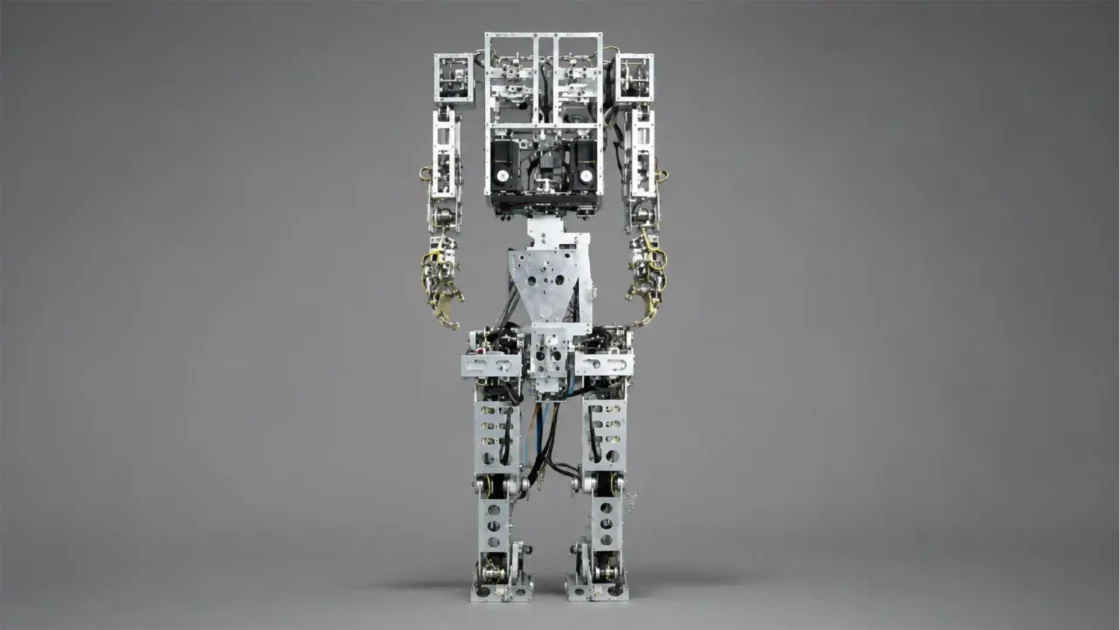
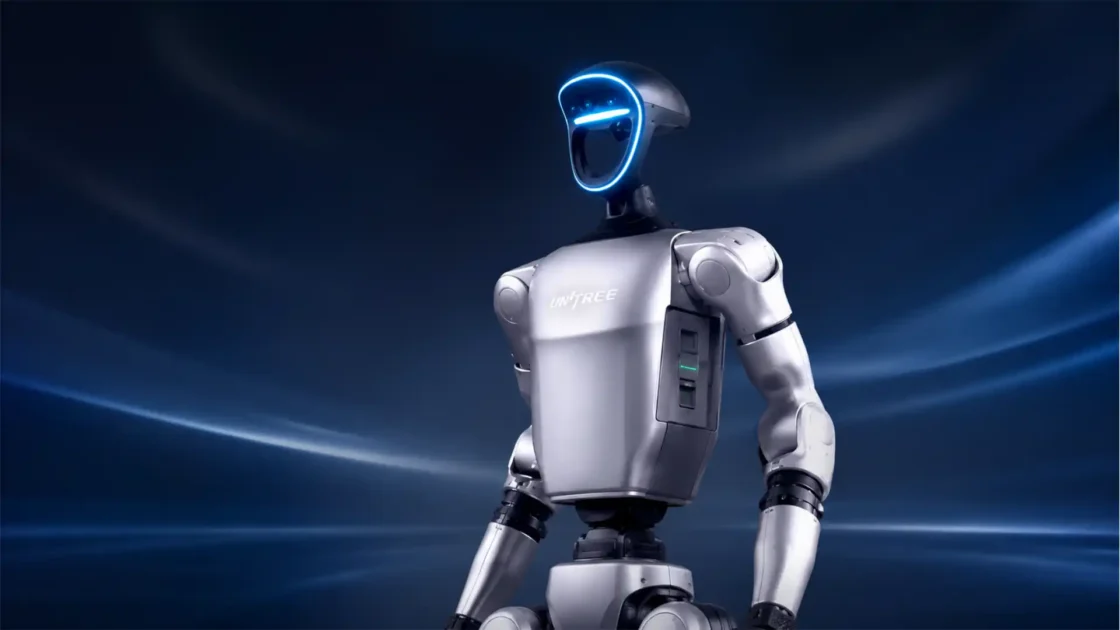
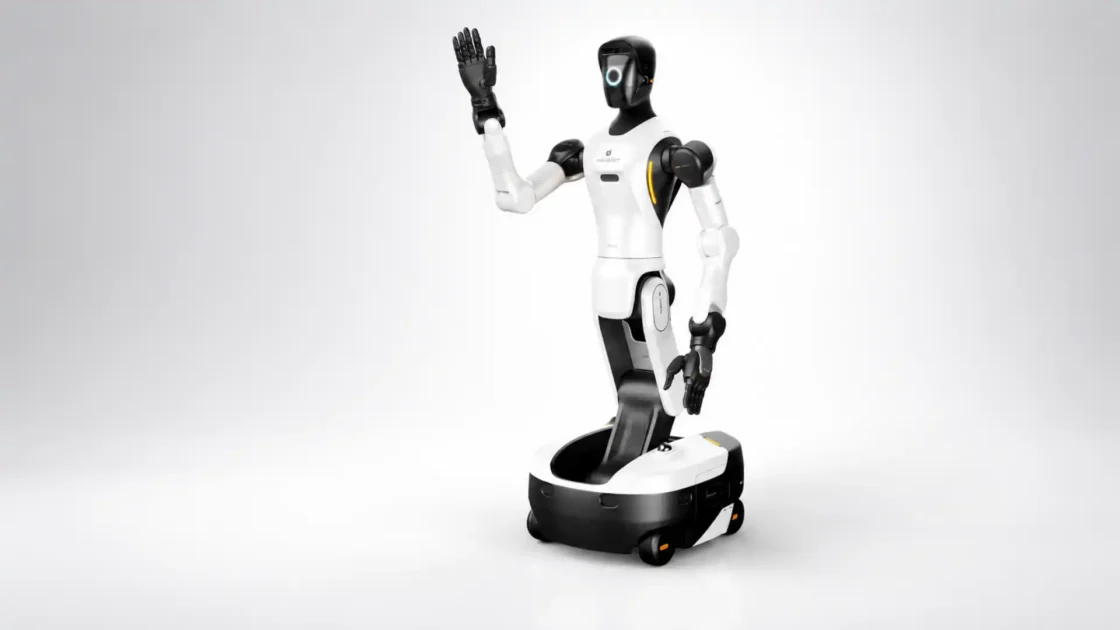
A robot trained in simulation can do only what its simulated motors can do, and Boston Dynamics’ wheeled Atlas video is a stunt that doubles as a load test of that rule. The published evidence comes from Spot and a smaller humanoid, not from the wheels. The video itself offers no torque, speed or failure figures, and actuator failure, the next test, is the one that counts.
Table of Contents
A robot trained in simulation can do only what its simulated motors can do, so the motor model decides whether a learned policy survives contact with hardware. Researchers at the RAI Institute reported in a 2025 paper that one round of tuning simulated joint friction and torque limits lifted the top speed of Spot, Boston Dynamics’ quadruped, from 3.8 m/s to 5.2 m/s on a real robot. It also made a flying-trot gait work that had failed before. Spot’s default controller tops out at 1.6 m/s, according to the same paper. The authors made only minor reward adjustments; what changed was the simulator’s picture of the motors.
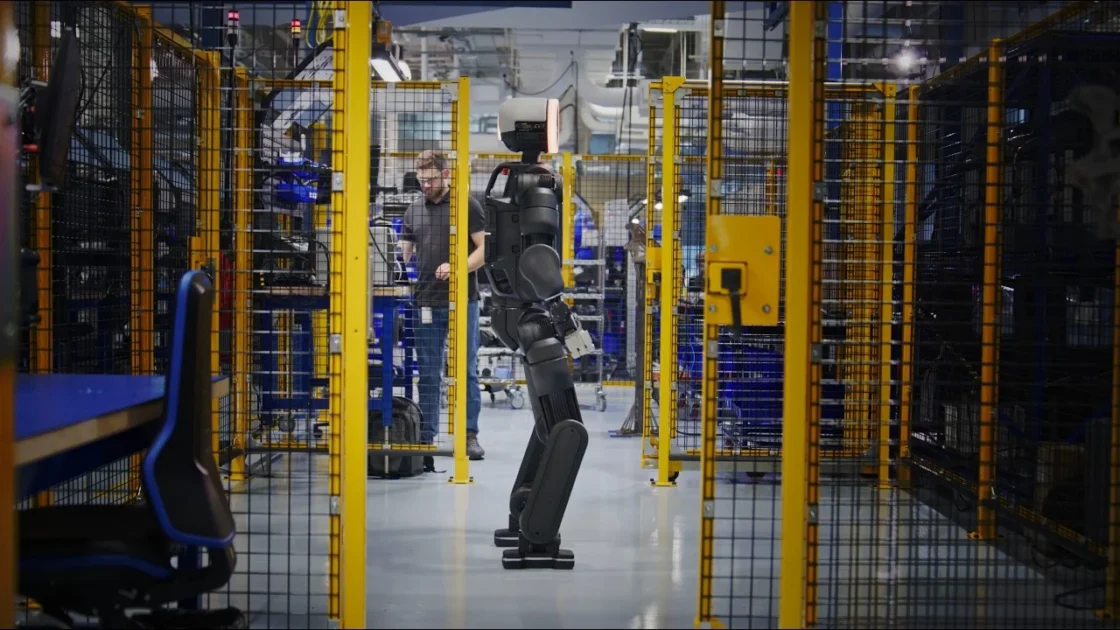
That is the idea behind Atlas on a Roll, a video Boston Dynamics published on its own channel on 9 November 2026. Controls engineer Andy Wu explains why the company swapped the humanoid’s feet for scooter wheels: the robot is a test of how a learned whole-body controller behaves when real actuators run at the edge of their limits. The video is company-made, and its description links to Boston Dynamics’ careers page. It makes claims about simulation-to-hardware transfer and gives no measurements to check them against.
A scooter rim, one adapter and a mocap jump
According to the blog post Wu wrote to accompany the video, the hardware change was a single custom adapter that mounts an off-the-shelf scooter rim onto Atlas’s existing ankle actuator, and that adapter is the only new part. In software each wheel is modelled as an ankle that can spin continuously, so he swapped the feet for wheels in the baseline robot model. The company calls the result a research testbed and says a wheeled Atlas is not a product.
The headline move, the 360-degree jump, was one of the lower-risk moves by Wu’s own account. It follows a motion-capture recording of a person jumping, run through a trajectory-tracking training pipeline, and he says it “just worked first try”. The side dashes are the more interesting case. Wu picked mocap clips with a lot of foot sliding, and the trained policy worked out how to steer the wheels and roll through them, a behaviour nobody scripted. Before the jump, the lower body rolls into position, which he says differs from how Atlas uses traction on feet.
The wheels were a load test for the motors
Wu’s stated reason for wheels is mechanical. He wanted motors delivering high torque and high speed continuously under real load, and driving does that: every launch, turn and stop pushes the motors across their full torque-speed range. The goal was to see how faithfully a learned controller works with actuators running at the edge of their performance envelopes.
The risk he describes is specific. If the simulation assumes motors that are over-idealised, the policy can learn moves the hardware cannot perform. Avoiding that took work the post calls unglamorous: checking that low-level control parameters matched across every software setup, running characterisation experiments on the robot, and tuning the simulated motor to what was measured. Wu also had to judge which approximations were safe and which the policy would learn to exploit. The reinforcement learning side needed only a few changes to existing frameworks, to the reward composition, the command range and posture handling.
Wu comes from classical motor control, and the post says this was his first real reinforcement learning project. He concludes that the robot’s limits usually sit between the layers, in how motors, low-level control and training interact.
Spot’s speed shows what a motor model is worth
The numbers behind Wu’s argument come from other robots. In the Spot paper, the authors recorded joint behaviour on hardware and in simulation, scored how far apart the two were, and let an evolutionary optimiser adjust eight parameters covering friction at the hips and knees and the torque-speed limits. The search ran 100 iterations with a population of 10. A single round was enough, they report, to raise maximum speed on hardware from 3.8 m/s to 5.2 m/s and to make flight-phase gaits work that had previously failed.
A second paper, on Atlas, Spot and Unitree’s smaller G1 humanoid, with authors from Boston Dynamics and the RAI Institute, trains each Atlas skill in about 10 hours on one NVIDIA L4 graphics card. In a controlled test on the G1, policies trained with a motor model that accounted for the linkages in the waist and ankle transferred reliably on three behaviours, while the version that ignored the linkages failed consistently on hardware. In simulation the two setups had similar training curves and comparable success, so simulation alone could not tell them apart.
Both papers are first-party research, and neither covers wheels.
Numbers the video leaves out
The video and the post give no torque or speed figures, no count of hardware trials, no failure rate and no comparison between the wheeled policy and a conventional controller. Wu’s remark that the move transferred “basically perfectly” is his judgement, offered without data, and the “first try” applies to a single trajectory-tracking jump.
Press coverage adds claims the primary material does not carry. The Robot Report, as summarised by Slashdot, says the work shows that combining classical motor control with reinforcement learning gives better agility than either alone, and that Atlas can switch between fast rolling on flat ground and legged movement over obstacles. Boston Dynamics’ own post makes no such comparison, and it describes wheels replacing the feet rather than a switch between rolling and walking.
The closest published comparison is in the Atlas paper. In simulation, its reinforcement learning policy matched a model predictive controller on walking, beat it on a jog and a cartwheel, and handled three motions that the controller could not execute at all. That was Atlas on feet, in simulation, and the same paper says its policies assume flat, non-slippery ground and rely only on the robot’s own sensors.
Atlas has two sets of published specifications
The post does not say which Atlas wore the wheels. It says only that the lessons are being adapted to the standard configuration and that Atlas was designed from the start for high-volume production and easy servicing. The Atlas in the research paper has 30 degrees of freedom, stands 1.8 m tall and weighs about 100 kg. The production robot unveiled at CES on 5 January 2026 has 56 degrees of freedom, a 2.3 m reach and a 50 kg lift, and a September 2026 report puts it at 1.9 m and 90 kg. Nothing in the material says which generation the wheels were bolted to, or whether its actuators came from Hyundai Mobis, which the company says will supply actuators for Atlas.
The answer matters because the 2026 production run is spoken for. Boston Dynamics said all deployments are committed to Hyundai’s robotics application centre and Google DeepMind, with more customers planned for early 2027, and The Register reports that the company declined to name any of them. As reported, Hyundai’s roadmap starts with parts sequencing at its Georgia plant in 2028, with component assembly targeted for 2030 and subject to technology validation.
Actuator failure is the next test before 2028
Wu says his next project is how a policy responds to failed actuators, and whether reinforcement learning can come up with behaviours of its own to cope. That is a reliability question, and the schedule gives it a date. Hyundai Motor’s union, which has about 40,000 members, voted by more than 86 percent in June 2026 to strike, with a demand for guaranteed employment and working conditions tied to AI, The Korea Times reported. The same article says Atlas is due at the Georgia plant from 2028.
It is an inference, not a statement from any party, that a humanoid which keeps its footing after a motor fails is a more defensible co-worker than one that performs stunts. The wheeled Atlas shows how the company tests for the first, and the failure project is where that test begins. The post reports no failure results yet.
Questions a buyer can put to any humanoid vendor
An engineer or procurement team comparing legged or wheeled robots can lift five checks from this material. Ask whether the motor model was fitted to measurements from the actual hardware, and who ran the characterisation. Ask how many hardware trials stand behind a demonstrated move, and how many failed. Ask what the robot does when an actuator fails mid-motion, which hardware generation the demo ran on, and whether the same controller has been tested on slippery or uneven ground.
The Spot paper shows that such answers can be reported as numbers, with speed before and after tuning. The wheeled Atlas post has not yet done that, and until it does, the video proves a point about method rather than about performance.
Author:
Jan Bielik
CEO & Founder of Webiano Digital & Marketing Agency
This article is an original analysis supported by the sources cited below
Atlas on a Roll | Classical Motor Controls and Whole-Body RL | Boston Dynamics
The video itself: published on Boston Dynamics’ channel on 9 November 2026, with a description calling the wheeled Atlas a testbed for a learned whole-body controller at the edge of actuator limits.
Atlas On a Roll
Wu’s own account of the adapter, the motor characterisation work, the mocap-based moves and the planned failed-actuator project, with no measurements attached.
ZEST: Zero-shot Embodied Skill Transfer for Athletic Robot Control
Atlas specifications of 30 degrees of freedom, 1.8 m and 100 kg, roughly 10 hours of training per skill, the G1 motor-model comparison and the simulation-only comparison with model predictive control.
High-Performance Reinforcement Learning on Spot: Optimizing Simulation Parameters with Distributional Measures
The motor-parameter tuning run and the hardware result of 3.8 m/s rising to 5.2 m/s against a 1.6 m/s default.
Boston Dynamics Unveils New Atlas Robot to Revolutionize Industry
The CES 2026 release giving the production Atlas at 56 degrees of freedom, committed 2026 deployments and Hyundai Mobis as actuator supplier.
Hyundai Motor union set to leverage strike against Atlas robot deployment
The June 2026 strike vote by more than 86 percent of about 40,000 union members and the union’s demand for AI-related job guarantees.
Boston Dynamics beats Tesla to the humanoid robot punch
Independent reporting that the production Atlas is being built and that the company declined to name its 2027 customers.
Boston Dynamics’ Atlas Goes to Work: Hyundai Opens Georgia Facility to Test 25,000 Humanoids
Report on the 21 September 2026 opening of the Georgia application centre, the 2028 and 2030 task roadmap and the alternative 1.9 m, 90 kg specification.
Boston Dynamics’ Atlas robot performs a 360-degree jump on wheels
Trade-press summary confirming the scooter-wheel adapter, the motor-model refinement and that the findings are meant to shape the standard Atlas.
Boston Dynamics Adds Wheels to Atlas Humanoid
Excerpts from The Robot Report carrying the claims about superior agility and switching between rolling and legged motion that the company’s own post does not make.
Boston Dynamics Turns Atlas Into a Wheeled Actuator Testbed
A same-day rewrite of the company post whose byline states it is AI-generated, useful only to confirm the 9 November 2026 date.
| Citing this article? Brief excerpts are welcome. Please credit Webiano.digital, name the author where stated, and include a link to https://webiano.digital and to this original article. Full or substantial republication requires prior written permission. Read our Copyright and Content Use Policy. |
This article was prepared with the assistance of artificial intelligence tools. The content underwent expert human review, and Webiano Digital & Marketing Agency assumes editorial responsibility for its final version and publication.