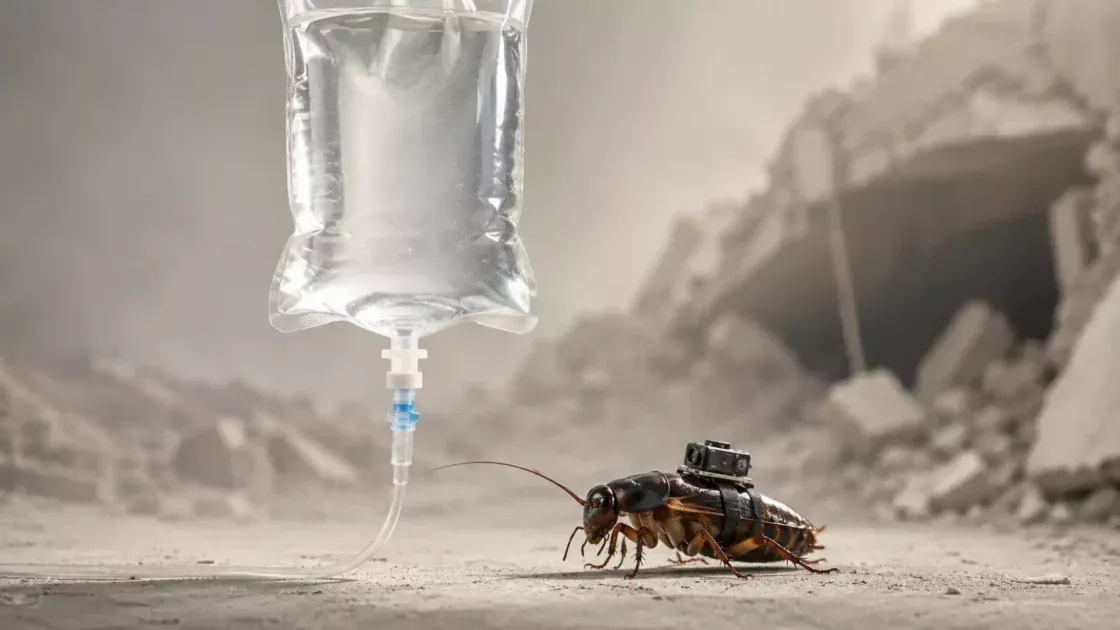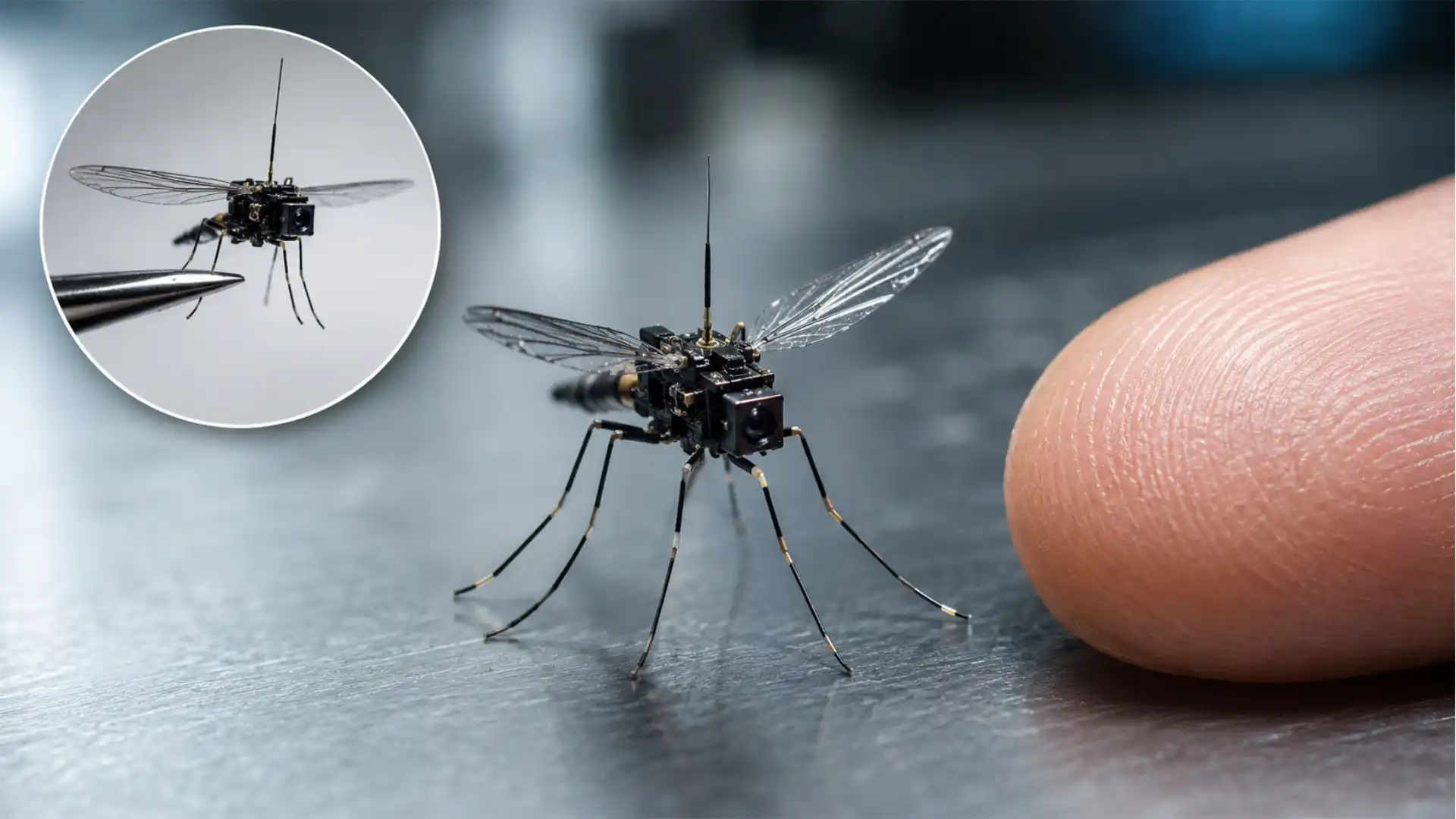
China’s mosquito-like microdrone is not yet the science-fiction weapon implied by the loudest online reactions. It is more revealing than that. The prototype shown by researchers linked to the National University of Defence Technology appears to be a laboratory-stage bionic micro air vehicle, roughly insect-sized, with flapping wings rather than rotors. Public reporting describes a device about 2 centimeters long and around 0.3 grams, shown on China’s CCTV-7 military channel, and framed by its demonstrator as suited to information reconnaissance and special battlefield missions.
Table of Contents
The serious part is not that this tiny machine can already do everything people fear. The serious part is that the system points to a direction of travel: surveillance platforms are shrinking toward the scale where detection, attribution, privacy law, counter-drone systems and battlefield assumptions all become less comfortable.
A laboratory object with strategic weight
The first mistake is to treat the mosquito drone as a finished weapon. The second mistake is to dismiss it because it is probably not one.
The available public evidence suggests a prototype, not an operational fleet. South China Morning Post reported on June 20, 2025, that a robotics laboratory at China’s National University of Defence Technology in Hunan province had developed a mosquito-sized drone for covert operations and that NUDT researchers showed it during a CCTV-7 report. The footage described a tiny body, two leaf-like wings and three hair-thin legs. A second, four-wing prototype could reportedly be controlled by smartphone.
Euronews described the device as about 2 centimeters long, weighing around 0.3 grams, with two small wings and three spindly legs. It also reported that the drone’s body carried sensors intended for covert surveillance and other military uses, while noting that the exact data collection capability was not disclosed.
That distinction matters. A public demonstration may show flight, shape and ambition. It does not prove endurance, usable live video quality, stable communications through walls, autonomous navigation, reliable manufacturing yield, swarm coordination or field deployment. The strategic signal is real; the operational capability remains uncertain.
This is why the phrase “China built a drone the size of a mosquito” needs careful handling. China’s researchers appear to have shown an insect-scale or near-insect-scale flapping-wing robot. The jump from “shown” to “fielded” is large. The jump from “can carry sensors” to “can quietly run a useful intelligence mission under real conditions” is larger still.
The public claim and the evidence behind it
The core public claim rests on three visible elements: the drone’s scale, its insect-like flight mechanism and its stated reconnaissance purpose.
The most-cited line from the CCTV segment came from Liang Hexiang, identified in reporting as a student at NUDT. He held the drone between his fingers and described it as a “mosquito-like” robot suited to information reconnaissance and special battlefield missions. South China Morning Post and Euronews both reported that framing from the televised segment.
Newsweek reported a slightly different size and mass detail, saying the device was about 2 centimeters long, around 3 centimeters wide, and weighed less than 0.2 grams. Euronews and National Defense Magazine used the 0.3-gram figure. Those discrepancies are normal in early reporting on a state-broadcast demonstration where no full technical datasheet has been published. The safe reading is that the device is well under one gram and around the size of a large insect, rather than that every reported number is settled engineering data.
A third claim is more delicate: sensor payload. Public reporting has referred to miniature cameras, microphones, environmental sensors and signals collection. National Defense Magazine described the demonstrated systems as dual- or quad-winged micro-UAVs equipped with miniature cameras, microphones and environmental sensors. Euronews reported that the body was packed with sensors but said the report did not disclose exactly what sort of data it could collect.
That gap should stay visible. A sensor being physically possible at insect scale does not mean the drone can deliver intelligence-grade data in a contested, noisy, windy or radio-hostile environment. Surveillance is a system, not a camera glued to a flying body. It needs power, stable motion, useful resolution, storage or transmission, mission planning, recovery or persistence, and a way to keep the operator from losing control.
A drone that imitates an insect instead of shrinking a quadcopter
A mosquito-like drone is not just a smaller quadcopter. At this scale, rotors, motors, batteries and flight control do not shrink in a simple linear way.
Large consumer drones work because electric motors, propellers, lithium batteries, GPS modules and cameras can be combined with enough margin for stability and payload. Shrink that system to a few centimeters and the margins collapse. Motors become hard to package. Propellers become inefficient and fragile. Batteries become too heavy relative to the airframe. A conventional design that works at 250 grams or 25 grams may fail at 0.3 grams.
That is why the Chinese prototype matters technically. It uses flapping wings, drawing from insect flight rather than rotorcraft design. The purpose is not cosmetic. Flapping wings can generate lift and control forces in ways that become attractive at tiny scales, where the aerodynamics are closer to the world insects inhabit than to the world quadcopters inhabit.
Harvard’s RoboBee program shows the same logic from a civilian research side. The Wyss Institute describes RoboBees as insect-inspired microrobots, smaller than a paper clip, weighing less than one-tenth of a gram, using artificial muscles and piezoelectric actuation. The program divides the problem into body, brain and colony: flight hardware, onboard sensing/control, and coordination across multiple small robots.
The Chinese demonstration sits inside that wider research lineage. It is not a sudden miracle. It is one more sign that micro air vehicles are moving from academic demonstrations toward military signalling and dual-use system design.
The wingbeat matters more than the mosquito shape
The viral image is the mosquito shape. The more important detail is the wingbeat.
Euronews reported that the wings could flap at 500 times per second, citing Chosun Ilbo. National Defense Magazine also described dual- or quad-winged configurations moving at 500 Hz. Such figures should be treated as reported claims rather than independently verified performance data, but the engineering direction is clear: the drone is built around rapid wing motion, not spinning rotors.
At insect scale, wing motion is the entire vehicle. The wing is propulsion, lift surface and control mechanism. Small changes in wing stiffness, hinge design, frequency, amplitude and timing can decide whether the robot hovers, tumbles, climbs, turns or crashes. This is why flapping-wing micro aerial vehicles are difficult even in the lab.
Harvard’s Nature paper on untethered insect-sized flight explained the basic obstacle with brutal clarity: heavier-than-air flight is energetically expensive, and the problem becomes worse at small scale. The paper said insect-sized robots under 500 milligrams and under 5 centimeters of wingspan had generally needed tethers because onboard electronics and power were too hard to integrate within limited payload capacity.
The NUDT prototype therefore belongs to a hard class of machines. It is not difficult because it is cute or small. It is difficult because every gram that does not exist still has to be allocated. There is no spare mass for sloppy design.
Tiny size turns ordinary engineering into systems engineering
A normal drone can be improved by swapping parts. A mosquito-scale drone cannot.
At a few tenths of a gram, the battery, wing membrane, actuator, frame, camera, microphone, antenna, processor and landing structure all compete for the same vanishing mass budget. South China Morning Post noted the manufacturing challenge directly: sensors, power devices, control circuits and other elements must fit into a very small space, requiring work across microscopic device engineering, materials science and bionics.
This is why the story is not only about China or surveillance. It is about a whole technological stack becoming smaller at once.
The body needs ultra-light materials that can survive repeated wingbeats. The actuator needs to flap fast without wasting power or tearing itself apart. The power source needs enough energy density to keep the robot airborne. The control system needs to stabilize a body that has almost no inertia. The communications system needs to move data without consuming the entire energy budget. The sensor package needs to produce useful information while being lighter than the dust on a consumer drone’s camera lens.
A larger drone can tolerate inefficiency. A mosquito drone cannot. At this scale, inefficiency is not a cost problem; it is a flight failure.
Reported prototype versus deployed microdrone systems
| System | Approximate scale | Flight method | Public maturity | Main lesson |
|---|---|---|---|---|
| NUDT mosquito-like drone | Around 2 cm, about 0.2–0.3 g reported | Flapping wings | Publicly shown prototype | Extreme stealth potential, severe power and payload limits |
| Harvard RoboBee X-Wing | 259 mg integrated untethered system | Four flapping wings, solar power | Research milestone | Power remains the central constraint at insect scale |
| Teledyne FLIR Black Hornet 4 | 70 g | Rotorcraft nano-UAV | Deployed military product | Larger size buys endurance, sensors, range and wind tolerance |
The comparison shows why “smaller” is not automatically “better.” The Black Hornet is far larger than the Chinese mosquito-like prototype, but its extra mass gives it more operational usefulness today. The mosquito-scale design points to a future category; the Black Hornet shows what troops can already use.
Prototype limits deserve as much attention as the spectacle
The strongest expert reactions have been cautious rather than panicked.
Business Insider interviewed military and technology experts after the Chinese demonstration. Herb Lin of Stanford’s Center for International Security and Cooperation said a mosquito-like drone could be useful for video feeds inside buildings, but he also pointed to battery capacity and wind as major limits. Samuel Bendett, a drone expert and adviser at the Center for Naval Analyses, said even indoor air currents from air conditioning, an open window or small obstacles could interfere with a drone that light. He also noted communications constraints because of the drone’s size.
Newsweek reported similar caution. Bryce Barros of the Truman National Security Project said the wartime surveillance impact would likely be minimal because of limited capacity, short range and presumed short battery life. The same article quoted analysts who still saw potential for intelligence, surveillance and reconnaissance in places larger drones cannot easily access, especially indoor spaces.
These judgments are not contradictory. They define the actual story. The mosquito drone is not yet a general battlefield sensor. It could become a specialized close-range reconnaissance tool if power, navigation, communications and payload limitations improve enough.
For now, its likely strength is not range. It is access. It could be aimed at cracks in the surveillance environment: an open window, a vent, a hallway, a room, a tunnel entrance, a collapsed structure, a vehicle interior, a temporary meeting site. Those are not wide-area missions. They are close, narrow and fragile missions.
Battery physics is the hard ceiling
The most important component in a mosquito-sized drone may be the component nobody sees: the power source.
Harvard’s RoboBee team described the problem as a “Catch-22”: at small scale, the tradeoff between mass and power becomes severe, and the smallest commercially available batteries can weigh more than the robot itself. In the RoboBee X-Wing demonstration, researchers used solar cells and intense laboratory lighting rather than a normal onboard battery; the system weighed 259 milligrams and needed about three Earth suns of light for flight, keeping outdoor operation out of reach at that stage.
That example is crucial for interpreting the Chinese claim. A tiny airframe can be impressive while still being power-starved. A camera can be present while still providing limited mission value. A microphone can be physically included while the aircraft cannot stay still long enough, quiet enough or close enough to collect useful audio.
The power problem appears in several forms:
- Endurance: a few minutes may be enough for a demonstration, but not for many missions.
- Payload: every milligram spent on sensing is a milligram not spent on power or structure.
- Transmission: live video and audio cost energy.
- Stability: active control uses electronics and actuation.
- Recovery: if the device cannot return or perch, it may be disposable by design.
A future battery breakthrough would change the equation, but battery improvements tend to arrive slowly compared with camera, processor and software improvements. That mismatch matters. AI may improve control before chemistry gives the drone enough energy to exploit that control for long missions.
Wind, air currents and the brutal scale problem
Wind is not just weather for an insect-sized drone. It is the operating environment.
A 70-gram Black Hornet 4 can advertise wind and rain tolerance because it has mass, rotor authority, sensors, battery capacity and control margin. Teledyne FLIR says the Black Hornet 4 weighs 70 grams, flies more than 30 minutes, operates beyond 3 kilometers and functions in 25-knot winds and rain.
A 0.3-gram flapping-wing robot lives in a different world. It is so light that ordinary indoor airflow can matter. Business Insider’s expert interviews underline this point: small drones are vulnerable to wind, and even air conditioning or a slight breeze can disturb a mosquito-like craft.
This limits near-term military use. A front line is not a laboratory. It has smoke, dust, rain, rotor wash, explosions, thermal currents, broken glass, wires, clutter and electromagnetic noise. A microdrone that performs in a controlled indoor demonstration may fail in a stairwell, factory, trench, vehicle bay or ruined apartment block.
The most plausible early use cases are therefore controlled or semi-controlled spaces: indoor reconnaissance, short inspection, close surveillance, laboratory research, tunnel peeking, search missions in tight voids and covert placement where the aircraft does not need to travel far.
Sensors are shrinking faster than full autonomy
The sensor story is real, but it should not be exaggerated.
Small cameras, microphones, inertial sensors, pressure sensors, light sensors and low-power processors have improved dramatically because of smartphones, wearables, medical devices, IoT hardware and consumer electronics. Those markets subsidize the miniaturization that military robotics can later use. The Chinese drone story reflects that broader supply chain.
Still, sensor presence is not the same as sensor quality. A tiny camera may produce low-resolution or unstable video. A microphone attached to a flapping robot may capture mechanical noise. Environmental sensors may collect useful readings only if the robot can hover, perch or pass through the target space in a controlled way.
Harvard’s RoboBee overview is useful because it separates the problem into body, brain and colony. Building a tiny body is only one part. The “brain” requires sensors and control electronics that allow the robot to sense and respond. The “colony” requires coordination among many robots.
The Chinese demonstration appears strongest as a body-and-miniaturization signal. Public information is thinner on autonomy, navigation and mission integration. The real leap will not be a smaller wing. It will be a small robot that can understand enough of its surroundings to complete a useful task without constant external support.
Communications may be the quiet bottleneck
A microdrone that cannot communicate is a flying recorder. A microdrone that communicates too much may exhaust itself or reveal itself.
This is the quiet bottleneck in insect-sized surveillance. The smaller the drone, the smaller its antenna and power budget. The lower its power, the more difficult it becomes to transmit useful video, audio or telemetry over distance, through walls or across cluttered indoor spaces.
Business Insider’s interviews made this point directly: communications are an issue because a drone that small is unlikely to carry much advanced equipment.
There are workarounds, but each has a trade-off. The drone could store data onboard and be recovered, but then the mission depends on recovery. It could transmit only short bursts, but then the operator gets less continuous awareness. It could fly near a relay, but then the relay becomes a larger detectable system. It could work as part of a swarm, but then swarm coordination adds overhead.
A microdrone is most convincing when the mission is local. The farther the data must travel, the less mosquito-like the whole system becomes, because somewhere nearby a larger receiver, relay, controller or operator is likely needed.
Indoor reconnaissance is the most plausible first mission
The drone’s best early mission is not sweeping across a battlefield. It is entering spaces where larger systems are too visible, too noisy or too big.
Indoor reconnaissance fits the physics. Distances are shorter. Wind is lower, though not absent. GPS is often unavailable, which is a problem, but visual, inertial or operator-guided control may be enough for very short missions. A tiny drone could look around a corner, inspect a room, approach a window, move through a narrow gap or check whether a person or object is present.
Herb Lin told Business Insider that a drone of this kind could be useful for video feeds inside buildings. Timothy Heath, quoted by Newsweek through earlier reporting, also framed potential value in places larger drones struggle to access, such as indoor areas.
This is also where the privacy concern becomes sharpest. A full-size drone flying over a crowd is visible and audible. A palm-sized Black Hornet may still be noticed if it comes close. A mosquito-like platform could be mistaken for an insect, ignored as a speck, or missed entirely in a cluttered interior.
That does not mean such drones are already roaming offices. It means privacy assumptions built around visible cameras and recognizable aircraft become weaker when the aircraft looks like environmental noise.
Battlefield use is harder than the viral framing suggests
Online reactions often jump straight to “battlefield spy” or “assassination drone.” The first is plausible in narrow cases. The second is speculative and unsupported by the public evidence around this prototype.
Battlefields reward systems that work under stress. They punish fragility. Useful drones need repeatable performance, logistics, operator training, repair or replacement pipelines, secure communications, resistance to jamming, and a mission role that justifies the burden. A mosquito-sized drone may be hard to detect, but it is also hard to power, hard to control and hard to recover.
The Black Hornet comparison is again useful. It is not mosquito-sized. It is roughly hand-portable. Its size buys a real mission envelope: daylight and thermal imaging, long endurance for its class, range measured in kilometers and declared wind/rain tolerance.
A mosquito-scale drone gives up much of that envelope in exchange for concealment. That could be worth it for very specific missions. It is not a replacement for quadcopters, fixed-wing reconnaissance drones, loitering munitions or soldier-borne nano-UAVs.
The right battlefield reading is narrow: a mosquito-like drone could become a special-purpose indoor or close-proximity sensor, not a general-purpose battlefield platform.
Espionage risk comes from proximity, not range
The most realistic concern is espionage at close range.
An insect-sized surveillance robot does not need to fly kilometers to matter. It might only need to cross a courtyard, enter through a gap, perch near a desk, move inside a vehicle, inspect a corridor or briefly capture what a guard, camera or human observer cannot see.
This is the kind of mission where smallness has strategic value. It creates ambiguity. Was it a bug, a piece of lint, a malfunctioning sensor, a toy, a natural insect, a laboratory accident or a deliberate device? Attribution becomes harder when the object is tiny, quiet and disposable.
Newsweek’s reporting framed both uses and risks: search and rescue on one side, personal privacy and criminal exploitation on the other.
Corporate security teams should read the drone less as a “flying mosquito camera” and more as a warning about physical-layer intelligence collection. Windows, vents, meeting rooms, labs, server rooms, loading docks and temporary executive spaces are already sensitive. Micro-robotics adds another reason to care about them.
The Black Hornet comparison shows the trade-off
The Black Hornet 4 is a useful reality check because it is small, military, mature and still far larger than a mosquito.
Teledyne FLIR describes the Black Hornet 4 as an airborne personal reconnaissance system for dismounted soldiers. At 70 grams, it offers more than 30 minutes of flight, more than 3 kilometers of range, 25-knot wind and rain operation, electro-optical and thermal imaging, obstacle avoidance and covert situational awareness.
Those specifications show what operational micro-reconnaissance currently demands. The aircraft needs enough mass for sensors, battery, radio, stability, ruggedness and usability. The operator needs a system, not just an airframe.
The mosquito-like drone is interesting because it attacks a different part of the trade space. It sacrifices endurance and payload for concealment. It may eventually reach places a Black Hornet cannot enter. But it will not soon match Black Hornet’s range, endurance, weather tolerance or sensor package.
The future may not be one winner. It may be layered: conventional drones for area coverage, nano-UAVs for soldier reconnaissance, insect-scale robots for short, covert access.
China’s low-altitude economy makes the story bigger than one robot
The mosquito drone appears inside a larger Chinese push into drones, robotics and low-altitude airspace.
China’s National Intellectual Property Administration cited Civil Aviation Administration of China forecasts that the country’s low-altitude economy would reach 1.5 trillion yuan by 2025 and exceed 3.5 trillion yuan by 2035. Reuters reported that China revised its Civil Aviation Law in December 2025 to formally regulate unmanned aircraft, with new rules effective July 1, 2026, including airworthiness certification requirements for drone-related entities and unique product identification codes for units.
That policy environment matters because military robotics does not develop in isolation. Civilian drone logistics, industrial inspection, navigation infrastructure, components, batteries, sensors, autonomous control software and manufacturing capacity all feed the same ecosystem. Reuters also reported that drone logistics had become a driver of China’s low-altitude economy, with millions of packages delivered by drone in 2024.
A mosquito-sized drone from a defense university is therefore not an oddity. It is a visible endpoint of a broader national stack: materials, microelectronics, aviation rules, dual-use industry, AI control, military research and manufacturing discipline.
A global research race that did not start in China
China did not invent the ambition to build insect-like flying machines.
Harvard’s RoboBee work has been public for years. The Wyss Institute describes potential uses including crop pollination, search and rescue, surveillance, weather and environmental monitoring. The RoboBee X-Wing achieved a major milestone in 2019 with untethered flight, but the details showed how demanding the field remains: a 259-milligram integrated system, solar power, about 120 milliwatts of power use and laboratory lighting far stronger than ordinary sunlight.
Nature’s paper on the RoboBee X-Wing reported a 90-milligram vehicle, a 259-milligram integrated flight system and the lightest sustained untethered insect-sized flight at that point. It also made clear that onboard electronics and payload capacity were the central obstacles.
The U.S. defense research community has also explored insect-scale ideas for decades. Euronews noted DARPA’s 2006 Hybrid Insect Micro-Electro-Mechanical Systems program, which pursued machine-insect interfaces rather than fully artificial robots.
The global pattern is clear. The United States, China, Europe and others are all interested in small autonomous systems. China’s demonstration matters because it moved a provocative microdrone image into a state-media military frame.
AI changes the control problem before it solves the power problem
AI will not repeal physics. It may still make insect-scale drones more capable.
The flight control problem at this scale is severe. Tiny robots have fast dynamics, low inertia and little tolerance for error. A gust, a wall effect, a wing imbalance or a slight actuator variation can destabilize the aircraft quickly. Software cannot create battery energy out of nothing, but better control can use limited energy more effectively and recover from disturbances that would otherwise end the flight.
MIT researchers reported major progress in insect-scale flight control in 2025. MIT News described an aerial microrobot that could fly with speed and agility closer to insects, using an AI-based controller and completing repeated body flips; the report said speed and acceleration improved by about 450 percent and 250 percent compared with earlier demonstrations.
Related research posted on arXiv described a 750-milligram flapping-wing robot performing aggressive maneuvers, resisting wind disturbance and completing 10 consecutive body flips in 11 seconds with deep-learned model predictive control. Another 2026 paper described a 1.29-gram aerial robot capable of onboard sensing and computation, centimeter-scale positional accuracy and a 30-second flight outside a motion-capture system.
Those systems are still larger than the reported Chinese mosquito-like drone. But they show the direction: autonomy is arriving first at the gram and sub-gram scale, then pushing downward.
Swarms are tempting but not automatic
The word “swarm” follows every microdrone story. It should be used carefully.
A swarm is not just many small drones in the air. It requires coordination, collision avoidance, task allocation, communications, identity management, power-aware planning and recovery from failures. At mosquito scale, every one of those requirements competes with the same tight energy and mass budget.
The Harvard RoboBee project’s “colony” concept captures the ambition: many independent robots acting as an effective unit. But public research also shows how hard it is to make even one insect-scale robot fly untethered, navigate and carry sensors. A swarm multiplies the system problem rather than removing it.
For military planners, the appeal is obvious. A swarm of tiny sensors could inspect many rooms, confuse defenders, distribute risk and make detection harder. For engineers, the cost is equally obvious. More units mean more charging, launch, control, networking, deconfliction and data filtering.
A future swarm of insect-sized drones is possible. A near-term swarm of reliable, autonomous, useful mosquito drones is not proven by the NUDT video.
Detection and countermeasures become harder at insect scale
The smaller the drone, the more awkward the defensive problem becomes.
Traditional counter-drone systems often rely on radar, radio-frequency detection, optical tracking, acoustic signatures or data fusion. Each method has weaknesses. A tiny flapping-wing device may have a very small radar cross-section, a weak radio link, low acoustic signature and an appearance that resembles biological clutter.
Euronews reported that experts said the Chinese device’s small size would make it difficult to detect with conventional radar systems.
The defensive side is already complicated even for larger drones. The FAA says airport UAS mitigation can include disrupting, disabling, destroying, taking control of or giving alternate flight instructions to a drone, but these are legally and operationally sensitive actions. CISA’s UAS detection guidance focuses on considerations for selecting and using detection technologies, while DHS Science and Technology says it is researching ways to protect against UAS threats and improve operational use.
For insect-sized drones, the defender may need a new mental model. It may not be enough to scan the sky. Sensitive sites may need layered physical security, controlled airflow, room-level monitoring, RF awareness, optical inspection and policies for suspicious micro-objects.
Privacy law was not built for artificial insects
Most drone laws were designed around aircraft, not artificial insects.
The FAA’s Remote ID framework requires registered or registration-required drones to provide identification and location information via broadcast, helping the FAA, law enforcement and other agencies locate the control station when a drone appears unsafe or is flying where it should not. EASA’s framework defines unmanned aircraft broadly and separates operations into categories such as open, specific and certified, with registration and remote identification requirements in the EU system.
Those systems are important for ordinary drones. They may be awkward for insect-scale devices, especially if used by state actors, covert operators, criminals or experimental labs outside standard civil aviation channels.
A mosquito-like drone raises privacy questions that aviation rules alone cannot answer. Who is allowed to deploy artificial insects near homes, offices, clinics, embassies, courts, factories or political meetings? How should consent work when a camera is invisible to ordinary perception? What counts as a search, trespass, wiretap or unauthorized recording when the device is smaller than a coin?
The privacy issue is not only flight safety. It is sensory access. A small drone changes who can place a microphone, camera or sensor near a person without being noticed.
Military signalling matters even when the prototype is weak
Defense demonstrations are messages.
The NUDT drone was shown on CCTV-7, China’s military channel, not buried in a technical journal. That does not make every claim operational. It does mean the demonstration was meant to be seen. The audience included domestic viewers, foreign analysts, rival militaries, engineers, investors and policymakers.
A prototype can signal several things at once: research competence, ambition, dual-use capacity, military imagination and willingness to explore uncomfortable technologies. It can also invite exaggerated foreign reactions, which may serve its own strategic purpose.
Business Insider quoted Michael Horowitz of the Council on Foreign Relations saying the demonstration showed that Chinese researchers want to push drone innovation forward, while noting that the real capability, fielding timeline and mission uses remain unclear.
That uncertainty is part of the signal. A visible prototype forces competitors to spend attention on the possibility space. Even if the current drone is fragile, adversaries must ask what version two, five or ten might do.
Civilian uses are real but politically fragile
The same technology that alarms security officials could also be useful in civilian missions.
Insect-scale robots could inspect collapsed buildings, search tight spaces after earthquakes, monitor pollution, examine hazardous industrial sites, support precision agriculture or collect environmental data without sending people into danger. Harvard’s RoboBee program explicitly lists crop pollination, search and rescue, surveillance, weather, climate and environmental monitoring as potential areas. MIT’s 2025 work on robotic insects also framed future use in search-and-rescue and mechanical pollination, while stressing that natural insects still outperform bug-sized robots in endurance, speed and maneuverability.
The problem is trust. A microdrone that can search rubble can also search a room. A sensor that can monitor air quality can also collect private data. A platform that can enter tight spaces can enter places people intended to keep private.
This does not make the research illegitimate. It makes governance urgent. The civilian future of insect-scale drones depends on strict use boundaries, visible accountability and credible limits on surveillance.
The dual-use dilemma will shape export controls and standards
The mosquito drone is dual-use by design. The same miniaturization stack serves medicine, industrial inspection, agriculture, rescue robotics, military reconnaissance and espionage.
The Black Hornet 4 page includes export-control language noting that the information may pertain to products subject to ITAR or EAR depending on specifications. That is the world insect-scale surveillance systems are likely to enter if they mature: controlled components, restricted transfer, military procurement channels and questions about end use.
China’s revised aviation rules also show that drone growth eventually forces regulatory catch-up. Reuters reported that China’s amended Civil Aviation Law added formal drone provisions, airworthiness certification rules and product identification requirements, while earlier interim rules required real-name registration of civil unmanned aircraft.
For mosquito-scale drones, standards will need to cover more than airworthiness. They may need to address sensor disclosure, remote identification, indoor use, law-enforcement authorization, critical infrastructure restrictions, research ethics, export controls, and procurement transparency.
A world with artificial insects needs rules before the devices become cheap enough to disappear into normal life.
The technology’s next phase will be incremental
The next version of a mosquito drone will probably not be a cinematic leap. It will be a series of small gains.
A little more endurance. A lighter battery. A better wing hinge. A quieter actuator. A more stable hover. A smaller camera. A lower-power radio. A better perch. A more reliable launch method. A control model trained on more failure cases. A manufacturing process that produces dozens of working units instead of a few fragile prototypes.
Those gains compound. That is why the “this is probably the worst the technology will ever be” line resonates, even though it should not be read as certainty. Early prototypes are often weak. Many remain weak forever. Some become practical after years of quiet engineering.
The RoboBee timeline shows the patience required. Harvard’s researchers worked through tethered flight, untethered solar flight, perching, swimming variants and control problems across many years. The Chinese prototype may follow a similar path: impressive in form, limited in mission, then improved through many unglamorous iterations.
The correct reading is neither panic nor dismissal
The mosquito drone deserves a sober reading.
Panic is wrong because the public evidence does not show a mature operational spy insect with long endurance, secure communications, full autonomy and high-quality data collection. The platform appears constrained by battery physics, payload limits, wind sensitivity and communications challenges. Experts quoted by Business Insider and Newsweek repeatedly emphasized those limits.
Dismissal is wrong because the prototype sits at the intersection of several real trends: microelectronics, flapping-wing robotics, military autonomy, China’s drone ecosystem, low-altitude economic policy, AI flight control and the global search for smaller reconnaissance tools. Each trend is moving. Together, they make the mosquito drone more than a curiosity.
The most important fact is not that China has already changed warfare with a mosquito-sized drone. It has not. The important fact is that serious defense researchers are now publicly showing systems that push surveillance toward insect scale. That shift will force militaries, regulators, companies and civil society to think about airspace, privacy and security at a size they have barely begun to govern.
Questions readers are asking about China’s mosquito-sized drone
Public reporting indicates that researchers linked to the National University of Defence Technology showed a mosquito-like flapping-wing microdrone on CCTV-7 in June 2025. The public evidence supports the existence of a prototype, not a confirmed operational field system.
Most reports describe it as roughly 2 centimeters long and around 0.2 to 0.3 grams. Reported figures vary slightly because no complete public technical datasheet has been released.
It uses flapping wings rather than propellers, which makes it more insect-like than a tiny quadcopter. Public reports describe leaf-like wings, a stick-shaped body and thin legs.
Reports say miniature cameras, microphones and sensors are part of the concept, but public information does not prove intelligence-grade video, audio or signal collection in real field conditions.
There is no public evidence that the mosquito-like drone is operationally deployed. The safer reading is that it is a defense-linked research prototype.
At insect scale, flight becomes extremely sensitive to mass, wing mechanics, power, control and air currents. Batteries, sensors and radios must fit into a tiny mass budget without preventing flight.
Power is the hardest limit. Tiny drones need energy for lift, control, sensing and communications, but batteries become heavy relative to the aircraft as size shrinks.
Possibly only under favorable conditions at this stage. Experts have warned that very small drones are easily disturbed by wind, and even indoor air currents can matter.
Indoor reconnaissance is one of the more plausible early uses because distances are shorter and the drone’s tiny size could help it enter spaces larger drones cannot reach.
Conventional radar may struggle because of the drone’s size, though detection depends on the radar system, distance, environment and whether the drone emits signals. Euronews reported expert concern that the small size would make conventional radar detection difficult.
The Black Hornet 4 is much larger at about 70 grams, but it is a mature military reconnaissance system with more than 30 minutes of flight, range beyond 3 kilometers and thermal/electro-optical sensors. The mosquito-like drone is far smaller but much less proven.
Yes. Harvard’s RoboBee program, DARPA-related research and other micro air vehicle programs have explored insect-scale or insect-inspired robotics for years.
AI-based control could improve stability, agility and autonomy, especially in chaotic airflow. It will not remove the power problem, but it could make small robots more capable within short missions.
Future swarms are possible, but swarming requires coordination, communications, collision avoidance and energy management. A swarm of useful insect-scale drones is much harder than flying one prototype.
They could become one if they mature. A very small drone with a camera or microphone could enter spaces where people expect privacy and where ordinary drone detection would fail.
Aviation rules such as FAA Remote ID and EASA drone categories cover many unmanned aircraft, but insect-scale covert systems raise privacy, law-enforcement and national-security questions that aviation rules alone may not settle.
Sensitive facilities may need layered security: controlled access, screened vents and windows, room-level inspection, RF monitoring, strict meeting controls and awareness that surveillance devices may become smaller and less recognizable.
Yes. Search-and-rescue, environmental monitoring, industrial inspection, agriculture and hazardous-site exploration are credible civilian uses. The same features also create surveillance risks.
The drone should be seen as a warning sign, not a finished superweapon. It shows where surveillance robotics is heading, while also exposing the severe limits that still hold insect-scale drones back.
Author:
Jan Bielik
CEO & Founder of Webiano Digital & Marketing Agency
This article is an original analysis supported by the sources cited below
Chinese military robotics lab creates mosquito-sized microdrone for covert operations
South China Morning Post report on the NUDT mosquito-sized drone demonstration, CCTV-7 broadcast context, visible design and miniaturization challenges.
China unveils tiny spy drone that looks like a mosquito
Euronews Next coverage describing reported dimensions, mass, CCTV-7 showcase, flapping-wing design, sensor claims and comparison with other small military drones.
China Military Unveils Mosquito-Sized Drones for Special Missions
Newsweek article providing additional reporting on the Chinese demonstration, reported size differences, expert caution and possible mission limits.
Military experts weigh in on China’s new mosquito-like spy drone
Business Insider analysis featuring expert comments on battery life, wind sensitivity, indoor usefulness, communications constraints and uncertainty about deployment.
Insect-Sized Microdrones
National Defense Magazine commentary discussing insect-sized micro-UAVs, NUDT’s reported demonstration and the broader convergence of microelectronics, materials and battery technologies.
National University of Defense Technology
Official English website of NUDT, providing institutional context for the Chinese defense research university linked to the reported microdrone.
Black Hornet 4 PRS
Official Teledyne FLIR Defense product page for the Black Hornet 4 personal reconnaissance system, used for comparison with deployed nano-UAV capabilities.
Teledyne FLIR Defense unveils new Black Hornet 4 personal reconnaissance system
Official Teledyne FLIR Defense announcement describing Black Hornet 4 specifications, endurance, range, wind tolerance and sensor payload.
RoboBees
Harvard Wyss Institute overview of RoboBee research, including insect-inspired micro-robotics, possible applications and the body-brain-colony engineering framework.
The RoboBee flies solo
Harvard Wyss Institute news release on the RoboBee X-Wing untethered flight milestone and the power-to-mass challenge at insect scale.
Untethered flight of an insect-sized flapping-wing microscale aerial vehicle
Nature paper documenting the RoboBee X-Wing, insect-scale untethered flight, energy constraints and integrated system mass.
Tiny robot bee powered by light takes flight
Nature news coverage explaining the solar-powered RoboBee flight milestone and its significance for insect-scale robotics.
MIT engineers design an aerial microrobot that can fly as fast as a bumblebee
MIT News report on AI-based control for agile aerial microrobots and recent progress in insect-like flight performance.
This fast and agile robotic insect could someday aid in mechanical pollination
MIT News report on robotic insect research, mechanical pollination concepts and the performance gap between natural insects and small robots.
Acrobatics at the insect scale
Science Robotics research article on a 750-milligram flapping-wing micro aerial vehicle with improved durability, precision and agility.
Untethered subcentimeter flying robots
Science Advances paper on untethered subcentimeter flying robots, relevant to the lower end of micro aerial vehicle miniaturization.
Insect-inspired AI for autonomous robots
Science Robotics article on insect-inspired artificial intelligence and its relevance to autonomous small-scale robots.
Controlled flight of an insect-scale flapping-wing robot via integrated onboard sensing and computation
Research preprint describing a 1.29-gram flapping-wing robot with onboard sensing, computation and short autonomous flight outside a motion-capture system.
Aerobatic maneuvers in insect-scale flapping-wing aerial robots via deep-learned robust tube model predictive control
Research preprint on AI-supported control for a 750-milligram flapping-wing robot performing aggressive maneuvers under disturbance.
Remote Identification of Drones
FAA guidance explaining Remote ID, registered-drone compliance and identification/location broadcasts for drones in flight.
14 CFR Part 89
Electronic Code of Federal Regulations text for the U.S. Remote Identification of Unmanned Aircraft rule.
Drones UAS
EASA drone FAQ explaining EU unmanned aircraft definitions, operator registration and open, specific and certified categories.
UAS detection, mitigation and response on airports
FAA resource on airport drone detection, mitigation and response, including the definition of UAS mitigation capabilities.
Unmanned Aircraft System Detection Technology Guidance
CISA guidance resource for critical infrastructure owners and operators evaluating UAS detection technologies.
Counter-Unmanned Aircraft Systems
DHS Science and Technology page describing U.S. research and development work on counter-UAS challenges and protection against drone threats.
City Fly is Coming
China National Intellectual Property Administration article citing CAAC forecasts for China’s low-altitude economy and its expected growth.
China revises aviation law to regulate drones, tighten safety rules
Reuters report on China’s revised Civil Aviation Law, drone airworthiness provisions, product identification rules and low-altitude economy context.
| Citing this article? Brief excerpts are welcome. Please credit Webiano.digital, name the author where stated, and include a link to https://webiano.digital and to this original article. Full or substantial republication requires prior written permission. Read our Copyright and Content Use Policy. |
This article was prepared with the assistance of artificial intelligence tools. The content underwent expert human review, and Webiano Digital & Marketing Agency assumes editorial responsibility for its final version and publication.