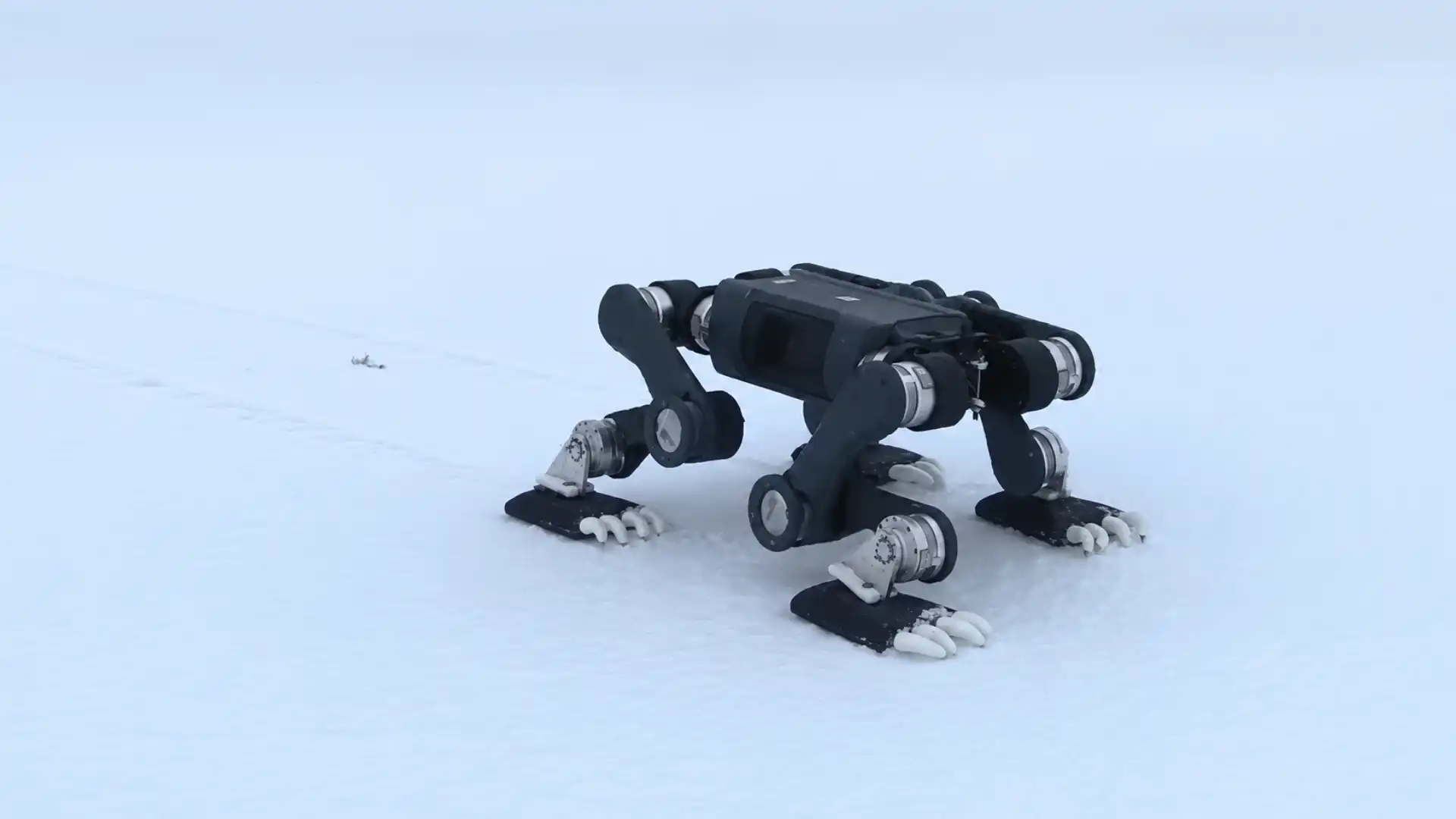
The video that pushed DEEP Robotics back into headlines in late June 2026 is short, and it is built to be shared. A four-legged machine with wheels at the end of each limb rolls across a gravel slope, locks its wheels, lifts itself over a band of broken rock, then wades into a river running with ice. The water reaches close to the top of its body. It keeps going. The on-screen claims stack up fast: temperatures down to -30°C, river crossings up to 80 centimetres deep, slopes of roughly 45 degrees, and an operating altitude near 5,177 metres. DEEP Robotics labels the robot its “ultimate all-terrain champion,” and for once the marketing line points at something real rather than dressing up a treadmill walk in a clean lab.
Table of Contents
The machine is the Lynx M20S, a wheeled-legged robot the Hangzhou company first unveiled on 18 May 2026. The new footage is not a product launch. It is a field reel meant to prove that the specifications on the launch sheet survive contact with weather, water, and thin mountain air. That distinction matters. Plenty of robots look capable in a demo hall and then stall the first time a wheel hits mud or a battery meets a freezing morning. The point of filming a robot at altitude, in a river, in the cold, is to answer the one question every industrial buyer asks before signing anything: will it still run when the conditions are bad, which is exactly when you want a robot doing the job instead of a person.
Strip away the cinematography and the technical core is straightforward. The Lynx M20S moves in two modes. On flat or gently broken ground it rolls on its four wheels, which is faster and uses less power than walking. When it meets stairs, rubble, a steep bank, or a ledge, the wheels lock and the legs take over, lifting the body over obstacles a pure wheeled robot could never clear. The cold-weather reel is built to show both modes under stress at the same time, which is the harder test. Rolling fast on a frozen track is one thing. Switching to a careful legged gait on an icy 45-degree slope while carrying sensors, at an altitude where battery chemistry slows and air offers less cooling, is a different problem.
The altitude figure deserves a closer look because it carries weight beyond the number. At roughly 5,177 metres, air pressure is about half of sea level. Cooling fans move less air, lithium cells lose capacity and deliver current more reluctantly in the cold, and any combustion-based machine would gasp. An electric robot does not breathe, which is part of the pitch, but its electronics and batteries still feel the altitude and the cold. Showing the M20S working at that height is a claim about thermal management and power delivery, not just about leg mechanics. It says the company has solved, or at least managed, the parts of the machine that usually fail quietly in the field rather than dramatically on camera.
DEEP Robotics frames the robot around three job families: industrial inspection, emergency response, and outdoor field operations. None of those are consumer uses. Nobody is buying a 33-kilogram wheeled-legged robot to fetch slippers. The buyer is a power utility that needs substations checked in a mountain region in winter, a fire and rescue service that needs eyes inside a flooded or burning structure, or a research and survey team working somewhere a truck cannot reach. The cold-river footage is aimed squarely at those buyers, and at the procurement officers who will compare it against a Boston Dynamics Spot, an ANYbotics ANYmal, or a Unitree wheeled quadruped before deciding where the budget goes.
There is also a timing story underneath the demo. DEEP Robotics filed its IPO prospectus on the same day it launched the M20S, 18 May 2026, and the company is racing several Chinese rivals to a public listing. A field reel that travels well across YouTube, news sites, and Chinese social platforms is not only product marketing. It is investor-facing proof that the company can ship hardware that does difficult work in the real world, at a moment when the market is trying to decide how much a Chinese robotics maker is actually worth.
A wheeled-legged robot built for work, not show
The Lynx M20S sits in a category that still confuses people who first met robot dogs through viral videos of machines dancing or opening doors. It is not a pure quadruped like Boston Dynamics’ Spot, and it is not a wheeled rover. It is a hybrid: four articulated legs, each ending in a powered wheel. That design choice is the whole identity of the product, and it explains both what the robot is good at and where it gives ground to other machines.
In plain terms, the M20S is a mid-sized industrial platform. It measures about 820 millimetres long, 430 wide, and 570 tall, and it weighs under 33 kilograms including its battery. That weight is deliberate. One person can lift it out of a vehicle and carry it to a worksite, which removes a real logistical headache. A heavier machine needs a ramp, a lift, or two people, and every extra step makes field deployment slower and more expensive. DEEP Robotics kept the M20S at the same body weight as the earlier M20 even while raising what it can carry, which is the engineering claim at the heart of this generation.
The robot is a carrier, not a manipulator. It has no arms in its base configuration. Its job is to move a payload of sensors, cameras, gas detectors, thermal imagers, or communication gear across ground that defeats wheels and would put a human in danger. On regular flat terrain it can carry a continuous load of 35 kilograms, more than double the 15 kilograms of the previous model. That payload is the difference between a robot that carries one inspection module and a robot that carries several at once, turning a single patrol into a multi-sensor sweep.
What sets the platform apart from a standard quadruped is speed on easy ground combined with reach over hard ground. A walking robot is slow and burns power with every step. A wheeled robot is fast and frugal but stops dead at a flight of stairs or a half-metre ledge. The wheel-leg design tries to keep the best of both. On a packed path or a road, the M20S rolls. When the path breaks up, it walks. DEEP Robotics quotes a lab-tested top speed of 9 metres per second, roughly 32 kilometres per hour, with everyday operation held well below that for safety and control. It can climb stairs of 20 to 25 centimetres per step, clear single obstacles up to 80 centimetres, and hold a slope of 45 degrees.
The other defining trait is durability. The M20S carries an IP67 rating, meaning it is fully sealed against dust and can sit in up to a metre of water for half an hour. Its rated operating range runs from -30°C to 55°C, wide enough to cover a frozen northern substation in January and a steel plant near a blast furnace in summer. These are not numbers a consumer needs. They are the numbers an industrial buyer checks first, because a robot that shuts down at the wrong temperature or drowns in a puddle is worse than no robot, since you have paid for it and still need to send a person.
So the honest description is unglamorous and exactly the point. The Lynx M20S is a rugged, sealed, mid-weight mobile platform that trades the agility tricks of a show robot for the boring reliability that keeps a machine earning its cost in the field. The cold-river demo is dramatic, but the product underneath it is built for repetition: the same patrol, the same route, the same dull dangerous places, done every day without a person standing in the cold.
DEEP Robotics and the Hangzhou lab behind the machine
DEEP Robotics, known in Chinese as Yunshenchu Technology, was founded in November 2017 in Hangzhou, the eastern city that has become one of China’s densest clusters of robotics and AI companies. Its full legal name is Hangzhou DEEP Robotics Co., Ltd., and its origin story is academic rather than garage-startup. The founder and chief executive is Zhu Qiuguo, born in 1982 in Haining, Zhejiang, an associate professor and doctoral supervisor at the School of Control Science and Engineering at Zhejiang University. His co-founder and chief technology officer is Li Chao, an alumnus from the same university. The pair built the company out of a research lab, not a consumer hardware dream.
That academic root shapes the company’s character. Before founding DEEP Robotics, Zhu led university work on the quadruped robots known as Jueying and Chitu, and on a humanoid called Wukong-II. He has published more than forty academic papers and holds dozens of authorized patents, including international ones. The company describes itself as committed to a full-chain technical system it calls “perception-decision-action,” meaning it builds its own sensing, its own motion-control software, and its own actuators rather than assembling parts from suppliers. Zhu has called this forced self-reliance the company’s main competitive strength, the result of having no off-the-shelf options good enough when the work began.
By 2026 that self-development had produced more than 100 authorized patents, over 20 of them invention patents, spread across hardware structure, motion-control algorithms, multi-sensor perception, and autonomous decision-making. The company employs somewhere between 250 and 500 people and holds the status of a Chinese National High-Tech Enterprise, a designation that brings tax benefits and signals state approval. It is not a fringe player. DEEP Robotics has appeared on the Fortune China Tech 50 list, and Zhu has been named among Forbes China’s science and technology figures.
The product range is broader than the robot dog that draws the cameras. On the quadruped side the company sells the Lite3, a smaller research and education model, and the industrial Jueying X20 and X30. It builds its own actuator joints, sold separately as the J60, J80, and J100 modules, which is a tell about how deep its hardware capability runs, since the joint is the hardest, most expensive part of a legged robot to get right. The wheel-leg line is the Lynx family, now anchored by the M20 and the M20S. And in October 2025 the company moved into bipeds with the DR02 humanoid, alongside a navigation software stack it calls DeepVLA 1.0, built on the visual-language-action approach that has become the dominant research direction in embodied AI.
The customer base tells you what kind of company this is. DEEP Robotics runs a focused business-to-business model aimed at energy firms, utility operators, public safety agencies, and industrial sites, not at consumers. Its machines have been deployed for power grid checks, factory patrols, tunnel work, public safety monitoring, mapping, and exploration. The company claims its robots already act as what it calls “super employees” in close to 30 substations under China Southern Power Grid, where it says they have cut operating costs by around 70 percent. Those claims come from the company and should be read as such, but the pattern is consistent across independent reporting: DEEP Robotics is built around real industrial deployment rather than viral spectacle, and the cold-river demo is an attempt to make that unglamorous reliability look exciting enough to sell.
From Jueying to Lynx, the road to a wheeled-legged dog
The Lynx M20S did not appear from nowhere. It is the product of roughly eight years of work that began with a more conventional robot dog and moved, step by step, toward a machine built for paying industrial customers in punishing places.
DEEP Robotics released its first industry-grade large quadruped, an early Jueying model, in February 2018. The company has described an early generation, the Jueying X10, as the first domestic Chinese quadruped able to climb and descend stairs and find its own way using onboard navigation. That was the foundation. A robot that can handle stairs and map its surroundings without a human joystick is already useful for inspection, and the early Jueying line went to power grids, tunnels, and security work. The breakthrough that made these machines genuinely deployable, in Zhu’s own telling, was the deep use of reinforcement learning in motion control, which sharpened the robots’ stability and their ability to adapt to messy, unstructured ground.
The Jueying line matured into the X20 and X30, industrial quadrupeds that won real contracts against global competitors. The X30 took a Singapore Power Group contract over established Western names, and it set up what the company describes as the first fully automated outdoor inspection system in the extreme beach environment of NEOM, Saudi Arabia’s planned megacity, turning a four-hour human patrol into continuous unmanned operation. These deployments are the proof points DEEP Robotics leans on when it argues it is an operating company, not a demo company.
The wheel-leg idea arrived as a separate bet. Pure quadrupeds are agile but slow and power-hungry. For large outdoor sites, long perimeters, and routes that mix smooth roads with rough patches, a robot that can roll most of the time and walk only when it must is a better economic fit. DEEP Robotics launched the first Lynx M20 in April 2025, calling it the world’s first mid-sized wheeled-legged robot built for industrial use in difficult terrain. An earlier and now discontinued Lynx Sport had tested the concept. The M20 set the template: a 33-kilogram body, a 15-kilogram payload, an IP66 seal, a -20°C to 55°C range, and the dual rolling-and-walking gait.
A little over a year later, the M20S is the refinement. It keeps the body size and weight but raises payload to 35 kilograms, lifts top speed from 5 to 9 metres per second, upgrades the seal to IP67, and widens the cold tolerance to -30°C. In parallel, the company unveiled the DR02 humanoid in October 2025, signalling that DEEP Robotics now sees itself as a maker of an entire fleet of body shapes, quadruped, wheel-leg, and biped, sharing the same perception and control core. The Lynx M20S is the most mature link in that chain right now, and the cold-weather reel is the company planting a flag on the wheel-leg category before its rivals do.
The wheel-leg hybrid idea explained without the marketing
To understand why a company would build legs that end in wheels, start with the weakness of each design on its own. A wheeled robot is fast and sparing with power. Rolling is one of the most economical ways to move a mass across the ground, which is why every delivery robot and warehouse machine uses wheels. But a wheel is helpless against a step taller than its radius. Stairs, kerbs, rubble, a fallen log, a half-metre rock ledge, all of these stop a wheeled robot cold. A legged robot has the opposite profile. It can step over, climb up, and pick its way across ground that has no smooth line through it at all, but walking is slow and it drains the battery, because every step means lifting and placing a limb and constantly correcting balance.
The wheel-leg hybrid tries to hold both advantages in one body. Each of the Lynx M20S’s four legs is a chain of powered joints ending in a driven wheel. On a road, a packed trail, or a factory floor, the legs hold a stable stance and the wheels do the work, so the robot rolls quickly and quietly while sipping power. The moment the ground breaks up, the control system locks the wheels, and the legs begin to walk, stepping the locked wheels over and onto obstacles the way a foot would. DEEP Robotics describes the switch between modes as continuous, with the robot reading the terrain ahead and choosing the gait without a human flipping a manual control.
The leg geometry is unusually flexible, and that flexibility is doing real work. The company highlights configurations it calls front-elbow and rear-knee, where the front and rear legs bend in opposite directions, letting the robot lower its body, tuck its limbs, and squeeze through gaps. It can work in corridors as narrow as 50 centimetres, which matters in pipe galleries, cable tunnels, and the cramped interiors of industrial plants where a wider machine simply will not fit. The same joint range lets the body raise and lengthen to step over tall obstacles, then drop low to pass under pipes or ducts.
The honest comparison is with the two obvious alternatives. A tracked robot, like a bomb-disposal or search robot on rubber treads, handles rough ground and stairs reasonably well and is mechanically simpler, but it is slow, heavy for its capability, and clumsy in tight turns. A pure wheeled rover is faster and simpler still, but it is defeated by vertical obstacles. A pure quadruped like Spot handles almost any terrain a dog could, but pays for it in speed and runtime. The wheel-leg machine aims to beat the tracked robot on speed and agility, beat the rover on obstacles, and beat the pure quadruped on energy use and range over mixed ground. On a large outdoor site that is mostly road with patches of bad terrain, that combination is genuinely the right tool, which is why both DEEP Robotics and Unitree have invested in it.
The cost of the design is complexity. A wheel-leg robot has all the joints of a quadruped plus a powered wheel and its drive at each foot, plus the control software to manage the handoff between rolling and walking. More moving parts mean more things that can wear, jam, or fail, and more software that has to make the right call in real time about which mode to use on ground it has never seen. The wheels also add unsprung mass at the end of each leg, which makes the walking gait harder to control than it would be with a simple foot. None of this is a reason the design is wrong. It is a reminder that the elegance of “roll where you can, walk where you must” is bought with engineering effort that has to hold up not in a demo, but across thousands of hours in the field. That is the bar the M20S is trying to clear, and it is why the company keeps filming the robot in conditions that would expose a weak design.
Breaking the force-speed tradeoff that limits these machines
The single most interesting engineering claim about the M20S has nothing to do with the cold or the river. It is the assertion that DEEP Robotics raised both payload and speed at the same time, on the same body weight, without one cancelling the other. In the world of legged machines, that is the claim that earns a raised eyebrow, because load and speed normally pull against each other.
The physics is simple to state. To carry more weight, a robot needs stronger joints, thicker structural members, and more powerful actuators. All of that adds mass to the robot itself. A heavier robot accelerates more slowly and tops out at a lower speed for the same motor power, because more of that power goes into moving the machine rather than moving it quickly. So the usual path to higher payload is a heavier, slower robot. DEEP Robotics says it refused that trade. The M20S carries 35 kilograms on flat ground, 233 percent of the previous generation’s 15 kilograms, while its lab-tested top speed rose to 9 metres per second, an 80 percent jump from the M20’s 5 metres per second — all at the same self-weight under 33 kilograms.
If that holds up in real use, it comes from work the company describes as structural and joint-module refinement rather than brute force. In practical terms, that means redesigning the actuators to deliver more torque per kilogram, reworking the leg structure to carry load without adding bulk, and tuning the control software to use the available power well. DEEP Robotics builds its own joints, the J-series modules, which is exactly the lever you would pull to break this tradeoff, since the joint is where torque, weight, and heat all meet. A company that buys its actuators cannot push this boundary the way one that designs them can.
There is a reason to treat the dual claim with measured caution. The 9-metre-per-second figure is lab-tested, an extreme number under controlled conditions, and the company itself limits everyday operation to a much lower speed for safety and control, as it did with the M20. The 35-kilogram payload is quoted for regular flat terrain, and load capacity falls as ground gets steeper and rougher, which is precisely where a wheel-leg robot earns its keep. Neither number is dishonest, but both are best-case figures, and a buyer should read them as the top of the envelope, not the middle of it.
What the higher payload genuinely changes is the robot’s role. At 15 kilograms, the M20 was a single-purpose carrier: it could take one inspection module to a location and bring back its readings. At 35 kilograms, the M20S can carry several modules at once, a thermal imager, a gas detector, a high-resolution camera, a communication relay, and run them together. DEEP Robotics says it also improved thermal management so that multiple devices can operate at the same time without overheating the robot. That turns the machine from an inspection assistant into what the company calls a core execution unit, able to do in one pass what used to take several. Whether the market values that enough to pay for it is the question the IPO and the demo are both trying to answer.
Built to keep running at -30°C and under water
The cold-river footage is really an advertisement for two unglamorous specifications: the seal and the temperature range. They are the parts of the machine that decide whether it works on the worst day of the year, and DEEP Robotics widened both for this generation.
The M20S carries an IP67 rating, up from the IP66 of the earlier M20. The two digits each mean something specific. The 6 means the casing is fully dust-tight, with no ingress at all, which matters on a construction site, in a coal mine, or near a sandblasted desert installation. The 7 means the robot can be submerged in up to one metre of water for thirty minutes without water reaching the electronics. The older IP66 robot could shrug off heavy rain and high-pressure spray but was not rated to sit in standing water. The upgrade is the difference between a machine that can wade a flooded corridor or a shallow river and one that should stay on dry land. For a robot pitched at firefighting and flood response, where the whole point is going into water that has driven people out, the IP67 seal is not a luxury, it is the feature that makes the use case legal to attempt.
The temperature range moved from -20°C to 55°C on the M20 to -30°C to 55°C on the M20S. The extra ten degrees at the bottom is aimed at a real market. Winter outdoor inspections across northern China, in places such as Mohe and Hulunbuir, routinely run below -20°C, which is outside the rated range of most wheel-leg robots, including the company’s own previous model. By stretching the cold tolerance to -30°C, DEEP Robotics covers year-round operation in the coldest inhabited parts of the country and at high-altitude stations where temperature and thin air combine. At the top end, 55°C covers a steel plant in summer, where the ambient air near a blast furnace can sit above 50°C, hot enough to disable a machine that was only ever tested in an office.
Cold is harder on a robot than the spec sheet admits, and this is where the demo earns genuine credit if it holds. Lithium-ion cells lose usable capacity as temperature drops and become reluctant to deliver high current, which is exactly when a robot fighting an icy slope needs power most. Lubricants stiffen, plastics grow brittle, and condensation can form when a cold machine moves into a warmer space. Running at -30°C and 5,177 metres at once, as the footage claims, stresses the battery, the joint lubrication, and the thermal system all together. The fact that the robot keeps moving says the company has done work on battery heating, sealing against condensation, and joint design for the cold, not just bolted a colder rating onto an unchanged machine. That work, if real, is worth more than the leg acrobatics, because it is the part nobody can see and the part that quietly kills field robots.
DEEP Robotics also trimmed the robot’s operating noise to 55 decibels or below, roughly the level of a quiet conversation. That sounds like a minor detail until you picture the deployment. A robot patrolling a hospital campus, a residential substation, a data centre, or a night-time security route cannot sound like a leaf blower. Lower noise widens the set of places the machine is welcome, and it is the kind of refinement that signals a company thinking about real installations rather than trade-show applause. Higher protection, a wider temperature window, and lower noise all point the same direction: toward a machine meant to disappear into routine industrial work in conditions that would stop a person, which is the only way a robot this expensive pays for itself.
The sensing stack that lets it pick a path
A robot that cannot see is just a remote-controlled toy. What lets the Lynx M20S move on its own, choose a route, and avoid obstacles is its sensing and computing package, and on paper it is built for autonomy rather than joystick driving.
The core sensor is LiDAR, the laser scanner that builds a three-dimensional point cloud of everything around the robot. The Lynx platform uses dual 96-line LiDAR units covering a 360-degree horizontal by 90-degree vertical field of view, generating on the order of 860,000 points per second. In practice that means the robot has a constantly updating map of its surroundings in every direction, including the ground close to its feet and obstacles overhead. With that data it performs SLAM, simultaneous localization and mapping, the technique that lets a machine build a map of an unknown space while tracking its own position inside it. SLAM is what allows the robot to be set loose on an inspection route it learns once and then repeats, and to know where it is when GPS is weak inside a building or a tunnel.
Vision fills the gaps LiDAR leaves. The platform carries wide-angle 1080p RGB cameras for the high-resolution imagery a human operator or an automated defect-detection system needs, plus bidirectional lighting front and rear so it can work in darkness, in a tunnel, or on a night patrol. LiDAR sees shape but not colour or fine detail; cameras see detail but struggle in the dark and in glare. Together they give the robot both a geometric map and a readable picture, which is what inspection work actually requires, since a thermal hotspot or a corroded bolt is found in the image, not the point cloud.
All of that data has to be processed on the robot, in real time, fast enough to steer the legs and wheels. The Lynx carries onboard computing built around dual octa-core 64-bit processors with 16 gigabytes of memory and 128 gigabytes of storage in the M20 specification. That is enough to run perception, mapping, path planning, and motion control locally, without depending on a constant link to a distant server. The result is omnidirectional obstacle avoidance, the robot’s ability to detect and route around obstacles from any direction rather than only what is straight ahead.
Connectivity rounds out the package. The robot supports Wi-Fi for high-bandwidth image and video transmission, GPS for outdoor positioning, Gigabit Ethernet and a 72-volt power port for attaching external equipment, and over-the-air software updates so its behaviour can be improved after it ships. It runs on ROS and Ubuntu, the standard open software base for serious robotics, which matters to the developers and integrators who will adapt the platform to a specific job. A closed, proprietary robot is a dead end for a system integrator. An open, ROS-based platform with documented ports is something a power utility’s engineering team or a third-party software firm can build a real deployment around, and that openness is a quiet but important part of why these machines win industrial contracts.
Reinforcement learning and the gait that adapts to terrain
The hardware decides what a robot can physically do. The software decides whether it actually does it well on ground nobody planned for. The Lynx M20S relies on a self-developed motion-control system that DEEP Robotics built around reinforcement learning, and that choice is the reason these machines stopped being lab curiosities and started taking real jobs.
A traditional control system for a legged robot is hand-engineered. Engineers write explicit rules and models for how the robot should move, and the robot follows them. That works on terrain the engineers anticipated and breaks down on terrain they did not. Reinforcement learning flips the approach. Instead of programming the gait directly, the developers train a control policy in simulation, letting a virtual robot try to move across thousands of randomized surfaces, slopes, and disturbances, and rewarding it when it stays upright and makes progress. The policy that survives millions of simulated falls is then transferred to the real machine, a process the field calls sim-to-real. The robot ends up with a learned sense of balance and footing that generalizes to conditions it was never explicitly taught, which is exactly what an outdoor robot needs.
Zhu Qiuguo has been blunt about how much this mattered. In his telling, the deep application of reinforcement learning to motion control was the milestone that lifted the stability, flexibility, and adaptability of robot dogs to the point where they could be put to real use, and it was the step that, in his words, let the industry cross the core technical gap on quadrupeds. He has also been careful to add that crossing the gap as a field does not mean every company has crossed it, and that the real test is whether a specific product is stable and reliable enough to deliver value to a paying customer. That distinction, between a category that works and a product that works, is the right frame for reading any robot demo.
In the M20S, the learned policy drives what the company describes as real-time posture adjustment and dynamic gait matching. The robot reads the terrain through its sensors and changes how it moves to suit it, shortening or lengthening its stride, raising or lowering its body, stiffening or softening its stance. DEEP Robotics says the machine handles grass, sand, gravel, and mud as well as stairs and rock, surfaces that each behave differently under a wheel or a foot. Sand shifts and swallows traction. Mud is slick and grabs. Gravel rolls underfoot. A control policy that handles all of them without a person adjusting settings is the practical payoff of the reinforcement-learning approach, and it is what the cold-river reel is really demonstrating when the robot moves from gravel to ice to water without stopping.
This is also where DEEP Robotics’ “perception-decision-action” framing becomes concrete rather than corporate. Perception is the LiDAR and cameras building a model of the world. Decision is the planning layer choosing a route and the control policy choosing a gait. Action is the joints and wheels executing it. The reason the company insists on building all three in-house is that they have to work as one loop, fast, with no weak link, on ground that changes every second. A robot that perceives well but decides slowly falls over. The cold-weather footage is a claim that the whole loop holds together under stress, which is a harder and more meaningful thing to prove than any single specification.
The numbers that matter, M20S against the M20 it replaces
The clearest way to read what DEEP Robotics actually changed is to put the two generations side by side. The M20S keeps the M20’s body, size, and the core wheel-leg design, then pushes hard on the four areas the company says industrial buyers care about most: how much it carries, how fast it moves, how well it is sealed, and how cold it can get before it quits.
Lynx M20 and Lynx M20S, the headline changes
| Specification | Lynx M20 | Lynx M20S |
|---|---|---|
| Continuous payload, flat ground | 15 kg | 35 kg |
| Top speed, lab-tested | 5 m/s | 9 m/s |
| Protection rating | IP66 | IP67 |
| Operating temperature | -20°C to 55°C | -30°C to 55°C |
| Water resistance | rain, high-pressure spray | 1 m submersion, 30 min |
| Body weight, incl. battery | ~33 kg | ~33 kg |
| Stair height per step | up to 25 cm | 20–25 cm |
| Max single obstacle | up to 80 cm | up to 80 cm |
| Max slope | 45° | 45° |
| Operating noise | not specified | ≤55 dB |
The table shows a deliberate strategy rather than a scattershot upgrade. Body weight, stair height, obstacle clearance, and slope are unchanged, because they were already competitive and changing them would have added cost or weight. The work went into payload, speed, sealing, cold tolerance, and noise, which together turn the machine from a capable inspection robot into one that can carry more sensors, cover ground faster, survive worse weather, and be deployed in places where the old model’s ratings ruled it out.
Read commercially, the most consequential rows are payload and protection. Doubling the payload while holding weight is the engineering headline, and widening the seal and temperature range opens markets, the flooded sites, the sub-zero northern grids, the high-altitude stations, that the M20 could not legally serve. The speed jump is real but should be read as a lab ceiling rather than a working number. For a buyer, the question is not whether the M20S is better than the M20, it clearly is, but whether the gains line up with the specific job, since a buyer who never works below -20°C or in standing water is paying for headroom they will not use.
The payload jump and what it changes on a real job
The move from a 15-kilogram payload to 35 kilograms is easy to underrate as just a bigger number. On a worksite it changes what the robot is for. A carrier that can take one instrument somewhere is a courier. A carrier that can take five instruments somewhere and run them at once is a mobile inspection station, and that is a different category of machine with a different value to the customer.
Consider a substation patrol, the bread-and-butter job for these robots. A thorough check wants several sensors. An infrared thermal camera finds overheating connections and failing components before they fail outright. A visual camera with enough resolution reads gauges, spots corrosion, and documents the state of equipment. A partial-discharge or acoustic sensor listens for the electrical faults that precede a breakdown. A gas detector sniffs for leaks. On the old 15-kilogram robot, an operator had to pick which of these the machine carried on a given run, or send it out more than once. On the M20S, the robot can carry the full set, plus a communication relay to push the data back, and complete the inspection in a single pass. That collapses several patrols into one and removes the awkward tradeoffs that made the lighter robot a partial solution.
The higher payload also lets the robot carry heavier, more capable instruments rather than only more of the light ones. Some of the most useful field sensors, certain ground-survey units, denser battery packs for longer missions, ruggedized communication gear for areas with no signal, are simply heavy. A 15-kilogram budget rules many of them out once you account for the mounting hardware and cabling. A 35-kilogram budget brings them into range. For emergency work the same headroom means the robot can carry supplies, a small medical kit, water, a radio repeater, into a place a person should not go, rather than only carrying eyes.
It is worth separating two numbers DEEP Robotics quotes. The 35 kilograms is a continuous payload on flat ground, the weight the robot can carry while working a normal shift. The M20 generation also quoted a higher short-term maximum load figure, around 50 kilograms, the weight it can bear briefly rather than haul all day. Buyers should design around the continuous figure, not the maximum, and should expect the usable payload to fall as the terrain gets steeper and rougher, because climbing and balancing under load costs capacity that flat rolling does not. A robot rated for 35 kilograms on a road is not a robot that carries 35 kilograms up a 45-degree slope.
DEEP Robotics ties the payload gain to its improved thermal management, and the link is real. Running several powered instruments at once generates heat inside the robot’s body, on top of the heat from the actuators and computer. A machine that can carry the sensors but cannot keep them cool will throttle or shut down. By widening the thermal headroom, the company turns the payload capacity into something usable rather than theoretical. This is the unflashy systems engineering that separates a spec sheet from a working tool, and it is the part the cold-river footage cannot show, since heat, not balance, is the thing that fails first when a robot is asked to do several jobs at once.
Speed, range, and the battery problem nobody escapes
Speed and range are where every mobile robot meets the same hard ceiling, the battery, and the M20S is no exception. The headline speed is impressive and the endurance is respectable, but both come with the asterisks that govern all electric machines.
The 9-metre-per-second lab speed is roughly 32 kilometres per hour, fast enough to keep pace with a car in a car park or run alongside a jogging person on open ground. In everyday operation, though, the robot is held to a much lower speed for safety and control, as the M20 was limited to around 3 metres per second in user mode. That is the right design choice. A 33-kilogram machine with sensors moving at 32 kilometres per hour through a worksite full of people and equipment is a hazard, not a feature. The high figure tells you the motors and structure have headroom; the operating figure tells you how fast it will actually go on the job, which is a brisk walk to a slow run.
Range follows the same pattern of best case and working case. DEEP Robotics quotes roughly 15 kilometres on a charge unloaded and about 12 kilometres carrying a load for the Lynx platform, with endurance of around three hours unloaded and two and a half hours under load. The company says it raised single-charge runtime over the previous generation, with figures cited in the range of 17 to 67 percent depending on conditions, and added dual hot-swappable batteries. The hot-swap design is the more important of the two. A battery that can be changed in seconds, without powering the robot down or sending it back to a dock, means a crew can keep the machine working through a long shift by rotating packs. For a patrol that must run continuously, that turns a two-and-a-half-hour battery into an all-day robot, limited by how many packs you own rather than by a single charge.
The catch is the cold, and it is unavoidable. Lithium-ion batteries deliver less energy and less current at low temperature, so the same robot that manages 12 kilometres on a mild day will go less far at -30°C, and it will lose some of its peak power exactly when fighting an icy slope demands it. DEEP Robotics’ cold-weather work, battery heating and insulation, is meant to soften this, but no engineering eliminates it. A buyer planning winter operations in northern China or at altitude should budget for shorter range, more frequent swaps, and time lost to keeping packs warm. The honest read is that the M20S manages the cold-battery problem better than most rivals rather than escaping it, which is itself a selling point, since the competition has the same chemistry and fewer of the mitigations.
Put against the Western benchmark, the endurance picture flatters the Chinese machines. Boston Dynamics’ Spot runs roughly 90 minutes on a charge, while the wheel-leg and industrial quadruped class from China typically claims several hours and adds hot-swap packs. Runtime is one of the clearest areas where the newer entrants have a real, measurable lead, and for a customer running long perimeters or all-day inspection routes, it is often the specification that decides the purchase.
The substation math behind the inspection pitch
DEEP Robotics built a specific worked example into the M20S launch, and it is worth walking through because it shows how a robot’s speed and payload turn into money rather than bragging rights. The example is a medium-sized electrical substation with about 200 inspection points, the gauges, connections, breakers, and components a patrol has to check.
The arithmetic the company offers runs like this. On a robot working point by point, each inspection takes roughly 150 seconds, split into about 120 seconds of travel to the next point and 30 seconds of detection once there. Across 200 points, that adds up to around 8.3 hours for a full sweep, effectively a whole shift for one robot. With the M20S’s higher speed cutting travel time and its higher payload letting it run several sensors at each point in parallel rather than in sequence, DEEP Robotics estimates per-point time falls to about 90 seconds, trimming more than three hours off a single inspection run.
That three hours is the entire economic argument in miniature. A substation that takes 8.3 hours to inspect can be checked roughly once a day by one robot. A substation that takes around 5 hours can be checked more often, or one robot can cover more than one site, or the same fleet can cover more substations with fewer machines. The saving compounds across a utility that operates hundreds or thousands of substations, which is precisely the scale Chinese grid operators work at. The robot’s value is not that it does something a human cannot. It is that it does a tedious, repetitive, sometimes dangerous job more often, more consistently, and without a person standing in a freezing switchyard at night.
The payload story feeds directly into this. Parallel multi-sensor detection, thermal, visual, and acoustic readings taken together at each point, is only possible because the M20S can carry and power several modules at once. On the lighter previous robot, the sensors would have to be run in separate passes, and the time saving would shrink or vanish. The speed and the payload upgrades are not two independent features; they multiply each other into the per-point figure the company is selling.
DEEP Robotics backs the model with a deployment claim. It says its robots already function as what it calls “super employees” across close to 30 substations under China Southern Power Grid, where it reports they have cut operating costs by around 70 percent. That figure comes from the company and covers its quadruped fleet rather than the brand-new M20S specifically, so it should be read as a vendor claim and a directional indicator rather than an audited result. Still, the direction is consistent with what independent analysts see across the sector: Chinese utilities are deploying inspection robots at scale and reporting large labour and safety savings, and the substation is the single most proven use case for the technology. The M20S is engineered to do that proven job faster, which is a far safer commercial bet than trying to invent a new market.
Power line and grid inspection as the anchor market
The reason DEEP Robotics, Unitree, and a dozen rivals are all racing into rugged outdoor robots is that one customer is buying them by the thousand: the Chinese electrical grid. The scale of that demand is the most important fact in this whole story, and it reframes the cold-river demo from a tech showcase into a sales pitch aimed at a buyer with a known, enormous budget.
In 2026 the State Grid Corporation of China allocated about 6.8 billion yuan, roughly one billion US dollars, to acquire embodied intelligence systems, the industry’s term for AI-enabled robots. According to reporting on the procurement, the order covers around 500 humanoid robots for complex high-risk tasks such as live-line work on ultra-high-voltage infrastructure, about 3,000 dual-arm wheeled robots for coordinated maintenance, and roughly 5,000 quadruped robot dogs for patrol and inspection, especially in mountainous terrain. The plan spans more than 600 specialized tasks, and the state utility is reported to be buying on the order of 8,500 robots in the year for inspection and maintenance work. State Grid operates across 26 of mainland China’s 31 provincial-level regions, so this is national infrastructure, not a pilot.
State Grid is not alone. China Southern Power Grid, which covers the five southern regions including Guangdong, is investing in the same technology, and total sector spending on embodied intelligence across China’s grid operators is expected to exceed 10 billion yuan, about 1.46 billion US dollars, in 2026. The robots are being supplied by a roster of domestic firms that reads like a who’s-who of Chinese robotics: Unitree, DEEP Robotics, AgiBot, UBTech, and Fourier Intelligence, among others. For a company like DEEP Robotics, with an existing footprint in substation inspection, this is the demand that justifies the engineering and the IPO at the same time.
The grid is the anchor market for reasons that are physical, not political. Electrical infrastructure is spread across exactly the terrain that defeats wheeled robots and endangers people: remote mountain substations, transmission lines strung across valleys and ridges, switchyards in deserts and on frozen plateaus. The work is repetitive, the environments are hazardous, and the cost of a missed fault, a fire, an outage, a cascading failure, is enormous. A robot that can patrol a mountain substation at -30°C, check 200 points faster than a person, and do it every day rather than once a month is solving a problem the grid genuinely has. The M20S’s wide temperature range and high payload are not abstract specifications; they map onto the specific conditions of Chinese grid inspection.
The market is also beginning to travel. China Southern Power Grid, through Guangdong Power Grid, has started exporting its in-house robot solutions, including robot dogs for substation inspection, to overseas markets such as Chile. DEEP Robotics’ own Jueying X30 set up an automated inspection system in NEOM, Saudi Arabia, and won a contract with Singapore Power Group over global competitors. Industry projections point to embodied AI output reaching 2.1 million units by 2030, with China already dominating global shipments. The grid is where these robots prove themselves at home, and proof at home is what lets Chinese makers pitch the same machines abroad, against Western incumbents, on price and on a track record measured in thousands of deployed units rather than dozens.
Emergency response, firefighting, and flood work
The second job family DEEP Robotics names for the M20S is emergency response, and this is where the IP67 seal stops being a specification and becomes the entire reason the robot can be used. Disasters happen in water, smoke, rubble, and cold, the exact conditions that disable people and ordinary machines, and a robot that can enter them is worth far more than one that can only patrol a tidy site.
Flooding is the clearest case. A machine sealed to survive a metre of water for thirty minutes can wade a flooded corridor, a submerged basement, or a shallow stream that has cut off access, carrying a camera to find trapped people or a sensor to assess a structure. DEEP Robotics has already put a robot dog to work in this role, fielding what it calls an “AI Flood-Fighting Warrior” at a flood-control drill run by Zhejiang Province’s emergency management department. The pitch is direct: in a flood, you want to know what is happening inside a dangerous, water-filled space before you risk sending a rescuer, and a robot that can wade in and stream back video answers that without putting a person in the current.
Firefighting follows the same logic. DEEP Robotics specifically points to flooded ground around fire scenes and rescue routes made impassable by extreme weather as targets for the M20S. A fire often comes with standing water from suppression efforts, hazardous footing, smoke that blinds people, and heat that pushes the limits of protective gear. A sealed, heat-tolerant robot rated to 55°C can move through some of that, carrying thermal imaging to find hotspots or victims, mapping a route for the human crews to follow, or hauling a hose, a relay, or supplies into a position too dangerous to staff. It does not replace firefighters. It scouts ahead of them and carries for them, which is a real reduction in the risk a crew has to accept.
Collapsed structures and earthquake zones are the hardest version of this work, and they are where the wheel-leg design’s reach over rubble matters most. A wheeled robot cannot cross a debris field. A legged or wheel-legged machine can pick its way over broken concrete and twisted steel to reach voids where survivors might be, listening, imaging, and mapping. The reference point here is Boston Dynamics’ Spot, which has been used for radiation monitoring at Fukushima, work that would have exposed people to dangerous doses. The same case applies to any contaminated, unstable, or toxic site: send the robot, keep the human out.
The honest limit on all of this is autonomy. In a clean, mapped substation, these robots can run a route on their own. In the chaos of a fresh disaster, with unmapped terrain, shifting debris, smoke, and no reliable signal, current robots, Chinese and Western alike, still lean heavily on teleoperation, a human operator driving from a safe distance. The machine is the body that goes into danger; the judgment usually still comes from a person at the controls. That is not a flaw so much as the present state of the technology, and it shapes how emergency services should plan: the M20S extends the reach and reduces the risk of a trained operator, rather than acting as a fully independent rescuer. Treated that way, it is genuinely useful. Treated as an autonomous hero, it will disappoint.
Mining, steel, and heavy industry under hard conditions
Heavy industry is the third large market, and it is the one where the M20S’s seal and temperature range earn their cost most directly, because mines and metal plants are hostile to both people and electronics in ways an office-tested robot cannot survive.
Underground mining is a natural fit. Mines are dark, dusty, often wet, and full of confined spaces where sending a person carries real risk of collapse, gas, or machinery accidents. A robot that is dust-tight, water-resistant, and able to climb stairs and ledges can patrol underground workings, map tunnels in three dimensions, check for structural problems, and carry gas detectors into atmospheres that might be explosive or oxygen-poor. Unitree’s industrial quadruped has already been put to work mapping Chinese coal mines, and DEEP Robotics lists metal and mining among its named sectors. The economic case is the same as everywhere else: a robot doing the routine, dangerous parts of underground inspection lets the mine run more checks and exposes fewer people to the worst conditions.
Steel and metal production is where the temperature ceiling matters. The ambient air near a blast furnace can sit above 50°C, hot enough to disable a machine rated only for office conditions. The M20S’s 55°C upper limit is set to cover exactly this, and DEEP Robotics calls it out by name. A steel plant wants continuous monitoring of equipment that runs hot and fails expensively, and it wants that monitoring done without sending workers repeatedly into the hottest, most hazardous corners of the works. A heat-tolerant, sealed robot can patrol there on a schedule a person could not sustain.
Tunnels, both for transport and utilities, are another listed use. DEEP Robotics names tunnel and construction work explicitly, and the appeal is the combination the wheel-leg design was built for: long, mostly smooth stretches where the robot rolls quickly, punctuated by stairs, cable trays, ledges, and debris where it walks. Inside a tunnel, GPS is useless, so the robot’s LiDAR-based SLAM does the positioning, building and following a map of a space with no satellite signal. Inspection here covers structural cracks, water ingress, ventilation, and the condition of cables and rails, the slow-developing problems that are cheap to catch early and catastrophic to miss.
What ties mining, steel, and tunnels together is confined and hazardous space. Across every safety regime, sending a person into a confined space, an atmosphere that might be toxic or explosive, or a structure that might be unstable is a tightly controlled, high-risk, expensive procedure, often requiring permits, standby rescue teams, and atmospheric testing. A robot that can do the routine entry instead removes much of that cost and nearly all of the human risk for the everyday checks, reserving people for the times their hands and judgment are truly needed. The M20S is not pitched as a miracle worker in these settings. It is pitched as a way to take humans out of the dull, dirty, and dangerous loop, which is the oldest and most durable justification for industrial robotics there is.
Logistics, last-mile delivery, and material transport
Beyond inspection and rescue, DEEP Robotics points the Lynx line at moving things, not just sensing them. The company’s materials name last-mile delivery and logistics among the M20’s applications, and industry analysts who have spoken with the firm report it may push further into delivery work. This is a smaller and less obvious market than grid inspection, but it fits the machine’s design unusually well.
The problem with most delivery robots is that they are wheeled, which ties them to smooth, predictable ground, pavements, warehouse floors, tidy campuses. The moment the route includes a kerb too high, a flight of steps, a gravel path, a muddy yard, or a construction site, the wheeled robot is stuck. The wheel-leg design exists precisely to cross that boundary. On the smooth parts of a route the M20S rolls quickly, then walks over the step or the broken patch that would strand a conveyor on wheels. For deliveries across a large industrial campus, a sprawling site under construction, a port, or a remote facility, that mixed-terrain capability is the difference between a robot that completes the route and one that needs a human to carry it over every obstacle.
The 35-kilogram payload sets the realistic scope. This is not a machine that replaces a delivery van or moves a pallet. It moves tools, parts, samples, documents, or supplies across the kind of terrain where a person would otherwise carry them by hand, often over distances and surfaces that make that carrying slow or unsafe. On a worksite, that might be ferrying components from a store to a work face across rough ground. In a research or industrial setting, it might be moving samples between buildings without a person making the trip. The value is in the awkward middle ground between a forklift and a person, where the load is too heavy or the trip too frequent for a human but too small or too rough for a vehicle.
Chinese makers are pragmatic about where this fits. Analysts note that the companies with the strongest AI for two-arm manipulation, the ones building humanoids, all keep wheeled and wheel-leg robots in their portfolios, because for moving material across real environments, a stable wheeled or wheel-leg base is often the better answer than a biped. Intralogistics, the movement of goods within a site, is one of the first applications Chinese robotics firms are trying to commercialize, alongside simple assembly and inspection. The M20S is not a delivery product first, but its design makes it a credible material-transport platform for exactly the rough, mixed sites where ordinary delivery robots fail, and that is a market that grows as sites get larger and labour gets scarcer.
Scientific fieldwork and the high-altitude case
The most striking single claim in the cold-weather demo is the altitude: an operating environment near 5,177 metres. That number is aimed at a specific and genuinely underserved market, scientific and environmental fieldwork in places that are hard, slow, and dangerous for people to reach.
High mountains, glaciers, and remote plateaus are among the most valuable places to take measurements and among the worst places to send a research team. The air is thin, the cold is severe, the terrain is unstable, and a single field season is expensive and short. A robot that can carry instruments to those places, hold position, and record data extends what a small team can cover and reduces the risk they have to take. DEEP Robotics has form here: it provided the technical solution for a “Robotic Tibetan Antelope” deployed in the Hoh Xil region, near Zhuonai Lake, on the Tibetan Plateau, a project using a legged robot to operate in one of the highest and most fragile ecosystems on Earth. The same capability that lets a robot patrol a mountain substation lets it carry a scientist’s sensors onto a glacier.
Altitude is a real test of the machine, not just a scenic backdrop. At 5,177 metres the air is about half as dense as at sea level, which means less air for cooling and a harder environment for any heat-generating electronics. Combined with severe cold, it stresses the battery, the thermal system, and the joint lubrication all at once. An electric robot has one clear advantage over any human or combustion-powered alternative at altitude: it does not need oxygen to operate, so thin air does not sap its strength the way it saps a person’s. But its lithium cells still lose capacity in the cold, and its cooling still works less well in thin air. Showing the M20S working at that height is therefore a claim about the whole system holding together in conditions that punish every weakness.
For scientific users, the appeal is reach without risk. Glaciologists, ecologists, geologists, and survey teams all need data from places that are expensive and dangerous to access. A rugged, sealed, cold-tolerant robot that can carry their instruments across that terrain, and increasingly find its own way with onboard mapping, turns multi-day human expeditions into shorter, safer, more repeatable robot missions. This market is small next to the grid, and it will not drive the company’s revenue. But it is the market where the altitude and cold specifications are not marketing headroom, they are the actual job, and it is the cleanest demonstration that the machine can work where people genuinely cannot.
Security patrols and the surveillance question
Security and policing are explicit markets for the Lynx line, and they are the uses that deserve the most careful eye, because a mobile, sensor-laden, autonomous robot patrolling a space is also, by definition, a mobile surveillance platform. DEEP Robotics lists police security and public infrastructure patrol among its application areas, and the appeal to a security operator is obvious. A robot can walk a perimeter, monitor a facility, and watch a site through the night without fatigue, carrying cameras, thermal imaging, and lighting to see in the dark. It does not get bored on the four-hundredth lap, and it can be sent toward a disturbance before a human guard arrives.
The functional case is real. Large sites, power plants, ports, warehouses, campuses, data centres, are expensive and tedious to patrol with people, and the gaps between human rounds are when problems happen. A robot that runs a continuous route, flags anything unusual, and streams video back to a control room raises the frequency and consistency of monitoring in exactly the way it does for inspection. The same cold tolerance and sealing that suit a substation suit an outdoor perimeter in bad weather, and the low operating noise makes the machine less obtrusive on a patrol than its hardware would suggest.
The question that case raises is harder, and it is not specific to DEEP Robotics. A fleet of autonomous robots equipped with cameras, thermal sensors, and increasingly with facial and behavioural analysis is a powerful tool for watching people, and the line between security and surveillance is set by policy, not by hardware. China has been quick to put autonomous machines into public-facing roles, the city of Hangzhou deployed a public robot traffic-management unit alongside human officers in 2026, and the same comfort with machines in public space that speeds adoption also raises the stakes for how the data they gather is used. A robot that patrols a private industrial site under clear rules is one thing. A fleet of them monitoring public or semi-public space, recording and analyzing the people who pass, is a different proposition that touches privacy, consent, and the balance of power between institutions and individuals.
For a buyer outside China, this is not an abstract worry. Deploying camera-equipped autonomous robots in any space where the public or employees are present triggers real obligations under data-protection law, the European Union’s GDPR being the strictest, covering what is recorded, how long it is kept, who can see it, and whether people must be informed. A security robot is a data-collection system on legs, and it should be governed as one. The technology is genuinely useful for protecting sites and people. It is also genuinely capable of overreach, and the responsibility for keeping it on the right side of that line sits with the operator and the law, not with the machine, which will patrol and record whatever it is told to.
The Lynx M20S against Unitree’s wheeled quadrupeds
DEEP Robotics’ most direct competitor is not in Boston or Zurich. It is an hour down the road in Hangzhou. Unitree Robotics, founded in 2016 by Wang Xingxing, is the best-known Chinese robot-dog maker, and it builds wheeled quadrupeds that compete head-on with the Lynx line. Understanding the M20S means understanding how it sits against Unitree, because that rivalry, more than any contest with Western firms, shapes the product.
Unitree’s industrial quadruped is the B2, and its wheeled variant, the B2-W, is the closest analogue to the Lynx M20S. The B2 is a serious machine: a walking payload around 40 kilograms, a top speed near 6 metres per second, a battery life of roughly four to six hours, and an IP67 rating. Those numbers are competitive with, and in payload slightly ahead of, the M20S, while the M20S claims a higher top speed at 9 metres per second and a wider cold range at -30°C. On raw specifications the two are close enough that the choice between them rarely comes down to a single number.
Where they differ is strategy. Unitree’s center of gravity is cost and the research market. Its consumer and research quadruped, the Go2, sells for as little as a few thousand dollars and has become the default platform for university robotics labs worldwide, which feeds a large software and developer community back to the company. Unitree is aggressive on price across its range, and its 2025 revenue passed a billion yuan, with humanoid sales overtaking quadrupeds. It is a volume-and-ecosystem player that also sells into industry. DEEP Robotics, by contrast, is an industrial-first company. It does less consumer and research business and more deep, vertical deployment into utilities, energy, and heavy industry, with robots tuned and sealed for those specific punishing environments and a sales model built around solving a customer’s inspection problem end to end.
That difference shows up in how the two are deployed. Analysts describe DEEP Robotics as strong in industrial inspection both inside China and abroad, with the kind of reference deployments, the Singapore Power contract, the NEOM system, the substation fleets, that win conservative industrial buyers. Unitree’s industrial presence is real but sits alongside a much larger research and developer business, and its wheeled quadrupeds are often pitched at speed-focused tasks like patrolling large perimeters. Both companies build genuinely capable wheel-leg robots; the M20S and the B2-W are rivals that will increasingly meet in the same tenders.
For a buyer, the practical read is that this is a close contest decided by fit rather than by a clear technical winner. A research lab or a cost-sensitive buyer wanting a flexible platform leans Unitree. A utility or industrial operator wanting a sealed, cold-hardened machine backed by vertical inspection expertise and a track record in their exact environment leans DEEP Robotics. The fact that the two strongest entries in the wheel-leg category are both Chinese, and both pushing each other to better specifications and lower prices, is the larger point, and it is the competitive pressure the Western incumbents now have to answer.
Spot, ANYmal, and the Western industrial benchmark
The robots the Lynx M20S is built to displace are the established Western industrial quadrupeds, and they set the standard the Chinese machines are measured against. Three names matter: Boston Dynamics’ Spot, ANYbotics’ ANYmal, and Ghost Robotics’ Vision 60. Each is strong where the Chinese entrants are still catching up, and each is expensive in ways that open the door for them.
Boston Dynamics’ Spot is the reference robot of the category. It has more than a thousand deployments worldwide since 2020, at organizations including National Grid for gas-leak detection, Woodside Energy and BP for oil and gas inspection, and NASA’s Jet Propulsion Laboratory for analog missions. Its base price is around 75,000 US dollars, rising past 100,000 to 180,000 once you add the arm, the inspection cameras, and the software licensing. Spot’s payload is a modest 14 kilograms and its top speed about 1.6 metres per second, both well below the Chinese machines, and its battery lasts roughly 90 minutes. What you pay for is not raw specification. It is maturity: a polished autonomy stack in Autowalk, Graph Nav, and the Scout fleet manager, years of field hardening, deep documentation, enterprise support, and a long list of reference customers a cautious buyer can call. Spot is also US-made, which removes the procurement restrictions that follow Chinese hardware in government and defense work.
ANYbotics’ ANYmal, from Switzerland, occupies the premium end. Its standout is certification: the ANYmal X is the only quadruped with native ATEX Zone 1 and IECEx approval, the explosion-proof rating required to work in the most hazardous atmospheres in refineries, chemical plants, and offshore platforms. That certification, built into the robot from the ground up rather than bolted on, is why ANYmal commands prices from roughly 150,000 to 400,000 euros depending on configuration. For a customer whose environment can ignite, ANYmal is often the only legal option, and price is secondary.
Ghost Robotics’ Vision 60 sits in a different lane again, a military-grade quadruped used by the US Air Force for base security, priced around 100,000 US dollars, and notable for the controversy around armed variants. It is less an industrial-inspection rival than a defense platform, but it rounds out the Western field.
Industry-grade quadruped and wheel-leg platforms compared
| Platform | Maker (country) | Type | Payload | Top speed | Battery | Approx. price |
|---|---|---|---|---|---|---|
| Lynx M20S | DEEP Robotics (China) | wheel-leg | 35 kg | 9 m/s (lab) | ~2.5–3 h, hot-swap | undisclosed |
| Unitree B2 / B2-W | Unitree (China) | quadruped / wheel-leg | ~40 kg | ~6 m/s | 4–6 h | from ~$25,000 |
| Spot | Boston Dynamics (US) | quadruped | 14 kg | 1.6 m/s | ~90 min | from ~$75,000 |
| ANYmal X | ANYbotics (Switzerland) | quadruped | ~10 kg | — | — | €150,000+ |
| Vision 60 | Ghost Robotics (US) | quadruped | — | — | — | ~$100,000 |
| Jueying X30 | DEEP Robotics (China) | quadruped | — | — | — | ~$20,000 |
Figures are approximate, drawn from vendor materials and independent comparisons, and vary widely by configuration and region. They are best read as a rough map of where each platform sits, not a precise quote.
The pattern is consistent. The Western robots lead on software maturity, certification, autonomy, and trust, the things a conservative buyer in a regulated industry values most, and they lead on the institutional confidence that comes from a US or European supplier with hundreds of deployments behind it. The Chinese robots lead on payload, speed, runtime, and price, often by a wide margin, with high-end Chinese quadrupeds running up to 50 percent cheaper than Western equivalents. The contest is between mature, expensive, trusted incumbents and capable, cheap, fast-improving challengers, which is the same contest that has played out in drones, solar, and electric vehicles, and it tends to end the same way unless the incumbents have a moat the challengers cannot cross.
Pricing, availability, and how buyers actually get one
For all the specifications DEEP Robotics publishes, the one number it does not put on the Lynx M20S is the price. Like most industrial robotics firms, it sells through a contact-sales model: a buyer talks to the company or a distributor, configures the robot and its sensors for a specific job, and gets a quote. That is normal for a machine that is rarely bought off the shelf and almost always deployed as part of a larger system, but it makes simple price comparison hard.
What can be said is where the Lynx sits in the rough market structure. DEEP Robotics’ industrial quadruped, the Jueying X30, is referenced by independent comparisons at around 20,000 US dollars, and the wheel-leg Lynx machines are more capable and more specialized, so a higher figure is reasonable to assume. Against the Western benchmark, the headline is the gap: Chinese industrial quadrupeds typically run a fraction of the price of a Spot or an ANYmal, with high-end models cited at up to half the cost of Western equivalents. Even allowing for the M20S being a premium Chinese product, the price advantage over the Western field is large, and it is central to the company’s pitch.
Availability differs sharply by region. Inside China and across much of Asia and the Middle East, DEEP Robotics sells directly and through partners, with reference deployments in Singapore and Saudi Arabia. In Western markets the picture is thinner. The earlier Lynx M20 is listed through specialist distributors and robotics resellers, but the company’s service and support presence in North America and Europe is far less developed than Boston Dynamics’ enterprise operation, and that gap matters for a buyer who needs spare parts, repairs, and software support on a tight timeline. A robot is only as useful as the support behind it, and this is an area where the Western incumbents still hold a clear edge.
There is also a procurement wall that has nothing to do with capability. Chinese-manufactured robots face purchasing restrictions for US government, defense-adjacent, and some publicly funded buyers, who may be barred or discouraged from buying Chinese hardware regardless of price or performance. Any buyer touching government funding should check with their compliance team before considering a Chinese platform, because a robot that cannot be bought is not a bargain. For private industrial buyers without those constraints, the calculus is more open and the price advantage more decisive.
Finally, the sticker price is only part of the cost. The real figure is total cost of ownership: the robot, plus the sensor payloads, plus operator training, plus integration with the systems that turn the robot’s data into action, plus maintenance and any software licensing. Independent analysis of the inspection-robot market puts typical return-on-investment payback at roughly 8 to 14 months for facilities with 50 or more weekly inspection points, the threshold where a robot’s consistency and frequency start clearly beating the cost of human patrols. Below that scale, the economics are harder, and a buyer is better served waiting until the workload justifies the machine. The M20S is a tool for operations with a lot of repetitive inspection to do, and for those operations it can pay for itself within a year. For everyone else, it is an expensive answer to a problem they may not yet have.
China’s grid is the world’s biggest robotics testbed
The thousand-robot orders from Chinese utilities do more than generate revenue. They hand the country’s robot makers something no amount of venture funding can buy: a vast, real, operating environment in which to deploy machines, watch them work, learn from their failures, and improve them faster than rivals who lack that scale. The grid is not just a customer. It is the world’s largest live testbed for field robotics, and the advantage it confers compounds.
Every robot patrolling a substation or a transmission corridor is generating data, on terrain, on weather, on how its joints wear, on where its perception fails, on the conditions that trip up its autonomy. A company with thousands of robots in the field sees edge cases a company with dozens never encounters: the specific way ice forms on a particular slope, the failure mode that only appears after a thousand hours, the lighting condition that confuses the cameras. That feedback flows back into the next software update and the next hardware revision. Analysts describe this as a virtuous cycle of deployment and data collection, and it is the same dynamic that let Chinese firms pull ahead in drones and electric vehicles: scale at home produces learning, learning produces better products, better products win more deployments.
The raw numbers behind China’s position are stark. The country already accounts for the large majority of global robot installations, and by one widely cited measure Chinese companies shipped on the order of 87 percent of all humanoid robots globally in 2025. China holds the world’s largest installed base of industrial robots and a manufacturing supply chain, batteries, sensors, actuators, motors, much of it shared with the electric-vehicle industry, that lets it build robots cheaply and at volume. When a Chinese maker needs to scale production from hundreds to thousands of units, the components and the factories largely already exist. A Western startup scaling the same way has to build much of that supply chain from scratch.
The grid testbed also doubles as a showroom for export. A robot that has logged thousands of hours across Chinese substations arrives at a foreign tender with a track record, not a promise. When DEEP Robotics pitches the Jueying X30 in Singapore or Saudi Arabia, or when China Southern Power Grid exports robot dogs to Chile, the credibility comes from the scale of home deployment. The domestic market hardens the product and builds the reference list that opens foreign doors. This is why the State Grid order matters far beyond its dollar value: it is the engine that turns Chinese robots from capable demos into battle-tested products, and it runs at a scale no other country’s institutions are matching.
The limit on this advantage is worth naming. Real-world deployment data is powerful, but it is also narrow, a robot that has mastered substation inspection has not necessarily learned anything that transfers to a warehouse or a hospital. The open question, which the next few years will answer, is whether the deployment-specific data Chinese firms are accumulating compounds into general capability faster than advances in foundation models erode the value of that data. For now, though, the grid gives China’s robot makers a head start that is real, large, and hard for outsiders to replicate.
The policy machine behind China’s robot surge
None of this happened by market forces alone. Behind the Lynx M20S, the State Grid orders, and the dozen rival firms sits one of the most deliberate state industrial efforts anywhere in the world, aimed squarely at making China the dominant force in robotics and embodied AI. Reading the M20S without that backdrop misses most of the story.
The policy roots run back a decade to Made in China 2025, the 2015 industrial strategy that named robotics as one of ten priority sectors deserving sustained state investment, subsidized land, and preferential tax treatment. That framing has only intensified. The current 15th Five-Year Plan, covering 2026 to 2030, elevates embodied intelligence to a distinct strategic industrial priority for the first time, placing it alongside quantum technology, brain-computer interfaces, and 6G as a named national focus. When a technology gets its own category in a Chinese five-year plan, capital, talent, and policy support follow in a coordinated wave.
The specifics are aggressive. The 2025 Humanoid Robot Action Plan, issued jointly by the Ministry of Industry and Information Technology and five other ministries, set a national target of 100,000 humanoid robots deployed by 2027 and called for building a complete domestic supply chain for the hardest components, high-performance actuators, dexterous hands, and perception systems. Parallel initiatives, the “Robot+” program and an “AI + Manufacturing” roadmap, aim to build humanoid pilot production lines and to double China’s manufacturing-robot density by 2030. Premier Li Qiang explicitly elevated the sector in the 2026 Government Work Report, the clearest possible signal of central priority.
The money is matched to the words. Since late 2024, Beijing, Shenzhen, and other Chinese cities have assembled investment funds worth over 26 billion US dollars specifically targeting humanoid robotics. Local governments sweeten the incentives further with free or subsidized land, cut-rate office rent, and buyer rebates worth roughly ten percent of each robot’s sale price, a direct subsidy on the demand side that makes deployment cheaper for customers. Dedicated robotics zones have sprung up in Beijing, Shanghai, Shenzhen, Guangzhou, Hangzhou, and Chengdu, offering subsidized facilities and streamlined permitting. Hangzhou, home to both DEEP Robotics and Unitree, sits at the center of this map.
The state is also writing the rules. In February 2026, China released its first national standard system for humanoid robots and embodied AI, drafted by more than 120 institutions under MIIT’s technical committee and organized into six parts covering everything from intelligent computing to safety and ethics. Setting standards early is a strategic move as much as a safety one: the country that defines the technical standards for a technology shapes the market that grows around them, and influences what gets built globally. The contrast with the West is sharp. In the United States, embodied AI investment is overwhelmingly private-sector, led by Tesla, Figure, and Boston Dynamics’ owner Hyundai. In China, the state is an active architect, funder, customer, and standard-setter all at once. That coordinated, top-down model is the machine that produced the Lynx M20S and the demand waiting to buy it, and it is the structural advantage Western firms are competing against, not just a better robot.
The money, the IPO rush, and DEEP Robotics’ listing
The cold-river demo arrived in the middle of a financial sprint, and that timing is not a coincidence. DEEP Robotics filed its IPO prospectus on 18 May 2026, the same day it launched the Lynx M20S, and the company is one of several Chinese robotics firms racing to public markets while investor appetite is at a peak. The robot footage and the share offering are two faces of the same effort: to convince the market that this company is worth a great deal of money.
The financial trail is steep. In December 2025, DEEP Robotics closed a Series C round of over 500 million yuan, roughly 68 million US dollars, led by CMB International and ChinaAMC. The most telling names on the cap table were strategic investors tied to the state telecom giants China Telecom and China Unicom, backers that bring not just money but the 5G networks and edge-computing infrastructure needed to coordinate fleets of autonomous robots. Across its rounds the company has raised on the order of 140 million US dollars, and at the time it began IPO preparation it was valued at about 8 billion yuan, around 1.1 billion US dollars.
The IPO itself targets Shanghai’s STAR Market, the exchange built for technology firms. DEEP Robotics plans to issue at least 82.98 million shares, no less than 18 percent of its post-issuance capital, to raise about 2.5 billion yuan, roughly 367 million US dollars. The prospectus earmarks the proceeds for research on embodied AI algorithms and large models, the design of new robot bodies, and the expansion of manufacturing capacity, the three things a company scaling from hundreds to thousands of units most needs to fund. Reporting on the filing indicates the company reached its first profitable year ahead of the listing, a meaningful signal in a sector where most players burn cash.
DEEP Robotics is far from alone in this rush. Unitree passed the Shanghai exchange’s listing-committee review on 2 June 2026, just 73 days from application, and is targeting a valuation in the 3 to 7 billion dollar range while seeking to raise around 4.2 billion yuan, about 608 million dollars. Leju Robot filed its prospectus on 19 May, a day after DEEP Robotics, and AgiBot is also advancing toward a listing. The speed of Unitree’s approval is itself a signal: China’s capital market is treating embodied intelligence not as speculative technology but as proven industrial infrastructure, and regulators are clearing the path.
The capital flooding in is enormous. Chinese humanoid-related investment reached 39.8 billion yuan, about 5.5 billion dollars, across 325 deals in 2025, a 326 percent jump year over year. Morgan Stanley raised its forecast for Chinese humanoid shipments in 2026 from 28,000 to 50,000 units, and projects 446,000 units and a 15-billion-dollar market by 2030, a compound annual growth rate above 100 percent. For DEEP Robotics, going public now means raising the capital to scale manufacturing and fund the humanoid pivot while the market is generous and rivals are still establishing themselves. The Lynx M20S demo is, among other things, a piece of that pitch: visible, shareable proof that the company ships real hardware that does hard work, delivered at the precise moment it is asking the public to buy its shares.
DEEP Robotics’ place in a crowded field
For all its strengths, DEEP Robotics is one competitor among many in the most crowded robotics market on Earth. China had more than 140 humanoid robot manufacturers releasing over 330 models in 2025 alone, and the quadruped and wheel-leg space is similarly packed. Understanding where DEEP Robotics actually stands means separating the headline names from the specialists, because the company does not lead the field on volume and does not try to.
The volume leaders are Unitree and AgiBot, which together are expected to account for nearly 80 percent of Chinese humanoid shipments in 2026. AgiBot, founded by the former Huawei engineer Peng Zhihui, rolled out its 10,000th general-purpose robot in early 2026 and ranked first globally in humanoid shipments for 2025 with a reported 39 percent share. UBTech, a Shenzhen firm, is pushing industrial humanoids like its Walker S2 and is targeting production in the tens of thousands. Fourier Intelligence and others fill out a field that is deep and well-funded. Against that backdrop, DEEP Robotics is not the biggest, the most famous, or the most heavily shipped.
What it is, is a specialist with a defensible niche. DEEP Robotics built its name on rugged, sealed, industrial quadrupeds and wheel-leg robots tuned for the hardest field environments, and it backs them with full-stack engineering, its own actuators, its own perception, its own control, and a vertical sales model built around solving specific industrial inspection problems. Its revenue sits in the several-hundred-million-yuan range, modest next to Unitree’s billion-plus but real and, as of its IPO filing, profitable. Independent trackers place it around fourth among its direct competitors by ranking, which is a strong position in a field of hundreds.
The company’s humanoid business is still tiny, which is honest to acknowledge. The DR02 launched only in late 2025, and humanoid robots reportedly generated on the order of just 823,000 yuan in revenue in the relevant period, a rounding error that reflects how new that line is rather than how it will end up. DEEP Robotics’ value today rests overwhelmingly on its quadruped and wheel-leg franchise, where it is genuinely strong, not on the humanoid bet, which is a claim on the future.
Zhu Qiuguo’s own framing of the market is the clearest guide to where DEEP Robotics fits. He has argued that the core technical gap on robot dogs has, as a field, been crossed, but that this does not mean every company has crossed it, and that the real test is whether a specific product is stable and reliable enough to bring genuine value to a customer. That is a specialist’s worldview, not a volume player’s. DEEP Robotics is not trying to win on price or shipment count against Unitree. It is trying to be the company a power utility or a heavy-industry operator trusts to put a robot into a frozen substation or a flooded plant and have it work, every day, without drama. The Lynx M20S is the current expression of that strategy, and the cold-weather demo is its argument made visible.
The humanoid pivot and what the DR02 signals
The Lynx M20S is the present, but DEEP Robotics has placed a clear bet on the future, and that bet has two legs. In October 2025 the company unveiled the DR02, which it describes as the world’s first industry-grade, all-weather humanoid robot. The framing matters as much as the machine. Where most humanoid demonstrations in 2025 were carefully staged dances, backflips, and warehouse choreography under studio lighting, DEEP Robotics positioned the DR02 as a worker built for the same brutal conditions its robot dogs already handle.
The specifications carry that argument. The DR02 is rated IP66 for dust and water resistance and is built to run from -20°C to 55°C, the same all-weather promise that defines the Lynx line. It walks at about 1.5 metres per second with a quoted top speed near 4 metres per second, climbs 25-centimetre stairs, and uses a modular, quick-detach design so a damaged limb can be swapped in the field rather than sent back to a factory. That last detail is the tell. A company designing for quick limb replacement is thinking about machines that break in real use and need to be back at work the same shift, not machines that live in a lab.
The strategic logic is that the hard problems DEEP Robotics already solved on four legs, sealing against dust and water, holding torque in extreme cold, fusing LiDAR and vision into a usable path, learning a stable gait through reinforcement learning, transfer to two legs. The actuators are the company’s own. The perception stack is shared. The control philosophy is the same. A humanoid is, in this view, a wheel-leg robot’s harder sibling rather than a different species, and a firm that has shipped rugged quadrupeds into power substations has a real claim to building humanoids that survive the same places.
The honest caveat is scale. The DR02 is barely on the market, and humanoid robots reportedly contributed on the order of just 823,000 yuan in revenue in the relevant period, a figure so small it shows how early this is. DEEP Robotics’ IPO prospectus earmarks a large share of its planned 2.5-billion-yuan raise for exactly this gap: embodied-AI algorithms, large models, and new robot bodies. The humanoid is where the company wants the next decade of growth to come from, and where it is asking public investors to fund a leap it has not yet proven at volume.
The competitive context sharpens the stakes. Unitree and AgiBot already dominate Chinese humanoid shipments, and dozens of well-funded rivals are chasing the same prize. DEEP Robotics’ edge is not first-mover advantage on humanoids, which it does not have, but a credibility argument: that its years of putting sealed, autonomous machines into frozen substations and flooded plants give it a head start on the one quality every buyer of an industrial humanoid will eventually demand, which is that the thing keeps working when conditions turn hostile. Whether that credibility converts into market share is the open question the IPO money is meant to answer.
Data, the real moat in embodied AI
Underneath the hardware sits the asset that may matter most, and it is the one least visible in a demo video. Every robot DEEP Robotics deploys into a substation, a mine, or a flooded street is also a sensor platform gathering data, and in embodied AI, real-world operational data is the scarce resource that money alone cannot quickly buy.
The reason is structural. Foundation models for text and images were trained on the open internet, an enormous corpus that already existed and was free to scrape. There is no equivalent ready-made dataset for a robot learning to cross an icy river or recover from a slip on a 45° slope. That data has to be generated, by real machines moving through real environments and recording what their sensors saw and what their motors did in response. A company with thousands of robots working in the field is running thousands of continuous data-collection experiments, and a company with a handful is not.
This is where the State Grid order and the substation deployments compound into something larger than their dollar value. DEEP Robotics claims its robots already operate as inspection workers across roughly 30 substations in the China Southern Power Grid network. Each of those machines, on each patrol, logs terabytes of perception data, LiDAR point clouds, camera frames, thermal readings, paired with the control decisions the robot made and whether they worked. Fed back into the company’s reinforcement-learning pipeline, that data trains the next gait, the next obstacle-recovery behaviour, the next iteration of the perception-decision-action chain. The robots in the field make the robots in the lab smarter.
The effect is a flywheel. More deployments produce more data, which produces better models, which produce more capable robots, which win more deployments. This is the deeper reason the Chinese state’s enormous procurement orders matter beyond their headline value. The 8,500-robot State Grid order is not only revenue and not only a vote of confidence. It is fuel for a data engine that Western competitors, operating in a market with far fewer large-scale deployments and stricter limits on data collection, will struggle to match at the same speed.
The caveat that keeps this from being a tidy story is that operational data is narrow and non-transferable in ways the flywheel framing can obscure. Data from a robot patrolling a substation in Guangdong teaches a model about substations, lighting, and the specific failure modes of that environment. It does not obviously generalize to a kitchen, a hospital, or a battlefield, and it does not erode the advantage of a rival who has trained a stronger underlying foundation model on different data. The open question, unanswered by any demo, is whether the deployment-data advantage compounds faster than better base models can erode it. China’s lead in fielded machines is real. Whether it is the decisive lead the flywheel story implies is something only the next several years of competition will show.
The security and data-handling concerns buyers can’t ignore
A robot built to inspect critical infrastructure is, by design, a mobile camera with a LiDAR scanner, a microphone, persistent network connectivity, and onboard computing, and that combination raises questions a buyer outside China cannot responsibly ignore. The concern is not the cold-river demo. It is what a fleet of these machines sees, records, and transmits once it is patrolling a power plant, a port, or a government facility, and where that data can end up.
The legal context is specific, not speculative. China’s National Intelligence Law of 2017 states in Article 7 that all organizations and citizens shall support, assist, and cooperate with national intelligence work, and keep secret any such work they are aware of. The Cybersecurity Law, in force since 2017 and amended effective 1 January 2026, and the Data Security Law of 2021 add further obligations around data handling and state access. These laws apply to companies operating in mainland China regardless of where their products are sold. The practical worry for a foreign buyer is straightforward: a networked robot from a Chinese vendor, deployed inside sensitive infrastructure and capable of transmitting detailed spatial and visual data, sits inside a legal regime that can compel cooperation with the state. This is a statement of what the law says, not an allegation about any specific company’s conduct, and DEEP Robotics has not been shown to have misused customer data. But procurement officers assess risk based on what is legally possible, not only on what has been proven, and on that test the concern is legitimate.
The response from Western governments has been concrete. Defense and security procurement in the United States and allied countries increasingly restricts or bars Chinese-made robots from sensitive deployments, part of a broader pattern that already covers Chinese-made drones, network equipment, and surveillance cameras. For a Chinese robotics firm, this effectively walls off the entire defense, government, and critical-infrastructure market across much of the West, no matter how good or how cheap the hardware is. It is one of the structural reasons a company like Boston Dynamics, whose Spot is US-made and carries no such procurement flag, retains a durable advantage in exactly the high-trust accounts where margins are best.
For commercial buyers in Europe, the issue is data protection rather than national security, and it is just as real. A robot equipped with cameras and microphones patrolling a workplace collects personal data on employees and visitors, which brings it squarely under the General Data Protection Regulation. A European operator deploying camera-equipped robots has to answer for what is recorded, how long it is stored, where it is processed, and whether any of it leaves the jurisdiction. A vendor whose data pipeline touches servers in China complicates every one of those answers. None of this makes a Chinese robot unusable in the West. It makes due diligence on data architecture, on-device versus cloud processing, network isolation, and contractual data-residency guarantees a non-negotiable part of the buying process, and it pushes the most sensitive accounts toward domestic alternatives even at a price premium.
The fair conclusion is that the cold-weather demo answers a question about capability while leaving the question about trust entirely untouched. For a Chinese utility, the trust question barely registers, which is part of why China is such fertile ground for these machines. For a hospital in Germany or a defense contractor in the United States, it can be the whole decision, and no amount of payload or ingress rating changes that.
The dual-use shadow over field robotics
The same qualities that make a wheel-leg robot good at inspecting a substation, autonomy over rough ground, sealed all-weather operation, a sensor suite that maps its surroundings, the ability to carry tens of kilograms, also describe a useful military platform, and that overlap hangs over the entire category. A machine engineered to carry 35 kilograms across broken terrain in a flood does not care whether the load is a thermal camera or something else, and that indifference is the heart of the dual-use problem.
The concern is not hypothetical in China’s case. Analysts including the Jamestown Foundation have documented that China’s robotics standardization bodies and humanoid programs include institutions with defense ties, and that civil-military fusion is explicit national policy rather than a suspicion. At a military parade in September 2025, China displayed robotic systems described as quadruped “wolves” intended for reconnaissance and battlefield support, a public demonstration that the same wheel-leg and quadruped technology being sold for substation inspection is also being developed for combat roles. The line between an industrial robot dog and a military one is, in engineering terms, thin: much the same chassis, much the same autonomy, a different payload and a different buyer.
This is not unique to China, which is the part of the story that resists easy moralizing. In the United States, Ghost Robotics has openly fitted weapons to its Vision 60 quadruped and markets to militaries, and its machines guard US Air Force installations. Boston Dynamics, by contrast, has publicly pledged not to weaponize its robots, a stance that distinguishes vendors within the same country. The dual-use tension runs through the whole field regardless of nationality. What differs is the governance around it: who decides what gets weaponized, under what oversight, and with what public accountability.
For a commercial buyer, the dual-use shadow has a reputational dimension even when the robot in question is plainly an inspection tool. Deploying a Chinese robot built by a company whose technological cousins appear in military parades invites scrutiny that a purely commercial vendor does not. For DEEP Robotics specifically, the public evidence points to an industrial-inspection focus, power, energy, emergency response, logistics, and the Lynx M20S is presented and engineered as a work machine, not a weapon. But the category it belongs to is one where capability and intent are separable, and buyers, regulators, and the public increasingly judge these machines by both. The honest position is that the technology is genuinely dual-use, that this is true across countries and not only in China, and that the cold-river demo, impressive as a feat of engineering, sits inside a category whose hardest questions are not about whether the robot can cross the river but about who else might want it to.
Reading the cold-weather demo for what it leaves out
A demonstration video is a marketing artifact before it is evidence, and the discipline of reading one well lies in noticing what it shows, what it implies, and what it quietly omits. The Lynx M20S footage is genuinely impressive, a machine wading an icy river, holding a 45° slope, working at -30°C on a ridge near 5,177 metres, and none of that should be dismissed. But each of those moments is a claim, and the gap between a claim and a guarantee is where a careful buyer lives.
Start with the altitude and the cold. A robot operating at 5,177 metres and -30°C is proof that the system can do these things at least once, under conditions the company chose, for the duration the camera ran. It is not proof of how long it runs, how it degrades over a full shift, or how reliably it repeats the feat on a bad day. The most demanding numbers in any field-robotics demo function as proof-of-system claims: they show the envelope has been touched, not that the machine lives comfortably inside it for an eight-hour patrol. The cold is the clearest example. Lithium batteries lose capacity sharply as temperature drops, and a pack that delivers its rated runtime at 20°C will deliver materially less at -30°C. The demo shows the robot moving in extreme cold. It does not show, and cannot show in a short clip, how far that cold cuts the roughly three-hour runtime the spec sheet quotes, and that erosion is precisely what determines whether a cold-weather deployment is practical or a photo opportunity.
The deeper omission is the question of autonomy versus teleoperation. Wheel-leg and quadruped demonstrations rarely state plainly whether the robot is finding its own way or being driven by an operator off-camera, and the difference is enormous for a buyer. A robot that crosses a river under full autonomy, sensing the water, choosing a line, adjusting its gait, recovering from a slip without human input, is a far more valuable and a far harder thing than one being skillfully piloted through the same crossing. DEEP Robotics markets a genuine self-developed autonomy stack, and its substation deployments imply real autonomous capability. But a single demo clip does not let an outside observer verify which mode produced which moment, and the honest reading is to treat the spectacular set pieces as demonstrations of the machine’s physical envelope rather than proof of unsupervised autonomy across all of them.
Speed deserves the same scrutiny. The headline 9 metres per second is a lab-tested top speed, and the company’s own materials indicate that user-mode operation is limited to something closer to 3 metres per second for safety and stability. Both numbers are true; they answer different questions. The 9 figure says what the hardware can do on a controlled surface. The 3 figure is closer to what an operator will actually see in the field. A reader who takes the headline speed as the working speed has misread the spec sheet, and the same logic applies to payload, which is rated on flat terrain and falls as slopes steepen and surfaces worsen.
None of this is an accusation that the demo is dishonest. It is a reminder that a demo is built to show a machine at its best, under conditions its maker controls, and that the work of evaluation is to ask what a representative day looks like rather than what the best ten seconds look like. The right response to the Lynx M20S footage is not skepticism that it happened. It is the discipline to separate the proof-of-system spectacle from the duty-cycle reality, and to insist on a structured trial before believing the ridge translates into the substation.
The limits the spec sheet doesn’t advertise
Every spec sheet is an argument made in the vendor’s favor, and reading one critically means reconstructing the constraints it leaves between the lines. The Lynx M20S is a strong machine, but its published numbers carry physical trade-offs that the headline figures soften, and naming them is what separates a procurement decision from a purchase made on enthusiasm.
The first constraint is the battery, because it governs everything else. The robot carries dual hot-swappable batteries good for roughly three hours unloaded and 2.5 hours loaded, with a 1.5-hour recharge and a range near 15 kilometres. Hot-swapping is a genuine strength, a fresh pair of packs returns the machine to work in minutes, but it is also an admission of the underlying limit: the robot cannot run a long shift on a single charge, and any deployment plan has to budget for swap logistics, spare packs, and the charging infrastructure to keep them ready. In the cold, as noted, those already-modest runtimes shrink further. A buyer who plans a deployment around the rated three hours, rather than the cold-and-loaded reality, will be short of power exactly when the conditions are hardest.
The second constraint is the trade-off between the impressive numbers themselves. A robot cannot simultaneously carry its maximum 35-kilogram payload, hold its top speed, climb its steepest 45° slope, and last its full runtime. Each capability draws on the same finite power and the same torque budget, and pushing one shrinks the others. The flat-terrain payload rating falls on inclines. The lab top speed is not a load-carrying speed. The steep-slope capability assumes the machine is not also hauling its heaviest load at the time. These are not flaws; they are physics, and they apply to every machine in the category. But the spec sheet lists them as if they were independently available, and the operational truth is that they trade against one another in every real task.
The third set of limits is the failure modes a spec sheet never lists. A wheel-leg robot has more moving parts than a wheeled robot and more complex control than a simple quadruped, and complexity is surface area for failure. Wheels and hub motors caked in mud or ice behave differently than they do clean. A slip on a genuinely icy 45° slope, as opposed to a demonstration slope, is a real risk, and recovery from a fall is one of the hardest unsolved problems in legged robotics. The IP67 rating protects against dust and brief submersion but does not make the machine immune to the abrasion, grit, and thermal cycling that wear field equipment down over months. None of these is disqualifying. All of them are reasons a serious buyer runs a trial in its own conditions rather than trusting the brochure.
The honest summary is that the Lynx M20S is a capable machine whose real envelope is narrower than the sum of its best numbers, in the ordinary way that all such machines are. The headline figures are real but not simultaneous, the cold degrades them, and the hardest behaviors, sustained autonomy, fall recovery, long-term reliability under abrasion, are exactly the ones a short demo and a spec table cannot prove. A reader who internalizes that the spec sheet is a ceiling rather than a daily average has understood the machine correctly.
Buying, testing, and deploying a wheeled-legged robot, a practical guide
For an operator actually weighing one of these machines, the demo is the least useful input and the structured trial is the most useful. A wheel-leg robot is a multi-year operational commitment dressed up as a hardware purchase, and the buyers who get value from one tend to follow a similar discipline, regardless of which vendor they choose.
The first step is to define the job in numbers before looking at any robot. How many inspection points, how often, over what distance, on what surfaces, in what temperature range, and what is a human currently being paid to do it. The substation arithmetic from earlier in this analysis is the template: a medium substation with roughly 200 inspection points, a per-point time, a travel time, and a labour cost together produce a concrete baseline. Without that baseline there is no way to judge whether a robot’s faster cycle time and continuous availability actually pay back its cost, and the eight-to-fourteen-month payback that makes these machines attractive only materializes for sites with enough inspection volume to amortize the price.
The second step is the trial, run in the buyer’s own conditions rather than the vendor’s. A demonstration on a chosen slope in chosen weather proves the envelope; a pilot in the actual substation, the actual mine, the actual cold proves the duty cycle. The trial should measure the things the spec sheet cannot: real runtime under the site’s temperatures and loads, how often the machine needs human intervention, how it behaves on the site’s specific surfaces and obstacles, how recovery from a stumble actually goes, and how much operator training the autonomy really requires. The single most important question a trial answers is the autonomy-versus-teleoperation one: how much of the work the robot does unsupervised, and how much still needs a human hand, because that ratio determines whether the machine saves labour or merely relocates it.
The third step is to price the whole system, not the robot. The purchase is the visible cost; the deployment is the real one. Spare batteries and charging infrastructure, integration with existing inspection-management software, network and data architecture, operator training, spare parts and the modular-replacement logistics that come with field repair, and ongoing software and OTA support all add to the total. For a Chinese-made machine deployed outside China, the data-architecture diligence described earlier, on-device versus cloud processing, data residency, network isolation, is part of this step and can be the gating factor for sensitive sites. A robot that is cheap to buy and expensive to run can easily cost more over three years than a pricier machine with lower operating overhead.
The fourth step is to match the vendor to the risk profile, because the right choice is rarely the one with the best spec sheet. A Chinese utility weighing cost and field-ruggedness above all, with no procurement restrictions and a deployment-data flywheel of its own, reasonably leans toward a DEEP Robotics or Unitree machine. A Western oil-and-gas operator with explosion-proof requirements needs ANYmal X and its native ATEX certification, full stop, regardless of price. A buyer in a defense, government, or critical-infrastructure context where Chinese hardware is restricted is steered toward Boston Dynamics’ Spot or another domestic platform almost by default. The machine is one variable; certification, procurement rules, data governance, and support footprint are the others, and for many buyers those others decide the question before the spec sheet is even opened.
The honest takeaway is that buying one of these robots well looks nothing like reacting to a viral video. It looks like quantifying the job, trialing in real conditions, pricing the full system, and matching the vendor to a risk profile that often has more to do with where a company operates than with which robot crosses a river fastest.
The competitive outlook for wheeled-legged machines
The Lynx M20S arrives at a moment when the wheel-leg category itself is being decided, and the more interesting question is not whether DEEP Robotics wins but what kind of machine wins. Wheeled-legged robots are a relatively young form factor, and the next few years will determine whether they become the default for industrial inspection or remain a specialist tool alongside pure quadrupeds and wheeled platforms.
The case for the form factor is the one the M20S embodies. Combining wheels and legs solves the central frustration of each: wheels are fast and cheap to run on flat ground but stop at stairs and rubble, while legs go anywhere but burn energy and speed doing it. A machine that rolls quickly on smooth surfaces and walks over obstacles captures most of the real world a power line, a factory, or a disaster site actually contains, and that versatility is why the category is growing. The M20S’s payload jump to 35 kilograms and its sealed, all-weather build are, in effect, an argument that wheel-leg robots are ready to graduate from clever demonstrations to load-bearing industrial work.
The competitive field is filling fast. Unitree’s B2-W is the closest direct rival and competes hard on price and capability, backed by a company with more than a billion yuan in revenue and its own IPO momentum. Boston Dynamics, ANYbotics, and others occupy the premium and certified-hazardous niches. Dozens of smaller Chinese firms are entering, and the result is the familiar pattern of a Chinese-led category: rapid capability gains, falling prices, and intense pressure on margins. Chinese high-end quadrupeds already undercut Western equivalents by up to half on price while matching or exceeding ingress ratings, and the same dynamic is reaching the wheel-leg segment.
Three forces will shape who comes out ahead. The first is autonomy software, because the hardware is converging and the durable advantage increasingly lies in how well a machine works without a human driving it, which is a software and data problem. The second is the deployment-data flywheel discussed earlier, where Chinese firms with thousands of fielded machines may iterate faster than rivals with fewer deployments, subject to the open question of whether that narrow operational data compounds faster than better foundation models. The third is trust and certification, the set of non-technical factors, data governance, procurement rules, explosion-proof and safety certs, that determine which vendor can sell into which market regardless of spec.
The likely outcome is not a single winner but a segmented market. Chinese firms led by Unitree and DEEP Robotics dominate cost-sensitive and ruggedness-driven deployments, especially within China and friendly markets. Western firms hold the premium, the hazardous-certified, and the trust-sensitive accounts where procurement rules and data concerns outweigh price. The wheel-leg form factor itself looks likely to keep gaining share against both pure quadrupeds and pure wheeled robots for the broad middle of industrial inspection, because its versatility maps so well onto messy real environments. DEEP Robotics is well positioned in that picture as a credible specialist, not as a presumptive category leader, and the cold-weather demo is best read as one strong move in a contest that is still wide open.
The questions the evidence cannot yet settle
Honesty about a fast-moving story means being clear about what is known, what is claimed, and what remains genuinely open, and the Lynx M20S sits at the intersection of all three. The hardware specifications are well documented and credible. The strategic context, the IPO, the State Grid order, the policy machine, is verifiable. But several of the questions that matter most to how this story ends cannot be answered from the available evidence, and pretending otherwise would be a disservice.
The first open question is real-world reliability over time. Every figure in this analysis describes a new machine in controlled or vendor-reported conditions. None of it tells us the mean time between failures over a year of daily substation patrols, the maintenance burden after six months of abrasion and thermal cycling, or how gracefully the autonomy degrades when sensors foul or batteries age. Field robotics has a long history of machines that demonstrate beautifully and disappoint in sustained service, and only longitudinal data from working deployments, which does not yet publicly exist for the M20S, can settle whether this machine breaks that pattern.
The second is the autonomy ceiling. DEEP Robotics markets a self-developed perception-decision-action stack and real autonomous capability, and its substation work implies the autonomy is genuine. But the precise boundary between what the robot does unsupervised and what still requires a human operator is not publicly specified, and it is the single most decision-relevant fact a buyer needs. Until independent trials publish that ratio for representative tasks, the degree of true autonomy remains an informed estimate rather than a verified figure.
The third is whether the vendor claims hold up under audit. The headline savings numbers, the roughly 70 percent cost reduction, the “super employee” framing of robots across 30 substations, the time-saving substation arithmetic, originate with the company and have not been independently verified. They are plausible and internally consistent, but they are marketing until a third party confirms them, and a careful reader holds them at that distance.
The fourth is the data-moat question raised earlier: whether China’s lead in fielded machines, and the operational data that lead generates, compounds into a durable advantage in embodied AI, or whether better foundation models trained elsewhere erode it faster than narrow deployment data can build it. This is one of the central unresolved questions in the entire field, and no demo, spec sheet, or IPO prospectus can answer it. It will be settled by years of competition, not by argument.
The fifth is simply execution risk on the IPO and the humanoid pivot. DEEP Robotics is asking public markets to fund a leap from rugged quadrupeds, where it is genuinely strong, into humanoids, where it is tiny and the field is brutally crowded. Whether the capital, the credibility, and the engineering transfer as the company hopes is a bet on the future, and bets on the future are by definition unsettled. The right posture toward all five questions is the same: take the verified facts seriously, treat the vendor claims as claims, and resist the pull of a great demo to fill the gaps with optimism the evidence does not yet support.
China’s export push and the contest for foreign markets
The domestic market made these machines, but the ambition does not stop at China’s borders, and the export question is where the strategic stakes turn global. A company that can build a rugged inspection robot cheaply, at volume, and sell it profitably at home has every incentive to take it abroad, and the early moves are already visible. China Southern Power Grid has reportedly begun exporting robot dogs to Chile, a concrete sign that Chinese field robotics is moving from domestic deployment toward international sales, and DEEP Robotics’ own track record includes the NEOM project in Saudi Arabia and a contract with Singapore Power Group, both export wins for its quadruped line.
The logic mirrors what China did with solar panels, electric vehicles, and drones. A vast protected home market funds the climb down the cost curve; state support and enormous domestic orders let firms reach scale and profitability that rivals elsewhere cannot match; and the resulting machines, cheaper and increasingly capable, then compete hard in foreign markets where buyers care more about price and performance than provenance. Chinese high-end quadrupeds already undercut Western equivalents by up to half while matching their ingress ratings, and that price gap is the wedge. For a utility in Latin America, Southeast Asia, the Middle East, or Africa, weighing inspection robots on cost and ruggedness rather than on procurement politics, a Chinese wheel-leg machine that crosses rivers at -30°C for a fraction of a Boston Dynamics price is a serious proposition.
The wall in front of this ambition is the same trust-and-procurement problem that shapes the domestic-versus-foreign split everywhere. The high-value, high-trust markets, defense, government, critical infrastructure in the United States, Europe, and allied countries, are increasingly closed to Chinese robots by the procurement restrictions and data-governance concerns discussed earlier. Those are exactly the accounts with the deepest pockets and the best margins, and they are the ones a Chinese vendor is least able to reach. So the export contest is likely to segment along the same fault line as the domestic one: Chinese firms competing fiercely for the cost-sensitive and politically unaligned markets, Western firms defending the premium and the trusted, with the contested middle decided case by case on price, certification, and how much a given buyer weighs data risk.
For DEEP Robotics specifically, export is both opportunity and necessity. The domestic market is enormous but crowded, and Unitree, AgiBot, UBTech, and dozens of others are fighting for the same customers. International sales offer growth and margin away from that scrum, and the company’s existing Saudi and Singapore wins show it can land them. But export also exposes the firm to the trust questions at their sharpest, in markets where a Chinese vendor’s data architecture and legal context face the most scrutiny. The cold-weather demo, shareable and language-independent, is a tool built precisely for this stage: a piece of proof that travels, aimed at a global audience of buyers the company now needs to reach. Whether it converts attention into foreign contracts, against both Western incumbents and the procurement walls, is one more open thread in a story whose ending is still being written.
A frozen river and a bigger story about who builds the robots
The image that started this is worth holding onto: a four-legged, wheel-footed machine stepping into an icy river at -30°C, holding a steep slope, working on a ridge near 5,177 metres, and not stopping. It is a genuinely arresting piece of engineering, and the temptation is to read it as a story about a clever robot. It is better read as a story about the system that produced the robot, because that system is the part with consequences.
The Lynx M20S is a real advance on its own terms. The payload jump to 35 kilograms, the widened -30°C to 55°C envelope, the IP67 sealing, the wheel-leg versatility that lets one machine roll and climb, these are concrete improvements that make the robot more useful for the unglamorous work it is built for: inspecting power lines, patrolling substations, carrying loads into places that hurt people. Stripped of the marketing, it is a competent, rugged industrial tool from a credible specialist, and that alone would be a reasonable story.
But the machine matters most as evidence of something larger. It exists because a coordinated national effort, the 15th Five-Year Plan‘s elevation of embodied intelligence, over 26 billion dollars in government funds, buyer rebates, dedicated robotics zones, early national standards, and enormous state procurement orders like the 8,500-robot State Grid contract, has built both the supply of these robots and the demand waiting to buy them. DEEP Robotics’ IPO, racing to market alongside Unitree and others while the 39.8-billion-yuan flood of 2025 investment crests, is the financial expression of that machine. The cold-river demo, launched the same day as the IPO prospectus, is its advertisement. The robot, the listing, and the policy are three views of one phenomenon.
The honest balance is to hold the achievement and the caveats together. China has built a real and structural lead in fielding industrial robots, fueled by a deployment-data flywheel that Western firms will struggle to match at speed. That lead is genuine. Whether it is decisive depends on open questions, reliability over time, the true autonomy ceiling, unaudited vendor claims, and whether narrow operational data compounds faster than better foundation models erode it, that no demonstration can settle. And the category carries shadows the footage never shows: a legal regime that can compel data cooperation, procurement walls that bar Chinese machines from sensitive Western deployments, and a dual-use overlap that runs through the whole field in every country, not only this one.
So the frozen river is the right place to end, but not for the reason the video intends. It is impressive that the machine crosses it. The larger truth is that the crossing is one visible move in a contest over who builds the robots that will inspect the world’s infrastructure, carry its loads, and gather the data that trains the next generation of machines, a contest being run, in China, by a state that treats it as strategy. The Lynx M20S walks into the cold and keeps working. The question that outlasts the demo is what it means that so much of the answer to who builds such machines is now being written in Hangzhou.
Questions readers ask about the Lynx M20S and China’s robot dogs
The Lynx M20S is a wheeled-legged robot, often called a robot dog, launched by the Chinese company DEEP Robotics on 18 May 2026. It combines wheels on its feet with four articulated legs, letting it roll on smooth ground and walk over stairs, rubble, and broken terrain. It is built for industrial work such as power line inspection, security patrols, emergency response, and carrying loads into places that are dangerous or hard to reach.
DEEP Robotics rates the Lynx M20S for continuous operation from -30°C to 55°C. That range covers the deep cold of northern Chinese regions like Mohe and Hulunbuir at the low end and the heat inside a working steel plant, which can exceed 50°C, at the high end. The widened cold tolerance, from the previous model’s -20°C floor, was a headline feature of the cold-weather demonstration.
The Lynx M20S has a rated payload of 35 kilograms on flat terrain, with a short-term maximum reported around 50 kilograms. That is more than double the 15-kilogram payload of the M20 it replaces, a 133 percent increase. The rated figure applies to level ground and falls as slopes get steeper, so the usable payload on an incline is lower than the headline number.
Its lab-tested top speed is about 9 metres per second, an 80 percent gain over the M20’s 5 metres per second. In normal user operation, however, the speed is limited to roughly 3 metres per second for safety and stability. Both numbers are accurate; the higher one is the hardware ceiling on a controlled surface, and the lower one is closer to what an operator sees in real use.
A wheeled-legged robot has powered wheels mounted at the ends of jointed legs. On flat or smooth ground it rolls like a wheeled vehicle, which is fast and uses little energy. When it meets stairs, a kerb, rubble, or a steep slope, it uses the legs to step, climb, or stabilize. The design captures the speed of wheels and the obstacle-crossing ability of legs in a single machine.
The Lynx M20S carries an IP67 ingress rating, an upgrade from the M20’s IP66. IP67 means it is fully dust-tight and can be submerged in up to one metre of water for 30 minutes without damage. In the demonstration the robot waded through icy rivers up to about 80 centimetres deep, which sits within that rating.
The robot uses dual hot-swappable batteries that provide roughly three hours of runtime unloaded and about 2.5 hours under load, with a recharge time near 1.5 hours and a range of about 15 kilometres. Swapping a fresh pair of packs returns it to work in minutes. In extreme cold, lithium batteries lose capacity, so real cold-weather runtime is shorter than the rated figure.
Its primary market is inspection of power lines, substations, and electrical grids, where it can patrol continuously and check equipment. DEEP Robotics also targets emergency response and firefighting, flood work, mining and heavy industry, logistics and last-mile material transport, security patrols, and scientific fieldwork in harsh environments. The cold-weather and high-altitude demonstration was meant to show readiness for the hardest of these conditions.
It is made by DEEP Robotics, known in Chinese as Yunshenchu, a company founded in Hangzhou in November 2017 by Zhu Qiuguo, a former associate professor at Zhejiang University, with co-founder and CTO Li Chao. The firm specializes in rugged quadruped and wheeled-legged robots and holds more than 100 patents. It builds its own actuators, perception systems, and control software.
DEEP Robotics sells through a direct enterprise sales model rather than a public price list, so the cost is quoted per deployment and depends on configuration and support. As context, Chinese high-end quadrupeds often undercut Western equivalents by up to half on price, and the company’s sales approach centres on solving a specific customer inspection problem rather than shipping a catalogue product. Serious buyers typically arrange a trial before committing.
The M20S keeps the same self-weight, under 33 kilograms, but more than doubles payload to 35 kilograms, raises top speed to 9 metres per second, improves sealing to IP67, and widens the temperature range to -30°C to 55°C. Single-charge runtime also improved. In short, it is the same size machine engineered to carry far more, move faster, and survive harsher conditions than the M20.
Unitree, also based in Hangzhou, is DEEP Robotics’ closest domestic rival, and its B2-W is the most direct wheeled-legged competitor. Unitree has larger overall revenue and strong momentum in both quadrupeds and humanoids, and competes hard on price. DEEP Robotics differentiates on rugged, sealed, all-weather industrial machines and full-stack engineering rather than on shipment volume.
Boston Dynamics’ Spot is a mature, widely deployed quadruped with over a thousand units in the field and strong inspection software, but it carries a smaller payload around 14 kilograms, moves more slowly, and costs far more, with a base price near 75,000 US dollars before add-ons. Spot’s decisive advantage for many buyers is that it is US-made and carries no procurement restrictions, which matters in defense, government, and critical-infrastructure accounts where Chinese robots are barred.
DEEP Robotics markets a self-developed perception-decision-action stack and real autonomous capability, and its substation deployments imply genuine autonomy. The precise boundary between what the robot does unsupervised and what still needs a human operator is not publicly specified, however, and a short demonstration video cannot prove which moments were autonomous and which were teleoperated. For a buyer, establishing that ratio in a real trial is one of the most important steps.
The demonstration appears genuine, showing the robot in icy rivers, on 45° slopes, at -30°C, and at an altitude near 5,177 metres. What it proves is that the machine can do these things at least once, under conditions the company chose, for the length of the clip. It does not prove how long the robot runs in those conditions, how it degrades over a full shift, or how reliably it repeats the feat, which are the questions a buyer needs answered by a structured trial.
A networked robot with cameras, LiDAR, and onboard computing collects detailed visual and spatial data, and Chinese laws including the 2017 National Intelligence Law, the Cybersecurity Law, and the Data Security Law create obligations that can compel companies to cooperate with the state. This is why defense and critical-infrastructure buyers in many Western countries restrict Chinese robots, and why European commercial buyers must address GDPR and data-residency questions. The concern is about what is legally possible, not a proven allegation against any specific firm.
The Lynx M20S is presented and engineered as an industrial inspection and field-work machine, not a weapon. The broader category is dual-use, though, because the same autonomy, ruggedness, and load-carrying that suit inspection also suit military logistics and reconnaissance, and China has publicly displayed robotic quadrupeds in a military context. This tension runs through field robotics in every country, including the United States, where some firms openly arm their quadrupeds.
China has made embodied intelligence a national strategic priority, backing it with over 26 billion US dollars in government funds, buyer rebates, dedicated robotics zones, early national standards, and enormous state procurement orders such as an 8,500-robot order from the State Grid Corporation. That coordinated supply-and-demand machine lets Chinese firms reach scale, drive down costs, and gather large amounts of real-world deployment data. The Western model, by contrast, is led mostly by private companies.
Yes. DEEP Robotics filed an IPO prospectus on 18 May 2026, the same day it launched the Lynx M20S, targeting Shanghai’s STAR Market. It plans to issue at least 82.98 million shares to raise about 2.5 billion yuan, roughly 367 million US dollars, for embodied-AI algorithms, new robot designs, and manufacturing capacity, and reporting indicates it reached its first profitable year ahead of the listing. Several Chinese robotics rivals, including Unitree, are pursuing listings at the same time.
Author:
Jan Bielik
CEO & Founder of Webiano Digital & Marketing Agency
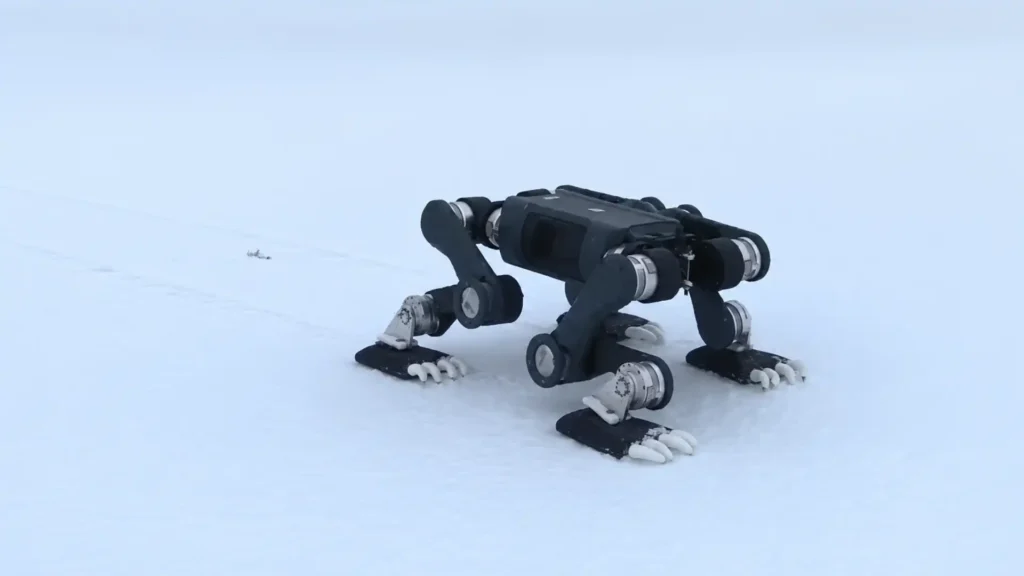
This article is an original analysis supported by the sources cited below
China’s robot dog tackles -22F cold, crosses river and rugged terrain in demo Report on the DEEP Robotics cold-weather demonstration of the Lynx M20S in icy rivers, on steep slopes, and at high altitude, with the core performance claims.
China deploys 8,500 robots across its power grid in landmark order Coverage of the State Grid Corporation procurement of humanoids, wheeled, and quadruped robots, the anchor demand signal behind China’s field-robotics surge.
DEEP Robotics launches new wheeled-legged robot for industrial inspection and emergency response Launch report for the Lynx M20S with detailed specifications on payload, speed, ingress rating, and intended markets.
DEEP Robotics Lynx M20S robot dog Technical overview of the M20S covering the payload increase, top speed, and sensing hardware against the previous M20 model.
Lynx wheeled-legged robot DEEP Robotics’ official Lynx product page describing the wheeled-legged platform, its sensors, control system, and target applications.
DR02 industry-grade humanoid robot Manufacturer page for the DR02 humanoid detailing its all-weather rating, walking speed, modular limbs, and industrial positioning.
DEEP Robotics completes Series C financing Company announcement of the Series C round, naming the lead investors and the strategic backers tied to state telecom operators.
DEEP Robotics files for $367M STAR Market IPO following first profitable year Report on the IPO prospectus, the planned share issuance and capital raise, the use of proceeds, and the company’s first profitable year.
DEEP Robotics secures $68M in Series C funding Details on the December 2025 funding round and the company’s valuation entering its public-listing preparation.
DEEP Robotics starts IPO tutoring for mainland listing Coverage of the company’s pre-IPO process and its reported valuation ahead of the STAR Market filing.
Quadruped state of the market: Unitree and the field Market analysis of the quadruped and wheeled-legged sector, including pricing, revenue, and the competitive position of leading Chinese firms.
Boston Dynamics Spot vs Unitree B2: a comparison Side-by-side comparison of payload, speed, battery life, and price for two of the most widely deployed industrial quadrupeds.
Spot vs Unitree B2 comparison Detailed competitor comparison covering deployment history, software ecosystems, and the procurement implications of country of origin.
Best quadruped robots for industrial maintenance in 2026 Survey of industrial quadrupeds with attention to explosion-proof certification, ingress ratings, and return-on-investment for inspection work.
Embodied AI: China’s ambitious path to transform its robotics industry Policy report on how the Chinese state funds, directs, and standardizes embodied intelligence as a strategic priority.
Embodied AI in China and the rise of smart robots Analysis of China’s industrial-policy approach to robotics, including government funding, procurement, and the contrast with Western private-sector models.
The robotics market in China Overview of Chinese government robotics funding, the dedicated development zones, and demand-side subsidies that shape the domestic market.
Chinese robotics outlook 2026 includes growth and competitive pressure Forecast of the Chinese robotics sector covering shipment growth, margin pressure, and the race of firms toward public listings.
China releases national standards for humanoid robotics and embodied AI Report on the first national standard system for humanoid robots and embodied AI, including the safety and ethics components.
Zhu Qiuguo profile Background on the DEEP Robotics founder, his academic origins at Zhejiang University, and his role in the company.
Quadruped robots: an industry overview Background on DEEP Robotics and its peers, including company history, product lines, and notable field deployments.
DEEP Robotics Lynx series Specification reference for the Lynx wheeled-legged series across its variants, including dimensions, sensors, and connectivity.
Lynx M20 specifications Detailed specification page for the earlier Lynx M20, used to benchmark the improvements introduced with the M20S.
The widening gap: China’s humanoid robotics dominance Analysis of China’s lead in embodied robotics, including the dual-use dimension and the involvement of defense-linked institutions.
| Citing this article? Brief excerpts are welcome. Please credit Webiano.digital, name the author where stated, and include a link to https://webiano.digital and to this original article. Full or substantial republication requires prior written permission. Read our Copyright and Content Use Policy. |
This article was prepared with the assistance of artificial intelligence tools. The content underwent expert human review, and Webiano Digital & Marketing Agency assumes editorial responsibility for its final version and publication.