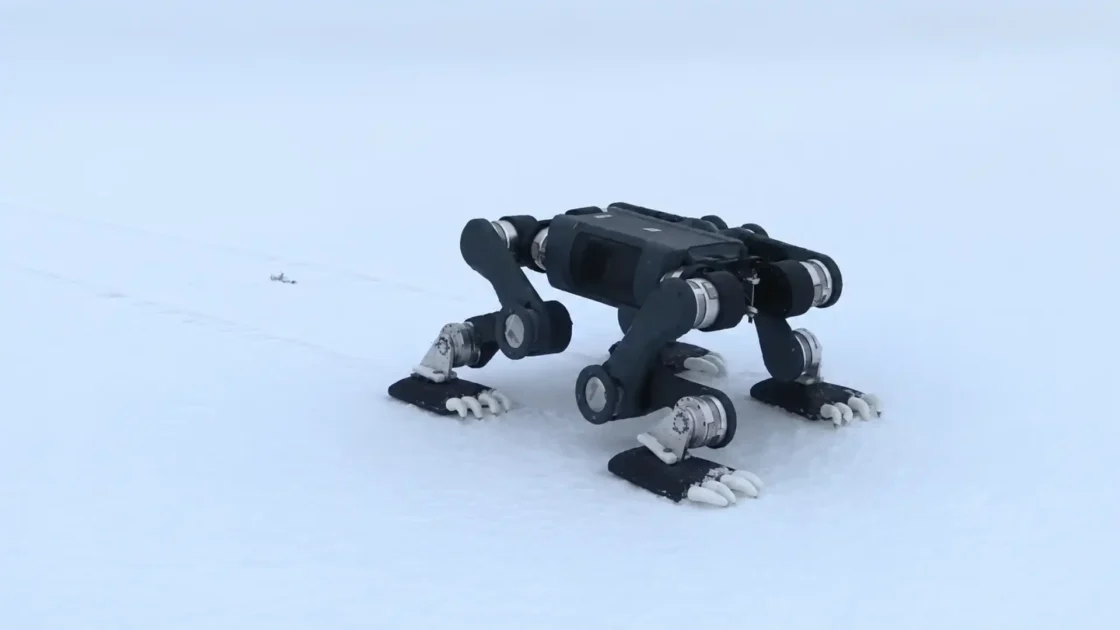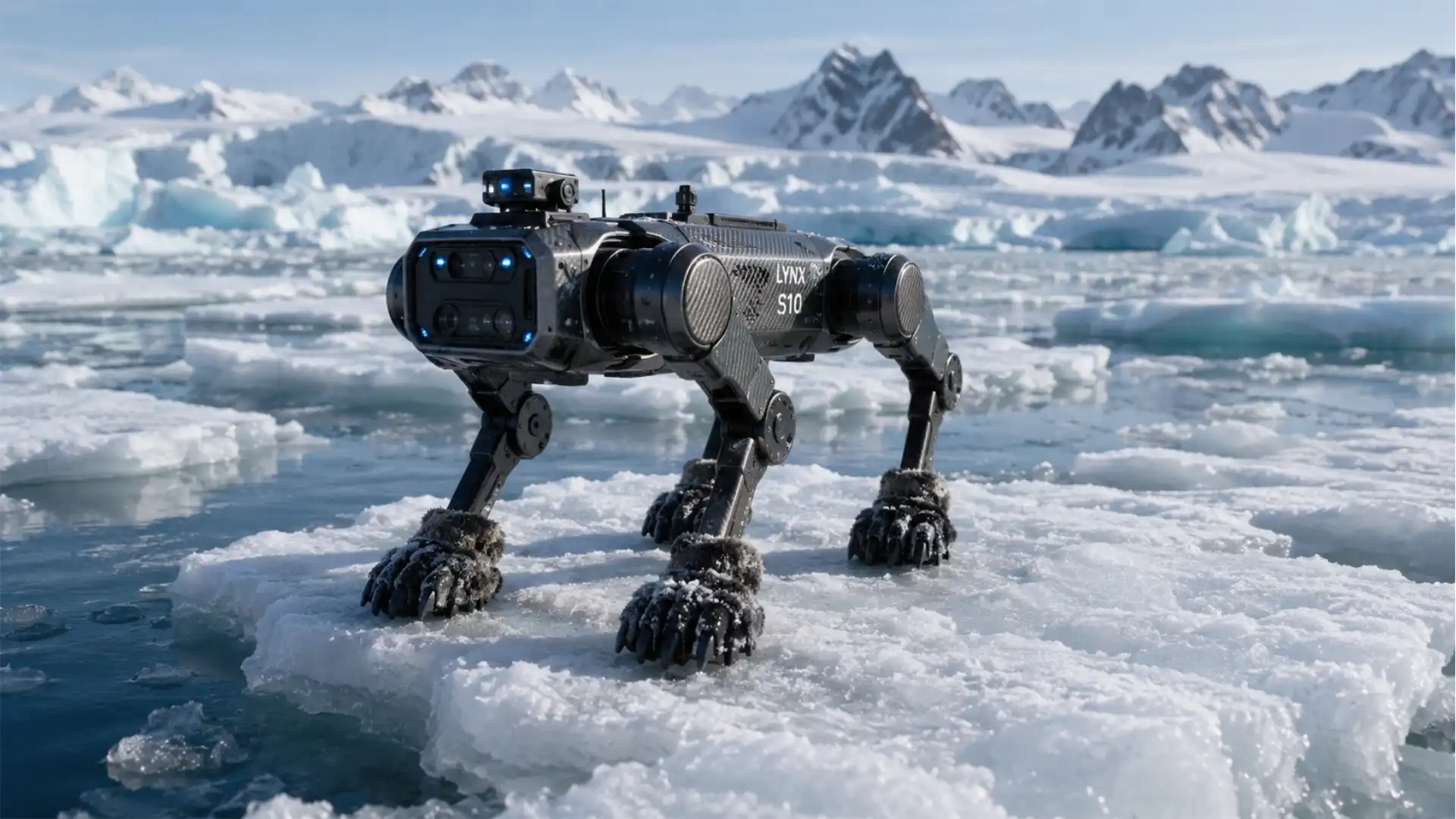
The Lynx S10 did not merely appear in another polished robotics video. A prototype of DEEP Robotics’ small wheeled-legged quadruped was taken aboard the research vessel Sun Yat-sen University Polar and tested on Arctic Ocean ice floes and in icy water during an expedition that the company says lasted 76 days, covered 11,852 nautical miles, reached 81.6°N, and included 38 faculty and students from 13 universities and research institutes. The company’s claim is specific: this was the first time a quadruped robot stepped onto the surface of the Arctic Ocean.
Table of Contents
That claim matters because the Arctic is not a robotics stage. Sea ice moves, cracks, ponds, drifts, floods, reflects light in awkward ways, and sometimes looks safer than it is. DEEP Robotics says the Lynx S10 used wide biomimetic paws, anti-slip sole textures, crampons, sealed body protection, and AI-based route planning to move across snow, ice, and ice-water mixes. The more serious reading is not that robot dogs are suddenly ready to replace polar researchers. The serious reading is that field robotics is moving from choreographed terrain into places where every step tests sensors, control software, hardware sealing, traction, battery behavior, and human trust at once.
The Arctic test was a field trial, not a product stunt
The most useful way to read the Lynx S10 Arctic run is as a field trial inside a scientific expedition. DEEP Robotics described the machine as a prototype, still in the R&D testing phase, rather than a finished polar robot ready for buyers. The robot accompanied Sun Yat-sen University Polar during its second Arctic Ocean expedition and carried out tests on ice floes and in icy waters. That distinction matters because an Arctic crossing clip can look like a finished capability, while the company’s own release places the event inside product development and reliability validation.
A prototype test has a different meaning from a commercial deployment. It answers narrower questions. Can the machine keep footing on low-friction ice? Can the body survive wet, cold contact? Can the legs produce useful force when the surface changes from crusted snow to slick ice to slush? Can route-planning and perception still function when light glare, white snow, blue meltwater, and flat horizons confuse cameras and depth sensors? The Arctic did not certify the Lynx S10 for polar operations. It gave engineers a harsher truth source than a laboratory floor.
The company says the field unit completed motion-control tests for crawling and moving on ice, stood on snow and ice using wide bear-inspired paws, and used crampons with those paws to cross slippery terrain. It also says the robot underwent underwater operation validation in an ice-water environment, after the body was sealed to IP67 and limb surface area was increased for paddling. Those details suggest a test program aimed at contact mechanics and survivability, not only locomotion spectacle.
The expedition context gives the trial more weight. The vessel carried researchers collecting ice samples, specimens, and data tied to air-ice-sea interaction and Arctic environmental change. That means the robot was not simply placed on a symbolic patch of snow outside a showroom. It entered a working polar setting where teams already face slow movement, safety protocols, wildlife risk, and fragile surface conditions. A robot in that setting earns credibility only when it reduces risk, records useful data, or reaches places that humans would rather avoid.
The first-step claim should still be handled carefully. “First” claims in robotics can be hard to audit because robots vary by definition, environment, and task. Here, the claim is narrower than a general “first robot in the Arctic.” It is a claim about a quadruped robot stepping onto Arctic Ocean ice floes. The available public evidence comes mainly from DEEP Robotics and secondary reports that relied on the company’s announcement. A cautious article should call it the company-reported first, not a universally audited milestone.
Even with that caveat, the test is worth close attention. Many robot demos show balance after being kicked, stair climbing, flips, or slick-floor tricks. Those show control talent, but they do not capture the mess of remote fieldwork. Arctic ice adds changing contact, temperature stress, water intrusion risk, uncertain footing, and high cost of retrieval. The Lynx S10 trial is newsworthy because the environment punished all weak points at once.
The confirmed facts behind the Lynx S10 Arctic run
The publicly confirmed core is compact. DEEP Robotics said on June 8, 2026, that its Lynx S10 prototype joined Sun Yat-sen University Polar, conducted multiple extreme-environment tests on Arctic Ocean ice floes and in icy waters, and marked the first time a quadruped robot stepped onto the Arctic Ocean surface. The expedition itself was described as 76 days long, 11,852 nautical miles in total voyage distance, reaching 81.6°N, with a 38-person academic team from 13 universities and institutes.
The machine was not a standard showroom unit. DEEP Robotics says it worked with teams from Sun Yat-sen University, Westlake University, and Hangzhou Dianzi University to add wide biomimetic paws with anti-slip textures, shaped around the grip structure of polar bear paws. The unit also used crampons, and the company says the paired paw-and-crampon setup let the robot stand and move on snow and ice while validating low-friction walking control.
The water trial is just as telling as the ice walk. Standard industrial robots often advertise dust and rain resistance, but Arctic slush and icy water create a harsher failure mode: cold fluid contact, conductive heat loss, seal stress, and a real chance of short-term immersion. DEEP Robotics says the field prototype used an integrated body-sealed design with IP67 protection, and that after increasing limb surface area for paddling, the robot moved through icy Arctic water.
The base Lynx S10 specification explains why the robot was selected for such a test. The official product page lists the S10 as weighing no more than 20 kilograms including battery, reaching 8 m/s on flat ground, clearing obstacles up to 50 centimeters, using next-generation AI motion control and gait algorithms, and carrying an omnidirectional sensing system with mapping, localization, route planning, and obstacle avoidance. Its standard commercial protection rating is listed as IP66, with an operating temperature range of -20°C to 55°C.
Field facts from the Arctic test
| Item | Reported detail | Practical meaning |
|---|---|---|
| Robot | DEEP Robotics Lynx S10 prototype | Small wheeled-legged quadruped under development |
| Expedition vessel | Sun Yat-sen University Polar | University-operated polar research platform |
| Voyage | 76 days and 11,852 nautical miles | Long enough to expose equipment to real expedition logistics |
| Farthest north | 81.6°N | High Arctic operating latitude |
| Team | 38 faculty and students from 13 institutions | Scientific expedition, not a private demo only |
| Arctic modification | Wide bear-like paws, anti-slip soles, crampons | More contact area and grip on snow and ice |
| Water modification | IP67 sealed body and larger limb surface for paddling | Short-term wet and icy-water survivability |
The table compresses the public record, but it should not be read as a full engineering test report. DEEP Robotics has not published a peer-reviewed dataset from the Arctic run, and public reports do not yet describe duration per trial, fall rates, battery drain, autonomy level at each stage, communications links, or recovery events.
The gap between “reported detail” and “usable evidence” is where the analysis begins. A field video can show that a robot survived selected tasks. A product sheet can show advertised performance. Neither alone proves repeatable polar readiness. The next test for Lynx S10 is not whether it can appear on ice once. It is whether it can return clean logs, repeat the run, fail safely, recover from slips, and prove that its sensors and controller understand terrain rather than merely surviving it.
Sea ice turns locomotion into a contact problem
A robot walking on Arctic sea ice is not only solving balance. It is solving contact. The foot touches a surface that may be dry snow, compacted crust, rough ice, soft slush, a melt pond lid, or a hidden water pocket. Each contact changes friction, sinkage, and force transfer. A leg controller that works on a grippy lab mat can waste energy, slip, or collapse into conservative crawling when the surface stops behaving like a floor.
The National Snow and Ice Data Center describes sea ice as a surface shaped by motion, compression, divergence, melt, and snow cover, not a uniform sheet. Ice floes collide and pile into pressure ridges; those ridges can create major obstacles for anyone trying to cross the ice. Leads can open when floes diverge or shear, creating narrow to kilometer-scale cracks that may branch across long distances.
For a small quadruped, those features create overlapping mobility problems. A pressure ridge is a height and geometry problem. A lead is a route-planning and safety problem. A melt pond is a sensing and flotation problem. Snow is both a traction surface and a visual veil. Wind can pack snow into hard ribs. Water can sit just under a thin crust. The machine does not simply need to “walk”; it needs to decide which surfaces should be stepped on, crawled across, avoided, probed, or treated as water.
The Lynx S10’s low mass is a useful starting point. A robot under 20 kilograms is easier to deploy and places less load on thin snow bridges or weak crust than heavier machines. Yet low mass alone does not solve the contact problem. A light robot with narrow feet can still punch into soft snow or slide on ice. A light robot with too much torque at the wrong moment can lose traction and spin its contact points. On sea ice, the force profile matters as much as the weight number.
The bear-like paw modification is a direct answer to that force profile. Wider paws spread load. Anti-slip textures add contact points. Crampons cut or bite into harder ice. Crawling lowers the center of mass and reduces the penalty of a single slip. Larger limb surfaces used for paddling add a second mode for ice-water mixtures. These are not cosmetic choices. They show that the team treated the Arctic run as a physical interaction problem rather than a pure AI problem.
This is where legged robotics becomes more interesting than wheeled mobility. Wheels are fast on smooth ground but struggle when the surface breaks, stacks, or contains negative space. Legs can place contact points with care, shift body posture, use multiple gaits, and step around hazards. Yet legs are slower, more mechanically complex, and power hungry. The Lynx S10’s wheeled-legged architecture sits between those poles. On smooth ground, it can roll. On broken or slippery surfaces, it can use leg motion. The Arctic run stripped away the easy part of that claim and tested the part that matters most: contact on unstable ground.
Bear-like paws were an engineering decision, not a visual gimmick
The phrase “bear-like paws” sounds made for headlines, but the engineering idea behind it is old and serious. Polar bears move across snow, sea ice, and water because their feet solve several problems at once: load distribution, grip, warmth, and propulsion. SeaWorld’s polar bear physical-characteristics guide notes that polar bear paws can reach about 30 centimeters across, act like snowshoes by spreading weight over snow and ice, use curved claws for traction, and have pads with papillae that create friction on ice.
The Lynx S10 modification borrowed the two parts most relevant to a robot: larger contact area and grip texture. DEEP Robotics described the field paws as wide, biomimetic, and equipped with anti-slip sole textures that mimicked polar bear grip structure. The team also added crampons. The result was a contact system that could spread load in soft snow and bite into harder surfaces when friction alone was not enough.
Biomimicry often gets oversold. A robot paw inspired by an animal does not reproduce the animal. It does not have living tissue, self-healing pads, sensory nerves, blood flow, fur insulation, adaptive claws, or the long evolutionary tuning behind a polar bear’s gait. The useful question is narrower: which animal principle translates into a mechanical feature? In this case, the principle is plain. Wide, textured contact surfaces reduce ground pressure and raise friction where a narrow wheel or pad would slide or sink.
A 2022 Journal of the Royal Society Interface paper on bear paw-pad roughness studied polar bear traction and found that paw microstructures are relevant to friction on snow. The work is part of a broader biomimetic line of thinking: if natural surfaces grip snow and ice well, engineered treads, soles, and robotic feet can learn from their geometry. The Lynx S10 paw does not prove that the company copied polar bear microstructure in a detailed scientific sense, but it sits squarely inside that design logic.
Crampons add a less subtle mechanism. They are not inspired by a bear so much as by human ice travel. They work by concentrating force into points that penetrate or catch hard ice. On mixed ice and snow, the pairing of a wide paw and crampon can be useful because each handles a different surface regime. The wide foot resists sinking; the metal points resist sliding. For a legged robot, the controller then has to manage the extra constraint: a foot with crampons may grip well but can snag, resist rotation, or break traction abruptly if the body pulls sideways.
This modification also hints at a wider future for field robots. The base robot may be a platform, but the foot is mission hardware. Rescue robots may need rubble claws. Agricultural robots may need soft soil feet. Tunnel robots may need abrasion-resistant pads. Polar robots need snow and ice contact tools. Legged robots become credible in harsh terrain when their feet stop being generic.
AI route planning is useful only when perception survives the ice
The Lynx S10’s official product page says it has an omnidirectional sensing system, mapping and localization algorithms, autonomous path planning, and obstacle avoidance. It also says the robot can complete assigned tasks without human intervention. The launch release describes four ultra-wide-angle HDR cameras and front and rear LiDAR units in a 3D perception architecture.
Those features sound familiar because nearly every advanced mobile robot now advertises perception, mapping, and autonomy. The Arctic makes the words harder. Snow can saturate cameras. Ice can reflect. Water can look like a hole, a mirror, or nothing at all. Fog and blowing snow cut contrast. Low sun angles create glare. A white surface can erase horizon cues. Dark water against white ice can look obvious to a human in one moment and invisible to a camera in another.
Robotics research has already named this problem. A Science Robotics paper on perceptive locomotion for quadrupeds notes that snow, vegetation, and water can visually appear as obstacles that cannot be stepped on, or may be missing from depth perception because of high reflectance. It also points to degraded depth perception under hard lighting, dust, fog, reflective surfaces, transparent surfaces, and sensor occlusion.
That finding is directly relevant to the Lynx S10 Arctic run. The robot’s AI route planning is not meaningful if the perception stack cannot classify the surface. The robot has to know whether a patch of white is load-bearing snow, whether a blue depression is shallow meltwater or a through-ice pond, whether a ridge is passable, whether a dark slot is open water, and whether glare is hiding an obstacle. Some of those judgments may require exteroception, meaning cameras and LiDAR. Some may require proprioception, meaning the robot learns from joint torque, slip, acceleration, and body motion after contact.
The best polar autonomy will use both. Cameras and LiDAR see ahead. Foot contact tells the truth at the ground. If the surface looks stable but the paw sinks or slips, the controller must adjust immediately. If the surface looks impossible but the paw has support, the robot can proceed slowly. On sea ice, AI route planning is less a map problem than a constant negotiation between what the robot sees and what its body feels.
This is why the Arctic data matters more than the Arctic photo. Every slip, torque spike, recovery movement, sensor dropout, and false surface classification is training material. A robot that gathers real polar mobility data can teach engineers which cues matter, which sensors fail, which gait changes work, and which hazard types still defeat the stack. Without that data, “AI navigation” remains a phrase. With it, route planning becomes an empirical engineering problem.
The wheeled-legged design has promise and compromise
The Lynx S10 belongs to a fast-growing class of wheeled-legged robots. Its limbs can act as legs, but the ends use wheels in the standard configuration. This design aims to combine wheel speed on easier surfaces with leg placement on obstacles, stairs, rubble, slopes, and broken ground. DEEP Robotics says the S10 can reach 8 m/s on flat ground and clear obstacles up to 50 centimeters, while its compact body and 16 high-precision joints let it fit into narrow spaces and rubble gaps.
The Arctic unit replaced or supplemented the standard wheel-ground interface with bear-like paws. That change exposes the core tension of wheeled-legged platforms. Wheels are excellent when there is a continuous surface. Paws are better when the surface is discontinuous, slippery, soft, or needs deliberate contact placement. A robot that can accept different end-effectors has a wider operating envelope, but every swap changes the dynamics, controller assumptions, calibration, and failure modes.
Academic work on wheeled-legged locomotion has long argued that combining legs and wheels could serve real applications that need both long-distance speed and rough-terrain motion. A 2019 paper, “Rolling in the Deep,” described online trajectory planning for wheeled quadrupeds and validated a platform in the DARPA Subterranean Challenge, where it mapped, moved, and explored dynamic underground spaces.
The Lynx S10 is part of that same design lineage, though as a commercial small robot rather than an academic prototype. The logic is easy to understand. A pure quadruped wastes energy if it must walk long corridors, patrol paved industrial sites, or cover flat terrain. A pure wheeled robot struggles when it meets stairs, debris, trenches, pressure ridges, or fractured ice. A wheeled-legged robot can roll when the ground permits and step when it must.
The compromise is complexity. The controller must know when rolling is safe, when rolling will slip, when to walk, when to crawl, when to lock or unload the wheel, and when to stop. The hardware must survive impact from both rolling and stepping. The end of each limb becomes a mobility module, not a simple foot. On sea ice, that complexity grows because the machine may need to roll on hard snow, step on ridges, crawl over low-friction patches, and paddle through slush in a single route.
The Arctic test makes the wheeled-legged idea more credible precisely because the team did not insist that wheels alone were enough. A platform that can be re-footed for ice is more adaptable than one trapped by its standard end-effectors. The larger question is whether future S10 units will support modular feet as a routine mission feature or whether the Arctic paws remain a one-off prototype adaptation.
The underwater validation matters more than it first appears
Walking on ice is visually dramatic. Moving through icy water may be more instructive. Many outdoor robots fail not because they cannot move but because water enters, batteries lose performance, connectors corrode, sensors fog, seals contract, actuators bind, or electronics behave differently in cold wet conditions. Arctic water brings several of those risks together.
DEEP Robotics says the Lynx S10 field prototype had an integrated sealed body rated IP67 and that the robot moved through an ice-water mixed environment after the team increased limb surface area for paddling. The standard Lynx S10 product page lists IP66, which protects against dust and powerful water exposure but is not the same claim as temporary immersion. The Arctic unit’s IP67 statement therefore appears to refer to the modified field prototype, not the standard product page baseline.
IEC explains that IP ratings come from IEC 60529, which grades enclosure resistance against dust and liquids. In practical terms, the “6” in IP67 refers to dust-tight protection under the test standard, while the “7” refers to temporary immersion protection under defined conditions. That does not mean a robot is a submarine, and it does not prove long-duration saltwater survivability. It means the body met a stronger short-term water-ingress design target than ordinary splash or rain resistance.
For Arctic field robotics, that difference matters. Sea ice fieldwork often includes melt ponds, slush, flooded snow, and sudden surface transitions. A robot may not be assigned to swim, but it may fall through a crust, step into a water pocket, or cross a shallow lead edge. If a single unexpected plunge destroys the machine, it is a fragile tool. If the machine can survive and self-extract or be retrieved safely, it becomes far more useful.
The paddling modification is also telling. Legs are not natural propellers, but a larger surface area can move water, especially for a small robot. This does not make Lynx S10 an autonomous underwater vehicle. It gives it a recovery or crossing mode in mixed ice-water conditions. In polar work, “not drowning immediately” is a mobility function. A land robot that can tolerate brief water contact and generate some propulsion has a safer failure envelope than a machine that treats water as instant mission loss.
Future reporting should watch for hard numbers: immersion depth, duration, salinity, number of cycles, post-test maintenance, thermal behavior, battery drain, and seal condition. Without those details, the water claim is promising but incomplete. Still, even incomplete public evidence shows that the team knew the Arctic would punish any simple separation between “walking terrain” and “water hazard.”
The robot’s small size changes expedition logistics
The Lynx S10 weighs no more than 20 kilograms including battery, according to the official product page. DEEP Robotics emphasized the same sub-20-kilogram figure for the Arctic unit. That matters because expedition logistics can decide whether a robot is used or left in a crate. A machine that one person can carry is easier to move through ship corridors, launch from deck, retrieve from ice, place in small boats, or bring back indoors before weather changes.
Field tools fail when they demand too much ceremony. A large vehicle may be more capable on paper, but it requires lifting gear, more deck space, charging infrastructure, spare parts, and a recovery plan if it gets stuck. A small robot has less payload and endurance, yet it can be tried more often. It invites experimentation. Researchers can send it to inspect a suspect patch, test a route, scout a ridge, or gather close-range data without rearranging the whole expedition day.
A sub-20-kilogram robot also reduces social friction. Scientists working from sea ice already manage survival suits, sampling tools, drills, radios, bear-watch procedures, and ship access routines. A robot that becomes another heavy operation may not be welcome. A robot that can be carried, placed, and recovered with little disruption has a better chance of becoming part of the workflow.
The tradeoff is energy and payload. Small robots carry smaller batteries and fewer heavy instruments. The standard S10 page emphasizes mobility and lightweight operations rather than heavy science payloads. That suggests its early polar role is more likely scouting, inspection, route assessment, close video, surface mobility data, and perhaps small sensor packages, not replacing large autonomous stations or hauling deep ice coring gear.
In polar research, small useful machines may beat larger impressive ones. The right task for a robot like Lynx S10 is not to recreate a human field team. It is to reduce the number of human steps on bad ice, extend the team’s eyes into risky zones, and collect mobility or environmental data in places where a person would pause. A small robot can be expendable in a way a human is not, but it should not be treated as disposable. Retrieval still costs time and risk, and a lost robot becomes debris in a fragile environment.
That raises another practical design question: can a robot this small carry enough sensors to justify its presence? A camera-only scout may be useful. A thermal camera, gas sensor, ice thickness proxy, snow depth sensor, or compact sampling payload could make it more useful. A communications relay, return-to-home behavior, and visible tracking beacon may matter as much as speed. The Arctic run points toward a platform, but the science value will depend on payload integration.
Polar research needs safer ways to collect local data
Polar research has a data problem that is also a human-risk problem. Satellites can measure sea ice extent, albedo, temperature patterns, and large-scale change, but many processes still require local observation. Ice thickness, snow structure, melt pond depth, brine channels, mechanical strength, surface roughness, biological sampling, and air-ice-sea exchange are hard to understand from orbit alone.
The Lynx S10 expedition sat inside that need. DEEP Robotics said the 38-person academic team collected ice samples, specimens, and data to support research on air-ice-sea interactions and Arctic environmental change. Xiamen University’s own article about a PhD student on the expedition describes work at ice stations, including ice-core drilling, surface snow and melt-pond water collection, and deployment of ice-based profiling buoys.
Those tasks place people on ice. Once people step onto sea ice, the safety burden grows. They must assess surface stability, maintain radio contact, watch for polar bears, manage cold exposure, avoid leads and melt ponds, handle tools, and return before weather or ice conditions worsen. The more measurements required, the more steps and decisions the team must make.
Robots cannot remove that burden, but they can change its shape. A small quadruped can scout a suspected route before a person commits. It can carry a camera toward a melt pond edge. It can inspect an ice station perimeter. It can repeat a route to quantify surface change. It can place or retrieve light instruments if the payload and manipulator are adequate. It can collect proprioceptive mobility data that also functions as a map of slipperiness, sinkage, and stability.
The PLOS Climate review on polar fieldwork argues that climate change is compounding polar fieldwork challenges through reduced snow and ice cover, thawing permafrost, intensified fires, and increased wildlife interactions. It recommends new fieldwork practices, better data sharing, and methods that reduce redundant trips and unnecessary exposure.
That is the larger scientific opening for robots such as Lynx S10. The aim is not to make polar research look futuristic. The aim is to reduce the number of high-risk human movements required to collect local evidence. A robot that moves only for spectacle has little value. A robot that produces repeatable local measurements, while keeping people closer to safe zones, has a clear field role.
The hard part is integration. Researchers need data standards, not only videos. They need timestamps, geolocation, calibration, sensor metadata, uncertainty estimates, and logs that can be used later. They need robots that can be cleaned, charged, repaired, and trusted by non-roboticists. They need protocols for wildlife, retrieval, failure, and environmental protection. The Lynx S10 Arctic run starts the conversation but does not finish it.
Arctic climate change makes the terrain harder to predict
The Arctic is warming faster than the global average, and that changes the surface that field teams and robots must cross. NOAA’s 2025 Arctic Report Card says surface air temperatures across the Arctic from October 2024 through September 2025 were the warmest recorded since 1900, that the last 10 years were the 10 warmest in the Arctic record, and that annual Arctic temperature since 2006 has risen at more than double the global rate. It also reports that March 2025 produced the lowest annual maximum sea-ice extent in the 47-year satellite record and that the oldest, thickest ice had declined by more than 95 percent since the 1980s.
That matters for robotics because older, thicker, more stable sea ice is a different operating surface from younger, thinner, wetter ice. A robot designed around one kind of ice may fail on another. Melt ponds, slush layers, snow crusts, ridges, leads, and broken floes become more common or more variable as seasonal conditions shift. A machine that handles a clean cold plate may still struggle when the real surface is wet, layered, and mechanically weak.
NSIDC explains that summer meltwater accumulates in depressions on sea ice as melt ponds, and those ponds absorb more heat than surrounding ice, growing in area and depth. It also explains that snow-covered sea ice can reflect as much as 90 percent of incoming solar radiation, while melt ponds lower surface albedo and increase solar absorption.
The robot’s challenge is therefore connected to climate science. It is not just walking on ice; it is walking on a climate indicator. The surface carries clues about heat, snow, melt timing, floe age, wind, ocean influence, and seasonal transition. A robot moving across that surface can potentially gather data about the very processes making future movement harder.
Arctic warming strengthens the case for field robots but also makes their job harder. Thinner and wetter ice creates more situations where people would benefit from standoff inspection. It also creates more situations where robots will slip, sink, flood, or misread terrain. The engineering target is moving.
This argues against treating one successful Arctic run as a solved problem. A robot that works in one season, region, and ice state may not work during another. The Arctic Ocean is not one terrain class. The same route may be stable in the morning and dangerous later. Ice drift can move the entire workspace. Weather can erase tracks. A useful polar robot must be conservative, adaptable, and instrumented enough to report uncertainty rather than pretending the map is certain.
Melt ponds are a sensor trap and a safety trap
Melt ponds are central to the Lynx S10 story because DEEP Robotics specifically described snow-covered melt ponds as a hazard that can look like a white surface but hide freezing water below. The company’s statement matches the broader science of sea ice: melt ponds form when surface snow and ice melt, collect in depressions, and change both the thermal behavior and the appearance of sea ice.
For humans, the danger is intuitive once explained. A person may see snow and assume support, but the snow may cover slush or water. A step can break through. The cost is not only wet boots; it can mean cold shock, injury, gear loss, and emergency retrieval. For a robot, the hazard is a mixed failure case. The machine can misclassify the surface, step onto it, lose contact, break through, flood, slip, or recover in a way that worsens the situation.
Melt ponds are hard for sensors because they combine water, ice, reflectance, translucency, and depth ambiguity. Cameras may see color differences, but snow can cover them. LiDAR may struggle on reflective or absorbing water surfaces. Thermal sensors may help in some conditions but not all. Radar or ground-contact probing may add evidence, but those sensors increase cost and complexity. The most reliable signal may come from the foot itself: sudden sinkage, changed load, slip, or drag.
This is one reason the Arctic run’s mobility data matters. If the robot logged its joint torques, body acceleration, foot contact state, slip estimates, and visual data, engineers can study where perception matched or failed the physical truth. A robot can learn that a certain visual texture predicts weak support, or that a small pre-slip pattern predicts a coming fall. It can also learn when the view is too uncertain and a crawl or stop behavior is safer.
A 2025 Cryosphere paper on melt ponds notes that they alter solar absorption in the Arctic sea ice-ocean system and influence sea ice mass balance through the ice-albedo feedback. That is a climate point, but it also explains why melt ponds are not marginal features. They are physically and visually central to the summer sea-ice environment.
For polar robots, melt ponds are not just obstacles. They are the feature that forces the robot to combine climate-aware terrain understanding with real-time body feedback. A machine that cannot detect or survive melt pond conditions will have only limited value during the melt season. A machine that can map them safely could become useful to scientists and expedition crews at the same time.
Low-friction ice exposes the limits of robot confidence
Low-friction surfaces punish overconfidence. A robot can look stable until a foot slides, and the slide may begin at lower forces than the controller expects. Once sliding starts, recovery depends on body posture, contact timing, spare friction, and whether the controller can reduce force quickly. On rough ground, a foot can catch. On slick ice, a foot can continue moving until the body loses its base of support.
DEEP Robotics says the Lynx S10’s paw-and-crampon setup validated walking control on highly slippery, low-friction ice surfaces. The phrasing is useful because it ties the field test to control, not only mechanical grip. Hardware gave the robot a better chance. The controller still had to use it.
Low friction changes every gait decision. Fast steps create higher horizontal impulses and more slip risk. High body posture increases the penalty of a foot losing support. Turning can be more dangerous than straight movement because sideways loads rise. Wheel motion can turn into spin. Crawling lowers the center of mass but sacrifices speed. A good controller must adapt force, step length, body height, and gait tempo to the surface.
The hard part is that friction is not directly visible. Cameras infer it from surface cues. LiDAR gives geometry. The robot learns true friction through contact. A patch of snow may be grippy, crusted, powdery, or hiding ice. A patch of ice may be rough, wet, snow-dusted, or polished. The same visual surface can have different mechanical behavior depending on temperature and melt state.
That gap between appearance and mechanics is a central problem in field robotics. It is why legged robots often combine exteroceptive sensors with proprioceptive feedback. The Science Robotics perceptive locomotion work describes the need to integrate terrain perception before contact with body sensing during motion, especially in settings where vision and depth perception become unreliable.
The robot’s confidence must be earned at the foot, not declared by the planner. A route planner can choose a path, but the controller must be willing to revise that plan after every contact. The safer polar robot may look less flashy than a demo robot. It will stop more often, lower its body, probe uncertain surfaces, back away from ambiguous zones, and prefer survival over speed. In the Arctic, caution is not a weakness. It is a mobility feature.
The S10’s autonomy claim needs careful interpretation
The official Lynx S10 product page says the robot enables autonomous route planning and obstacle avoidance, and can complete assigned tasks without human intervention. In a factory, campus, tunnel, or controlled outdoor setting, that may mean the robot can map, localize, plan, and avoid barriers over a set route. In the Arctic, autonomy must be judged more narrowly unless DEEP Robotics publishes detailed logs.
Autonomy is not a single state. A robot may be remotely driven, semi-autonomous, waypoint-driven, supervised, or fully autonomous for selected segments. It may plan its own path but require a human to approve riskier moves. It may avoid obstacles but not classify ice safety. It may walk autonomously while a human chooses the route. Public reports on the Arctic run do not yet specify which autonomy mode was used during each task.
That matters because the phrase “AI navigation” can mislead readers. A robot that survives remote operation on Arctic ice is impressive. A robot that autonomously selects safe routes across ice floes is a stronger claim. A robot that collects useful mobility data under human supervision is still valuable. The public record supports a careful statement: Lynx S10 is built with AI route planning and obstacle avoidance, and its Arctic prototype completed field mobility tests. It does not yet prove unsupervised polar navigation at expedition scale.
There are also safety reasons for keeping a human in the loop. A robot operating near a ship, researchers, fragile instruments, melt ponds, or wildlife should not be granted reckless independence. Humans may need to prevent it from entering a protected sampling area, approaching animals, damaging instruments, or becoming debris. Full autonomy is not always the goal. Controlled autonomy may be the wiser model.
The better question is what autonomy should mean for polar use. It should include safe self-stop behavior. It should include loss-of-signal handling. It should include return-to-home or return-to-line-of-sight routines. It should include uncertainty reporting: “surface confidence low,” “slip risk high,” “water probability high,” “route blocked,” “battery margin poor.” It should include readable logs for scientists and operators.
The future polar robot should not only move by itself. It should explain why it is refusing to move. That may be the difference between a machine that builds trust and one that produces anxiety. In harsh field settings, a cautious robot with transparent limits is more useful than a bold robot whose decisions are opaque.
The Arctic run sits inside the embodied AI race
DEEP Robotics describes itself in the embodied AI space, and the Lynx S10 launch release frames the robot as part of a broader push from lab technology into real-world industry tasks. “Embodied AI” refers to AI systems that act through physical bodies, receiving sensory input, making decisions, and affecting the world through motors, limbs, wheels, grippers, or other mechanisms. A language model predicts text. An embodied robot must place a foot on ice and live with the result.
That distinction is the center of the Arctic story. AI in the cloud can be wrong without falling into freezing water. AI in a robot becomes accountable to physics. The S10’s route planner, perception stack, gait controller, and hardware all meet at the foot. The body is not an accessory to the intelligence. It is part of how the system learns what the terrain is.
The quadruped robotics field has been moving toward this integration for years. A 2025 review in Robotics describes quadruped robots as systems combining mechanical design, control, perception, AI, and applications in fields such as search and rescue, industrial inspection, agriculture, defense, and public safety. It also notes continuing barriers around cost, reliability, regulation, environmental impact, and cybersecurity.
The Arctic run gives embodied AI a harder benchmark than warehouse navigation. A robot cannot rely on crisp lane markings, known obstacles, level floors, or clean lighting. It must handle surface uncertainty, changing friction, cold, water, and mission safety. That is the kind of trial that separates embodied AI rhetoric from embodied AI engineering.
Still, the industry language should not be accepted uncritically. “Embodied AI” can become a market label attached to any mobile robot with perception. The useful test is whether the machine’s intelligence improves through bodily contact with hard environments. Did the Arctic run produce data that changes the controller? Did it reveal sensor failure modes? Did it teach better foot design? Did it improve future autonomy? If yes, the embodied AI claim has substance.
The S10’s Arctic trial is best seen as a test of embodied learning under environmental stress. The robot’s value will come less from one symbolic crossing and more from the feedback loop between field data, model improvement, hardware revision, and the next deployment. That loop is where embodied AI becomes more than a phrase.
Search and rescue is the obvious market, but not the only one
DEEP Robotics positions the Lynx S10 for power inspection, security patrol, emergency firefighting, education and research, and outdoor exploration. Its launch release also names emergency search and rescue. The Arctic test strengthens that story because disaster zones and polar ice share a basic feature: both are unstructured, unstable, and dangerous for humans.
Search and rescue teams need machines that can enter collapsed structures, icy flood zones, avalanche debris, industrial accidents, tunnel collapses, and storm-damaged areas before humans do. A small wheeled-legged robot with cameras, LiDAR, obstacle avoidance, and adaptable feet could scout routes, locate hazards, carry small sensors, or relay visual information. The Arctic paws themselves may not be used in rubble, but the same modular thinking applies.
The DARPA Subterranean Challenge showed why autonomy matters in hazardous search. DARPA described the challenge as an effort to equip responders and warfighters to explore underground spaces too dangerous, dark, or deep for human lives, with robots required to map, move, and search tunnels, urban underground spaces, and caves.
The Arctic adds a cold-and-water dimension to that same logic. Flooded basements, frozen industrial sites, ice-covered roads, disaster zones in winter, and avalanche terrain can defeat ordinary wheels. A robot that handles water exposure, slippery contact, and mixed locomotion has a plausible role beyond polar science.
Yet buyers will ask for proof that field demos often do not provide. Can the robot operate for hours, not minutes? Can it survive repeated impacts? Can it be disinfected after contaminated water? Can it carry gas sensors, thermal cameras, radios, or medical payloads? Can it climb over rebar without snagging? Can firefighters operate it while wearing gloves? Can it send reliable video through concrete, snow, or metal structures? Can it fail without blocking a rescue route?
The Arctic run is a strong credibility signal, not a market guarantee. For rescue use, the S10 must meet responder workflows, maintenance budgets, training limits, radio constraints, and safety rules. A machine that excites engineers may still fail adoption if it is fragile, too complex, or hard to repair under stress. Field robotics succeeds when it is boring enough to be trusted.
Industrial inspection may adopt this faster than polar science
Polar science is a compelling use case, but industrial inspection may buy and deploy robots faster. Power plants, substations, tunnels, mines, factories, refineries, construction sites, and campuses have a clearer business case: reduce worker exposure, inspect more often, document conditions, and enter spaces that are cramped, hot, wet, dusty, or unsafe. The Lynx S10 product page names power and utilities, rescue, tunnels, metal and mining, construction, and research as target sectors.
Industrial buyers also have repeatable routes. A robot may patrol the same corridor every night, inspect the same gauges, scan the same tunnel, or check the same perimeter. That repeatability helps autonomy. The robot can build a map, compare new data with prior runs, and flag anomalies. The Arctic has no such stable map. Ice drifts and changes. A factory gives the robot a more controlled learning environment.
This is why the Arctic run has marketing value for industrial customers. If a small robot can survive a polar trial, it looks more credible for rain, dust, mud, stairs, flooded areas, and outdoor inspection. The Arctic becomes a proof symbol. The risk is that the symbol outruns the evidence. A power company does not need an Arctic hero; it needs uptime, integration, cybersecurity, service, replacement parts, and clear ownership cost.
DEEP Robotics’ launch release argues that Lynx S10 fills a market gap for small wheeled-legged robots in narrow spaces and lightweight operations. The product’s sub-20-kilogram weight and obstacle clearance fit that positioning. It is not a heavy-duty hauling robot. It is a compact mobile sensor platform.
The most likely early commercial value is inspection in places where the robot’s eyes matter more than its payload. Cameras, LiDAR, thermal imaging, gas detection, acoustic sensors, or radiation sensors can turn mobility into operational value. A robot that only moves is a novelty. A robot that moves and reports actionable anomalies is a tool.
Polar science may still shape the technology. If the robot’s controllers and sealing improve because of Arctic testing, industrial buyers benefit. The harshest environments often teach lessons that transfer downward. A robot prepared for ice, slush, glare, and cold may be better in a wet mine or storm-hit substation. The Arctic is not the main market, but it may become an unforgiving test bench for machines sold elsewhere.
Military and security interest will follow, even if the story begins with science
Quadruped robots attract defense and security attention because they move through places that humans, wheeled vehicles, and drones cannot easily handle. The Lynx S10’s Arctic run will be watched through that lens, even though the public story centers on scientific expedition support. The Arctic itself is also a geopolitically sensitive region, with expanding shipping, resource interest, research activity, and military observation.
DEEP Robotics’ product positioning includes security patrol. Its broader robot portfolio has industrial and inspection uses. A small wheeled-legged platform with autonomous route planning, obstacle avoidance, and cold-weather potential could interest border security, base inspection, port authorities, coast guards, and military logistics teams. It could also raise concerns about surveillance, escalation, and dual-use deployment.
The Arctic adds another layer. A robot that can move on sea ice may support science, but the same mobility can serve monitoring or reconnaissance. That does not make the Lynx S10 a weapon, and there is no public evidence from this test suggesting weaponization. It does mean public analysis should be honest about dual-use robotics. Mobility in dangerous terrain is useful to scientists, rescuers, industrial operators, and security agencies for the same physical reason.
This is not unique to Deep Robotics. Boston Dynamics’ Spot, ANYbotics’ ANYmal, Unitree platforms, and academic quadrupeds all sit inside the dual-use debate. The DARPA Subterranean Challenge itself framed underground autonomy around responders and warfighters. The technology stack—mobility, sensing, autonomy, mapping, communications—travels across sectors.
The policy question is not whether such robots should exist. They already do. The question is how they are governed in public spaces, research areas, critical infrastructure, and fragile ecosystems. Who owns the data? Can the robot record people? Can it operate near wildlife? Can it be hacked? Can operators be identified? Can regulators distinguish a scientific robot from a security platform when hardware is similar?
A serious Arctic robotics program should get ahead of those questions. Field permits, data handling rules, wildlife standoff protocols, environmental recovery plans, and transparency about payloads will become part of deployment credibility. The Lynx S10’s first Arctic steps are a technical story now. They may become a governance story next.
China’s polar research capacity is part of the background
The test took place on Sun Yat-sen University Polar, described by DEEP Robotics as a pioneering polar scientific research vessel independently owned and operated by a university. Xiamen University’s article similarly describes Sun Yat-sen University Polar as China’s first polar research vessel independently owned and operated by a domestic university.
That matters because the robot trial is not isolated from China’s expanding polar science infrastructure. University-operated vessels, ice-class ships, cross-institution expeditions, and onboard technology trials create a pathway for Chinese robotics companies to test systems in real extreme environments. A company does not need to own an Arctic program if it can join academic expeditions that need tools and are willing to test them.
The expedition was described as the vessel’s second Arctic Ocean scientific expedition, with data collection tied to air-ice-sea interactions and environmental change. The robot’s presence therefore signals a coupling between climate research and domestic robotics development. It also shows how field science can become a proving ground for embodied AI hardware.
Internationally, that coupling will be read through multiple lenses. Scientists may see useful instrumentation and safer fieldwork. Robotics analysts may see a commercial platform gaining hard-environment validation. Security observers may see mobility technology being tested in a region of strategic interest. All of those readings can be true at once.
The Arctic is no longer remote in policy terms. It is a climate front line, a shipping concern, a resource region, a homeland for Indigenous communities, a military planning area, and a scientific archive. Robots entering that environment will carry national and commercial context with them. The Lynx S10 is a small machine, but the setting gives it larger meaning.
This does not require alarmism. A robot dog walking on ice is not a geopolitical shift by itself. Yet the test shows that advanced robotics companies can reach polar environments through scientific partnerships and return with data, imagery, and claims that support future markets. That is worth noting because field access is often the limiting factor in robotics. Once companies can test in the Arctic, they can accelerate design cycles for cold, wet, remote terrain.
The data gathered may be more valuable than the crossing
The headline is the first quadruped step onto Arctic Ocean ice. The long-term value is the data. DEEP Robotics says the Lynx S10 gathered real-world experience and that the field test promotes iterative product upgrading. Public reports do not yet show the dataset, but the types of data available from such a robot are clear: video, LiDAR returns, inertial measurements, joint positions, motor currents, temperature readings, battery behavior, slip events, gait transitions, impact loads, and operator interventions.
For a robotics team, those logs are gold. Lab data is clean; field data is rude. It shows that a camera saturates at a certain sun angle, a connector stiffens after cold spray, a paw collects snow, a crampon snags, a gait works on granular snow but not on wet ice, a LiDAR return is unreliable over dark water, or a battery voltage sag changes torque margins. These lessons are rarely visible in a promotional clip.
For scientists, robot mobility data could also become environmental data if calibrated properly. Foot sinkage can hint at snow strength. Slip can indicate surface friction. Body vibration can reveal roughness. Repeated runs can show surface change. Coupled with GPS and environmental sensors, the robot could produce a mobile map of traversability.
The emerging idea is sometimes called proprioceptive terrain mapping: using the robot’s own internal sensing to estimate how the terrain behaves under its body. Research on proprioceptive mapping for quadrupeds has explored foot slippage, energy cost, stability margins, and terrain interaction as layers in a map, especially for hard exploration settings.
The Arctic robot becomes more useful when its struggles become measurements. A slip is not only a failure. It is a data point about surface friction. A slow crawl is not only caution. It is evidence about terrain difficulty. A failed visual classification is not only a software bug. It is a label for retraining.
That is why future releases should publish more than images. Even a limited technical note—trial count, terrain categories, sensor suite, autonomy level, falls, recoveries, battery drain, environmental conditions, water exposure duration—would make the Arctic run far more useful to the robotics community. Without that, the story remains credible but shallow. With it, the Lynx S10 could become part of a larger body of field-robotics evidence.
The limits are as revealing as the achievement
The public record leaves many gaps. It does not say how far the Lynx S10 walked on ice floes, how long it operated per sortie, how many times it slipped, whether it fell, how often humans intervened, how deep the water trial was, how many repeated runs occurred, whether all sensors operated during the test, or whether the robot carried science payloads. It does not say whether route decisions were autonomous or supervised at each stage.
Those missing details do not invalidate the achievement. They define its boundary. A robot can be first without being mature. A prototype can succeed without being ready. An Arctic test can produce valuable data without proving a product. The honest assessment is that Lynx S10 has shown promising polar mobility behavior, not that it has solved Arctic autonomy.
This distinction is especially needed because robotics marketing often compresses multiple layers into one claim. “AI robot dog conquers Arctic ice” sounds simple. The real system is a collection of partial successes: modified feet, sealing, controller adaptation, route selection, operator oversight, retrieval, environmental luck, and selected terrain. A field trial tests the chain, but the public does not yet know which links were strongest.
There are also environmental limits. A robot moving across sea ice can disturb wildlife, leave tracks, break crusts, contaminate samples, drop parts, or become stranded. A small battery-powered robot has a lower footprint than a vehicle, but low footprint is not no footprint. Arctic deployment needs recovery plans, material controls, cleaning procedures, and wildlife protocols.
Then there is the maintenance question. Cold, wet environments punish rubber, seals, lubricants, batteries, adhesives, screens, connectors, and mechanical tolerances. A robot can survive one expedition trial and still require extensive service afterward. Commercial readiness demands repeatable survival across many cycles, not one success.
The limits are not reasons to dismiss the test. They are reasons to take it seriously. A weak demo hides limits. A real field trial reveals them. The best next move for DEEP Robotics would be to publish more technical detail and show repeated tests under varied ice states. The best response from readers is neither hype nor cynicism. It is disciplined curiosity.
The Arctic is a better benchmark than a staircase
Stairs became a standard robot demo because they are easy for humans to understand and hard for simple wheeled machines. Rubble piles, slopes, and balance disturbances followed. These tests still matter, but they are controlled. The dimensions are known. The surface is often dry. The lighting is manageable. The recovery team stands nearby.
Arctic sea ice is a better benchmark because it combines uncertainty with consequence. The robot does not know the true surface before contact. The terrain changes over short distances. Water and cold can damage hardware. Retrieval can expose humans to risk. The surface may drift. Weather can change the test. Wildlife protocols may interrupt operations. There is no reset button that makes the ice identical again.
This is why the S10’s Arctic run deserves attention beyond the novelty of a robot dog with bear paws. It moves the benchmark from mobility theater toward field ecology. The robot must coexist with a scientific mission, a ship, ice-safety rules, weather windows, and human caution. That is closer to how robots will be judged in real work.
A staircase tests kinematics. Arctic ice tests judgment. A rubble pile tests obstacle clearance. Melt ponds test perception and uncertainty. A slick lab floor tests balance. Sea ice tests contact mechanics, sealing, and recovery. A speed run tests motors. A polar sortie tests energy margins under stress.
The next generation of robot benchmarks should look more like the Arctic and less like a stage. Not every company can access polar ice, and not every robot should. But the principle transfers. Test in rain, mud, snow, dust, darkness, clutter, wireless dead zones, and changing terrain. Publish failures. Measure recovery. Track maintenance. Compare autonomy levels honestly.
The Lynx S10 Arctic run is not the end of robot demos. It is a reminder that demos become more useful when nature is allowed to be inconvenient. A robot that looks less graceful but survives a bad surface may be more valuable than a robot that performs perfectly on known ground.
The role of human operators remains central
It is tempting to frame the Lynx S10 as a replacement for humans on dangerous ice. That is too simple. In polar fieldwork, robots will usually work with human teams, not instead of them. Humans choose objectives, interpret risk, approve routes, maintain equipment, recover machines, and decide when conditions are too unsafe for any operation.
The Arctic run itself depended on a ship, expedition crew, academic teams, engineering support, field procedures, and human judgment. The robot could step onto the ice because people got it there. It could collect data because people selected a test window and recovered it. A robot in the Arctic is part of a system of operations.
That matters for design. The user interface must show what the robot sees and what it is uncertain about. Controls must work with gloves, cold fingers, and shipboard constraints. Batteries must swap easily. Fault messages must be readable. The robot must be easy to carry without awkward grips. It should have physical attachment points for retrieval. It should be visible against snow and trackable if communications fail.
Human trust is built by predictable behavior. A robot that suddenly accelerates near a melt pond, ignores a stop command, or hides its autonomy state will not be trusted. A robot that moves slowly when uncertain, reports slip, and stops before risk grows will be welcomed. In dangerous fieldwork, the best robot may be the one that makes conservative decisions easy for the operator.
The same logic applies to data. Scientists need to know whether a route was remotely driven, waypoint-followed, or self-selected. They need to know whether a sensor reading came from calibrated payload data or a navigation camera. They need to know whether a measurement was taken on undisturbed snow or after the robot’s paw altered the surface. A useful field robot must make its own role in the data record clear.
The Lynx S10’s first Arctic run shows that a small quadruped can enter the workflow. The next stage is usability. Can a polar scientist who is not a robotics expert deploy it under pressure? Can a field safety lead understand its limits? Can engineers diagnose faults remotely? Can it be maintained during a multi-week voyage? Those questions will decide whether the robot becomes a tool or remains a rare demonstration.
The power problem has not gone away
Legged robots spend energy moving bodies up, down, and across uneven terrain. Cold environments reduce battery performance. Water and snow increase drag. Crawling is stable but slow. Paddling through icy water consumes power while adding little distance. Arctic operations also require reserve energy for return, recovery, heating, computing, sensors, and communication.
The official Lynx S10 page emphasizes performance—speed, obstacle clearance, perception, route planning—but public Arctic reports do not state how long the modified unit operated per sortie or what battery drain looked like in cold conditions. That missing detail is one of the largest unknowns. A robot that can move impressively for a short clip may still be operationally limited if endurance collapses under polar conditions.
Battery chemistry matters. Lithium-ion packs can lose usable power in cold temperatures because electrochemical reactions slow and internal resistance rises. Heated packs, insulation, smart power management, and keeping spare batteries warm can help. Yet each solution adds weight, complexity, or operational burden. A sub-20-kilogram robot has little margin to waste.
Wheeled-legged design may help on easier surfaces. Wheels reduce energy cost when the robot can roll. Legs cost more but extend access. On Arctic ice, the standard wheel advantage may be reduced if the robot uses paws or crawls. That is not a flaw; it is the cost of surviving the terrain. The question is whether the platform can switch between modes in a way that saves energy when possible and spends it only when needed.
Energy is the hidden budget behind every polar robotics claim. Route planning must include battery margin. The robot should avoid entering a risky zone if it cannot return. It should know that cold, slush, and repeated slip raise energy cost. It should report energy uncertainty, not only percentage remaining.
For field science, endurance needs depend on task. A 20-minute scout may be useful. A 3-hour patrol may transform workflow. A multi-day autonomous station is a different class of machine. The Lynx S10 appears aimed at portable short-to-medium missions, not long autonomous drifts. That is a sensible position, but public interpretation should match it. The robot is a mobile field assistant, not a replacement for buoys, satellites, ice camps, or large autonomous systems.
Sensors must be judged by failure modes, not feature counts
The Lynx S10’s sensing package sounds strong: ultra-wide-angle HDR cameras, front and rear LiDAR, omnidirectional perception, mapping, localization, and route planning. These are useful pieces. They are not magic. Every sensor has failure modes, and the Arctic has a talent for finding them.
Cameras depend on light, contrast, exposure, and lens condition. Snow glare can wash out texture. Blowing snow can obscure the view. Water droplets or frost can cover lenses. Low sun can create hard shadows. White terrain can deprive visual algorithms of features. HDR helps with strong contrast, but it does not solve everything.
LiDAR depends on returns from surfaces. Snow, fog, blowing ice crystals, black water, and reflective wet surfaces can complicate readings. LiDAR can see geometry better than cameras in some cases, but it may not tell whether a surface can bear weight. A ridge is visible; weak snow over water may not be.
Inertial sensors and joint feedback measure the body’s response. They are closer to the physical truth of traction and stability. A motor current spike, body tilt, foot slip, or sudden sink can tell the robot that the terrain is worse than it looked. The problem is timing. By the time the robot feels the failure, it may already be in it.
The best system fuses these imperfect signals. It uses camera and LiDAR to plan ahead, foot contact to test assumptions, and conservative rules when the signals conflict. It also treats missing data as information. If glare blinds the camera and LiDAR returns are uncertain over a patch, the robot should slow down or stop rather than pretend confidence.
Feature counts are less revealing than behavior under bad sensing. A robot with fewer sensors but honest uncertainty may be safer than a robot with many sensors and brittle confidence. Arctic deployment should therefore report sensor dropouts and misclassifications as openly as successes. That is how operators learn when to trust the machine.
For the Lynx S10, the public product architecture is plausible for field scouting. The Arctic test suggests the platform can carry its sensing stack into harsh conditions. The next proof is whether those sensors actively guided route decisions on ice floes, or whether human operators supplied most of the judgment. That distinction will separate a capable remotely operated robot from a credible polar autonomy platform.
The robot’s body had to become part of the terrain sensor
A polar robot cannot rely only on what it sees. It must read the terrain through its own body. This is the value of proprioception: internal sensing of joint position, motor load, acceleration, contact, and body orientation. On sea ice, those signals can reveal slipping, sinking, dragging, impact, and unstable support.
Research on quadruped locomotion has moved strongly in this direction. Perceptive locomotion work combines exteroceptive cues such as vision and depth sensing with proprioceptive cues from the robot body. The goal is not to choose one side but to merge them, especially because snow, water, vegetation, glare, fog, and occlusion can mislead external sensors.
The Lynx S10’s Arctic data could strengthen exactly that loop. A paw begins to slide on polished ice. The controller detects lateral foot velocity or unexpected body motion. It reduces force, changes gait, lowers posture, uses another contact, or retreats. A foot sinks into slush. Joint load changes and the leg motion slows. The robot classifies the patch as unsafe. Over time, those physical reactions become labels for future perception.
This is also where bear-like paws create new sensing possibilities and new complications. A wide paw spreads force, but it may hide small local failures until the whole surface gives way. Crampons grip, but they can mask early slip. Paddling limbs detect water resistance, but water drag differs from snow drag. Engineers must tune the controller to understand the modified foot, not assume the standard wheel-foot model still applies.
The phrase “AI navigation” therefore covers only part of the intelligence. The robot’s body is part of the AI system because it generates the evidence that vision cannot supply. In field robotics, learning from touch, load, slip, and recovery is not secondary. It is how the machine discovers the physical world.
Future polar robots may carry explicit terrain-state estimators: friction estimate, sinkage estimate, crust-break risk, water probability, energy cost, and stability margin. These values could be mapped and shared with the human team. A scientist might see not only a video feed but a traversability layer showing where the robot struggled. That would turn mobility into situational awareness.
The first-step claim should be treated with disciplined caution
“First-ever” is powerful language. It attracts readers, investors, and social media attention. It also demands careful framing. DEEP Robotics says the Arctic expedition marked the first time a quadruped robot stepped onto the surface of the Arctic Ocean. Secondary outlets repeated the claim, but public verification is still based largely on company-provided material.
A disciplined article should not pretend there is an independent registry of every robot that has ever touched Arctic sea ice. There have been many polar robots, including underwater vehicles, drifting instruments, aerial systems, rovers, and field instruments. The claim here is narrower: a quadruped robot, stepping onto Arctic Ocean ice floes. Within that wording, the claim appears plausible based on available reporting, but it remains a reported milestone rather than an audited historical fact.
This caution does not weaken the story. It strengthens it. Robotics has enough hype. The facts are already interesting without overstatement. A prototype small quadruped joined a real Arctic expedition, used modified polar paws, completed ice and ice-water tests, and generated data for harsh-environment mobility. That is enough.
The “first” label also risks distracting from the more durable question: what was learned? If another robot stepped on a floe earlier but did little, the S10 test would still matter if it produced richer data. If the S10 truly was first but the data stays private, the historical claim will be less useful than the engineering evidence could have been.
The milestone is a door, not a conclusion. The next credible claims will concern repeatability, autonomy, payload integration, field safety, and real scientific or industrial work. First steps become important when they lead to second, third, and hundredth steps under different conditions.
Journalists, analysts, and buyers should ask for details without dismissing the achievement. What terrain types were crossed? How many sorties? What autonomy level? What failures? What environmental conditions? What hardware changed after the trial? Which logs will inform the next model? Those questions turn a “first-ever” headline into a useful technical story.
Two compact tables show the design logic
The S10 Arctic adaptation can be read as a chain of specific problems and specific engineering responses. The value is not in one heroic feature but in the match between terrain and design. Wide paws respond to snow and weak crust. Crampons respond to hard low-friction ice. Sealing responds to water exposure. AI route planning responds to route uncertainty. Small mass responds to deployment and weak-surface load. Paddling surface responds to mixed ice-water contact.
Mobility problem and design response
| Arctic mobility problem | Lynx S10 response | Remaining question |
|---|---|---|
| Snow hides weak ice and melt ponds | Slow locomotion, perception, body feedback | Can it classify weak surfaces before contact? |
| Slick low-friction ice | Biomimetic paws, anti-slip soles, crampons | How often did it slip or need human correction? |
| Broken floes and ridges | Legged movement and crawling modes | What obstacle sizes were crossed on ice? |
| Slush and icy water | IP67 field sealing and larger paddling limb area | What depth and duration were tested? |
| High deployment burden | Sub-20 kg portable body | What payload can it carry without losing mobility? |
| Sensor confusion from glare and snow | Cameras, LiDAR, mapping, route planning | Which sensors failed under Arctic light? |
The table shows why the Arctic run is technically interesting. Every design response is plausible, but every response leaves a measurement gap. A mature polar robotics claim will need the missing numbers, not only the concept.
The remaining questions are not hostile. They are the normal next layer after a prototype field trial. In engineering, a successful first test should create better questions. The Lynx S10 has done that. It has shown enough capability to justify deeper scrutiny. It has not shown enough public data to close the case.
Field robots need environmental ethics from the start
A robot that works in the Arctic enters an environment that is scientifically valuable, ecologically sensitive, and culturally important. Sea ice is habitat. It supports marine life, polar bears, Indigenous hunting and travel practices, climate processes, and research records. A field robot should reduce human risk without adding unnecessary environmental harm.
Small electric robots have a lighter footprint than many vehicles, but they still pose risks. They can leak materials if damaged, disturb wildlife through sound or movement, contaminate samples, break fragile crusts, leave parts behind, or encourage more activity in sensitive areas. A lost robot on sea ice may drift away and become marine debris. A robot approaching wildlife could change animal behavior or create safety hazards.
The 2025 Robotics review notes environmental concerns around quadruped robots, including energy use, battery disposal, material footprint, and potential wildlife disturbance when robots operate in natural settings. Those concerns become sharper in polar work because recovery is hard and ecosystems are vulnerable.
Arctic robotics should be judged by what it prevents as well as what it does. If a robot prevents risky human crossings and reduces repeated field trips, it may lower total impact. If it encourages unnecessary deployment or produces debris, it may add harm. The difference depends on planning, permits, mission design, and recovery protocols.
Good practice would include pre-deployment environmental review, clean materials, secure batteries, retrieval lines or beacons when appropriate, wildlife stand-off rules, acoustic awareness, sample-contamination controls, and post-mission inspection for missing parts. It would also include restraint. Not every possible robot run should happen simply because it can.
The Lynx S10 Arctic report does not discuss these ethical details in depth. That is normal for a company announcement, but future polar robotics programs should. As robots become more capable in remote environments, deployment norms must mature. The question is not whether machines can reach fragile places. The question is whether they should, under what rules, and with what evidence of net value.
Wildlife risk is real, and robots do not erase it
DEEP Robotics’ release mentions polar bears as a major danger on the ice and says expedition crew members used steel structures similar to “shark cages” when disembarking. That detail is vivid, but it points to a real field issue: polar work often involves wildlife risk, especially in bear country.
Robots can reduce some human exposure by scouting routes or inspecting areas before people step out. They might also help monitor perimeters with cameras or thermal sensors, though such use requires careful wildlife protocols. A robot is not a complete bear-safety system. It may fail, miss an animal, create false confidence, or attract curiosity.
Polar bear foot biology also reminds us that the robot is entering an animal’s domain. Polar bears are adapted to ice travel through large paws, claws, rough pads, and friction structures. The Lynx S10’s bear-like paws borrow from the animal’s mechanical logic, but that does not give the robot ecological entitlement.
Wildlife disturbance is a serious design and operations issue. A robot dog’s shape, movement, sound, and smell may affect animals differently from a wheeled rover or drone. Some animals may flee; others may approach. If a polar bear damages the robot, the result may endanger both the animal and the crew tasked with recovery. If a robot changes animal behavior near researchers, the safety situation can worsen.
A polar robot should be designed to avoid wildlife, not to confront it. Its cameras may support human awareness, but it should not be sent toward animals for footage or curiosity. It should stop or retreat when animals are detected. Its operating plan should define minimum distances and recovery rules before deployment.
This is one area where autonomous systems require conservative policy. A human operator under pressure may be tempted to keep filming. A robot with rules can enforce retreat. Yet autonomy must be reliable enough to detect animals and act. The technology and ethics need to develop together.
The robot dog form carries cultural baggage
Calling the Lynx S10 a “robot dog” helps readers picture it, but the term carries baggage. Robot dogs have appeared in police trials, military experiments, viral videos, factory inspections, entertainment clips, and consumer demos. Some people see them as useful tools. Others see them as surveillance machines. The Arctic setting changes the emotional register but not the baggage.
The Lynx S10 does not look like a pet in the Arctic story. It is a small industrial quadruped modified with bear-like paws. Yet the phrase “dog” softens the technology. It can make a machine seem friendly, loyal, or harmless. That may be useful for public communication but less useful for governance. A robot’s social label should not obscure its sensors, data collection, autonomy, or deployment context.
For scientific use, the “robot dog” label may also distract from the real capability. The platform is a mobile sensor body. Its dog-like shape is less important than its ability to place four contact points, shift posture, carry payloads, and survive terrain. The animal analogy helps explain locomotion but can oversimplify the engineering.
The bear-paw analogy has the same risk. It is useful when discussing load distribution and traction. It becomes misleading if readers imagine the robot has animal-level adaptation. A polar bear can sense through living paws, adjust muscle stiffness, use claws with biological nuance, swim powerfully, smell, decide, and survive in the Arctic as a whole organism. The Lynx S10 has engineered contact surfaces and algorithms.
Animal language should explain the design, not romanticize the machine. The Arctic test is stronger when described plainly: a small wheeled-legged robot was modified with wide textured feet and ice-gripping hardware to test movement on snow, ice, and icy water. The animal references are useful but secondary.
This matters for public trust. People are more likely to accept field robots when claims are precise. A robot “inspired by polar bear paws” is credible. A robot “moving like a polar bear” would need much more evidence. The Lynx S10 story should stay in the first category.
The test also shows the rise of modular robot bodies
The Arctic unit’s modified paws reveal a larger shift in robotics: the base platform is becoming modular. The same body may use different feet, sensors, payloads, protection levels, and software profiles depending on mission. That is how robots move from demos into field work. A single fixed configuration rarely suits every environment.
For the Lynx S10, modularity could mean wheel-feet for indoor patrol, rubber pads for facilities, crampon paws for ice, soft wide feet for snow, abrasive feet for rubble, or paddling surfaces for wet terrain. It could mean adding thermal cameras, gas sensors, communications relays, small manipulators, snow probes, or environmental sensors. It could mean software modes tuned for patrol, search, ice scouting, tunnel inspection, or education.
The difficulty is that every module changes the system. A new foot changes contact dynamics. A new payload changes center of mass and battery drain. A new sensor changes computation and calibration. A new seal changes heat management. A serious modular platform must include calibration routines, safety limits, and clear compatibility rules.
The Arctic paws are a promising sign because they treat the robot as a field platform rather than a fixed gadget. The next proof will be whether users can swap mission hardware without deep engineering support. If only the manufacturer’s lab can reconfigure the robot, modularity remains limited. If field teams can choose certified modules, the platform becomes far more useful.
This is also a business issue. Companies that sell a robot body once may struggle with service margins. Companies that sell mission kits, software updates, payload integrations, and support contracts can build a longer market. The Arctic kit may not be a mass product, but the development lesson transfers: specialized feet and environmental packages can open sectors.
For polar research, a modular S10 would be more attractive if teams could select a science payload and a terrain kit for a specific expedition. A sea-ice mobility kit, melt-pond inspection kit, snow-depth kit, or ship-deck inspection kit would turn the platform into a toolset. The Arctic trial hints at that future.
Reliability will decide whether the technology leaves the headline cycle
Robot headlines come easily. Reliability comes slowly. A field robot becomes useful only when it works repeatedly under boring conditions, survives abuse, and can be repaired without heroics. The Lynx S10’s Arctic run is a reliability signal, but not a reliability proof.
Reliability has layers. Mechanical reliability means joints, seals, feet, wheels, bearings, and fasteners survive repeated loads. Electrical reliability means batteries, wiring, boards, connectors, cameras, and LiDAR survive cold, moisture, vibration, and shock. Software reliability means the robot handles edge cases without dangerous behavior. Operational reliability means humans can deploy, retrieve, charge, maintain, and troubleshoot it under real schedules.
The Arctic attacks all layers. Cold stiffens materials. Water enters tiny paths. Ice forms on exposed parts. Snow clogs mechanisms. Low friction increases falls. Glare hurts perception. Shipboard movement complicates storage and charging. Long expeditions limit spare parts. A robot that emerges working after such exposure deserves attention.
Still, the public does not know the after-action state. Did the robot need part replacement? Did seals degrade? Were paws damaged? Did crampons bend? Did sensors fog? How many missions were aborted? How many times did the robot require manual rescue? These are not embarrassing details. They are exactly the details that make field robotics credible.
Reliability is not the absence of failure. It is the ability to predict, survive, recover, and learn from failure. A robot that fails safely and tells operators why may be more reliable in practice than a robot that hides degradation until it stops.
DEEP Robotics’ broader product strategy will be judged by serviceability. A small robot can travel widely only if parts, training, and support scale with it. Arctic experience can strengthen the engineering, but commercial adoption will depend on the mundane afterlife of the test: maintenance manuals, spare feet, battery care, sealing checks, logs, warranties, and field training.
The Arctic run may change how robotics companies prove claims
Robotics companies have long used videos to prove agility. The format is familiar: the robot climbs stairs, recovers from a push, crosses stones, runs, flips, opens a door, or dances. These clips are useful but limited. They rarely show failed attempts, environmental conditions, human intervention, or maintenance afterward.
The Lynx S10 Arctic run fits the same media pattern in some ways, but the setting raises the standard. Arctic footage carries an implied claim of harshness. Viewers will ask: How cold was it? How long did it run? Was it autonomous? Did it survive immersion? Did it collect data? Did it work repeatedly? The harsher the environment, the more readers expect evidence.
This may push companies toward better proof formats. A field-trial report could include route maps, terrain categories, weather, autonomy mode, trial count, battery metrics, failure logs, and videos with uncut segments. It could include operator notes and post-test inspection results. It could include a small dataset for research partners. That level of transparency would separate serious field robotics from marketing.
The S10 story is well positioned for that shift because the company already frames the test as R&D validation. It can publish more without undermining the prototype status. Buyers and researchers do not expect perfection from an alpha field unit. They expect honesty and learning.
A robot company that publishes controlled failures may earn more trust than one that publishes only perfect clips. Harsh-environment buyers know failure exists. They want to know whether the manufacturer understands it.
The Arctic run may also influence benchmarks. Instead of showing a robot on a single obstacle, companies may increasingly test in named environments: mines, deserts, snowfields, offshore platforms, flooded tunnels, high-altitude stations, forests, and polar ice. The credibility will depend on documentation. A named place without data is scenery. A named place with measured trials is evidence.
The science value depends on payloads, not walking alone
A mobile robot is only as useful as the work it performs. Walking across an ice floe proves access. Science requires measurement. The Lynx S10’s Arctic trial reportedly gathered real-world mobility data, and that is useful for robotics. For polar science, the platform would need to carry or support instruments tied to research questions.
Possible payloads include panoramic cameras for surface mapping, thermal cameras for melt features, compact weather sensors, snow-depth probes, GNSS receivers, ice-surface roughness measurement, small spectrometers, water-quality sensors, acoustic sensors, or markers for sampling routes. Some tasks need a manipulator, which adds weight and complexity. Others need only repeatable positioning and a stable sensor mast.
The robot’s sub-20-kilogram base limits payload size, but small sensors can be powerful. The challenge is calibration. Science data must be traceable. A camera used for navigation may not be calibrated for measurement. A thermal reading from a low-mounted sensor may be biased by the robot body. A snow contact reading may disturb the surface. A GPS track may be too coarse unless corrected.
For polar researchers, the question is not “can it walk?” but “can it produce data I can cite?” That requires metadata, calibration, uncertainty, time synchronization, and integration into expedition data systems. It may also require open formats and clear ownership rules.
There is a middle ground. Even before carrying formal science sensors, the robot can support field safety and logistics. It can scout the path to a sampling site, inspect a melt pond edge, check whether a floe has broken, or document route conditions. Those tasks help science indirectly by making human work safer and faster.
The long-term opportunity is to combine both: a scouting robot that also records calibrated environmental observations. If the Lynx S10 or similar platforms can become trusted mobile measurement bodies, they will earn a place on expeditions. If they only generate dramatic footage, their role will remain narrow.
The robot’s route across ice is a small sign of a larger mobility shift
Mobile robots are leaving structured spaces. Warehouses, factories, and offices remain easier targets, but the next credibility frontier is rough, remote, and risky terrain. The Lynx S10 Arctic run belongs to a broader movement that includes quadrupeds in mines, inspection robots in tunnels, drones in caves, autonomous underwater vehicles under ice, and rovers in volcanic or disaster zones.
DARPA’s Subterranean Challenge pushed robots into tunnels, urban underground spaces, and caves. ANYmal-based teams and other systems showed that legged and aerial robots could map and search in degraded conditions. The Arctic run extends that idea into cold, wet, moving surfaces.
The technical pattern is consistent. Robots need perception, autonomy, mobility, communications, power management, and recovery behavior. Each environment stresses a different subset. Tunnels stress darkness, dust, GPS denial, and communications. Arctic ice stresses glare, cold, water, low friction, and surface uncertainty. Disaster rubble stresses clutter, sharp debris, unstable supports, and human proximity.
A platform that learns across environments can improve faster. Lessons from tunnels may improve mapping. Lessons from snow may improve perception under feature-poor conditions. Lessons from water exposure may improve sealing. Lessons from rescue drills may improve operator interfaces. The Lynx S10’s Arctic data becomes more useful if it feeds a cross-environment development cycle.
The deeper story is the expansion of robot mobility from known infrastructure into uncertain terrain. That expansion will not happen evenly. Some environments will remain too hard, too sensitive, or too costly. Some robots will perform well in one terrain and fail in another. The winning platforms will be those that admit this and adapt.
The Arctic is an extreme case, but extreme cases expose design truth. A robot that survives there can still fail in a mine. A robot that fails there may still be useful indoors. The value is not universal conquest. It is sharper knowledge of where each design belongs.
Public understanding should move past the “robot dog” spectacle
The phrase “robot dog walks across Arctic ice” is easy to share. It is also too small for the story. The real issues are terrain mechanics, sensor failure, polar safety, climate-driven ice change, modular foot design, autonomy limits, data quality, dual-use governance, and environmental ethics. The spectacle gets attention. The substance decides whether the technology matters.
Readers should look for several signals in future reporting. First, whether the robot was remote controlled or autonomous during each task. Second, whether the field data is shared in any technical form. Third, whether the company reports failures. Fourth, whether the robot carried useful payloads. Fifth, whether the design changes become repeatable modules. Sixth, whether polar scientists—not only the manufacturer—describe practical value.
The Lynx S10’s Arctic run scores well on novelty and plausible engineering. It scores moderately on public evidence because the core source is a company announcement. It scores well on relevance because polar fieldwork is dangerous and real-world mobility data is useful. It remains unproven on repeatability, scientific payload value, autonomy level, and commercial readiness for polar use.
That balanced assessment is not lukewarm. It is the only way to treat a serious prototype test. The point is not to drain excitement. It is to put excitement in the right place. The robot did something hard enough to merit attention. The next claims should now become more specific.
A mature public conversation would stop asking whether robot dogs are “cool” and start asking what tasks they can perform safely, reliably, and ethically. The Arctic test gives that conversation a concrete case. It shows both promise and unfinished work.
The next polar robotics race will be about trust
Trust in field robotics is built slowly. It comes from repeated performance, transparent limits, useful data, safe failures, and operators who understand the machine. The Lynx S10 has taken a visible first step into a trust-demanding environment. Now it must earn the next layers.
For polar researchers, trust means the robot does not create new hazards. It does not drive into sampling zones without permission. It does not disturb wildlife. It does not become litter. It does not overstate its confidence. It provides data that can be used after the expedition, not only footage for a launch page.
For industrial buyers, trust means uptime, service, payload integration, cybersecurity, weather tolerance, and predictable behavior. For rescue teams, trust means quick deployment, low training burden, glove-friendly control, strong communications, and safe recovery. For regulators, trust means clear responsibility, data rules, and environmental safeguards.
The Arctic trial touches all of these. A robot on ice is not just moving; it is asking to be trusted in a place where mistakes cost more. That is why the most valuable future feature may not be speed or agility. It may be uncertainty reporting. A robot that says “I do not know if this surface is safe” is more mature than one that keeps moving because the route planner found a path.
Trustworthy autonomy is not bold autonomy. It is autonomy that knows when to slow down, ask, stop, or retreat. The Lynx S10’s bear-like paws may help it grip the Arctic. Its long-term success will depend on whether its software can become equally grounded.
The Arctic setting changes the meaning of “all-terrain”
“All-terrain” is one of the most abused terms in robotics. It often means a robot can handle grass, gravel, stairs, dirt, and mild slopes under favorable conditions. The Arctic is a reminder that terrain is not only geometry. It is material, temperature, wetness, light, risk, and change.
A pressure ridge is terrain geometry. A melt pond is terrain material and hazard. Snow glare is terrain perception. Cold is terrain stress on batteries and seals. Ice drift is terrain change over time. Wildlife risk is terrain context. A robot that claims all-terrain ability must answer all of these, not only obstacle height.
The Lynx S10’s official specs—speed, obstacle clearance, sensing, route planning, IP66 protection, temperature range—are strong for a small platform. The Arctic prototype’s modified IP67 sealing, paws, crampons, and paddling limb area show that the standard spec was not assumed to be enough. That is good engineering. It also proves that “all-terrain” needs mission-specific adaptation.
The Arctic did not validate a generic all-terrain claim. It validated the need to specialize all-terrain robots for the terrain that matters. This distinction should shape marketing, procurement, and research. A buyer should ask: all terrain under what conditions, with what foot, with what payload, at what speed, for how long, and with what failure response?
The answer may differ by mission. For polar ice scouting, slow stable crawling may be better than speed. For industrial patrol, rolling speed matters. For search and rescue, obstacle negotiation and sensor payloads matter. For mining, dust, vibration, and communications matter. A good platform can support different answers. A vague all-terrain promise cannot.
The Lynx S10 Arctic run gives DEEP Robotics a chance to define the term more honestly. If the company turns the trial into specific terrain kits and measured capability profiles, it will raise the market standard. If it leaves the story at a dramatic first, the technical value will fade.
The strongest business case is risk transfer
The business value of a robot like Lynx S10 is not that it is futuristic. It is that it transfers risk away from humans and toward machines in a controlled way. A person stepping onto weak ice faces injury or death. A robot stepping first risks hardware loss. That is a trade many organizations will consider, provided the robot does not create larger risks.
Risk transfer has limits. If a robot gets stuck and a human must retrieve it from a dangerous spot, risk returns. If a robot gives false confidence and leads a team onto unsafe ice, risk grows. If a robot records sensitive data and leaks it, operational risk changes form. If a robot fails during a rescue, trust suffers. Good robot design must transfer risk without hiding it.
The Arctic run makes this business case vivid. The company described snow-covered melt ponds, freezing water, polar bear risk, and cautious disembarkation procedures. A robot that can scout or test the surface before people move has obvious value.
In industry, the same logic applies. A robot can inspect a hot area, a flooded floor, a gas-risk zone, a tunnel, a substation, or a storm-damaged facility. If it returns useful information, humans make better decisions from safer positions. That value is easier to justify than abstract automation talk.
Risk transfer is the clearest route from robot spectacle to robot procurement. The buyer does not need to believe in a robotic future. The buyer needs to believe that fewer people will enter dangerous places, inspections will improve, and the robot’s ownership cost is lower than the risk it reduces.
The Arctic test supports that argument, but it also raises the bar. Risk transfer depends on reliability, autonomy boundaries, payload quality, and operator training. A robot that transfers risk only during a demo but adds maintenance burden later will struggle. A robot that repeatedly performs high-risk scouting will find customers.
Scientific partnerships may become robotics accelerators
The Lynx S10 reached the Arctic through a scientific expedition, not a private robot-only mission. That model may become common. Harsh-environment testing is expensive. Scientific expeditions already travel to deserts, glaciers, volcanoes, oceans, forests, caves, and polar regions. Robotics companies need real environments. Researchers need safer tools and new sensors. The partnership logic is clear.
Such partnerships must be structured carefully. Science should not become a backdrop for marketing. Researchers should receive useful tools, data access, and authorship or credit when they contribute design and testing knowledge. Companies should be transparent about what was tested and what was learned. Environmental and safety protocols should be led by field experts.
The Lynx S10 release credits collaboration with Sun Yat-sen University, Westlake University, and Hangzhou Dianzi University for the polar paw design and control algorithms. That is a useful detail because it shows that the Arctic adaptation was not only a company hardware swap. It involved academic teams and field context.
The best harsh-environment robots will likely come from mixed teams. Companies bring manufacturing and integration. Universities bring research and field questions. Expedition teams bring logistics and safety knowledge. Domain scientists bring measurement priorities. No single group understands the whole problem.
The risk is misalignment. A company may want dramatic footage. Scientists may want reliable boring measurements. An expedition may want minimal disruption. A university may want publications. A field safety officer may want fewer moving parts. Successful partnerships will define success before deployment: mobility metrics, data products, safety boundaries, publication rights, environmental rules, and failure reporting.
The Lynx S10 Arctic run is a public example of this model. Its real impact may be in showing other robotics companies how to reach hard environments through serious partnerships rather than staged simulations.
Regulation has not caught up with quadruped field robots
Quadruped robots operate between existing categories. They are not cars, not drones, not boats, not simple tools, and not workers. They move through human spaces, industrial sites, natural environments, and sometimes public areas. They collect data. They can fall, collide, record, disturb animals, or be hacked. Yet certification and legal frameworks remain fragmented.
The 2025 Robotics review notes that unified certification processes for quadruped robot safety and reliability are lacking, and that liability can be unclear when accidents or damages occur. It also discusses privacy, cybersecurity, and environmental concerns as deployments expand.
Polar deployments add special questions. Which authority permits a robot on sea ice during research? What happens if it is lost? Who is responsible if it disturbs wildlife? Can it operate near other teams? How are images and location data handled? Does it need shipboard safety approval? Does a modified robot require separate field review after hardware changes?
For now, many answers will come from expedition protocols, institutional review, environmental permits, safety plans, and operator agreements rather than robot-specific law. That may be enough for small trials. It will not be enough if polar robots become routine.
Governance should mature before deployment becomes common. The Arctic is not the place to discover after the fact that a robot had no recovery plan, no data policy, or no wildlife rule. Manufacturers can help by building governance features into products: logs, geofencing, remote stop, visible status lights, encrypted communications, data controls, payload declarations, and environmental checklists.
The Lynx S10 story is early enough that regulation is not the headline. But early milestones shape norms. If the industry treats polar robotics as a responsible field practice from the beginning, later expansion will be easier to trust. If it treats the Arctic as a dramatic stage, pushback will follow.
The global robotics market will read this as a positioning move
DEEP Robotics launched the Lynx S10 in May 2026 as an industry-grade small wheeled-legged robot. Less than a month later, it had an Arctic expedition story. That timing is commercially useful. A new product enters the market, then receives harsh-environment validation in a setting most rivals cannot easily match.
The robot dog market is crowded. Boston Dynamics has brand recognition. Unitree has price attention. ANYbotics has industrial inspection credibility. Many academic labs are pushing legged locomotion forward. Deep Robotics needs differentiation. A small, fast, wheeled-legged platform with polar field footage gives it a clear story: compact size, mixed locomotion, strong terrain claims, and real-world testing.
This does not mean the Arctic run was only marketing. Serious engineering and marketing often overlap. Field tests generate data and credibility. The public story helps sell the platform. The danger is when marketing outruns technical proof. The opportunity is when marketing creates pressure to publish better proof.
Buyers will compare the S10 against other options. They will ask whether wheeled-legged design is better than a pure quadruped for their site. They will ask whether the lower mass is worth lower payload. They will ask about price, service, SDK access, autonomy stack, cybersecurity, spare parts, and sensor options. The Arctic run gets attention; procurement will depend on details.
The Arctic story gives Deep Robotics a rare market asset: a memorable harsh-environment proof point. The company can use it well by turning it into technical documentation, terrain kits, and customer-relevant metrics. It can waste it by repeating only the “first robot dog on Arctic ice” line.
In SEO and search terms, the story will travel under “robot dog,” “Lynx S10,” “Deep Robotics,” “Arctic ice floes,” “bear paws,” “AI navigation,” and “quadruped robot.” In industry search, it will matter under “inspection robot,” “search and rescue robot,” “wheeled-legged robot,” and “embodied AI.” The strongest long-term entity is not the headline. It is the product-platform association with harsh, wet, icy terrain.
The technical next steps are clear
The Lynx S10 Arctic trial points to several next steps. First, repeat the test under varied conditions: dry cold snow, wet snow, hard ice, slush, melt pond edges, ridged floes, and low visibility. Second, quantify autonomy: remote operation, waypoint following, local obstacle avoidance, self-selected route, and fail-safe stop behavior. Third, publish mobility logs with slips, falls, recoveries, speed, energy cost, temperature, and sensor performance.
Fourth, test modular feet systematically. Compare standard wheel-feet, rubber pads, wide paws, crampons, and hybrid designs across the same surfaces. Measure friction, sinkage, energy cost, and damage. Fifth, test water exposure cycles rather than one event. Show depth, duration, salinity, post-test function, and maintenance. Sixth, integrate a science payload and show data quality, not only movement.
Seventh, build operator tools. A polar field interface should display route, battery margin, sensor status, surface risk estimate, autonomy mode, and confidence. It should allow quick stop, retreat, and manual recovery. Eighth, define environmental rules and recovery procedures. Ninth, run tests with non-engineer field users to see whether the robot fits real workflows.
These steps sound demanding because the environment is demanding. They are also realistic. None require a fantasy breakthrough. They require disciplined engineering and transparent reporting.
The most valuable next claim would not be “faster” or “more agile.” It would be “repeatably safer, better measured, and easier for field teams to use.” That is how a prototype becomes an expedition tool.
The Lynx S10 has already crossed the threshold from lab-style mobility into real polar exposure. The next threshold is evidence. If Deep Robotics provides it, the Arctic run will be remembered as more than a novelty clip. It will become an early data point in the practical arrival of small legged robots in polar fieldwork.
A cautious but real milestone
The Lynx S10 Arctic run deserves neither hype nor dismissal. It is a real milestone if framed carefully: a company-reported first quadruped step onto Arctic Ocean ice floes, achieved by a modified prototype during a university-led polar expedition. The machine used wide bear-like paws, anti-slip textures, crampons, sealed body protection, and AI route-planning capabilities to test movement on snow, ice, and icy water.
The event matters because the Arctic is a harsh judge. It tests traction, perception, sealing, power, communications, autonomy, and operational judgment at once. It also matters because polar research needs safer ways to inspect and measure unstable surfaces. Climate change is making Arctic sea ice thinner, wetter, more variable, and more difficult to predict, even as the need for local data grows.
The limits are plain. The public record does not yet show trial length, autonomy level, failure rate, detailed logs, payload data, or independent validation. The robot is a prototype, not proof that quadrupeds can now handle Arctic missions on their own. It is a strong opening, not a completed case.
The most honest conclusion is that Lynx S10 has shown field robotics moving in the right direction: away from controlled spectacle, toward harsh environments where machines must earn every step. Its bear-like paws may be the visual hook. The deeper story is the shift toward robots that learn from real terrain, carry risk away from people, and force engineers to treat nature as the final test bench.
Direct answers about the Lynx S10 Arctic robot test
Yes. DEEP Robotics reported that a prototype Lynx S10 joined the research vessel Sun Yat-sen University Polar and carried out tests on Arctic Ocean ice floes and in icy water. The company described it as the first quadruped robot to step onto the Arctic Ocean surface.
The robot was the Lynx S10, a small wheeled-legged quadruped from DEEP Robotics. The Arctic unit was a prototype in the R&D testing phase, not simply a standard commercial unit.
The Lynx S10 is made by DEEP Robotics, a Hangzhou-based robotics company focused on quadruped and embodied AI systems.
The Arctic prototype used wide biomimetic paws, anti-slip sole textures, crampons, body sealing described as IP67, and larger limb surface area for paddling through icy water.
Polar bears have large paws that spread weight on snow and ice, claws for traction, and pad structures that increase grip. The S10’s wide textured paws borrowed the same engineering idea: more contact area and better grip on slippery surfaces.
The standard Lynx S10 is marketed with AI motion control, mapping, localization, route planning, and obstacle avoidance. Public Arctic reports do not fully detail how much of the ice-floe movement was autonomous versus supervised.
The public record does not prove full unsupervised Arctic autonomy. It supports a more careful reading: the robot has autonomous route-planning features and completed field mobility tests on Arctic ice under expedition conditions.
Sea ice is uneven, slippery, moving, and often covered by snow that can hide melt ponds or weak surfaces. It also includes ridges, leads, slush, glare, and water exposure.
Melt ponds are pools of meltwater that form in depressions on sea ice. They absorb more heat than surrounding ice and can create both climate effects and mobility hazards.
No. A robot like Lynx S10 is more likely to scout risky surfaces, collect mobility data, carry small sensors, or reduce human exposure. It cannot replace the judgment, sampling work, and scientific interpretation of field teams.
It could inspect dangerous ice, map traversability, carry compact sensors, document melt pond edges, scout routes, and gather body-based mobility data such as slip, sinkage, and energy cost.
The standard Lynx S10 product page lists IP66 protection, while DEEP Robotics says the Arctic prototype used an IP67 sealed body for the field test. IP67 indicates stronger temporary immersion protection under defined IP-code conditions.
DEEP Robotics said the robot propelled itself through icy Arctic water after the team increased limb surface area for paddling. That should be read as icy-water mobility or recovery capability, not proof that the machine is an underwater robot.
At under 20 kilograms including battery, the Lynx S10 is light enough for single-person transport and easier expedition handling. Low weight also reduces load on weak surfaces compared with larger robots.
Likely uses include industrial inspection, power and utility patrols, tunnel inspection, mining, construction, emergency response, research, and outdoor exploration.
Yes, the platform’s small size, mixed locomotion, cameras, LiDAR, and route-planning features fit search-and-rescue scouting needs. Real rescue adoption would still require payloads, training, communications, reliability data, and safety certification.
Public reports do not yet prove long-duration polar autonomy, repeated Arctic reliability, science-grade payload data, deep water capability, or commercial readiness for polar missions.
The test moves quadruped robotics from controlled demonstrations toward harsh field environments where traction, sensing, sealing, power, and human trust are tested together.
The most useful next information would include trial duration, distance, terrain categories, autonomy mode, failures, recovery events, battery data, water exposure details, sensor performance, and post-test maintenance findings.
Author:
Jan Bielik
CEO & Founder of Webiano Digital & Marketing Agency
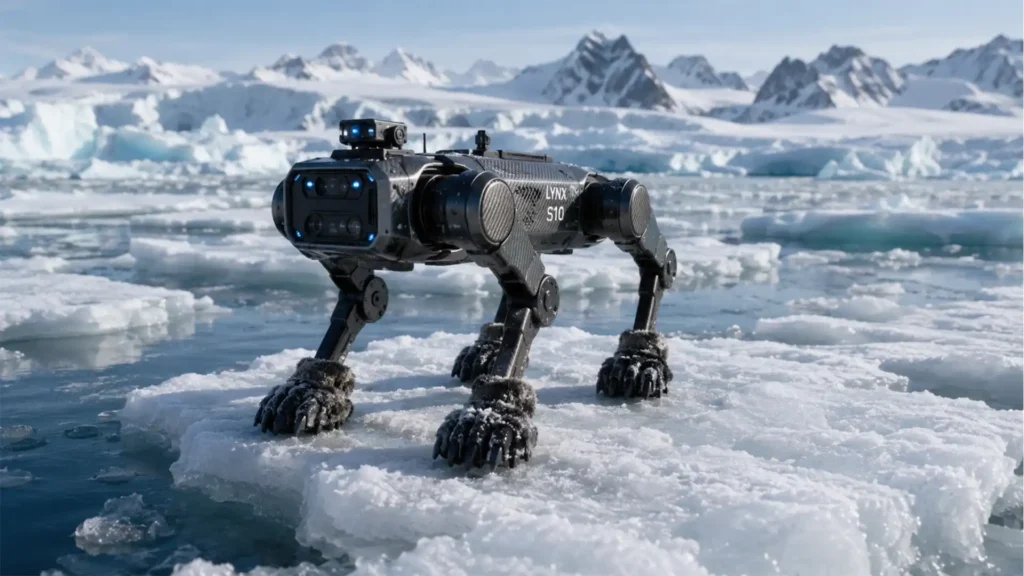
This article is an original analysis supported by the sources cited below
Completes Arctic Scientific Expedition Field Test! DEEP Robotics’ Robot Dog Conquers Another Extreme Scenario
Primary company announcement describing the Lynx S10 Arctic Ocean expedition field test, the Sun Yat-sen University Polar voyage, the bear-like paw modification, and icy-water validation.
Deep Robotics Launches Industry-Grade Small Wheeled-Legged Robot, Setting a New Benchmark for Lightweight Operations
Official launch announcement for the Lynx S10, including weight, joints, speed, obstacle clearance, sensors, LiDAR, cameras, and target industries.
DEEP Robotics Lynx S10 product page
Official product page listing Lynx S10 specifications, AI motion control, route planning, obstacle avoidance, IP66 protection, temperature range, and industry positioning.
Lynx S10 becomes first four-legged robot to walk on Arctic ice floes
News report summarizing the Arctic test and its relevance for polar mobility, robotics, and hazardous fieldwork.
Deep Robotics puts its Lynx S10 prototype to the ultimate test by equipping the robot with bear paws on Arctic ice
Secondary technology report detailing the modified paws, field prototype status, icy-water movement, and expected applications.
Learning robust perceptive locomotion for quadrupedal robots in the wild
Science Robotics paper explaining why snow, water, vegetation, glare, and difficult sensing conditions challenge legged robot locomotion.
Learning quadrupedal locomotion over challenging terrain
Science Robotics paper on quadruped locomotion control across natural challenging terrain, useful for understanding the technical background of field robotics.
Rolling in the Deep — Hybrid Locomotion for Wheeled-Legged Robots using Online Trajectory Optimization
Research paper on wheeled-legged quadruped locomotion, including hybrid walking-driving strategies and validation in challenging environments.
Quadruped Robots: Bridging Mechanical Design, Control, and Applications
Recent review of quadruped robot design, control, sensing, applications, costs, safety issues, environmental concerns, and governance challenges.
Subterranean Challenge
DARPA overview of autonomous robot exploration in dangerous underground environments, used as a comparison point for harsh-environment robotics.
ANYmal wins the world’s hardest robotics challenge
ANYbotics report on the CERBERUS team’s use of legged robots in the DARPA Subterranean Challenge, relevant to field robotics beyond controlled spaces.
NOAA Arctic Report Card 2025
NOAA’s current Arctic climate assessment, including record warmth, sea-ice decline, ocean warming, and long-term changes affecting polar field conditions.
NOAA Arctic Report Card 2025 sea ice chapter
Focused NOAA chapter on Arctic sea ice conditions, used for context on the changing ice environment around polar operations.
Science of sea ice
National Snow and Ice Data Center explainer on sea ice formation, melt ponds, albedo, pressure ridges, leads, sea-ice motion, and remote sensing.
Climate change Arctic sea ice summer minimum
NOAA Climate.gov background source on long-term Arctic sea-ice summer decline and the satellite record.
Regional and seasonal evolution of melt ponds on Arctic sea ice
Peer-reviewed Cryosphere study on melt ponds, albedo feedback, energy balance, and sea-ice mass balance.
Polar bear paw pad surface roughness and its relevance to contact mechanics on snow
Royal Society Interface paper on polar bear paw-pad structures and snow traction, relevant to the biomimetic logic behind the robot’s bear-like paws.
All about polar bears physical characteristics
Reference source describing polar bear paw size, claws, pads, papillae, and traction adaptations on ice and snow.
Polar fieldwork in the 21st century
PLOS Climate review on safety, sustainability, logistics, climate impacts, and evolving practice in polar fieldwork.
76 Days in the Arctic: A PhD student’s polar scientific expedition
Xiamen University account of the Sun Yat-sen University Polar expedition, ice-station work, ice-core sampling, melt-pond water collection, and buoy deployment.
Ingress protection ratings
International Electrotechnical Commission resource explaining IP ratings under IEC 60529 for dust and liquid ingress protection.
MOSAiC expedition
Official MOSAiC expedition site, used for context on the scale and difficulty of Arctic sea-ice field research.
Polar bear guards – MOSAiC
Field account from MOSAiC showing the practical role of polar bear safety procedures during Arctic ice operations.
| Citing this article? Brief excerpts are welcome. Please credit Webiano.digital, name the author where stated, and include a link to https://webiano.digital and to this original article. Full or substantial republication requires prior written permission. Read our Copyright and Content Use Policy. |
This article was prepared with the assistance of artificial intelligence tools. The content underwent expert human review, and Webiano Digital & Marketing Agency assumes editorial responsibility for its final version and publication.